If you are running an adult brand, you have likely experienced how unpredictable platforms like Instagram, Facebook, TikTok, and YouTube can be.
One algorithm change can cut your reach. One policy update can restrict your ads. In some cases, accounts get suspended without warning. For adult and high-risk businesses, this is not rare. It is normal.
That is exactly why Telegram is becoming a serious business platform.
In 2026, Telegram has crossed 900 million monthly active users worldwide. But what makes it powerful is not just the number. It is the control.
On Telegram, you can:
• Build private communities
• Create gated subscriber groups
• Share content directly without algorithm interference
• Own your audience communication
There is no unpredictable feed deciding who sees your content. If someone joins your channel, they will receive your updates. For adult brands, this stability is critical. You are not fighting for visibility. You are building a controlled ecosystem.
But here is the challenge.
Once your Telegram community starts growing, managing it manually becomes overwhelming.
You have to:
• Reply to repetitive questions
• Approve members
• Send welcome messages
• Deliver premium content
• Handle subscription access
• Guide users toward offers
Doing this one by one is not scalable.
This is where automation becomes necessary.
A Telegram chatbot acts like a system inside your community. It can automatically welcome new members, answer common questions, deliver gated content, collect leads, and even guide users through structured sales funnels. Instead of handling everything manually, you create a process that runs consistently.
At Triple Minds, we see Telegram not just as a messaging app, but as a stable growth channel for adult and high-risk brands. When you combine a strong community with automation, you move from manual management to scalable infrastructure.
In this guide, we will walk you through how to create a Telegram chatbot and how to use it strategically to grow your community without increasing operational workload.
Scale Your Business with a Telegram Chatbot
Turn your Telegram community into a structured growth channel with secure infrastructure, smart workflows, and seamless user journeys—engineered by Triple Minds.
👉 Partner With Our Development Team
Key Takeaways
- Telegram has over 900 million users in 2026
- Telegram chatbots automate conversations and engagement
- Bots can manage subscriptions, payments, and content delivery
- Custom development offers advanced automation control
- SEO traffic combined with Telegram automation works extremely well
- Compliance and legal awareness are critical
- Telegram bots are powerful for adult and restricted niches when used correctly
What Is a Telegram Chatbot?
A Telegram chatbot is an automated account inside Telegram that talks to users without a human needing to reply manually. It follows pre-set commands, workflows, or AI instructions to answer questions, guide users, and perform tasks instantly. Unlike a normal Telegram account, a chatbot is always active. It can handle thousands of conversations at the same time, making it useful for businesses that want fast, reliable communication. Think of it as a digital assistant for your business that lives inside Telegram. When a user sends a message, clicks a button, or joins your channel, the bot responds automatically with the right information or next step. This saves time, reduces support workload, and ensures users never have to wait for basic help.
A Telegram chatbot can:
• Reply instantly to common questions (pricing, services, availability)
• Send scheduled messages, reminders, or announcements
• Deliver welcome messages and onboarding steps to new users
• Collect user details like name, phone number, preferences, or feedback
• Share content such as guides, videos, links, or product updates
• Accept payments directly inside the chat
• Connect with CRM, email tools, or other business software
• Run lead generation flows and qualify potential customers
• Support affiliate campaigns and subscription services
Because Telegram messages usually get very high open rates, chatbots give businesses direct access to their audience without depending on social media algorithms. They are widely used for customer support, marketing, sales, community management, and automated notifications. In simple terms, a Telegram chatbot helps you communicate, sell, and support customers automatically in one place. For businesses that want faster responses, better user experience, and scalable communication without hiring a large team, it has become a powerful and practical tool.
Why Businesses Are Using Telegram Bots in 2026
Here is what we see in real projects. Email open rates are declining. Social media reach is unpredictable. Ad accounts get suspended, especially in adult or restricted industries. Telegram gives businesses:
- Direct user access
- High message delivery rates
- Automation control
- Reduced dependency on third-party algorithms
For adult businesses, creators, and subscription platforms, Telegram bots allow:
- Private content distribution
- Paid community access
- Automated onboarding
- Anonymous interaction options
This is one of the biggest reasons Telegram automation is growing rapidly.
Types of Telegram Chatbots
Before you build a bot, first be clear about what you want it to do for your business. Different goals need different types of bots. Here are the most common ones explained in simple terms.
1. Customer Support Bot
This bot acts like your support assistant that never sleeps. It answers common questions, helps users solve basic problems, shares order updates, and passes complicated issues to a human when needed. Because it works 24/7, customers get instant replies instead of waiting. This reduces your support workload, improves response time, and makes your business feel reliable and easy to reach.
2. Lead Generation Bot
Think of this as a smart form that chats with people. It asks simple questions to collect details like name, phone number, email, location, and what the person is looking for.
It can also identify serious buyers and send their information directly to your sales team. This helps you capture potential customers the moment they show interest and turn conversations into real business opportunities automatically.
3. Content Delivery Bot
This bot sends content directly to your audience inside Telegram. That could be articles, videos, PDFs, course lessons, updates, or announcements. Users can request content anytime, or you can schedule it to be sent automatically. It keeps your audience engaged, builds a stronger connection, and turns your Telegram into a powerful channel for sharing valuable information.
4. E-commerce or Payment Bot
This bot turns Telegram into a mini online store. Users can browse products, check prices, place orders, and even pay without leaving the app. It can also send payment confirmations and order updates automatically. This makes buying quick and easy, reduces drop-offs, and helps you generate sales directly from Telegram.
5. Subscription Access Bot
If you run a paid community or premium content, this bot manages access for you. It gives entry to paying members and removes access when a subscription ends. It can verify payments, send renewal reminders, and control who can join private channels or groups. This keeps your premium content secure and automates membership management without manual work.
Below is a simplified overview of the different Telegram chatbot types and their uses.
| Bot Type | Primary Purpose | Key Functions | Best For |
| Customer Support Bot | Automate user assistance | Answer FAQs, resolve basic issues, route complex queries to human agents | Businesses with high support volume |
| Lead Generation Bot | Capture potential customers | Collect user details, qualify leads, send data to sales team | Service providers, agencies, consultants |
| Content Delivery Bot | Distribute information | Send articles, videos, PDFs, updates, scheduled content | Educators, creators, media brands |
| E-commerce / Payment Bot | Enable in-chat purchases | Product browsing, order placement, payment processing, confirmations | Online stores, digital product sellers |
| Subscription Access Bot | Manage paid communities | Verify payments, grant/revoke access, renewal reminders | Membership platforms, premium content brands |
How to Create a Telegram Chatbot
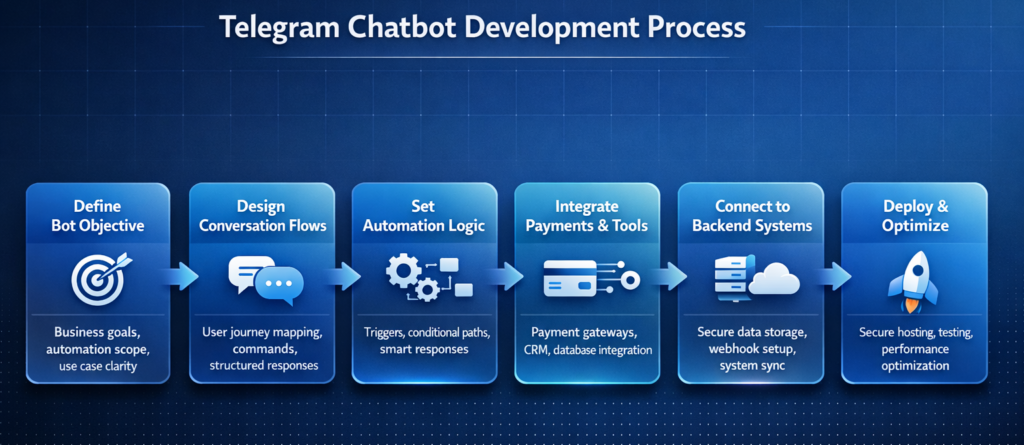
A Telegram chatbot can be built using custom development tailored to your business goals.
The process typically includes:
- Defining the objective of the bot
- Designing conversation flows
- Setting automated triggers and responses
- Integrating payment gateways if needed
- Connecting to CRM or database systems
- Deploying on secure infrastructure
At Triple Minds, we design Telegram chatbots around business strategy, not just technical setup. The goal is always automation that supports growth and revenue.
Setting Up Commands and Automation Logic
Telegram bots respond to structured commands such as:
/start
/help
/pricing
Beyond simple commands, advanced bots include:
- Interactive buttons
- Conditional response flows
- Automated payment confirmation
- User tagging and segmentation
For example:
User clicks “Join Premium”
→ Bot shares secure payment option
→ After confirmation
→ Access is granted automatically
This removes manual handling completely and creates a seamless user journey.
Automation is where Telegram chatbots truly become powerful business assets.
Connecting Telegram Chatbots to Your Website Funnel
A chatbot alone is not enough. It must be part of a funnel.
At Triple Minds, we combine:
- SEO traffic
- Optimized landing pages
- Telegram onboarding automation
Example flow:
User searches for your service
→ Lands on optimized website
→ Clicks “Join on Telegram”
→ Bot collects user information
→ User enters paid or subscription flow
SEO brings consistent traffic. Telegram handles engagement and retention.
This system works especially well in restricted niches where paid advertising options are limited.
Telegram Bots for Adult and High-Risk Niches
Let’s address this clearly.
Telegram allows adult content within platform guidelines. However, illegal activities and prohibited content are not allowed.
For adult businesses, Telegram bots are commonly used for:
- Subscription-based content access
- Adult toy promotions
- Private communities
- Member-only updates
It is essential to comply with local laws and maintain proper age restrictions.
We always recommend:
- Clear disclaimers
- Transparent terms
- Proper age gating
- No illegal services
Compliance is not optional. It protects long-term business sustainability.
Compliance and Safety Considerations
When building a Telegram chatbot, businesses must follow legal, safety, and privacy standards to protect both users and the company. A bot is not just a communication tool. It collects data, handles payments, and interacts with people in real time. That creates responsibility. Ignoring compliance can lead to account restrictions, legal issues, or loss of user trust.
Businesses should ensure:
Legal Operation within Jurisdiction
Your chatbot must follow the laws of the countries or regions where you operate. Rules can differ for content, payments, data storage, and online services, so compliance is essential.
Secure Handling of User Data
Bots often collect personal details such as names, contact information, or preferences. This data must be stored securely and protected from leaks, misuse, or unauthorized access.
Transparent Payment Systems
If your bot processes payments or subscriptions, users should clearly understand pricing, billing terms, refund policies, and what they are paying for before completing a transaction.
Clear Content Guidelines
Users should know what type of content, services, or interactions they can expect. Setting boundaries helps prevent misuse and keeps the platform safe for everyone.
Proper User Consent
Always inform users when data is being collected and get their permission before storing or using it. Consent builds trust and protects your business legally.
Telegram bots collect and process sensitive information, which makes security and privacy extremely important. This is especially true in high-risk or restricted industries where trust, discretion, and data protection are critical for long term success.
SEO for Telegram
Many businesses launch Telegram bots but struggle to attract users.
The missing element is SEO.
A structured approach includes:
- Ranking for high-intent keywords
- Publishing relevant content
- Building landing pages
- Adding a strong Telegram call-to-action
- Nurturing users inside Telegram
At Triple Minds, we see this model scale consistently:
Organic traffic → Telegram automation → Monetization → Retention
Instead of relying on ad platforms that may suspend accounts, this approach builds stable and controlled growth.
Common Mistakes to Avoid
Many businesses rush into building a Telegram chatbot without proper planning, which leads to poor performance and low engagement. The biggest mistake is launching a bot without a clear objective. If you do not define whether it is for support, sales, lead generation, or content delivery, users will not understand its purpose and will stop using it.
Another common problem is overcomplicating the menu. Too many buttons, commands, or paths confuse users and make the experience frustrating. A chatbot should guide users step by step, not overwhelm them. Many businesses also skip the onboarding flow, which is critical. New users should immediately understand what the bot does, how it helps them, and what they should do next.
Lack of tracking and analytics is another serious issue. Without data, you cannot see where users drop off, what they click, or what drives conversions. Compliance is also often ignored, especially when payments, subscriptions, or restricted content are involved, which can lead to account issues or trust problems.
What can go wrong:
• Launching a bot without a clear goal
• Creating complex menus instead of simple flows
• Not adding a proper welcome and onboarding sequence
• Failing to track user behavior and performance
• Ignoring compliance, payment, or platform rules
A Telegram chatbot is not just a technical experiment. It is part of your revenue system. Without a clear strategy, ongoing optimization, and proper structure, it quickly becomes an inactive asset instead of a growth tool.
Thinking of Launching a Telegram Chatbot?
Every Telegram community grows differently — we assess your audience, automation needs, and business goals before building the right solution. Get a clear, strategic roadmap designed for long-term growth — not just a bot.
👉 Discuss Your Automation RoadmapConclusion
Creating a Telegram chatbot in 2026 is easier than ever, but real success comes from using it with a clear strategy. A bot should support a specific business goal, whether that is generating leads, driving sales, delivering content, or managing customers. Without a defined purpose, it becomes just another unused tool.
The most effective chatbots are built with structured automation, connected funnels, proper compliance, and a steady flow of users. Traffic is essential because even the best bot cannot perform if people are not entering the system. This is why combining chatbot automation with search visibility and audience growth channels creates stronger results.
In restricted or competitive markets, owning a direct communication channel with your audience is extremely valuable. It reduces dependence on platforms you cannot control and protects your ability to reach users anytime.
When planned and implemented correctly, a Telegram chatbot becomes a long-term digital asset that supports growth, retention, and revenue. This is exactly how we approach automation systems at Triple Minds.
FAQs
Yes. Even small businesses can automate support, collect leads, and manage subscriptions using a chatbot.
Yes, payment integration can be implemented depending on your region and compliance requirements.
They can be, as long as local laws, age restrictions, and platform policies are followed strictly.
Building and launching a Telegram chatbot typically takes 6 to 8 weeks, covering planning, development, integrations, testing, and deployment. The timeline may vary depending on feature complexity, automation requirements, payment setup, and the specific needs of the business or team.
A Telegram chatbot can handle tasks such as answering FAQs, sending welcome messages, collecting leads, delivering content, managing subscriptions, and processing payments. It can also automate onboarding, segment users, send scheduled updates, and integrate with CRM or other business systems to streamline operations.
Voice search is no longer a next-generation concept – it’s already here. The real question is no longer whether you should adopt it. The real challenge is how to deliver a voice search experience that is faster, smarter, and better than anyone else in your market.
Today, smart businesses are using voice AI to improve user experience, increase accessibility, and respond to customers faster. It’s becoming a competitive advantage, not just a technical feature. If your competitors are optimizing conversational queries and you’re not, you’re already behind. Voice search is now a standard expectation in modern digital experiences – and the focus has shifted from adoption to optimization. As of 2026, voice AI search has evolved from a convenience feature into a significant segment of global search behavior.
While traditional typing remains dominant for detailed or complex tasks, voice-based interactions now account for around 20% – 50% of overall searches globally, with significantly higher adoption on mobile devices and smart assistants. In fact, billions of voice-enabled devices are active worldwide, and conversational queries continue to grow as users prioritize speed, convenience, and hands-free access. Voice AI search is especially prominent in local searches, quick information queries, navigation, and transactional intents. The shift is not about replacing text-based search entirely it’s about expanding how users access information. As conversational AI improves in accuracy and contextual understanding, voice is becoming a stable and influential layer of modern search behavior rather than just an experimental trend. Users ask complete questions like, “Which agency offers AI-powered SEO services near me?” rather than typing fragmented keywords. This change directly impacts SEO strategy, structured data implementation, and content architecture.
Voice Search AI integration enables websites, applications, and digital platforms to listen, understand intent using Natural Language Processing (NLP), and respond with precise, context-aware answers. It is not a simple feature addition it is a layered integration that connects speech recognition, AI models, backend systems, and search optimization frameworks. At Triple Minds, we approach voice search AI integration as a strategic digital growth initiative. Our focus is not just implementation, but aligning voice technology with long-term search visibility, Answer Engine Optimization (AEO), and enhanced user experience. As conversational search continues to expand, businesses must build scalable, future-ready voice capabilities into their digital ecosystem to stay competitive.
Want to Integrate Voice Search AI the Right Way?
Transform your digital presence with advanced Voice Search AI integration that strengthens visibility, improves user experience, and positions your brand as the trusted answer in AI-driven search environments. Move beyond traditional SEO and build a smarter, future-ready search ecosystem today.
Start Your Voice Search Optimization Today
Key Takeaways
- Voice search now accounts for a significant share of global searches and is no longer an experimental feature.
- Implementation timelines range from 2 weeks to 16+ weeks depending on project complexity.
- Clean infrastructure and structure data can significantly speed up deployment.
- Voice AI integration combines speech recognition, NLP, intent matching, and backend connectivity.
- Conversational SEO and featured snippet optimization are critical for voice visibility.
- ROI often appears first through operational efficiency and reduced support costs.
- Costs vary widely based on customization, integrations, and enterprise requirements.
- Businesses that adopt voice strategically position themselves for AI-driven discovery and future search behavior.
What Is Voice Search AI Integration?
Voice Search AI Integration is the process of adding intelligent voice capabilities to your digital platforms so users can search, ask questionns, and interact using natural speech instead of typing. Instead of clicking through menus or entering short keywords, users simply speak – and the system understands, processes, and responds in real time.
At its core, voice AI integration combines speech recognition and Artificial Intelligence. First, speech recognition technology converts spoken words into text. Then, AI and Natural Language Processing (NLP) analyze the meaning behind those words – not just the exact phrasing, but the intent. This allows the system to respond accurately, even if different users ask the same question in different ways.
Voice Search AI integration can appear in several forms across a business ecosystem. It may include voice-enabled search bars on websites, AI-powered assistants within mobile apps, integrations with smart assistants like Alexa, Google Assistant, or Siri, voice-driven customer support systems, or even automated AI call handling solutions. Unlike traditional search, which relies heavily on specific keywords, voice AI understands context, conversational tone, and follow-up queries.
For example, a user might ask, “What are your service packages?” and then follow up with, “Which one is best for small businesses?” The system connects both questions naturally.
In simple terms, voice search AI shifts digital interaction from typing keywords to having conversations – creating faster, more intuitive, and more human-like user experiences.
How Does Voice Search AI Integration Work?
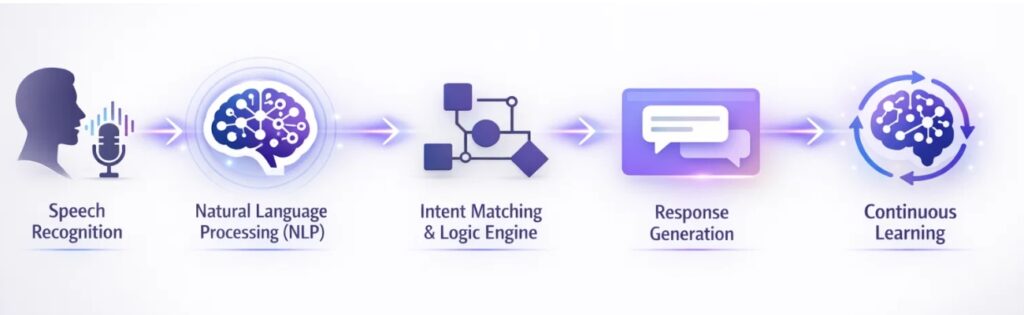
Voice search AI may sound complex, but the process behind it follows a clear and logical flow. It works through multiple connected layers that allow the system to listen, understand, and respond intelligently.
1. Speech Recognition
The first step is listening. When a user speaks, the system uses speech recognition technology to convert spoken words into text. This step ensures the AI accurately captures what was said, even with different accents, speeds, or pronunciations.
2. Natural Language Processing (NLP)
Once the speech is converted into text, NLP takes over. This is the “brain” of the system. Instead of just reading the words literally, NLP analyzes the meaning behind them. It understands intent, context, tone, and even variations in phrasing. For example, “Find me a nearby SEO agency” and “Which SEO company is close to me?” mean the same thing – and NLP recognizes that.
3. Intent Matching & Logic Engine
After understanding the query, the system identifies the user’s intent. It then matches that intent to the correct action – whether that means retrieving information from a database, triggering a workflow, or displaying specific results.
4. Response Generation
The system prepares a response. This could be text displayed on a screen, a spoken answer through text-to-speech, or even an automated system action like booking an appointment.
5. Continuous Learning
Modern voice AI systems improve over time. They analyze user behavior, repeated queries, and interaction patterns to refine accuracy and make responses more relevant.
At the core of all these layers is NLP, which enables the system to move beyond simple keyword matching and truly understand conversations – making interactions feel natural, fast, and human-like.
How Long Does It Take to Implement Voice Search AI Integration?
There isn’t a single fixed timeline for voice search AI integration. The duration depends on how complex your systems are, what you want the voice assistant to do, and how prepared your infrastructure already is. A simple voice-enabled search bar is very different from a fully automated, AI-driven conversational ecosystem.
To make it easier to understand, here’s a estimated structured breakdown:
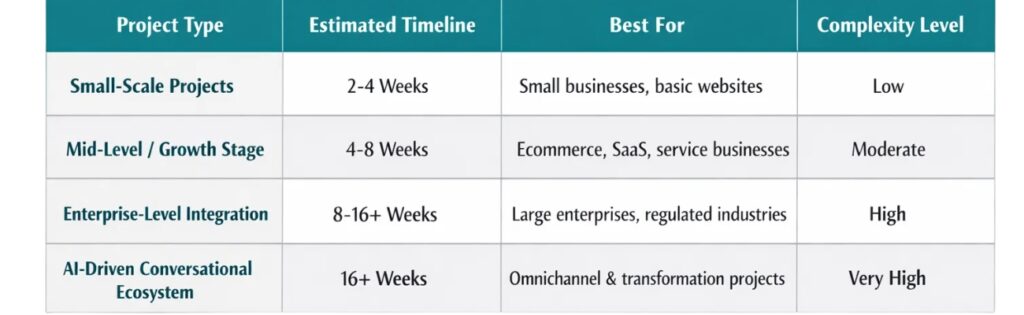
1. Small-Scale Projects (2-4 Weeks)
This is ideal for small businesses or informational websites that want basic voice functionality. For example, adding a voice-enabled search button that allows users to speak instead of type.
Typically, this includes integrating a speech-to-text API, setting up simple NLP intent recognition, building limited conversational flows (like FAQs), and running initial testing. If your backend systems are already structured and organized, implementation is relatively fast.
2. Mid-Level / Growth Stage Projects (4-8 Weeks)
At this stage, voice AI becomes more interactive. Ecommerce stores, SaaS platforms, and service businesses often fall into this category.
Here, the system must handle multiple intents, connect with product databases or service catalogs, integrate with CRM systems, and optimize structured data. Conversational flows become more advanced, and testing becomes deeper to ensure accuracy.
3. Enterprise-Level Voice AI Integration (8-16+ Weeks)
Enterprise projects are more complex because voice AI connects with multiple operational systems. This often includes advanced NLP modeling, multilingual capabilities, personalization layers, deep CRM/ERP integration, security validation, and compliance checks.
For industries like healthcare or fintech, additional regulatory layers increase the timeline.
4. AI-Driven Conversational Ecosystem (16+ Weeks)
This goes beyond integration – it becomes digital transformation. Organizations implementing omnichannel voice systems, AI-powered automation, smart device ecosystems, and personalized voice commerce fall into this category.
Voice AI becomes embedded across customer support, marketing, operations, and sales.
What Determines the Timeline?
Several factors influence speed:
- How organized your technical infrastructure is
- Whether APIs are ready for integration
- Clean and structured data availability
- Complexity of conversational design
- Multilingual requirements
- Compliance and security layers
- Level of AI customization needed
Projects slow down when backend systems are fragmented or content is unstructured. The cleaner your data and systems, the faster voice AI can be deployed. In short, voice search AI integration can take a few weeks or several months – depending on how deeply you want voice embedded into your digital ecosystem.
Ready to Lead in Voice Search AI?
Get a detailed cost estimate and ROI projection for your Voice Search AI integration project. Free consultation with our experts.
Request Your Custom StrategyHow Much Does Voice Search AI Integration Cost?
The investment required for voice search AI integration varies based on project scope, system complexity, and customization level. While there is no one-size-fits-all pricing, below are general industry estimates to help businesses understand the typical investment range. Actual investment depends on infrastructure readiness, integration depth, and customization requirements.
Estimated Market Investment Range
| Project Type | Estimated Investment (USD) | Best For | Scope Level |
| Foundational Integration | $3,000 – $10,000 | Small businesses, basic websites | Entry-Level |
| Growth-Level Integration | $10,000 – $35,000 | Ecommerce, SaaS, service platforms | Moderate |
| Enterprise Integration | $35,000 – $150,000+ | Large enterprises, regulated industries | Advanced |
| Ongoing Monthly Costs | Usage-Based | All project types | Continuous |
Foundational Integration ($3,000 – $10,000)
This includes basic speech-to-text API integration, simple NLP intent mapping, and limited conversational flows such as FAQ responses or voice-enabled search bars.
Growth-Level Integration ($10,000 – $35,000)
This tier involves custom NLP configuration, backend database integration, CRM connectivity, structured data optimization, and multi-intent conversational handling.
Enterprise-Level Integration ($35,000 – $150,000+)
Enterprise projects require advanced AI modeling, multilingual support, compliance validation, ERP/CRM integration, personalization layers, and scalability testing.
Ongoing Costs
Beyond implementation, businesses should budget for:
- API usage fees (based on voice query volume)
- Cloud infrastructure
- AI model refinement
- Monitoring and maintenance
What Kind of Businesses Benefit from Voice Search AI Integration?
Voice search isn’t limited to tech companies or large enterprises. It benefits any business where users search, ask questions, book services, or make decisions quickly. The key advantage is speed and convenience – users get answers without friction.
1. Ecommerce
In ecommerce, voice AI simplifies product discovery and purchasing decisions. Instead of typing filters manually, users can simply say:
“Find eco-friendly running shoes under $100.”
The AI instantly filters products based on price, category, and attributes. Voice can also support order tracking, stock checks, and personalized product recommendations.
For online stores, this reduces search friction and improves conversion rates by making product discovery conversational and intuitive.
2. SaaS Platforms
For SaaS businesses, voice AI improves user experience inside the platform. Users can navigate features, access documentation, or request help using natural speech.
For example:
“Show me how to integrate this tool with Salesforce.”
Instead of searching help articles manually, the system guides them directly. Voice AI can also assist during onboarding, reducing support tickets and improving user retention.
3. Healthcare
Healthcare platforms can use voice AI for appointment booking, service location queries, and general symptom guidance. Patients can ask simple questions and get quick responses, improving accessibility – especially for elderly users.
4. Financial Services
Banks and fintech companies can use voice AI for loan eligibility checks, account information, or product comparisons. Secure, conversational access improves customer convenience while reducing call center load.
5. Local & Multi-Location Businesses
Voice is extremely powerful for local discovery.
Users commonly ask:
- “Find the nearest branch.”
- “Are you open today?”
- “Do you offer same-day service?”
Voice integration improves visibility in local search environments and helps businesses capture high-intent queries.
How Voice Search Impacts Digital Marketing
Voice search doesn’t just change technology – it reshapes digital marketing strategy.
1. Conversational SEO
Content must answer real-world questions, not just target keywords. People speak differently than they type.
2. Featured Snippet Optimization
Voice assistants often pull answers from concise, well-structured content blocks. Clear summaries matter more than ever.
3. Local Search Visibility
A large percentage of voice searches are location-based. Optimizing Google Business Profiles and structured data becomes critical.
4. Entity Optimization
AI systems rely on structured brand signals – consistent business information, schema markup, and authority signals.
5. Reduced Click Dependency
Sometimes users get answers directly from voice assistants without visiting a website. That means brand presence and structured visibility matter even beyond traffic.
Voice AI pushes digital marketing toward clarity, structured data, topical authority, and conversational relevance. It aligns closely with Generative AI Optimization and AI-driven discovery models.
Common Mistakes That Delay Voice Search AI Integration
When businesses decide to implement voice search AI integration, delays often occur not because of technology limitations, but due to poor planning and unclear execution strategies.
| Issue | Explanation |
|---|---|
| Neglecting conversational search behavior | Ignoring how users naturally speak and ask questions in voice search can lead to irrelevant or poorly matched responses. |
| Overlooking Natural Language Processing (NLP) optimization | Voice search depends on understanding context and user intent. Without intent-focused and question-based content, accuracy and performance decrease. |
| Poor content structuring | Not organizing content with proper semantic structure, FAQs, and structured data makes it harder for AI to understand and respond correctly. |
| Technical misalignment during integration | If API compatibility, server setup, or scalable infrastructure are not ensured, it can cause system conflicts and project delays. |
| Underestimating data training requirements | AI models need clean, labeled, and structured data. Poor data preparation reduces accuracy and slows development. |
| Inadequate infrastructure planning | Without scalable architecture, voice AI systems may face performance issues as user traffic increases. |
| Lack of cross-team coordination | Poor communication between SEO teams, developers, and AI engineers can cause confusion and longer project timelines. |
| Unclear execution strategy | Without clear goals, milestones, and performance benchmarks, the implementation process can lose direction and delay launch. |
Measuring ROI After Implementation
Voice search ROI is not just about traffic – it’s about efficiency and experience.
Key performance indicators include:
- Voice query success rate
- Task completion rate
- Customer support cost reduction
- Improved engagement
- Assisted conversions
- AI-driven brand visibility
Many businesses see operational ROI first reduced support costs and faster customer interactions – before direct revenue impact becomes visible.
The Triple Minds Approach
At Triple Minds, we treat voice AI integration as part of a broader AI visibility and digital authority strategy. The objective isn’t just enabling voice interaction – it’s ensuring your brand is understood, trusted, and surfaced across conversational search environments.
Businesses that integrate voice strategically today are not just improving user experience – they are positioning themselves for the next evolution of AI-driven discovery.
FAQs
Voice search AI integration involves adding speech recognition APIs, connecting NLP models to process user queries, and configuring the backend to deliver accurate voice-based responses. Proper SEO structuring and conversational content optimization are also essential.
AI analyzes conversational queries, user intent, and long-tail keywords to structure content in a natural Q&A format. This improves semantic relevance and increases chances of ranking in voice search results.
The timeline depends on data availability, your existing tech stack, API integrations, NLP training, security requirements, multilingual support, and testing phases. The more complex the setup, the longer the implementation takes.
Yes, voice AI can be added to existing websites, mobile apps, CRM systems, and eCommerce platforms using APIs and cloud-based AI services. It usually does not require rebuilding the entire system.
Yes, using third-party platforms like Google Cloud Speech-to-Text, Amazon Alexa, or Microsoft Azure Speech Services can significantly speed up development. They provide ready-made tools instead of building everything from scratch.
Custom models offer higher accuracy and better personalization but require more time and investment. API-based solutions are quicker to deploy and more cost-effective for most businesses.
From MS Excel to Google Sheets, spreadsheets are the backbone of business data management worldwide. However, if you are still relying on traditional spreadsheet formulas to analyze critical business data, you may be slowing down decisions and increasing the risk of costly errors. Manual reporting, complex functions like VLOOKUP and pivot tables, and repetitive data cleaning consume valuable time. In fact, it’s been reported that data professionals spend nearly 60–80% of their time preparing data instead of analyzing it. This is where an AI Excel chatbot changes how modern businesses work with spreadsheets. Rather than making Excel itself “intelligent,” businesses can upload their Excel files into a secure AI-powered chatbot and analyze the data using plain English questions. The chatbot reads the spreadsheet, applies the correct calculations, and delivers structured insights instantly – turning static spreadsheets into dynamic analytical workspaces.
At Triple Minds, we implement secure AI Excel chatbot solutions that allow organizations to upload spreadsheet data and interact with it conversationally. An AI Excel chatbot is a tool that enables users to analyze Excel data using natural language instead of complex formulas. It helps clean messy datasets, generate visual reports, identify trends, and extract actionable insights faster and more accurately. For B2B teams managing sales reports, financial statements, operational dashboards, or inventory sheets, this shift from manual spreadsheet analysis to AI-driven conversational data analysis improves efficiency, reduces errors, and accelerates decision-making.
Ready to Transform Your Excel Analysis with AI?
Discover how AI-powered Excel chatbots help your team analyze spreadsheets in plain English—eliminating complex formulas, reducing reporting delays, and accelerating business decisions.
Explore Secure AI Excel Chatbot Solutions
Key Takeaways
- AI Excel chatbots let you analyze uploaded spreadsheet data using simple, natural language queries.
- They significantly reduce manual data cleaning and dependency on complex Excel formulas.
- Businesses can speed up decision-making with instant, structured insights generated by AI.
- Sales, finance, operations, and leadership teams gain faster access to accurate reports and performance analysis.
- AI-driven calculations minimize human errors and improve overall data reliability.
- Conversational analytics makes data accessible to both technical and non-technical teams across the organization.
What is AI in Excel?
AI in Excel refers to using intelligent AI-powered tools that can analyze your Excel data in a smarter and more efficient way. Instead of manually building complex formulas, calculations, and pivot tables, you can upload your spreadsheet into a secure AI chatbot and ask questions in plain language. The AI understands your request, applies the right logic behind the scenes, and delivers accurate, structured insights within seconds.
It can clean messy datasets, identify trends, summarize performance metrics, generate visual reports, and highlight unusual patterns automatically. At Triple Minds, we see AI in Excel as an evolution in how businesses interact with spreadsheet data — shifting from manual effort to AI-assisted analysis that makes insights faster, simpler, and accessible to every team, not just technical experts.
When we talk about cleaning messy datasets, we mean identifying and correcting common data issues that affect analysis accuracy. Business spreadsheets often contain duplicate entries, missing values, inconsistent date formats, numbers stored as text, or slight variations in naming conventions. These small inconsistencies may seem harmless, but they can significantly distort reports and performance metrics. An AI Excel chatbot automatically scans the uploaded file, detects such irregularities, and either corrects them or highlights them for review. This ensures that insights are generated from structured, reliable data, reducing errors and improving confidence in decision-making.
What Does It Mean to “Chat with Your Excel Files”?
“Chatting with your Excel files” means uploading your spreadsheet into a secure AI chatbot and asking questions about your data in plain English — without writing formulas or building complex reports.
Traditionally, extracting insights from Excel requires formulas like VLOOKUP, INDEX-MATCH, pivot tables, filters, or nested IF statements. Not everyone understands what these functions do or how to use them correctly. Even experienced users spend significant time building reports, and small formula errors can lead to inaccurate analysis. With an AI-powered Excel chatbot, that entire process becomes faster and more intuitive.
At Triple Minds, we implement secure AI chatbot systems that allow businesses to upload their spreadsheets and interact with them conversationally. Instead of struggling with formulas, your team can ask business questions and receive clear, structured answers instantly. Let’s look at how this works in practice.
Ask Questions in Plain Language
Instead of writing formulas, you simply type what you want to know. For example, if your uploaded file contains sales data with columns like Date, Product, Region, Customer, and Revenue, you can ask:
“What were last quarter’s highest-performing products?”
You receive a ranked list of top products based on revenue.
“Show monthly revenue trends for the past year.”
You get a clear month-by-month breakdown, often supported with a visual chart.
“Which customers reduced their purchase volume?”
The chatbot compares time periods and highlights customers with declining orders.
“Calculate churn rate from this dataset.”
The AI identifies inactive customers and calculates the percentage automatically.
How It Works
Behind the scenes, the AI chatbot reads your uploaded Excel file, understands column headers, analyzes the data structure, and performs the required calculations automatically. You do not need to define formulas or build reports – you simply ask the question, and the system generates the insight.
Why It Matters
Your spreadsheet remains the source of truth, but when connected to an AI chatbot, it becomes far more powerful. Instead of manually extracting insights, your team can interact with data conversationally and receive faster, more accurate answers. In simple terms, chatting with your Excel files means enabling AI to analyze your spreadsheet data on demand — making business analysis quicker, easier, and accessible across the organization.
Why Traditional Spreadsheet Analysis Slows Businesses Down
Spreadsheets have supported business operations for decades. They are reliable for storing and organizing structured data. However, as organizations scale and datasets grow larger, traditional spreadsheet workflows begin to create operational friction. What once worked for small teams can become inefficient when speed, accuracy, and cross-team collaboration become critical.
1. Analysis Becomes Time-Heavy
Generating meaningful insights from spreadsheets often requires multiple steps — filtering data, building calculations, validating numbers, and formatting reports. As data grows, this process takes longer, slowing down decision cycles.
2. Reporting Creates Dependency
Business leaders often rely on analysts or Excel experts to extract insights. This creates internal bottlenecks where decision-makers must wait for reports instead of exploring data independently.
3. Scalability Challenges
Spreadsheets are excellent storage tools, but as datasets expand across departments, managing versions, consolidating files, and maintaining consistency becomes increasingly complex.
4. Limited Real-Time Exploration
Most spreadsheet workflows are report-based. You generate a report, review it, and then request another version if you need deeper insights. This slows down dynamic decision-making.
5. Insight Gaps
Valuable business data often remains underutilized because extracting deeper patterns requires time and technical effort. Many organizations sit on strong datasets but struggle to convert them into continuous insight. For growing B2B businesses, these slowdowns directly impact agility and competitive advantage.
How AI Excel Chatbots Transform Business Analysis
AI Excel chatbots shift spreadsheet analysis from static reporting to interactive exploration. Instead of manually preparing reports, teams upload Excel files into a secure AI chatbot and engage with the data conversationally.
1. Instant Insight Generation
Rather than building step-by-step reports, teams receive structured answers immediately after asking a business question. This dramatically shortens decision cycles.
2. Self-Service Data Access
Non-technical users can interact with uploaded spreadsheet data without relying on specialists. This reduces bottlenecks and empowers cross-functional teams.
3. Interactive Follow-Up Questions
Instead of requesting a new report for every clarification, leaders can ask follow-up questions in real time. This enables deeper exploration without delays.
4. Structured Outputs & Visual Summaries
The chatbot doesn’t just provide numbers — it delivers organized summaries and visual breakdowns that are easier to interpret and present.
5. Strategic Focus Over Manual Work
By automating analytical tasks, teams can shift focus from spreadsheet management to strategic decision-making and performance improvement.
At Triple Minds, we see this transformation as moving from spreadsheet-driven reporting to AI-driven data conversations – where insight is continuous, not periodic.
Business Use Cases: Who Benefits the Most?
Sales Teams
Sales leaders can track pipeline health, deal velocity, win-loss trends, and account performance instantly after uploading their reports into the chatbot. Instead of waiting for analysts, representatives can analyze territory performance and identify stalled deals independently. This improves forecasting accuracy and strengthens revenue performance.
Finance Teams
CFOs and finance managers can review cash flow trends, cost centers, revenue variance, and profitability within seconds. Rather than rebuilding complex spreadsheets for each query, teams can drill into uploaded financial data conversationally. This improves financial clarity and speeds up reporting cycles.
Operations Teams
Operations managers can analyze inventory levels, supply chain delays, and vendor performance using simple queries. After uploading operational data, bottlenecks and inefficiencies become easier to identify. Instead of compiling reports manually, teams can focus on resolving issues faster.
Marketing Teams
Marketing leaders can evaluate campaign performance, conversion rates, ROI, and channel effectiveness instantly. Comparing campaign outcomes and identifying high-performing channels becomes straightforward. This enables smarter budget allocation and quicker optimization decisions based on real data.
Founders & Executives
Leaders can move beyond static dashboards and ask follow-up questions in real time. By interacting with uploaded business data through an AI chatbot, they can quickly explore revenue trends, growth drivers, and cost structures. This reduces dependency on multiple reports and meetings – making decisions faster, clearer, and data-backed.
Step-by-Step Guide: How to Chat with Your Excel Files
Below is a practical step-by-step guide to start analyzing your Excel data using a secure AI chatbot.
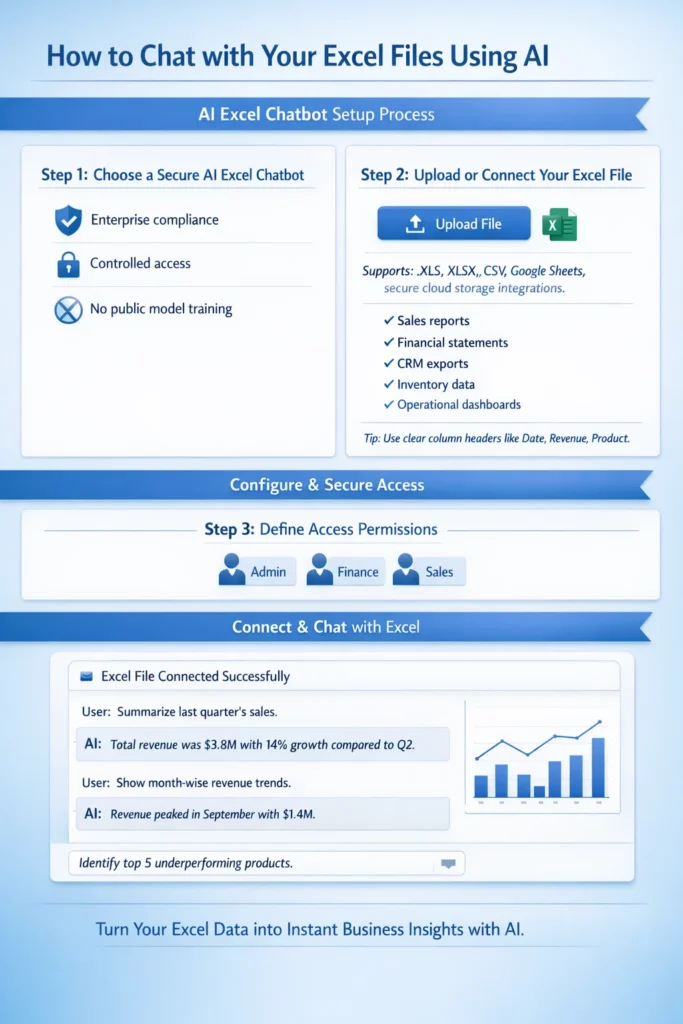
Step 1: Choose a Secure AI Excel Chatbot
Select a private AI chatbot solution that allows you to securely upload or connect Excel files. For business use, ensure the platform supports controlled access, enterprise compliance, and does not use your data for public model training.
Security should always be the first consideration when working with internal financial, sales, or operational data.
Step 2: Upload or Connect Your Excel File
Upload your Excel sheet directly into the chatbot or connect the secure folder where your spreadsheets are stored.
Typical business files include:
- Sales reports
- Financial statements
- CRM exports
- Inventory data
- Operational dashboards
For best results, ensure your spreadsheet has clear column headers such as Date, Revenue, Customer Name, or Product Category. Clean structure improves AI accuracy.
Step 3: Define Access Permissions
Decide which team members can access the chatbot and what data they are allowed to analyze. Role-based permissions protect sensitive information and ensure responsible usage across departments.
Step 4: Start Asking Business Questions
Once your file is connected, you can begin interacting with your data in plain English.
For example:
- “Summarize last quarter’s sales.”
- “Show month-wise revenue trends.”
- “Identify top 5 underperforming products.”
The AI chatbot reads your uploaded spreadsheet, performs the required calculations, and delivers structured answers instantly – without manual formula building or report preparation.
Public AI vs Private AI for Excel
Many AI tools are publicly available, but businesses handling sensitive operational or financial data must prioritize secure implementation.
Public tools may:
- Store conversation history externally
- Lack enterprise-grade compliance
- Offer limited integration with internal systems
At Triple Minds, we implement secure AI layers that allow businesses to connect Excel files or live databases privately. This ensures:
- Data privacy
- Controlled user access
- Enterprise compliance
- Scalable system integration
When working with internal business data, security is not optional – it is foundational.
The ROI of Using an AI Excel Chatbot
When we evaluate the return on investment of AI-powered Excel chatbots, we consistently see impact across three strategic areas:
1. Time Efficiency
Teams reduce hours spent preparing reports and restructuring spreadsheets. Instead of building analysis step-by-step, they ask questions and receive immediate answers. This shifts focus from operational tasks to strategic execution.
2. Improved Accuracy
Automated calculations reduce reliance on manual formulas, lowering the risk of reporting inconsistencies. More reliable insights lead to stronger business decisions.
3. Accelerated Decision Cycles
Executives gain clarity instantly instead of waiting for scheduled reports. Real-time follow-up questions allow deeper exploration, enabling faster course correction in competitive markets.
Common Mistakes to Avoid
Even with AI chatbots, best practices matter:
- Maintain clear and consistent column headers
- Avoid combining unrelated datasets in a single sheet
- Validate AI-generated outputs for business context
- Use secure platforms for confidential data
- Train teams to ask clear, goal-oriented questions
AI enhances analysis – but structured data and thoughtful usage maximize results.
The Future of Conversational Analytics
We believe spreadsheet analysis is evolving from static reporting toward interactive, AI-assisted decision support. In the coming years:
- AI systems will automatically detect key performance indicators
- Predictive insights will become embedded in analysis workflows
- Automated forecasting will become standard practice
- Businesses will rely more on conversational queries than static dashboards
This shift is not about replacing analysts. It is about empowering them to focus on strategic thinking rather than repetitive data preparation.
Why We Recommend Secure AI Implementation
Although subscription-based AI tools are easy to access, companies that prioritize stronger security and want their data to remain entirely within their own environment often benefit more from customized chatbots built exclusively for their business. As organizations grow, they typically require deeper integrations, such as:
- Connecting CRM systems
- Linking ERP platforms
- Integrating SQL databases
- Building centralized AI dashboards
At Triple Minds, we implement private AI systems that allow teams to securely chat with live business data. This removes silos, improves accessibility, and ensures leadership always works with updated insights.
Final Thoughts
Spreadsheets remain central to business operations. What is changing is how organizations extract value from them. Moving from manual formula-based analysis to AI-powered conversational data interaction is not just a productivity upgrade — it is a strategic advantage. When teams spend less time managing spreadsheets and more time interpreting insights, efficiency improves. When executives can explore data in real time, decision cycles shorten. When accuracy increases, confidence in data strengthens.
At Triple Minds, we see AI-powered spreadsheet analysis as the new standard for modern, data-driven organizations. Your Excel file remains structured data — but when connected to a secure AI chatbot, it becomes a powerful decision-support system. If your organization is ready to move beyond static reporting toward intelligent data conversations, the transition starts here.
FAQs
An AI Excel chatbot is a secure tool that allows users to upload spreadsheets and analyze data using natural language instead of formulas.
No. The chatbot removes dependency on complex formulas, making data analysis accessible to non-technical users.
Security depends on the solution. Private AI implementations provide enterprise-level protection and controlled access.
AI can automate most common analytical tasks, but maintaining clean and structured data remains important.
AI delivers highly accurate results when data is properly structured. Human validation is recommended for critical decisions.
Yes. These solutions are scalable and beneficial for startups as well as large enterprises.
Structured tabular data such as sales reports, financial sheets, CRM exports, inventory logs, and operational metrics.
Most businesses today collect a huge amount of data, from sales and customer interactions to marketing performance and financial records. Yet having data doesn’t automatically lead to better decisions. Research shows that nearly 55% of enterprise data is stored but never used, and close to 68% of available business data goes underutilized simply because it’s hard to access, fragmented across systems, or too technical to interpret. While this data sits inside databases and analytics platforms, very few leaders can interact with it directly, something that modern tools like database chatbots are beginning to change.
At the same time, 80% of business leaders say data is critical for decision-making, yet many still struggle to act on it. Insights are locked behind dashboards, reports, and technical tools that require analysts or data teams to interpret. Instead of getting quick answers to everyday questions, what worked? Where did customers drop off? What should we change next?
Leaders are forced to wait, guess, or rely on incomplete information. This gap between having data and actually using it is where many organizations get stuck. Data becomes something that exists in the background rather than something leaders and non-technical teams can actively engage with. This is exactly where a database chatbot, capable of answering questions in plain English, can bridge the gap between raw data and real decisions. By enabling users to ask questions directly to their databases through a conversational interface, database chatbots make data accessible, actionable, and decision-ready, without complex dashboards or SQL queries. Just answers.
At Triple Minds, we build database chatbot solutions that connect directly to your existing data systems and translate natural language questions into real-time insights. Leaders don’t need to “learn data” – they simply talk to it, explore trends, uncover gaps, and make confident decisions based on live business data.
Looking to Chat With Your Own Data Using AI?
Connect with Triple Minds to see how AI-powered database chatbots enable teams to query complex data in plain language—without dashboards, SQL, or manual reporting.
Start Your AI-Driven Data Interaction Journey Today.
Key Takeaways
- Most businesses already have valuable data, but traditional SQL databases make it difficult for non-technical teams to access insights.
- Business users often depend on analysts or engineers to run queries, which slows down decision-making and limits data usage.
- AI-powered database chatbots allow users to ask questions in plain English and receive accurate answers directly from their databases.
- Text-to-SQL technology removes the need for SQL knowledge while preserving data accuracy and reliability.
- Public AI chatbots are not suitable for confidential business data due to security and compliance risks.
- A private, securely deployed database chatbot ensures full data ownership, access control, and data privacy.
- Chatting with your database helps teams make faster, more confident, data-driven decisions.
- AI database chatbots can be used across departments such as sales, marketing, operations, finance, and leadership.
- Organizations can connect conversational AI to various data sources, including SQL databases, CRM systems, and ERP platforms.
The Core Problem: Why Traditional Databases Block Business Insights
Traditional databases were created for technical teams, not for everyday business users. They are very good at storing and organizing large amounts of information, but they are not designed to help managers or leaders easily find answers. As a result, important business data often stay locked away, even though it holds valuable insights.
For technical teams, this may be normal. For non-technical roles such as marketing managers, operations leaders, finance teams, and executives, it creates a constant challenge. These teams need fast answers to make decisions, but they cannot easily access the data on their own.
Because of this, organizations face several problems:
- Simple questions take too long to answer
- Business teams must wait for reports or dashboards
- Data teams become overloaded with requests
- Many useful questions are never asked
Over time, this leads to slow decision-making. Instead of using real data, teams start relying on assumptions, experience, or incomplete information. This limits growth and reduces the value of the data the business already owns.
The real issue is not the amount of data or the quality of tools. The problem is that traditional databases are not built for how business people think, ask questions, or make decisions.
The Hidden Cost of Inaccessible Data
Most businesses collect large amounts of data every day. This data holds valuable information that can guide better decisions, improve performance, and support growth. However, when this data is difficult to access, it becomes a hidden problem that affects the entire organization.
When teams cannot easily get answers from data, decision-making slows down. Leaders are forced to wait for reports or depend on others to pull out information. In fast-moving business environments, these delays can be costly. By the time insights are available, the opportunity to act may already be gone.
When data is hard to access, businesses face several challenges:
- Decisions take longer than necessary
- Teams rely on assumptions instead of real data
- Growth opportunities are missed
- Past data remains unused and forgotten
Over time, this creates a pattern where people stop asking questions altogether. If getting answers feels difficult or time-consuming, curiosity fades. Teams begin to operate based on habits and opinions rather than facts.
Most organizations already have years of stored data that could offer powerful insights, such as:
- Which strategies delivered the best results
- Why customers stopped engaging or buying
- Where costs increased without clear returns
- Which channels supported long-term growth
Yet, because this data is locked behind technical tools, it rarely gets explored. Instead of learning from past performances, businesses often repeat the same mistakes.
The real cost of inaccessible data goes beyond slow reporting. It leads to missed learning, weaker decisions, and limited growth. Making data easier to access allows teams to move faster, ask better questions, and use information they already own to make smarter, more confident business decisions.
What Does It Mean to Chat with Your Database?
Chatting with your database means interacting with structured data using natural language.
An AI-powered text-to-SQL system allows users to ask questions in plain English. The system automatically:
- Understands the intent of the question
- Converts it into a SQL query
- Executes the query securely
- Returns results in a readable format
The complexity of the database remains hidden, while insights become accessible to everyone.
How to Chat With Your Own Database – Step-by-Step Guide
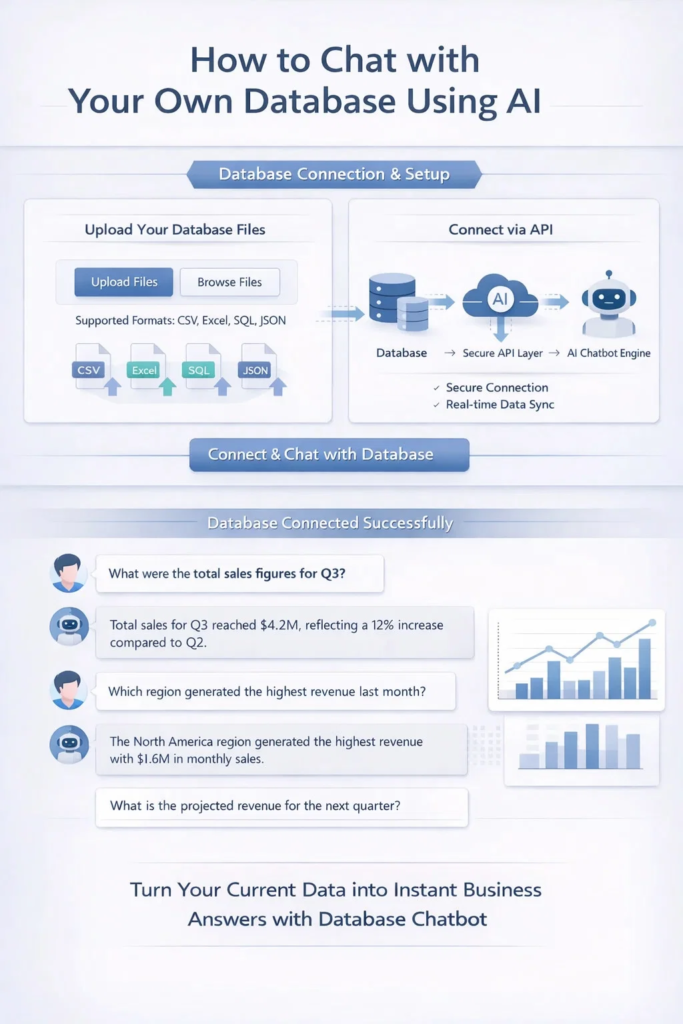
Scenario 1: Upload Your Database into the Chatbot
If your data already exists in Excel, CSV files, or exported reports, you can upload it directly into the chatbot. If it doesn’t, you’ll first need to export it from your system.
Step 1: Download your database
Export your data from your system into commonly used formats such as Excel (XLS/XLSX), CSV, Google Sheets, PDF reports, or JSON files. These formats are easy to upload and work well for analysis.
Step 2: Upload the file into our database chatbot
Once downloaded, simply upload the files into the data base chatbot. The system automatically reads, structures, and understands your data – no manual setup required.
Step 3: Start asking questions in plain English
You can now interact with your data naturally. Ask questions like:
Example Query:
“What were our total sales last quarter?”
What you get: A clear sales summary with total revenue, quarter-wise breakdown, and key trends—ready to understand briefly.
Example Query:
“Which products are performing the best?”
What you get: A ranked list of top-performing products with revenue contribution and growth indicators.
Scenario 2: Connect Your Database Directly with Us (Using Secure APIs)
For real-time and ongoing insights, we connect your live database to a private AI layer using secure APIs. An API (Application Programming Interface) acts as a safe bridge that allows the AI to fetch only the required data – without downloading or moving it.
Step 1: Connect your systems via APIs
We integrate your CRM, ERP, SQL databases, or data warehouses through secure APIs. Your data stays in your system while the AI accesses it in real time.
Step 2: Set access and permissions
API access is controlled with clear permission rules, ensuring each team can only view the data they are authorized to see.
Step 3: Start chatting with live data
Once connected, teams can ask questions in plain English and get instant answers based on the latest data.
Example Query:
“What does our sales pipeline look like today?”
What you get: A real-time pipeline view showing deal stages, total value, and key risks.
Example Query:
“Which customers are likely to churn?”
What you get: A focused list of at-risk customers with behavior signals and recommended actions.
How Database Chatbots Are Different from General AI Chatbots
Database chatbots are built for precision and control, not casual conversation. Unlike general AI chatbots that generate answers from broad training data, database chatbots connect directly to your live business databases and respond strictly based on real, structured data.
Triple Minds designed database chatbots to understand business intent, convert natural language into secure queries, and deliver accurate, traceable outputs like reports, charts, and metrics. This makes them ideal for decision-makers who need reliable insights, not assumptions or generic AI responses.
Business Benefits of Chatting with Your Own Database
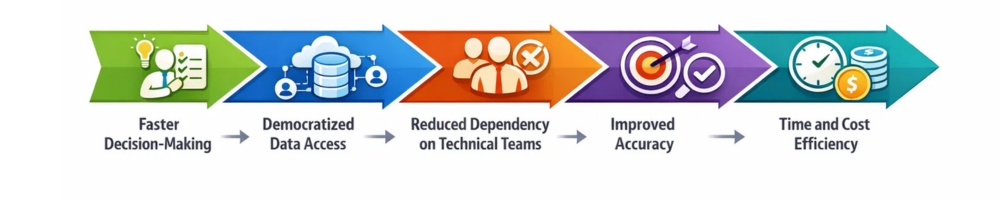
Faster Decision-Making: Leaders can ask questions in natural language and get answers in seconds. This removes delays caused by manual reporting and back-and-forth with data teams. Decisions are made while opportunities are still hot.
Democratized Data Access: Employees no longer need SQL or BI tools to explore data. Anyone can ask questions and receive clear, contextual answers. This creates a more data-driven culture across the organization.
Reduced Dependency on Technical Teams: Routine data requests no longer consume engineering or analytics bandwidth. Technical teams can focus on high-value initiatives instead of ad-hoc queries. This improves productivity and morale across teams.
Improved Accuracy: Insights are pulled directly from live databases rather than static reports. This minimizes human error and eliminates outdated assumptions. Teams operate with a single source of truth.
Time and Cost Efficiency: Organizations reduce the need for multiple dashboards and reporting tools. Less manual effort means faster insights at lower operational cost. Overall data workflows become simpler and more scalable.
Industry and Department-Wise Use Cases
How Sales Teams Can Chat With Their Database
Sales leaders can instantly track pipeline health, deal velocity, and win-loss trends. Sales representatives can ask questions about account activity or performance gaps. This enables faster course correction and better forecasting.
How Marketing Teams Can Use Database Chatbots for Better Decisions
Marketers can evaluate campaign performance, channel ROI, and lead quality in real time. Questions that once required dashboards can be answered conversationally. This helps optimize spend and messaging quickly.
How Operations Teams Can Chat With Operational Database
Operations managers can identify bottlenecks, delays, and inefficiencies as they happen. Real-time visibility supports proactive issue resolution. This leads to smoother workflows and lower operational costs.
Data Base Chatbot For Finance Teams
Finance leaders can monitor budgets, revenue trends, and cash flow on demand. Forecasts become more accurate with live data access. This improves financial planning and risk management.
How Executive Leaders Can Chat With Company-Wide Data
Executives can ask high-level questions and get immediate, trustworthy insights. There’s no need to wait for reports or presentations. This supports faster strategic decision-making.
Types of Databases You Can Chat With
AI database chatbots can connect to a wide range of data sources, including:
- SQL databases (MySQL, PostgreSQL, MS SQL Server)
- CRM and ERP systems
- Sales and revenue databases
- Analytics and reporting databases
SQL Databases (MySQL, PostgreSQL, MS SQL Server) store customer data, orders, payments, and business records. CRM and ERP systems store customer information, sales activities, finance data, and internal employee processes. Sales and revenue databases store revenue details, pricing data, sales transactions, and product performance. Analytics and reporting databases store summarized data used for performance tracking and business reports.
Chat With Your Own Database Without Compromising Security Using Triple Minds
Public AI tools are not built to handle sensitive enterprise data. A safer approach is using a private, customized AI solution where data stays within your environment and remains fully under your control. With a secure, private database chatbot, teams can query their own SQL databases and structured data using natural language, without exposing information to public models. This makes data access faster and easier for both technical and non-technical users, while still meeting enterprise security and compliance requirements. These systems are designed, so data never leaves your infrastructure; models do not train your data, and access is strictly controlled through encryption and role-based permissions. Built-in monitoring and governance provide full visibility into how data is accessed and used.
This is the exact approach implemented by Triple Minds. Backed by experienced industry professionals, we build private, enterprise-grade AI database chat solutions tailored to each organization’s needs. We’ve already helped teams securely connect their databases, deploy customized AI tools, and start chatting with their data – without compromising security. The result is a practical, secure way to unlock insights from your own data, using AI that’s built specifically for enterprise use, not public experimentation.
Final Thoughts
Most businesses already have the answers they need. Those answers are stored in databases but locked behind technical barriers. AI-powered database chatbots remove those barriers, allowing teams to ask questions naturally and make faster, more confident decisions. When implemented securely, chatting with your database turns data into a strategic advantage.
Triple Minds helps organizations securely chat with their SQL databases using AI. If you want to explore how conversational access to data can work for your business, book a call with Triple Minds and discover the insights hidden inside your data.
FAQs
Yes, you can ask questions in plain English, and the system automatically converts them into SQL in the background. No technical knowledge or query writing is required.
Yes, if it’s built privately and securely. Uploading business data to public or third-party AI tools can risk data leaks and loss of control. A private text-to-SQL chatbot runs within your own secure environment, keeps data confidential, and never shares or trains your information, making it safe for business use.
Yes. A single database chatbot can be connected to multiple SQL databases, CRM systems, ERP platforms, and analytics data sources, providing a unified conversational interface across systems.
In most organizations, valuable business data already exists inside databases — sales records, customer activity, operations data, finance numbers, product metrics, and more. Yet, as we have seen while working with startups and enterprises, this data often remains under-utilized because accessing it requires technical knowledge, SQL expertise, or dependency on analysts and IT teams.
We work closely with business leaders who face the same challenge: “We have the data, but getting answers takes too much time.” This is exactly where AI database chatbots are changing the way organizations interact with their own data.
Instead of writing queries or waiting for reports, teams can now ask questions to the database in plain English. Get Accurate answers directly from their databases. From leadership teams tracking performance to operations managers monitoring daily activity, AI database chatbots remove friction between data and decisions.
When decision-makers get insights directly from their own data—without friction—the biggest obstacle between them and growth disappears. Across many organizations, adopting an AI database chatbot has contributed to nearly 30–40% improvement in operational efficiency, faster decision-making, and stronger revenue-impacting actions.
Key Takeaways
- Most organizations already have valuable data, but access barriers prevent teams from using it effectively.
- AI database chatbots allow teams to ask questions in plain English instead of writing SQL queries or waiting for reports.
- Business users get real-time, accurate answers directly from live databases.
- Decision-making becomes faster, more confident, and data-backed across all departments.
- AI database chatbots improve operational efficiency, reduce reporting costs, and increase data adoption.
- Security, compliance, and governance remain fully controlled through role-based access and audit logs.
- Over time, AI database chatbots become smarter as they learn from business usage patterns.
We’ve already built AI database chatbots used by businesses worldwide. Connect with our team to see how it fits your data and workflows.
How to Chat with a Database Using AI
Connection OKHow Database Chatbot Work?
From a business point of view, an AI database chatbot is not a technical experiment—it’s a decision-enablement layer built on top of your existing data. At Triple Minds, we design these systems so business teams can move from question → insight → action in minutes, not days.
Here’s how it works in practice—without getting lost in technical jargon.
1) Business Questions Go In, Not SQL
Users interact with the chatbot using plain language, the same way they would ask a colleague:
- “What were last month’s top-performing regions?”
- “How many active users converted after the campaign?”
- “Which products have declining margins this quarter?”
The chatbot interprets intent, context, and business terminology—so non-technical users can work independently without writing queries or understanding database schemas.
2) AI Translates Intent Into Secure Data Queries
Behind the scenes, the AI maps each question to the right data source, tables, and relationships. From a business standpoint, the key advantages are:
- No risk of users accessing unauthorized data
- Role-based controls for departments and leadership levels
- Consistent logic across teams (no conflicting reports)
This ensures decision-makers trust the answers they receive.
3) Real-Time Answers, Not Static Reports
Instead of waiting for weekly or monthly reports, the chatbot fetches live data and returns:
- Clear textual summaries
- Tables for validation
- Charts or trend indicators for quick understanding
This shift alone reduces reporting delays and improves operational agility, especially for leadership and ops teams.
4) Business Context Is Preserved
One major issue with traditional BI tools is that numbers appear without explanation. We design AI database chatbots to retain business context, such as:
- Time periods (QoQ, YoY, campaign windows)
- Department-specific metrics
- Industry or internal KPIs
This allows executives and managers to ask follow-up questions naturally, without restarting the analysis.
5) Continuous Learning From Business Usage
As teams use the chatbot daily, the system learns:
- Common questions asked by each department
- Frequently used metrics and dashboards
- Decision patterns across roles
From a business lens, this means the chatbot becomes smarter and more aligned with how the organization actually operates—reducing friction over time.
6) Centralized Oversight for Leadership
While access feels simple for users, leadership retains full control:
- What data can be queried
- Who can see what
- Audit logs for compliance and governance
This balance between ease of use and governance is critical for enterprises and one of the core reasons organizations adopt AI database chatbots at scale.
Business Use Cases Across Departments (Sales, Finance, Operations, CX)
When businesses ask us whether AI based database chatbots are actually useful beyond demos, our answer is simple: their real value shows up when every department starts using data daily—without friction. Triple Minds design AI database chatbots with department-specific workflows in mind, because each team asks different questions, at different speeds, for different outcomes.
Below are the most impactful, real-world use cases we consistently see across organizations.
Sales Teams: Faster Insights, Better Conversions
Sales teams live on numbers—pipelines, conversions, deal velocity, and regional performance. With an AI database chatbot, sales leaders and reps can instantly ask:
- “Which leads are most likely to convert this week?”
- “What’s the current pipeline value by region?”
- “Which salesperson has the highest close rate this quarter?”
Instead of waiting for CRM reports or analyst support, sales teams make real-time decisions during meetings and calls. The result is faster follow-ups, better prioritization, and improved win rates—without adding operational overhead.
Finance Teams: Control, Accuracy, and Confidence
Finance departments rely on accuracy and consistency. AI database chatbots help finance teams query:
- Revenue vs. expense trends
- Outstanding invoices and cash flow status
- Budget utilization by department or project
Because access rules and logic are predefined, finance teams get one source of truth. This reduces reporting discrepancies, shortens month-end cycles, and gives leadership immediate visibility into financial health—without relying on spreadsheets or manual reconciliations.
Operations Teams: Real-Time Visibility Into Daily Performance
Operations teams benefit the most from instant data access. Typical questions include:
- “Which orders are delayed today?”
- “What’s the current inventory status of the warehouse?”
- “Where are bottlenecks happening in fulfillment?”
An AI database chatbot turns operational data into live insights, allowing teams to act before small issues become major disruptions. This leads to smoother workflows, fewer escalations, and more predictable outcomes.
Customer Experience (CX): Smarter Support, Happier Customers
CX and support teams deal with high-volume, time-sensitive queries. With AI database chatbots, they can quickly access:
- Customer history and recent interactions
- Open tickets and resolution timelines
- Common complaint patterns across products or regions
This enables support agents to respond with context-aware answers, reduce handling time, and improve customer satisfaction—without switching between multiple tools.
Leadership & Management: One View Across the Business
Beyond individual departments, leadership teams use AI database chatbots to ask high-level questions like:
- “How is the business performing today compared to last quarter?”
- “Which departments are underperforming against KPIs?”
- “Where should we focus resources this month?”
Instead of static dashboards, leaders get dynamic conversations with their data, supporting faster, more confident strategic decisions.
Why This Matters for Businesses
What makes these use cases powerful is not just automation—it’s accessibility. When every department can ask questions directly to data, organizations reduce dependency, improve speed, and create a culture of data-driven decision-making.
This is exactly how we approach AI database chatbot development at Triple Minds: building systems that align with how businesses actually operate, not how tools expect them to behave.
Measurable Business Benefits: Time Saved, Cost Reduced, Decisions Accelerated
When organizations evaluate AI database chatbots, the real question is not “Is this impressive technology?”—it’s “What measurable business impact does this create?”
These are not abstract benefits. They are operational improvements businesses can clearly track.
1) Time Saved Across Teams
Traditional data access depends heavily on analysts, reporting cycles, and dashboards that require setup or interpretation. AI database chatbots remove these layers.
Business impact we typically observe:
- Leadership and managers get answers in seconds instead of days
- Sales and ops teams stop waiting for weekly or ad-hoc reports
- Analysts spend less time answering repetitive queries and more time on high-value analysis
When multiplied across departments, this results in hundreds of productive hours recovered every month, especially in mid-to-large organizations.
2) Reduced Operational and Reporting Costs
Reporting is expensive—often in ways businesses don’t immediately see. Dedicated BI tools, manual reporting processes, and analyst dependency all add cost.
AI database chatbots help reduce:
- Dependency on large BI dashboards for day-to-day questions
- Manual report creation and maintenance
- Internal back-and-forth between business teams and data teams
Instead of hiring more analysts or adding complex tools, organizations enable existing teams to self-serve insights. The outcome is lower tooling costs and better ROI from existing data infrastructure.
3) Faster, More Confident Decision-Making
Speed matters, but clarity matters more. With AI database chatbots:
- Decisions are made using live data, not outdated reports
- Follow-up questions happen instantly, without restarting analysis
- Leadership discussions become data-backed in real time
This dramatically shortens decision cycles—from strategy meetings to daily operations—allowing businesses to respond faster to risks, opportunities, and market changes.
4) Improved Data Adoption Across the Organization
One overlooked benefit is cultural. When data becomes easy to access:
- Teams actually use it more often
- Decisions are based on facts instead of assumptions
- Data literacy improves without formal training
This shift creates a data-driven organization by design, not enforcement.
5) Better Use of Existing Systems
AI database chatbots don’t replace your databases, CRMs, ERPs, or warehouses—they unlock their full value. Businesses start seeing stronger returns from tools they already pay for, simply because access becomes effortless.
Why These Benefits Compound Over Time
The biggest advantage is compounding impact. As teams rely more on AI-powered data access:
- Processes become leaner
- Decision-making becomes faster and more aligned
- Operational blind spots reduce significantly
This is why many enterprises view AI database chatbots not as a feature, but as a core business capability.
Industry-Based Questions Businesses Can Ask Their Database (Using AI Chatbot)
One of the easiest ways to understand the power of an AI database chatbot is to look at real questions businesses ask every day. At Triple Minds, we design these systems so teams don’t think in queries or reports—they just ask business questions and get instant answers.
Below are examples across five major industries.
🛒 eCommerce Businesses
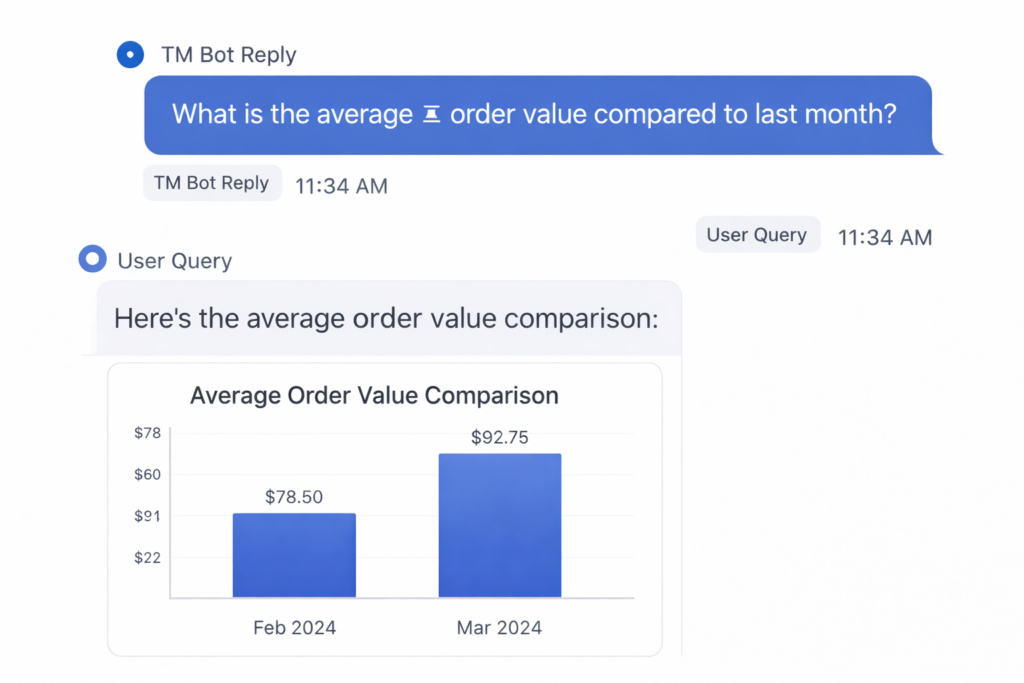
Sell more, fix leaks, move faster.
With an AI database chatbot, eCommerce teams can ask:
- “Which products are selling the most this week?”
- “Where are customers dropping off before checkout?”
- “Which marketing campaign brought the highest revenue?”
- “Which products are running low in inventory today?”
- “What is the average order value compared to last month?”
This helps teams optimize pricing, inventory, and campaigns without waiting for reports or dashboards.
🏫 eLearning Platforms
Improve engagement, reduce churn, grow subscriptions.
eLearning businesses commonly ask:
- “Which courses have the highest completion rate?”
- “Where are students dropping out the most?”
- “Which instructors get the best feedback?”
- “How many users upgraded from free to paid this month?”
- “Which course brings the highest lifetime value?”
Product, content, and marketing teams get clear direction on what to improve and what to scale.
🏢 Real Estate Companies
Track leads, deals, and performance in real time.
Real estate teams use the chatbot to ask:
- “How many new leads came in today?”
- “Which property listings are getting the most inquiries?”
- “Which agents are closing the most deals this quarter?”
- “What’s the average deal closure time?”
- “Which locations are performing better than expected?”
This helps brokers and managers focus effort where money is actually coming from.
🏭 Manufacturing Companies
Reduce delays, control costs, improve output.
Manufacturing teams often ask:
- “Which orders are delayed right now?”
- “Where is production slowing down?”
- “Which supplier causes the most delays?”
- “What is today’s production vs target?”
- “Which machine has the highest downtime?”
Operations teams get live visibility, not yesterday’s reports.
🏨 Hotel Booking & Hospitality
Increase occupancy, improve guest experience.
Hotel and booking platforms ask:
- “What is today’s occupancy rate?”
- “Which room types are selling fastest?”
- “Which booking channel gives the highest revenue?”
- “How many cancellations happened this week?”
- “What are the most common guest complaints?”
Revenue managers and hotel staff can adjust pricing, promotions, and service instantly.
This is exactly how we position AI database chatbots at Triple Minds—not as a technical tool, but as a daily decision assistant for the business.
Types of Databases That Can Be Integrated With an AI Database Chatbot
One concern we often hear from businesses is:
“Our database is old.” or “Our setup is not standard.”
The good news is—AI database chatbots are not limited to modern or popular databases. At Triple Minds, we design chatbot architectures that work with both legacy systems and modern data stacks, because real businesses rarely run on a single, clean database.
Below is a clear, business-friendly breakdown.
1) Traditional SQL Databases (Most Common)
Works perfectly with existing enterprise systems.
If your business uses:
- MySQL
- PostgreSQL
- Microsoft SQL Server
- Oracle Database
You’re already in a great position. These databases are widely used in CRMs, ERPs, finance systems, and internal tools.
The chatbot can query sales, finance, operations, and customer data directly and securely, without changing your setup.
2) Legacy & Enterprise Databases
Yes—even old systems can be integrated.
Many enterprises still rely on:
- Oracle legacy systems
- IBM DB2
- On-premise enterprise databases
We frequently work with businesses running 10–20 year old systems. Instead of forcing migration, we integrate the chatbot on top of existing infrastructure, protecting your past investments.
No forced upgrades. No risky rewrites.
3) Cloud Databases & Data Warehouses
Ideal for fast-growing and data-heavy companies.
If your data lives in:
- Amazon RDS / Aurora
- Google BigQuery
- Snowflake
- Azure SQL / Synapse
The AI chatbot can handle large-scale analytical queries like trends, forecasting, and performance analysis.
Perfect for leadership dashboards, finance analysis, and growth tracking.
4) NoSQL & Semi-Structured Databases
Great for modern apps and high-volume data.
For businesses using:
- MongoDB
- Firebase
- DynamoDB
- Cassandra
The chatbot can still answer meaningful questions—even when data is not stored in tables.
Useful for apps, marketplaces, IoT platforms, and high-traffic systems.
5) ERP, CRM & Business Systems Databases
Most businesses don’t even realize these are databases.
AI database chatbots can sit on top of:
- ERP systems (inventory, finance, procurement)
- CRM systems (leads, customers, sales)
- HR and operations platforms
Teams ask questions like “How many unpaid invoices exist?” or “Which leads are stuck in follow-up?” without opening multiple tools.
6) Multiple Databases at the Same Time
This is where real power shows up.
Many businesses run:
- One database for sales
- Another for finance
- Another for operations
We design chatbots that connect to multiple databases simultaneously, so businesses can ask:
- “Compare revenue with fulfillment delays”
- “Which regions have high sales but low margins?”
One question. Multiple systems. One answer.
7) Read-Only & Secure Integrations (No Risk to Data)
For sensitive businesses, the chatbot can be configured as:
- Read-only access
- Department-level permissions
- Audit-logged queries
This keeps compliance, security, and leadership confidence intact.
Security & Compliance: Built for Enterprise Confidence
When businesses think about using AI to access their databases, the first real concern is not features—it’s security.
Questions like “Is our data safe?”, “Who can see what?”, and “Will this create compliance risks?” are completely valid. At Triple Minds, we treat security and compliance as core design requirements, not add-ons.
Here’s how we ensure enterprise confidence from day one.
1) Your Data Never Leaves Your Control
AI database chatbots do not mean your data is sent everywhere. We design systems where:
- Databases stay in your environment (cloud or on-premise)
- The chatbot connects securely using controlled access
- No raw data is exposed outside approved boundaries
Businesses keep ownership and control of their data at all times.
2) Role-Based Access for Every Team
Not everyone in an organization should see the same data—and we fully respect that.
We implement:
- Role-based access (Sales, Finance, Ops, Leadership)
- Permission-level query restrictions
- Department-specific visibility rules
A sales executive sees sales data. Finance sees financials. Leadership sees everything—cleanly and safely.
3) Read-Only Database Access (Zero Risk to Data)
For most enterprises, chatbot access is configured as read-only.
That means:
- No updates
- No deletes
- No accidental data changes
Teams can ask unlimited questions without any risk to operational systems.
4) Full Audit Logs & Query Tracking
Every interaction can be logged:
- Who asked the question
- When it was asked
- Which data was accessed
This is critical for:
- Internal audits
- Compliance reviews
- Security investigations
Nothing happens silently in the background.
5) Compliance-Ready Architecture
Different industries have different compliance needs. We design AI database chatbots that align with:
- Enterprise IT policies
- Data privacy standards
- Industry-specific compliance requirements
Whether you operate in finance, healthcare, education, or enterprise SaaS, the chatbot can be tailored to match your compliance framework, not challenge it.
6) On-Premise or Private Cloud Deployment
For organizations that cannot use shared environments, we offer:
- Fully on-premise deployment
- Private cloud setups
- Network-restricted access
Ideal for enterprises with strict data residency or internal IT rules.
7) Human Oversight & Admin Controls
Admins always stay in charge:
- Control data sources
- Manage user access
- Pause or restrict functionality if needed
AI assists decisions—it does not override governance.
We’re a globally trusted AI development company and we’ve already built AI database chatbots. Talk to our team to see how this can work for your business.
FAQs
Yes. AI database chatbots can interpret multi-step, context-aware business questions and return accurate answers by combining data from multiple tables or systems when required.
By providing a single, consistent source of answers, AI database chatbots eliminate conflicting reports and ensure every department works from the same data logic.
Yes. AI database chatbots can be tailored with department-specific metrics, KPIs, permissions, and workflows for sales, finance, operations, CX, and leadership.
Implementation depends on data complexity and security requirements, but most businesses can deploy a working AI database chatbot within weeks, not months.
Understanding the difference between RPA and agentic workflows is essential in today’s automation-driven world.
While RPA streamlines routine tasks, agentic AI brings adaptive, decision-making intelligence to complex processes. This article breaks down their core distinctions, use cases, and future impact on digital transformation.
If you’re navigating automation choices in 2026, this guide will help you make the right call.
Let’s dive in for the detailed information!
What is RPA?
RPA is a technological solution that makes use of robots, or digital assistants, to carry out uncomplicated and rules-based operations. The robots execute unambiguous directions and are most effective in dealing with organized data. This quality matches RPA appropriately in numerous business process automation streams.
Where Is It Used? RPA is often used for data entry, form filling, data migration, and other repetitive tasks. It saves time, reduces errors, and lowers costs, making it a good option for quick wins in AI and automation without major system changes.
But RPA also has limits. It can’t handle unstructured data, adapt to change, or make decisions. This drives businesses to compare robotic process automation vs. agentic workflows and RPA vs. AI agents for more intelligent automation.
At Triple Minds, we specialize in advanced AI development, agentic model training, and automation solutions tailored to real-world business needs. With hands-on experience across industries, we help organizations make informed decisions when navigating automation—whether it’s RPA, agentic workflows, or custom AI agents. This guide is grounded in both technical expertise and practical implementation.
What is Agentic Workflow?
Agentic workflow uses AI-powered autonomous agents that can understand goals, make decisions, and act with minimal human input. Unlike RPA, which follows strict rules, agentic systems rely on reasoning, context-awareness, and adaptive decision-making. They can understand natural language, plan tasks, self-correct, and complete multi-step workflows on their own. To autonomously manage outreach, a cold email AI agent can identify leads, craft personalized messages, and handle follow-ups based on recipient behavior.
The advantages of these capabilities make agency workflows very effective in the context of contemporary business process automation. You will see the usage of these capabilities in customer service, data analysis, operations management, and intricate workflow handling. While businesses are comparing RPA to agentic workflows, the latter keeps distinguishing itself due to its adaptability and smartness.
What are the Differences Between RPA and Agentic Workflow?
Agentic AI workflows and RPA are two different automation strategies. While Agentic AI offers autonomous, goal-driven activities with the capacity to adapt, reason, and intelligently solve complicated problems, RPA uses structured logic to manage rule-based, repetitive tasks.
1. Narrow Use Cases vs. Broad Application Scope
RPA is perfect for heavy-duty, repetitive use cases, payroll processing, invoice generation, or data migration. But outside these narrow lanes, its utility drops.
Agentic AI has a broad spectrum. It can assist in legal review, marketing strategy, or IT operations. Whether you’re dealing with structured finance reports or unstructured customer feedback, agentic automation offers flexibility.
Key Takeaways:
- RPA is good for narrow and repetitive tasks.
- Agentic AI supports diverse and creative workflows.
- Better fit for cross-functional enterprise automation.
2. Fragile to Change vs. Resilient to Change
RPA scripts are prone to malfunction due to even the slightest user interface upgrades or alterations. A bad layout change can lead to the malfunctioning of the robots. Consequently, the maintenance costs escalate quickly as the bots require regular updates.
Agentic AI is durable. It resonates with workflows, interprets purpose, and adjusts to system changes. Imagine it as a self-driving automobile negotiating building sites. It adapts rather than stops it.
Key Takeaways:
- Small adjustments cause RPA to break.
- Agentic AI elegantly adjusts and recovers.
- Cut downtime and maintenance expenses.
3. No Collaboration vs Multi-Agent Coordination
RPA bots operate independently. They follow set instructions and don’t ring up their buddies.
AI that is agentic is social. To finish intricate tasks, it works with other AI agents, human operators, or digital systems. One agent might, for instance, manage the creation of contracts while another verifies compliance, coordinating actions and results.
Key Takeaways:
- RPA bots work on their own.
- Intelligent coordination is made possible by agentic AI.
- Increases the effectiveness of large-scale systems.
4. Task-Level Automation vs. Workflow-Level Autonomy
RPA focuses on micro-tasks, like copying and pasting data, filling out forms, and sending emails. Although it is quite good at automating these specific processes, it is unable to view or control the larger workflow.
Whereas entire workflows are planned by agentic AI. It prioritizes steps, recognizes the connections between jobs, and guarantees seamless execution from beginning to end. An agentic workflow is defined by this macro perspective, which is an intelligent process chain rather than merely discrete operations.
Key Takeaways:
- RPA automates individual, repetitive tasks.
- Agentic AI manages entire workflows from start to finish.
- Agentic AI is ideal for handling complex business processes.
Agentic AI’s ability to handle more than just simple tasks is key in the RPA vs.. Agentic AI debate.
5. Human-Defined Rules vs. AI-Driven Reasoning
RPA uses fixed rules (if-then statements) to make decisions, so its effectiveness depends on the person coding it. This makes it fragile in situations that require adaptation.
In contrast, agentic AI makes decisions based on data and adapts in real-time. For example, in customer support, RPA may escalate a ticket based only on keywords, while agentic AI looks at past interactions, tone, and sentiment to assess urgency.
Key Takeaways:
- RPA follows strict scripts.
- Agentic AI reasons from data and adjusts independently.
- It enables smarter, real-time decision-making.
6. Static Automation vs. Adaptive Intelligence
RPA uses static logic and can’t adapt without reprogramming. It works well for consistent, high-volume tasks but struggles with unpredictability, making it less effective in dynamic environments.
On the other hand, agentic AI uses machine learning to continuously improve and adapt. It can respond to new inputs, user preferences, or shifting business priorities without needing to be reprogrammed.
For example, where RPA might always send a report at 9AM, AI agents can decide to adjust the timing based on evolving business needs or urgent exceptions.
Key Takeaways:
- RPA doesn’t change unless it is manually modified.
- Agentic AI automatically changes and adapts.
- Perfect for evolving workflows and changing surroundings.
Static logic versus adaptive reasoning is a crucial distinction in the argument between RPA and agentic AI.
7. Rule-based Execution & Goal-Driven Autonomy
RPA (Robotic Process Automation) follows fixed, predefined steps with no flexibility; if a task isn’t in the script, it won’t be done. It’s perfect for repetitive, high-volume tasks requiring consistency.
Agentic AI, on the other hand, operates autonomously. You set the goal, and the AI decides how to achieve it, adapting to changing circumstances. This makes it ideal for dynamic, unpredictable environments, like a GPS adjusting to avoid traffic.
Key Takeaways:
- RPA follows strict rules, while agentic AI adapts to reach goals.
- Agentic AI is more flexible and suited for uncertain, evolving situations.
- RPA excels in stability, but AI agents thrive in changeable contexts.
8. No Learning and Continuous Improvement
Traditional RPA cannot learn from its environment. When an issue arises, it fails repeatedly until a human intervenes, as it has no memory or adaptive capabilities.
In contrast, Agentic AI learns from experience, analyzing feedback and adjusting over time. It becomes more accurate, faster, and better at handling exceptions, making it ideal for dynamic enterprise workflows.
Key Takeaways:
- RPA can’t learn from past performance and needs human intervention.
- Agentic AI supports self-optimization and continuous improvement.
- Agentic AI becomes more efficient and scalable over time.
Comparison of RPA vs. Agentic Workflows: Key Differences at a Glance
Here is a comparison table between RPA and agent-based workflow:
| Features | RPA (Robotic Process Automation) | Agentic Workflow (AI-Driven) |
| Use Case | Simple, repetitive tasks, like data entry, form filling | Complex, dynamic workflows, like customer support |
| Task Complexity | Rule-based, narrow tasks | Multi-step, decision-making tasks |
| Data Type | Structured data | Structured and unstructured data |
| Adaptibility | Frgile to change | Adapts automatically to new conditions |
| Collabration | Operates independently | Coordinates with agents, systems, and humans |
| Automations Scope | Task-level automation | End-to-end workflow management |
| Decision Making | Fixed rules | Adaptive, AI-driven decision-making |
| Flexibility | Rigid and predefined | Highly flexible and adaptable |
| Learning Capability | Regid and predefined | Highly flexible and adaptable |
| Maintenance | Frequent updates needed | Self-correcting, minimal human oversight |
| Best Use Case | Stable, predictable tasks | Dynamic, evolving tasks needing intelligence |
Can RPA and Agentic Workflows Work Together?
Yes, RPA and agentic workflows can work together. In many enterprise environments, this combination creates a stronger and more flexible automation stack. RPA handles stable, rule-based tasks, while agentic AI manages tasks that need reasoning, decision-making, and adaptation.
When both systems run in one workflow, your business gains speed, accuracy, and intelligence at the same time. For example, RPA can extract data from legacy systems, and an AI agent can analyze that data, detect patterns, and trigger the next steps. This hybrid model improves process efficiency and reduces the need for manual oversight.
Modern companies use this combined approach to scale automation faster, increase productivity, and reduce operational risk. RPA delivers consistency, and agentic AI brings intelligence; together, they support end-to-end automation across business functions.
Key advantages of combining RPA and agentic workflows:
- RPA handles repetitive tasks at high speed
- AI agents manage exceptions, decisions, and complex workflows
- Businesses reduce operational bottlenecks
- Teams gain real-time insights and better process visibility
- Automation becomes scalable, resilient, and future-ready
How to Choose Between RPA and Agentic Workflows?
Choosing between RPA and agentic workflows depends on your business goals, data type, and process complexity.
Use RPA when your process is stable, rules are clear, and data stays structured. RPA delivers fast automation wins, reduces manual effort, and performs well in predictable environments like finance operations, HR processing, and data migration.
Choose agentic workflows when your process requires decision-making, multi-step planning, or adaptation. Agentic AI works best in dynamic environments where tasks change often, users interact in natural language, or the workflow needs contextual understanding. It supports business functions like customer support, operations, IT service management, and analytics.
Most companies benefit from a hybrid model. Start with RPA to automate basic tasks, then add AI agents to scale automation into complex workflows.
Key factors to guide your choice:
1. Process Type:
- Stable and repetitive: RPA
- Dynamic and complex: Agentic AI
2. Data Type:
- Structured data: RPA
- Unstructured or mixed data: Agentic AI
3. Automation Goals:
- Cost reduction: RPA
- Intelligent decision-making and scalability: Agentic AI
4. Change Frequency:
- Low chance: RPA
- High change or unpredictable workflows: Agentic AI
By evaluating your workflow needs, you can pick the right automation model and build a scalable, future-ready automation strategy for your business.
Why Triple Minds Is the Right Partner for AI-Ready Digital Growth
In today’s fast-evolving digital landscape, businesses are rapidly adopting AI transformation, agentic workflows, and RPA-driven automation to streamline operations and stay ahead of the curve. Triple Minds stands at the forefront of this shift—offering powerful, future-ready solutions that bridge innovation with business outcomes.
As a full-service AI and RPA development company, Triple Minds empowers organizations to unlock efficiency, reduce operational costs, and scale faster. Our expertise spans intelligent automation, custom AI integrations, autonomous agent systems, and smart workflow orchestration—tailored to drive measurable results.
We help global brands navigate the complexity of emerging technologies by delivering end-to-end solutions: from strategy and architecture design to development, deployment, and optimization. Our focus on agent-based systems, AI-enhanced products, and process automation ensures that your digital transformation is not just implemented—but impactful.
With a proven track record across industries and markets, Triple Minds combines deep tech capabilities with a consultative approach—aligning every project with your long-term vision. Whether you’re digitizing workflows, building AI-powered applications, or launching enterprise-level automation, we provide the technology and execution to make it real.
If you’re looking to transform operations, enhance decision-making, and future-proof your business through AI and RPA—Triple Minds is your strategic partner.
Conclusion
RPA and agentic workflows complement each other in modern automation. RPA delivers speed and accuracy for repetitive, rule-based tasks, while agentic AI adds flexibility, problem-solving, and workflow intelligence. Together, they reduce manual work, boost efficiency, and support scalable automation. As businesses shift toward AI-driven operations, adaptive workflows become essential. The right approach depends on process complexity and long-term goals, with many companies using a hybrid model. Now is the time to explore both to build a future-ready automation framework.
Mental health concerns are rising at an unprecedented rate—yet access to timely, affordable, and stigma-free therapy remains a challenge for many. Enter AI therapy chatbots: intelligent digital companions designed to bridge the gap between mental health support and accessibility. By combining the power of artificial intelligence with psychology, these chatbots are not only reshaping how care is delivered but also revolutionizing how people perceive and engage with mental wellness.
As a forward-thinking tech company committed to leveraging innovation for real-world impact, Triple Minds explores how AI-driven mental health solutions are redefining the landscape of therapy—making it more inclusive, accessible, and personalized than ever before.
At Triple Minds, we create smart AI tools for mental health. We work with more than 10 large language models to build powerful chatbots. We have trained many AI Models for therapy chatbots that help people talk about their feelings and get support.
Our chatbots use advanced technology to understand emotions and offer helpful advice. We also help businesses design and develop their own AI therapy chatbots. Our goal is simple: to make mental health help easy to get, anytime and anywhere. We want everyone to have access to support when they need it most.
What is AI Therapy?
AI therapy is a digital mental health support. It refers to the use of artificial intelligence tools to support mental health and well-being. It involves AI programs or chatbots that help individuals manage stress, anxiety, and other mental health issues by providing conversations, exercises, or personalized advice.
AI therapy can offer immediate support and is available 24/7. It is often more accessible and affordable than traditional therapy. While it doesn’t replace human therapists, it can complement traditional care. This offers guidance and assistance during tough times or as a first step toward seeking help.
1. The Dual Nature of AI Therapy
AI therapy chatbots have rapidly emerged as a potential solution to global mental health gaps, offering non-judgmental, on-demand support. However, their rise has also invited scrutiny. Concerns around clinical safety, emotional nuance, and suicide risk response are real—and backed by recent research. While some studies show AI’s potential in alleviating distress and enhancing therapy, others warn of its limitations, especially when human lives are at stake. Controversial lawsuits and regulatory responses in the U.S. further highlight the need for a cautious, evidence-driven approach.
2. Human Intelligence, Enhanced by AI
At Triple Minds, we don’t just follow AI trends—we shape them with responsibility and purpose. We believe the future of mental health technology lies in augmentation, not automation. AI should support human therapists, not replace them. Our development philosophy centers on ethical, secure, and empathetic AI—built with clinical input, bias safeguards, and data transparency. This approach ensures our clients leverage cutting-edge tools without compromising user safety or integrity.
3. Building Smarter, Safer Digital Health Tools
As regulations evolve and expectations rise, it’s crucial for tech partners to deliver not just smart solutions—but right solutions. At Triple Minds, we’re committed to building AI platforms that prioritize user well-being, respect ethical boundaries, and meet regulatory standards. Whether you’re a healthcare startup or an enterprise building digital wellness tools, our team ensures your innovation is both scalable and socially responsible. Because in healthcare, trust isn’t optional—it’s everything.
How AI Chatbots Address Mental Health Challenges: A Technical Breakdown
As a leading AI development company with over 6 years of hands-on experience, Triple Minds has engineered intelligent systems across industries—including the development of specialized AI-powered mental healthcare chatbots. Our team has worked on real-world applications that blend psychological theory with cutting-edge AI to deliver emotionally intelligent, secure, and responsive solutions for mental wellness. Based on our deep technical expertise, here’s a breakdown of how AI chatbots can effectively address and manage mental health challenges using state-of-the-art technologies.
1. Sentiment & Emotion Analysis
AI chatbots use advanced NLP models trained on emotional datasets to detect sentiment, tone, and mood from user messages. Tools like transformer-based models (e.g., BERT, GPT, RoBERTa) process linguistic patterns to assess psychological states such as anxiety, sadness, or agitation. This enables the chatbot to adapt its responses in real-time, offering empathetic, mood-appropriate support.
2. Cognitive Behavioral Techniques (CBT) Mapping
Many therapeutic chatbots are programmed to simulate CBT interventions through predefined rule-based pathways and ML classifiers. These systems can guide users through thought reframing, mindfulness exercises, journaling prompts, and goal setting—structured around psychological models. For instance, decision trees trained on CBT frameworks allow the bot to deliver step-by-step interventions tailored to a user’s current emotional state.
3. Dialog Management & Intent Recognition
AI chatbots use dialog state tracking and intent classification algorithms to maintain coherent, context-aware conversations. By using RNNs or attention-based models, the bot can understand user goals, track conversation history, and avoid irrelevant or repetitive responses—mimicking a human therapist’s ability to “remember” and evolve the session over time.
4. Risk Detection & Escalation Protocols
Advanced bots integrate risk detection models trained on annotated suicide-risk and self-harm datasets. These models flag critical keywords or sentiment combinations and trigger crisis response protocols, such as redirecting to emergency services or human professionals. Integration with Named Entity Recognition (NER) helps extract personal identifiers or location data, which can assist in directing urgent support where applicable.
5. Personalized Progress Tracking
AI systems can use reinforcement learning and user profiling algorithms to build personalized wellness plans. Over time, the chatbot adapts to the user’s behavior, providing data-driven recommendations, sending nudges or reminders, and tracking improvement through sentiment shifts, conversation metrics, and engagement scores.
6. Data Security & HIPAA-Grade Compliance
Technically robust platforms also incorporate end-to-end encryption, role-based access controls, and anonymization protocols to ensure HIPAA or GDPR compliance. Secure cloud architecture combined with AI model sandboxing helps contain sensitive user interactions, minimizing the risk of data misuse.
(Text or Voice)
(Tokenization, Cleaning)
(Sentiment, Emotion)
Detected?
Refer to Human or Hotline
& Context Tracking
(CBT Mapping, Prompts)
(GPT / LLM)
(Delivered Response)
Challenges in Mental Healthcare
Mental health faces many challenges. Many people can’t access therapy because of its high cost and the difficulty in finding a qualified therapist. An AI therapy chatbot helps to solve these problems, as people can easily access it anytime and anywhere. These therapy chatbots use advanced technology to talk in a natural and caring way. Many think that AI replaces human therapists, but it does not. It offers quick support when human help is not available.
Benefits of AI Therapy Chatbot
The only big advantage of an AI therapy chatbot is that it is always available. Whereas human therapists work for limited hours only. People can talk to them whenever they are feeling stressed, anxious, or lonely. It doesn’t make them feel left out. It can help reduce stress, anxiety, and loneliness. An AI therapy chatbot provides immediate relief and useful coping strategies until professional help is available if needed.
Key Features of AI Therapy Chatbots
AI therapy chatbots are designed with advanced technology to provide meaningful, supportive interactions. Some of the key features include:
- 24/7 Availability – Always accessible, offering immediate emotional support whenever users need it.
- Emotion Recognition – Uses natural language processing (NLP) and sentiment analysis to detect mood, tone, and emotions during conversations.
- Personalized Guidance – Provides coping strategies, exercises, and advice tailored to the user’s mental health needs.
- Confidential & Anonymous – Ensures safe spaces where users can openly share feelings without fear of judgment.
- Multilingual Support – Breaks language barriers, making mental health help available to diverse communities.
- Integration with Other Tools – Can connect with wearables, mental health apps, or wellness platforms to track moods and progress.
- Scalable Support—It can handle multiple users at once, making mental health care more accessible at a larger scale.
Use Cases of AI Therapy Chatbot
AI therapy can be used in many ways for mental health concerns like anxiety, stress, and depression. It helps to monitor moods, build coping skills, and manage loneliness. Moreover, it also provides an immediate response provides support between therapy sessions. And it is easily accessible, lower cost than traditional therapy. Below are the key use cases:
- Its 24*7 availability makes it easily accessible at any time. And also reduce the waiting time period of the office hours or available appointments.
- AI therapy helps to manage symptoms of depression, anxiety, and stress by using techniques like Cognitive Behavioral Therapy (CBT), mindfulness, and positive psychology.
- Chatbots can provide coping skill suggestions, emotional support, and a way to log feelings. Especially for those who are facing mild stress, anxiety, or mood fluctuations.
- An AI therapy chatbot offers a low-cost, accessible option. It is beneficial for those facing financial, time, or hesitancy barriers to professional help.
- AI can help identify individuals who may need more advanced care. This can guide them toward appropriate resources or professionals.
Which Industries Can Benefit From AI Therapy Chatbots?
An AI therapy chatbot can be beneficial for many industries. Here we have listed some of them:
- Healthcare: AI chatbots can provide mental health support. It offers therapy and counseling to patients. This makes mental health services more accessible and reduces the burden on therapists.
- Education: Students can use AI therapy chatbots to manage stress, anxiety, and study-related pressures. This can provide emotional support and help with coping strategies.
- Corporate/Workplace: Businesses may install AI chatbots for the benefit of employee mental well-being. It also provides various ways of stress management, etc.
- Customer Service: AI chatbots may have customers dealing with such emotional concerns. Especially in areas like retail and telecommunications, where customers express frustration or dissatisfaction.
- Insurance: Insurers may enhance their services with AI chatbots in providing mental health assistance. This tool helps policyholders in seeking therapy or counseling for emotional distress and thereby improving wellness.
- Non-profit: Non-profit organizations can implement AI chatbots to offer mental health support to the underserved, ensuring more people have therapy resources.
- Entertainment: Streaming platforms or gaming companies can use AI chatbots to help users manage stress and anxiety. These chatbots address issues related to their content. This feature offers a unique service to its audience.
Conclusion
An AI chatbot today is everywhere in the evolving world and has become essential in the diversification of industries. Primarily, they aided us in obtaining answers to our questions. Gradually, this began to transform into the area of healthcare. Now they work as personal therapists for those who cannot afford counseling or those who find it rather uncomfortable to share their emotions with another person. These AI-based therapy chatbots stand to give the feeling to their users that there is somebody there with them, along with the idea of curing depression and anxiety-related mental issues.
SDXL stands out as the best overall model for NSFW image generation due to its unmatched detail, realism, and versatility across complex prompts. However, Flux is ideal for artistic flexibility, and Pony wins in fast, stylized anime-focused content. Read the detailed article to know which is suitable for you and why.
At Triple Minds, we specialize in AI development and have hands-on experience working with all major NSFW image generation models. From building Candy AI Clones to partnering with SugarLab and powering over 10+ NSFW chatbots, we’ve tested, fine-tuned, and deployed Flux, SDXL, and Pony in real-world environments. Our team has trained custom LLMs, optimized prompt pipelines, and understands exactly how these models perform in live production—making us more than qualified to break down which one truly stands out.
Artificial Intelligence, or AI, has changed how we produce and see images. In the past, creating realistic images or digital art needed a high level of design expertise. Word-to-image creation, on the other hand, is the ability of AI to create beautiful images from word prompts. This has also opened doors for artists and businesses.
NSFW is the area where these tools are used heavily. Anything with graphic or adult elements is frequently referred to as “not safe for work” (NSFW). NSFW has always been significant in digital media, art, and society, despite its sensitivity. Many people are interested in comparing the quality, safety, and flexibility of current AI models for NSFW content.
Right now, Flux, SDXL, and Pony are the most well-known names. Each of these types has its own target market, advantages, and disadvantages. In this blog, we’ll break down in simple terms, so you can understand which one may fit your needs for NSFW art creation.
Understanding AI Image Generation
Before diving into model comparison, you should get familiar with how this technology works. AI image generation uses a special computer system called a neural network. Many images and words are used to teach these systems. When you describe anything to the AI, such as “a cat wearing a crown in a cartoon style,” it uses your words to generate an image.
These models are also called text-to-image models, as the input is text and the output is an image. In recent years, these AI models have gotten much better. They can now generate realistic humans, fantasy scenes, or highly detailed artworks. With this, you can make NSFW images, including adult art, erotic illustrations, and experimental designs.
Overview of the Leading Models: Flux, SDXL, and Pony
Flux
Flux is a newer rising name in the AI scene. It has gained attention for its ability to create smooth and realistic images that are artistically balanced. The term Flux stands for an open-source series of text-to-image AI models that generate visuals from text descriptions, or prompts. We recently implemented Flux in one of our NSFW chatbot project development where the client specifically requested adaptive style-shifting between semi-realistic and anime art within a single session. This level of dynamic style control was only possible through Flux’s flexible architecture and prompt responsiveness—making it the ideal choice for customized, real-time NSFW generation.
Strengths:
- Versatile Style Options: Flux excels in creating a diverse set of NSFW content, capable of adapting to any style through a text prompt. Flux can produce anything ranging from realism to cartoons, or something in between.
- High-Quality Output: The program generates very detailed images, best suited for a more detailed and complex type of NSFW art.
- Flexibility: Flux is the way to go if one wants to customize by request or prefers any other canvas for creativity.
Weaknesses:
- May Struggle with Fine Detail: Flux, being a great all-rounder, sometimes struggles to nail down those super-fine details, especially in more complex NSFW images.
- Slower Rendering: The higher the level of detailing, the more downhill the rendering time goes compared to others; an inconvenience to some who want results now.
👉 Want to build your own NSFW AI chatbot using these models?
Read our next blog: NSFW Chatbot Development – Cost & Tech Stack You Need to Know to discover what it really takes to bring it to life.
SDXL (Stable Diffusion XL)
SDXL is a leading text-to-image AI model known for generating sharp, refined visuals. It’s especially popular for NSFW content due to its advanced image quality and more precise approach to text-to-image generation.
Strengths:
- Refined and Sharp Output: Stable Diffusion XL is renowned for producing images that are clear, sharp, and of excellent quality. For people who require more sophisticated NSFW stuff, this makes it perfect.
- Handle Complex Prompts Well: It performs exceptionally well when generating images for more complex or specific prompts, producing high realism and precision.
- Great For Professional Use: For creators working on more professional or commercial NSWF art, SDXL offers a kind of detailed, refined results that are often needed.
Weaknesses:
- Limited Artistic Variety: SDXL is good for realistic and detailed images, but less good for highly stylized or abstract NSFW art.
- Resource Heavy: SDXL needs more computation power, meaning slow or hard to operate on devices with lower specifications.
Pony
Pony is a new player, but it has quickly gained popularity due to its efficiency in generating NSFW content. It focuses on creating high-quality, stylized images that stand out for their artistic flair. It was trained with datasets that include stylized and adult themes.
Strengths:
- Creative and Stylized: Pony stands out for its artistic flair and ability to generate NSFW images with a unique, stylized approach. If you’re looking for something with a creative twist, Pony delivers.
- Quick Rendering: Unlike some other models, Pony can generate images quickly, making it a great choice for users who need fast results.
- User-Friendly: Pony is more accessible for users with less powerful hardware because it is comparatively simple to use and requires less processing power than Flux or SDXL.
Weaknesses:
- Less Realism: Pony may not be the greatest choice for people looking for really realistic NSFW stuff because it concentrates more on styled graphics. The outcomes are more likely to be artistic interpretations.
- Limited Detail in Complex Images: When generating highly detailed or intricate NSFW content, Pony may not perform as well as Flux or SDXL. It sometimes lacks the accuracy and depth that other models provide.
Architecture & Model Details (Deep Dive)
To better understand how Flux, SDXL, and Pony create NSFW images, it helps to look under the hood. These tools are powered by advanced deep learning techniques, particularly diffusion models. While each has its unique twists, they all follow a similar core process: start with random noise, then refine it over multiple steps until a detailed image forms based on your text prompt.
Here’s a simplified technical breakdown of how each model functions:
Flux Architecture
Flux is built on an open-source text-to-image framework using transformer-based latent diffusion. Its architecture is optimized for both style transfer and detail control. It typically uses:
- 12B+ parameters for model weights.
- A U-Net backbone for image generation steps.
- Integration with CLIP-like encoders to understand prompt semantics.
- Advanced samplers like DDIM or Euler Ancestral, offering more artistic flexibility.
Flux models also support fine-tuning and LoRA (Low-Rank Adaptation) layers, letting creators customize for their style.
SDXL (Stable Diffusion XL) Architecture
SDXL is one of the most powerful models available, developed by Stability AI. It improves on the original Stable Diffusion with:
- Dual-stage architecture: one model generates a low-res draft, another refines it.
- More than 2.3 billion parameters, with larger CLIP text encoders.
- Wider latent space and attention maps, which help capture subtle prompt cues.
- Uses high guidance scale (CFG) values and better prompt parsing to preserve meaning.
SDXL needs more VRAM but excels at photorealism and anatomical accuracy, making it a top choice for professional NSFW artists.
Pony Architecture
Pony uses a lighter version of the diffusion architecture, trained with a focus on anime and stylized adult content. Its model is built for speed and simplicity:
- Uses U-Net with fewer parameters, optimized for faster rendering.
- Tightly integrated with anime-trained CLIP variants, boosting stylized interpretation.
- Shorter inference paths (fewer steps) allow quicker outputs.
- Mostly uses the Euler A or DPM++ samplers, striking a balance between quality and speed.
Its training data includes a mix of fantasy, furry, and anime themes, making it ideal for niche creative expression but less so for hyperrealism.
API / Integration Guide
Creating NSFW images with AI is exciting, but using these tools effectively often comes down to how well you can integrate them into your workflow. Whether you’re a developer building an app or an artist experimenting with styles, understanding the API and setup for Flux, SDXL, and Pony will save you a lot of time.
Here’s how each model typically works from an integration perspective:
POST https://api.flux1.ai/generate
{
  "prompt": "fantasy NSFW female portrait, soft lighting",
  "negative_prompt": "blurry, distorted anatomy",
  "guidance_scale": 9,
  "steps": 40,
  "width": 512,
  "height": 768
}Self-Hosting: Downloadable via GitHub or CivitAI with support for LoRA and ControlNet plug-ins.
🚀 Looking to integrate NSFW image generation into your app or platform?
We offer powerful API solutions using models like SDXL, Flux, and Pony—fully customizable and production-ready.
👉 Explore our NSFW AI Image Generator API Services here and start building today.
Accessing SDXL via Stable Diffusion APIs
SDXL can be accessed through platforms like Stability AI, Replicate, Hugging Face, or custom pipelines built using Diffusers (by Hugging Face).
- API Providers: Stability AI, Banana.dev, RunPod, and more.
- Parameters:
prompt,negative_promptnum_inference_steps: 50+ for high quality.cfg_scale(Classifier-Free Guidance): ranges from 5 to 12.image_format,upscaleoptions for HD results.
- Integration Example (Python):
from diffusers import StableDiffusionXLPipeline
pipe = StableDiffusionXLPipeline.from_pretrained("stabilityai/stable-diffusion-xl-base-1.0")
pipe.to("cuda")
image = pipe(prompt="nsfw female concept art, realistic skin", guidance_scale=7.5).images[0]
image.save("output.png")
Compute Requirements: Typically needs >=12 GB VRAM to run smoothly locally.
Using Pony via API (Great for Fast Results)
Pony is designed for NSFW anime and fantasy images. It’s often used through platforms like StableDiffusionAPI, AppyPie, or niche hosting services.
- API Platforms: stablediffusionapi.com, appypiedesign.ai
- Model Tags:
pony-diffusion-v6-xl,pony-v2,astraliteheart - Parameters:
prompt,negative_promptmodel_id: (e.g."pony-diffusion-v6-xl")width,height: typical default is 512×768.steps: 25–35 for a decent image.
- Quick API Call:
POST https://stablediffusionapi.com/api/v3/text2img
{
  "key": "your_api_key",
  "prompt": "anime style NSFW girl, soft blush, thigh high socks",
  "model_id": "pony-diffusion-v6-xl",
  "steps": 30
}
Using Flux via API or Local Deployment
Flux offers both cloud API access and local deployment options. It’s open-source, which means you can download models and run them on your own hardware.
- API Endpoint: Available via platforms like Hugging Face or directly from Flux1.ai for certain versions.
- Basic Parameters:
prompt: main description.negative_prompt: optional filter for unwanted elements.guidance_scale: controls prompt strength (usually 7.5–12).steps: how detailed the image will be (default 30–50).width,height: size of the output.seed: reproducibility of outputs.
- Integration Example:
Flux, SDXL, and Pony: Head-to-Head Comparison
Now that we know the basics, let’s compare Flux, SDXL, and Pony across key areas.
| Feature | Flux | SDXL | Pony |
| Image Style | Clean, balanced, semi-realistic | Highly detailed, flexible | Anime, stylized, fantasy |
| Ease of Use | Easy prompts | Requires detailed prompts | Simple for anime fans |
| NSFW Focus | Moderate | Broad (many custom models) | Strong (anime/furry) |
| Community Support | Small but growing | Huge and active | Strong in niche fandoms |
| Hardware Needs | Moderate | High | Moderate |
| Best For | Artistic erotic art | Realistic + flexible NSFW | Anime NSFW art |
The Future of AI Models for NSFW Content
The future of AI in NSFW content will bring powerful models that create more realistic and detailed images quickly and easily. In order to provide authors with more possibilities, we will also see specific text-to-image models for various types, such as anime, realism, and fantasy. Making adult art will be easier and faster with these tools.
But as technology develops, it will be crucial to include robust protections against detrimental abuse, such as producing information that is not consented to. To ensure responsible use, future platforms will probably mix ethical controls with creativity.These advancements will give artists more control and variety, making adult digital art more accessible and diverse, while encouraging respectful and responsible creation.
Conclusion
Flux, SDXL, and Pony each bring something unique to the world of NSFW image generation. Flux gives somewhat balanced artistic output; SDXL offers superior levels of detail and flexibility, and Pony beats in anime and stylized NSFW art. Together, they portray how far AI modeling for NSFW content has come, hence suggesting the direction it is going. As the technology matures, these NSFW AI tools will give creative power, choice, and freedom—on the condition that they are responsibly and ethically used.
In many comparisons, FLUX (or “FLUX 1.x” series) produces better hand/finger/limb anatomy, fewer weird distortions in bodies or faces. For example: “FLUX.1 outperforms Stable Diffusion in several key areas … human anatomy, especially tricky areas like hands”. But SDXL is a more mature, well-documented, widely used model in the open-source space.
Yes, but it depends on the model’s license. SDXL has stricter terms; Flux and Pony are more flexible, but always check the specific license before use.
Use a high guidance_scale (8–12), increase steps (40–60), add detailed descriptors in the prompt, and always include a negative_prompt to remove flaws.
Pony is the best choice for anime, furry, or fantasy-themed NSFW content. It’s trained specifically on stylized datasets and renders fast, clean outputs.
For SDXL, a GPU with at least 12–16 GB VRAM is recommended. Flux and Pony can work with 8 GB but perform better with more. CPU-only is slow.
SDXL is the top choice for hyper-realistic and detailed NSFW images. It handles complex prompts well and is ideal for professional or commercial use.
Flux is best for users seeking creative freedom. It supports various styles from realism to surreal art, and is ideal for experimental or niche adult content.
Pony excels in stylized outputs like anime, furry, or fantasy characters. It’s lightweight, fast, and tailored to niche fandoms with strong community backing.
Artificial Intelligence (AI) is a hot topic everywhere. You’ve probably heard discussions about AI-generated blogs or AI-created images, but understanding how AI actually works is a different story. In simple terms, artificial intelligence refers to machines using technology to perform tasks similar to humans. AI operates by utilizing algorithms that analyze data, learn from patterns, and improve over time.
An AI agent is a program designed to perform tasks such as problem-solving and interacting with humans using AI-driven techniques. These agents collect information from their environment and use Natural Language Processing (NLP) and Machine Learning (ML) to analyze data. Over time, AI agents enhance their performance by learning from past mistakes.
There are 5 different types of AI agents, including:
- Simple Reflex Agents
- Model-Based Reflex Agents
- Goal-Based Agents
- Utility-Based Agents
- Learning Agents
| AI Agent Type | Decision-Making | Complexity | Learning Capability | Real-World Example |
|---|---|---|---|---|
| Simple Reflex Agent | Condition-action rule | Low | No | Thermostat |
| Model-Based Reflex Agent | Uses internal model | Medium | Limited | Autonomous vacuum cleaner |
| Goal-Based Agent | Evaluates actions to achieve goals | High | No | Self-driving car navigation |
| Utility-Based Agent | Chooses best outcome | Higher | No | Stock trading AI |
| Learning Agent | Improves through experience | Very High | Yes | ChatGPT, AlphaGo |
In this blog, we’ll dive deeper into AI agents and their types, with a focus on goal-based agents in artificial intelligence.
5 Types of AI Agents and Their Complexity Levels

Let’s Learn More About 5 Types of Agents in Artificial Intelligence
AI agents are software programs that use Artificial Intelligence (AI) to assist humans in performing daily tasks efficiently. These agents collect information from their surroundings and provide recommendations based on their analysis. AI agents utilize Natural Language Processing (NLP) to understand data better and improve their performance over time.
In our daily lives, we interact with various AI-powered tools such as Alexa, Siri, navigation apps, customer service chatbots, and smart home devices. These virtual assistants and intelligent systems help automate tasks, making life easier.
1. Simple Reflex Agents
Simple Reflex Agents are a type of AI agent that functions based on condition-action rules, meaning they follow predefined instructions to make decisions. These agents respond to the current state of their environment without storing past data. They perform well in structured, detectable tasks.
Real-World Applications of Simple Reflex Agents
Automated Doors
Automatic doors detect human motion and signal the control system to open. These doors also incorporate safety features to prevent accidental closures if someone is too close.
Vending Machines
Vending machines operate based on customer input. When a button is pressed, the AI agent processes the selection and dispenses the chosen product. The entire process relies on real-time inputs from users.
Thermostat Devices
Thermostats regulate room temperature by adjusting heating or cooling settings. If the temperature drops, the system increases the heat. If it rises, it activates cooling to maintain a comfortable environment.
Traffic Lights
Traffic lights use sensors, cameras, and radars to monitor vehicle movement, speed, and direction at intersections. AI-based traffic lights dynamically adjust signals to optimize traffic flow and reduce congestion.
2. Model-Based Reflex Agents
Model-Based Reflex Agents are a type of AI agent that utilize internal memory and historical data to make informed decisions. Unlike Simple Reflex Agents, these agents can handle partially observable environments, meaning they can process and respond to complex situations by storing and analyzing past experiences. Their ability to retain and use memory allows them to function effectively in dynamic and unpredictable environments.
Real-World Applications of Model-Based Reflex Agents
Autonomous Cars
Self-driving cars rely on multiple sensors, including cameras, LiDAR, radars, and ultrasonic sensors, to gather environmental data. AI agents use this data to create real-time maps for safe navigation, detecting road conditions, traffic flow, and obstacles to ensure smooth driving.
Robotic Vacuum Cleaners
Smart vacuum cleaners use AI-powered sensors to map the room’s layout and identify obstacles such as furniture, beds, and walls. They efficiently detect dirt, avoid hurdles, and adjust their navigation paths accordingly. These devices continuously update their mapping system to improve cleaning performance
3. Goal-Based Agents
Goal-Based Agents are AI agents designed to achieve specific objectives. Unlike Model-Based Reflex Agents, these agents plan their actions and make informed decisions by using an internal model of the environment. They analyze data, execute tasks efficiently, and continuously improve based on input. Compared to Simple Reflex Agents and Model-Based Reflex Agents, Goal-Based Agents exhibit a higher level of intelligence and adaptability.
Real-World Applications of Goal-Based Agents
Driverless Cars
Self-driving cars rely on AI agents to navigate roads, avoid traffic, and reach destinations safely. They use sensors such as cameras, LiDAR (Light Detection and Ranging), radars, ultrasonic sensors, and GPS. By utilizing Convolutional Neural Networks (CNNs), a deep learning algorithm, AI processes real-time data to handle tasks like braking, accelerating, and steering with precision.
Warehouse Robots
Warehouse robots lift, sort, and transport goods with high efficiency. They perform real-time data analysis, learn from past experiences, and use computer vision to identify and pick the correct products, enhancing warehouse operations.
Autonomous Delivery Drones
Autonomous drones use cameras and LiDAR sensors to navigate flight paths and detect obstacles. They leverage SLAM (Simultaneous Localization and Mapping) technology to create real-time maps while tracking their position, ensuring smooth and accurate deliveries.
Personal Assistants
Voice assistants like Siri, Alexa, and Google Assistant use AI to process human commands. They assist with setting reminders, making calls, answering questions, chatting, and providing personalized suggestions based on user behavior.
Gaming AI
AI agents enhance gaming experiences by acting as virtual opponents or guides. Chess AI, such as Stockfish and AlphaZero, analyzes game moves and suggests the best strategies to win. Many online multiplayer games also use AI to adjust difficulty levels and optimize player engagement.
Why Goal-Based AI Stands Out?
The biggest advantage of Goal-Based AI is its flexibility and adaptability based on inputs. Whether in autonomous vehicles, robots, assistants, drones, or gaming AI, these intelligent agents continue to evolve, making human tasks more efficient and seamless.
4. Utility-Based Agents
Utility-Based Agents are intelligent AI agents similar to Goal-Based Agents, but with a key difference—they prioritize efficiency while considering risks and preferences. These agents aim to maximize output while minimizing time, cost, and potential errors, making them highly effective for complex decision-making.
Real-World Applications of Utility-Based Agents
Google Maps
Google Maps assists with navigation by analyzing real-time traffic data and suggesting the fastest routes. It provides accurate estimates for travel time based on different modes of transportation, whether by car, bike, or on foot.
Stock Trading Bots
AI-powered stock trading bots analyze market trends, historical data, and live stock prices to recommend buying and selling strategies that maximize profits. These bots execute trades automatically based on risk assessment and market predictions.
Recommendation Systems
AI-driven recommendation engines suggest content based on user behavior and past interactions. Platforms like Netflix, Amazon Prime, ZEE5, and Hotstar analyze watch history to recommend movies and shows, providing a personalized experience for users.
Flowchart of AI Agent Decision-Making
Here is a flowchart representing AI agent decision-making. It visually explains how different types of AI agents process information and make decisions.
Conclusion of Types of Agent in AI
AI agents are powerful software programs that help save human effort, time, and money. Different types of AI agents are designed for different tasks:
- Simple Reflex Agents and Model-Based Reflex Agents excel in detectable and immediate-response scenarios.
- Goal-Based Agents and Utility-Based Agents focus on achieving long-term objectives and ensuring optimal results while maintaining safety.
These AI agents are widely used in industries such as robotics, healthcare, finance, and entertainment. However, it is crucial to use AI responsibly and ethically to ensure fairness and security.
The 5 types of AI agents are Simple Reflex Agents, Model-Based Reflex Agents, Goal-Based Agents, Utility-Based Agents, and Learning Agents. Each type has different decision-making abilities.
A goal-based agent in AI selects actions based on achieving a specific objective. It evaluates multiple possibilities before making a decision, unlike reflex agents that respond immediately.
A self-driving car is an example of a goal-based agent in AI. It calculates the best route to reach a destination while avoiding traffic and obstacles, optimizing for safety and efficiency.
A goal-based agent considers future consequences and selects actions to achieve a goal, while a reflex agent reacts instantly to conditions without considering long-term outcomes.