How Much Does It Cost to Build an AI Agent?
How much does it cost to build an AI agent? Explore real pricing ranges, cost drivers, timelines, and ROI before investing in AI development.

Published Date: February 24, 2026
Almost every founder who reaches out to us at Triple Minds asks the same question first: how much does it cost to build an AI agent for my business?
It is a fair question. But the honest answer is it depends on what you are actually trying to build. AI agents are no longer experimental tools used only by tech companies. Today, they are becoming the backbone of modern businesses. Companies are using them to handle customer conversations, qualify leads, support internal teams, automate repetitive tasks, and even power full digital products.
You might hear very different price estimates in the market. Some companies promise an AI agent for $1,000, while others quote $25,000, $50,000, or more. Both can be correct. The difference usually comes down to what is included, how complex the system is, and whether the agent is meant for simple automation or serious business operations.
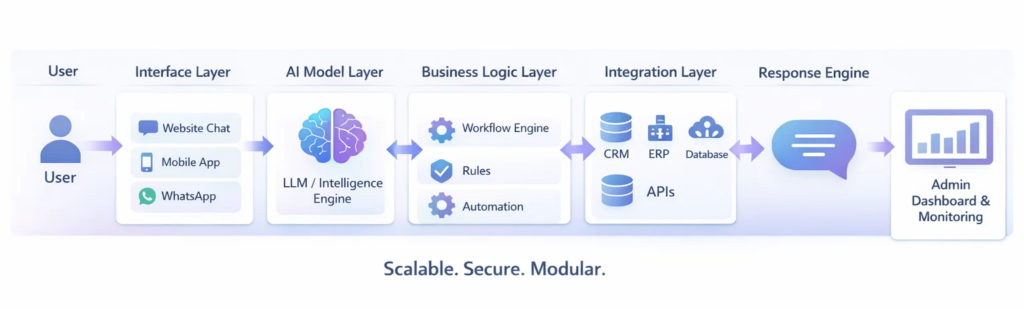
An AI agent is not just a chatbot. It is a complete software system made up of several parts working together, such as:
• AI intelligence (the model that understands and responds)
• Business logic (rules, workflows, and automation)
• Integrations (CRM, databases, tools, APIs)
• User interface (chat window, dashboard, controls)
Once businesses understand these layers, the AI agent development cost becomes much easier to understand. As an AI development company, we build everything from early-stage prototypes for startups to enterprise automation systems for large organizations. After working on multiple projects across industries, one thing is clear.
The cost to build an AI agent is mainly determined by three factors:
• How complex the agent needs to be
• How many systems it must connect with
• What role it will play inside your business
In this guide, we will break down the numbers in a simple, practical way. No vague estimates. No technical confusion. Just clear insights so you can plan your investment with confidence. At Triple Minds, we’ve helped businesses across industries understand AI agent development costs, from early-stage prototypes to enterprise-grade systems, so you can make informed decisions with clarity and confidence.
Build AI Infrastructure That Scales With You
From MVP to enterprise automation, Triple Minds designs AI agents that are modular, secure, and built for real business impact.
👉 Speak With Our AI Development Team
Key Takeaways
• The type of AI agent you build determines most of the total cost
• Enterprise systems require more time due to integrations and security
• Multi-channel support and custom training increase costs quickly
• Phased development helps control investment and reduce risk
• Operational costs should be planned alongside development budget
What Type of AI Agents Are You Building? (This Decides 60% of the Cost)
Before talking about timelines or pricing, the most important question is what kind of AI agent you actually need. This single decision determines most of the total investment. Not all AI agents are built the same. Some are simple automation tools. Others function like full digital employees connected to your systems.
When founders approach us, we spend more time defining the use case than discussing money. Because once the use case is clear, the development hours and AI development company pricing become predictable.
From a business perspective, most AI agents fall into three broad categories.
Don’t Miss This Guide: What is a Database Chatbot and How Does it Work?
Basic AI Agent (Entry-Level Automation)
This is the starting point for most startups and small businesses entering AI. Think of it as a smart assistant that can handle repetitive conversations and routine tasks but does not deeply interact with your internal systems or databases.
These agents typically run on existing AI models and are designed to solve surface-level problems quickly. They can answer common questions, capture leads, book appointments, and guide users through simple steps. You will often see them used for website chat support, FAQ automation, or basic customer interaction.
Typical Capabilities Include:
• Answering frequently asked questions
• Capturing and qualifying leads
• Booking appointments or demos
• Providing basic product or service information
• Handling simple customer queries
If your goal is to launch quickly, validate an AI idea, or reduce the workload on your support team, this level works well. The AI chatbot development cost here stays relatively low because the system does not require deep integrations or complex backend logic.
Business AI Agent (Operational Intelligence)
This is where AI starts delivering real business value. At this level, the agent moves beyond simple conversations and begins acting more like a digital team member.
A business AI agent connects with your CRM, database, or internal tools. Instead of just answering questions, it can perform actions, retrieve real data, and support daily operations.
Common use cases include:
• Checking order or delivery status
• Updating customer records in the CRM
• Assisting sales teams with lead insights
• Pulling reports or business data
• Creating and managing support tickets
For example, an AI customer support agent that checks shipping details, opens support cases, and escalates complex issues to human staff falls into this category.
Most serious SaaS companies and scaling businesses choose this type first because it directly impacts efficiency, response time, and customer experience.
Advanced Autonomous AI Agent (High-Complexity Systems)
This is the most advanced and powerful category. These agents can handle multi-step tasks, run workflows automatically, use multiple tools, and operate with minimal human supervision.
They are typically built for AI-first startups, automation-focused companies, and large enterprises aiming to transform how work gets done.
Advanced capabilities often include:
• Multi-step reasoning and task execution
• Automatic workflow management
• Integration with multiple business systems
• Long-term memory and learning
• Custom-trained models for specific industries
These systems may require domain-specific training, complex integrations, and autonomous decision-making abilities. Naturally, enterprise AI agent cost increases significantly at this level because development becomes more demanding and time-intensive.
Why This Decision Matters
If you simply tell a developer you want an AI agent, the estimate will likely be vague because the scope is unclear.
But if you specify that you need an AI sales assistant connected to your CRM, with reporting features and an admin dashboard, the development team can calculate the effort accurately.
Defining the type of AI agent helps clarify:
• Development time required
• Team size needed
• Integration complexity
• Overall cost to build the AI agent
Clarity reduces surprises, delays, and budget overruns. This is why identifying the exact type of AI agent you need is the step that determines nearly 60 percent of the total development cost.
How AI Agent Development Actually Works
Understanding the pricing is important. But what truly builds confidence is understanding the process behind it.
An AI agent is not built in a single step. It is developed in structured phases to ensure clarity, performance, and long-term scalability.
1. Discovery & Use Case Validation
Every successful AI project starts with defining the exact problem.
At this stage, the focus is on identifying repetitive workflows, decision points, and system dependencies. The goal is to determine where automation creates measurable business impact and where human involvement is still necessary.
Without this clarity, projects either over-expand or fail to deliver value.
2. Architecture Planning
Once the use case is validated, the technical foundation is designed.
This includes defining how the AI model connects with internal systems, how data flows through the platform, and how security layers are implemented. A well-planned architecture ensures the system can scale without requiring a rebuild later.
This stage determines long-term stability.
3. Model Selection & Intelligence Design
Not every AI agent requires custom training.
In many cases, structured prompt engineering and well-organized knowledge integration are sufficient. For more advanced systems, this phase may involve domain-specific fine-tuning, workflow reasoning design, memory configuration, and confidence-based escalation logic.
This step determines how intelligently the agent behaves in real-world scenarios.
4. Backend Development & Integrations
This is where the AI moves from theory to operational capability.
The system is integrated with CRMs, databases, ticketing systems, APIs, or internal tools. These integrations allow the AI agent to retrieve real data, update records, trigger workflows, and perform actions instead of simply generating responses.
This is what separates an AI agent from a basic chatbot.
5. Interface & Control Layer
An AI agent must be usable and manageable.
This may include a website interface, application integration, and an internal dashboard for monitoring performance, reviewing conversations, and managing permissions. Adoption depends heavily on usability, not just intelligence.
6. Testing, Deployment & Continuous Monitoring
Before launch, the system is tested for response accuracy, workflow reliability, integration stability, and security compliance.
After deployment, performance monitoring becomes essential. AI agents improve over time through structured analysis, refinement, and system updates.
A properly built AI agent is not a one-time launch. It is an evolving operational system.
Here’s Something Similar: Major Differences Between RPA and Agentic Workflows?
Enterprise AI Customer Support Agent Cost (4-Month Build)
Let’s walk through a realistic scenario so you can clearly understand the enterprise AI agent cost.
Imagine a company wants a production-ready AI customer support agent that can actually handle real customer traffic, not just demo conversations. This agent should be able to:
• Answer customer queries instantly
• Check order or ticket details from internal systems
• Create and update support cases automatically
• Escalate complex issues to human agents with full context
• Remember past conversations for continuity
• Provide an admin dashboard for monitoring and control
• Meet enterprise-level security and access requirements
At this level, you are not building a simple chatbot. You are building a core support infrastructure.
A typical enterprise build takes around four months because multiple specialists are involved, including AI developers, backend engineers, frontend developers, UI/UX designers, QA testers, DevOps engineers, and a project manager coordinating everything.
A properly engineered system in this category usually costs between $45,000 and $60,000 for development. If you add multi-channel support (WhatsApp, email, app integration), advanced analytics, or custom training, the cost can rise to $85,000 or more.
This is why AI development company pricing varies so much. Two projects may sound similar on the surface but require very different levels of engineering effort behind the scenes.
What Increases AI Agent Development Cost the Fastest
Many businesses begin with a simple requirement but expand the scope during planning. Each new feature adds development time, testing effort, and integration work.
The biggest cost drivers include:
• Multi-channel support (website, WhatsApp, email, mobile apps)
• Advanced knowledge base systems for large document sets
• Human escalation workflows and ticketing integration
• Security, compliance, and access control
• Analytics dashboards and reporting tools
• Custom AI model or domain training
For example, connecting the agent to multiple communication channels can increase development effort by 20 to 30 percent because each platform requires separate APIs, formatting rules, and testing.
Similarly, if your AI needs to accurately read thousands of documents such as policies, manuals, or product catalogs, the architecture becomes more complex. This requires additional engineering to ensure accurate responses.
This is why two companies building a “customer support AI agent” can receive very different quotes.
How Smart Businesses Reduce AI Development Cost
Controlling cost does not mean compromising quality. The smartest approach is phased development.
Instead of automating everything at once, successful companies start with one high-impact use case, such as FAQ handling or order tracking. Once the system proves its value, they expand features in later phases.
Another effective strategy is building an investor-ready prototype first. This creates a working system for demos, testing, and fundraising without committing to full enterprise investment immediately.
Avoid heavy customization early unless absolutely necessary. In many cases, structured prompts and knowledge integration perform well in the early stages.
Designing the system with modular architecture is also important. It allows new features, integrations, and upgrades to be added later without rebuilding the entire platform.
Ongoing Costs After Development
Development is a one-time investment, but running the AI agent involves recurring expenses.
Monthly operational costs typically include:
• AI model usage based on conversations
• Cloud hosting and infrastructure
• Database and knowledge storage
• Monitoring and logging systems
• Technical maintenance and updates
For an enterprise AI customer support agent handling moderate traffic, ongoing costs usually range from $2,000 to $5,000 per month.
However, if the system reduces support workload, improves response speed, and increases customer satisfaction, the long-term savings often outweigh the operational expense.
Understanding the ROI of an AI Agent
Cost alone does not determine whether an AI agent is worth building. Return on investment does.
Consider a simple operational example.
If a company spends $20,000 per month on customer support operations and an AI agent successfully handles 40 percent of repetitive queries, the workload reduces significantly. That reduction may translate into approximately $8,000 in monthly operational efficiency.
In that case, the development investment can be recovered within months.
But direct cost savings are only part of the equation.
An AI agent also creates value by:
- Reducing response time
- Offering 24/7 availability
- Improving consistency in communication
- Allowing teams to focus on high-value work
- Supporting scale without immediate hiring
The real return comes from operational leverage.
Instead of hiring proportionally as demand grows, the business scales with automation support already in place.
This is why experienced founders evaluate AI agents as infrastructure investments rather than short-term experiments. The long-term efficiency and scalability often outweigh the initial development cost.
You Might Also Find This Useful: How to Chat with Your Own Database Using AI
Final Budget Guide for Founders
Here is a simplified cost overview to help you plan realistically.
| Project Type | Timeline | Estimated Development Cost |
| Basic AI Support Agent | 6–8 weeks | $12,000 – $18,000 |
| Investor-Ready Prototype | 8–10 weeks | $15,000 – $25,000 |
| Enterprise AI Customer Support Agent | ~4 months | $45,000 – $60,000 |
| Advanced Multi-Channel Enterprise System | 4–6 months | Up to $85,000+ |
Estimated Monthly Operating Cost
| Business Scale | Monthly Cost |
| Startup Usage | $800 – $1,500 |
| Growing Company | $2,000 – $4,500 |
| Large Enterprise | $5,000+ |
What This Means for Your Business
You are an early-stage startup, start with a focused MVP to validate demand before scaling.
Even you are a growing company, invest in a structured AI agent that integrates with your existing operations.
If you are an enterprise, plan a phased rollout with proper security, compliance, and monitoring from the beginning.
The biggest mistake businesses make is either building something too simple that fails under real usage or building an overly complex system before proving value.
Ready to Build the Right AI Agent for Your Business?
Every business needs a different approach. Let’s analyze your use case, systems, and growth stage before you invest. Talk to our AI experts at Triple Minds and get a clear roadmap — not just an estimate.
👉 Book Your Free AI Strategy ConsultationConclusion
An AI agent is not just another software tool. It is a long-term decision that can change how your business works, helping reduce support costs, respond faster to customers, and improve satisfaction while giving you an edge over competitors. The real question is not how cheaply you can build one, but which version to start with based on your current needs and growth stage.
That clarity, which we at Triple Minds focus on, determines your total AI agent development cost and ensures you get the most value. Building the right AI agent from the start sets your business up for smarter, faster, and more efficient growth.
FAQs
The timeline for building an AI agent depends on the level of complexity and integration required. A basic AI agent typically takes around 6 to 8 weeks to develop. A business-level AI agent with system integrations and workflow automation may require 8 to 12 weeks. Enterprise-grade AI agents, especially those involving multiple integrations, dashboards, security layers, and custom logic, usually take between 4 to 6 months. The exact timeline ultimately depends on features, integrations, and customization requirements.
Several elements significantly influence AI agent development cost. The number of system integrations, such as CRM platforms, APIs, and internal databases, plays a major role. Multi-channel support across web, mobile apps, and messaging platforms increases complexity. Custom AI model training, advanced workflow automation, and enterprise-level security or compliance requirements also raise development effort. The more intelligent and connected the system needs to be, the higher the engineering involvement.
Yes. Modern AI agents can integrate with:
CRM systems
ERP software
Payment gateways
Ticketing tools
Internal databases
Third-party APIs
Integration capability is one of the main reasons businesses move beyond basic chatbots.
The most common mistake is overbuilding before validating the actual business need. Many companies underestimate integration complexity or ignore security and compliance planning. Others fail to design for scalability from the beginning. Treating AI as a short-term experiment instead of long-term infrastructure often leads to underperformance or unnecessary rework. Clear scope definition and phased development significantly reduce these risks.
The best starting point is identifying your highest repetitive workload and the areas where delays directly impact revenue. Look at processes that rely heavily on structured data and follow predictable logic. The first AI agent should focus on solving one clear, high-impact business problem rather than attempting to automate everything at once. A focused initial deployment creates measurable results and builds a foundation for future expansion.
Table of Content
- Key Takeaways
- What Type of AI Agents Are You Building?…
- Basic AI Agent (Entry-Level Automation)
- Business AI Agent (Operational Intelligence)
- Advanced Autonomous AI Agent (High-Complexity Systems)
- Why This Decision Matters
- How AI Agent Development Actually Works
- Enterprise AI Customer Support Agent Cost (4-Month Build)
- What Increases AI Agent Development Cost the Fastest
- How Smart Businesses Reduce AI Development Cost
- Understanding the ROI of an AI Agent
- Final Budget Guide for Founders
- Estimated Monthly Operating Cost
- What This Means for Your Business
- Ready to Build the Right AI Agent for…
- Conclusion
- FAQs