How AI Helping Drive – Thru Restaurants?
AI is reshaping drive-thru restaurants by automating order taking, improving accuracy, and reducing wait times. From voice-based ordering systems to predictive menus and real-time analytics, AI helps restaurants handle high demand more efficiently. By streamlining operations and enhancing customer experience, it enables businesses to deliver faster, smarter, and more reliable service.

Published Date: March 18, 2026
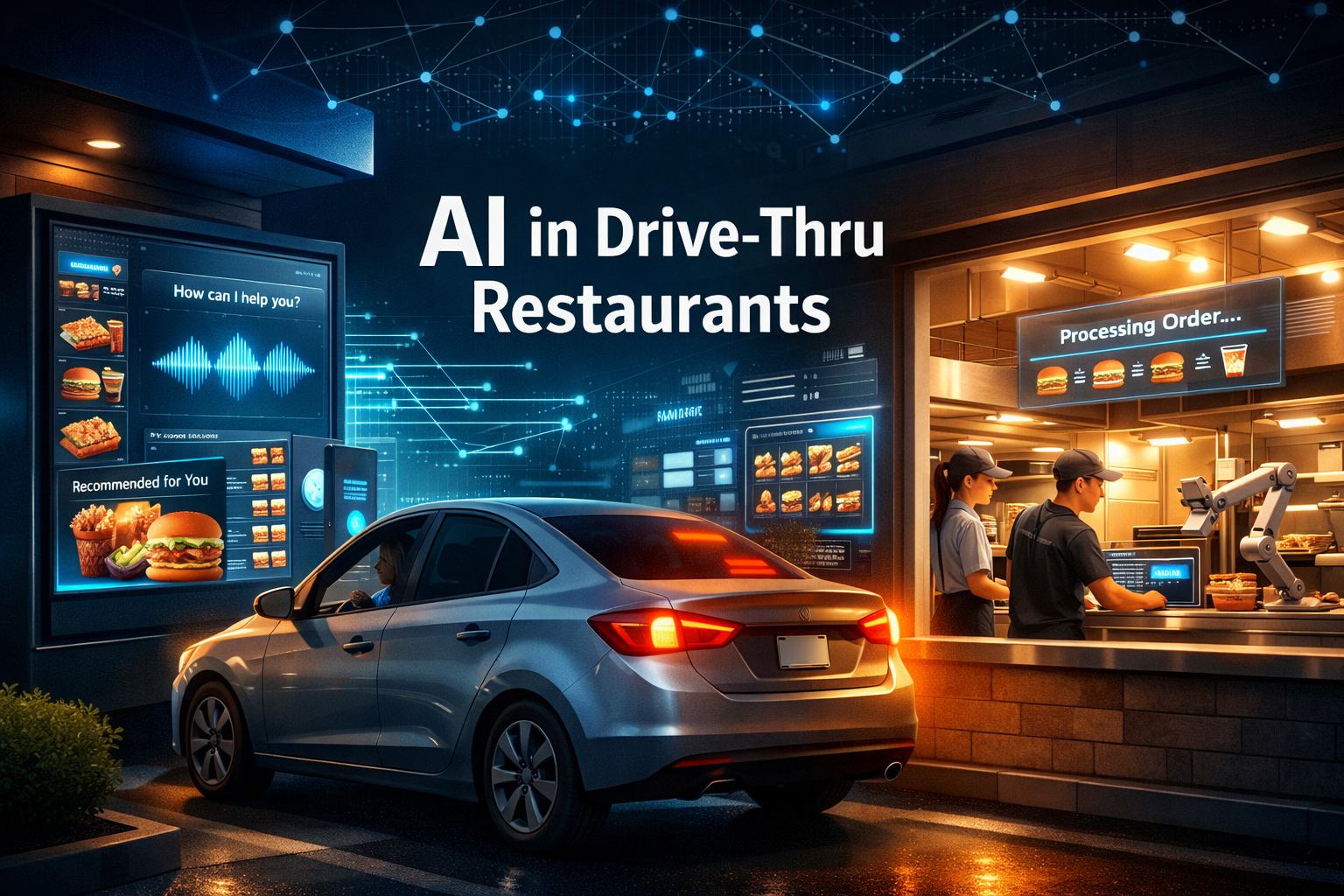
Drive-thru restaurants were built to deliver fast and convenient service, but as demand has grown, managing speed and accuracy during peak hours has become a challenge. Today, nearly 70% of restaurant orders come from drive-thru, takeaway, or mobile channels, which makes efficiency more important than ever.
AI is helping solve this by automating the most critical parts of the drive-thru process. It can take orders through voice systems, understand customer requests using natural language processing, send orders directly to the kitchen in real time, and even predict demand to reduce waiting time. This reduces human error, speeds up service, and allows restaurants to handle more customers without compromising accuracy.
At Triple Minds, we help restaurants work smarter and faster using AI technology.
AI-powered voice assistants can take orders at drive-thrus quickly and accurately, reducing waiting time by around 30 seconds. This means customers get their food faster and businesses can serve more people.
We also use AI tools like computer vision to suggest additional items (upselling), track inventory automatically, and help manage staff more efficiently.
With these solutions, restaurants can increase their revenue while also providing a smoother and better experience for their customers.
What Is AI in Drive-Thru Restaurants?
What AI in drive-thru restaurants means is simply smart technology to help them take orders, understand customers and manage the whole ordering system more seamlessly. Because AI systems listen to what you say, understand the request (probably), and send the order directly to the restaurant system, they don’t need staff passively waiting for customers to come in. The aim is to speed up the drive-thru experience, as well as to make it more — accurate.
These AI systems work quietly in the background while the customer is placing the order. They help restaurants handle more customers during busy hours, reduce waiting time, and avoid small order mistakes that can happen when things get rushed.
Upgrade Your Drive-Thru with AI Automation
Discover how Triple Minds helps restaurants implement AI-powered drive-thru systems to automate order taking, improve accuracy, reduce wait times, and enhance overall customer experience—streamlining operations and boosting efficiency.
Explore AI Drive-Thru Solutions
How Technology Enables Smart Drive-Thru Systems
Voice AI allows customers to speak their orders naturally through the drive-thru speaker. The system listens and processes the order just like a human staff member would.
Natural Language Processing (NLP) helps the system understand how people normally talk. Customers may order in different ways or change their mind while ordering, and NLP helps the system understand those requests clearly.
Machine learning helps the system get better over time. As it handles more orders, it learns common ordering patterns and improves its accuracy.
Predictive analytics helps restaurants prepare for demand. By looking at past order trends, time of day, or even weather, the system can predict what customers are likely to order.
In a drive-thru workflow, AI usually helps at the ordering stage. It takes the order, confirms it with the customer, and sends it directly to the kitchen system. This helps restaurants keep the line moving faster and serve customers more efficiently.
How a Drive-Thru Restaurant Works
A drive-thru system is designed to keep the ordering process smooth, fast, and continuous without requiring customers to leave their vehicles. While the setup may look simple from the outside, it follows a well-defined flow to handle multiple customers efficiently.
The process usually includes 3–4 key steps:
Entry Lane
The customer enters a dedicated drive-thru lane that is designed to guide vehicles in a single direction. This lane is often structured to manage traffic flow efficiently, especially during peak hours, ensuring cars move forward without confusion or delays.
Order Point
At the order point, the driver stops near a speaker system or a digital display. This is where the order is placed. In traditional setups, a staff member takes the order through a headset, while in modern systems, digital screens or AI-based voice systems can assist in capturing the order more accurately.
Payment Window
After placing the order, the vehicle moves forward to the payment window. Customers can complete the transaction using cash, cards, or mobile payment options. This step ensures that the ordering and payment processes remain separate, helping maintain speed and order flow.
Pickup Window
At the final window, the prepared food or beverage is handed to the customer. The goal at this stage is to ensure that orders are delivered quickly and accurately so the line keeps moving without delays.
When Drive-Thru Success Becomes Difficult to Manage
A long waiting line at any drive-thru means the food is amazing, and this restaurant actually has a good following. More cars in the line mean more customers are choosing this brand, which is a sign of a successful business. But success also comes with challenges. When customers start rushing in at once, managing everything smoothly and making sure no one goes unsatisfied can be tough. If businesses choose to keep old-school, staff-dependent services at drive-thrus, there are chances of getting orders delayed, and customized orders might miss out on minor things that impact the overall order and impression. In easy wording, rush hours can become overwhelming and can slow down communication between staff and can lead to extended waiting times.
In traditional drive-thru setups, staff members handle most of the process. They take orders, communicate with the kitchen, confirm requests, and keep the line moving. During rush hours, this can become overwhelming. Orders pile up, communication slows down, and waiting times start getting longer.
The main reason people choose a drive-thru is convenience. They want to order quickly, stay in their car, pick up their food, and be on their way. When the process becomes slow or orders are not accurate, the experience can quickly turn frustrating for customers. This is the reason making sure you are managing drive-thrus properly is so important. They need to deliver exactly what they were asked to, at correct times without compromising taste and quality. And AI ensures that all these things are being taken care of.
Why Drive-Thru Restaurants Are Adopting AI
Drive-thru restaurants are built around one simple promise: fast and convenient service. Customers expect to order quickly, stay in their car, and receive their food without long waits. But as demand grows and customer expectations rise, managing drive-thru operations the traditional way is becoming more difficult. This is one of the main reasons many restaurants are now turning to AI-powered systems to improve speed, accuracy, and overall efficiency.
Here are some key reasons why AI adoption is growing in drive-thru restaurants.
Rising Customer Expectations for Faster Service
Today’s customers are used to fast digital experiences. Whether it is online shopping, food delivery apps, or mobile ordering, everything happens quickly. Because of this, customers expect the same level of speed when they visit a drive-thru.
If the line moves slowly or customers have to repeat their order multiple times, the experience can quickly feel frustrating. AI helps restaurants process orders faster, keep the line moving smoothly, and deliver the quick service customers expect.
Staff Shortages in Restaurants
Many restaurants face challenges when it comes to hiring and retaining staff. During busy hours, employees often need to manage several tasks at once, such as taking orders, coordinating with the kitchen, and handling payments.
AI systems can assist with repetitive tasks like order taking or menu guidance. This reduces pressure on employees and allows them to focus more on food preparation and customer service.
Need for Higher Order Accuracy
Drive-thru environments can be noisy, and communication between customers and staff is not always perfect. This sometimes leads to incorrect orders or missing items.
AI systems can capture orders clearly and confirm them with customers before sending them to the kitchen. This helps reduce mistakes and improve overall customer satisfaction.
Competitive Pressure in the Quick Service Industry
The quick-service restaurant industry is highly competitive. Customers have many options, and they often choose brands that offer the fastest and most convenient experience.
Restaurants that adopt smart technologies like AI can improve service speed and create smoother ordering experiences, which helps them stay competitive in the market.
Growing Demand for Automation
Businesses across many industries are adopting automation to improve efficiency. Restaurants are no different. With AI-powered tools, restaurants can automate routine tasks, reduce manual work, and manage operations more effectively.
For drive-thru restaurants, automation helps handle large numbers of orders without slowing down service, making it easier to maintain a consistent customer experience even during peak hours.
AI Voice Ordering (Replacing Manual Order Taking)
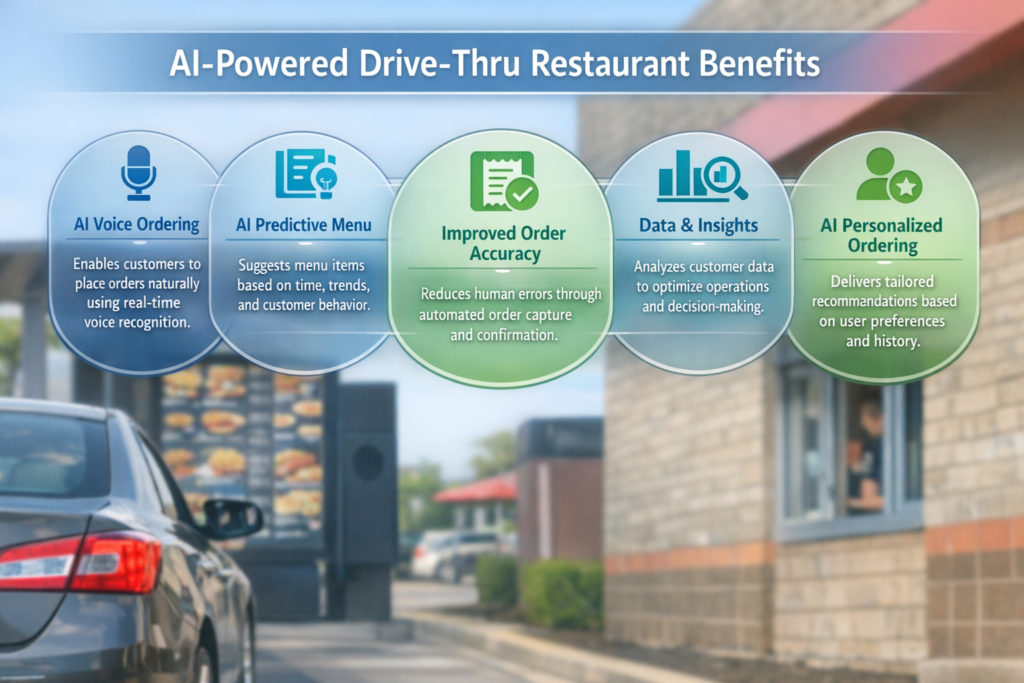
One of the most impactful ways AI is improving drive-thru operations is through automated voice ordering systems.
Current Pain Point
At most drive-thrus:
- Staff take orders through headsets
- Noise from traffic causes miscommunication
- Accents or fast speech create wrong orders
- Restaurants need 1–2 employees only for order taking
AI Solution
AI voice assistants listen to customers and automatically process orders in real time.
Example flow:
- Car stops at speaker
- AI greets the customer
- Customer speaks order naturally
- AI confirms the order
- Order goes directly to the kitchen POS
Why AI is Required
Traditional systems cannot understand natural speech, handle different accents, or correct incomplete orders. AI uses speech recognition and natural language processing to solve these problems.
Companies like IBM, Google, and Presto Automation are already working on such systems.
AI Predictive Menu (Dynamic Menu Boards)
AI is also transforming how menus are displayed in drive-thru systems.
Current Pain Point
Menu boards show the same items to everyone, even though:
- Morning customers prefer coffee
- Evening customers prefer burgers
- Weather affects demand
Example:
Rain → more coffee
Hot weather → more cold drinks
AI Solution
AI analyzes:
- Time of day
- Weather
- Past sales data
- Current queue
Menus automatically adjust based on this data.
Example:
- Morning → coffee combos highlighted
- Evening → burger meals promoted
Why AI is Required
Traditional systems cannot predict demand patterns. AI learns from large datasets and adjusts menus in real time.
Improving Order Accuracy with AI
AI Camera Order Verification
Current Pain Point
Wrong orders happen frequently.
Example:
Customer orders: 2 burgers, fries, coke
But receives: 1 burger, fries, coke
This leads to refunds, unhappy customers, and slower service.
AI Solution
AI-powered cameras verify orders before handing them to customers.
The system compares:
- Order data
- Actual items on the tray
If there is a mismatch, staff are alerted instantly.
Why AI is Required
Only computer vision AI can automatically recognize food items and reduce such errors.
Reduced Communication Errors
Drive-thru environments can be noisy, and communication between customers and staff may not always be perfect. AI systems process orders digitally, reducing miscommunication.
Automated Order Confirmations
AI systems repeat the order back to customers, allowing them to confirm or correct it before it reaches the kitchen.
Digital Order Processing
Orders are directly converted into digital entries, removing manual errors.
Reduced Food Waste
Accurate orders ensure correct preparation, reducing waste and improving efficiency.
How AI Improves Restaurant Staff Efficiency
AI Queue Management
Current Pain Point
Drive-thru lines become long and difficult to manage. Restaurants cannot predict order time or queue flow.
AI Solution
AI analyzes:
- Number of cars
- Order complexity
- Kitchen load
- Preparation time
It helps optimize lane flow, manage rush hours, and improve overall efficiency.
Some restaurants are also testing AI-powered dual-lane systems.
AI Handling Repetitive Tasks
AI handles routine tasks like order taking and menu guidance, reducing staff workload.
Staff Focusing on Customer Experience
Employees can focus more on food quality and service.
Improved Workflow Coordination
Orders move instantly from ordering systems to the kitchen, improving speed and coordination.
Data and Insights from AI Systems
AI Demand Forecasting
Current Pain Point
Restaurants often face sudden rush hours, food shortages, or over-preparation.
AI Solution
AI predicts demand 30–60 minutes in advance.
This allows restaurants to:
- Prepare ingredients early
- Pre-cook high-demand items
- Allocate staff efficiently
Understanding Customer Preferences
AI identifies frequently ordered items to help improve menus.
Identifying Peak Hours
Restaurants can prepare better for busy times.
Tracking Menu Performance
AI helps identify top-performing and underperforming items.
Improving Operational Efficiency
These insights help optimize staffing, inventory, and service speed.
AI Personalized Ordering
Current Pain Point
Restaurants do not recognize repeat customers, so every order starts from zero.
AI Solution
AI uses:
- Loyalty programs
- Mobile apps
- License plate recognition
to identify returning customers.
Example:
“Welcome back. Would you like your usual order?”
This improves customer experience and increases repeat orders.
AI Fraud Detection
Restaurants can lose revenue due to fake refunds, order manipulation, or internal misuse.
AI helps detect:
- Unusual refund patterns
- Suspicious employee activity
- Abnormal order edits
This improves operational security and reduces losses.
Future of AI in Drive-Thru Restaurants
AI technology in the restaurant industry is evolving quickly. In the coming years, drive-thru systems will become even more advanced.
Future systems may include fully automated drive-thrus where:
- AI takes orders
- AI processes payments
- AI verifies food
- AI supports kitchen automation
This can reduce operational costs by up to 30–40% while improving speed and consistency.
Restaurants may also offer highly personalized experiences and smarter analytics for better decision-making.
Real-World Adoption
A real-world example is Wendy’s, which tested AI voice ordering in drive-thrus. The result was faster service, reduced staff workload, and improved order accuracy.
How Triple Minds Helps Restaurants Implement AI
At Triple Minds, we work closely with restaurant brands to turn traditional drive-thru systems into intelligent, automated workflows. Instead of adding disconnected tools, we build AI solutions that fit directly into your existing operations.
Our approach focuses on solving real operational challenges like long queues, order inaccuracies, and high staff dependency. We develop AI voice ordering systems that can take and process orders in real time, reducing communication gaps and improving speed.
We also help restaurants implement smart automation across the workflow, from order capture to kitchen coordination. This ensures that orders move instantly to the right systems without delays.
Beyond automation, we integrate AI with your existing POS, kitchen display systems, and customer platforms, so everything works as one connected ecosystem. This not only improves efficiency but also gives you better visibility into your operations.
Our solutions are built to handle high-volume environments, helping restaurants serve more customers without compromising accuracy or experience.
Conclusion
AI is transforming drive-thru restaurants by making them faster, more accurate, and easier to manage at scale. From automated ordering to smarter decision-making, it helps businesses handle growing demand without compromising customer experience. For restaurants looking to stay competitive, adopting AI is becoming a practical step toward more efficient and scalable operations.
Quick Answers to Common Questions
AI in drive-thru restaurants uses voice recognition, natural language processing, and automation to take orders, process requests, and improve service speed.
AI is designed to assist staff rather than replace them. It automates repetitive tasks so employees can focus on food preparation and customer service.
AI speeds up order taking, predicts popular menu items, and helps restaurants prepare food more efficiently during busy hours.
Yes. AI systems confirm orders automatically and convert voice requests into digital orders, reducing communication errors.
The cost varies depending on the system, but many restaurants see long-term benefits such as faster service, lower operational costs, and improved customer satisfaction.
Yes. AI can recommend menu items, promote combos, and personalize suggestions, which can increase the average order value.
Common technologies include voice AI, natural language processing, machine learning, predictive analytics, and automated ordering systems.
Restaurants can partner with AI solution providers to implement voice ordering systems, automation tools, and data analytics platforms.
Table of Content
- What Is AI in Drive-Thru Restaurants?
- How Technology Enables Smart Drive-Thru Systems
- How a Drive-Thru Restaurant Works
- When Drive-Thru Success Becomes Difficult to Manage
- Why Drive-Thru Restaurants Are Adopting AI
- AI Voice Ordering (Replacing Manual Order Taking)
- AI Predictive Menu (Dynamic Menu Boards)
- Improving Order Accuracy with AI
- How AI Improves Restaurant Staff Efficiency
- Data and Insights from AI Systems
- AI Personalized Ordering
- AI Fraud Detection
- Future of AI in Drive-Thru Restaurants
- Real-World Adoption
- How Triple Minds Helps Restaurants Implement AI
- Conclusion
- Quick Answers to Common Questions