How to Chat with Your Own Database Using AI
This guide explains how AI-powered chatbots can connect directly to databases, allowing users to ask questions in plain language and receive accurate, real-time insights without complex queries or dashboards.

Published Date: February 10, 2026
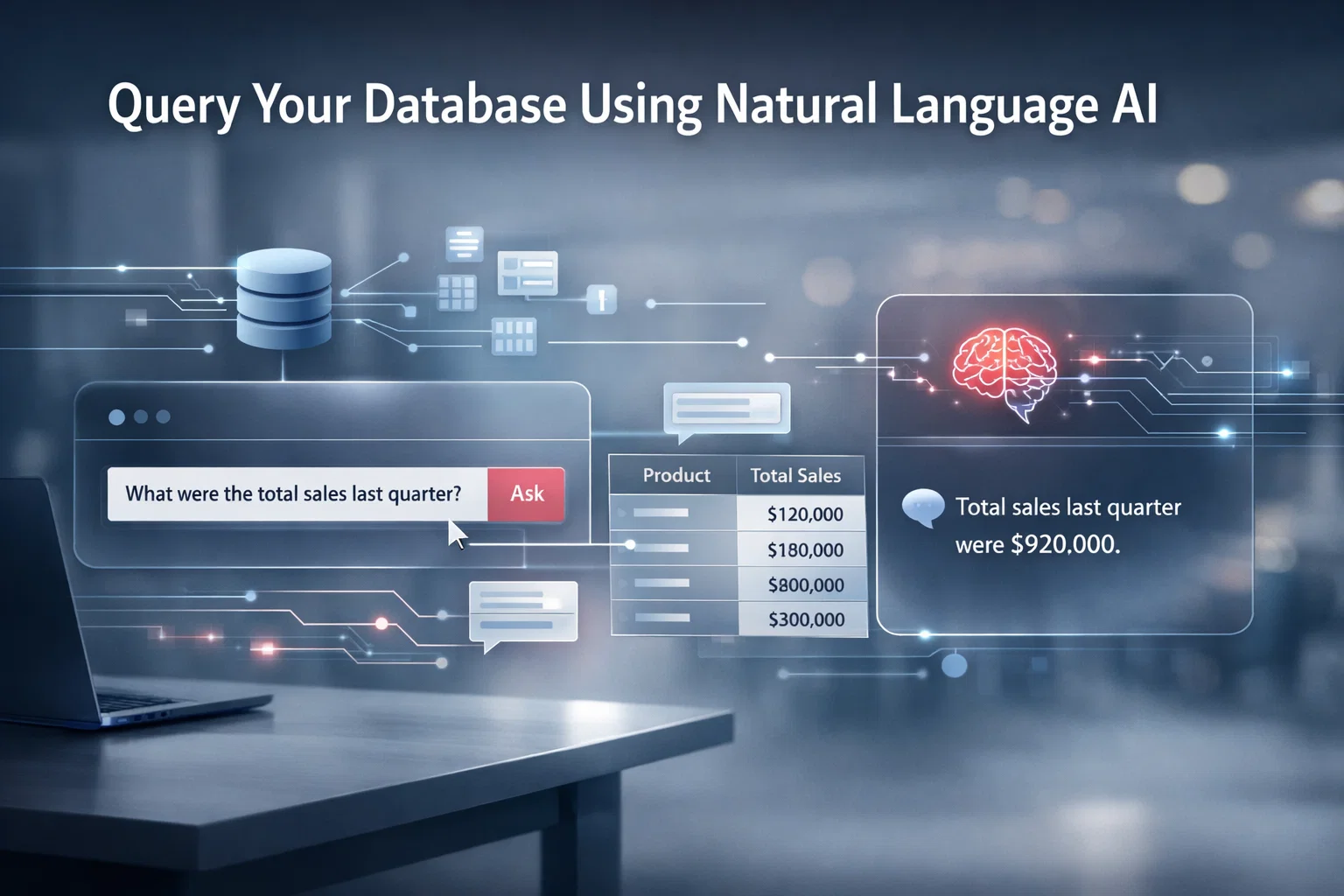
Most businesses today collect a huge amount of data, from sales and customer interactions to marketing performance and financial records. Yet having data doesn’t automatically lead to better decisions. Research shows that nearly 55% of enterprise data is stored but never used, and close to 68% of available business data goes underutilized simply because it’s hard to access, fragmented across systems, or too technical to interpret. While this data sits inside databases and analytics platforms, very few leaders can interact with it directly, something that modern tools like database chatbots are beginning to change.
At the same time, 80% of business leaders say data is critical for decision-making, yet many still struggle to act on it. Insights are locked behind dashboards, reports, and technical tools that require analysts or data teams to interpret. Instead of getting quick answers to everyday questions, what worked? Where did customers drop off? What should we change next?
Leaders are forced to wait, guess, or rely on incomplete information. This gap between having data and actually using it is where many organizations get stuck. Data becomes something that exists in the background rather than something leaders and non-technical teams can actively engage with. This is exactly where a database chatbot, capable of answering questions in plain English, can bridge the gap between raw data and real decisions. By enabling users to ask questions directly to their databases through a conversational interface, database chatbots make data accessible, actionable, and decision-ready, without complex dashboards or SQL queries. Just answers.
At Triple Minds, we build database chatbot solutions that connect directly to your existing data systems and translate natural language questions into real-time insights. Leaders don’t need to “learn data” – they simply talk to it, explore trends, uncover gaps, and make confident decisions based on live business data.
Looking to Chat With Your Own Data Using AI?
Connect with Triple Minds to see how AI-powered database chatbots enable teams to query complex data in plain language—without dashboards, SQL, or manual reporting.
Start Your AI-Driven Data Interaction Journey Today.
Key Takeaways
- Most businesses already have valuable data, but traditional SQL databases make it difficult for non-technical teams to access insights.
- Business users often depend on analysts or engineers to run queries, which slows down decision-making and limits data usage.
- AI-powered database chatbots allow users to ask questions in plain English and receive accurate answers directly from their databases.
- Text-to-SQL technology removes the need for SQL knowledge while preserving data accuracy and reliability.
- Public AI chatbots are not suitable for confidential business data due to security and compliance risks.
- A private, securely deployed database chatbot ensures full data ownership, access control, and data privacy.
- Chatting with your database helps teams make faster, more confident, data-driven decisions.
- AI database chatbots can be used across departments such as sales, marketing, operations, finance, and leadership.
- Organizations can connect conversational AI to various data sources, including SQL databases, CRM systems, and ERP platforms.
The Core Problem: Why Traditional Databases Block Business Insights
Traditional databases were created for technical teams, not for everyday business users. They are very good at storing and organizing large amounts of information, but they are not designed to help managers or leaders easily find answers. As a result, important business data often stay locked away, even though it holds valuable insights.
For technical teams, this may be normal. For non-technical roles such as marketing managers, operations leaders, finance teams, and executives, it creates a constant challenge. These teams need fast answers to make decisions, but they cannot easily access the data on their own.
Because of this, organizations face several problems:
- Simple questions take too long to answer
- Business teams must wait for reports or dashboards
- Data teams become overloaded with requests
- Many useful questions are never asked
Over time, this leads to slow decision-making. Instead of using real data, teams start relying on assumptions, experience, or incomplete information. This limits growth and reduces the value of the data the business already owns.
The real issue is not the amount of data or the quality of tools. The problem is that traditional databases are not built for how business people think, ask questions, or make decisions.
The Hidden Cost of Inaccessible Data
Most businesses collect large amounts of data every day. This data holds valuable information that can guide better decisions, improve performance, and support growth. However, when this data is difficult to access, it becomes a hidden problem that affects the entire organization.
When teams cannot easily get answers from data, decision-making slows down. Leaders are forced to wait for reports or depend on others to pull out information. In fast-moving business environments, these delays can be costly. By the time insights are available, the opportunity to act may already be gone.
When data is hard to access, businesses face several challenges:
- Decisions take longer than necessary
- Teams rely on assumptions instead of real data
- Growth opportunities are missed
- Past data remains unused and forgotten
Over time, this creates a pattern where people stop asking questions altogether. If getting answers feels difficult or time-consuming, curiosity fades. Teams begin to operate based on habits and opinions rather than facts.
Most organizations already have years of stored data that could offer powerful insights, such as:
- Which strategies delivered the best results
- Why customers stopped engaging or buying
- Where costs increased without clear returns
- Which channels supported long-term growth
Yet, because this data is locked behind technical tools, it rarely gets explored. Instead of learning from past performances, businesses often repeat the same mistakes.
The real cost of inaccessible data goes beyond slow reporting. It leads to missed learning, weaker decisions, and limited growth. Making data easier to access allows teams to move faster, ask better questions, and use information they already own to make smarter, more confident business decisions.
What Does It Mean to Chat with Your Database?
Chatting with your database means interacting with structured data using natural language.
An AI-powered text-to-SQL system allows users to ask questions in plain English. The system automatically:
- Understands the intent of the question
- Converts it into a SQL query
- Executes the query securely
- Returns results in a readable format
The complexity of the database remains hidden, while insights become accessible to everyone.
How to Chat With Your Own Database – Step-by-Step Guide
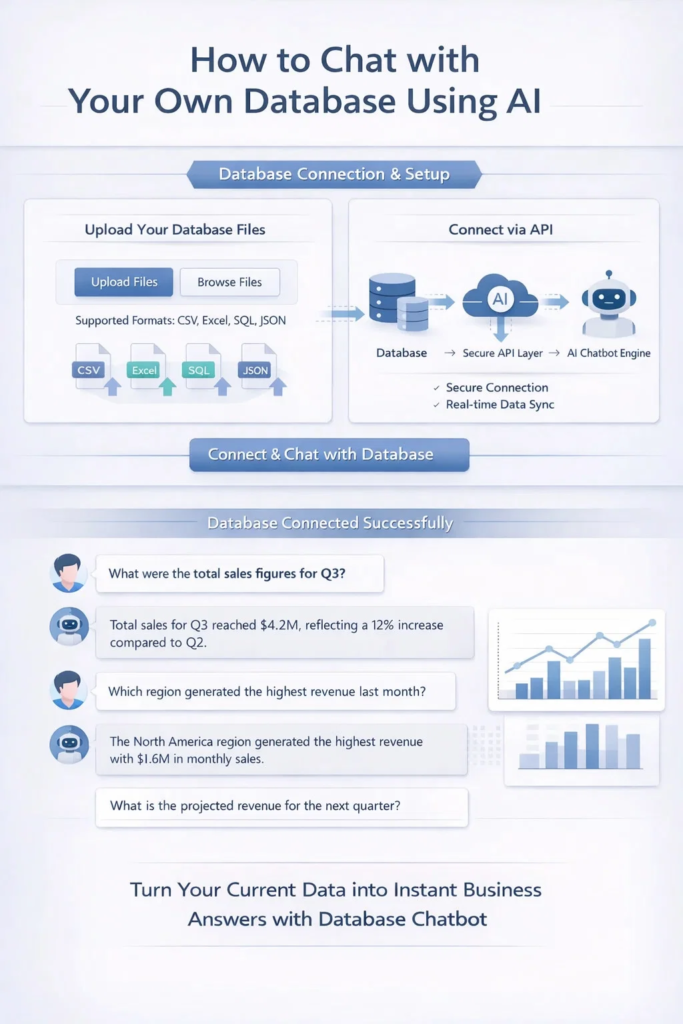
Scenario 1: Upload Your Database into the Chatbot
If your data already exists in Excel, CSV files, or exported reports, you can upload it directly into the chatbot. If it doesn’t, you’ll first need to export it from your system.
Step 1: Download your database
Export your data from your system into commonly used formats such as Excel (XLS/XLSX), CSV, Google Sheets, PDF reports, or JSON files. These formats are easy to upload and work well for analysis.
Step 2: Upload the file into our database chatbot
Once downloaded, simply upload the files into the data base chatbot. The system automatically reads, structures, and understands your data – no manual setup required.
Step 3: Start asking questions in plain English
You can now interact with your data naturally. Ask questions like:
Example Query:
“What were our total sales last quarter?”
What you get: A clear sales summary with total revenue, quarter-wise breakdown, and key trends—ready to understand briefly.
Example Query:
“Which products are performing the best?”
What you get: A ranked list of top-performing products with revenue contribution and growth indicators.
Scenario 2: Connect Your Database Directly with Us (Using Secure APIs)
For real-time and ongoing insights, we connect your live database to a private AI layer using secure APIs. An API (Application Programming Interface) acts as a safe bridge that allows the AI to fetch only the required data – without downloading or moving it.
Step 1: Connect your systems via APIs
We integrate your CRM, ERP, SQL databases, or data warehouses through secure APIs. Your data stays in your system while the AI accesses it in real time.
Step 2: Set access and permissions
API access is controlled with clear permission rules, ensuring each team can only view the data they are authorized to see.
Step 3: Start chatting with live data
Once connected, teams can ask questions in plain English and get instant answers based on the latest data.
Example Query:
“What does our sales pipeline look like today?”
What you get: A real-time pipeline view showing deal stages, total value, and key risks.
Example Query:
“Which customers are likely to churn?”
What you get: A focused list of at-risk customers with behavior signals and recommended actions.
How Database Chatbots Are Different from General AI Chatbots
Database chatbots are built for precision and control, not casual conversation. Unlike general AI chatbots that generate answers from broad training data, database chatbots connect directly to your live business databases and respond strictly based on real, structured data.
Triple Minds designed database chatbots to understand business intent, convert natural language into secure queries, and deliver accurate, traceable outputs like reports, charts, and metrics. This makes them ideal for decision-makers who need reliable insights, not assumptions or generic AI responses.
Business Benefits of Chatting with Your Own Database
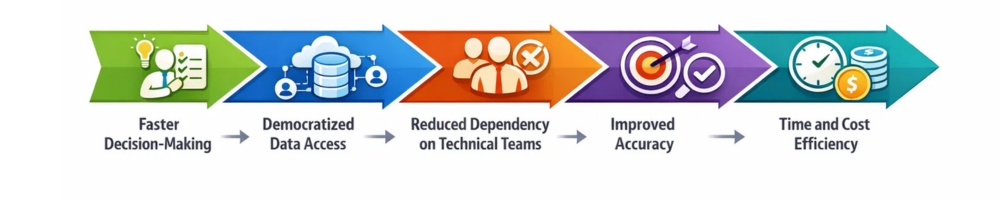
Faster Decision-Making: Leaders can ask questions in natural language and get answers in seconds. This removes delays caused by manual reporting and back-and-forth with data teams. Decisions are made while opportunities are still hot.
Democratized Data Access: Employees no longer need SQL or BI tools to explore data. Anyone can ask questions and receive clear, contextual answers. This creates a more data-driven culture across the organization.
Reduced Dependency on Technical Teams: Routine data requests no longer consume engineering or analytics bandwidth. Technical teams can focus on high-value initiatives instead of ad-hoc queries. This improves productivity and morale across teams.
Improved Accuracy: Insights are pulled directly from live databases rather than static reports. This minimizes human error and eliminates outdated assumptions. Teams operate with a single source of truth.
Time and Cost Efficiency: Organizations reduce the need for multiple dashboards and reporting tools. Less manual effort means faster insights at lower operational cost. Overall data workflows become simpler and more scalable.
Industry and Department-Wise Use Cases
How Sales Teams Can Chat With Their Database
Sales leaders can instantly track pipeline health, deal velocity, and win-loss trends. Sales representatives can ask questions about account activity or performance gaps. This enables faster course correction and better forecasting.
How Marketing Teams Can Use Database Chatbots for Better Decisions
Marketers can evaluate campaign performance, channel ROI, and lead quality in real time. Questions that once required dashboards can be answered conversationally. This helps optimize spend and messaging quickly.
How Operations Teams Can Chat With Operational Database
Operations managers can identify bottlenecks, delays, and inefficiencies as they happen. Real-time visibility supports proactive issue resolution. This leads to smoother workflows and lower operational costs.
Data Base Chatbot For Finance Teams
Finance leaders can monitor budgets, revenue trends, and cash flow on demand. Forecasts become more accurate with live data access. This improves financial planning and risk management.
How Executive Leaders Can Chat With Company-Wide Data
Executives can ask high-level questions and get immediate, trustworthy insights. There’s no need to wait for reports or presentations. This supports faster strategic decision-making.
Types of Databases You Can Chat With
AI database chatbots can connect to a wide range of data sources, including:
- SQL databases (MySQL, PostgreSQL, MS SQL Server)
- CRM and ERP systems
- Sales and revenue databases
- Analytics and reporting databases
SQL Databases (MySQL, PostgreSQL, MS SQL Server) store customer data, orders, payments, and business records. CRM and ERP systems store customer information, sales activities, finance data, and internal employee processes. Sales and revenue databases store revenue details, pricing data, sales transactions, and product performance. Analytics and reporting databases store summarized data used for performance tracking and business reports.
Chat With Your Own Database Without Compromising Security Using Triple Minds
Public AI tools are not built to handle sensitive enterprise data. A safer approach is using a private, customized AI solution where data stays within your environment and remains fully under your control. With a secure, private database chatbot, teams can query their own SQL databases and structured data using natural language, without exposing information to public models. This makes data access faster and easier for both technical and non-technical users, while still meeting enterprise security and compliance requirements. These systems are designed, so data never leaves your infrastructure; models do not train your data, and access is strictly controlled through encryption and role-based permissions. Built-in monitoring and governance provide full visibility into how data is accessed and used.
This is the exact approach implemented by Triple Minds. Backed by experienced industry professionals, we build private, enterprise-grade AI database chat solutions tailored to each organization’s needs. We’ve already helped teams securely connect their databases, deploy customized AI tools, and start chatting with their data – without compromising security. The result is a practical, secure way to unlock insights from your own data, using AI that’s built specifically for enterprise use, not public experimentation.
Final Thoughts
Most businesses already have the answers they need. Those answers are stored in databases but locked behind technical barriers. AI-powered database chatbots remove those barriers, allowing teams to ask questions naturally and make faster, more confident decisions. When implemented securely, chatting with your database turns data into a strategic advantage.
Triple Minds helps organizations securely chat with their SQL databases using AI. If you want to explore how conversational access to data can work for your business, book a call with Triple Minds and discover the insights hidden inside your data.
FAQs
Yes, you can ask questions in plain English, and the system automatically converts them into SQL in the background. No technical knowledge or query writing is required.
Yes, if it’s built privately and securely. Uploading business data to public or third-party AI tools can risk data leaks and loss of control. A private text-to-SQL chatbot runs within your own secure environment, keeps data confidential, and never shares or trains your information, making it safe for business use.
Yes. A single database chatbot can be connected to multiple SQL databases, CRM systems, ERP platforms, and analytics data sources, providing a unified conversational interface across systems.
Table of Content
- Key Takeaways
- The Core Problem: Why Traditional Databases Block Business…
- The Hidden Cost of Inaccessible Data
- What Does It Mean to Chat with Your…
- How to Chat With Your Own Database – Step-by-Step Guide
- How Database Chatbots Are Different from General AI…
- Business Benefits of Chatting with Your Own Database
- Industry and Department-Wise Use Cases
- Types of Databases You Can Chat With
- Chat With Your Own Database Without Compromising Security Using Triple…
- Final Thoughts
- FAQs