How Long Does It Take to Implement Voice Search AI Integration?
Voice Search AI integration doesn’t happen overnight. From planning and technology selection to API integration, testing, and optimization, the timeline depends on your business goals and technical complexity. Here’s what to realistically expect before launching a fully functional voice-enabled experience.

Published Date: February 18, 2026
Voice search is no longer a next-generation concept – it’s already here. The real question is no longer whether you should adopt it. The real challenge is how to deliver a voice search experience that is faster, smarter, and better than anyone else in your market.
Today, smart businesses are using voice AI to improve user experience, increase accessibility, and respond to customers faster. It’s becoming a competitive advantage, not just a technical feature. If your competitors are optimizing conversational queries and you’re not, you’re already behind. Voice search is now a standard expectation in modern digital experiences – and the focus has shifted from adoption to optimization. As of 2026, voice AI search has evolved from a convenience feature into a significant segment of global search behavior.
While traditional typing remains dominant for detailed or complex tasks, voice-based interactions now account for around 20% – 50% of overall searches globally, with significantly higher adoption on mobile devices and smart assistants. In fact, billions of voice-enabled devices are active worldwide, and conversational queries continue to grow as users prioritize speed, convenience, and hands-free access. Voice AI search is especially prominent in local searches, quick information queries, navigation, and transactional intents. The shift is not about replacing text-based search entirely it’s about expanding how users access information. As conversational AI improves in accuracy and contextual understanding, voice is becoming a stable and influential layer of modern search behavior rather than just an experimental trend. Users ask complete questions like, “Which agency offers AI-powered SEO services near me?” rather than typing fragmented keywords. This change directly impacts SEO strategy, structured data implementation, and content architecture.
Voice Search AI integration enables websites, applications, and digital platforms to listen, understand intent using Natural Language Processing (NLP), and respond with precise, context-aware answers. It is not a simple feature addition it is a layered integration that connects speech recognition, AI models, backend systems, and search optimization frameworks. At Triple Minds, we approach voice search AI integration as a strategic digital growth initiative. Our focus is not just implementation, but aligning voice technology with long-term search visibility, Answer Engine Optimization (AEO), and enhanced user experience. As conversational search continues to expand, businesses must build scalable, future-ready voice capabilities into their digital ecosystem to stay competitive.
Want to Integrate Voice Search AI the Right Way?
Transform your digital presence with advanced Voice Search AI integration that strengthens visibility, improves user experience, and positions your brand as the trusted answer in AI-driven search environments. Move beyond traditional SEO and build a smarter, future-ready search ecosystem today.
Start Your Voice Search Optimization Today
Key Takeaways
- Voice search now accounts for a significant share of global searches and is no longer an experimental feature.
- Implementation timelines range from 2 weeks to 16+ weeks depending on project complexity.
- Clean infrastructure and structure data can significantly speed up deployment.
- Voice AI integration combines speech recognition, NLP, intent matching, and backend connectivity.
- Conversational SEO and featured snippet optimization are critical for voice visibility.
- ROI often appears first through operational efficiency and reduced support costs.
- Costs vary widely based on customization, integrations, and enterprise requirements.
- Businesses that adopt voice strategically position themselves for AI-driven discovery and future search behavior.
What Is Voice Search AI Integration?
Voice Search AI Integration is the process of adding intelligent voice capabilities to your digital platforms so users can search, ask questionns, and interact using natural speech instead of typing. Instead of clicking through menus or entering short keywords, users simply speak – and the system understands, processes, and responds in real time.
At its core, voice AI integration combines speech recognition and Artificial Intelligence. First, speech recognition technology converts spoken words into text. Then, AI and Natural Language Processing (NLP) analyze the meaning behind those words – not just the exact phrasing, but the intent. This allows the system to respond accurately, even if different users ask the same question in different ways.
Voice Search AI integration can appear in several forms across a business ecosystem. It may include voice-enabled search bars on websites, AI-powered assistants within mobile apps, integrations with smart assistants like Alexa, Google Assistant, or Siri, voice-driven customer support systems, or even automated AI call handling solutions. Unlike traditional search, which relies heavily on specific keywords, voice AI understands context, conversational tone, and follow-up queries.
For example, a user might ask, “What are your service packages?” and then follow up with, “Which one is best for small businesses?” The system connects both questions naturally.
In simple terms, voice search AI shifts digital interaction from typing keywords to having conversations – creating faster, more intuitive, and more human-like user experiences.
You Might Also Find This Useful: How Much Does It Cost to Build an AI Agent?
How Does Voice Search AI Integration Work?
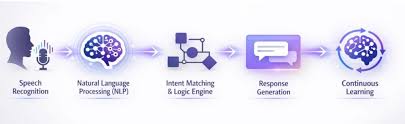
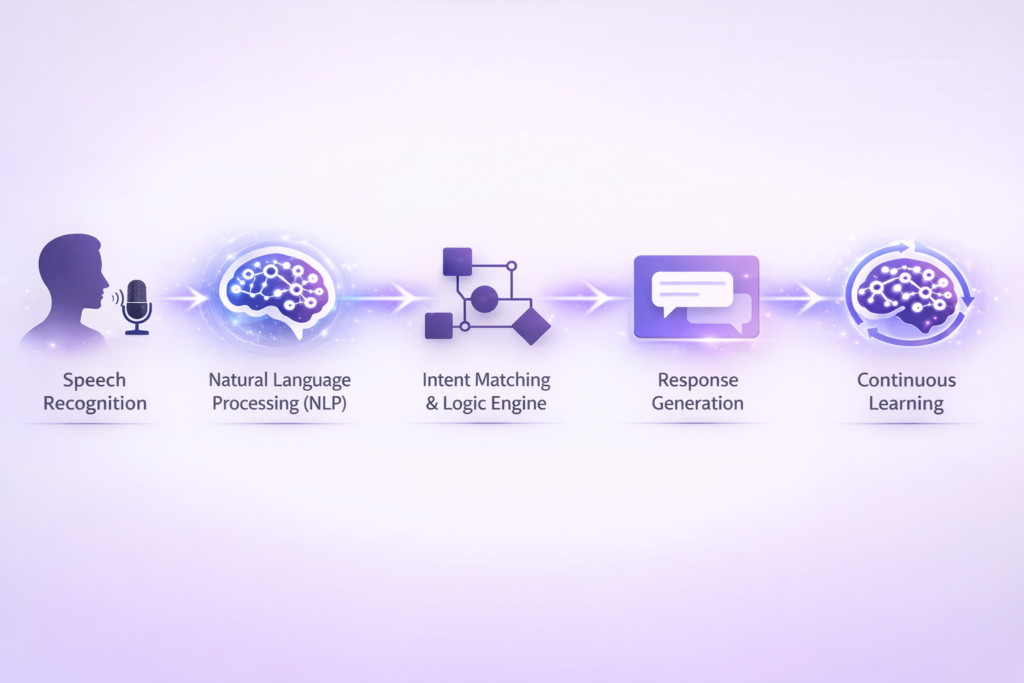
Voice search AI may sound complex, but the process behind it follows a clear and logical flow. It works through multiple connected layers that allow the system to listen, understand, and respond intelligently.
1. Speech Recognition
The first step is listening. When a user speaks, the system uses speech recognition technology to convert spoken words into text. This step ensures the AI accurately captures what was said, even with different accents, speeds, or pronunciations.
2. Natural Language Processing (NLP)
Once the speech is converted into text, NLP takes over. This is the “brain” of the system. Instead of just reading the words literally, NLP analyzes the meaning behind them. It understands intent, context, tone, and even variations in phrasing. For example, “Find me a nearby SEO agency” and “Which SEO company is close to me?” mean the same thing – and NLP recognizes that.
3. Intent Matching & Logic Engine
After understanding the query, the system identifies the user’s intent. It then matches that intent to the correct action – whether that means retrieving information from a database, triggering a workflow, or displaying specific results.
4. Response Generation
The system prepares a response. This could be text displayed on a screen, a spoken answer through text-to-speech, or even an automated system action like booking an appointment.
5. Continuous Learning
Modern voice AI systems improve over time. They analyze user behavior, repeated queries, and interaction patterns to refine accuracy and make responses more relevant.
At the core of all these layers is NLP, which enables the system to move beyond simple keyword matching and truly understand conversations – making interactions feel natural, fast, and human-like.
How Long Does It Take to Implement Voice Search AI Integration?
There isn’t a single fixed timeline for voice search AI integration. The duration depends on how complex your systems are, what you want the voice assistant to do, and how prepared your infrastructure already is. A simple voice-enabled search bar is very different from a fully automated, AI-driven conversational ecosystem.
To make it easier to understand, here’s a estimated structured breakdown:
1. Small-Scale Projects (2-4 Weeks)
This is ideal for small businesses or informational websites that want basic voice functionality. For example, adding a voice-enabled search button that allows users to speak instead of type.
Typically, this includes integrating a speech-to-text API, setting up simple NLP intent recognition, building limited conversational flows (like FAQs), and running initial testing. If your backend systems are already structured and organized, implementation is relatively fast.
2. Mid-Level / Growth Stage Projects (4-8 Weeks)
At this stage, voice AI becomes more interactive. Ecommerce stores, SaaS platforms, and service businesses often fall into this category.
Here, the system must handle multiple intents, connect with product databases or service catalogs, integrate with CRM systems, and optimize structured data. Conversational flows become more advanced, and testing becomes deeper to ensure accuracy.
3. Enterprise-Level Voice AI Integration (8-16+ Weeks)
Enterprise projects are more complex because voice AI connects with multiple operational systems. This often includes advanced NLP modeling, multilingual capabilities, personalization layers, deep CRM/ERP integration, security validation, and compliance checks.
For industries like healthcare or fintech, additional regulatory layers increase the timeline.
4. AI-Driven Conversational Ecosystem (16+ Weeks)
This goes beyond integration – it becomes digital transformation. Organizations implementing omnichannel voice systems, AI-powered automation, smart device ecosystems, and personalized voice commerce fall into this category.
Voice AI becomes embedded across customer support, marketing, operations, and sales.
What Determines the Timeline?
Several factors influence speed:
- How organized your technical infrastructure is
- Whether APIs are ready for integration
- Clean and structured data availability
- Complexity of conversational design
- Multilingual requirements
- Compliance and security layers
- Level of AI customization needed
Projects slow down when backend systems are fragmented or content is unstructured. The cleaner your data and systems, the faster voice AI can be deployed. In short, voice search AI integration can take a few weeks or several months – depending on how deeply you want voice embedded into your digital ecosystem.
Ready to Lead in Voice Search AI?
Get a detailed cost estimate and ROI projection for your Voice Search AI integration project. Free consultation with our experts.
Request Your Custom StrategyHow Much Does Voice Search AI Integration Cost?
The investment required for voice search AI integration varies based on project scope, system complexity, and customization level. While there is no one-size-fits-all pricing, below are general industry estimates to help businesses understand the typical investment range. Actual investment depends on infrastructure readiness, integration depth, and customization requirements.
Estimated Market Investment Range
| Project Type | Estimated Investment (USD) | Best For | Scope Level |
| Foundational Integration | $3,000 – $10,000 | Small businesses, basic websites | Entry-Level |
| Growth-Level Integration | $10,000 – $35,000 | Ecommerce, SaaS, service platforms | Moderate |
| Enterprise Integration | $35,000 – $150,000+ | Large enterprises, regulated industries | Advanced |
| Ongoing Monthly Costs | Usage-Based | All project types | Continuous |
Foundational Integration ($3,000 – $10,000)
This includes basic speech-to-text API integration, simple NLP intent mapping, and limited conversational flows such as FAQ responses or voice-enabled search bars.
Growth-Level Integration ($10,000 – $35,000)
This tier involves custom NLP configuration, backend database integration, CRM connectivity, structured data optimization, and multi-intent conversational handling.
Enterprise-Level Integration ($35,000 – $150,000+)
Enterprise projects require advanced AI modeling, multilingual support, compliance validation, ERP/CRM integration, personalization layers, and scalability testing.
Ongoing Costs
Beyond implementation, businesses should budget for:
- API usage fees (based on voice query volume)
- Cloud infrastructure
- AI model refinement
- Monitoring and maintenance
What Kind of Businesses Benefit from Voice Search AI Integration?
Voice search isn’t limited to tech companies or large enterprises. It benefits any business where users search, ask questions, book services, or make decisions quickly. The key advantage is speed and convenience – users get answers without friction.
1. Ecommerce
In ecommerce, voice AI simplifies product discovery and purchasing decisions. Instead of typing filters manually, users can simply say:
“Find eco-friendly running shoes under $100.”
The AI instantly filters products based on price, category, and attributes. Voice can also support order tracking, stock checks, and personalized product recommendations.
For online stores, this reduces search friction and improves conversion rates by making product discovery conversational and intuitive.
2. SaaS Platforms
For SaaS businesses, voice AI improves user experience inside the platform. Users can navigate features, access documentation, or request help using natural speech.
For example:
“Show me how to integrate this tool with Salesforce.”
Instead of searching help articles manually, the system guides them directly. Voice AI can also assist during onboarding, reducing support tickets and improving user retention.
3. Healthcare
Healthcare platforms can use voice AI for appointment booking, service location queries, and general symptom guidance. Patients can ask simple questions and get quick responses, improving accessibility – especially for elderly users.
4. Financial Services
Banks and fintech companies can use voice AI for loan eligibility checks, account information, or product comparisons. Secure, conversational access improves customer convenience while reducing call center load.
5. Local & Multi-Location Businesses
Voice is extremely powerful for local discovery.
Users commonly ask:
- “Find the nearest branch.”
- “Are you open today?”
- “Do you offer same-day service?”
Voice integration improves visibility in local search environments and helps businesses capture high-intent queries.
How Voice Search Impacts Digital Marketing
Voice search doesn’t just change technology – it reshapes digital marketing strategy.
1. Conversational SEO
Content must answer real-world questions, not just target keywords. People speak differently than they type.
2. Featured Snippet Optimization
Voice assistants often pull answers from concise, well-structured content blocks. Clear summaries matter more than ever.
3. Local Search Visibility
A large percentage of voice searches are location-based. Optimizing Google Business Profiles and structured data becomes critical.
4. Entity Optimization
AI systems rely on structured brand signals – consistent business information, schema markup, and authority signals.
5. Reduced Click Dependency
Sometimes users get answers directly from voice assistants without visiting a website. That means brand presence and structured visibility matter even beyond traffic.
Voice AI pushes digital marketing toward clarity, structured data, topical authority, and conversational relevance. It aligns closely with Generative AI Optimization and AI-driven discovery models.
Common Mistakes That Delay Voice Search AI Integration
When businesses decide to implement voice search AI integration, delays often occur not because of technology limitations, but due to poor planning and unclear execution strategies.
| Issue | Explanation |
|---|---|
| Neglecting conversational search behavior | Ignoring how users naturally speak and ask questions in voice search can lead to irrelevant or poorly matched responses. |
| Overlooking Natural Language Processing (NLP) optimization | Voice search depends on understanding context and user intent. Without intent-focused and question-based content, accuracy and performance decrease. |
| Poor content structuring | Not organizing content with proper semantic structure, FAQs, and structured data makes it harder for AI to understand and respond correctly. |
| Technical misalignment during integration | If API compatibility, server setup, or scalable infrastructure are not ensured, it can cause system conflicts and project delays. |
| Underestimating data training requirements | AI models need clean, labeled, and structured data. Poor data preparation reduces accuracy and slows development. |
| Inadequate infrastructure planning | Without scalable architecture, voice AI systems may face performance issues as user traffic increases. |
| Lack of cross-team coordination | Poor communication between SEO teams, developers, and AI engineers can cause confusion and longer project timelines. |
| Unclear execution strategy | Without clear goals, milestones, and performance benchmarks, the implementation process can lose direction and delay launch. |
Measuring ROI After Implementation
Voice search ROI is not just about traffic – it’s about efficiency and experience.
Key performance indicators include:
- Voice query success rate
- Task completion rate
- Customer support cost reduction
- Improved engagement
- Assisted conversions
- AI-driven brand visibility
Many businesses see operational ROI first reduced support costs and faster customer interactions – before direct revenue impact becomes visible.
The Triple Minds Approach
At Triple Minds, we treat voice AI integration as part of a broader AI visibility and digital authority strategy. The objective isn’t just enabling voice interaction — it’s ensuring your brand is understood, trusted, and surfaced across conversational search environments, powered by advanced AI model training techniques.
Businesses that integrate voice strategically today are not just improving user experience – they are positioning themselves for the next evolution of AI-driven discovery.
FAQs
Voice search AI integration involves adding speech recognition APIs, connecting NLP models to process user queries, and configuring the backend to deliver accurate voice-based responses. Proper SEO structuring and conversational content optimization are also essential.
AI analyzes conversational queries, user intent, and long-tail keywords to structure content in a natural Q&A format. This improves semantic relevance and increases chances of ranking in voice search results.
The timeline depends on data availability, your existing tech stack, API integrations, NLP training, security requirements, multilingual support, and testing phases. The more complex the setup, the longer the implementation takes.
Yes, voice AI can be added to existing websites, mobile apps, CRM systems, and eCommerce platforms using APIs and cloud-based AI services. It usually does not require rebuilding the entire system.
Yes, using third-party platforms like Google Cloud Speech-to-Text, Amazon Alexa, or Microsoft Azure Speech Services can significantly speed up development. They provide ready-made tools instead of building everything from scratch.
Custom models offer higher accuracy and better personalization but require more time and investment. API-based solutions are quicker to deploy and more cost-effective for most businesses.
Table of Content
- Key Takeaways
- What Is Voice Search AI Integration?
- How Does Voice Search AI Integration Work?
- How Long Does It Take to Implement Voice…
- What Determines the Timeline?
- Ready to Lead in Voice Search AI?
- How Much Does Voice Search AI Integration Cost?
- What Kind of Businesses Benefit from Voice Search…
- How Voice Search Impacts Digital Marketing
- Common Mistakes That Delay Voice Search AI Integration
- Measuring ROI After Implementation
- The Triple Minds Approach
- FAQs