What is a Database Chatbot and How Does it Work?
An AI database chatbot allows businesses to interact with their own databases using plain language instead of technical queries. It helps decision-makers access real-time insights, reduce dependency on analysts, and make faster, data-backed decisions across sales, finance, operations, and customer experience.

Published Date: January 31, 2026

In most organizations, valuable business data already exists inside databases — sales records, customer activity, operations data, finance numbers, product metrics, and more. Yet, as we have seen while working with startups and enterprises, this data often remains under-utilized because accessing it requires technical knowledge, SQL expertise, or dependency on analysts and IT teams.
We work closely with business leaders who face the same challenge: “We have the data, but getting answers takes too much time.” This is exactly where AI database chatbots are changing the way organizations interact with their own data.
Instead of writing queries or waiting for reports, teams can now ask questions to the database in plain English. Get Accurate answers directly from their databases. From leadership teams tracking performance to operations managers monitoring daily activity, AI database chatbots remove friction between data and decisions.
When decision-makers get insights directly from their own data—without friction—the biggest obstacle between them and growth disappears. Across many organizations, adopting an AI database chatbot has contributed to nearly 30–40% improvement in operational efficiency, faster decision-making, and stronger revenue-impacting actions.
Key Takeaways
- Most organizations already have valuable data, but access barriers prevent teams from using it effectively.
- AI database chatbots allow teams to ask questions in plain English instead of writing SQL queries or waiting for reports.
- Business users get real-time, accurate answers directly from live databases.
- Decision-making becomes faster, more confident, and data-backed across all departments.
- AI database chatbots improve operational efficiency, reduce reporting costs, and increase data adoption.
- Security, compliance, and governance remain fully controlled through role-based access and audit logs.
- Over time, AI database chatbots become smarter as they learn from business usage patterns.
We’ve already built AI database chatbots used by businesses worldwide. Connect with our team to see how it fits your data and workflows.
How to Chat with a Database Using AI
Connection OKHow Database Chatbot Work?
From a business point of view, an AI database chatbot is not a technical experiment—it’s a decision-enablement layer built on top of your existing data. At Triple Minds, we design these systems so business teams can move from question → insight → action in minutes, not days.
Here’s how it works in practice—without getting lost in technical jargon.
1) Business Questions Go In, Not SQL
Users interact with the chatbot using plain language, the same way they would ask a colleague:
- “What were last month’s top-performing regions?”
- “How many active users converted after the campaign?”
- “Which products have declining margins this quarter?”
The chatbot interprets intent, context, and business terminology—so non-technical users can work independently without writing queries or understanding database schemas.
2) AI Translates Intent Into Secure Data Queries
Behind the scenes, the AI maps each question to the right data source, tables, and relationships. From a business standpoint, the key advantages are:
- No risk of users accessing unauthorized data
- Role-based controls for departments and leadership levels
- Consistent logic across teams (no conflicting reports)
This ensures decision-makers trust the answers they receive.
3) Real-Time Answers, Not Static Reports
Instead of waiting for weekly or monthly reports, the chatbot fetches live data and returns:
- Clear textual summaries
- Tables for validation
- Charts or trend indicators for quick understanding
This shift alone reduces reporting delays and improves operational agility, especially for leadership and ops teams.
4) Business Context Is Preserved
One major issue with traditional BI tools is that numbers appear without explanation. We design AI database chatbots to retain business context, such as:
- Time periods (QoQ, YoY, campaign windows)
- Department-specific metrics
- Industry or internal KPIs
This allows executives and managers to ask follow-up questions naturally, without restarting the analysis.
5) Continuous Learning From Business Usage
As teams use the chatbot daily, the system learns:
- Common questions asked by each department
- Frequently used metrics and dashboards
- Decision patterns across roles
From a business lens, this means the chatbot becomes smarter and more aligned with how the organization actually operates—reducing friction over time.
6) Centralized Oversight for Leadership
While access feels simple for users, leadership retains full control:
- What data can be queried
- Who can see what
- Audit logs for compliance and governance
This balance between ease of use and governance is critical for enterprises and one of the core reasons organizations adopt AI database chatbots at scale.
Business Use Cases Across Departments (Sales, Finance, Operations, CX)
When businesses ask us whether AI based database chatbots are actually useful beyond demos, our answer is simple: their real value shows up when every department starts using data daily—without friction. Triple Minds design AI database chatbots with department-specific workflows in mind, because each team asks different questions, at different speeds, for different outcomes.
Below are the most impactful, real-world use cases we consistently see across organizations.
Sales Teams: Faster Insights, Better Conversions
Sales teams live on numbers—pipelines, conversions, deal velocity, and regional performance. With an AI database chatbot, sales leaders and reps can instantly ask:
- “Which leads are most likely to convert this week?”
- “What’s the current pipeline value by region?”
- “Which salesperson has the highest close rate this quarter?”
Instead of waiting for CRM reports or analyst support, sales teams make real-time decisions during meetings and calls. The result is faster follow-ups, better prioritization, and improved win rates—without adding operational overhead.
Finance Teams: Control, Accuracy, and Confidence
Finance departments rely on accuracy and consistency. AI database chatbots help finance teams query:
- Revenue vs. expense trends
- Outstanding invoices and cash flow status
- Budget utilization by department or project
Because access rules and logic are predefined, finance teams get one source of truth. This reduces reporting discrepancies, shortens month-end cycles, and gives leadership immediate visibility into financial health—without relying on spreadsheets or manual reconciliations.
Operations Teams: Real-Time Visibility Into Daily Performance
Operations teams benefit the most from instant data access. Typical questions include:
- “Which orders are delayed today?”
- “What’s the current inventory status of the warehouse?”
- “Where are bottlenecks happening in fulfillment?”
An AI database chatbot turns operational data into live insights, allowing teams to act before small issues become major disruptions. This leads to smoother workflows, fewer escalations, and more predictable outcomes.
Customer Experience (CX): Smarter Support, Happier Customers
CX and support teams deal with high-volume, time-sensitive queries. With AI database chatbots, they can quickly access:
- Customer history and recent interactions
- Open tickets and resolution timelines
- Common complaint patterns across products or regions
This enables support agents to respond with context-aware answers, reduce handling time, and improve customer satisfaction—without switching between multiple tools.
Leadership & Management: One View Across the Business
Beyond individual departments, leadership teams use AI database chatbots to ask high-level questions like:
- “How is the business performing today compared to last quarter?”
- “Which departments are underperforming against KPIs?”
- “Where should we focus resources this month?”
Instead of static dashboards, leaders get dynamic conversations with their data, supporting faster, more confident strategic decisions.
Why This Matters for Businesses
What makes these use cases powerful is not just automation—it’s accessibility. When every department can ask questions directly to data, organizations reduce dependency, improve speed, and create a culture of data-driven decision-making.
This is exactly how we approach AI database chatbot development at Triple Minds: building systems that align with how businesses actually operate, not how tools expect them to behave.
Measurable Business Benefits: Time Saved, Cost Reduced, Decisions Accelerated
When organizations evaluate AI database chatbots, the real question is not “Is this impressive technology?”—it’s “What measurable business impact does this create?”
These are not abstract benefits. They are operational improvements businesses can clearly track.
1) Time Saved Across Teams
Traditional data access depends heavily on analysts, reporting cycles, and dashboards that require setup or interpretation. AI database chatbots remove these layers.
Business impact we typically observe:
- Leadership and managers get answers in seconds instead of days
- Sales and ops teams stop waiting for weekly or ad-hoc reports
- Analysts spend less time answering repetitive queries and more time on high-value analysis
When multiplied across departments, this results in hundreds of productive hours recovered every month, especially in mid-to-large organizations.
2) Reduced Operational and Reporting Costs
Reporting is expensive—often in ways businesses don’t immediately see. Dedicated BI tools, manual reporting processes, and analyst dependency all add cost.
AI database chatbots help reduce:
- Dependency on large BI dashboards for day-to-day questions
- Manual report creation and maintenance
- Internal back-and-forth between business teams and data teams
Instead of hiring more analysts or adding complex tools, organizations enable existing teams to self-serve insights. The outcome is lower tooling costs and better ROI from existing data infrastructure.
3) Faster, More Confident Decision-Making
Speed matters, but clarity matters more. With AI database chatbots:
- Decisions are made using live data, not outdated reports
- Follow-up questions happen instantly, without restarting analysis
- Leadership discussions become data-backed in real time
This dramatically shortens decision cycles—from strategy meetings to daily operations—allowing businesses to respond faster to risks, opportunities, and market changes.
4) Improved Data Adoption Across the Organization
One overlooked benefit is cultural. When data becomes easy to access:
- Teams actually use it more often
- Decisions are based on facts instead of assumptions
- Data literacy improves without formal training
This shift creates a data-driven organization by design, not enforcement.
5) Better Use of Existing Systems
AI database chatbots don’t replace your databases, CRMs, ERPs, or warehouses—they unlock their full value. Businesses start seeing stronger returns from tools they already pay for, simply because access becomes effortless.
Why These Benefits Compound Over Time
The biggest advantage is compounding impact. As teams rely more on AI-powered data access:
- Processes become leaner
- Decision-making becomes faster and more aligned
- Operational blind spots reduce significantly
This is why many enterprises view AI database chatbots not as a feature, but as a core business capability.
Industry-Based Questions Businesses Can Ask Their Database (Using AI Chatbot)
One of the easiest ways to understand the power of an AI database chatbot is to look at real questions businesses ask every day. At Triple Minds, we design these systems so teams don’t think in queries or reports—they just ask business questions and get instant answers.
Below are examples across five major industries.
🛒 eCommerce Businesses
Sell more, fix leaks, move faster.
With an AI database chatbot, eCommerce teams can ask:
- “Which products are selling the most this week?”
- “Where are customers dropping off before checkout?”
- “Which marketing campaign brought the highest revenue?”
- “Which products are running low in inventory today?”
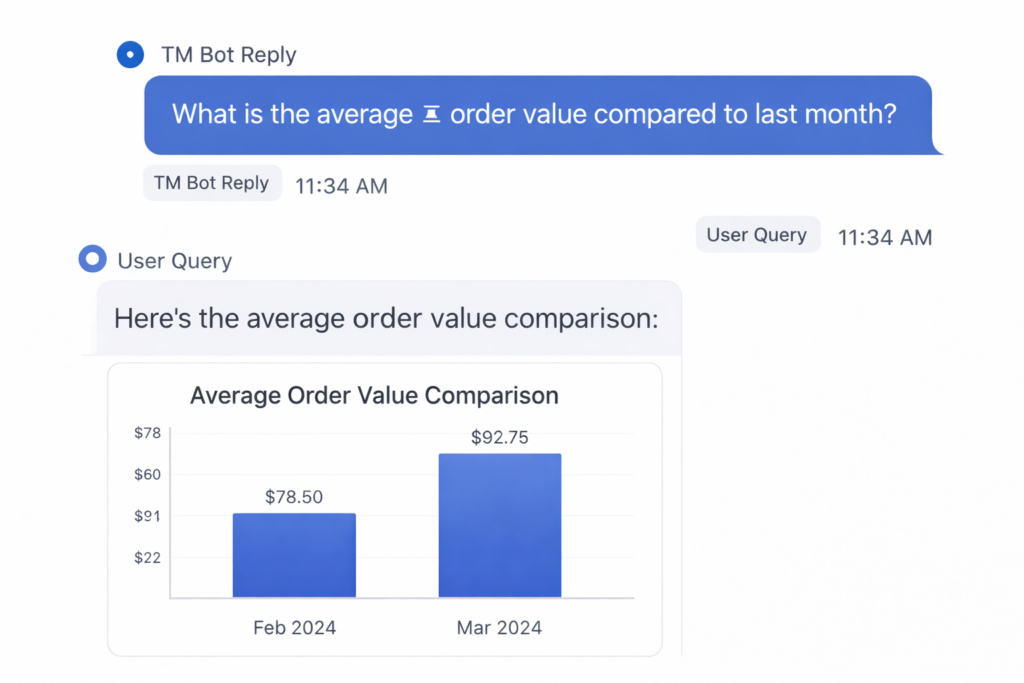
- “What is the average order value compared to last month?”
This helps teams optimize pricing, inventory, and campaigns without waiting for reports or dashboards.
🏫 eLearning Platforms
Improve engagement, reduce churn, grow subscriptions.
eLearning businesses commonly ask:
- “Which courses have the highest completion rate?”
- “Where are students dropping out the most?”
- “Which instructors get the best feedback?”
- “How many users upgraded from free to paid this month?”
- “Which course brings the highest lifetime value?”
Product, content, and marketing teams get clear direction on what to improve and what to scale.
🏢 Real Estate Companies
Track leads, deals, and performance in real time.
Real estate teams use the chatbot to ask:
- “How many new leads came in today?”
- “Which property listings are getting the most inquiries?”
- “Which agents are closing the most deals this quarter?”
- “What’s the average deal closure time?”
- “Which locations are performing better than expected?”
This helps brokers and managers focus effort where money is actually coming from.
🏭 Manufacturing Companies
Reduce delays, control costs, improve output.
Manufacturing teams often ask:
- “Which orders are delayed right now?”
- “Where is production slowing down?”
- “Which supplier causes the most delays?”
- “What is today’s production vs target?”
- “Which machine has the highest downtime?”
Operations teams get live visibility, not yesterday’s reports.
🏨 Hotel Booking & Hospitality
Increase occupancy, improve guest experience.
Hotel and booking platforms ask:
- “What is today’s occupancy rate?”
- “Which room types are selling fastest?”
- “Which booking channel gives the highest revenue?”
- “How many cancellations happened this week?”
- “What are the most common guest complaints?”
Revenue managers and hotel staff can adjust pricing, promotions, and service instantly.
This is exactly how we position AI database chatbots at Triple Minds—not as a technical tool, but as a daily decision assistant for the business.
Types of Databases That Can Be Integrated With an AI Database Chatbot
One concern we often hear from businesses is:
“Our database is old.” or “Our setup is not standard.”
The good news is—AI database chatbots are not limited to modern or popular databases. At Triple Minds, we design chatbot architectures that work with both legacy systems and modern data stacks, because real businesses rarely run on a single, clean database.
Below is a clear, business-friendly breakdown.
1) Traditional SQL Databases (Most Common)
Works perfectly with existing enterprise systems.
If your business uses:
- MySQL
- PostgreSQL
- Microsoft SQL Server
- Oracle Database
You’re already in a great position. These databases are widely used in CRMs, ERPs, finance systems, and internal tools.
The chatbot can query sales, finance, operations, and customer data directly and securely, without changing your setup.
2) Legacy & Enterprise Databases
Yes—even old systems can be integrated.
Many enterprises still rely on:
- Oracle legacy systems
- IBM DB2
- On-premise enterprise databases
We frequently work with businesses running 10–20 year old systems. Instead of forcing migration, we integrate the chatbot on top of existing infrastructure, protecting your past investments.
No forced upgrades. No risky rewrites.
3) Cloud Databases & Data Warehouses
Ideal for fast-growing and data-heavy companies.
If your data lives in:
- Amazon RDS / Aurora
- Google BigQuery
- Snowflake
- Azure SQL / Synapse
The AI chatbot can handle large-scale analytical queries like trends, forecasting, and performance analysis.
Perfect for leadership dashboards, finance analysis, and growth tracking.
4) NoSQL & Semi-Structured Databases
Great for modern apps and high-volume data.
For businesses using:
- MongoDB
- Firebase
- DynamoDB
- Cassandra
The chatbot can still answer meaningful questions—even when data is not stored in tables.
Useful for apps, marketplaces, IoT platforms, and high-traffic systems.
5) ERP, CRM & Business Systems Databases
Most businesses don’t even realize these are databases.
AI database chatbots can sit on top of:
- ERP systems (inventory, finance, procurement)
- CRM systems (leads, customers, sales)
- HR and operations platforms
Teams ask questions like “How many unpaid invoices exist?” or “Which leads are stuck in follow-up?” without opening multiple tools.
6) Multiple Databases at the Same Time
This is where real power shows up.
Many businesses run:
- One database for sales
- Another for finance
- Another for operations
We design chatbots that connect to multiple databases simultaneously, so businesses can ask:
- “Compare revenue with fulfillment delays”
- “Which regions have high sales but low margins?”
One question. Multiple systems. One answer.
7) Read-Only & Secure Integrations (No Risk to Data)
For sensitive businesses, the chatbot can be configured as:
- Read-only access
- Department-level permissions
- Audit-logged queries
This keeps compliance, security, and leadership confidence intact.
Security & Compliance: Built for Enterprise Confidence
When businesses think about using AI to access their databases, the first real concern is not features—it’s security.
Questions like “Is our data safe?”, “Who can see what?”, and “Will this create compliance risks?” are completely valid. At Triple Minds, we treat security and compliance as core design requirements, not add-ons.
Here’s how we ensure enterprise confidence from day one.
1) Your Data Never Leaves Your Control
AI database chatbots do not mean your data is sent everywhere. We design systems where:
- Databases stay in your environment (cloud or on-premise)
- The chatbot connects securely using controlled access
- No raw data is exposed outside approved boundaries
Businesses keep ownership and control of their data at all times.
2) Role-Based Access for Every Team
Not everyone in an organization should see the same data—and we fully respect that.
We implement:
- Role-based access (Sales, Finance, Ops, Leadership)
- Permission-level query restrictions
- Department-specific visibility rules
A sales executive sees sales data. Finance sees financials. Leadership sees everything—cleanly and safely.
3) Read-Only Database Access (Zero Risk to Data)
For most enterprises, chatbot access is configured as read-only.
That means:
- No updates
- No deletes
- No accidental data changes
Teams can ask unlimited questions without any risk to operational systems.
4) Full Audit Logs & Query Tracking
Every interaction can be logged:
- Who asked the question
- When it was asked
- Which data was accessed
This is critical for:
- Internal audits
- Compliance reviews
- Security investigations
Nothing happens silently in the background.
5) Compliance-Ready Architecture
Different industries have different compliance needs. We design AI database chatbots that align with:
- Enterprise IT policies
- Data privacy standards
- Industry-specific compliance requirements
Whether you operate in finance, healthcare, education, or enterprise SaaS, the chatbot can be tailored to match your compliance framework, not challenge it.
6) On-Premise or Private Cloud Deployment
For organizations that cannot use shared environments, we offer:
- Fully on-premise deployment
- Private cloud setups
- Network-restricted access
Ideal for enterprises with strict data residency or internal IT rules.
7) Human Oversight & Admin Controls
Admins always stay in charge:
- Control data sources
- Manage user access
- Pause or restrict functionality if needed
AI assists decisions—it does not override governance.
We’re a globally trusted AI development company and we’ve already built AI database chatbots. Talk to our team to see how this can work for your business.
FAQs
Yes. AI database chatbots can interpret multi-step, context-aware business questions and return accurate answers by combining data from multiple tables or systems when required.
By providing a single, consistent source of answers, AI database chatbots eliminate conflicting reports and ensure every department works from the same data logic.
Yes. AI database chatbots can be tailored with department-specific metrics, KPIs, permissions, and workflows for sales, finance, operations, CX, and leadership.
Implementation depends on data complexity and security requirements, but most businesses can deploy a working AI database chatbot within weeks, not months.
Table of Content
- Key Takeaways
- How to Chat with a Database Using AI
- How Database Chatbot Work?
- Business Use Cases Across Departments (Sales, Finance, Operations,…
- Measurable Business Benefits: Time Saved, Cost Reduced, Decisions…
- Industry-Based Questions Businesses Can Ask Their Database (Using…
- Types of Databases That Can Be Integrated With…
- Security & Compliance: Built for Enterprise Confidence
- FAQs