Climate Tech Startup Ideas That Actually Make Money
This article explores practical climate tech startup ideas that are not only environmentally impactful but also commercially viable in 2026. It highlights profitable business models across energy management, EV fleet software, carbon marketplaces, supply chain analytics, and waste tech, while explaining why software-first and AI-powered solutions are gaining investor attention. The article also breaks down why many climate startups fail and what makes a climate tech business truly scalable and investable. Additionally, it emphasizes the growing role of AI, regulatory compliance, and recurring SaaS revenue in building sustainable climate-focused companies.

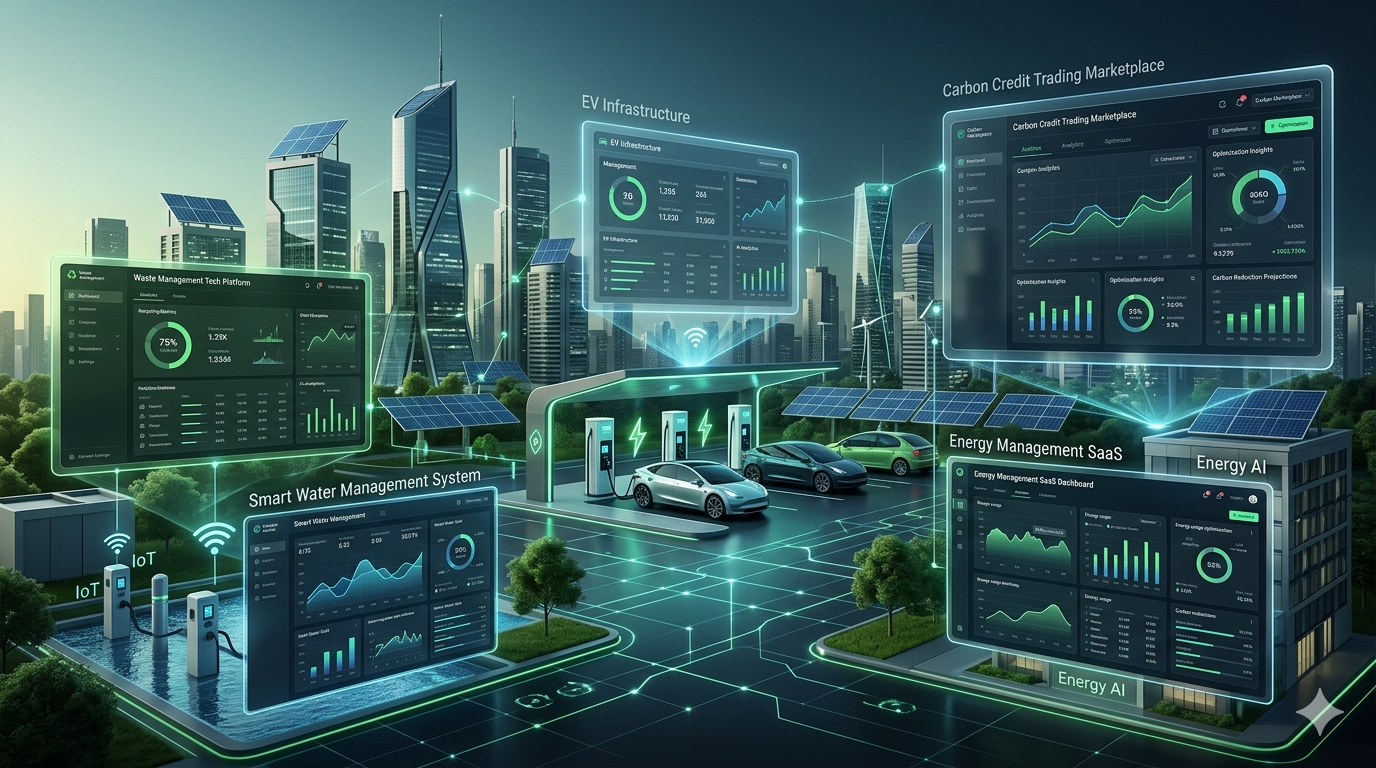
The climate tech space has come a long way and so have the people building in it.
Startups and businesses today are not just passionate about the planet, they understand that a startup without revenue cannot help anyone. The real question serious builders are asking in 2026 is not “is this good for the planet?” It is “how do we build something sustainable enough to create a lasting impact?”
The answer is yes, but only if you pick the right model. The ideas below are not concept pitches. They are business models with real revenue mechanics, growing demand, and measurable market size.
If you are building in this space and need help shaping your product strategy or developing the AI infrastructure behind it, Triple Minds offers consulting and AI development services built for exactly this kind of technical and commercial startup challenge.
Have an Eco Business Idea and want to Make it Real?
Triple Minds helps businesses like yours prototype and validate climate tech ideas — from EV fleet software and carbon tracking platforms to smart energy SaaS and sustainable supply chain tools. Whether you are at the idea stage or ready to build, we can help you shape the right product, fast.
Visit Prototyping Services
Key Takeaways
1) The most profitable climate tech startups solve problems with existing budgets behind them, not problems waiting for future regulation to create demand.
2) Software-first business models in climate tech reach profitability faster than hardware-heavy approaches because margins are higher and scaling costs are lower.
3) AI integration is becoming a core competitive differentiator in climate tech, not a nice-to-have feature.
4) Regulatory compliance, particularly around carbon reporting and supply chain emissions, is creating a fast-growing market of enterprise buyers who have no choice but to purchase solutions.
5) The most defensible climate tech businesses build proprietary data assets over time that make their platform harder to replace the longer a customer stays.
Climate Tech Startup Ideas With Real Revenue Potential
1. Energy Management SaaS For Commercial Buildings
Commercial buildings account for roughly 40% of global energy consumption. Building owners and facility managers are under pressure from regulators, tenants, and their own operating budgets to cut energy costs. This is not a future problem. It is a present pain with money attached.
An energy management platform connects to a building’s existing systems such as HVAC, lighting, and electrical meters. It monitors consumption in real time, spots inefficiencies, and either alerts the facility manager or adjusts settings automatically through AI-driven controls.
Key revenue details to know:
- Revenue model: monthly SaaS subscription tied to building size or number of sensors
- Buyers already have energy budgets and pay utility bills, so ROI is immediately calculable
- Payback period of 12 to 18 months makes it easy for finance teams to approve
- Upsell path through carbon reporting modules as ESG compliance requirements increase
2. Carbon Credit Platforms And Marketplaces
The voluntary carbon market crossed $2 billion in 2023 and is projected to reach $50 billion by 2030. Corporations are committing to net zero targets and need to offset what they cannot eliminate. The problem is the market is fragmented, opaque, and riddled with quality issues that make buyers nervous.
A platform that brings transparency, verification, and liquidity to carbon credit transactions solves a problem that large corporate buyers genuinely care about.
What makes this model work commercially:
- Transaction fee model on every credit bought and sold, similar to how a financial exchange earns revenue
- Subscription tier for corporate buyers who need portfolio management and reporting tools
- Developer-side revenue from helping project developers list, verify, and manage their credit inventory
- High-margin business once the marketplace reaches liquidity
This Might Be Useful: How to Make Money Producing and Selling Carbon Offsets
3. EV Fleet Management Software
Fleets are electrifying faster than anyone expected. Logistics companies, delivery services, municipalities, and ride-share operators are all adding electric vehicles. But managing an EV fleet is not the same as managing a diesel fleet. Charging schedules, range planning, battery health monitoring, and energy cost optimization are entirely new problems.
This is a pure software play with zero hardware dependency if done right.
Revenue and market details:
- Per-vehicle monthly subscription scales automatically with fleet size
- Buyers are existing fleet operators with clear software budgets already allocated
- Displacement of older fleet management tools means a clear sales conversation
- Integration with energy procurement opens a secondary revenue stream through demand response programs
Read Also: How to Create Used Car Marketplace & App?
4. Sustainable Supply Chain Analytics
Regulators in the EU, UK, and increasingly the US are requiring companies to report on the carbon footprint of their supply chain, not just their direct operations. This is called Scope 3 emissions reporting, and most companies have no idea how to do it.
A B2B analytics platform that helps procurement and sustainability teams map, measure, and reduce supply chain emissions is solving a compliance problem with a hard regulatory deadline behind it.
Why this makes money:
- Enterprise SaaS with annual contracts, typically $50,000 to $500,000 per year
- Compliance-driven demand means the buyer has no choice but to purchase a solution
- Sticky product because switching requires re-integrating supplier data
- Professional services revenue from implementation and ongoing consulting
5. Climate Risk Intelligence Platforms
Insurance companies, banks, infrastructure funds, and real estate firms need to understand how physical climate risks such as flooding, wildfires, and extreme heat will affect their assets over the next 10 to 30 years. Standard financial models do not include this data. Regulatory guidance from bodies like the SEC and Bank of England is pushing financial institutions to integrate it.
A climate risk data and analytics platform license its models and datasets to institutional buyers.
Business model highlights:
- Data licensing revenue from financial institutions and insurers
- API access for fintech companies building climate risk into their own products
- High switching costs once the platform is embedded into an institution’s risk models
- Extremely defensible business because proprietary datasets and model accuracy compound over time
6. Water Tech And Smart Irrigation SaaS
Agriculture accounts for 70% of global freshwater use. In regions facing drought, farmers are under pressure from both cost and regulation to reduce water consumption. Smart irrigation platforms use soil sensors, weather data, and AI to tell farmers exactly when and how much water, cutting consumption by 20 to 40% without reducing yield.
This model works because it saves the buyer money directly and immediately.
Key points:
- Hardware plus software subscription creates two revenue streams and high lock-in
- Government subsidies in many regions reduce the effective price for farmers
- Water utility partnerships create a second buyer channel alongside direct farm sales
- Expanding from agriculture into golf courses, municipalities, and commercial landscaping is a natural upsell path
This May Be Useful To You: Forest Management Software Cost Guide
7. Recycling And Waste Tech Platforms
The recycling industry is broken. Contamination rates are high, logistics are inefficient, and economics only work in certain commodity cycles. Startups building technology to fix the operational layer of recycling, whether through AI sorting, reverse logistics software, or materials traceability platforms, are finding paying customers in both the public and private sector.
Revenue mechanics:
- SaaS licensing to waste management companies and municipalities
- Per-ton processing fee for AI-driven sorting platforms installed at materials recovery facilities
- Brand partnerships with consumer goods companies that need certified recycled material supply chains
- Carbon credit generation from verified diversion of materials from landfill
Read Also: A Complete Guide To Build A Battery Recycling Management Software
Why Most Climate Tech Startups Struggle To Make Money ?
Before jumping into ideas, it is worth understanding why so many climate startups fail in the first place.
Many climate startups fail because they confuse a problem worth solving with a product thinking someone will pay for it.
They build grant-dependent solutions, rely on government contracts that take years to close or price their product at a premium that only enterprise buyers can afford while targeting small businesses.
The startups that survive do three things differently:
1) They find a buyer who already has a budget.
2) They solve a problem the buyer already knows they have.
3) They make switching from the old ways and solution feel easy, not complex.
What Makes A Climate Tech Idea Actually Investable?
Investors in this space are no longer impressed by the project alone. They want to see the same fundamentals they look for in any software or technology business.
Four things that separate fundable climate tech startups from the rest:
1) A buyer who has the budget today, not in three years when regulations tighten.
2) A revenue model that grows without your costs growing at the same rate. In simple terms, adding 100 new customers should not require hiring 100 new people.
3) A data or network effect that makes the business harder to copy over time.
4) Measurable environmental impact that can be reported, verified and used in the buyer’s own ESG disclosures.
How AI Is Accelerating climate tech profitability?
Every idea on this list becomes more valuable and more defensible when AI is at the core of the product rather than bolted on as a feature. Energy management platforms that predict consumption before it happens are worth more than ones that report it after. Carbon credit platforms that use AI to verify project quality reduce the biggest trust barrier in the market. Supply chain analytics tools that surface actionable insights rather than raw data are the ones that get renewed.
The gap between climate tech companies that use AI well and those that do not is widening fast.
If you are building in this space and want to explore how AI development or product strategy consulting can sharpen your competitive position then you should know that Triple Minds works with startups at exactly this stage. See our AI development services here.
Ready to Launch your own Carbon Trading Marketplace?
The voluntary carbon market is growing fast — and the window to build a trusted platform is now. Triple Minds helps founders and enterprises build end-to-end carbon trading marketplaces with verified credit listings, buyer-seller matching, compliance reporting, and AI-driven quality checks. From architecture to launch, we handle the full build.
Explore Our Services
Conclusion
Climate tech is not a charity sector anymore. The ideas with the strongest commercial potential in 2026 are the ones solving problems that businesses, institutions, and governments already know they have and already have budgets to fix. Energy management, fleet software, supply chain compliance, climate risk data, and waste tech are not speculative bets. They are markets with proven buyers and growing regulatory tailwinds. Pick the model that matches your technical strengths, find the buyer who already has a reason to pay, and build the product around their existing workflow rather than asking them to change it.
Quick Answers to Common Questions
Is climate tech still a good space to raise venture capital in 2026?
Yes, but investors are now prioritizing revenue-generating models over pure impact plays, meaning startups with clear SaaS or marketplace revenue are getting funded faster than hardware-heavy projects.
What is the difference between deep tech climate startups and software-first climate startups?
Deep tech climate companies build physical technology like new battery chemistries or carbon capture machines, while software-first climate startups build platforms and analytics tools on top of existing infrastructure, typically with faster paths to revenue.
Do climate tech startups qualify for government grants and tax incentives?
Many do, particularly in the US through the Inflation Reduction Act, in the EU through the Green Deal Industrial Plan, and in various national subsidy programs, but grants should complement revenue, not replace it.
What is Scope 3 emissions reporting and why does it matter for startups?
Scope 3 covers indirect emissions across a company’s supply chain and is increasingly mandated by regulators in Europe and proposed in the US, creating a large and urgent market for analytics tools that help companies measure and manage these emissions.
How large is the voluntary carbon market expected to be?
Estimates vary, but leading analysts project the voluntary carbon market will reach between $50 billion and $250 billion by 2050, depending on how aggressively corporations pursue net zero commitments.
Got a project in mind? Let’s build it together.
We work with founders and product teams across consulting, development, and growth marketing. Tell us what you’re building and we’ll show you how we’d ship it.