Building an AI companion app is one of the most exciting opportunities in the market right now. But the first question every founder asks is: how long will this actually take?
The honest answer is that it depends entirely on the path you choose. A white label solution can have you live in 6 weeks while a fully custom build typically takes anywhere from 4 to 12 months based on the features you want to ship.
If you are planning to build an AI companion app and want a team that has already shipped multiple AI products then, Triple Minds offers both a ready to launch white label AI companion platform and a full custom AI companion app development service.
Book a free consulting session to map out your timeline before you spend a penny.
Key Takeaways
1) A white label AI companion app can be live in little as 6 weeks while a fully custom build takes 4 to 12 months depending on feature scope.
2) The biggest timeline driver in any AI companion app is feature complexity not the AI itself.
3) Integrating a third-party AI API is significantly faster than training a custom model and delivers strong results for most products.
4) Compliance planning for NSFW platforms must happen at the start of the project, not after development begins.
5) Choosing the right engagement model, whether white label, fixed price or dedicated team, determines your speed, cost and control over the final product.
Launch Your Next AI Companion App with Triple Minds
Whether you’re looking for a fast market entry with a white-label solution or a fully custom AI companion platform, Triple Minds delivers both. From product strategy and development to launch planning and growth, we help businesses build, launch, and scale AI companion apps with confidence.
Explore Our AI Companion Solutions
What Determines The Timeline Of An AI Companion App?
Before you can pin down a timeline, you need to understand what actually drives it. Most founders underestimate how much scope affects delivery. Here are the key variables that control how fast or slow your build goes:
1) Scope Of Features
A simple text chat companion is far faster to build than one with voice interaction, video generation, memory, persona customization, and a subscription model. The overall feature set is one of the biggest factors determining your project’s development timeline—more advanced capabilities require additional design, development, testing, and integration. Every feature you include adds weeks.
2) Custom AI Model Vs. Third Party API
If you integrate an existing AI provider like OpenAI or Anthropic then your development timeline shortens significantly. If you want a proprietary trained model except the timeline to stretch by 6 to 10 weeks minimum.
3) Platform Choice
Building for the web only is the fastest. Adding iOS and Android on top doubles the frontend work. Supporting all three simultaneously requires a larger team and tighter coordination.
4) Compliance And Content Moderation
NSFW platforms in particular require content moderation layers, age verification and payment processor approval. These add real weeks to your timeline and cannot be skipped.
5) Team Size And Engagement Model
A two individual freelance team and a dedicated 8 person product studio will not deliver in the same window. The engagement model you choose has a direct impact on how quickly decisions get made and code ships.
Planning your AI companion app is only one part of entering the market. Understanding acquisition costs, customer lifetime value, retention, and churn is equally important when evaluating the business opportunity. Explore the key metrics and unit economics investors and founders should consider in our guide on AI Companion CAC, LTV, and Churn Benchmarks.
The Two Main Paths And How Long Each Takes?
Every founder building an AI companion app is essentially choosing between two routes. Understandding both will help you match your timeline to your actual goals.
1) White Label: The Fastest Route To Market
A white label AI companion app is a fully built, tested and market proven platform that you license, brand and launch as your own product. You are not starting from scratch. You are taking something that already works and making it yours.
Here is what the white label path looks like in practice:
1) What Is It Actually?
A white label AI companion platform is a complete product with all the core infrastructure already built. The AI chat engine, user accounts, persona system, admin panel and monetization tools are all there. You bring your brand, your content strategy and your target audience.
2) What Comes Included Out Of The Box?
Triple Minds white label AI companion platform includes human like chat, voice and video interaction, character and persona generation, a 50 plus control admin panel for full operational management and branding customization across the full product. You are not getting a skeleton. You are getting a working platform.
3) How Much Can You Customize It?
The platform is designed to be brandable at every level. You can change the name, visual identity, onboarding flow, character roster, pricing model and content policies
4) Timeline
With the white label route, Triple Minds can have your branded AI companion platform live in as little as 6 weeks. That is the same product that has powered 20 plus brands already in the market.
Custom Build: The Full Development Route
A custom AI companion app is built from the ground up to your exact specifications. You own everything, the architecture, the AI behavior, the data and the product roadmap. This is the right path when your vision cannot be served by an existing platform or when you need a genuinely proprietary product.
Custom builds take longer because every decision is made fresh. The typical timeline for a custom AI companion app ranges from 4 months on the lighter end to 9 to 12 months for a full featured product with voice, video, trained AI behavior and multi-platform support. The next section breaks down exactly where that time goes.
Read Also: Discover Revenue Models for Your Next AI Companion App
Phase By Phase Breakdown Of A Custom AI Companion App
If you are going the custom route, here is a realistic view of what happens at each stage and how long it takes:
1) Discovery And Strategy (2 to 3 weeks)
This is where the product scope is locked, technical decisions are made and the architecture is designed. Skipping or rushing this phase is the number one reason projects go over budget.
2) UI and UX design (3 to 4 weeks)
Wireframes, user flows and full design mockups for every screen. A good design phase prevents costly rebuilds during development.
3) AI Model Selection And Integration (3 to 6 weeks)
Choosing the right AI provider, setting up API connections, configuring persona behavior, and testing response quality. If you are training a custom model, this phase extends by 6 to 10 weeks.
4) Backend And API Development (6 to 10 weeks)
Server architecture, database setup, user authentication, subscription and payments, content moderation and all the logic that runs behind the scenes. This is typically the longest phase.
5) Frontend Development (4 to 8 weeks)
Building the actual product interface across your chosen platforms, web, iOS or Android. Each additional platform adds 2 to 4 weeks.
6) Testing And Quality Assurance (2 to 4 weeks)
Load testing, security testing, user experience testing and fixing what breaks before real users touch it. This phase is non-negotiable.
7) Launch And Deployment (1 to 2 weeks)
App store submissions, server provisioning, monitoring setup and going live. App store reviews alone can take 1 to 2 weeks.
Read Also: Best Countries to Register an Adult or NSFW AI Company
What Can Slow Down Your Timeline?
Even with a great team and a clear plan, certain things consistently cause delays. Being aware of them ahead of time is the best way to avoid them:
1) Unclear Or Changing Scope
Starting development before the product is fully scoped is the fastest way to double your timeline. Every change in mid build costs two to three times more than making the decision before development starts.
2) Switching AI Providers Mid Build
Changing from one AI provider to another after integration has started requires rebuilding the API layer, retaining prompts and retesting behavior. It sets most projects back by 4 to 6 weeks.
3) Compliance Surprises
If you are building an NSFW platform and did not plan for age verification, payment processor requirements and content moderation from day one, you will hit a wall late in development when it is expensive to fix.
4) Underestimating QA
Many founders treat testing as a formality. In AI companion apps where conversation quality and user trust are everything, poor QA leads to broken launches and poor retention. Plan for it properly.
5) Single Point of Failure On The Team
If one developer holds all the knowledge about a critical system and they become unavailable, the whole project stalls. Proper documentation and team redundancy matters.
Want to Estimate the Cost of Your AI Companion App?
Planning your budget doesn’t have to be complicated. Triple Minds offers an App Cost Calculator that helps founders and businesses estimate development costs by answering a few simple questions—providing a realistic project estimate in just minutes.
Calculate Your AI Companion App Cost
Conclusion
The timeline for building an AI companion app comes down to two things:
1) What are you building?
2) How are you building it?
A white label platform gets you live in 6 weeks with a proven product you can brand and scale. A custom build gives you full ownership and differentiation but demands 4 to 12 months of disciplined execution.
The right choice is not about which is faster. It is about which matches your goals, your budget and where you want to be in 12 months.
Triple Minds has experienced delivering both with white label platforms already live across 20 plus brands and custom AI products shipped for founders across multiple markets.
Quick Answers to Common Questions
Costs range for white label Candy.ai start at $18,000 and while custom AI companion cost starts from $50000 and can increase depending on features, platforms and team size.
Yes, A white label solution requires no technical involvement from your end. A custom build is manageable with the right development partner handling the technical decisions.
Not necessarily. Most successful AI companion apps use existing AI APIs and focus their differentiation on persona design, UX, and content strategy rather than building models from scratch.
Web is the fastest and cheapest to launch on. Mobile apps take longer due to development time and app store review cycles. Most founders start on web and add mobile once the product is validated.
The most common models are subscription plans (monthly or annual), token or credit based system for premium interactions and one time purchase for specific personas or features.
Mental health apps have emerged as one of the fastest growing categories in mobile technology. More people are shifting to AI powered therapy tools to manage anxiety, stress and emotional burnout from the comfort of their phones.
The market size of AI mental health apps was estimated at USD 1.71 billion in 2025 and is projected to reach USD 9.12 billion by 2033, at a CAGR of 23.29% from 2026 to 2033. The market growth is driven by factors such as the increasing rate of mental health disorders and heightened awareness regarding mental health as a significant health concern.
Elomia is one of the most widely known when it comes to AI powered therapy tools. It uses conversational AI to simulate CBT (Cognitive Behavioral Therapy) and help users work through emotional challenges without needing to book any therapist.
If you are a startup, product manager or investor exploring how to build a mental health app like Elomia clone then this guide contains everything you need to know. From features and tech stack to development and cost, you will find it all here.
At Triple Minds, we specialize in AI agent development and custom chatbot development including emotional intelligent, conversation driven apps.
If you are ready to explore your idea then talk to our consultant and we will help you choose the smartest path forward.
Key Takeaways
1) The most critical technical investment in a mental health app is the AI conversation engine. An empathetic, context aware AI is what separates a useful product from a frustrating one.
2) Crisis detection is not optional. Any app that handles mental health conversations must have built in safety protocols to detect distress signals and respond appropriately.
3) Session memory is what makes users come back. An AI that remembers previous conversations creates a sense of continuity and trust that drives long term retention.
4) HIPAA and GDPR compliance should be built in from day one, not added as a patch after launch. Retrofitting security is far more expensive than building it right the first time.
5) You do not have to build from zero. White label AI chatbot platforms can significantly reduce your time to market while still giving you a fully branded, customizable product.
Planning to Launch an AI Mental Health App Like Elomia?
Whether you’re building for a healthtech startup, clinic, rehab center, or enterprise, Triple Minds develops secure AI therapy chatbot solutions with custom and white-label options. Our platforms combine NLP-powered conversations, compliance-ready architecture, and proven therapeutic frameworks like CBT and DBT.
Build Your AI Therapy Chatbot
What is Elomia Clone?
Elomia clone is a pre-build and ready to deploy AI therapy assistant which is funtional replica of the popular Elomia. It uses natural language conversations to support people dealing with anxiety, stress, low mood and loneliness. Unlike traditional therapy apps that simply connect users to licensed therapists, our Elomia clone uses a trained AI model to conduct structured conversations guided by CBT principles.
What makes it so attractive is it’s simplicity. Users open the app, start a conversation and feel heard. The AI asks follow up questions, helps users reframe their thoughts and tracks emotional patterns over time. There is no appointment booking, no waiting room. That is what makes this app so wanted in the market.
Read Also: How AI Therapy Chatbots Are Making Mental Healthcare?
Who Actually Uses Apps like Elomia Clone?
Before writing a single line of code, understanding your target user is essential. Apps like Elomia typically serve three core groups:
1) People dealing with everyday mental health struggles like anxiety, overthinking or mild depression who either cannot afford therapy or are not ready to speak with a human therapist. This is the largest audience.
2) Professionals in high pressure environments such as tech, healthcare or finance who want a quick daily emotional check in without committing to weekly therapy sessions.
3) Corporate wellness programs that embed mental health tools as an employee benefit. This is a growing B2B use case where companies pay for app access on behalf of their teams.
Note: Defining your target user upfront shapes every product decision from the tone of the AI conversations to how you handle crisis situations within the app.
Core Features Your Mental Health App Like Elomia Must Have
Making a basic AI mental health app is not enough. To compete with or improve on Elomia, your app needs a thoughtful set of features that balance engagement, safety, and emotional intelligence.
Here are the features that matters most:
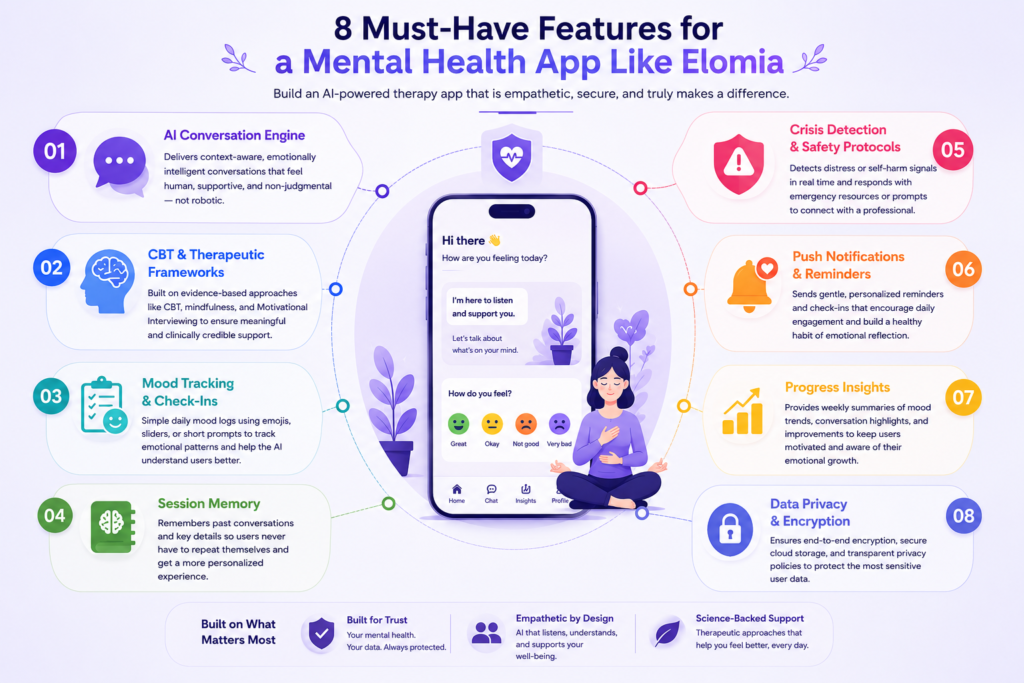
1) AI Conversation Engine
The heart of the app. The AI must be able to hold contextually, emotionally sensitive conversations and respond in a way that feels human and supportive not robotic.
2) CBT and Therapeutic Frameworks
The conversation logic should be guided by evidence-based approaches like Cognitive Behavioral Therapy, mindfulness based stress reduction, or Motivational Interviewing. This gives the product clinical credibility.
3) Mood Tracking And Check Ins:
Daily mood logs with simple inputs (emoji, sliders, short prompts) help users track their emotional patterns and give the AI more context for future conversations.
4) Session Memory
The AI must remember previous conversations. A user who shared that they are stressed about a job interview should not have to repeat that context on day two.
5) Crisis Detection with Safety Protocols
If a user expresses thoughts of self-harm then the app must detect the signal and respond with emergency resources or a prompt to contact a professional. This is non-negotiable from both an ethical and legal standpoint.
6) Push Notifications And Reminders
Gentle, personalized check in reminders improve daily engagement and help users build a habit around emotional reflection.
7) Progress Insights
Weekly summaries showing mood trends, conversation highlights and areas of improvement give users a sense of movement and motivate continued use.
8) Data Privacy And Encryption
Mental health data is among the most sensitive data users can share. End-to-end encryption, secure cloud storage, and transparent privacy policies are mandatory.
Tech Stack Behind An App Like Elomia Clone
You do not need to build everything from scratch. Here is a practical tech stack breakdown for a production ready mental health app
1) AI, NLP Layer
GPT 4 or a fine-tuned open-source model (like LLaMA or Mistral) forms the conversational core. The model needs to be fine-tuned, or system prompted for empathetic, therapeutic dialogue. At Triple Minds, we have trained custom AI models across 25+ use cases.
2) Backend
Node.js or Python (FastAPI or Django) for API management, session handling and data logic. A secure REST or GraphQL API connects the mobile app to the AI engine.
3) Database
PostgreSQL for structured data (user profiles, mood logs, session summaries) and a vector database like Pinecone or Weaviate for sorting and retrieving semantic conversation memory.
4) Mobile Frontend
React Native for a single codebase that runs on both iOS and Android reducing development time and cost significantly.
5) Cloud Infrastructure
AWS, GCP or Azure for scalable hosting. Use HIPAA compliant cloud configurations if you are targeting users in the United States.
6) Security And Compliance
AES 256 encryption for stored data, TLS for data in transit and HIPAA or GDPR compliance depending in your target market.
Development Guide To Make A Mental Health App Like Elomia Clone
Building an app like Elomia is not just a development project. It is a product journey that starts with strategy and ends with a system that continuously improves after launch.
Here is how the process should look
1) Discovery and Consulting
Before any design or development begins, you need a product strategy session. What problem are you solving? Who is your user? What is your monetization model? These questions if answered early, prevent expensive rebuilds later.
2) UX and UI Design
Mental health apps require a calm, safe, and trustworthy visual experience. The design should reduce cognitive load with soft colors, clean typography and minimal friction in every user flow from onboarding to daily check ins.
3) AI Model Selection And Prompt Engineering
Choose your base model and build a detailed system prompt that defines the AI’s personality, safety guardrails, therapeutic approach and response style. This step is where most teams underinvest and pay for it later with a product that feels generic.
4) Core Development
Build the backend APIs, mobile app, conversation engine, mood tracker, session memory system and admin dashboard in parallel sprints. Use agile methodology to ship testable increments every two weeks.
5) Safety And Compliance Testing
Run end to end tests specifically for crisis detection scenarios. Have mental health consultants review the AI’s responses across a range of emotional inputs. Ensure all data handling is compliant with relevant regulations.
6) Launch and Post Launch Optimization
Release to a limited beta audience first. Collect real usage data, identify conversation drop off points, retrain or re-prompt the model where needed and iterate before a full public launch.
Read Also: AI Medical Scribe Development Cost & Features List
How Much Does Elomia Clone Costs
Development cost depends on scope, team location and whether you use a white label foundation or build everything custom.
Here is an estimated breakdown:
| Development phase | Estimated cost |
| Discovery and strategy | $2,000 – $5,000 |
| UX and UI design | $5,000 – $12,000 |
| AI model integration and prompt engineering | $8,000 – $20,000 |
| Mobile app development (iOS and Android) | $20,000 – $45,000 |
| Backend and database infrastructure | $10,000 – $20,000 |
| Security, compliance, and testing | $5,000 – $10,000 |
| Total estimated range (production ready MVP) | $50,000 – $110,000 |
If you want to move faster and at a lower initial cost, a white label chatbot foundation can reduce your time to launch from 6 months down to 6 to 8 weeks, with full custom branding and feature configuration.
Our Elomia clone cost starts from $9,000 and is tailored to your specific business requirements. The final pricing depends on the features, AI capabilities, integrations, and level of customization you need. Whether you’re building an MVP or a fully scalable mental wellness platform, we deliver a solution designed to match your goals and budget.
Read Also: How Much Does an AI Hospital Management System Development Cost
Why Choose Us?
1) AI Agent and Chatbot Development teams with 5 or more emotionally intelligent conversational AI products shipped.
2) 25 or more custom AI models trained across industries, with over 150 apps and chatbot systems delivered.
3) White label AI chatbot solution ready to adapt into a mental health platform and launch in weeks, not months.
4) Full service support across consulting, development, and growth so you have one team from idea to launch.
Whether you need strategic consulting to validate your idea before investing, a dedicated development team to build your MVP, or a white label solution you can launch in weeks, we have the right model for where you are in your journey.
Talk to our consultant today.
Have an AI Mental Health App Idea? Validate It Before You Build
The fastest way to test an idea isn’t by building a full platform. Triple Minds helps founders and healthcare innovators turn concepts into interactive AI prototypes, allowing you to validate user experience, refine features, and gather feedback before investing in full-scale development.
Prototype Your AI Mental Health App
Conclusion
Building a mental health app like Elomia Clone is one of the most profitable product bets a founder can make right now.
The demand is real, the technology is mature and the gap between what people need emotionally and what existing apps deliver is still wide open.
Success in this space comes down to building an experience that removes friction and making safety a core product value not an afterthought. With the right development partner and a clear product strategy, you can go from idea to a live, clinically credible mental health companion faster than you think.
Quick Answers to Common Questions
No, Apps like Elomia position themselves as AI companions or emotional wellness tools, not licensed therapy. However, having mental health professionals review your AI’s responses and safety protocols is strongly recommended.
Yes, You can use GPT 4 or another foundation model with a well-designed system prompt to create a highly effective mental health conversation experience without full model training.
In the US, HIPAA applies if you collect and store protected health information. In Europe, GDPR applies. Apps that do not position themselves as medical devices generally have more flexibility, but legal review for your specific market is advisable.
A production ready MVP typically takes 4 to 6 months with a full team. Using a white label foundation can bring that timeline down to 6 to 8 weeks.
A freemium model with a subscription upgrade is the most proven approach. Free users get limited daily conversations, while paid subscribers get unlimited sessions, session memory, and progress tracking.
Setting up an adult AI business is one of the fastest growing opportunities in the AI industry in current times globally. But before you build your platform, hire developers, or onboard your first users, getting your legal foundation right is equally important. Without proper registration and compliance, even the most well-built adult AI product can be shut down or hit with serious legal consequences.
If you are a business, startup or entrepreneur planning to start an adult AI platform and want to do it the right and effective way, this guide walks you through every legal step you need to take from day one.
Triple Minds has already helped multiple founders build and launch compliant adult AI platforms. From AI strategy consulting to full NSFW AI development, our team knows what it takes to get your business live and legal. Talk to our consultant or explore our NSFW AI solutions to get started.
Key takeaways
1) Adult AI businesses face significantly stricter legal requirements than standard tech startups including content liability, age verification laws and payment processing restrictions.
2) Choosing the right jurisdiction and business structure early protects founders from personal liability and simplifies regulatory compliance.
3) Age verification is a very important step in most markets, and failure to implement it properly is one of the highest legal risk areas for adult AI platforms.
4) High risk payment processors are a necessary part of operating an adult business and getting compliant legal documentation ready first improves approval rates significantly.
5) Your Terms of Service, Privacy Policy, and Content Policy must be specifically written for adult AI business and not adapted from generic tech templates.
Entering the NSFW AI Market? Talk to Experts First
Building an NSFW AI business takes more than technology. Triple Minds helps founders with strategy, compliance, development, monetization, and go-to-market planning for a successful launch. We help you reduce risk, accelerate growth, and enter the market with confidence.
Plan Your NSFW Business Strategy
Strategies For Setting Up An Adult AI Business Legally
1) Choosing The Right Business Structure
The first legal decision you need to make is what type of business entity to form. This affects your personality liability, your tax obligations, and how investors and payment processors view your business.
Here are the most common options for adult AI businesses:
1) Limited Liability Company (LLC)
The most popular choice for adult AI startups. An LLC separates your personal assets from your business liabilities which is critical in a regulated industry. It is easier to form, has fewer compliance requirements and is tax flexible.
2) Corporation
Best if you plan to raise venture capital or institutional investment. Investors prefer C Corps. However, they come up with more administrative overhead and stricter reporting requirements.
3) Offshore Company (IBC or Ltd)
Some founders register in offshore jurisdictions to reduce regulatory exposure. This is a legitimate strategy but requires careful legal advice you still need to comply with the laws of the countries where your users are located.
The Most Important Rule
No matter where you register, you must comply with the laws of every country your users are accessing your platform from. Registration location does not exempt you from content laws in other markets.
Read Also: Best Countries to Register an Adult or NSFW AI Company
2) Pick The Right Jurisdiction To Register In
Where you register, your business has a significant impact on your legal obligations, tax structure and operational flexibility. There is no single right answer, but some jurisdictions are far more business friendly for adult AI companies.
1) Best jurisdictions commonly used by adult AI businesses
1) United States (Wyoming or Delaware LLC) for credibility access to US payment processors and strong limited liability protections.
2) United Kingdom (Ltd company) for EU adjacent market access with relatively clear adult content regulations.
3) Cyprus Or Malta for EU based operations with favorable tax structures.
4) British Virgin Islands or Cayman Islands for offshore structures with minimal local regulation (still subject to user country laws).
5) Canada for a balanced regulatory environment with strong privacy law alignment.
Work with a business attorney who has experience in the adult content or adult tech industry specifically. Generic business lawyers often miss the niche compliance requirements of this sector.
3) Register Your Business and Obtain Necessary Licenses
Once you have chosen your structure and jurisdiction, the formal registration process begins. Here is what that typically involves:
1) Business registration steps:
1) Choose and register your business name (make sure it is not trademark protected)
2) File your Articles of Incorporation or LLC formation documents with the relevant government body.
3) Obtain your Employer Identification Number (EIN) if operating in the us or equivalent tax identification number in your jurisdiction.
4) Open a dedicated business bank account in your company name.
5) Register for applicable local, state or national taxes.
2) Licenses And Permits You May Need
1) A general business operating license in your jurisdiction.
2) A content distribution license if applicable in your region.
3) Data processing registration under GDPR if serving EU users (you register with your local Data Protection Authority).
4) Adult content permits where specifically required (certain US states and countries have additional licensing requirements).
4) Understanding And Implementing Age Verification Requirements
This is one of the most critical compliance areas for adult AI businesses and one of the most commonly neglected by new founders.
Key Age Verification Laws You Must Know:
1) 18 U.S.C. 2257 (United States)
If your platform generates or distributes sexually explicit content, then you are required to maintain records verifying that all individuals depicted 18+. For AI-generated content, this law is still evolving, but operating without a compliance framework is a serious legal risk.
2) Online Safety ACT (United Kingdom)
Requires robust age verification for any platform delivering pornographic or adult content to UK users. Non-compliance can result in platform blocking and significant fines.
3) Digital Services Act (European Union)
Platforms operating in the EU must implement risk assessments and user protection measures, including age gating especially for content that could harm minors.
Practical Age Verification Methods Used By Adult AI Platforms:
1) Credit card verification at signup (assumes cardholder is an adult).
2) Third party age verification services (AgeID, Yoti, Veriff).
3) Government ID verification with data minimization protocols.
4) Device based parental controls in combination with account verification.
Your Terms Of Service must explicitly state the minimum age requirements (18 or 21 depending on your market) and your enforcement mechanism.
5) Data Privacy Compliance
Adult AI platforms collect behavioral preferences and often biometric data. This puts you squarely in the high sensitivity category under most global privacy laws.
Privacy frameworks you must comply with based on your user base:
1) GDPR (European Union and UK)
Requires explicit user content before collecting personal data, a clear privacy policy, a Data Processing Agreement if you use third party tools and the ability for users to request deletion of their data. Non-compliance fines can reach up to 4 percent of global annual revenue.
2) CCPA (California, United States)
Requires businesses to disclose data collection practices, give users the right to opt out of data selling and provide deletion rights. If you have California users then this applies to you regardless of where you are registered.
3) PIPEDA (Canada)
Requires consent for data collection and gives individuals the right to access and correct their personal information.
Minimum privacy infrastructure your platform needs before launch:
- A clear, legally reviewed Privacy Policy.
- A cookie consent management tool.
- A documented data retention and deletion policy.
- Secure data storage with encryption at rest and in transit.
- A process for handling user data requests and complaints.
6) Set Up Payment Processing For Adult Platforms
Payment processing is one of the biggest practical challenges for adult AI businesses. Many mainstream processors including Stripe and PayPal either prohibit adult content entirely or require specific high risk merchant agreements that are difficult to obtain. Payment processors commonly used by adult AI platforms
- Segpay (specialist in adult content billing)
- Epoch (widely used by adult platforms globally)
- CCBill (one of the oldest and most trusted adult billing processors)
- Verotel (European focused adult payment processing)
- Paxum (digital wallet popular in the adult industry)
- Cryptocurrency payments (as a supplementary option for privacy focused users)
To get approved by high-risk payment processors, you will typically need to provide your business registration documents, proof of age verification implementation, your Terms of Service and Privacy Policy and sometimes as a sample of your platform or product.
Getting your legal documents and compliance framework in place before approaching payment processors significantly improves your chances of approval.
7) Draft Your Legal Documents Before Launch
No adult AI platform should go live without these core legal documents in place. These are not just formalities. They are your legal protection and your compliance evidence.
1) Essential Legal Documents For Adult AI Businesses :
1) Terms Of Service Must clearly define age restrictions, acceptable use policies, content ownership, liability limitations and grounds for account termination. For AI platforms, include specific clauses about AI generated content ownership and restrictions.
2) Privacy Policy Must cover data collection, processing, storage, sharing and user rights in detail. Must be GDPR and CCPA complaint if serving those markets.
3) Content Policy Specific to your platform detailing what content can and cannot be generated or shared, including prohibitions on content involving minors, non-consensual scenarios or any other legally restricted categories.
4) DMCA Policy If your platform allows user uploads or user directed content generation, a DMCA takedown procedure is legally required in the US and good practice globally.
5) Cookie Policy Required under GDPR and UK PECR for any platform setting cookies on EU or UK user devices.
Hire a technology attorney with adult industry experience to draft or review these documents. Generic template policies will not provide adequate protection in this sector.
Why Choose Triple Minds For Your Adult Business?
1) AI Strategy & Business Consulting
Get expert guidance on product validation, market opportunities, monetization models, compliance considerations, and launch planning before investing in development.
2) Custom Adult AI Development
Build AI companion apps, NSFW chatbots, AI girlfriend platforms and other adult AI products tailored to your vision.
3) Compliance & Legal Ready Setup
We help implement age verification systems, privacy frameworks, and platform features that support regulatory compliance.
4) Content Moderation & Safety Systems
Deploy AI powered moderation tools and content controls to reduce legal and operational risks.
5) White Label Solutions & Growth Support
Launch faster with ready-made platforms and scale through SEO, content marketing and AI search optimization.
Have an NSFW AI Business Idea? Prototype It With Us
Turn your concept into a working prototype with Triple Minds. We help founders validate ideas, build MVPs faster, and launch AI companion apps, AI girlfriend platforms, NSFW chatbots, and other adult AI products with confidence.
Prototype Your NSFW Business Idea
Conclusion
Registering and operating an adult AI business legally is entirely achievable but it requires deliberate planning before you write a single line of code or acquire your first user. The businesses that succeed long term in this industry are the ones that treat legal compliance as a foundation, not an afterthought.
Start with the right business structure, register in a jurisdiction that works for your model, implement age verification from day one, get your data privacy framework in place, secure a high risk payment processor and have your legal documents drafted by someone who understands this industry. Do those things and you are building on solid ground.
Quick Answers to Common Questions
Yes, an LLC is one of the most commonly used structures for adult AI businesses. The key is ensuring your operating agreement and compliance framework address the specific requirements of the adult content industry.
It depends on your jurisdiction. Most countries do not have a specific adult AI license but you must comply with general content laws, age verification mandates and data privacy regulations that apply to adult platforms.
The legal consequences vary by country but can range from significant fines to criminal liability for platform operators. This is why a robust age verification system is non-negotiable before launch.
Most mainstream advertising platforms including Google Ads, Meta and TikTok prohibit adult content advertising. Adult AI businesses typically rely on SEO, niche adult ad networks, affiliate marketing and direct partnerships for user acquisition.
This area of law is still evolving globally. In most jurisdictions, platforms operators are held responsible for AI generated content just as they would be for user generated or produced content. Staying current with regulatory developments in your target markets is essential.
Most startups think investor-ready means having a fully built product, but in reality it does not work this way. What investors actually want to see is proof – the kind of proof showing that your idea solves a real problem, that people want it, and you can execute it.
If you are a startup and wondering where to even begin, this guide walks you through exactly what it takes to build something investors take seriously without burning through your savings before you even pitch.
Triple Minds helps early-stage founders turn ideas into investor-ready prototypes through expert consulting and hands-on development.
Key Takeaways
1) Investor-ready does not mean fully built, it means clear enough to prove the problem, the solution, and the market opportunity are all real.
2) Talking to real users before writing a single line of code is the single most important step most founders skip.
3) A focused prototype that shows the core user journey confidently will always outperform a bloated product that tries to do too much.
4) Over-building before validation is the fastest way to waste your pre-seed budget on features investors never asked to see.
5) The right consulting partner at the start of your build can save you months of rework and position your product correctly before you ever walk into a pitch room.
Need a Prototype Investors Can Actually Believe In?
Triple Minds helps startups turn raw ideas into investor-ready prototypes with the right strategy, UX flow, and scalable product planning. From validation to clickable demos and MVP architecture, the focus stays on building what matters most before pitching investors.
Explore Prototype Development Services
What Does An Investor-Ready Actually Mean?
Investor-ready does not mean creating a fine product. It actually means to create a kind of product which is convincing enough for an investor to bet money on it’s future.
An investor-ready startup product shows three things clearly:
1) The problem is real and worth solving
2) Your solution works, at least at a basic level
3) There is market that will pay for it
That is it. You do not need every feature built. You do not need thousands of users. You need to answer those three questions with proper evidence and expertise.
Read Also: What Does It Cost to Make an AI-Built MVP Production Ready?
Start With The Problem, Not The Product
The most common mistake founders make is focusing on their solution before understanding the problem deeply enough.
Before you build anything, ask yourself – who exactly is struggling with this and how often does it hurt them? If you cannot answer that clearly then you are not ready to build.
Here is simple way to validate before you build :
1) Try to know your target users and audience, talk to some people who match your target users.
2) Ask about their current pain, not about your idea.
3) Look for patterns that frustrates them the most.
4) After that, check if your solution addresses that frustration.
This step costs nothing but time and it will save you from building the wrong thing entirely. Investors have seen hundreds of pitches. They can immediately spot startups who skipped this step.
Major Things Investors Look For In A Startup Product
When an investor looks at your product, they are not judging the design or the feature list. They are looking for signals that this is worth their money and attention.
Here are the five things that matter most:
- A working prototype or demo that shows your core idea in action, not just slides.
- A clear and specific use case so they immediately understand who uses it and why.
- Evidence of market size even rough numbers showing the opportunity is large enough.
- Some form of early traction or validation like signups, waitlists, pilot users, or letters of intent.
- A product architecture that can scale meaning it will not fall apart if a thousand users show up tomorrow.
Build A Prototype That Shows, Not Just Tells
There is a big difference between an MVP and an investor-ready prototype. An MVP is built for users to test. An investor-ready prototype is built to communicate your vision clearly and prove feasibility.
Your prototype should do three things well:
1) Show the core user journey from start to finish without getting stuck.
2) Highlight the part of your product that is unique or difficult to copy.
3) Feel polished enough that the investor can imagine the finished product.
What you can skip at this stage: advanced features, complex integrations, full mobile optimization, and anything that does not directly support your core pitch.
A good prototype is focused. Every screen and every interaction should answer the question: why does this exist?
If you are unsure what to include or how to scope it correctly then this is where working with an experienced consulting and development team saves you from over-building or building in the wrong direction.
Read Also: Climate Tech Startup Ideas That Actually Make Money
Common Mistakes Startups Make Before Pitching
Even strong ideas lose investor interest because of avoidable mistakes in how the product is built and presented.
Here are the most common ones to watch out for:
1) Over-building before validating and spending months on features no one asked for.
2) Skipping professional consulting and making expensive technical decisions without enough experience.
3) No clear monetization path leaving investors to guess how this ever makes money.
4) Poor user experience where the prototype feels confusing or unfinished even for a demo.
5) No documentation or structure behind the product making it look like a side project rather than a serious business.
The best thing you can do before your first investor meeting is to have someone who has already built and evaluated products before.
How to Get Expert Help Without Burning Your Budget
Building an investor-ready product does not require a massive team or a large upfront investment. What it requires is the right guidance early on.
Many startups and businesses waste their first funding round fixing mistakes they made before they even had the money. The smarter approach is to bring in consulting support before you build, so your first version is already built with the right priorities in mind.
This is where a partner like Triple Minds makes a real difference. Our Investor Ready Prototype Solution is built specifically for businesses who need to move fast, keep costs under control, and show up to investor conversations with something credible. From initial consulting to prototype development, the process is designed to help you build what matters and skip what does not.
Whether you are starting from a rough idea or already have some early work done, getting a clear outside perspective before you pitch can make a big difference.
Validate Your Startup Idea Before You Burn Your Budget
Avoid the common mistakes early-stage founders make before fundraising. Triple Minds provides startup consulting focused on idea validation, product scoping, monetization planning, and technical guidance to help founders move faster with clarity and confidence.
Book a Startup Strategy Session
Conclusion
Building an investor-ready startup product comes down to four things
1) Understanding the problem deeply
2) Validating before building
3) Focusing your prototype on what matters most
4) Making sure the product tells a clear story.
Investors are not looking for perfection. They are looking for clarity, conviction, and evidence. Get these things right, and your product will stand out in the market.
Ready to build something investors actually want to fund? Talk to us about our investor ready prototype solution and get expert guidance from day one.
Quick Answers to Common Questions
It depends on your idea’s complexity and scope. Most founders can get a credible prototype built for far less than a full product by scoping it correctly from the start, which is what a consulting session helps you figure out before any development begins.
No, many founders have raised funding without one by working with the right development and consulting partner. What matters is that the product is built with a clear strategy, not who builds it.
A focused and well-scoped prototype can be ready in 6 to 12 weeks. Founders who come in with a validated idea and a clear user journey move significantly faster than those still figuring out the core concept during the build.
In most cases no, the majority of angels and early-stage VCs want to see something working before they commit. Even a simple but polished prototype dramatically increases your credibility in the room.
A prototype validates your idea for investors. An MVP is a functional version released to real users to prove demand. A final product is fully built and market-ready. Focus on the prototype first, use funding to build the MVP, and grow from there.
Building a SaaS startup is one of the best business decision you can make in 2026. But one question stops most founders before they even start – how much is this actually going to cost?
The honest answer is that SaaS development cost depends on what you are building, who builds it, and how smart your decisions are early on. A simple MVP can start from $8,000 to $15,000. A fully loaded product with AI, billing and a custom admin panel can go well above $80,000. The gap is wide, but it is not random.
If you are planning to build a SaaS startup and want to avoid wasting money on the wrong things, Triple Minds offers consulting-led development where we first help you plan and then build it right. Talk to our team before you spend a single dollar on development.
Key Takeaways
- A well-scoped SaaS MVP typically ranges around $8,000 with an experienced team.
- The biggest cost drivers are feature complexity, team quality, and whether you consulted before building.
- Hidden costs like hosting, maintenance, and compliance can add 30 to 40 percent on top of development spend.
- Building in stages (MVP first, full product later) is almost always the smartest financial decision for founders.
- Consulting before development is not an extra cost. It is how you avoid spending money on the wrong things.
Looking to Launch Your First SaaS Startup?
Triple Minds helps founders turn ideas into successful SaaS products through expert consulting, development, and growth marketing—all under one roof. From validating your concept and building an MVP to scaling your product and acquiring customers, our team provides the strategy, technology, and execution needed to compete in today’s SaaS market.
Schedule a Free Consultation
What Actually Drives the Cost of Building a SaaS Startup?
Before you look at numbers, it helps to understand what makes one SaaS project cost $8,000 and another cost $80,000. There is no mystery here. These are the real cost drivers:
1) Product Type and Target Audience
Who you are building for and what category your SaaS falls into shapes everything else. A B2C productivity tool needs a frictionless onboarding experience and polished UI from day one. A B2B enterprise tool needs role-based access, audit logs and multi tenancy. The audience defines the complexity and the complexity defines the cost.
2) Feature Complexity
This is the single biggest variable. A SaaS with user login, a dashboard and basic data management is very different from one with AI workflows, real time collaboration or advanced permission systems. Knowing which features are essential at launch and which can wait is one of the most valuable things a consulting session can give you.
3) Development Team Structure
Hiring developers from the US or UK is significantly more expensive than working with an experienced cross-functional team elsewhere. The structure matters too. A scattered group of freelancers with no coordination will almost always run over budget compared to a focused team where a consulting layer sits on top of development.
4) Tech Stack Selection
The technology choices made at the start of a project affect how expensive it is to build, maintain and scale. Over-engineered stacks with exotic frameworks cost more to develop and much more to hire for later. Proven, well-supported technologies like Node.js, React, PostgreSQL and AWS are faster to build on and cheaper to maintain long-term.
5) Integration And API
Every third-party integration adds time and cost. Payment gateways, CRM tools, communication APIs like Twilio or SendGrid, analytics platforms, and automation tools like Zapier all require proper implementation and testing. A SaaS with five integrations at launch will cost noticeably more than one that handles integrations in a later phase.
6) Scalability And Cloud Infrastructure
How your SaaS is architecture to handle growth has a direct effect on upfront and ongoing cost. A product designed to scale from 10 users to 100,000 requires more planning, better database architecture and more infrastructure work than one built without that consideration. Getting this right from the start is cheaper than rebuilding it later.
7) Design And UX
Template-based UI using component libraries keeps costs down. Custom design systems with unique visuals animations and branded experiences cost significantly more. The right choice depends on your audience. A consumer-facing product competing on experience needs investment in design. An internal enterprise tool often does not.
8) Security And Compliance
If your SaaS handles sensitive data like health records, financial information or personal data of EU residents then compliance becomes mandatory. HIPAA, GDPR,SOC 2 and similar standards require specific architectural decisions, documentation audits. Building compliance from the start is always cheaper than retrofitting it after launch.
9) Project Management
This is an often-ignored cost driver. A project without clear millstones, proper communication and experienced oversight tends to expand in scope, miss deadlines and cost more than planned. Good project management is not overhead. It is what keeps a build on time and on budget.
Read Also: How To Build A Review Website Like Trustpilot?
SaaS Development Cost Breakdown by Stage
Most successful SaaS products are not built all at once. They follow a clear build path from MVP to full product. Here is a realistic breakdown:
1) MVP (Minimum Viable Product) — $8,000 to $20,000
This includes core user flows, login and authentication, a basic dashboard, and one or two key features that prove your idea works. The goal is to test the market with real users, not to launch a finished product.
2) Beta / Growth Stage — $20,000 to $50,000
At this stage you add subscription billing, team features, more integrations, improved UI, and performance improvements based on real user feedback.
3) Full Product Launch — $50,000 to $80,000
A complete SaaS product with a custom admin panel, role-based access control, analytics, AI features, mobile responsiveness, and ongoing maintenance.
These ranges are based on building with an experienced team. If you go with freelancers without proper oversight, you may spend the same amount and end up with an unfinished product.
This Might Be Useful: How to Build an Investor-Ready Startup Product?
How Much Does Each Feature Actually Cost?
Here is a quick breakdown of what individual features typically cost to build, so you can plan your budget feature by feature:
| Feature | Estimated Cost | What It Covers |
| User Authentication and Roles | $800 to $2,500 | Basic login is fast. Multi-role systems with permissions add time. |
| Dashboard and Data Visualization | $2,000 to $6,000 | Depends on how dynamic and custom the charts and reports need to be. |
| Subscription Billing with Stripe | $1,500 to $4,000 | Includes plan management, invoices, and webhook handling. |
| Admin Panel | $3,000 to $8,000 | A powerful admin with user management, moderation controls, and analytics can be complex. |
| AI or Chatbot Features | $5,000 to $8,000 | LLM integration, fine-tuning, agent workflows, and AI-powered outputs vary widely in scope. |
| Third-Party Integrations (Slack, Zapier, CRM, etc.) | $500 to $3,000 per integration | Each integration requires proper implementation and testing. |
| Mobile App (iOS + Android) | $8,000 to $25,000 | Added on top of the web product cost. |
One of the most practical things you can do is consult with a team before locking your feature list. At Triple Minds, the consulting step exists specifically to help you prioritize what to build first and what to skip entirely in the early stage.
Hidden Costs Businesses Often Overlook
The feature development cost is only part of the total. Many startups underestimate these ongoing and indirect costs :
1) Cloud hosting and infrastructure (AWS,GCP or Azure) typically runs $200 to $2,000 per month depending on traffic and database load.
2) Security and compliance audits especially if you are handling sensitive data, can cost up to $3,000 to $8,000 one time.
3) Post-launch maintenance and bug fixes usually run 15 to 20 percent of the original development cost annually.
4) Customer support tools and live chat integrations like intercom or crisp add both tool cost and integration time.
5) Domain, SSL, email infrastructure, and monitoring tools add up to $100 to $500 per month when you are operational.
Should You Build an In-House Team or Hire an Agency?
This is one of the most important decisions early-stage SaaS founders face. Here is how the three options compare honestly:
1) In-house team
An In-house team gives you full control but is expensive before you have revenue. And that’s why most development companies in the USA prefer hiring a development agency from India and Asia.
2) Development agency with consulting
It is the most efficient model for most early-stage founders. You get experienced cross-functional teams, project management included, and someone accountable for outcomes.
At Triple Minds, we offer three flexible models based on where you are:
- Fixed Price Model – for founders with a clear feature list and defined scope
- Hire a Developer – for teams that want dedicated developers under their direction
- Time and Material Model – for products that are still evolving and need flexibility
The right model depends on how defined your requirements are. If you are not sure, start with a consulting session.
How to Reduce Your SaaS Development Cost Without Cutting Quality?
Smart founders do not just ask how much it costs. They ask how to build what they need without overspending. Here are the most effective ways to do that:
1) Start with an MVP, not a full product
You do not need every feature on day one. Build the one thing that solves the core problem and get it in front of users. This single decision can cut your initial cost by 60 percent.
2) Use white label foundations where they fit
At Triple Minds, we have ready-to-launch platforms for categories like AI chat products, property listing, safety apps, and database chatbots. If your SaaS fits an existing category, launching a white label base is significantly faster and cheaper than building from scratch.
3) Invest in consulting before development
This sounds counterintuitive but saves money. A few hours with an experienced consultant can eliminate weeks of rework. Triple Minds was built around this principle: consult first, then build. Most costly mistakes happen before a single line of code is written.
4) Build on proven tech stacks
Avoid exotic frameworks or over-engineered architectures at the MVP stage. A boring, well-known stack is easier to maintain and cheaper to build on.
5) Plan integrations for later
Unless a specific integration is core to your product, plan it for version two. Adding Zapier or Slack integration at launch adds time and cost without proving your core value.
Ready to Prototype Your Next Big SaaS Idea?
Before you invest thousands in development, validate your vision with Triple Minds. We help startups and entrepreneurs create clickable prototypes, define product requirements, and build clear development roadmaps. From idea validation to launch strategy, our experts guide you through every stage of the product journey.
Start Prototyping Today
Conclusion
Building a SaaS startup is not about spending the most money. It is about spending the right money at the right time. Founders who start with a clear MVP, consult before they commit, and build in stages almost always get further for less than those who try to build everything at once.
If you are serious about building a SaaS and want to get the planning right before you invest in development, Triple Minds can help. We have consulted, built, and grown 500+ digital products across industries.
Quick Answers to Common Questions
A focused MVP with the right team typically takes 8 to 14 weeks from kickoff to launch-ready.
Yes, if you use a white label base or have a very narrow feature scope. Pure custom development rarely comes in under $10,000 for anything functional.
Fixed price works when requirements are clear. Time and material works when the product is still evolving and features may change during development.
Not at the MVP stage. A mobile-responsive web app is usually enough to validate. Native mobile apps are better scoped for your second phase.
Define your MVP clearly, consult with an experienced team before development starts, and avoid adding features mid-build without reassessing timeline and cost.
The demand for verified carbon tracking has never been higher. Governments are tightening emissions regulations, investors are asking harder questions about ESG compliance, and businesses across every industry are under pressure to show real sustainability progress, not just promises.
A carbon offset tracking system sits at the center of all this. It is the infrastructure that turns raw emissions data into verified, auditable, and reportable offset records.
If you are a startup exploring this space or a business that needs to build a carbon offset tracking system then this guide walks you through exactly how it works, what you need to build, and where most teams go wrong.
Triple Minds builds AI-powered SaaS platforms and data systems for startups and growing businesses. If you are exploring how to turn this into a product, our development and consulting team can help you go from idea to working system without the usual agency handoff chaos.
Key Takeaways
1) A carbon offset tracking system is only as credible as the registry it connects to. Without real API integration, it is just an internal calculator.
2) Double-counting prevention is not a feature you add later. It needs to be a design principle from day one.
3) Blockchain sounds impressive but a well-audited traditional database with cryptographic logging delivers the same trust at far lower complexity.
4) The reporting layer is what enterprise clients actually evaluate. It deserves as much investment as the data pipeline behind it.
5) Compliance standards like Verra VCS and ISO 14064 are not optional checkboxes. They determine whether your platform gets adopted or ignored.
Planning to Build a Carbon Offset Tracking Platform?
Triple Minds helps businesses build carbon tracking systems with registry integrations, audit trails, compliance workflows, and scalable sustainability infrastructure. Our team helps you design platforms that are ready for enterprise reporting and long-term compliance requirements.
Build Your Carbon Tracking Platform
Features Every Carbon Offset Tracking System Needs
Before writing a single line of code, you need to understand what the system is actually made of. A carbon offset tracking platform is not one thing. There are several interconnected layers that work together.
Here are the five components you cannot skip:
1) Data ingestion layer
It collects emissions data from multiple sources like utility bills, IoT sensors, ERP systems, or manual uploads and normalizes it into a standard format.
2) Offset registry integration
This connects your platform to recognized registries such as Verra, Gold Standard, or the American Carbon Registry so offset credits can be fetched, verified, and retired in real time.
3) Verification engine
It is the logic layer that checks whether a claimed offset is valid, has not already been used (double-counting prevention), and meets the required standard for your use case.
4) Reporting and dashboard layer
Thid layer translates all the data into human-readable reports, compliance documentation, and visual summaries that both internal teams and external auditors can use.
5) User and role management
It controls who can view, submit, approve, or audit data inside the system, which matters a great deal for enterprise clients who need clear accountability trails.
Read Also: How Does Carbon Credit Issuance System Work?
How the data flow works: From Emission Source To Verified Offset
Understanding the data journey from start to finish makes every technical decision easier. Here is how it flows in a well-built system, step by step.
Step 1: Emission data enters the system
Data comes in from multiple sources such as an API connected to a smart meter, a CSV uploaded by a facility manager, or an automated sync with an ERP tool. The challenge here is that every source sends data in a different format, unit, and structure.
Step 2: The ingestion layer cleans and standardizes everything
All incoming data gets converted into one common unit, tonnes of CO2 equivalent (tCO2e). This step sounds simple but is where most early builds underestimate the real complexity.
Step 3: The system calculates the total emissions footprint
Once data is standardized, the platform calculates the total emissions for a given period, asset, or business unit. These calculations must follow a recognized methodology like the GHG Protocol to hold up under audit.
Step 4: The platform queries an offset registry
With the emissions figure established, the system searches a registry such as Verra or Gold Standard to find and match a corresponding carbon credit. The credit is reserved and the verification engine checks its authenticity, compliance status, and whether it has already been retired.
Step 5: The verified offset gets recorded and a certificate is issued
The approved offset is written to an immutable audit log, a certificate is generated, and the dashboard updates the offset balance. In a well-architected system, this entire cycle can complete in minutes.
Tech Stack Options for Building Your Platform
The right stack depends on your scale, budget, and whether you are building an internal tool or a commercial product. Here is how to think about it.
For a lightweight internal tool:
A straightforward backend built with Node.js or Python, a relational database like PostgreSQL, and a clean front end dashboard is enough to get started. You can connect to registries via their official APIs and build reporting on top.
For a commercial-grade platform:
When you are serving multiple clients with high data volumes and strict compliance requirements, the architecture becomes more involved. You will need a microservices or modular monolith structure, event-driven data pipelines, robust API gateway management, and either a blockchain-based ledger or a traditional database with tamper-evident logging.
On the blockchain vs traditional database question:
Blockchain solves the immutability and transparency problem elegantly and gets a lot of attention in this space. However, it introduces operational complexity that most early-stage products do not need. A traditional database with proper audit trail design, cryptographic hashing on records, and strict write access controls delivers the same trust outcomes at a fraction of the cost.
The one non-negotiable across every stack:
Proper API integration with at least one major offset registry. Without it, your platform has no access to real verified offset data and becomes just an internal calculation tool with no external credibility.
This Might Be Useful to You: Cost to Build a Carbon Credit Marketplace
Compliance and Verification: What You Must Get Right
This is the section most businesses skip in the early stages, and it is also where platforms fail to gain enterprise adoption.
The standards that matter most in this space are:
1) ISO 14064 which covers greenhouse gas quantification, monitoring, and reporting at the organizational and project level
2)Verra Verified Carbon Standard (VCS) which is one of the most widely recognized voluntary carbon offset standards globally
3) Gold Standard which is often required for projects claiming social and environmental co-benefits alongside carbon reduction
Your platform needs to be designed around whichever standard your target market relies on. This means your verification engine must be able to read and validate the data fields and documentation formats each standard requires.
A few compliance checkpoints teams frequently miss:
1) Additionality checks, which verify that the carbon reduction would not have happened without the offset project
2) Permanence validation, which confirms that the carbon will stay sequestered for the required time period
3) Audit trail completeness, meaning every state change in the system is logged with timestamps, user IDs, and source references
4) Retirement record visibility, so that once an offset is used it cannot be claimed again by any other party on your platform or elsewhere
Common Mistakes When Building a Carbon Offset Tracking Platform
Most businesses in this space for the first time make the same set of errors. Knowing them ahead of time saves months of rework.
1) Ignoring double-counting prevention from day one
This is the most dangerous technical oversight. If the same offset credit gets claimed by two different users or entities, the entire platform loses credibility. Prevention needs to be a design principle, not an afterthought.
2) Skipping third-party registry API integration
Some teams build the full internal logic first and plan to connect to real registries later. The problem is that the data models of real registries often force architectural changes. Build the integration early, even in a limited form.
3) Building without immutable audit trail support
Regulators and enterprise clients need to see a complete, uneditable history of every transaction. Systems that use mutable records or lack proper logging fail compliance checks and lose enterprise deals.
4) Underestimating the reporting layer
Most of the budget and engineering effort goes into data collection and verification, leaving reporting as a rush job at the end. The reporting layer is often what clients see and evaluate most directly. It deserves proper investment.
Read Also: How to Make Money Producing and Selling Carbon Offsets
Should You Build it in-house or Work with a Development Partner?
This is the decision most businesses are quietly wrestling with before they ever search for a guide like this one.
Building in-house gives you full control over architecture decisions, timelines, and intellectual property. It makes sense if you already have a strong technical team, a long-term product roadmap in this space, and the runway to absorb the learning curve that comes with a compliance-heavy domain.
Working with a development partner makes sense when you need to move fast, when your core team strength is in business development or domain expertise rather than engineering, or when you want someone who has already built data-heavy SaaS platforms and knows where the hidden complexity lives.
The wrong move is trying to do both at once by hiring a low-cost generalist agency while also building a small in-house team with overlapping responsibilities. That is where timelines stretch, accountability gets blurry, and the product ends up half-built on two separate codebases.
Whichever path you choose, the most important thing is making the decision with full clarity about your timeline, budget, and what market-ready actually looks like for your version of a carbon offset tracking system.
Conclusion
Building a carbon offset tracking system is one of the more technically and regulatory-complex products in the sustainability tech space. But for businesses and startups who get it right, it is also one of the most defensible. The compliance depth, the registry integrations, and the audit infrastructure create real barriers that casual competitors cannot easily replicate.
If you are in the planning stage and want a technical partner who understands both the product and the growth side, Triple minds works with founders to build and scale data heavy platforms including carbon offset tracking system starting from strategy till launch.
Schedule a Call to Build Your Carbon Compliance Platform
From carbon offset tracking systems to carbon marketplaces, Triple Minds helps startups and enterprises build scalable sustainability platforms designed for compliance, reporting, and verification. Speak with our experts to discuss your platform architecture, registry integrations, compliance workflows, and growth roadmap.
Schedule a Call With Our Experts
Quick Answers to Common Questions
A carbon credit is a tradable certificate representing one tonne of CO2 reduced or removed, while a carbon offset is the actual emissions reduction activity that generates that credit.
It Depends, Blockchain solves immutability elegantly but adds operational complexity. A traditional database with proper audit trail design and cryptographic hashing achieves the same credibility at a fraction of the cost.
Verra VCS is the most widely recognized voluntary carbon standard globally and is the safest starting point. Gold Standard is worth adding if your clients require verified social and environmental co-benefits alongside carbon reduction.
A lightweight internal tool can be ready in 8 to 12 weeks. A commercial-grade platform built for multiple clients with full compliance support typically takes 4 to 6 months depending on the scope of registry integrations and reporting requirements.
Incomplete audit trails. Every state change in the system needs to be logged with timestamps, user IDs, and source references. Platforms that skip this cannot satisfy enterprise or regulatory auditors.
Carbon credits are no longer just a policy tool. They have become a global financial key that businesses, governments and investors actively trade to meet climate goals.
But before a credit can be bought or sold, it must go through a structured issuance process that ensures every credit represents a real, verified and measurable reduction in emissions.
Understanding how a carbon credit issuance system works can make a big difference. Businesses make smarter decisions whether they are developing a carbon project, buying offsets or building a platform to manage it all.
At Triple Minds, we help businesses design and develop AI-powered platforms, data pipelines, and software systems that support modern carbon credit operations. If you are building or scaling a carbon credit platform, talk to our team and we will help you find the right approach.
Key Takeaways
1) Carbon credit issuance is a multi-step process that turns a real emission reduction into a tradeable and verifiable financial instrument.
2) Third-party verification is the most critical step in ensuring that credits represent genuine climate benefits.
3) Each issued credit carries a unique serial number that tracks its full lifecycle from issuance to retirement.
4) IoT and blockchain are transforming how carbon projects are monitored and verified, making the process faster and more accurate.
5)The rules of issuance differ significantly between voluntary and compliance with carbon markets and understanding that difference is essential before entering either one.
Launch Your Carbon Trading Marketplace with Triple Minds
If you are planning to build a carbon trading marketplace but are unsure how to structure the platform, onboard buyers and sellers, or manage carbon credit transactions, the challenge is not the vision — it is building the right system. At Triple Minds, we help businesses develop scalable carbon trading platforms with smart automation, secure infrastructure, and seamless marketplace experiences.
Start Building Your Carbon Trading Marketplace Today
What Is a Carbon Credit and Why Issuance Matters?
A carbon credit represents one metric ton of carbon dioxide (or its equivalent in other greenhouse gases) that has been reduced, avoided or removed from the atmosphere. It sounds simple but the process of creating that credit which is called issuance is where most of the complexity lives.
Issuance is the formal step where a recognized registry confirms that an emission reduction happened, was properly measured and met the required standards. Without a credible issuance process, carbon credits have no market value and no environmental integrity.
This is why the issuance system is the foundation of the entire carbon market. It determines which projects qualify, how credits are counted and who gets to sell them.
How Are Carbon Credits Issued?
1) Nature Based Projects (plantation, forests)
Nature-based projects, such as plantation and forest conservation projects, generate carbon credits by removing carbon dioxide (CO₂) from the atmosphere.
These projects are usually started on empty, damaged, or degraded land where little to no carbon absorption takes place due to the absence of trees and vegetation. To improve the condition of the land, trees are planted or existing forests are protected from deforestation.
As the trees grow, they absorb CO₂ from the air through the natural process of photosynthesis. Over time, the total amount of carbon absorbed and stored by the trees is measured and verified. Based on this verified carbon removal, carbon credits are issued by authorized certification bodies or regulatory authorities.
2) Renewable Energy Projects (Solar, Wind, Hydro)
Renewable energy projects, such as solar, wind, and hydro power projects, generate carbon credits by reducing or avoiding greenhouse gas emissions that would otherwise occur from fossil fuel use.
In a normal or baseline scenario, electricity is typically produced using fossil fuels like coal, oil, or diesel, which release large amounts of carbon dioxide (CO₂) into the atmosphere. When a renewable energy project is implemented, clean energy sources such as solar panels, wind turbines, or hydroelectric systems generate the same electricity with little to no emissions.
The reduction in emissions is then measured by comparing the emissions from the baseline fossil-fuel scenario with the actual emissions from the renewable energy project. This avoided amount of CO₂ becomes the basis for carbon credits, which are later verified and issued by authorized certification bodies or regulatory authorities.
3) Energy Efficiency Projects
Energy efficiency projects generate carbon credits by reducing the amount of energy needed to perform the same activity or task, which ultimately lowers greenhouse gas emissions. In the baseline scenario, older equipment, machines, or systems consume more energy and produce higher emissions due to lower efficiency.
When an energy efficiency project is implemented, these outdated systems are replaced or upgraded with more efficient technologies that require less energy to operate. As a result, overall energy consumption and emissions are reduced while maintaining the same level of output or performance.
The amount of emissions avoided or saved through these improvements is carefully measured and verified. Based on this verified reduction, carbon credits are issued by recognized certification bodies such as Verra and Gold Standard.
4) Waste And Methane Projects
In waste and methane projects, carbon credits are generated by preventing harmful gases from entering the atmosphere. Methane is a particularly powerful greenhouse gas which is much more impactful than CO2 in the short term.
In the baseline scenario, waste from landfills or farms releases methane directly into the air. With a project in place, the methane is captured and either burned or reused as energy. This stops gas from being released. The amount of prevented emissions is converted into carbon credits and then get issued by the authorities.
Read Also: A Complete Guide On How to Build a Carbon Offset Tracking System?
The Step By Step Guide To Carbon Credit Issuance Process
The journey from an emission reduction activity to a tradeable carbon credit follows a structured path. Here is how it works from start to finish.
1) Project Registration
The project developers can be :
1) Forestry Companies (plantation and nature-based projects)
2) Renewable energy companies (Solar, Hydro, wind)
3) Energy service companies
4) Waste management businesses etc.
Such project developers submit their projects to a recognized carbon registry such as Verra, Gold standard or the American Carbon Registry. The submission includes a project design document explaining the type of emission reduction activity, the location, the methodology being used and the expected volume of credits.
2) Baseline Establishment
Before any credits can be issued, the registry needs to know how much emission would have occurred without the project. This is called the baseline. It is a calculated estimate of the business as usual scenario. Before a project starts, experts estimate how much pollution a company would normally produce. This is called the baseline.
For example, if a factory is expected to emit 100 tons of CO2 but after a new project it only emits 60 tons, then the 40-ton reduction becomes carbon credits.
Simply put, the bigger the drop in emissions compared to the baseline, the more carbon credits the project can earn.
3) Monitoring and Data Collection
Once approved, the project must continuously collect data to prove that the emission reductions are happening as planned. This includes energy output data, satellite imagery, sensor readings, land use records and more. Monitoring plans are defined in advance and must be followed precisely.
4) Third Party Verification
An independent auditor reviews all the collected data and checks whether the project delivered the promised reductions. This step is important because it removes any conflict of interest. The verifier must be accredited by the relevant registry and follows strict protocols to validate the numbers.
5) Credit Issuance By The Registry
Once the verifier signs off, the registry issues the carbon credits and records them in a public database. Each credit gets a unique serial number that tracks its origin, the project it came from and it’s status. This is how double counting is prevented.
6) Listing On The Carbon Market
After issuance, the credits can be sold on voluntary carbon markets or used for compliance purposes depending on the program. Once a buyer retires a credit then it is permanently removed from the circulation and cannot be sold again.
Read Also: How to Make Money Producing and Selling Carbon Offsets
How Technology Is Changing Carbon Credit Issuance System?
The traditional issuance process is slow, paper heavy and prone to errors. Technology is changing that in meaningful ways and this is where modern platforms are making a real difference.
1) IOT Sensors
Sensors installed at project sites collect real time environmental data, making monitoring continuous rather than periodic. This improves data quality and reduces the risk of manipulation.
2) Blockchain
It is being explored to create tamper proof records of credits issuance, ownership and retirement. A decentralized ledger makes it harder to double count or fraudulently retire credits.
3) Automated Reporting Systems
Reporting systems replace manual data collection with structured pipelines that feed directly into verification workflows, cutting the time from project completion to credit issuance.
4) MRV Platforms (Monitoring, Reporting and Verification)
Such platforms are purpose-built software systems that bring all of these tools together in one place. They are becoming the standard infrastructure for serious carbon project developers and registries.
Voluntary vs Compliance Carbon Markets: What Changes in Issuance?
The issuance process differs depending on which market the credits are intended for.
In voluntary carbon markets, companies and individuals buy credits to meet self-imposed sustainability goals. The standards are set by private registries like Verra and Gold Standard. Participation is optional, and there is more flexibility in the types of projects that qualify. The issuance process is still rigorous, but it is governed by market-driven standards rather than government regulation.
In compliance with carbon markets, participation is mandatory for certain industries under government regulation. Examples include the European Union Emissions Trading System and California’s Cap and Trade program. Issuance in these markets is tightly controlled by regulatory bodies, and credits are often called allowances rather than offsets. The rules are stricter, the penalties for non-compliance are significant, and the entire process is subject to government oversight.
Prototype Your Carbon Trading Platform Before Full-Scale Development
Building a carbon trading or credit issuance platform requires the right strategy, workflows, and user experience before investing in full development. Triple Minds helps businesses create interactive prototypes and validate platform concepts for carbon marketplaces, MRV systems, and carbon credit management solutions.
Start Your Carbon Platform Prototype Today
Conclusion
A carbon credit issuance system is the mechanism that gives a carbon credit its value, integrity, and market credibility. From project registration to third party verification to registry issuance, every step exists to ensure that a credit represents a real and measurable climate benefit.
As the carbon market grows and regulations tighten, the demand for reliable, technology-driven issuance systems will only increase. Businesses that understand this process are better positioned to participate in it, whether as project developers, buyers, or platform builders.
Quick Answers to Common Questions
It typically takes several weeks to a few months depending on the registry and the complexity of the project.
Yes, registries can cancel credits if fraud or data errors are discovered after issuance.
Credits come from voluntary offset projects while allowances are government-issued permits used in compliance markets.
Additionality means the emission reduction would not have happened without the carbon credit incentive, and it is a core requirement for credit approval.
No, different markets and regulators recognize different registries, and credits from one registry may not be accepted in another program.
The global carbon credit trading platform market was valued at $199 million in 2025 and is projected to reach $1.27 billion by 2034. For entrepreneurs, climate-tech companies, and enterprises looking to enter this space, the first question is always the same:
“How much does it cost to build a carbon credit marketplace?”
A carbon credit marketplace ranges between $25,000 to $40,000 and can increase based on features, integrations, compliance needs, and development scope. But most businesses fall somewhere in between, and understanding what drives those costs is the key to making a smart investment decision.
In this blog, we break down everything you need to know — the types of carbon credit marketplaces, the features that shape your budget, the factors that influence the final number, and the revenue models available to you once you launch.
What Is a Carbon Credit Marketplace?
A carbon credit marketplace is a digital platform where buyers and sellers trade carbon credits. A carbon credit represents the reduction or removal of one metric ton of carbon dioxide or its equivalent from the atmosphere. Sellers list credits generated from verified projects such as reforestation, renewable energy, methane capture, or direct air capture. Buyers, including corporations, governments, and investors, purchase these credits to offset emissions and meet sustainability goals.
Modern carbon credit marketplaces do far more than simple buying and selling. They manage project verification, credit issuance, transaction processing, compliance documentation, ESG reporting, and registry integrations within a single platform. The more advanced features and integrations included, the higher the development complexity and cost.
Ready to Build Your Own Carbon Trading Marketplace?
Triple Minds helps businesses design and develop compliant, scalable carbon credit trading platforms — from verified listings and buyer-seller matching to real-time reporting and payment infrastructure. Let us turn your vision into a market-ready product.
Start Building With Triple Minds
Types of Carbon Credit Marketplaces
Before estimating cost, it is important to understand the type of platform you want to build. Each marketplace has different users, features, and development complexity.
Compliance Carbon Marketplaces
These platforms operate within government-regulated carbon systems where businesses must offset emissions above legal limits. They require registry integration, compliance reporting, audit trails, and support for regulated carbon credits. Due to strict compliance requirements, they are the most complex and expensive to build.
Voluntary Carbon Marketplaces
These platforms help businesses and individuals purchase carbon offsets for ESG and sustainability goals. They are more flexible, faster to build, and currently the most common type of carbon marketplace in the market.
Corporate ESG and Sustainability Platforms
Built for enterprises that need carbon tracking, ESG reporting, and offset purchasing in one system. These platforms often include emissions dashboards, sustainability reporting, and ERP integrations.
API-First Carbon Offset Platforms
These platforms provide carbon offset functionality through APIs instead of a traditional marketplace interface. They are commonly used by e-commerce, travel, logistics, and fintech businesses that want to embed carbon offsetting into their own products.
Project Developer Platforms
Designed for organizations generating carbon credits through projects such as reforestation, renewable energy, or waste management. These platforms manage project registration, verification, credit issuance, inventory management, and buyer transactions.
You Might Find This Useful: How to Make Money Producing and Selling Carbon Offsets
Key Features of a Carbon Credit Marketplace and Their Cost Impact
The features you include will directly affect development cost. Below are the core and advanced features most carbon credit marketplaces require.
User Registration and Identity Verification
Every buyer, seller, project developer, and admin needs a secure account system. Most platforms also require KYC and AML verification for compliance and fraud prevention. Basic account management is simple, while advanced verification integrations increase development cost.
Project Listing and Verification Workflow
Project developers need tools to submit project details, certifications, and supporting documents. The platform also requires approval workflows and verification processes to ensure only certified credits are listed. More automation and registry integrations increase complexity and cost.
Credit Issuance and Inventory Management
The platform must issue credits, track inventory, manage available quantities, and prevent double counting. Strong inventory management is critical for marketplace reliability and scalability.
Trading Engine and Order Matching
This is the core transaction system of the marketplace. Buyers can browse listings, place orders, and purchase credits. A fixed-price marketplace is simpler to build, while live trading engines with automated order matching and price discovery require significantly higher investment.
Payment Gateway Integration
Secure payment processing is essential for carbon credit transactions. Most platforms include payment gateways, invoice generation, refunds, and multi-currency support. International payment support increases development scope.
Carbon Credit Retirement and Certificate Issuance
When credits are used, they must be retired permanently to avoid reuse. The platform should update records and generate retirement certificates for ESG reporting and compliance purposes.
Registry Integration
Most platforms integrate with registries such as Verra or Gold Standard to verify credit authenticity and update issuance or retirement records. Multi-registry integrations add significant development complexity.
MRV Tools (Monitoring, Reporting, and Verification)
MRV tools help collect and validate emissions data through reports, sensors, satellite imagery, or IoT devices. Manual workflows are simpler, while automated MRV systems are among the most advanced and expensive features to build.
Analytics and ESG Reporting Dashboard
Buyers and enterprises need dashboards to track offset purchases, ESG progress, and carbon reporting data. Sellers also require insights into pricing, sales, and inventory performance.
Admin Panel and Platform Management
The admin panel allows operators to manage users, transactions, approvals, commissions, disputes, and compliance reporting. Advanced automation and detailed controls increase development cost but improve operational efficiency.
Notification and Communication System
The platform should support email and in-app notifications for transactions, approvals, price alerts, and compliance updates. Basic alerts are simple, while real-time notification systems with custom triggers require more development effort.
Read Also: Climate Tech Startup Ideas That Actually Make Money
Factors That Affect Carbon Credit Marketplace Development Cost
Understanding the cost ranges is only half the picture. These are the specific variables that will push your project toward the lower or higher end of any given range.
Platform Complexity and Feature Scope
Platform complexity is the biggest cost factor. More features mean more development time and higher costs. A simple fixed-price marketplace costs far less than a live trading platform with dynamic pricing and order matching. Starting with an MVP and adding features later is usually the most cost-effective approach.
Number of Credit Types and Verification Standards
Different carbon credit types such as renewable energy, biochar, methane capture, and forestry projects require different workflows and documentation. Supporting multiple standards like Verra, Gold Standard, and national registries also increases integration work. Platforms with limited credit types and one verification standard are cheaper to build.
Registry Integration Depth
Carbon registry integration can be simple or highly complex depending on the registry API. Some registries offer easy API access, while others require custom integrations and manual approval workflows. More registry integrations increase both development and maintenance costs.
MRV System Complexity
MRV systems collect and verify emissions data. Manual reporting workflows are the most affordable option. Advanced systems using satellite data, IoT sensors, or drone monitoring cost much more but offer stronger verification and automation.
Compliance and Regulatory Requirements
Compliance platforms must follow legal requirements such as KYC, audit trails, reporting standards, and data retention rules. Supporting multiple countries or regulatory systems increases both development and legal costs.
UI/UX Design Quality
A basic template design is more affordable than a custom UI/UX built around complex buyer and seller workflows. Consumer platforms often invest more in design and user experience, while B2B platforms focus more on usability and clarity.
Third-Party Integrations
Most carbon credit marketplaces require integrations with payment gateways, KYC providers, analytics tools, email systems, and ESG reporting platforms. Each additional integration increases development time, licensing fees, and ongoing maintenance costs.
Development Team Location and Engagement Model
Development rates vary widely by region, and team location can significantly impact your total project cost. A carbon credit marketplace built by a US-based team may cost three to four times more than a similar platform developed by an experienced team in India or Southeast Asia.
| Region | Average Hourly Rate |
| India & Southeast Asia | $20–$50/hour |
| Eastern Europe | $40–$80/hour |
| US, UK & Australia | $80–$150+/hour |
For startups and MVPs, offshore or hybrid development teams are often the most cost-effective option. Enterprise platforms with strict compliance or institutional requirements may prefer local teams despite the higher cost.
Post-Launch Maintenance and Support
Development is only the initial investment. Ongoing maintenance is required to keep the platform secure, stable, and compliant as carbon market regulations and registry APIs evolve.
Most carbon credit marketplaces spend around 15% to 20% of the initial development cost annually on maintenance and support. This typically includes:
- Bug fixes and technical support
- Security patches and monitoring
- Registry API updates
- Compliance and regulatory updates
- Performance optimization
- Server and infrastructure maintenance
Platforms with live trading systems, automated MRV tools, or multiple registry integrations generally require higher ongoing maintenance than simpler listing-based marketplaces.
Revenue Models for Carbon Credit Marketplaces
A carbon credit marketplace is not just a sustainability initiative — it is a business. Here are the primary revenue models available to platform operators.
Transaction Fees
The most common revenue model. The platform charges a commission on every carbon credit transaction, usually between 1% and 5%. As trading volume grows, revenue increases without major operating cost increases.
Subscription Plans
Platforms can offer monthly or yearly subscription plans with premium features such as advanced analytics, API access, better reporting tools, priority listings, and dedicated support. Subscription plans create stable recurring revenue.
Listing Fees for Project Developers
Project developers can be charged a fee to list carbon credit projects on the marketplace. This may be a flat listing fee or based on credit volume. This model is commonly used in voluntary carbon markets.
Premium Data and Analytics
Institutional buyers and sustainability teams often need pricing insights, market trends, ESG reporting data, and project quality analysis. Selling premium analytics and market intelligence creates an additional high-margin revenue stream.
Not Sure Where to Start? Prototype Your Carbon Marketplace First
Before committing to a full build, validate your carbon trading concept with a working prototype. Triple Minds helps you test your platform idea — credit flows, user journeys, and marketplace mechanics — before a single line of production code is written.
Explore Prototyping Services
Conclusion
Building a carbon credit marketplace is a major opportunity as demand for carbon trading and ESG solutions continues to grow. Development costs for a carbon credit marketplace range between $25,000 to $40,000 and increase based on features, registry integrations, compliance requirements, and platform complexity.
The key to controlling cost is starting with a focused MVP and scaling features over time. Along with development, businesses should also budget for maintenance, security, compliance updates, and third-party integrations.
The market is growing quickly, and businesses that enter early with the right platform and strategy are better positioned for long-term growth.
Quick Answers to Common Questions
A carbon credit marketplace ranges between $25,000 to $40,000 and can go upto $200,000 based on features, integrations, compliance needs, and development scope.
Compliance marketplaces operate under government-regulated carbon systems and require strict reporting and audit capabilities. Voluntary marketplaces support businesses and individuals purchasing offsets for ESG and sustainability goals. Voluntary platforms are generally faster and less expensive to build.
Not for an MVP. Early-stage platforms can use manual verification and documentation workflows. However, registry integrations become important as the platform grows and institutional buyers require verified, traceable credits.
A basic MVP should include user login, project listings, search and filters, payment integration, credit purchasing, retirement certificates, and an admin panel. These features are enough to validate the market and onboard early users.
Most new platforms start with transaction fees and listing fees. As the platform scales, subscription plans, premium analytics, and enterprise tools create additional recurring revenue streams.
The climate tech space has come a long way and so have the people building in it.
Startups and businesses today are not just passionate about the planet, they understand that a startup without revenue cannot help anyone. The real question serious builders are asking in 2026 is not “is this good for the planet?” It is “how do we build something sustainable enough to create a lasting impact?”
The answer is yes, but only if you pick the right model. The ideas below are not concept pitches. They are business models with real revenue mechanics, growing demand, and measurable market size.
If you are building in this space and need help shaping your product strategy or developing the AI infrastructure behind it, Triple Minds offers consulting and AI development services built for exactly this kind of technical and commercial startup challenge.
Have an Eco Business Idea and want to Make it Real?
Triple Minds helps businesses like yours prototype and validate climate tech ideas — from EV fleet software and carbon tracking platforms to smart energy SaaS and sustainable supply chain tools. Whether you are at the idea stage or ready to build, we can help you shape the right product, fast.
Visit Prototyping Services
Key Takeaways
1) The most profitable climate tech startups solve problems with existing budgets behind them, not problems waiting for future regulation to create demand.
2) Software-first business models in climate tech reach profitability faster than hardware-heavy approaches because margins are higher and scaling costs are lower.
3) AI integration is becoming a core competitive differentiator in climate tech, not a nice-to-have feature.
4) Regulatory compliance, particularly around carbon reporting and supply chain emissions, is creating a fast-growing market of enterprise buyers who have no choice but to purchase solutions.
5) The most defensible climate tech businesses build proprietary data assets over time that make their platform harder to replace the longer a customer stays.
Climate Tech Startup Ideas With Real Revenue Potential
1. Energy Management SaaS For Commercial Buildings
Commercial buildings account for roughly 40% of global energy consumption. Building owners and facility managers are under pressure from regulators, tenants, and their own operating budgets to cut energy costs. This is not a future problem. It is a present pain with money attached.
An energy management platform connects to a building’s existing systems such as HVAC, lighting, and electrical meters. It monitors consumption in real time, spots inefficiencies, and either alerts the facility manager or adjusts settings automatically through AI-driven controls.
Key revenue details to know:
- Revenue model: monthly SaaS subscription tied to building size or number of sensors
- Buyers already have energy budgets and pay utility bills, so ROI is immediately calculable
- Payback period of 12 to 18 months makes it easy for finance teams to approve
- Upsell path through carbon reporting modules as ESG compliance requirements increase
2. Carbon Credit Platforms And Marketplaces
The voluntary carbon market crossed $2 billion in 2023 and is projected to reach $50 billion by 2030. Corporations are committing to net zero targets and need to offset what they cannot eliminate. The problem is the market is fragmented, opaque, and riddled with quality issues that make buyers nervous.
A platform that brings transparency, verification, and liquidity to carbon credit transactions solves a problem that large corporate buyers genuinely care about.
What makes this model work commercially:
- Transaction fee model on every credit bought and sold, similar to how a financial exchange earns revenue
- Subscription tier for corporate buyers who need portfolio management and reporting tools
- Developer-side revenue from helping project developers list, verify, and manage their credit inventory
- High-margin business once the marketplace reaches liquidity
This Might Be Useful: How to Make Money Producing and Selling Carbon Offsets
3. EV Fleet Management Software
Fleets are electrifying faster than anyone expected. Logistics companies, delivery services, municipalities, and ride-share operators are all adding electric vehicles. But managing an EV fleet is not the same as managing a diesel fleet. Charging schedules, range planning, battery health monitoring, and energy cost optimization are entirely new problems.
This is a pure software play with zero hardware dependency if done right.
Revenue and market details:
- Per-vehicle monthly subscription scales automatically with fleet size
- Buyers are existing fleet operators with clear software budgets already allocated
- Displacement of older fleet management tools means a clear sales conversation
- Integration with energy procurement opens a secondary revenue stream through demand response programs
Read Also: How to Create Used Car Marketplace & App?
4. Sustainable Supply Chain Analytics
Regulators in the EU, UK, and increasingly the US are requiring companies to report on the carbon footprint of their supply chain, not just their direct operations. This is called Scope 3 emissions reporting, and most companies have no idea how to do it.
A B2B analytics platform that helps procurement and sustainability teams map, measure, and reduce supply chain emissions is solving a compliance problem with a hard regulatory deadline behind it.
Why this makes money:
- Enterprise SaaS with annual contracts, typically $50,000 to $500,000 per year
- Compliance-driven demand means the buyer has no choice but to purchase a solution
- Sticky product because switching requires re-integrating supplier data
- Professional services revenue from implementation and ongoing consulting
5. Climate Risk Intelligence Platforms
Insurance companies, banks, infrastructure funds, and real estate firms need to understand how physical climate risks such as flooding, wildfires, and extreme heat will affect their assets over the next 10 to 30 years. Standard financial models do not include this data. Regulatory guidance from bodies like the SEC and Bank of England is pushing financial institutions to integrate it.
A climate risk data and analytics platform license its models and datasets to institutional buyers.
Business model highlights:
- Data licensing revenue from financial institutions and insurers
- API access for fintech companies building climate risk into their own products
- High switching costs once the platform is embedded into an institution’s risk models
- Extremely defensible business because proprietary datasets and model accuracy compound over time
6. Water Tech And Smart Irrigation SaaS
Agriculture accounts for 70% of global freshwater use. In regions facing drought, farmers are under pressure from both cost and regulation to reduce water consumption. Smart irrigation platforms use soil sensors, weather data, and AI to tell farmers exactly when and how much water, cutting consumption by 20 to 40% without reducing yield.
This model works because it saves the buyer money directly and immediately.
Key points:
- Hardware plus software subscription creates two revenue streams and high lock-in
- Government subsidies in many regions reduce the effective price for farmers
- Water utility partnerships create a second buyer channel alongside direct farm sales
- Expanding from agriculture into golf courses, municipalities, and commercial landscaping is a natural upsell path
This May Be Useful To You: Forest Management Software Cost Guide
7. Recycling And Waste Tech Platforms
The recycling industry is broken. Contamination rates are high, logistics are inefficient, and economics only work in certain commodity cycles. Startups building technology to fix the operational layer of recycling, whether through AI sorting, reverse logistics software, or materials traceability platforms, are finding paying customers in both the public and private sector.
Revenue mechanics:
- SaaS licensing to waste management companies and municipalities
- Per-ton processing fee for AI-driven sorting platforms installed at materials recovery facilities
- Brand partnerships with consumer goods companies that need certified recycled material supply chains
- Carbon credit generation from verified diversion of materials from landfill
Read Also: A Complete Guide To Build A Battery Recycling Management Software
Why Most Climate Tech Startups Struggle To Make Money ?
Before jumping into ideas, it is worth understanding why so many climate startups fail in the first place.
Many climate startups fail because they confuse a problem worth solving with a product thinking someone will pay for it.
They build grant-dependent solutions, rely on government contracts that take years to close or price their product at a premium that only enterprise buyers can afford while targeting small businesses.
The startups that survive do three things differently:
1) They find a buyer who already has a budget.
2) They solve a problem the buyer already knows they have.
3) They make switching from the old ways and solution feel easy, not complex.
What Makes A Climate Tech Idea Actually Investable?
Investors in this space are no longer impressed by the project alone. They want to see the same fundamentals they look for in any software or technology business.
Four things that separate fundable climate tech startups from the rest:
1) A buyer who has the budget today, not in three years when regulations tighten.
2) A revenue model that grows without your costs growing at the same rate. In simple terms, adding 100 new customers should not require hiring 100 new people.
3) A data or network effect that makes the business harder to copy over time.
4) Measurable environmental impact that can be reported, verified and used in the buyer’s own ESG disclosures.
How AI Is Accelerating climate tech profitability?
Every idea on this list becomes more valuable and more defensible when AI is at the core of the product rather than bolted on as a feature. Energy management platforms that predict consumption before it happens are worth more than ones that report it after. Carbon credit platforms that use AI to verify project quality reduce the biggest trust barrier in the market. Supply chain analytics tools that surface actionable insights rather than raw data are the ones that get renewed.
The gap between climate tech companies that use AI well and those that do not is widening fast.
If you are building in this space and want to explore how AI development or product strategy consulting can sharpen your competitive position then you should know that Triple Minds works with startups at exactly this stage. See our AI development services here.
Ready to Launch your own Carbon Trading Marketplace?
The voluntary carbon market is growing fast — and the window to build a trusted platform is now. Triple Minds helps founders and enterprises build end-to-end carbon trading marketplaces with verified credit listings, buyer-seller matching, compliance reporting, and AI-driven quality checks. From architecture to launch, we handle the full build.
Explore Our Services
Conclusion
Climate tech is not a charity sector anymore. The ideas with the strongest commercial potential in 2026 are the ones solving problems that businesses, institutions, and governments already know they have and already have budgets to fix. Energy management, fleet software, supply chain compliance, climate risk data, and waste tech are not speculative bets. They are markets with proven buyers and growing regulatory tailwinds. Pick the model that matches your technical strengths, find the buyer who already has a reason to pay, and build the product around their existing workflow rather than asking them to change it.
Quick Answers to Common Questions
Yes, but investors are now prioritizing revenue-generating models over pure impact plays, meaning startups with clear SaaS or marketplace revenue are getting funded faster than hardware-heavy projects.
Deep tech climate companies build physical technology like new battery chemistries or carbon capture machines, while software-first climate startups build platforms and analytics tools on top of existing infrastructure, typically with faster paths to revenue.
Many do, particularly in the US through the Inflation Reduction Act, in the EU through the Green Deal Industrial Plan, and in various national subsidy programs, but grants should complement revenue, not replace it.
Scope 3 covers indirect emissions across a company’s supply chain and is increasingly mandated by regulators in Europe and proposed in the US, creating a large and urgent market for analytics tools that help companies measure and manage these emissions.
Estimates vary, but leading analysts project the voluntary carbon market will reach between $50 billion and $250 billion by 2050, depending on how aggressively corporations pursue net zero commitments.
If you run a dealership, you already know the truth — selling the car is the easy part. The real money is lost between the first enquiry and the test drive. Leads cool off, follow-ups slip, your sales reps work from WhatsApp screenshots, and the customer who was ready to buy on Monday goes to a competitor by Thursday.
A car dealer CRM website fixes exactly that. It is not a digital brochure. It is a sales engine that captures every enquiry, routes it to the right rep, automates follow-ups, books test drives, and tells you precisely where each deal stands — all from one dashboard.
Quick proof: Triple Minds has already built a full car dealership platform with lead management, vehicle listings, test drive booking, and 30+ advanced features. Book a free live demo → No signup. No commitment.
This guide walks you through every decision — business model, must-have features, tech stack, integrations, cost, timeline, and how to pick the right development partner — so you do not waste budget rebuilding what should have been done right the first time.
Key Takeaways
- A car dealer CRM website is a complete sales system, not a digital brochure.
- Choose your business model first — single dealer, multi-vendor marketplace, or lead-gen platform — before writing a single line of code.
- Revenue-driving features: smart listings, instant lead capture, automated follow-ups, test drive booking, and a unified dealer dashboard.
- Budget ranges from $3K (single dealer) to $50K+ (full Auto Trader-style marketplace) — the difference is scale, not quality.
- Dealerships running a real CRM website respond 3–5x faster, retain more customers, and close more deals than those still relying on spreadsheets and WhatsApp.
What Is a Car Dealer CRM Website?
A car dealer CRM website is a business website + customer relationship management system built specifically for automotive sales. It does three jobs at once:
- Attracts buyers — SEO-optimized vehicle listings, filters, photos, finance calculators.
- Captures intent — every enquiry, call, WhatsApp message, and test drive request is logged automatically.
- Closes deals — sales reps see every lead in their pipeline, get follow-up reminders, and never lose a hot buyer to a slow response.
The difference vs. a regular dealership website? A regular site has a contact form. A CRM website runs your sales process for you.
Why Dealerships Cannot Ignore This in 2026
- 76% of car buyers start their research online before ever visiting a showroom.
- The dealership that responds within 5 minutes is 9x more likely to convert that lead.
- Manual lead tracking via spreadsheets and WhatsApp loses an estimated 30–40% of enquiries to missed follow-ups.
- Google now ranks dealership sites with structured vehicle data and local SEO above generic catalog sites — making proper SEO architecture non-negotiable.
If your competitor has a CRM website and you do not, the math is brutal. They are closing leads you both paid for.
Step 1: Choose Your Business Model First
This is the single most important decision you will make. The model decides your features, tech stack, monetization, and budget. Get it wrong and you will pay twice.
A. Inventory-Based Model (Single Dealer Website)
A site for one dealership showcasing its own stock and managing enquiries in one place. The CRM is built around your inventory — a customer enquires about a specific vehicle, the lead is auto-tagged to that car, assigned to a sales rep, and tracked until it closes (or is lost).
Best for: Independent dealers, single-location showrooms, and dealerships moving from manual spreadsheets to a proper digital system for the first time.
B. Multi-Vendor Marketplace (Auto Trader / CarDekho Style)
A platform where multiple dealers list cars under one roof. Your website itself becomes the product. The CRM is more complex — you are managing leads across many sellers, tracking dealer performance, and earning via commissions or subscriptions.
Best for: Entrepreneurs building a car listing marketplace, established dealer groups onboarding other dealers, and businesses targeting recurring revenue in the automotive space.
C. Lead Generation Model
You do not sell cars at all. You attract high-intent buyers via SEO and ads, qualify them, and sell those leads to dealerships on a per-lead or monthly retainer basis. Pure data and intent — no inventory.
Best for: Performance marketing teams, automotive media properties, affiliate businesses, and agencies that want to monetize traffic without holding inventory.
Must-Have Features of a Car Dealer CRM Website
A pretty website does not sell cars. The system underneath does. Here are the features that separate a working CRM website from an expensive brochure.
1. Smart Car Listing System
Your listing page is your digital showroom floor. It must show model, year, KMs, fuel type, transmission, ownership, condition, multiple photos (and ideally a 360° walkaround), location, and price — all filterable in seconds.
Pro tip: Use Vehicle schema markup so Google can display your listings as rich results. This is one of the highest-ROI SEO wins specifically available to dealerships.
2. Lead Capture System (Built Into Every Page)
Most dealership sites lose leads because contact forms are too long, too generic, or buried on a “Contact” page. A real lead capture system has:
- Inline enquiry forms on every car listing (not just the contact page).
- Click-to-call button for mobile (60%+ of dealership traffic is mobile).
- WhatsApp Business API integration with auto-responder.
- Instant callback request widget.
- Exit-intent popup offering a finance calculator or brochure download.
Keep forms short: name, phone, preferred car. That is it. You can collect more once they are in your CRM.
3. Built-In CRM & Lead Management
This is the heart of the system. Every enquiry that comes in via the website auto-flows into the CRM:
- Auto-assignment to the right sales rep (round-robin or by location).
- Lead scoring so reps prioritize hot buyers first.
- Full conversation and interaction history per customer.
- Automated follow-up reminders so no lead goes cold.
- Stage tracking: New → Contacted → Test Drive → Negotiation → Closed/Lost.
4. Dealer / Seller Dashboard
The control room. Your team sees active leads, top-performing listings, real-time inventory updates, and customer interactions without switching between five tools. In multi-vendor or franchise setups, each dealer gets their own dashboard while the platform admin sees everything across the network.
5. Test Drive Booking System
Test drive = final mile before purchase. Friction here kills deals. The booking system should:
- Show real-time slot availability per vehicle and rep.
- Send instant SMS + WhatsApp + email confirmation.
- Remind both customer and rep before the appointment.
- Log the booking directly inside the CRM lead record.
6. Trust-Building Features
Buyers spend lakhs (or tens of thousands of dollars). They need confidence before they pick up the phone:
- Verified dealer badges.
- Customer reviews & ratings on each listing.
- Transparent, no-hidden-cost pricing.
- HD photos + video walkarounds.
- RC, insurance, and inspection report visibility on used cars.
- Google Reviews widget pulling live social proof.
7. Finance & EMI Tools
A working EMI calculator on every listing, plus optional integration with loan partners for instant pre-approval. Buyers who see “EMI from ₹X/month” convert at meaningfully higher rates than buyers who only see the on-road price.
8. AI Chatbot (The Modern Edge)
This is where most dealership sites are still behind. A trained AI chatbot can:
- Answer 80% of pre-sales questions instantly (mileage, availability, finance, comparisons).
- Qualify leads 24/7 — even at 2 AM.
- Hand off hot buyers to a human rep with full context.
- Book test drives directly inside the chat.
Triple Minds specializes in this exact layer — see our AI Database Chatbot Development work.
9. Local SEO & Vehicle Schema
Dealership traffic is hyper-local. The site must be built with:
- Location-based landing pages (“Used Honda City in Pune”, etc.).
- Google Business Profile integration.
- Vehicle schema (
schema.org/Vehicle) on every listing. - Local business schema with hours, address, and reviews.
- Fast Core Web Vitals — Google rewards speed for local searches.
Our Automotive SEO team handles this end-to-end alongside the build.
10. Reporting & Analytics
Vanity metrics do not matter. The dashboard must answer:
- Which listings drive the most enquiries?
- Which sales rep has the best close rate?
- Which traffic source produces the highest lifetime value?
- Where are leads dropping off in the pipeline?
Tech Stack & Integrations You Will Need
A list of the integrations a serious dealership CRM website should support — most clients underestimate this.
| Layer | Common Tools |
|---|---|
| Frontend | Next.js / React, or WordPress with a custom theme |
| Backend | Node.js, Laravel, or Django |
| Database | PostgreSQL or MySQL |
| Hosting | AWS, Google Cloud, or DigitalOcean |
| Messaging | WhatsApp Business API, Twilio (SMS + voice) |
| SendGrid, Postmark, or Amazon SES | |
| Payments | Razorpay, Stripe, PayU |
| Loan APIs | Bank/NBFC partner APIs for pre-approval |
| Insurance | Insurance partner APIs for on-the-spot quotes |
| KYC | Aadhaar/PAN verification APIs (India) or equivalent |
| DMS | Dealer Management System integration if you already use one |
| Analytics | GA4, Hotjar, server-side tracking |
| AI | OpenAI / Claude APIs for chatbot + lead scoring |
How Much Does It Cost to Build a Car Dealer CRM Website?
The honest answer: it depends on what you are building. A single-dealer site and an Auto Trader-style marketplace are different products at different price points.
Want a precise estimate for your scope? Use our Mobile App Cost Calculator — same logic applies to web builds.
Tier 1 — Single Dealer CRM Website
Price: $3,000 – $8,000
For independent dealers and single-showroom owners going digital for the first time. You get:
- Responsive website with car listings + search filters
- Basic lead capture (forms, WhatsApp, click-to-call)
- Simple CRM dashboard for enquiries and follow-ups
- Inventory management (up to a few hundred vehicles)
- EMI calculator + transparent pricing
- Mobile-optimized, SEO-ready foundation
Tier 2 — Multi-Location / Franchise Network
Price: $10,000 – $22,000
For dealer groups and franchise networks across multiple locations. You get everything in Tier 1, plus:
- Individual dashboard per dealer / location
- Central admin panel with full network visibility
- Automated lead routing by location or buyer preference
- Advanced CRM (lead scoring, pipeline automation, sales forecasting)
- Full test drive booking system with reminders
- Per-location and consolidated reporting
- Email marketing, payment gateway, and loan partner integrations
Tier 3 — Full Marketplace Platform (Auto Trader Style)
Price: $25,000 – $50,000+
For entrepreneurs and dealer groups building a real platform business. You get everything in Tier 2, plus:
- Dealer registration + onboarding with profile pages
- Subscription or pay-per-lead monetization built in
- Advanced search across thousands of listings
- Verified dealer & listing badge system
- Customer reviews and ratings
- Dual CRM (platform admin + per-dealer)
- SEO-optimized listing architecture engineered to rank at scale
- Optional companion mobile app for dealers (see our Mobile App Development Services)
- Dedicated support + maintenance infrastructure
At Triple Minds, we deliver each tier at the prices listed above — no bait-and-switch, no surprise change orders.
What Moves the Final Price?
- Number of features at launch vs. phase 2.
- Whether you need a mobile app alongside the web build.
- Depth of CRM automation and AI features.
- Third-party integrations (loan partners, insurance, KYC, DMS).
- Experience and location of the development team.
A poorly-built CRM costs 3–5x more to fix than it would have to build correctly. Always pick the right partner over the cheapest quote.
This Might Be Useful: How to Create Used Car Marketplace & App?
How Long Does It Take to Build?
| Tier | Timeline |
|---|---|
| Single Dealer CRM | 6–10 weeks |
| Multi-Location / Franchise | 3–5 months |
| Full Marketplace Platform | 6–12 months |
Timeline depends on feature scope, integration count, and how fast your team can give feedback during reviews.
How To Choose the Right Development Partner
This is where most dealerships get burned. Watch for these green flags:
- Domain experience — they have built dealership/automotive products before, not just generic websites.
- A live demo you can click through — not just a portfolio of screenshots.
- Fixed scope and fixed price — vague hourly billing on long projects always blows the budget.
- Source code ownership — you own the code, not them.
- A maintenance plan — what happens after launch is just as important as the build.
- SEO baked into the architecture — not added as an afterthought.
Red flags: agencies that will not show working products, refuse fixed pricing, lock you to their hosting, or treat SEO and AI features as “phase 2.”
Post-Launch: Maintenance & Growth Costs
A CRM website is not “build it and forget it.” Plan for:
- Hosting & infrastructure: $50–$500/month depending on traffic
- Maintenance & updates: 10–15% of build cost annually
- SEO & content: $500–$5,000/month based on competitive market
- Paid ads: entirely scope-dependent
- AI/chatbot API usage: typically $50–$500/month at moderate scale
This is where the Automotive SEO services become a multiplier — the build captures leads, the SEO brings them in.
Why Triple Minds for Your Car Dealer CRM Website?
- Live, working dealership platform — book a demo and see it before you commit.
- 30+ advanced features pre-built — you are not paying us to learn the domain.
- AI-first — chatbot, lead scoring, automated follow-ups built in, not bolted on.
- In-house automotive SEO team — your site ranks because it is engineered to.
- Fixed-price tiers — same prices listed above, no creep.
- Proven delivery — see our case studies for how we ship.
Ready to Build?
If your dealership is still tracking leads in WhatsApp groups and Excel sheets, every week you wait is real revenue going to a competitor with a proper system.
Two ways to start with Triple Minds today:
🚗 Book a Free Demo — see our live car dealership CRM platform in action. No signup. No card. 15 minutes.
💰 Get a Custom Quote — tell us your model and scale, get a fixed price within 24 hours.
Quick Answers to Common Questions
A basic website takes around 6 to 10 weeks while a mid-level franchise network can take 3 to 5 months. A full marketplace platform like Auto Trader can go up to 6 to 12 months depending on complexity and decision-making speed.
Off the shelf, CRMs are built for general business use and need heavy customization to work for a dealership. A custom-built CRM gives you features designed specifically around how car dealerships operate from day one.
Yes. A properly built CRM website can integrate with WhatsApp Business, email marketing platforms, payment gateways, loan partner APIs and insurance providers to reduce manual work across your entire team.
A regular dealer website is a digital catalogue with a contact form. A CRM website captures leads automatically, tracks every customer interaction, assigns follow-ups and gives you full visibility into your sales pipeline.
Not at the start. A mobile responsive CRM website covers most needs in the early stages but as your business scales, a mobile app becomes a valuable addition especially for franchise networks and marketplace platforms.
SEO needs to be built into the website from the beginning with fast loading speeds, structured listing pages and location-based content. A website built with SEO in mind from day one will always outperform one where it is treated as an afterthought.