How Does Carbon Credit Issuance System Work?
Learn how carbon credit issuance systems work, from project registration and baseline calculations to third-party verification and credit issuance. This article explores the complete lifecycle of carbon credits, the role of technology like IoT and blockchain, and the key differences between voluntary and compliance carbon markets. Perfect for businesses, developers, and sustainability-focused organizations entering the carbon economy.

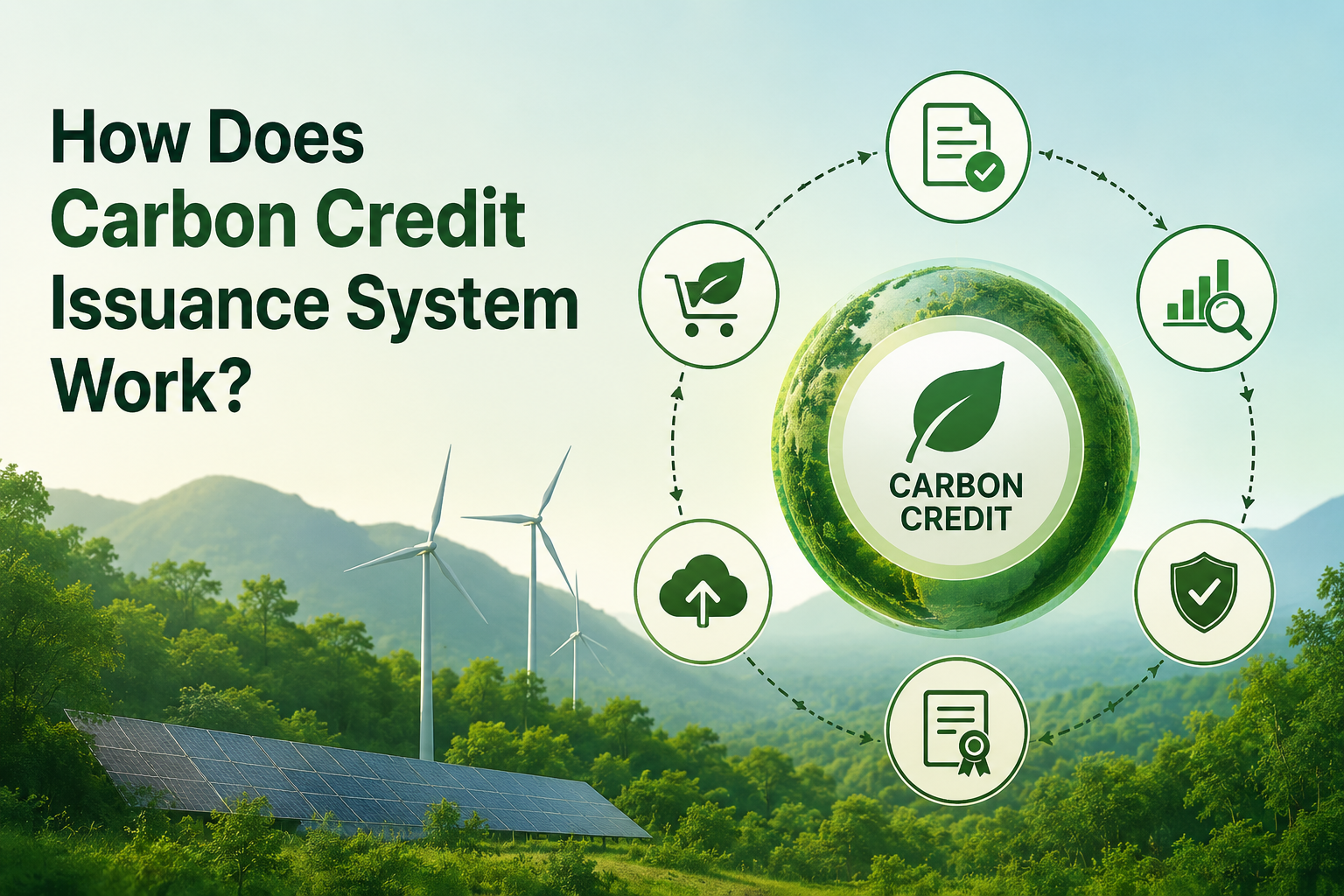
Carbon credits are no longer just a policy tool. They have become a global financial key that businesses, governments and investors actively trade to meet climate goals.
But before a credit can be bought or sold, it must go through a structured issuance process that ensures every credit represents a real, verified and measurable reduction in emissions.
Understanding how a carbon credit issuance system works can make a big difference. Businesses make smarter decisions whether they are developing a carbon project, buying offsets or building a platform to manage it all.
At Triple Minds, we help businesses design and develop AI-powered platforms, data pipelines, and software systems that support modern carbon credit operations. If you are building or scaling a carbon credit platform, talk to our team and we will help you find the right approach.
Key Takeaways
1) Carbon credit issuance is a multi-step process that turns a real emission reduction into a tradeable and verifiable financial instrument.
2) Third-party verification is the most critical step in ensuring that credits represent genuine climate benefits.
3) Each issued credit carries a unique serial number that tracks its full lifecycle from issuance to retirement.
4) IoT and blockchain are transforming how carbon projects are monitored and verified, making the process faster and more accurate.
5)The rules of issuance differ significantly between voluntary and compliance with carbon markets and understanding that difference is essential before entering either one.
Launch Your Carbon Trading Marketplace with Triple Minds
If you are planning to build a carbon trading marketplace but are unsure how to structure the platform, onboard buyers and sellers, or manage carbon credit transactions, the challenge is not the vision — it is building the right system. At Triple Minds, we help businesses develop scalable carbon trading platforms with smart automation, secure infrastructure, and seamless marketplace experiences.
Start Building Your Carbon Trading Marketplace Today
What Is a Carbon Credit and Why Issuance Matters?
A carbon credit represents one metric ton of carbon dioxide (or its equivalent in other greenhouse gases) that has been reduced, avoided or removed from the atmosphere. It sounds simple but the process of creating that credit which is called issuance is where most of the complexity lives.
Issuance is the formal step where a recognized registry confirms that an emission reduction happened, was properly measured and met the required standards. Without a credible issuance process, carbon credits have no market value and no environmental integrity.
This is why the issuance system is the foundation of the entire carbon market. It determines which projects qualify, how credits are counted and who gets to sell them.
How Are Carbon Credits Issued?
1) Nature Based Projects (plantation, forests)
Nature-based projects, such as plantation and forest conservation projects, generate carbon credits by removing carbon dioxide (CO₂) from the atmosphere.
These projects are usually started on empty, damaged, or degraded land where little to no carbon absorption takes place due to the absence of trees and vegetation. To improve the condition of the land, trees are planted or existing forests are protected from deforestation.
As the trees grow, they absorb CO₂ from the air through the natural process of photosynthesis. Over time, the total amount of carbon absorbed and stored by the trees is measured and verified. Based on this verified carbon removal, carbon credits are issued by authorized certification bodies or regulatory authorities.
2) Renewable Energy Projects (Solar, Wind, Hydro)
Renewable energy projects, such as solar, wind, and hydro power projects, generate carbon credits by reducing or avoiding greenhouse gas emissions that would otherwise occur from fossil fuel use.
In a normal or baseline scenario, electricity is typically produced using fossil fuels like coal, oil, or diesel, which release large amounts of carbon dioxide (CO₂) into the atmosphere. When a renewable energy project is implemented, clean energy sources such as solar panels, wind turbines, or hydroelectric systems generate the same electricity with little to no emissions.
The reduction in emissions is then measured by comparing the emissions from the baseline fossil-fuel scenario with the actual emissions from the renewable energy project. This avoided amount of CO₂ becomes the basis for carbon credits, which are later verified and issued by authorized certification bodies or regulatory authorities.
3) Energy Efficiency Projects
Energy efficiency projects generate carbon credits by reducing the amount of energy needed to perform the same activity or task, which ultimately lowers greenhouse gas emissions. In the baseline scenario, older equipment, machines, or systems consume more energy and produce higher emissions due to lower efficiency.
When an energy efficiency project is implemented, these outdated systems are replaced or upgraded with more efficient technologies that require less energy to operate. As a result, overall energy consumption and emissions are reduced while maintaining the same level of output or performance.
The amount of emissions avoided or saved through these improvements is carefully measured and verified. Based on this verified reduction, carbon credits are issued by recognized certification bodies such as Verra and Gold Standard.
4) Waste And Methane Projects
In waste and methane projects, carbon credits are generated by preventing harmful gases from entering the atmosphere. Methane is a particularly powerful greenhouse gas which is much more impactful than CO2 in the short term.
In the baseline scenario, waste from landfills or farms releases methane directly into the air. With a project in place, the methane is captured and either burned or reused as energy. This stops gas from being released. The amount of prevented emissions is converted into carbon credits and then get issued by the authorities.
Read Also: A Complete Guide On How to Build a Carbon Offset Tracking System?
The Step By Step Guide To Carbon Credit Issuance Process
The journey from an emission reduction activity to a tradeable carbon credit follows a structured path. Here is how it works from start to finish.
1) Project Registration
The project developers can be :
1) Forestry Companies (plantation and nature-based projects)
2) Renewable energy companies (Solar, Hydro, wind)
3) Energy service companies
4) Waste management businesses etc.
Such project developers submit their projects to a recognized carbon registry such as Verra, Gold standard or the American Carbon Registry. The submission includes a project design document explaining the type of emission reduction activity, the location, the methodology being used and the expected volume of credits.
2) Baseline Establishment
Before any credits can be issued, the registry needs to know how much emission would have occurred without the project. This is called the baseline. It is a calculated estimate of the business as usual scenario. Before a project starts, experts estimate how much pollution a company would normally produce. This is called the baseline.
For example, if a factory is expected to emit 100 tons of CO2 but after a new project it only emits 60 tons, then the 40-ton reduction becomes carbon credits.
Simply put, the bigger the drop in emissions compared to the baseline, the more carbon credits the project can earn.
3) Monitoring and Data Collection
Once approved, the project must continuously collect data to prove that the emission reductions are happening as planned. This includes energy output data, satellite imagery, sensor readings, land use records and more. Monitoring plans are defined in advance and must be followed precisely.
4) Third Party Verification
An independent auditor reviews all the collected data and checks whether the project delivered the promised reductions. This step is important because it removes any conflict of interest. The verifier must be accredited by the relevant registry and follows strict protocols to validate the numbers.
5) Credit Issuance By The Registry
Once the verifier signs off, the registry issues the carbon credits and records them in a public database. Each credit gets a unique serial number that tracks its origin, the project it came from and it’s status. This is how double counting is prevented.
6) Listing On The Carbon Market
After issuance, the credits can be sold on voluntary carbon markets or used for compliance purposes depending on the program. Once a buyer retires a credit then it is permanently removed from the circulation and cannot be sold again.
Read Also: How to Make Money Producing and Selling Carbon Offsets
How Technology Is Changing Carbon Credit Issuance System?
The traditional issuance process is slow, paper heavy and prone to errors. Technology is changing that in meaningful ways and this is where modern platforms are making a real difference.
1) IOT Sensors
Sensors installed at project sites collect real time environmental data, making monitoring continuous rather than periodic. This improves data quality and reduces the risk of manipulation.
2) Blockchain
It is being explored to create tamper proof records of credits issuance, ownership and retirement. A decentralized ledger makes it harder to double count or fraudulently retire credits.
3) Automated Reporting Systems
Reporting systems replace manual data collection with structured pipelines that feed directly into verification workflows, cutting the time from project completion to credit issuance.
4) MRV Platforms (Monitoring, Reporting and Verification)
Such platforms are purpose-built software systems that bring all of these tools together in one place. They are becoming the standard infrastructure for serious carbon project developers and registries.
Voluntary vs Compliance Carbon Markets: What Changes in Issuance?
The issuance process differs depending on which market the credits are intended for.
In voluntary carbon markets, companies and individuals buy credits to meet self-imposed sustainability goals. The standards are set by private registries like Verra and Gold Standard. Participation is optional, and there is more flexibility in the types of projects that qualify. The issuance process is still rigorous, but it is governed by market-driven standards rather than government regulation.
In compliance with carbon markets, participation is mandatory for certain industries under government regulation. Examples include the European Union Emissions Trading System and California’s Cap and Trade program. Issuance in these markets is tightly controlled by regulatory bodies, and credits are often called allowances rather than offsets. The rules are stricter, the penalties for non-compliance are significant, and the entire process is subject to government oversight.
Prototype Your Carbon Trading Platform Before Full-Scale Development
Building a carbon trading or credit issuance platform requires the right strategy, workflows, and user experience before investing in full development. Triple Minds helps businesses create interactive prototypes and validate platform concepts for carbon marketplaces, MRV systems, and carbon credit management solutions.
Start Your Carbon Platform Prototype Today
Conclusion
A carbon credit issuance system is the mechanism that gives a carbon credit its value, integrity, and market credibility. From project registration to third party verification to registry issuance, every step exists to ensure that a credit represents a real and measurable climate benefit.
As the carbon market grows and regulations tighten, the demand for reliable, technology-driven issuance systems will only increase. Businesses that understand this process are better positioned to participate in it, whether as project developers, buyers, or platform builders.
Quick Answers to Common Questions
How long does it take to get carbon credits issued after a project is verified?
It typically takes several weeks to a few months depending on the registry and the complexity of the project.
Can a carbon credit be cancelled after it is issued?
Yes, registries can cancel credits if fraud or data errors are discovered after issuance.
What is the difference between a carbon credit and a carbon allowance?
Credits come from voluntary offset projects while allowances are government-issued permits used in compliance markets.
What is additionality and why does it matter in issuance?
Additionality means the emission reduction would not have happened without the carbon credit incentive, and it is a core requirement for credit approval.
Are all carbon registries globally recognized and accepted?
No, different markets and regulators recognize different registries, and credits from one registry may not be accepted in another program.
Got a project in mind? Let’s build it together.
We work with founders and product teams across consulting, development, and growth marketing. Tell us what you’re building and we’ll show you how we’d ship it.