How to Build an Investor-Ready Startup Product? (Step By Step)
Learn how startups can build investor-ready products without wasting time or budget on unnecessary features. This guide explains how to validate ideas, create focused prototypes, and present a scalable product vision that attracts investors. Perfect for early-stage founders preparing for funding conversations.

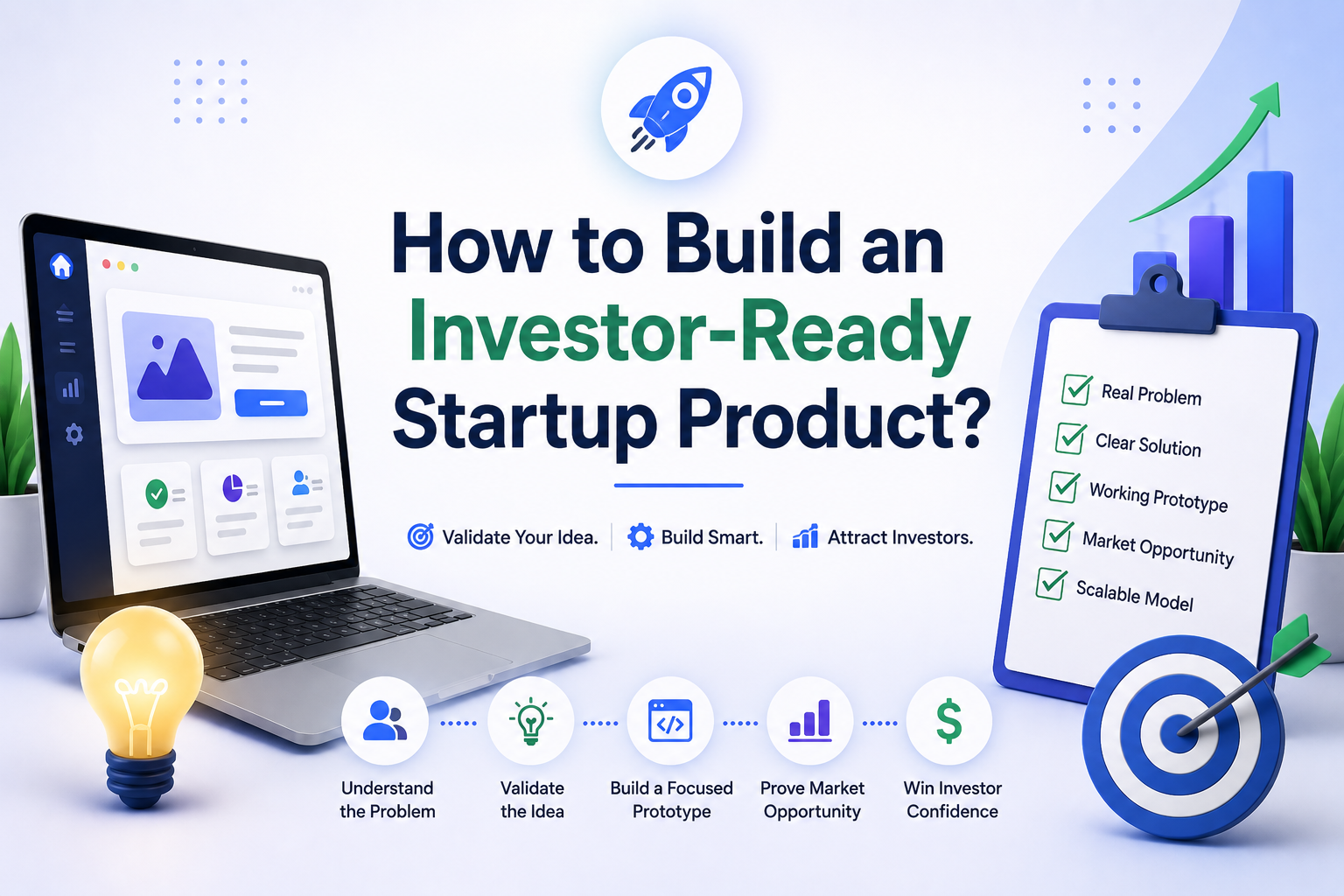
Most startups think investor-ready means having a fully built product, but in reality it does not work this way. What investors actually want to see is proof – the kind of proof showing that your idea solves a real problem, that people want it, and you can execute it.
If you are a startup and wondering where to even begin, this guide walks you through exactly what it takes to build something investors take seriously without burning through your savings before you even pitch.
Triple Minds helps early-stage founders turn ideas into investor-ready prototypes through expert consulting and hands-on development.
Key Takeaways
1) Investor-ready does not mean fully built, it means clear enough to prove the problem, the solution, and the market opportunity are all real.
2) Talking to real users before writing a single line of code is the single most important step most founders skip.
3) A focused prototype that shows the core user journey confidently will always outperform a bloated product that tries to do too much.
4) Over-building before validation is the fastest way to waste your pre-seed budget on features investors never asked to see.
5) The right consulting partner at the start of your build can save you months of rework and position your product correctly before you ever walk into a pitch room.
Need a Prototype Investors Can Actually Believe In?
Triple Minds helps startups turn raw ideas into investor-ready prototypes with the right strategy, UX flow, and scalable product planning. From validation to clickable demos and MVP architecture, the focus stays on building what matters most before pitching investors.
Explore Prototype Development Services
What Does An Investor-Ready Actually Mean?
Investor-ready does not mean creating a fine product. It actually means to create a kind of product which is convincing enough for an investor to bet money on it’s future.
An investor-ready startup product shows three things clearly:
1) The problem is real and worth solving
2) Your solution works, at least at a basic level
3) There is market that will pay for it
That is it. You do not need every feature built. You do not need thousands of users. You need to answer those three questions with proper evidence and expertise.
Read Also: What Does It Cost to Make an AI-Built MVP Production Ready?
Start With The Problem, Not The Product
The most common mistake founders make is focusing on their solution before understanding the problem deeply enough.
Before you build anything, ask yourself – who exactly is struggling with this and how often does it hurt them? If you cannot answer that clearly then you are not ready to build.
Here is simple way to validate before you build :
1) Try to know your target users and audience, talk to some people who match your target users.
2) Ask about their current pain, not about your idea.
3) Look for patterns that frustrates them the most.
4) After that, check if your solution addresses that frustration.
This step costs nothing but time and it will save you from building the wrong thing entirely. Investors have seen hundreds of pitches. They can immediately spot startups who skipped this step.
Major Things Investors Look For In A Startup Product
When an investor looks at your product, they are not judging the design or the feature list. They are looking for signals that this is worth their money and attention.
Here are the five things that matter most:
- A working prototype or demo that shows your core idea in action, not just slides.
- A clear and specific use case so they immediately understand who uses it and why.
- Evidence of market size even rough numbers showing the opportunity is large enough.
- Some form of early traction or validation like signups, waitlists, pilot users, or letters of intent.
- A product architecture that can scale meaning it will not fall apart if a thousand users show up tomorrow.
Build A Prototype That Shows, Not Just Tells
There is a big difference between an MVP and an investor-ready prototype. An MVP is built for users to test. An investor-ready prototype is built to communicate your vision clearly and prove feasibility.
Your prototype should do three things well:
1) Show the core user journey from start to finish without getting stuck.
2) Highlight the part of your product that is unique or difficult to copy.
3) Feel polished enough that the investor can imagine the finished product.
What you can skip at this stage: advanced features, complex integrations, full mobile optimization, and anything that does not directly support your core pitch.
A good prototype is focused. Every screen and every interaction should answer the question: why does this exist?
If you are unsure what to include or how to scope it correctly then this is where working with an experienced consulting and development team saves you from over-building or building in the wrong direction.
Read Also: Climate Tech Startup Ideas That Actually Make Money
Common Mistakes Startups Make Before Pitching
Even strong ideas lose investor interest because of avoidable mistakes in how the product is built and presented.
Here are the most common ones to watch out for:
1) Over-building before validating and spending months on features no one asked for.
2) Skipping professional consulting and making expensive technical decisions without enough experience.
3) No clear monetization path leaving investors to guess how this ever makes money.
4) Poor user experience where the prototype feels confusing or unfinished even for a demo.
5) No documentation or structure behind the product making it look like a side project rather than a serious business.
The best thing you can do before your first investor meeting is to have someone who has already built and evaluated products before.
How to Get Expert Help Without Burning Your Budget
Building an investor-ready product does not require a massive team or a large upfront investment. What it requires is the right guidance early on.
Many startups and businesses waste their first funding round fixing mistakes they made before they even had the money. The smarter approach is to bring in consulting support before you build, so your first version is already built with the right priorities in mind.
This is where a partner like Triple Minds makes a real difference. Our Investor Ready Prototype Solution is built specifically for businesses who need to move fast, keep costs under control, and show up to investor conversations with something credible. From initial consulting to prototype development, the process is designed to help you build what matters and skip what does not.
Whether you are starting from a rough idea or already have some early work done, getting a clear outside perspective before you pitch can make a big difference.
Validate Your Startup Idea Before You Burn Your Budget
Avoid the common mistakes early-stage founders make before fundraising. Triple Minds provides startup consulting focused on idea validation, product scoping, monetization planning, and technical guidance to help founders move faster with clarity and confidence.
Book a Startup Strategy Session
Conclusion
Building an investor-ready startup product comes down to four things
1) Understanding the problem deeply
2) Validating before building
3) Focusing your prototype on what matters most
4) Making sure the product tells a clear story.
Investors are not looking for perfection. They are looking for clarity, conviction, and evidence. Get these things right, and your product will stand out in the market.
Ready to build something investors actually want to fund? Talk to us about our investor ready prototype solution and get expert guidance from day one.
Quick Answers to Common Questions
How much does it cost to build an investor-ready prototype?
It depends on your idea’s complexity and scope. Most founders can get a credible prototype built for far less than a full product by scoping it correctly from the start, which is what a consulting session helps you figure out before any development begins.
Do I need a technical co-founder to build an investor-ready product?
No, many founders have raised funding without one by working with the right development and consulting partner. What matters is that the product is built with a clear strategy, not who builds it.
How long does it take to go from idea to investor-ready prototype?
A focused and well-scoped prototype can be ready in 6 to 12 weeks. Founders who come in with a validated idea and a clear user journey move significantly faster than those still figuring out the core concept during the build.
Should I apply for funding before my product is built?
In most cases no, the majority of angels and early-stage VCs want to see something working before they commit. Even a simple but polished prototype dramatically increases your credibility in the room.
What is the difference between a prototype, an MVP, and a final product?
A prototype validates your idea for investors. An MVP is a functional version released to real users to prove demand. A final product is fully built and market-ready. Focus on the prototype first, use funding to build the MVP, and grow from there.
Got a project in mind? Let’s build it together.
We work with founders and product teams across consulting, development, and growth marketing. Tell us what you’re building and we’ll show you how we’d ship it.