AI Medical Scribe Development Cost & Features List – Build Guide for Clinics, Hospitals and Health Tech Startups
What it actually costs to build a HIPAA-compliant AI medical scribe in 2026 — $18K to $25K, shipped in under 90 days. Real component breakdown, EHR integration math, and the corners other shops cut to quote you $5K.

Doctors spend more time typing into the EHR than they spend with the patient in front of them. The American Medical Association’s 2025 burnout survey put it at roughly 5 to 6 hours of documentation for every 7 hours of actual clinical care. That math used to be unfixable. In 2026 it isn’t, because the AI medical scribe category has gone from demo-stage to production-grade in about eighteen months.
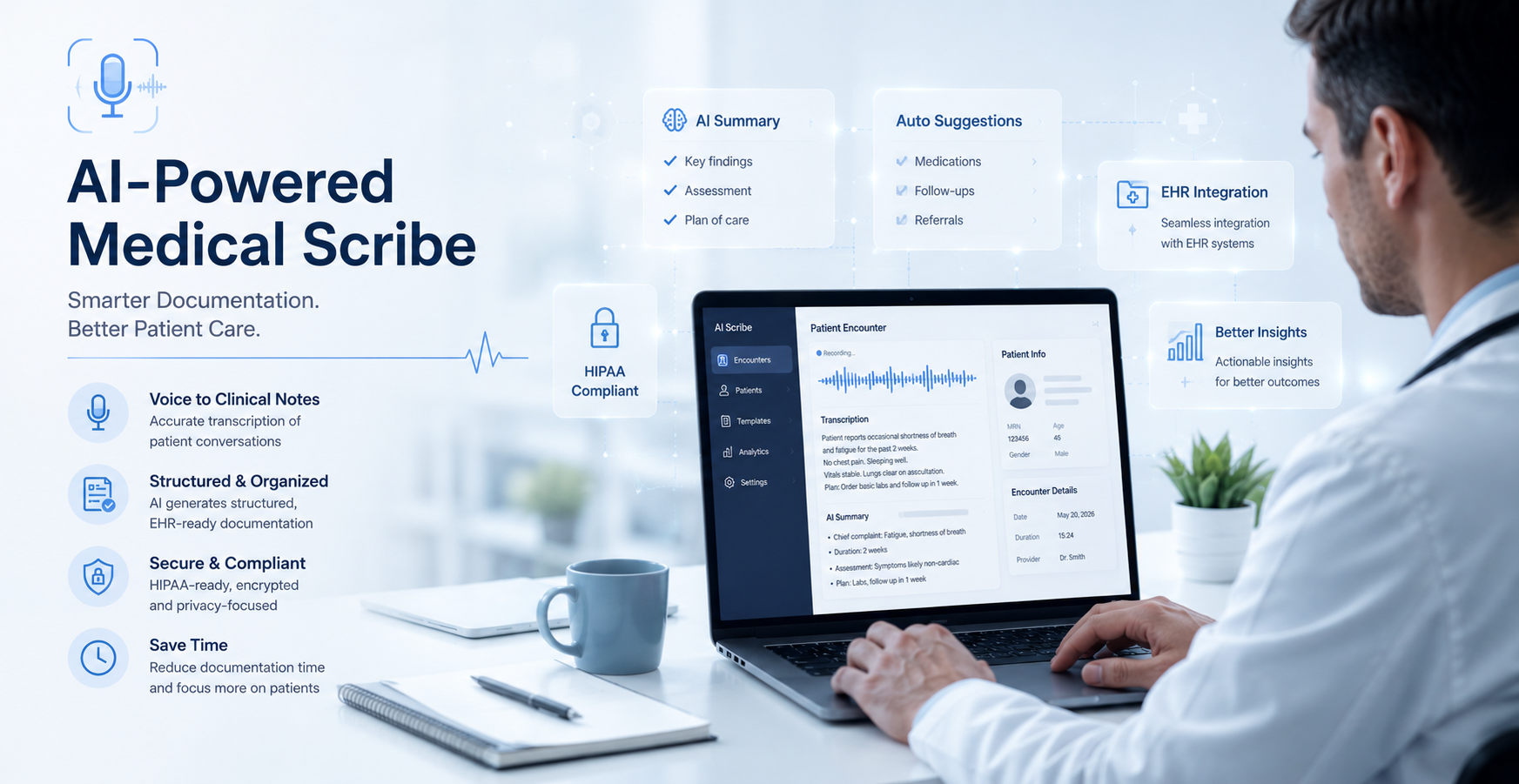
An AI medical scribe sits in the encounter (usually a phone in the doctor’s pocket or a discrete USB mic on the desk), listens to the conversation, and writes the visit note. SOAP format, structured fields, ICD-10 and CPT code suggestions, pushed directly into the EHR before the next patient walks in. The good ones save a clinician 1 to 2 hours a day. The best ones we’ve seen save 3.
We build them. Production-grade, HIPAA-compliant, EHR-integrated, ready for real patient encounters. Our typical AI medical scribe build runs $18,000 to $25,000 total, shipped in under 90 days. This blog is the honest breakdown — what’s in the price, what isn’t, what to skip, which EHR you’re integrating with, and which corners the cheaper shops cut when they quote you $5,000 (spoiler: most of them).
We’re Triple Minds. We’ve built compliance-heavy AI products — including a white-label AI mental health app running on the same architectural pattern a medical scribe needs (secure transcription, structured output, audit logging, integration with downstream clinical systems). The underlying engineering for healthcare AI is what we do every week. If you want a real quote scoped to your clinic or platform, the link below opens our scoping form.
Want a real quote for your AI medical scribe? Free 30-minute scoping call, no sales theatre: book a slot here.
What an AI medical scribe actually does (and what people confuse it with)
An AI medical scribe is not a transcription service. Transcription gives you a word-for-word log of what was said. A scribe gives you a structured clinical note — chief complaint, history of present illness, review of systems, physical exam findings, assessment, plan, billing codes, follow-up tasks. Three different problems wrapped into one product.
Under the hood, every AI medical scribe is three layers stacked on top of each other:
- Speech-to-text (ASR). Converts the audio of the patient encounter into a transcript with speaker labels. The hard parts: medical vocabulary, accents, mumbling, two people talking at once, the patient’s elderly mother chiming in from the corner.
- Medical NLP + structuring. A language model reads the transcript and reorganises it into the clinical note format your specialty uses. SOAP for most outpatient work, BIRP for behavioural health, H&P for hospital admissions, discharge summary for inpatient releases.
- EHR integration. Pushes the structured note into Epic, Cerner, Athena, eClinicalWorks, or whatever the clinic runs. Maps fields, attaches codes, schedules follow-ups. This is the layer most demo videos quietly skip past, and it’s usually where the real money in a build goes.
Get any one of the three wrong and the product looks like a tech demo in front of investors and a clinical liability in front of real patients. That gap — demo-grade vs production-grade — is the whole reason real AI medical scribe development costs what it does.
Read Also: How AI Therapy Chatbots Are Making Mental Healthcare?
AI medical scribe development cost in 2026 — the real $18K to $25K breakdown
The full component breakdown for a typical build with us:
| Component | Cost range | What it is |
|---|---|---|
| Discovery + clinical workflow mapping | $1,500 – $2,500 | We sit with your clinicians, watch a couple of encounters, map your exact note format, decide which EHR fields the scribe writes into |
| ASR layer (provider selection + integration) | $2,500 – $3,500 | Picking the right speech-to-text engine for your accent/specialty mix, wiring it up with diarization and medical-term hinting |
| Medical NLP + SOAP structuring | $3,500 – $5,000 | LLM prompting + post-processing layer that turns transcript into a structured note. The biggest variable in the build. |
| EHR integration | $3,500 – $6,000 | Epic App Orchard / Cerner CODE / Athena Marketplace / eClinicalWorks — each has its own approval process and integration depth |
| Frontend (clinician web + mobile companion) | $2,500 – $3,500 | The actual app the doctor uses — record button, transcript view, note review, send-to-EHR confirmation |
| HIPAA compliance layer + audit logging | $2,000 – $2,500 | BAAs, encryption at rest + in transit, immutable audit log, PHI handling, access controls |
| Clinical testing + validation | $1,500 – $1,500 | 50+ test encounters across specialties, accuracy scoring against gold-standard notes, hallucination detection |
| Deployment + 30 days post-launch support | $1,000 – $1,000 | Production rollout, monitoring setup, daily triage of any issues for the first month |
| Total | $18,000 – $25,500 | End-to-end, ready for real patient encounters |
The variance inside the band is driven by three things: which EHR you’re integrating with (Epic is more work than Athena), how many specialties you support at launch (one is the floor, three is realistic, five gets expensive), and whether you need a mobile companion app on day one or can ship web-first.
Why the $5,000 AI medical scribe quote is a trap
You’ll see other agencies quote $5K to $25K for the same scope. Some of them are honest about what the $5K end actually delivers. Most aren’t.
What $5,000 buys you in 2026, in roughly the order things break:
- A Whisper-API wrapper around OpenAI’s audio endpoint, with no medical-vocabulary tuning, so medication names come out wrong roughly 1 in 8 times
- A single GPT-4o-mini call to “summarise this transcript into a SOAP note” with a 200-word system prompt, no validation, no specialty awareness
- No EHR integration — just a button that emails the note to you, which the clinician then pastes manually
- No BAA with the LLM provider, which means you’re technically violating HIPAA on every encounter
- No audit log, no role-based access, no PHI redaction in the logs you do keep
- No clinical validation — the note quality has never been compared against a real chart by a real clinician
It will demo beautifully. It will fail the first time you put it in front of a regulator, a malpractice insurer, or a doctor who actually checks the chart it generated. We’ve cleaned up four of these in the last twelve months. The cleanup costs more than building it right the first time would have.
AI medical scribe features list — what’s in, what’s optional, what to skip
The feature list every healthcare buyer wrestles with. Grouped by priority, with our opinion on each.
Must-have (every build, no exceptions)
- Ambient audio capture from a mobile device or USB mic
- Speaker diarization (knows who’s the clinician and who’s the patient)
- Medical-vocabulary-tuned ASR with at least 95% accuracy on common drug names
- SOAP-format note generation with structured sections
- Inline edit interface so clinicians can correct before signing
- HIPAA-compliant data handling — BAA with every subprocessor, AES-256 at rest, TLS 1.3 in transit
- Immutable audit log of who accessed what PHI when
- One EHR integration (whichever the launch customer uses)
- Clinician dashboard with daily summary, notes pending review, error flags
Should-have (in most builds, adds modest cost)
- ICD-10 and CPT code suggestions tied to the assessment + plan sections
- Specialty-specific note templates (primary care, cardiology, mental health, ortho — pick the ones you need)
- Patient instruction generation (the after-visit summary in patient-friendly language)
- Follow-up task creation (lab orders, referrals, reminders pushed into the EHR task queue)
- Multi-language support if the clinic sees non-English-speaking patients
- Voice command interface (“scribe, add chief complaint…”)
Nice-to-have (only if the budget allows and the use case justifies)
- Real-time draft generation (the note is being written while the visit is still happening — looks magical, adds 25-30% to ASR cost because of streaming inference)
- Prior authorization pre-fill (auto-completes prior auth forms from the encounter data)
- Clinical decision support hints (think “this drug interacts with their current statin”)
- Multi-provider rooms (residents + attending + nurse all separately diarised)
Avoid (regulatory landmines or low ROI)
- Diagnostic suggestions (“this looks like X disease”). The moment your product makes a diagnosis, the FDA wants to talk to you about Class II medical device clearance. That’s a different blog post and a different price band.
- Full on-premise deployment. Adds 25-40% to the build and almost never makes business sense for clinics under 100 providers. Cloud + a proper BAA covers HIPAA cleanly.
- Patient-facing chatbots layered into the same product. Worth building separately, not bundled into the scribe.
Read Also: How to Make Mental Health App Like Elomia Clone?
The AI medical scribe tech stack — and why we picked it
Speech-to-text (ASR)
This is where naive builds die. Generic ASR has a Word Error Rate of 10-15% on clinical speech. That’s one mistake every 8-10 words, which on a 5-minute encounter is unworkable. Medical-tuned ASR is required.
| ASR provider | Approx WER on clinical speech | Cost / minute | HIPAA BAA | Best for |
|---|---|---|---|---|
| AWS Transcribe Medical | ~5-7% | ~$0.075 | Yes | Most US deployments — boring, reliable, BAA-ready |
| Google Speech-to-Text Medical | ~6-8% | ~$0.024 | Yes | Cost-sensitive builds with Google Cloud already in stack |
| Deepgram Nova-3 Medical | ~5-6% (vendor benchmark) | ~$0.043 | Yes | Real-time / streaming use cases |
| Whisper Large v3 (self-hosted) | ~8-12% on clinical without tuning | ~$0.005 (GPU cost) | N/A (self-hosted) | On-prem deployments only — needs fine-tuning to be competitive |
Our default for most builds is AWS Transcribe Medical or Deepgram Nova-3 depending on whether the client needs real-time streaming or can wait 5-10 seconds for batch processing.
LLM for note generation
The model that turns transcript into structured SOAP note. Cost-per-token matters because every encounter sends 2,000-5,000 tokens of context. A clinic doing 80 encounters a day is sending 200K-400K tokens daily.
| Model | Cost / 1M input tokens | Note quality (our scoring) | BAA | When we pick it |
|---|---|---|---|---|
| GPT-4o | ~$2.50 | 9/10 | Yes (OpenAI Enterprise) | Complex specialties, long encounters |
| Claude 3.7 Sonnet | ~$3.00 | 9/10 | Yes (Anthropic Enterprise) | Mental health, complex narrative notes |
| GPT-4o mini | ~$0.15 | 7.5/10 | Yes (OpenAI Enterprise) | Routine primary care, high-volume clinics |
| Claude Haiku 3.5 | ~$0.80 | 8/10 | Yes (Anthropic Enterprise) | Our default — best balance of cost and clinical accuracy |
| Fine-tuned Llama-3.3 (self-hosted) | ~$0.10 (compute) | 7/10 unless heavily tuned | N/A | Tier-1 hospitals with on-prem mandate |
Important: the LLM provider must sign a Business Associate Agreement. OpenAI, Anthropic, and Google all offer BAAs on their enterprise tiers. Consumer ChatGPT or Claude.ai accounts do not. We’ve audited builds where the previous shop had been routing PHI through a standard consumer OpenAI key. That’s an instant HIPAA violation per encounter.
EHR integration — the part most agencies hand-wave
This is the line item where our $3,500-$6,000 range comes from. Each EHR is a different animal.
| EHR | Integration path | Approval timeline | Relative build cost |
|---|---|---|---|
| Epic | App Orchard / Showroom (FHIR R4, USCDI) | 3-6 months for app listing; can integrate via SMART on FHIR sooner for a specific customer | High (~$5K-$6K) |
| Oracle Cerner | CODE program (FHIR + proprietary APIs) | 2-4 months | High (~$4.5K-$6K) |
| Athenahealth | Athena Marketplace (REST APIs, FHIR) | 4-8 weeks | Medium (~$3.5K-$4.5K) |
| eClinicalWorks | eCW API access via partnership | 4-6 weeks | Medium (~$3.5K-$4.5K) |
| Allscripts / Veradigm | Developer program (FHIR) | 4-8 weeks | Medium (~$3.5K-$5K) |
If you’re building for a specific clinic that uses Epic, you do not have to go through App Orchard to start — you can do a direct SMART on FHIR integration scoped to that one customer and ship in weeks. App Orchard is what you need when you want to sell the scribe as a product to other Epic-using clinics.
HIPAA, BAAs, and the compliance layer that’s non-negotiable
The bit of an AI medical scribe build that most non-healthcare developers underestimate. HIPAA compliance is not a checkbox — it’s a stack of things that have to be true at every layer.
- BAAs with every subprocessor that touches PHI. AWS, Anthropic, OpenAI, your CDN, your email provider, your error monitoring tool. If you can’t get a signed BAA, you can’t route PHI through that vendor.
- Encryption at rest (AES-256) and in transit (TLS 1.3 minimum). Boring, mandatory, and somehow still missed by ~30% of the audits we run on existing builds.
- Immutable audit log of every PHI access. Who looked at what, when, from where. Has to survive an OCR audit five years later.
- Role-based access control. The receptionist doesn’t see the psychiatry notes. The medical assistant doesn’t see the billing data. The cleaner doesn’t see anything.
- PHI redaction in observability tools. Sentry, Datadog, your own logs — all of them have to scrub PHI before it leaves the production environment.
- Incident response + breach notification flow documented. 60-day window for HHS notification on a breach affecting 500+ patients.
- SOC 2 Type II if you’re selling to enterprise health systems. Not legally required, but every hospital procurement team asks for it. Plan for a 6-12 month audit cycle.
The $2,000-$2,500 we quote for compliance covers all of the above except SOC 2 (which is a separate annual cost, typically $15-$40K depending on the auditor). It’s not a fee for paperwork — it’s a stack of engineering controls baked into the application.
Read Also: How Much Does an AI Hospital Management System Development Cost
The under-90-day delivery timeline (week by week)
The reason we can ship an AI medical scribe in under 90 days when most healthcare-IT consultancies quote 6-12 months: we built our reference architecture in 2024, ASRs and LLMs both shipped enterprise BAAs through 2025, and we don’t bill for waiting on procurement we can’t influence.
| Phase | Weeks | What ships |
|---|---|---|
| Discovery + spec | 1-2 | Workflow mapping, EHR access scoped, BAAs lined up, note format finalised with your clinical team |
| ASR + transport layer | 3-4 | Audio capture, streaming, diarization, transcript display |
| NLP + note generation | 4-6 | SOAP structuring, code suggestions, specialty templates, edit interface |
| EHR integration | 6-9 | FHIR connection (or proprietary API), field mapping, push-back testing in your sandbox |
| Compliance hardening | 8-10 | Audit log, RBAC, PHI redaction, encryption review, penetration test |
| Clinical validation | 9-11 | 50+ test encounters across your specialties, accuracy scoring, hallucination triage |
| Deployment + first-month support | 12+ | Production rollout, monitoring, daily issue triage |
The phases overlap — clinical validation starts before EHR integration is fully done, compliance hardening runs in parallel with NLP work. The 90-day clock starts when the spec is signed and the EHR vendor confirms sandbox access, not when you sign the contract.
Specialty matters more than people think
Different specialties produce wildly different note formats, vocabulary, and validation challenges. A scribe that’s great for primary care is bad at psychiatry. A psychiatry scribe doesn’t know what to do with an ED encounter.
- Primary care. Standard SOAP, broad vocabulary, lots of preventive screening fields. The easiest specialty to build well — most of the published benchmarks come from here.
- Cardiology. Heavy on diagnostics — EKG findings, echo measurements, stress test interpretations. Often needs integration with imaging systems. Notes are longer.
- Mental health / psychiatry. Long-form narrative notes, BIRP format, sensitive PHI handling, suicide risk screening fields. The LLM choice matters most here — generic models miss the clinical nuance. Claude Sonnet outperforms GPT-4o in our internal scoring for this specialty.
- Emergency medicine. Fast, time-stamped, action-heavy. Doctors don’t have time to dictate cleanly, so the ASR + diarization layer carries more weight.
- Orthopedics. Surgical procedure notes are highly structured (CPT-driven). Lots of named anatomy. Often the easiest to get high accuracy on because the vocabulary is bounded.
- Telehealth. The audio pipeline is different (mixed-down audio from the video call) and the scribe has to work without seeing the patient. Most builds need a separate audio path here.
Our $18K-$25K range assumes one or two specialties at launch. Adding more later is a smaller cost line — once the scribe framework exists, each additional specialty adds roughly $2K-$3K for the template work and clinical validation.
The ROI math nobody publishes
Honest version, with real numbers:
- Average US physician spends ~1.5 hours per day on documentation outside scheduled clinical hours (the “pajama time” the AMA tracks)
- A well-built AI medical scribe reclaims 60-80% of that — call it 1 hour a day saved per physician
- That hour can go to one of three places: more patient slots (revenue), reduced burnout (retention), or shorter days (quality of life)
- At the revenue conversion end, one extra patient per day at a $150 average visit reimbursement = $30K-$40K per provider per year
- For a 5-provider primary care group, that’s $150K-$200K annual upside against a one-time $18K-$25K build cost and ~$200-$400/month in API costs going forward
The ROI is a no-brainer on paper. The reason it isn’t ubiquitous yet is that most clinics had bad experiences with the first wave of scribes in 2024 (low accuracy, EHR fights, no specialty awareness) and are skeptical. The 2026 generation of scribes is materially better. The difference is mostly in the engineering choices we just walked through.
Why hire us (the short version)
We’re not a healthcare-only shop. We’re an AI development team that ships compliance-heavy products. The white-label AI mental health app in our portfolio runs on the same architectural principles a medical scribe needs — secure capture, structured output, audit logging, integration with downstream clinical systems. We’ve also shipped AI products at real scale, including platforms with persistent memory and real-time inference for thousands of paying users, so the engineering depth carries cleanly across.
Practically: we quote you the real number on day one ($18K to $25K depending on EHR + specialty count), we ship in under 90 days from spec sign-off, and we don’t take on builds we can’t validate clinically before launch. If your encounter volume is too low to recover the investment in 12 months, we’ll tell you that on the scoping call instead of selling you something.
FAQs
Is $18K really enough to build a real HIPAA-compliant AI medical scribe?
Yes — for one specialty, one EHR integration (Athena, eCW, Allscripts at the lower end of the range; Epic and Cerner push you toward the $25K end), with all the must-have features in the list above. It’s not enough for multi-specialty + on-prem + real-time streaming on day one. That’s why the range exists.
What’s the ongoing cost after the build?
Two parts. The ASR + LLM API bill, typically $200 to $400 per provider per month at normal clinic volume (~30 encounters/day). And cloud hosting + monitoring, usually $150-$400/month for clinics under 25 providers. Optional retainer for changes and updates runs $2,000-$5,000/month if you want one, but most clients drop it after the first quarter once the product stabilises.
Do you need a Business Associate Agreement with OpenAI / Anthropic?
Yes, absolutely. Routing PHI through an LLM API without a signed BAA is a HIPAA violation per encounter. Both OpenAI and Anthropic offer BAAs on their enterprise / API tiers. The consumer ChatGPT and Claude.ai products do not — never route PHI through those.
Can you integrate with Epic without going through App Orchard?
For a single specific Epic-using clinic, yes — via SMART on FHIR scoped to that customer. The clinic’s Epic team has to enable the connection. This is the fastest path if you have a launch customer in mind. App Orchard is the path when you want to sell the scribe as a product to other Epic clinics, and it takes 3-6 months for app listing approval on top of the build.
Does an AI medical scribe need FDA clearance?
Not for documentation work — note generation, code suggestion, transcript-to-SOAP. Those are administrative aids and outside FDA scope. The moment your product crosses into diagnosis or treatment recommendation (“this looks like atrial fibrillation, consider an EKG”), it becomes a Class II medical device and needs 510(k) clearance. That’s a different product and a different price band. We don’t build into that territory unless the client comes in with a regulatory pathway already mapped.
How accurate is the SOAP note compared to a human scribe?
For a well-built 2026 system on a routine outpatient visit, the structured note matches a human scribe roughly 85-92% of the time on factual content, with a clinician edit time of 1-3 minutes per note. Specialty-specific notes can be lower (mental health drops to 75-85% before edits). The clinician always reviews and signs before the note is finalised — that’s a regulatory requirement, not just a quality one.
What if my clinic uses an EHR that isn’t in your integration table?
If your EHR has a public API or FHIR endpoint, we’ll quote the integration specifically. We’ve shipped to NextGen, Practice Fusion, AdvancedMD, and a few specialty-specific systems. If the EHR is a regional or boutique product with no developer program, that’s harder — and usually pushes the build to the top of the price range.
Why hire you instead of buying Abridge / Suki / Nuance DAX?
If you’re a clinic that just wants the product, those off-the-shelf vendors might be the right call (their pricing is typically $99-$250/provider/month). If you’re a health tech startup building a product to sell to other clinics, or a clinic with a specialty workflow none of the off-the-shelf vendors handle well, custom is the right call. We build the second category. The decision tree usually comes down to: do you want to own the IP and the integration, or rent it?
Ready to build your AI medical scribe?
Tell us the specialty (or specialties), the EHR you’re integrating with, and whether you’re a clinic or a health tech startup. We’ll come back with a real quote in writing — not a “starts from” range — within two business days. If your scope falls outside our $18K-$25K band, we’ll tell you that on the call instead of dragging out the conversation.
Hire us to build your AI medical scribe — $18K to $25K, under 90 days, HIPAA-grade engineering.
Same compliance-heavy AI work we ship across digital therapeutics, AI companions, and enterprise agents. Real quote on day one, no scope creep, clinical validation before launch. Free 30-minute scoping call below.
Got a project in mind? Let’s build it together.
We work with founders and product teams across consulting, development, and growth marketing. Tell us what you’re building and we’ll show you how we’d ship it.