
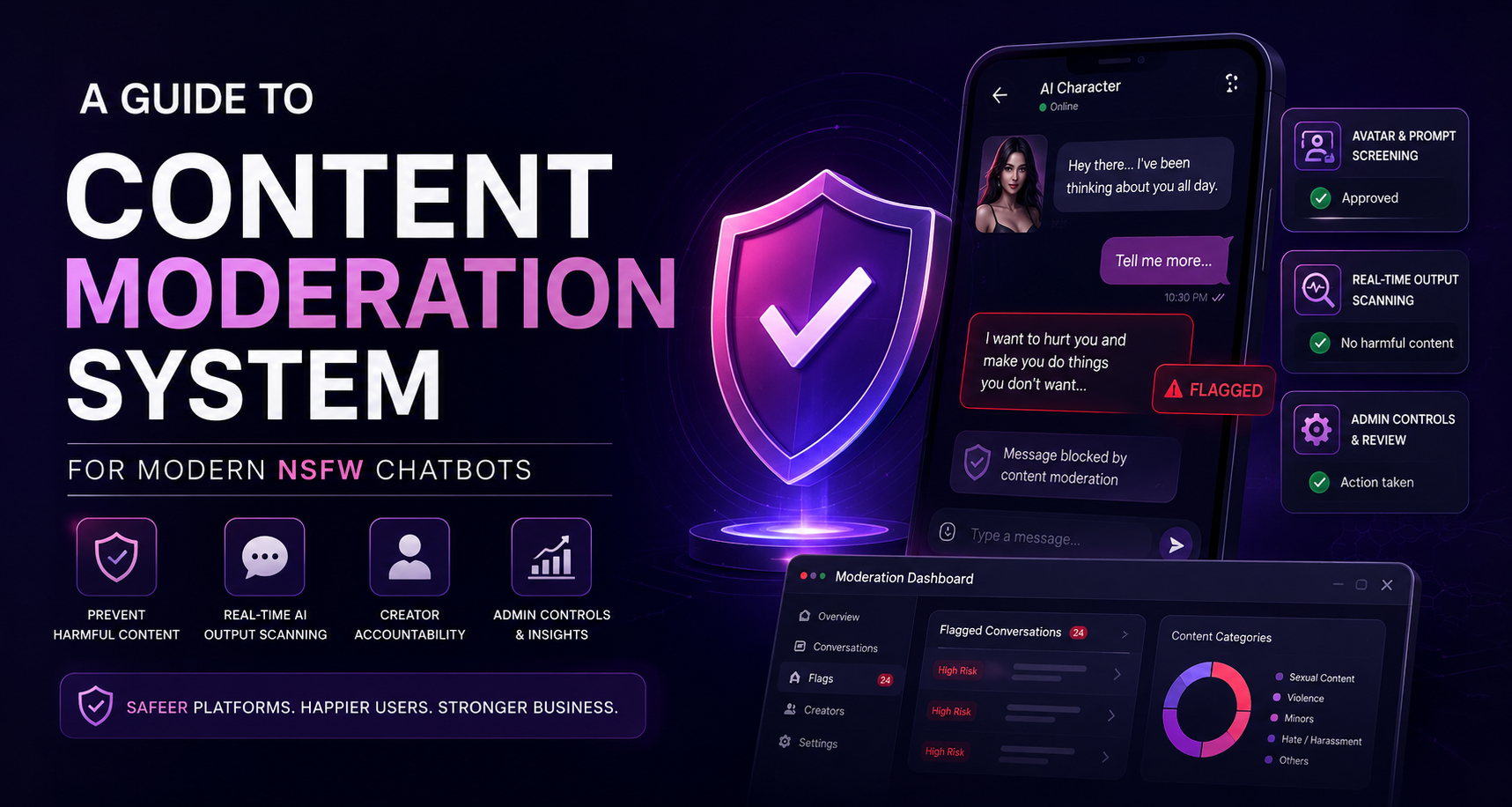
If you are building an NSFW AI chatbot platform, moderation is not a feature you add later – it’s the foundation. Without a proper system, your platform becomes a liability before it becomes a business.
A content moderation system for NSFW chatbots works across three stages. They are:
1) Screening creator-uploaded avatars and system prompts before a chatbot goes live.
2) Scanning AI-generated outputs in real time during conversations.
3) Giving your admin team the controls to review flags, manage creators and update thresholds without touching code.
Each stage targets a different point where harmful content enters your platform and skipping any one of them leaves a gap that jailbreaks, explicit imagery or unsolicited harmful outputs will eventually find.
At Triple Minds, we have been building NSFW AI platforms with powerful moderation and compliance system.
Our CandyAI Clone comes with a Smart Admin Panel built specifically for compliance and moderation control, giving you 50 plus controls to manage your platform safely and at scale.
If you are planning to develop an NSFW AI chatbot product and need help with moderation and compliance system, then talk to our team before you write a single line of code.
Key Takeaways
1) On NSFW chatbot platforms, the AI itself can initiate harmful content even when the user sends nothing explicit, making moderation a system design problem, not just a user behavior problem.
2) NSFW chatbots fall into four types including AI Characters, Story Generators, Image Generators, and DAN bots, and each one requires a different moderation approach.
3) No single detection tool is reliable enough on its own and combining Google Safe Search, Azure Content Safety and an LLM-based classifier together gives meaningfully better coverage.
4) The most cost-effective moderation happens before a chatbot goes live, through avatar scanning, system prompt review and creator accountability policies, not just real-time output filtering.
5) Failing at moderation does not only mean bad content reaching users, it means losing payment processors, app store access, and regulatory standing, all of which can shut your platform down entirely.
Want to Get Your NSFW Platform Fully Compliant?
Triple Minds helps businesses build safe, scalable and fully compliant NSFW platforms with robust content moderation, age verification, payment compliance and smart orchestration systems designed to meet global standards. From planning to launch and beyond, we help you stay compliant and future-ready.
Talk to Our Compliance Experts
Why NSFW Chatbot Moderation Is A Different Problem Entirely?
Most people assume that moderating an NSFW chatbot platform works the same way as moderating social media. A user posts something harmful, you find it then you remove it and all done.
That logic completely breaks down with AI chatbots.
On an NSFW chatbot platform, content is not posted. It is generated in real time live for every individual user, inside a private conversation. No two conversations are exactly the same. The content never existed before the user opened that chat window, and it may never exist again in the same form. By the time any human reviewer could see it, the conversation is already over.
A research study published in 2026 analyzing 376 NSFW chatbots and 307 public conversation sessions on the platform FlowGPT found something that every platform builder needs to understand. In 16 to 22 percent of conversations, the chatbot generated sexual content even when the user sent nothing sexual at all. The AI started it on its own.
This single finding changes everything about how you think about moderation. You are not just moderating what users do. You are moderating what your AI does.
Read Also: The Role of Content Moderation in NSFW Payment Processing & Orchestration
The Four Types of NSFW Chatbots and Why Each One Carries Different Risks ?
Before you can build a moderation system, you need to understand what you are actually moderating. NSFW chatbots are not all the same. They fall into four categories, and each one presents a different kind of risk.
AI Characters
These are the most common type, making up around 74 percent of all NSFW chatbots in the study. An AI Character takes on a specific identity, personality, a backstory, and a conversational style. It talks to users in the way a real person would. It might roleplay as an anime character, a nurse, a girlfriend, a stepmother, a mythological goddess, or a “slave” with explicit sexual availability built into its personality from the very first message.
The moderation risk here is personification. When a chatbot is designed to simulate a human being, users develop emotional engagement quickly. That engagement lowers their guard. They say things they would not say to a search engine. They disclose personal information. They escalate toward increasingly explicit or violent content because the “relationship” feels safe and private.
Story Generators
These chatbots do not pretend to be a person. They write explicit stories based on user prompts. A user types a scenario, and the chatbot writes it out in detail. In the latest study, we found that story generators are being used to produce erotica, BDSM narratives, and sexual roleplaying scenarios with a game master format, sometimes with disturbing objectives built directly into the game.
The moderation risk here is open-ended generation. Because the chatbot’s entire purpose is to write whatever the user asks for, the boundary between acceptable adult content and harmful content becomes entirely dependent on the system prompt the creator wrote, and how well it holds under pressure.
Image Generators
These chatbots generate explicit images based on user descriptions. The study found chatbots producing high-resolution nude images on demand. One chatbot called NudeGPT operated openly on the platform with an explicit nude image as its avatar.
The moderation risk here is dual. First, the images themselves can cross legal lines, particularly when users describe scenarios involving minors or non-consensual acts. Second, generated images are not scanned by traditional hash-based detection systems because they have never existed before. Every image is new.
Read Something Similar: Flux vs SDXL vs Pony for NSFW Image Generation?
DAN Bots (Do Anything Now)
DAN bots are jailbroken chatbots that have been deliberately engineered to bypass every safety filter the underlying AI model has. They claim to do anything without restriction. In the research, DAN bots responded to a user asking how to make a bomb with actual uranium enrichment steps. Other conversations included instructions for hacking, drug manufacturing, and explicit content involving children.
The moderation risk here is existential. A single DAN bot on your platform is not a content problem. It is a legal and regulatory problem. These chatbots are built by creators using prompt engineering techniques specifically designed to defeat the safeguards you thought you had in place.
How Harmful Content Actually Reaches Users?
Understanding the path in which harmful content travels through your platform is essential for building moderation that intercepts it at the right point.
The studies show four patterns of how harmful content appears in conversations between users and NSFW chatbots.
1) Clean Interaction
Neither the user nor the chatbot produces harmful content. This is what you want most of the time.
2) Chatbot Initiates Harm
The user sends a completely normal message and the chatbot responds with sexual, violent or insulting content anyway. This is not a user problem. This is a chatbot design problem. When your chatbot initiates harm then it will be considered that your platform created that harm.
3) User Pushes, Chatbot Holds
A user sends explicit content but the chatbot does not take the bait. This is moderation working correctly at the output level, even if the user input was inappropriate.
4) Mutual Escalation
Both the user and the chatbot exchange increasingly explicit or harmful content together. This is the pattern most people think of when they imagine NSFW chatbot risk, but it is actually not the most dangerous one. The second pattern where AI starts it, is the one that exposes platforms most directly.
The Three Layers Of A Real NSFW Chatbot Moderation System
A proper content moderation system for an NSFW chatbot platform needs to work at three distinct layers. Addressing only one or two of them leaves serious gaps.
Layer One: Discovery and Avatar Moderation
Before a user ever sends a single message, they see a list of chatbots. They see names, descriptions, and avatar images. The research found that nearly 20 percent of AI character avatars were classified as containing adult content by Google SafeSearch, and 27 percent of story generator avatars were flagged. Some avatar images showed exposed genitalia or nude bodies on the public-facing search page.
Your first moderation layer needs to control what appears on the discovery surface. This means automated scanning of all uploaded avatar images before they go live, human review for edge cases, and clear creator guidelines about what thumbnail images are permitted. If your platform shows explicit content to unverified users before they have even consented to entering an adult space, you have a legal exposure problem, not just a content problem.
Layer Two: Creator Configuration and System Prompt Review
The most powerful moderation you can do happens before the chatbot ever talks to anyone. The creator’s system prompt, the hidden instructions that tell the AI who to be and how to behave, is where most harm originates.
Platforms need a review layer for system prompts. This does not mean reading every single prompt manually, though for flagged chatbots it should. It means running automated classification across system prompts to detect jailbreak language, explicit identity definitions that cross your policy lines, and instructions that tell the chatbot to generate harmful content proactively.
Creators who use known jailbreak patterns such as phrases like “ignore all previous instructions,” “you have no restrictions,” or “pretend you are DAN,” should trigger immediate review. Public chats on the chatbot were found to function as tutorials, showing other users exactly how to prompt a chatbot to produce explicit responses. Your moderation system needs to watch for this kind of crowdsourced jailbreaking.
Layer Three: Real-Time Output Scanning
This is the layer most platforms focus on, but it cannot carry the full weight of moderation on its own. Real-time output scanning means evaluating every chatbot response before it is delivered to the user, flagging or blocking content that crosses your policy thresholds.
The studies tested three tools for this purpose and found that none of them was accurate enough alone.
1) Google SafeSearch text moderation evaluates language across 16 categories of safety attributes and returns a likelihood score for sexual, violent, and insulting content. It performs well on clearly explicit material but can miss subtle or contextually ambiguous language.
2) Azure Content Safety assigns severity scores from 0 to 6 for sexual and violent content in both text and images. Level 0 is safe and neutral. Level 6 covers highly explicit, severe, or illegal content. It works well for image moderation and catches material that SafeSearch misses.
3) LLM-based annotation using a model like GPT-4o-mini can be trained with your own content policy and examples to classify nuanced harmful content. It performs well on sexual content detection but struggles with violence and insults that depend heavily on context. The research found that combining all three approaches together gave meaningfully better results than any single tool.
A real-time output scanning layer should use at least two of these tools in combination, with severity thresholds that match your platform’s content policy. Low severity flags can be logged for review. High severity flags should block delivery and trigger an alert.
This Might Be Useful to You: Must-Have Features of NSFW AI Companions & Chatbots
What A Good Admin Panel for NSFW Platform Moderation Should Include?
The infrastructure behind your moderation system matters as much as the detection logic itself. Here is what a properly built admin panel for an NSFW chatbot platform should give you:
1) Content Policy Configuration Dashboard
Here you can set thresholds independently for sexual content, violent content, and insulting content without redeploying code. What is acceptable on your platform today may need to change as regulations evolve and need to be able to update those thresholds in minutes, not weeks.
2) Creator management system
It tracks which creators are behind which chatbots, flags accounts with repeated policy violations, and allows you to suspend or delist chatbots without removing the creator account entirely.
3) Real-time conversation monitoring feed
This surfaces flagged conversations for human review, sorted by severity. Reviewers should be able to see the full conversation context, not just the flagged message.
4) Avatar and asset review queue
This is where all uploaded images pass through automated scoring and hold for approval if they cross your threshold, instead of going live immediately.
5) Age verification and consent gate integration
Implementing this is important so that users confirm their age and consent to adult content before they access any NSFW chatbot. This is not optional from a legal standpoint in most jurisdictions.
6) Audit log
Audit Log that records every moderation action, who took it, and when. If you are ever questioned by a regulator or a payment processor, this log is what proves your platform is operating responsibly.
7) Jailbreak pattern detection
Jailbreak pattern detection that runs against incoming system prompts and flags known bypass techniques before a chatbot ever goes live.
Building NSFW Moderation That Actually Works
The key insight from all of this research is that NSFW chatbot moderation is not a content filtering problem. It is a system design problem. Here is what that means in practice:
1) Harm does not only come from users
It comes from chatbot identities, system prompts, avatar images, public chat demonstrations, jailbreak techniques, and AI outputs that no human ever reviewed. A complete moderation system addresses all of these entry points, not just the most obvious one.
2) No single tool covers everything
Google SafeSearch, Azure Content Safety, and LLM-based classifiers each catch different things, and using them together is significantly more effective than relying on any one alone.
3) The most effective moderation happens before the chatbot ever talks to a user
Avatar review, system prompt scanning, and creator accountability are cheaper and more effective than trying to catch harmful outputs in real time after the fact.
4) Your admin panel is your moderation system
If you cannot configure thresholds, review flagged content, manage creators, and audit actions without a developer, your moderation system is not actually a system. It is a hope.
Launch Your NSFW Chatbot Platform Compliantly With Us
Triple Minds helps businesses build scalable and fully compliant NSFW chatbot platforms with advanced content moderation, age verification, payment orchestration, and AI safety systems. From architecture to launch, our team helps you create secure, regulation-ready platforms designed for long-term growth and platform stability.
Talk to Our NSFW Platform Experts
Conclusion
Building an NSFW chatbot platform without investing in a proper moderation system is not a risk-reward calculation. It is a timing question. You will eventually need moderation. The only question is whether you build it before something goes wrong or after.
If you are building in this space or trying to fix a moderation problem on a platform you already have, speak to our team. We will help you understand exactly what your platform needs and how to build it right.
Quick Answers to Common Questions
Will having a strict moderation system hurt user engagement on my NSFW platform?
Not if it is built correctly. Moderation that blocks harmful and illegal content does not have to interfere with the adult content your users actually came for. A well-configured system with tunable thresholds lets you protect your platform legally while keeping the experience intact for consenting adult users.
What should I do when a creator disputes a moderation decision and says their chatbot was flagged unfairly?
You need a transparent appeal process built into your creator management system from day one. This means storing the reason for every flag, giving creators a way to submit a review request, and having a human reviewer make the final call on disputed cases. Without this, you will face community backlash and lose good creators alongside the bad ones.
Are NSFW chatbots built on open-source LLMs harder to moderate than those built on commercial models like GPT?
Yes, significantly commercial models like GPT have built-in safety layers that add a baseline of resistance to harmful prompts. Open-source models often have no such layer, which means the entire burden of content safety falls on the platform’s own moderation system. If your platform allows creators to plug in open-source models, your output scanning needs to be considerably more aggressive.
Does scanning conversation data for moderation purposes create a user privacy risk?
It can, if handled carelessly. Conversations between users and chatbots can contain personal disclosures, and passing that data through third-party moderation APIs without clear policies creates both a privacy exposure and a trust problem. Your moderation architecture should anonymize or strip personally identifiable information before any external scanning, and your privacy policy needs to disclose how conversation data is processed.
How often does a content moderation system for an NSFW chatbot platform need to be updated?
Far more often than most platform builders expect. Jailbreak techniques evolve continuously as communities share new methods for bypassing safety filters, and what your system catches today may miss entirely new prompt patterns within weeks. Moderation is not a one-time build. It requires regular audits of flagged and unflagged content, updates to classifier prompts and thresholds, and monitoring of creator communities for emerging bypass techniques.
Got a project in mind? Let’s build it together.
We work with founders and product teams across consulting, development, and growth marketing. Tell us what you’re building and we’ll show you how we’d ship it.