The top 10% of AI companion apps capture 89% of the category’s revenue. Everyone else is fighting over the remaining 11%.
That single number should change how investors underwrite the AI companion category.
The question is no longer:
“Is AI companion a good market?”
The downloads and consumer spend already answer that.
The real question is:
“Does this specific target have a realistic path into the top decile — or is it one of the hundreds of apps quietly bleeding cash to acquire users it can’t retain?”
And retention is where this category gets structurally difficult.
AI companion apps monetize their payers more aggressively than almost any other subscription vertical. Realized LTV per payer is roughly 40% higher than for non-AI subscription apps.
But there is a catch.
AI companion apps also lose subscribers faster than almost any other subscription category. For monthly plans, 12-month retention falls into the single digits.
In other words:
High value per survivor. Low survival rate.
Most diligence mistakes in this category come from underwriting the first half of that equation while ignoring the second.
Then there is an acquisition problem that most consumer subscription categories simply don’t face.
Paid advertising and app-store distribution are heavily constrained. As a result, customer acquisition is driven disproportionately by organic reach, creators, and affiliate networks rather than a marketing budget that can simply be increased.
CAC, therefore, is not just a dial an operator can turn.
It is partly a function of how effectively the company can access and monetize distribution partners — a much harder capability to diligence than the efficiency of a Meta or Google ad account.
That is why even exponential category growth does not automatically translate into a sustainable business.
For founders entering the space — and investors evaluating them — three metrics matter disproportionately:
- CAC: How much does it cost to acquire a paying customer?
- LTV: How much revenue or contribution does that customer generate over their lifetime?
- Churn: How quickly do paying users leave?
There is no single publicly reported benchmark for CAC, LTV, or churn specifically across AI companion apps.
So we analyzed subscription-app data from 2026 to estimate what these metrics actually look like in the category — and, more importantly, why conventional SaaS and DTC benchmarks can misread all three.
The result is a framework for understanding what the numbers really mean and what investors should ask before underwriting an AI companion target.
At Triple Minds, we help founders and businesses enter the AI companion market securely — from training and deploying AI models to launching products built for the realities of this category. We’ve successfully trained 40+ AI models and worked with teams navigating the technical, product, safety, and go-to-market challenges involved in bringing AI products to market.
1. Why AI Companion Apps Break the Standard Subscription Playbook
Every investor evaluating a consumer subscription business reaches for the same toolkit:
- CAC by channel
- LTV:CAC
- Cohort retention
- Payback period
Those metrics still matter.
But applying conventional SaaS or DTC benchmarks to an AI companion app without adjusting for the category’s underlying mechanics can produce a dangerously distorted picture.
The problem isn’t the metrics themselves. It’s the mechanics generating them.
Two structural differences drive almost everything that follows.
A. Acquisition is a distribution problem, not simply a spending decision
In most consumer categories, CAC is heavily influenced by how much a company is willing to spend on Meta, Google, TikTok, and other performance channels.
AI companion apps have far less access to that lever.
The category faces significant restrictions across paid advertising and app-store distribution, pushing companies toward organic search, social content, creator partnerships, and affiliate networks.
Character.AI illustrates the point. The category’s best-known consumer brand derives well under 1% of its traffic from paid advertising, with the overwhelming majority coming from organic and social channels.
That isn’t simply a strategic preference.
It is a constraint imposed by the distribution environment.
For an investor, this changes what CAC actually tells you.
A low CAC may not mean the company has discovered a highly scalable paid acquisition engine. It may mean the company has unusually strong organic distribution or exceptional affiliate relationships.
Conversely, a high CAC may not be fixable by simply increasing spend.
The relevant question becomes:
How repeatable and scalable is the company’s access to distribution?
That is a fundamentally different diligence exercise from evaluating paid-media efficiency.
Customer acquisition is one of the biggest factors shaping AI companion app economics. Learn how to approach paid acquisition, choose the right media channels, manage advertising constraints, and build a more efficient growth strategy in our guide on Media Buying Strategy for AI Companion Apps.
B. Retention decays faster than revenue per user suggests
AI companion apps extract meaningfully more revenue from the users who stay than comparable non-AI subscription apps.
But significantly fewer users stay long enough to generate that value.
This creates the central tension in AI companion unit economics:
High realized value per surviving user, combined with a low survival rate.
That distinction matters because a headline LTV number can look excellent while masking a fundamentally weak retention curve.
If the users who survive generate $X of LTV, but only a small percentage of the original cohort survives to month 12, the headline LTV can obscure the economic reality of acquiring the initial cohort.
This is why LTV cannot be evaluated in isolation.
An investor needs to see the retention curve, monetization curve, and acquisition cost together.
That is the purpose of the analysis that follows: to translate these two structural characteristics — constrained distribution and unusually fast retention decay — into CAC, LTV, and churn benchmarks that can actually be used to underwrite an AI companion business.
Launch Your AI Companion Business With a Ready-Made Foundation
Entering the AI companion market requires more than understanding CAC, LTV, and churn. You also need a product capable of delivering the personalization, AI interactions, monetization, and engagement needed to build lasting user relationships. Triple Minds’ white-label AI companion platform gives startups and businesses a customizable foundation to launch faster, validate their business model, and focus on building sustainable growth.
Explore Our White-Label AI Companion Solution
2. CAC: The Acquisition Bottleneck
Before narrowing to AI companion apps specifically, it’s worth anchoring on the broader AI-app pattern, since it’s the best-evidenced dataset available and companion apps sit inside it:
| Metric | AI Apps | Non-AI Apps |
| Median trial start rate | 8.5% | 5.6% |
| Median download-to-paid | 2.4% | 2.0% |
| 30-day realized LTV per payer | $18.92 | $13.59 |
| 1-year realized LTV per payer | $30.16 | $21.37 |
| 12-month monthly-plan retention | 6.1% | 9.5% |
| 12-month annual-plan retention | 21.1% | 30.7% |
| Median refund rate | 4.2% | 3.5% |
The pattern that matters for an investor: AI apps convert better and monetize better, but retain worse and refund more. Every other number in this piece needs to be read against that baseline, and an AI companion app that reports a strong LTV figure without a retention figure sitting next to it is showing you half the picture.
The paid-channel ban is the single fact that matters most
Ask a generic CAC benchmark report what “good” looks like for a consumer subscription app, and it will hand you a blended figure built on the assumption that a meaningful share of new users are coming through paid social and search. That assumption doesn’t hold here.
Apple and Google reject or heavily restrict most AI companion apps, which pushes many operators toward web-first distribution and a responsive or installable web app that sidesteps app-store gatekeeping but also forfeits app-store discovery entirely. Combine that with the absence of Google and Meta ads as a channel, and acquisition becomes something operators have to manufacture themselves, almost entirely through organic search, content, creators, and affiliates.
This matters for diligence because it inverts who wins. In a paid-acquisition category, the best-funded operator usually buys the most users. Here, the operator with the strongest affiliate and creator network wins, regardless of how much dry powder they’re sitting on. That’s a different kind of moat to underwrite — relationship and reputation-based rather than balance-sheet-based — and it’s worth asking any operator you’re evaluating to show you their partner program, not just their ad account.
3. LTV: High Revenue-Per-User, But Fragile
The AI-app LTV premium is real — $30.16 median one-year realized LTV per payer versus $21.37 for non-AI apps, a 41% gap. But that’s revenue and not profit. The gap between the two is wider in this category than almost anywhere else in consumer subscription.
Work through a simplified example on a $50 revenue-LTV customer:
| Item | Amount |
| Customer revenue | $50 |
| App-store / payment fees | -$8 |
| AI inference costs | -$12 |
| Storage and infrastructure | -$3 |
| Moderation and support | -$2 |
| Contribution before CAC | $25 |
| CAC | -$15 |
| Contribution after CAC | $10 |
Half the revenue LTV disappears before CAC is even subtracted. The AI inference line is the one that doesn’t exist, or exists at a fraction of the size, in a normal SaaS or DTC cost stack — every message, image, or voice response a companion generates has a variable cost attached, and that cost scales with the exact engagement behavior the product is trying to maximize.
This is the single most important adjustment to make to any LTV figure a target shows you: ask whether it’s revenue LTV or contribution LTV, and if it’s the former, ask for the AI cost per active user and per paying user before you do anything with the number.
Where the companion-specific value actually comes from
Inside that contribution number, three mechanics are doing most of the work of pushing AI companion-app LTV above the general AI-app baseline:
- Persistent relationship, not task completion. Users return to continue an ongoing thread rather than to accomplish something once, which is structurally closer to a media/entertainment retention model than a utility-app one.
- Personalization as a moat. Memory, personality customization, and relationship history compound over time — the longer a user stays, the more costly it becomes (in relationship terms) to switch to a competitor and start over.
- A wide monetization surface. Beyond the base subscription, companion apps layer in premium characters, voice, image and video generation, expanded memory, and consumable credits. Apps using a token/credit model alongside or instead of flat subscriptions report meaningfully higher revenue per user than flat-subscription-only competitors, because heavy users can be charged in proportion to the (expensive) engagement they’re actually generating.
That last point cuts both ways for diligence: a credit-based model can look like better monetization while really just being a more honest pass-through of variable AI cost. Ask which effect you’re looking at.
Understanding the economics of an AI companion business also means understanding how long it takes to bring the product to market. Explore the key development phases, timeline drivers, and differences between white-label and custom AI companion platforms in our guide on How Long Does It Take to Build an AI Companion App?
4. Churn: The Category’s Defining Weakness
Retention in this category is weak by any subscription-app standard, and weaker still relative to the LTV premium these apps command. Monthly-plan subscribers show roughly 6% retention at 12 months against a ~9.5% non-AI baseline; annual-plan subscribers roughly 21% against a ~31% baseline; weekly subscribers — a common trial-style entry point — fall to around 1% retained at 12 months. Every plan type underperforms its non-AI equivalent, and the gap doesn’t close as commitment length increases.
Why users leave and why “WHY” matters more here than elsewhere
Generic churn analysis treats cancellation as roughly homogeneous: price sensitivity, better competitor, no longer needs the product. AI Companion apps have all of that plus failure modes that don’t really exist in utility software:
- Novelty churn. The product is interesting for the first several conversations and then isn’t, absent deeper personalization to sustain engagement.
- Personality churn. Users form something like a relationship with a specific character, and changes to that character’s behavior — tone shifts, new safety restrictions, memory resets — can trigger a reaction closer to loss than to product disappointment. Research on Replika users specifically has documented this pattern following identity/behavior changes to the companion.
- Quality churn. Latency, repetition, broken memory, and inconsistent personality erode trust in a product where trust is the entire value proposition.
- Competition churn. Switching costs are low relative to the emotional stakes users describe — a competitor with better memory or voice can pull users with minimal friction.
The operational implication: a target that reports “churn” as one blended number is telling you less than you need to know. A business losing users primarily to novelty churn has a product-depth problem; one losing users primarily to personality/quality churn has an engineering and moderation problem; one losing users primarily to competition has a differentiation problem. Same headline churn rate, three completely different investment theses.
Measure by cohort, or the number lies to you
Blended monthly churn averages over organic, paid, influencer, referral, free-to-paid, and engagement-tier cohorts into a single figure — and those cohorts do not behave alike. A cohort acquired through an influencer push can show a lower apparent CAC than an organic cohort while carrying meaningfully worse retention, which means the “cheaper” acquisition channel is often the one generating less real value once churn is accounted for.
CAC and churn have to be evaluated together, by channel, or neither number means much on its own.
One more trap specific to this category: paying-subscriber retention and free-user retention are different funnels, and public figures sometimes conflate them. Character.AI, for instance, has been reported at roughly 47% subscriber retention at six months — a figure describing people who already converted to paid, not the broader free user base, and it should never be benchmarked directly against a 30-day install-to-active retention number. Always confirm which population a retention figure describes before comparing it across targets.
Ready to Build a Sustainable AI Companion Business?
Building a successful AI companion business requires more than an engaging product. You need the right AI architecture, scalable infrastructure, monetization strategy, retention-focused experiences, and technology foundation to support sustainable growth. Triple Minds helps startups and businesses turn AI companion ideas into scalable, market-ready products—from product strategy and AI development to deployment and ongoing optimization.
Connect With Our AI Product Experts
Conclusion: Underwrite the Survivor, Not the Story
The AI companion category is already large enough to prove that consumers will pay for persistent AI relationships. The question is no longer whether demand exists.
The harder question is whether a particular company can build a business around that demand.
The data points to a category with unusually asymmetric economics. Revenue per surviving payer is high, conversion is strong, and monetization can expand with engagement. But retention is weak, acquisition is distribution-constrained, and AI inference costs make revenue LTV a poor proxy for actual contribution.
That combination explains why the top of the market looks so attractive while the median company can be economically fragile.
The 89% revenue concentration is therefore more than a market-share statistic. It is a warning about how difficult it is to become a durable winner.
For investors, the underwriting framework should consequently be different from a conventional SaaS or DTC subscription business.
Don’t start with LTV:CAC. Start with the cohort.
Ask:
- Who is being acquired, and through which distribution partner?
- What does CAC look like after accounting for affiliate payouts, refunds, and early churn?
- How much of reported LTV remains after inference, payment, moderation, and infrastructure costs?
- What percentage of the original cohort is still paying at 30, 90, 180, and 365 days?
- Why are users churning — and is the company actually fixing the underlying reason?
- How quickly does cumulative contribution recover CAC?
- Are newer cohorts retaining and monetizing better than older ones?
Ultimately, the opportunity in AI companions is not simply about building another AI application. It is about building a product capable of creating durable relationships, repeat engagement, and sustainable unit economics within a uniquely constrained distribution environment.
This is also where Triple Minds comes in.
We work with founders and businesses looking to enter the AI companion market securely and with the infrastructure required to scale. Having successfully trained 40+ AI models, we help teams move beyond the idea stage — from model training and product development through deployment and launch.
In a market where most of the revenue is already concentrated among a small group of winners, the underwriting question becomes remarkably simple:
Can this company become one of the survivors — and can its economics improve as it scales?
If the answer is yes, the category’s unusual monetization profile creates a potentially exceptional consumer subscription business.
If the answer is no, a large TAM, cheap installs, impressive engagement, or headline LTV will not save the model.
In AI companions, growth gets you into the game. Distribution gets you users. Retention determines whether they matter. And contribution margin determines whether the business survives.
The market is moving quickly, but speed alone isn’t an advantage if the underlying economics don’t work.
The most important distinction is between a product that monetizes engagement and a product that creates durable relationships.
The former can produce impressive early LTV and still collapse under churn. The latter has the potential to compound: better memory, personalization, character consistency, voice, and relationship history can increase engagement, willingness to pay, and switching costs simultaneously.
That is ultimately what investors should be looking for.
A strong AI companion business isn’t simply one with a high LTV. It is one where LTV is rising because retention is improving, contribution margins are holding as engagement increases, and acquisition remains scalable despite the category’s distribution constraints.
Quick Answers to Common Questions
CAC is the cost of acquiring a paying customer, LTV represents the revenue or contribution generated by that customer over their lifetime, and churn measures how quickly paying users leave. The article identifies these three metrics as especially important for evaluating AI companion businesses.
AI companion apps face significant restrictions across paid advertising and app-store distribution. As a result, businesses often rely more heavily on organic search, social content, creators, affiliates, and other distribution partnerships to acquire users.
A high revenue LTV does not necessarily mean strong profitability. AI companion apps have variable costs for AI inference, storage, infrastructure, moderation, support, and payment processing. Investors therefore need to distinguish revenue LTV from contribution LTV and consider retention alongside the headline figure.
AI companion apps can generate high value from users who remain engaged, but retention can decline quickly. Churn can also result from novelty, personality changes, quality issues such as latency or poor memory, and competition. Understanding why users leave is therefore as important as measuring the overall churn rate.
Investors should examine acquisition channels, CAC after affiliate payouts and refunds, contribution LTV after AI and infrastructure costs, cohort retention at 30, 90, 180, and 365 days, churn reasons, CAC payback, and whether newer cohorts are improving in retention and monetization.
Since you’ve landed on this post, it’s safe to assume that you have already built a digital product and now you need an AI ethics consultant.
But now the question you are actually trying to answer is how to find the right AI ethics consultant. And we can understand your dilemma.
The right AI ethics consultant will genuinely make your product safer, fairer, and more defensible. On the other hand, the wrong AI consultant will produce a framework document, invoice you, and leave your engineering team exactly where they started.
The gap between the two is enormous — and it is rarely obvious from a proposal document or an introductory call.
According to EY, AI compliance failures cost organisations approximately $4.4 billion in 2025. Non-compliance limits market access for 68% of global AI firms. Strong compliance frameworks cut penalties by 80%.
You are not hiring a consultant for philosophical reasons. You are hiring one because the cost of getting this wrong is real and measurable. This post will guide you with the specific criteria, questions, and red flags you need to make the right hiring decision for your product and your situation.
Key Criteria to Choose the Right AI Ethics Consultant
Finding the right AI ethics consultant can have a significant impact on the success of your digital product. To help you choose the right partner, we’ve outlined the key criteria to guide your decision and make the selection process easier. Today, many consultants claim expertise in responsible AI. The difference lies in their ability to turn AI ethics, regulatory compliance, bias testing, and audit readiness into practical product controls that work in real-world deployments.
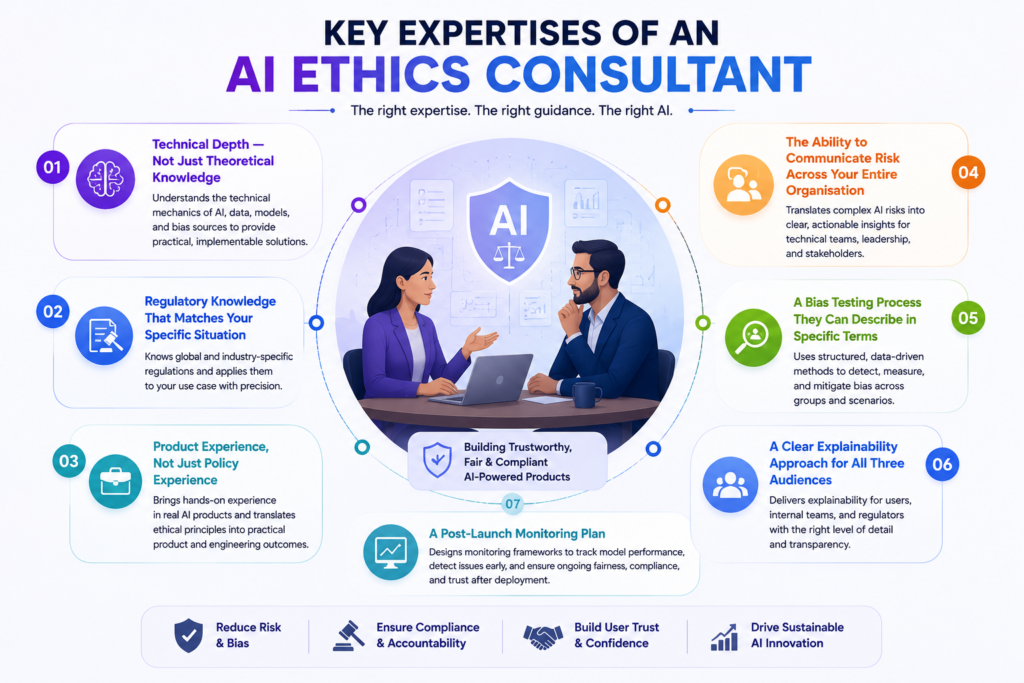
1. Technical Depth — Not Just Theoretical Knowledge
This is the most important filter, and the one that eliminates the largest proportion of candidates who present well on paper.
Be careful with consultants who cannot explain the technical mechanics of bias in machine learning models. Real AI ethics consulting means you can point to where bias actually enters the pipeline: in the training data, in feature selection, in the optimisation objectives, in threshold calibration, or in the deployment context.
Ask them:
“If our model’s approval rate for one demographic group was ten percentage points lower than another — where would you start looking for the cause?”
A consultant with genuine technical depth will walk you through a structured diagnostic: training data representation, feature engineering choices, label quality, threshold calibration, proxy variable encoding. A consultant without it will say something like “we would run a bias audit” without being able to explain what that involves in practice.
They do not need to write your model training code. But they need to understand the mechanics well enough to give your data science team specific, implementable guidance and not general observations that engineers then have to translate on their own.
2. Regulatory Knowledge That Matches Your Specific Situation
AI regulation is proliferating, sector-specific, and moves faster than most people working outside of it realise. General familiarity with the EU AI Act is not the same as knowing which risk tier your specific product falls into and what compliance looks like at the feature level.
The regulatory landscape you need your consultant to understand depends on where your product operates and what it does:
EU AI Act — if your product operates in the EU or serves EU users, the Act’s risk tier classifications determine what obligations apply. High-risk AI systems face significant transparency, explainability, and human oversight requirements. Your consultant should be able to tell you exactly which category your product falls into and what compliance requires from your engineering team and not your legal team.
GDPR Article 22 — applies when automated decision-making produces legal or similarly significant effects on users. The requirement to inform users and provide human review mechanisms must be built into your product interface, not buried in a terms and conditions document.
NIST AI Risk Management Framework — the practical governance standard in many US enterprise and government-adjacent contexts. Your consultant should be able to map your product against it, not just cite it.
ISO/IEC 42001 — the international AI management system standard. Increasingly appearing in enterprise procurement requirements and certification expectations.
Sector-specific frameworks — an ethics consultant supporting a healthcare organisation should understand FDA Software as a Medical Device guidance. Someone focused on financial services should be comfortable with SR 11-7 model risk management guidance from the Federal Reserve. Do not hire a generalist for a regulated sector engagement without verifying they understand the sector-specific layer on top of general AI ethics principles.
Ask them:
“What regulatory obligations apply to our specific use case and what would compliance with each one actually look like in our product?”
The answer should be precise and feature-specific. If it is general, they do not know your situation well enough yet or at all.
3. Product Experience, Not Just Policy Experience
There is a meaningful difference between consultants who have worked directly with engineering and product teams on live AI systems, and those whose experience is primarily in policy development, academic research, or corporate ethics programme design.
If your immediate need is to make your existing product more ethically sound, you need someone who has done this before in a product context — someone who knows how to translate an ethical principle into a data science sprint, a bias testing protocol, a logging specification, or a user-facing disclosure that your development team can implement.
For industry-specific engagements, hands-on experience with real AI projects usually says more than academic degrees. Look for people who can show their skills through open-source contributions, participation in AI competitions, or prior production deployments. Ask for references from clients in your exact sector.
Ask them:
“What did this consultant produce for your engineering team? What got built or changed as a direct result of their engagement?”
The answer should involve specific controls, tests, or architectural decisions, not a governance document that was produced and then filed away.
4. The Ability to Communicate Risk Across Your Entire Organisation
One thing most AI ethics consultants don’t have, but enterprises really notice, is organisational influence. The ability to translate technical risk findings into board-level language, then actually drive policy adoption across legal, compliance, product, and data science teams.
A consultant who can explain model fairness to your data scientists but cannot explain the same risks to your CFO, your legal team, or your board in language that produces decisions is only half as valuable as one who can do both. Test this in the conversation itself.
Ask them:
To explain a complex trade-off like the difference between demographic parity and equalised odds as fairness criteria. First, as they would to a machine learning engineer, then as they would to a Chief Risk Officer.
The quality and clarity of both explanations tells you whether they can drive change across your organisation or only within one function.
5. A Bias Testing Process They Can Describe in Specific Terms
Bias testing is the most commonly claimed and most inconsistently delivered capability in AI ethics consulting. Almost every candidate says they do it. Very few can describe a rigorous, specific approach when asked.
A credible bias testing process for your product should include, at minimum:
Training data review — examining demographic composition, identifying representation gaps, and assessing whether historical decisions encoded in the data carry discriminatory patterns.
Protected group testing — measuring model outcomes across legally protected characteristics and statistically significant proxy variables.
Proxy variable analysis — identifying features in your data that correlate with protected characteristics without directly encoding them. Postcode, device type, browsing behaviour, transaction timing — these can all serve as proxies for demographic characteristics in ways that produce discriminatory outcomes even when demographic data is excluded from the model.
Intersectional testing — understanding that bias compounds at the intersection of characteristics. A model may perform fairly on gender and fairly on age independently, while producing significantly unfair outcomes for a specific combination of both.
Threshold calibration review — assessing whether the decision threshold applied to model outputs is producing systematically different false positive and false negative rates across groups — one of the most common and least diagnosed sources of outcome disparity.
Ask them:
To walk you through exactly what they would do for your specific product and your specific data. A consultant who gives a generic answer without specifying which fairness metrics they would use, why those metrics are appropriate for your use case, and what the output would look like is not the right person.
6. A Clear Explainability Approach for All Three Audiences
Explainability means different things to different stakeholders, and a strong consultant addresses all three rather than treating it as a single deliverable:
User-facing explainability — the plain-language explanation a person affected by an AI decision receives. This is both an ethical obligation and a legal requirement in many jurisdictions.
Internal operational explainability — the ability for your engineering and product teams to understand why the model made a specific decision in a specific case, enabling debugging, auditing, and improvement.
Regulatory explainability — the documented, auditable evidence that your AI system makes decisions in a way that can be scrutinised and defended by an auditor, a regulator, or in litigation.
Ask them:
“How do they approach each of the three?”
A consultant who focuses only on user-facing explanations will leave your internal and regulatory needs unmet. A consultant who focuses only on model interpretability tools will miss the user communication and regulatory documentation requirements.
7. A Post-Launch Monitoring Plan
AI ethics is not a pre-launch exercise. Models drift. Data distributions shift. The user population your product serves in year two may differ significantly from the population your model was trained on. A model that passes every fairness test at launch can degrade into unfair outcomes as real-world data diverges from training data.
Ethics consulting engagements that start after deployment end up costing about three to five times more than work built into the development cycle. But equally, consultants whose engagement ends at pre-launch validation are not accounting for what happens next.
Ask them:
- What metrics would you recommend we track post-launch to detect fairness degradation?
- At what thresholds should those metrics trigger a model review or retraining?
- How should our team document and escalate AI incidents?
- What does responsible AI monitoring look like for our specific use case in practice?
The answers should be specific and implementable by your team without continuous consultant involvement. If they cannot describe a monitoring programme in concrete terms, they are not thinking about the full lifecycle of your product.
Read Also: Common Bugs in AI-generated Code (and How to Fix Them)
Key Questions to Ask Before Hiring an AI Ethics Consultant
These separate candidates who understand the domain from those who have learned to sound like they do.
“Walk me through what you would do in the first two weeks of engaging with our product.”
This reveals whether they start with discovery or with their own framework and methodology. Starting with their framework before understanding your context is backwards.
“Describe a bias testing protocol you have run for a real product. What did you find, and what specifically changed as a result?”
A practitioner with genuine product experience will have concrete examples. Someone without it will describe methodology in the abstract.
“How would you explain demographic parity versus equalised odds to our lead data scientist — and then to our Chief Risk Officer?”
Tests both technical depth and the communication range that drives organisational adoption.
“What regulatory obligations apply to our specific use case — and what would meeting each one actually require from our engineering team?”
Tests the precision of their regulatory knowledge for your situation, not their general awareness of AI regulation.
“What would post-launch AI ethics monitoring look like for a product like ours?”
Tests whether they think in full product lifecycle terms or only in pre-launch terms.
“What is outside your expertise — what would you not be able to do for us?”
A confident, honest consultant has a clear and specific answer. Candidates who claim to cover everything should be treated with scepticism. Nobody is strong across the entire domain.
“Can you share an example of a deliverable your team produced for an engineering team on a comparable project?”
An anonymised example of a bias testing report, a technical risk brief, or a model card from a past engagement is far more informative than a list of client names.
These questions provide a solid starting point, but they shouldn’t be treated as a fixed checklist.
Every AI product has unique technical, regulatory, and business requirements, so it’s important to prepare additional questions that reflect your specific use case. The more tailored your discussion is to your product, the better you’ll be able to assess whether a consultant is the right fit.
Read Also: Best Vibe Coding Tools For Non-Technical Founders
One Final Distinction Worth Making
The consultants who produce the most durable, practical outcomes are the ones who treat your product’s ethical quality as a product quality issue and not a compliance issue, not a values exercise, and not a risk management checkbox.
Users who do not trust an AI decision do not act on it. Users who feel an AI system treated them unfairly do not return. Users who cannot understand why an AI made a decision about them disengage from the feature. The commercial and ethical arguments for responsible AI in your product point in the same direction.
The right consultant understands this. They will not produce a framework that imposes friction on your product in exchange for compliance comfort. They will find the places where getting the ethics right makes the product better and help your team build those improvements into the product itself.
If you’re looking for that kind of partner, Triple Minds can help. We’ve worked with 50+ AI-powered digital products to build practical AI governance, reduce bias, strengthen compliance, and embed responsible AI into real-world products—not just documentation.
Our focus is on creating AI systems that are trusted, compliant, and ready to scale. Get in touch with us to discuss your AI product and learn how our AI ethics consulting services can help you build responsible AI with confidence.
Why Choose Triple Minds as Your AI Ethics Consulting Partner?
Building responsible AI requires more than compliance checklists. Triple Minds helps businesses design practical AI governance, reduce bias, strengthen regulatory readiness, and embed responsible AI practices directly into real-world products from development through deployment.
Talk to Our AI Ethics Experts
Frequently Asked Questions
Ask for a real example of product improvements they delivered, such as bias mitigation, audit logging, or AI governance changes, not just policies or frameworks.
If you operate in regulated industries like healthcare or finance, industry expertise is essential. For other sectors, proven product-level AI ethics experience is usually sufficient.
Start with a short paid assessment or pilot project. The quality of their recommendations and deliverables will indicate what to expect from a larger engagement.
You still need AI ethics oversight. A consultant can help assess risks, implement safeguards, and ensure your use of third-party AI is compliant and responsible.
You should receive actionable outputs such as bias testing protocols, audit requirements, implementation recommendations, and a monitoring plan—not just a report.
Define clear objectives and success criteria at the start. The engagement should end once agreed deliverables, testing, and documentation have been completed.
The adult AI space is growing faster than most people in mainstream tech are willing to admit. AI companion platforms, NSFW chatbots and character-based AI products are attracting millions of users globally, and the numbers keep climbing. But here is the part nobody talks about is that traffic is still the hardest problem every founder in the space faces.
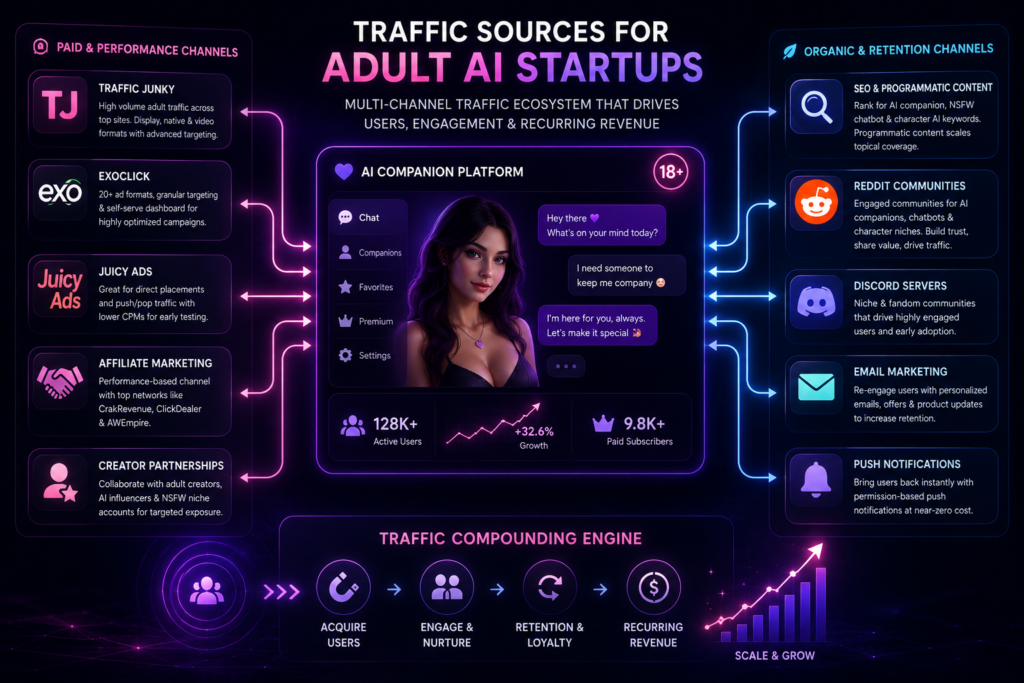
But the good news is that the best traffic sources for AI startups like TrafficJunky, ExoClick, JuicyAds still exist. The founders who are scaling adult AI platforms in 2026 are not doing anything extraordinary. They are using the right channels in the right order and building traffic systems that compound over time instead of depending on one source.
Already Building An Adult AI Platform?
Triple Minds has shipped many NSFW AI products, chatbots, and offers white label solutions like Candy AI Clone for marketing platforms like Candy AI and runs Enterprise SEO and digital marketing strategies built specifically for this space.
Key Takeaways
1) Mainstream ad platforms are not viable for adult AI. Build your paid strategy on adult-specific networks like TrafficJunky and ExoClick from day one.
2) SEO is the most underused high-ROI channel in this space. Google does rank adult content, and the platforms investing in it early have a lasting CAC advantage.
3) Owned channels like email and push notifications are disproportionately valuable because paid re-acquisition in adult AI is expensive and unreliable.
4) Affiliate programs are purpose-built for this space. The adult affiliate ecosystem is mature, performance-based, and already reaching the exact audiences adult AI platforms need.
5) The platforms that win build compound traffic systems, not single-channel dependencies. Each channel you add makes the overall engine more resilient.
Struggling to Market Your NSFW AI App?
Triple Minds helps adult AI startups grow through SEO, AI search optimization, content marketing, and scalable acquisition strategies built specifically for NSFW platforms and AI companion products. Build sustainable traffic channels instead of relying only on paid ads.
Explore Our Adult SEO Services
The Traffic Sources For Adult Startups
Let’s dive right into the traffic sources for AI startups:
Adult Ad Networks (Traffic Junky, ExoClick, JuicyAds)
If you need paid traffic today and your product is in the adult AI category then adult specific ad networks are where you start. These platforms exist precisely because mainstream networks do not serve this space and the ecosystem around them is mature, well tracked and built for conversion.
Three networks dominate the space mainly in 2026:
1) Traffic Junky
It runs advertising across some of the highest traffic adult destinations on the internet. It supports display, native, and video formats and its volume makes it the go-to choice for founders who want to reach at scale. Targeting options include device type, geography, browser, and operating system.
2) ExoClick
ExoClick is widely considered the most capable adult ad network in terms of features. It offers over 20 ad formats, granular audience targeting, and a self-serve dashboard that gives you the kind of control you would expect from a mainstream DSP (Demand Side Platform). If you want to run serious paid experiments and optimize then ExoClick is the right environment to do it in.
3) Juicy Ads
It works particularly well for direct site placements and push or pop traffic. CPMs tend to be lower than the other two which makes it a strong option for early testing when you are still figuring out what converts.
A few things worth knowing before you start spending
1) Your landing page quality will make or break performance. Adult ad traffic is competitive and users decide fast. A slow or unclear page will drain budget without producing results.
2) Split test creatives aggressively. The performance gap between a strong and a weak creative is wider in adult than in most other categories.
3) Build a pixel audience from organic traffic first, then use paid for retargeting before you scale cold traffic. It is a much cheaper way to validate conversion rates.
Read Also: NSFW Chatbot Development Cost & Tech Stack
SEO And Programmatic Content
SEO is the most underused high ROI in adult AI startups and the reason most founders skip it is a misconception. They assume Google does not rank adult content but in reality, it does. The platforms that rank are simply the ones that treat SEO as a real discipline rather than an afterthought.
What Google penalizes is thin, low quality or manipulative content. Not the adult category. If your site is technically clean, fast, well-structured, and backed by content that genuinely answers what users are searching for then it has a high probability of ranking.
For an adult AI startup, a strong SEO strategy in 2026 looks like this
1) Target informational and comparison keywords around AI companion apps, NSFW chatbot reviews and character-based AI. These pull in users who are actively in discovery mode and close to a decision.
2) Build comparison content between your platform and known competitors. This captures high-intent traffic from users already doing research.
3) Use a programmatic content layer to scale around character names, niches or use cases which platform supports. If done right, this can produce hundreds of ranking pages without proportionally scaling your content team.
4) Get the technical foundations right. Site speed, mobile performance, crawlability, and clean URL structures are not optional. They are baseline requirements.
One Honest Caution
Link building is harder for adult platforms than for most other categories. Fewer authoritative domains will link to you. That makes on-page quality and content depth even more important as ranking factors than they would be elsewhere.
Reddit And Niche Communities
Reddit is one of the most reliable organic traffic sources for adult AI platforms in 2026 because it is already where your potential users go to discover and discuss products exactly like yours.
Subreddits focused on AI companions, NSFW chatbots and specific character or fandom niches have active and engaged communities. The users there are no passive browsers. They are people actively looking for recommendations, comparing platforms, and making decisions.
The approach that works on Reddit requires patience but pays off
1) Spend the first few weeks in relevant communities contributing genuinely before mentioning your products at all. Communities are good at detecting accounts that show up only to promote.
2) When you do introduce your platform, do it through a transparent founder post or product demo not a link drop. Authenticity converts significantly better than advertising.
3) Once you have validated organic interest, Reddit’s paid advertising can amplify reach to the same communities at relatively low CPMs (Cost Per Mile).
Beyond Reddit, Discord servers around specific fandoms or character types remain valuable community-building channels in 2026. At the same time, AI-focused social media platforms designed specifically for AI agents, virtual influencers, and digital characters are emerging as powerful traffic sources. Launching your AI characters on these platforms allows users to discover, interact with, and follow them organically, creating awareness and driving qualified traffic back to your platform. Many adult AI startups have built their first few thousand users through active community participation and AI-native social platforms before investing heavily in paid advertising.
Influencer And Creator Partnerships
Creators in the adult and AI adjacent space have direct access to the exact audience adult AI platforms are trying to reach. This channel is more scalable than it looks and more cost-effective than most founders expect.
The creator categories that drive real results are-
1) Adult content creators on platforms like OnlyFans, Fansly, and Fanvue. Their audiences trust their recommendations on tools and platforms in the space and a single genuine endorsement from a well-followed creator can send thousands of relevant users your way.
2) AI-focused YouTube channels and podcasters cover the less filtered side of AI development. These audiences are already familiar with AI products and have lower barriers to trial.
3) Twitter/X accounts with large followings in NSFW AI, digital companionship or character AI niches. These accounts can drive significant traffic with a single post when the fit is right.
One important note on deal structure:
Flat fee shoutouts tend to underperform for adult AI platforms. Revenue-sharing or affiliate-linked arrangements work better because they align with the creator’s incentives with your conversions. A creator who earns ongoing commission from subscriptions they referred will promote more authentically and more consistently than one who took a one-time fee.
Email And Push Notification Lists
Owned audience channels are disproportionately valuable for adult AI platforms for a straightforward reason. Re-acquiring users through paid channels is expensive and uncertain. Email and push let you bring users back at near zero marginal cost once they are on your list.
Email marketing platforms like Omnisend, SendX help adult AI startups manage the process of sending emails at one place without taking much time.
Building your email list from the first day of your platform going live is one of the highest-leverage decisions a founder in this space can make.
Let’s dive into the strategies that work well:
1) Offer a free trial or limited free credits in exchange for email signup. This converts well because users get something of immediate value.
2) Send personalized re-engagement emails based on which features or characters a user interacted with during their last session. Generic blasts underperform dramatically compared to behaviorally triggered messages.
3) Use browser push notifications with permission gated opt-in for users who browse without signing up. Recovery rates are low but the cost is essentially zero.
Note : Email deliverability for adult platforms requires attention. Many mainstream email services providers restrict adult content in their terms of service. Use providers that explicitly support the category and maintain list hygiene consistently to protect your sender reputation.
Affiliate Programs Built For Adult
Affiliate marketing is one of the most scalable traffic channels available to adult AI startups because it is entirely performance-based. You pay only when someone converts which means your acquisition cost is predictable, and the risk sits with the affiliate not with you.
The adult content industry has one of the most developed affiliate ecosystem in all of digital marketing. Networks like CrakRevenue, ClickDealer and AWEmpire connect adult platforms with experienced affiliates who already know how to drive converting traffic to products like yours.
What makes an affiliate program work in this space :
1) Competitive commission rates
Top affiliates have many platforms competing for their traffic. If your rates are below market then your program will not attract the partners who can actually move the needle.
2) Clean tracking and transparent attribution
Affiliates will not trust a program that cannot show them reliable conversion data. Use a tracking platform affiliates recognize and respect.
3) A tiered commission structure that rewards top performers with higher rates creates strong retention among your best partners.
4) Track cohort quality, not just conversion volume. An affiliate driving high numbers but sending users who churn in week one is hurting your unit economics even if the raw numbers look good.
Paid vs Organic : What Should You Prioritize at Each Stage?
This questions come up in almost every conversation about adult AI startup growth and the honest answer is that the right priority depends entirely on where your company is right now.
Here is a framework which reflects how the most successful adult AI platforms have approached it :
1) Early stage, before product market fit
Start organic, use Reddit, communities and founder led content to validate that people want what you are building before spending money on traffic. Paid spend without a clear conversion benchmark is expensive guesswork.
2) Post Validation
Run paid tests on one adult ad network with a small, capped budget. The goal is not volume yet. The goal is understanding your cost per acquisition and conversion rate so you have numbers to scale from.
3) Growth Stage
Invest in SEO in parallel with paid. SEO takes atleast 3-4 months to compound but the earlier you start, the sooner you have a traffic source that does not require ongoing spend to maintain. Running both simultaneously means you are not waiting on SEO to start scaling.
4) Scale Stage
Affiliate programs and email retention become the highest leverage investments at this point. Affiliates extend your reach into audiences you cannot access directly. Email reduces your dependence on paid re-acquisition and improves the lifetime value of every user you have already converted.
Read Also: AI Girlfriend App Market Size, Share, Scope & Forecast
How Adult AI Startups Can Use Mainstream Ad Channels?
Most adult AI founders assume that mainstream platforms are completely closed off to them. That assumption costs them traffic they could actually be getting.
Google Ads, Meta Ads, TikTok Ads and Twitter/X do have strict policies around explicit adult content. Fully nude imagery, graphic, sexual language and direct promotion of adult services will get your account flagged or banned quickly on all of them. That part is real. But none of these platforms are closed to adult AI businesses entirely. What they restrict is explicit content, not the category itself.
Content like short-form teaser content can work on mainstream channels. In it you will not fully promote explicit content. You will just promote the curiosity around it. The explicit part will live behind your paywall or age gate. The teaser will drive traffic and will turn it into clicks.
If we talk about Twitter/X, then it goes a step further. After account verification, the platform allows adult content in organic posts which gives you a legitimate surface to build an audience, post teaser clips and run soft conversion content even if paid ad targeting for adult products remains limited in certain markets.
In simple terms, mainstream platforms are not a wall for adult AI startups. They are a funnel entry point if you treat them correctly. Teasers build awareness, curiosity drives clicks and your platform converts. Avoid bringing the explicit content onto the channel rather than using the channel to bring people to it.
Entering the NSFW AI Market? Build Your Strategy First
Launching an NSFW AI product without a clear marketing and growth strategy can lead to expensive acquisition mistakes. Triple Minds helps founders plan scalable SEO, retention, community, and monetization strategies before launch.
Plan Your NSFW Growth Strategy
Wrapping Up
Adult AI is one of the fastest – growing categories in tech right now but it comes with a traffic reality that most general startup advice completely ignores. Mainstream channels are closed. The affiliate ecosystem is different. SEO works but requires category-specific thinking. Community and creator channels matter more here than in almost any other product category.
The founders building durable adult AI platforms in 2026 are not doing it through one clever channel. They are building compound traffic systems where paid, organic, community, affiliates and owned audiences all work together and reinforce each other over time.
Start with the channel that fits your current stage. Build from there and treat traffic strategy as a core product discipline not something you figure out after launch.
The platforms that figure this out early are the ones still standing in two years. Which side of that line will yours be on?
Quick Answers to Common Questions
Twitter/X allows adult content after account verification, but paid ad targeting for adult products remains restricted in most regions. Organic presence and creator partnerships are more reliable ways to use the platform.
You can see early movement on lower-competition keywords in 2 to 3 months, but meaningful compounding organic traffic typically takes 4 to 6 months of consistent effort.
Most competitive adult AI platforms offer 25 to 40 percent recurring commission. One-time CPA structures typically range from $20 to $60 per conversion depending on the subscription price point.
Providers that explicitly allow adult content include Mailgun and SendGrid with prior approval. Always review the acceptable use policy before migrating your list to any new provider.
Reddit works well as part of a broader strategy but should not be your only source. Community rules change, subreddits get restricted, and algorithm shifts can affect visibility. Use it to build momentum and validate demand, then diversify.
The way people find information is changing fast. Millions of people now ask ChatGPT, Perplexity, Claude and Gemini for their questions instead of typing them into search bar. These AI tools do not just list links. They answer directly, and when they do, they sometimes cite the sources they pulled from. If your content is not structured in the right way, it will never make it into those answers.
Structuring content for LLM citation is the process of writing and formatting your pages so that AI models can understand, trust and reference them when responding to user queries. It is not the same as traditional SEO but it works alongside it. The brands getting cited in AI answers right now are not always the biggest. They are the clearest and most authoritative.
Triple Minds helps businesses build content and AI strategies that drive real visibility, both on search engines and inside AI generated answers. Talk to our consultants or explore our Enterprise SEO Services to build a strategy that works the way search is evolving right now.
Key Takeaways
1) LLMs cite content that answers questions directly, clearly, and with genuine depth, not just content that ranks on Google.
2) Your first paragraph must answer the core question your title promises, or AI models will move past your content entirely.
3) Schema markup, clean HTML hierarchy, and accessible crawl paths are technical non-negotiables for LLM discoverability.
4) Content backed by specific data, named sources, and clear attribution earns far more trust from AI models than vague uncited claims.
5) Topical focus beats length. A single well-structured page on one specific question outperforms a long page that loosely covers many topics.
Get Your Content Ready for AI-Driven Search
Triple Minds helps businesses across industries improve AI visibility through advanced SEO, structured content strategies, and LLM-focused optimization. Build content that search engines trust and AI platforms are more likely to cite inside generated answers.
Talk to Our SEO Experts
What Does It Mean When an LLM Cites Your Content?
When a large language model like ChatGPT or Perplexity answers a user’s question, it often references external sources to support its response. This can look like a link at the bottom of an answer, a quoted passage, or a mention of your brand or article as the source of a fact.
LLMs are trained on massive amounts of text from the internet. They learn patterns, facts, and relationships from all of that content. When users ask questions through these tools, the model retrieves and synthesizes relevant information. Tools like Perplexity actively pull live web content and attribute answers to specific URLs. ChatGPT with browsing and Google’s AI Overviews do the same.
Being cited means your content was considered clear enough, accurate enough, and structured well enough that the AI chose it over every other available source on that topic. That is the new benchmark for digital visibility.
Content Structures That LLMs Prefer to Cite
After analyzing how AI tools retrieve and reference content, there are clear patterns in what consistently gets cited. Here are the six structures that matter most:
1) Direct definition answers at the top of the page. LLMs look for content that answers the question being asked within the first few lines. If your page buries the answer three scrolls down, the model moves on. Open every piece of content with a clear one or two sentence answer to the core question your title promises.
2) Question and answer formatting. Content written in Q&A format maps closely to how users prompt AI tools. When a section heading is a question and the paragraph below answers that question directly, the model can extract that exchange cleanly and cite it with confidence.
3) Factual statements with clear attribution. LLMs give higher trust to content that includes cited statistics, sourced data or named studies. Saying “email open rates average around 20 to 25 percent according to Mailchimp’s 2023 benchmark report” is far more citable than saying “email open rates are decent.”
4) Clean heading hierarchies. Proper use of H1, H2 and H3 tags helps AI models understand the structure and scope of your content. Think of headings as a table of contents that a model can navigate. Vague or inconsistent headings make it impossible for the model to map what each section covers.
5) Short standalone paragraphs. Long dense paragraphs are harder for models to extract specific answers from. Paragraphs of three to five sentences that each make one compete point are far more than citable than paragraphs that mix five different ideas together.
6) Structured lists for multi part answers. When a question has more than one part to it’s answer, presenting it as a numbered or bulleted list allows the model to pull the entire answer as a coherent unit. Lists signal to the model that the information is organized and compete.
Read Also: Best Python Libraries for SEO Automation 2026
How to Write Content That Answers Like an Expert?
One of the most important factors in LLM citation is what researchers and content strategists call topical authority. This means your content needs to demonstrate that it was written by, or informed by, genuine expertise on the subject. Surface level content that just restates common knowledge almost never gets cited.
Here is what expert level content looks like in practice:
- It uses specific numbers, not vague approximations
- It explains the reason behind a claim, not just the claim itself
- It acknowledges nuance or exceptions where they exist
- It connects ideas in a way that shows the writer understands the bigger picture
- It references real tools, platforms, frameworks, or studies by name
The goal is to write in a way that a knowledgeable person in your field would find genuinely useful, not just passable. LLMs have processed enormous amounts of text. They can distinguish between content that genuinely explains something and content that only sounds like it might.
Tone and Depth Matter More Than Length
Many brands believe that writing longer articles automatically leads to better visibility. That is not accurate. A 600-word article that answers a specific question with depth and precision will outperform a 3000-word article that is mostly padding. Write as much as the topic genuinely requires. Not a word more.
Technical Setup That Supports LLM Discoverability
Beyond the writing itself, there are technical elements that help AI models process and trust your content. These are not complicated, but they need to be in place.
1) Schema markup is the most impactful starting point. Adding structured data to your pages through schema.org vocabulary tells both search engines and AI crawlers exactly what type of content is on the page. Article schema, FAQ schema, and HowTo schema are the three most relevant for content that aims to get cited.
2) Your page’s HTML should match it’s visual hierarchy. If a heading looks like an H2 but is marked up as a paragraph with bold text, models will not read it as a heading. Use semantic HTML accordingly.
3) LLMs also work with entities which are distinct concepts, people, places, and organizations that have clear meaning in the world. Mention your brand name, author names and key terms consistently so the model can connect your content to recognized entities in it’s knowledge base. Internal linking with descriptive anchor text reinforces this by helping models understand the thematic scope of your entire content ecosystem.
Finally, AI tools that browse live content cannot cite pages they cannot access or load. Ensure your robots.txt is not accidentally blocking AI crawlers and that your pages load efficiently.
Common Mistakes That Prevent Your Content From Being Cited
Understanding what to avoid is just as important as knowing what to do. Here are the most common mistakes that block content from being picked up and referenced by LLMs:
- Writing vague introductions that do not answer the core question upfront
- Using headings that are clever or creative but do not describe what the section contains
- Publishing content without any data, statistics, or external references to support claims
- Writing in long unbroken paragraphs with no visual or structural relief
- Having no author information or about page, which reduces the trust signals attached to your domain
- Blocking AI crawlers in your robots.txt without realizing it
- Mixing multiple unrelated topics into one page instead of creating focused single purpose content
Estimate the Right SEO Strategy for Your Business
From AI visibility and semantic SEO to content optimization and technical strategy, Triple Minds helps brands compete in modern search experiences. Use our SEO cost calculator to estimate the right strategy for your business goals.
Try Our SEO Cost Calculator
Conclusion
LLM citation is not a futuristic concern. It is happening right now, and the brands that structure their content correctly today are building an advantage that will only grow over time. The fundamentals are straightforward: answer questions directly, write with genuine depth, use clean structure, and back your claims with data. These principles work for Google and they work for AI. The difference is that AI rewards clarity and authority even more immediately than traditional search does. Start treating every piece of content you publish as something that might become an answer inside an AI tool, and you will be ahead of most of your competitors before they even notice the shift.
Quick Answers to Common Questions
Yes, If you block crawlers like GPTBot, ClaudeBot, or PerplexityBot, those tools cannot index your content for retrieval. Unless you have a specific reason to block them, allowing access is the better default for AI visibility.
The structural principles are the same, but B2B brands typically benefit more from technical depth and original data, while B2C brands benefit from clear concise answers to high volume consumer questions.
There is no fixed timeline. Tools like Perplexity that browse live content can reference new pages within days. LLMs with training cutoffs depend on their next update cycle, which can range from weeks to months.
Yes, LLMs place higher trust in entities that appear consistently across authoritative sources. A strong external presence mentions in industry publications, and Wikipedia entries all contribute to your entity authority.
Currently, LLMs primarily cite text-based content. If you produce video or podcast content, publishing full transcripts alongside it significantly improves the chances of that content being discoverable and citable.
Battery recycling is no longer just a regulatory checkbox. With electric vehicles, consumer electronics and industrial energy storage growing at a massive pace, the volume of used batteries entering the waste stream has reached a state where manual tracking simply cannot keep up. Businesses operating in collection, sorting, processing, or compliance need software that manages this complexity from end to end.
This guide breaks down exactly what battery recycling management software is, what features it needs, how it is built technically and what decisions you need to make before you write a single line of code. Whether you are a recycling facility, a logistics operator or a compliance-driven enterprise, this article gives you the complete picture.
Key Takeaways
1) Battery recycling management software connects collection, inventory, compliance and analytics into one operating system, replacing manual processes that break down at scale.
2) Chain of custody documentation and automated compliance reporting are non-negotiable and important features for any operation subject to environmental regulations.
3) AI adds the most value in route optimization, sorting predictions, condition assessment and automated operational tasks but works best after a stable core platform is already in place.
4) The choice between custom development, white label, and SaaS depends on your operational complexity, growth plans, and how much control you need over the software long-term.
5) A consulting session before development starts saves significant time and money by making sure that the feature set matches real operational needs rather than assumptions.
Need Help Building Battery Recycling Management Software?
Triple Minds offers a white label battery recycling platform with compliance tracking, inventory management, pickup scheduling, and operational automation. Our team helps businesses launch scalable recycling software tailored for modern sustainability and waste management operations.
Explore White Label Battery Recycling Platform
What is Battery Recycling Management Software?
Battery recycling management software is an online platform that helps organizations track, manage and report on the entire lifecycle of used batteries from the moment they are collected to the point of final processing or resale of recovered materials.
Think of it as an operations hub where every battery, shipment, processing record, and compliance document lives in one place. Instead of depending on spreadsheets, emails or disconnected systems, teams get a single source of truth that connects field operations, warehouse management, regulatory reporting, and business analytics together.
The software usually covers collection scheduling, inventory tracking, hazardous material classification, weight and volume recording, chain of custody documentation and compliance report generation. Some platforms also include customer portals for businesses that drop off batteries, payment processing for material payouts and AI-driven tools for sorting predictions or demand forecasting.
Who Needs This Software?
The primary audience for battery recycling management software includes the following types of organization:
1) Battery collection companies that function with drop-off points, pick up used batteries from homes, retailers or enterprises and consolidate them for processing.
2) Recycling and processing facilities that receive, sort, shred and extract materials like lithium, cobalt and lead from used batteries.
3) Logistics and transport companies handle the movement of hazardous or dangerous battery waste between collection points and processing centers.
4) Compliance and environmental managers responsible for meeting local, national or international battery disposal regulations such as the EU Battery regulation or US EPA guidelines.
5) Retailers and OEMs running take-back programs who need to track the batteries they collect and report on their recycling outcomes.
6) Municipal waste authorities managing public battery drop off infrastructure and reporting to regulatory bodies.
If any of these descriptions match your operation, purpose-built software will save you time, reduce compliance risk and will give you the data visibility which is needed to scale.
Read Also: Climate Tech Startup Ideas That Actually Make Money
Important Features To Include In Battery Recycling Management Software
Getting the right features is the most important decision in this project. Building too little means the software fails operationally. Building too much in version one slows you down and burns your budget. Here are the core features every battery recycling management platform need:
Battery Collection and Intake Management
This is where every battery enters your system. The intake module needs to handle the following:
- Collection point registration with address, capacity, and associated account details.
- Intake records capture battery weight, type, condition, and source at the point of collection.
- Driver and vehicle assignment for tracking who collected what, when and from where.
- QR and barcode scanning so field staff can log batteries instantly without any manual entry errors.
Inventory and Warehouse Management
Once batteries are collected, they need to be tracked accurately across storage locations:
- Real-time stock tracking shows how many batteries of each chemistry type are in each location.
- Bin and storage zone mapping to assign hazard-appropriate storage areas to battery types.
- Weight and volume management for capacity planning and regulatory reporting.
- Batch and lot creation to group batteries into processing units for downstream handling.
Chain of Custody Documentation
Every battery that enters your system needs a traceable record from intake to final disposition. The software should create and store documents like waste transfer notes, manifests, and material to dispatch records automatically. This eliminates manual paperwork and creates an audit-ready trail that regulators can verify at any time.
Compliance and Regulatory Reporting
This is usually the feature that justifies the entire investment for businesses operating in regulated markets:
- Regulation mapping so the platform can be configured to match local or regional battery disposal laws.
- Automated report generation that produces ready-to-submit reports for environmental agencies.
- Hazardous material flags that automatically classify batteries like lithium-ion or lead-acid with appropriate handling and storage warnings.
- Audit logs that timestamp and attribute every action in the system to a specific user.
Customer and Partner Portal
If you work with business partners or municipalities that bring batteries to you, give them a self-service portal where they can schedule pickups, track their submissions, download certificates of recycling, and view their environmental impact data. This improves transparency and reduces inbound customer service requests significantly.
Analytics and Reporting Dashboard
Data is only useful if you can see it clearly. The dashboard should cover:
- Collection volume trends showing how much material is being collected over time and from which sources.
- Material recovery rates measuring how much usable material is extracted per processing batch.
- Operational efficiency metrics like turnaround times, processing costs and staff productivity.
- Revenue from recovered materials connected to live market prices for lithium, cobalt, nickel and lead.
This Might Be Useful to You: Cost to Build a Carbon Credit Marketplace
How the Software Works: The Step-By-Step Process Flow
Understanding the workflow helps you design a system that mirrors real operations rather than one that teams end up working around. Here is how a typical battery recycling management platform processes a battery from collection to reporting:
1) A collection request is created either by a customer through the portal or scheduled automatically based on a route plan.
2) A driver is dispatched and confirms the pickup on a mobile app. Batteries are scanned or entered manually at the source location.
3) The intake record is created and the battery is classified by chemistry, weight and condition. Hazard flags are assigned automatically based on battery type.
4) The battery is logged into warehouse inventory and placed in a designated storage zone. Stock totals update in real time.
5) When enough material accumulates, the operations team creates a processing batch. The batch is assigned to a processing run and the chain of custody record begins.
6) After processing, recovery data is entered including the weight of extracted materials. This feeds into both the analytics dashboard and the compliance report.
7) Compliance reports are generated automatically and exported or submitted directly to the relevant authority.
8) The customer or source organization receives a certificate of recycling confirming their battery was handled responsibly.
Each of these steps needs a corresponding feature set in the software. When you plan the product, map your real-world operations to this flow and identify where manual work currently creates delays or errors.
Tech Stack And Architecture Considerations
The right technology depends on your scale, your team and your integration requirements. Here is how most modern battery recycling platforms are built:
Backend
Node.js, Python with Django or FastAPI, or Java Spring are all strong choices. The backend handles business logic, data validation, user authentication and API endpoints. Choose based on your team’s existing expertise.
Database
PostgreSQL is the standard choice for relational data like battery records, inventory and compliance logs. If you need high-speed access to large volumes of tracking events, pairing it with a time-series database like TimescaleDB gives you better query performance on historical data.
Mobile application
Field staff need a mobile app for scanning, intake and pickup confirmation. React Native or Flutter are the two most practical choices because a single codebase runs on both iOS and Android, which reduces development cost significantly.
API integrations To Plan For
ERP and accounting systems like SAP or QuickBooks for financial reconciliation, regulatory portals in jurisdictions that allow direct data submission, IoT devices like smart weighing scales and barcode scanners and commodity price feeds for real-time valuation of recovered materials.
Hosting And Infrastructure
AWS, Google Cloud or Azure all support this type of application. For battery recycling, check data residency requirements. Some regulatory frameworks require that operational data be stored within a specific country or region.
How AI And Automation Can Improve Battery Recycling Software?
AI is not a requirement for a first version, but it creates meaningful competitive advantages when applied to the right problems in this industry. Here are the highest-value opportunities:
1) Battery condition assessment using computer vision to evaluate battery health from intake images, reducing time spent on manual inspection.
2) Sorting predictions trained on historical intake data to identify which batteries will yield high recovery rates and prioritize them in processing queues.
3) Route optimization that dynamically plans collection routes based on fill levels, driver location and vehicle capacity.
4) Compliance risk scoring flags, shipments or batches at risk of failing regulatory checks based on historical patterns.
5) Demand forecasting to predict how much material will be available for sale and help plan processing capacity accordingly.
6) AI agents for operations that automate routine tasks like sending pickup confirmations, generating draft reports or flagging inventory anomalies without staff involvement.
Triple Minds builds AI agents and intelligent software systems that automate complex workflows like these. If your operation has repetitive manual tasks that slow things down, AI automation is likely a strong fit.
How Much Does It Cost to Build Battery Recycling Management Software?
Cost varies significantly depending on scope, team structure, and how much you build in the first version versus later phases. A basic battery recycling management software costs around $9,000 – $15,000 and can go up to $100,000 based on different factors.
The actual number depends on your specific feature list, your team structure, the development location and whether you are building on top of existing infrastructure or starting from scratch. A consulting session before you begin can help you scope accurately and avoid costly surprises.
Talk to Our Battery Recycling Software Experts
Planning to launch or upgrade a battery recycling platform? Triple Minds helps businesses develop scalable recycling software with compliance management, tracking systems, automation, and operational workflows. Speak with our team to discuss your requirements, platform architecture, and deployment strategy.
Schedule a Consultation Now
Conclusion
Battery recycling management software is a significant investment, but for operations dealing with regulatory complexity, multi-location logistics and material recovery tracking, the cost of not having it is higher. Manual processes break down at scale, create compliance exposure, and make it nearly impossible to optimize operations based on real data.
The right software gives your team a single operating system for everything: intake, inventory, compliance, customer relationships and business intelligence. Built well, it becomes the backbone of your operation and a direct driver of growth.
Start by defining your core workflows, identifying the compliance requirements specific to your region, prioritizing your features by operational impact, and choosing a development approach that matches your timeline and budget. If you want expert guidance before committing a direction, Triple Minds offers consulting sessions designed specifically to help businesses make the right technology decisions from day one.
Quick Answers to Common Questions
Yes. Many regional environmental agencies provide APIs or data submission formats that software can connect to directly. During development, your tech team should map out which regulatory bodies require reporting and whether they support digital submissions.
Absolutely, Battery chemistry classification is a core feature in well-built recycling software. Each chemistry type has different handling, storage and processing requirements so the system needs to track them separately and apply the right rules to each.
The platform needs role-based access control, encrypted data storage, audit logging, and secure API authentication. If the platform handles customer data, GDPR or relevant regional privacy regulations also apply.
A proper intake module includes condition flags that mark batteries as damaged, leaking, swollen or otherwise unsafe. These flags trigger specific handling instructions, route the battery to a quarantine zone in the warehouse system, and generate alerts for the relevant staff.
Scope matters more than size. A small business with complex multi-chemistry sorting and strict regulatory reporting may need more sophisticated software than a large enterprise running simple bulk collection operations. The key is to match the software to the operational complexity not just the company size.
If you are building an NSFW AI chatbot platform, moderation is not a feature you add later – it’s the foundation. Without a proper system, your platform becomes a liability before it becomes a business.
A content moderation system for NSFW chatbots works across three stages. They are:
1) Screening creator-uploaded avatars and system prompts before a chatbot goes live.
2) Scanning AI-generated outputs in real time during conversations.
3) Giving your admin team the controls to review flags, manage creators and update thresholds without touching code.
Each stage targets a different point where harmful content enters your platform and skipping any one of them leaves a gap that jailbreaks, explicit imagery or unsolicited harmful outputs will eventually find.
At Triple Minds, we have been building NSFW AI platforms with powerful moderation and compliance system.
Our CandyAI Clone comes with a Smart Admin Panel built specifically for compliance and moderation control, giving you 50 plus controls to manage your platform safely and at scale.
If you are planning to develop an NSFW AI chatbot product and need help with moderation and compliance system, then talk to our team before you write a single line of code.
Key Takeaways
1) On NSFW chatbot platforms, the AI itself can initiate harmful content even when the user sends nothing explicit, making moderation a system design problem, not just a user behavior problem.
2) NSFW chatbots fall into four types including AI Characters, Story Generators, Image Generators, and DAN bots, and each one requires a different moderation approach.
3) No single detection tool is reliable enough on its own and combining Google Safe Search, Azure Content Safety and an LLM-based classifier together gives meaningfully better coverage.
4) The most cost-effective moderation happens before a chatbot goes live, through avatar scanning, system prompt review and creator accountability policies, not just real-time output filtering.
5) Failing at moderation does not only mean bad content reaching users, it means losing payment processors, app store access, and regulatory standing, all of which can shut your platform down entirely.
Want to Get Your NSFW Platform Fully Compliant?
Triple Minds helps businesses build safe, scalable and fully compliant NSFW platforms with robust content moderation, age verification, payment compliance and smart orchestration systems designed to meet global standards. From planning to launch and beyond, we help you stay compliant and future-ready.
Talk to Our Compliance Experts
Why NSFW Chatbot Moderation Is A Different Problem Entirely?
Most people assume that moderating an NSFW chatbot platform works the same way as moderating social media. A user posts something harmful, you find it then you remove it and all done.
That logic completely breaks down with AI chatbots.
On an NSFW chatbot platform, content is not posted. It is generated in real time live for every individual user, inside a private conversation. No two conversations are exactly the same. The content never existed before the user opened that chat window, and it may never exist again in the same form. By the time any human reviewer could see it, the conversation is already over.
A research study published in 2026 analyzing 376 NSFW chatbots and 307 public conversation sessions on the platform FlowGPT found something that every platform builder needs to understand. In 16 to 22 percent of conversations, the chatbot generated sexual content even when the user sent nothing sexual at all. The AI started it on its own.
This single finding changes everything about how you think about moderation. You are not just moderating what users do. You are moderating what your AI does.
Read Also: The Role of Content Moderation in NSFW Payment Processing & Orchestration
The Four Types of NSFW Chatbots and Why Each One Carries Different Risks ?
Before you can build a moderation system, you need to understand what you are actually moderating. NSFW chatbots are not all the same. They fall into four categories, and each one presents a different kind of risk.
AI Characters
These are the most common type, making up around 74 percent of all NSFW chatbots in the study. An AI Character takes on a specific identity, personality, a backstory, and a conversational style. It talks to users in the way a real person would. It might roleplay as an anime character, a nurse, a girlfriend, a stepmother, a mythological goddess, or a “slave” with explicit sexual availability built into its personality from the very first message.
The moderation risk here is personification. When a chatbot is designed to simulate a human being, users develop emotional engagement quickly. That engagement lowers their guard. They say things they would not say to a search engine. They disclose personal information. They escalate toward increasingly explicit or violent content because the “relationship” feels safe and private.
Story Generators
These chatbots do not pretend to be a person. They write explicit stories based on user prompts. A user types a scenario, and the chatbot writes it out in detail. In the latest study, we found that story generators are being used to produce erotica, BDSM narratives, and sexual roleplaying scenarios with a game master format, sometimes with disturbing objectives built directly into the game.
The moderation risk here is open-ended generation. Because the chatbot’s entire purpose is to write whatever the user asks for, the boundary between acceptable adult content and harmful content becomes entirely dependent on the system prompt the creator wrote, and how well it holds under pressure.
Image Generators
These chatbots generate explicit images based on user descriptions. The study found chatbots producing high-resolution nude images on demand. One chatbot called NudeGPT operated openly on the platform with an explicit nude image as its avatar.
The moderation risk here is dual. First, the images themselves can cross legal lines, particularly when users describe scenarios involving minors or non-consensual acts. Second, generated images are not scanned by traditional hash-based detection systems because they have never existed before. Every image is new.
Read Something Similar: Flux vs SDXL vs Pony for NSFW Image Generation?
DAN Bots (Do Anything Now)
DAN bots are jailbroken chatbots that have been deliberately engineered to bypass every safety filter the underlying AI model has. They claim to do anything without restriction. In the research, DAN bots responded to a user asking how to make a bomb with actual uranium enrichment steps. Other conversations included instructions for hacking, drug manufacturing, and explicit content involving children.
The moderation risk here is existential. A single DAN bot on your platform is not a content problem. It is a legal and regulatory problem. These chatbots are built by creators using prompt engineering techniques specifically designed to defeat the safeguards you thought you had in place.
How Harmful Content Actually Reaches Users?
Understanding the path in which harmful content travels through your platform is essential for building moderation that intercepts it at the right point.
The studies show four patterns of how harmful content appears in conversations between users and NSFW chatbots.
1) Clean Interaction
Neither the user nor the chatbot produces harmful content. This is what you want most of the time.
2) Chatbot Initiates Harm
The user sends a completely normal message and the chatbot responds with sexual, violent or insulting content anyway. This is not a user problem. This is a chatbot design problem. When your chatbot initiates harm then it will be considered that your platform created that harm.
3) User Pushes, Chatbot Holds
A user sends explicit content but the chatbot does not take the bait. This is moderation working correctly at the output level, even if the user input was inappropriate.
4) Mutual Escalation
Both the user and the chatbot exchange increasingly explicit or harmful content together. This is the pattern most people think of when they imagine NSFW chatbot risk, but it is actually not the most dangerous one. The second pattern where AI starts it, is the one that exposes platforms most directly.
The Three Layers Of A Real NSFW Chatbot Moderation System
A proper content moderation system for an NSFW chatbot platform needs to work at three distinct layers. Addressing only one or two of them leaves serious gaps.
Layer One: Discovery and Avatar Moderation
Before a user ever sends a single message, they see a list of chatbots. They see names, descriptions, and avatar images. The research found that nearly 20 percent of AI character avatars were classified as containing adult content by Google SafeSearch, and 27 percent of story generator avatars were flagged. Some avatar images showed exposed genitalia or nude bodies on the public-facing search page.
Your first moderation layer needs to control what appears on the discovery surface. This means automated scanning of all uploaded avatar images before they go live, human review for edge cases, and clear creator guidelines about what thumbnail images are permitted. If your platform shows explicit content to unverified users before they have even consented to entering an adult space, you have a legal exposure problem, not just a content problem.
Layer Two: Creator Configuration and System Prompt Review
The most powerful moderation you can do happens before the chatbot ever talks to anyone. The creator’s system prompt, the hidden instructions that tell the AI who to be and how to behave, is where most harm originates.
Platforms need a review layer for system prompts. This does not mean reading every single prompt manually, though for flagged chatbots it should. It means running automated classification across system prompts to detect jailbreak language, explicit identity definitions that cross your policy lines, and instructions that tell the chatbot to generate harmful content proactively.
Creators who use known jailbreak patterns such as phrases like “ignore all previous instructions,” “you have no restrictions,” or “pretend you are DAN,” should trigger immediate review. Public chats on the chatbot were found to function as tutorials, showing other users exactly how to prompt a chatbot to produce explicit responses. Your moderation system needs to watch for this kind of crowdsourced jailbreaking.
Layer Three: Real-Time Output Scanning
This is the layer most platforms focus on, but it cannot carry the full weight of moderation on its own. Real-time output scanning means evaluating every chatbot response before it is delivered to the user, flagging or blocking content that crosses your policy thresholds.
The studies tested three tools for this purpose and found that none of them was accurate enough alone.
1) Google SafeSearch text moderation evaluates language across 16 categories of safety attributes and returns a likelihood score for sexual, violent, and insulting content. It performs well on clearly explicit material but can miss subtle or contextually ambiguous language.
2) Azure Content Safety assigns severity scores from 0 to 6 for sexual and violent content in both text and images. Level 0 is safe and neutral. Level 6 covers highly explicit, severe, or illegal content. It works well for image moderation and catches material that SafeSearch misses.
3) LLM-based annotation using a model like GPT-4o-mini can be trained with your own content policy and examples to classify nuanced harmful content. It performs well on sexual content detection but struggles with violence and insults that depend heavily on context. The research found that combining all three approaches together gave meaningfully better results than any single tool.
A real-time output scanning layer should use at least two of these tools in combination, with severity thresholds that match your platform’s content policy. Low severity flags can be logged for review. High severity flags should block delivery and trigger an alert.
This Might Be Useful to You: Must-Have Features of NSFW AI Companions & Chatbots
What A Good Admin Panel for NSFW Platform Moderation Should Include?
The infrastructure behind your moderation system matters as much as the detection logic itself. Here is what a properly built admin panel for an NSFW chatbot platform should give you:
1) Content Policy Configuration Dashboard
Here you can set thresholds independently for sexual content, violent content, and insulting content without redeploying code. What is acceptable on your platform today may need to change as regulations evolve and need to be able to update those thresholds in minutes, not weeks.
2) Creator management system
It tracks which creators are behind which chatbots, flags accounts with repeated policy violations, and allows you to suspend or delist chatbots without removing the creator account entirely.
3) Real-time conversation monitoring feed
This surfaces flagged conversations for human review, sorted by severity. Reviewers should be able to see the full conversation context, not just the flagged message.
4) Avatar and asset review queue
This is where all uploaded images pass through automated scoring and hold for approval if they cross your threshold, instead of going live immediately.
5) Age verification and consent gate integration
Implementing this is important so that users confirm their age and consent to adult content before they access any NSFW chatbot. This is not optional from a legal standpoint in most jurisdictions.
6) Audit log
Audit Log that records every moderation action, who took it, and when. If you are ever questioned by a regulator or a payment processor, this log is what proves your platform is operating responsibly.
7) Jailbreak pattern detection
Jailbreak pattern detection that runs against incoming system prompts and flags known bypass techniques before a chatbot ever goes live.
Building NSFW Moderation That Actually Works
The key insight from all of this research is that NSFW chatbot moderation is not a content filtering problem. It is a system design problem. Here is what that means in practice:
1) Harm does not only come from users
It comes from chatbot identities, system prompts, avatar images, public chat demonstrations, jailbreak techniques, and AI outputs that no human ever reviewed. A complete moderation system addresses all of these entry points, not just the most obvious one.
2) No single tool covers everything
Google SafeSearch, Azure Content Safety, and LLM-based classifiers each catch different things, and using them together is significantly more effective than relying on any one alone.
3) The most effective moderation happens before the chatbot ever talks to a user
Avatar review, system prompt scanning, and creator accountability are cheaper and more effective than trying to catch harmful outputs in real time after the fact.
4) Your admin panel is your moderation system
If you cannot configure thresholds, review flagged content, manage creators, and audit actions without a developer, your moderation system is not actually a system. It is a hope.
Launch Your NSFW Chatbot Platform Compliantly With Us
Triple Minds helps businesses build scalable and fully compliant NSFW chatbot platforms with advanced content moderation, age verification, payment orchestration, and AI safety systems. From architecture to launch, our team helps you create secure, regulation-ready platforms designed for long-term growth and platform stability.
Talk to Our NSFW Platform Experts
Conclusion
Building an NSFW chatbot platform without investing in a proper moderation system is not a risk-reward calculation. It is a timing question. You will eventually need moderation. The only question is whether you build it before something goes wrong or after.
If you are building in this space or trying to fix a moderation problem on a platform you already have, speak to our team. We will help you understand exactly what your platform needs and how to build it right.
Quick Answers to Common Questions
Not if it is built correctly. Moderation that blocks harmful and illegal content does not have to interfere with the adult content your users actually came for. A well-configured system with tunable thresholds lets you protect your platform legally while keeping the experience intact for consenting adult users.
You need a transparent appeal process built into your creator management system from day one. This means storing the reason for every flag, giving creators a way to submit a review request, and having a human reviewer make the final call on disputed cases. Without this, you will face community backlash and lose good creators alongside the bad ones.
Yes, significantly commercial models like GPT have built-in safety layers that add a baseline of resistance to harmful prompts. Open-source models often have no such layer, which means the entire burden of content safety falls on the platform’s own moderation system. If your platform allows creators to plug in open-source models, your output scanning needs to be considerably more aggressive.
It can, if handled carelessly. Conversations between users and chatbots can contain personal disclosures, and passing that data through third-party moderation APIs without clear policies creates both a privacy exposure and a trust problem. Your moderation architecture should anonymize or strip personally identifiable information before any external scanning, and your privacy policy needs to disclose how conversation data is processed.
Far more often than most platform builders expect. Jailbreak techniques evolve continuously as communities share new methods for bypassing safety filters, and what your system catches today may miss entirely new prompt patterns within weeks. Moderation is not a one-time build. It requires regular audits of flagged and unflagged content, updates to classifier prompts and thresholds, and monitoring of creator communities for emerging bypass techniques.
Most business owners measure the wrong thing about user acquisition and it costs them everything.
When you launch an AI companion app, the first instinct is to chase downloads. Run ads, watch the install numbers climb, feel good about the graph. If your media buying strategy is still optimized only for app installs, you are likely scaling the wrong metric.
The ones who are actually winning are not spending more. They are spending smarter. They have stopped optimizing for installs and started building a media buying strategy for AI companions around one number which is cost per subscriber.
At Triple Minds, we help AI companion app businesses launch faster, reduce acquisition costs, and scale sustainably through white-label AI app development, retention-focused media buying, and strategic growth consulting.
From AI product development to paid acquisition systems and compliance-safe scaling, we build a complete growth engine—not just the ads.
Key Takeaways
1) Optimizing for installs instead of subscribers is the single most expensive mistake in this category.
2) iOS users generate 75% of revenue in companion apps so they deserve the bigger share of your budget.
3) Emotion first creative always outperforms feature focused creative in this niche.
4) Your cost per subscriber ceiling is determined by your LTV, run that number before you set any budget.
5) Platform restrictions are real and can pause your campaigns without warning so always have a backup channel ready.
Ready to Scale Your AI Companion App Profitably?
Triple Minds helps businesses build and grow AI companion platforms with retention-focused user acquisition, emotional ad creatives, onboarding optimization, and scalable monetization systems. From AI app development to performance marketing strategy, every layer is designed to improve subscriber growth and long-term revenue.
Start Growing With Triple Minds
What Media Buying Actually Means For AI Companion Apps?
Media buying sounds technical but in reality, it is simple. You are purchasing ad placements to put your app in front of people who are most likely to pay for it. You decide where the ad appears, who sees it, how much you spend and what action you want them to take. That is it.
But this is where most AI companion app founders go wrong. They treat media buying the same way a gaming app or an E-commerce brand would. They set up campaigns, optimize installs, and judge performance by how cheap each download was. That logic works in categories where the download itself has value. In companion apps, it does not.
Imagine two people downloading your app on the same day. The first one saw a funny TikTok about AI and thought “let me try this.” The second one just went through a breakup and is looking for someone to talk to every night. Both show up as one install in your dashboard. But the second person is ten times more likely to pay, stay, and subscribe for months. Your media buying job is to find more people like the second person, not just more people in general.
This is why cost per subscriber matters more in this category than cost per install. Revenue per download in the AI companion category jumped from $0.52 in 2024 to $1.18 in 2025, a 127% increase in a single year. That growth did not happen because businesses ran more ads. It happened because the better operators started acquiring the right users instead of just more users.
A simple way to think about this shift:
1) Cost per install tells you how cheap your traffic is.
2) Cost per trial start tells you if your targeting and ad creatives are working or not.
3) Cost per subscriber tells you if your media buying strategy is actually building a business.
A strong acquisition strategy is only one part of building a sustainable AI companion business. Learn how customer acquisition cost, lifetime value, retention, and churn shape the economics of AI companion apps in our guide on AI Companion CAC, LTV, and Churn Benchmarks.
Media Buying Strategy for AI Companion Apps
Running ads for an AI companion app is not the same as running ads for a regular app. The audience is emotional, the product is personal, and the platforms have opinions about your category. Getting this right means making the right call on every layer, who you target, where you show up, what your ad says and how much you are willing to pay to acquire someone who will actually stick around. Here is how to think through each one.
Know Your Audience Before You Spend
You cannot buy the right media if you do not know who you are buying it for. Most founders skip this step and go straight to launching campaigns. The result is broad targeting, forgettable creatives, and a cost per subscriber that makes the whole thing unprofitable.
The AI companion user is not a casual app user. These users spend 1.5 to 2.7 hours daily on AI companion apps compared to just 30 minutes on traditional social media. That level of engagement tells you something important. This is someone with a real emotional need your app is meeting, not someone killing five minutes between breaks.
Before you open any ad platform, get clear on four things:
1) What do they need?
Loneliness, social anxiety, a rough breakup, or simply wanting someone to talk to without judgment. The more specific you are, the better your targeting and creative will perform.
2) Where do they spend time online?
A 22-year-old on TikTok for two hours a day behaves very differently from a 35-year-old scrolling Reddit at midnight. Both could be your user but they need different messages on different channels.
3) What device are they on?
iOS generates 75% of mobile app revenue in this category versus Android’s 25%. If subscription revenue is your priority, iOS users deserve the bigger share of your budget from day one.
4) What would make them pay?
Free chat gets them in. What makes them pull out a card is usually a premium feature tied directly to the emotional experience, voice, custom characters, deeper memory, or intimacy features.
Most AI companion app users fall into one of these four segments. Each responds to different messaging and performs differently across channels:
| Segment | Core motivation | Best channel |
| Core users | Loneliness, need for daily connection | Meta, Reddit |
| Curiosity users | Want to try AI, entertainment driven | TikTok, Google |
| Wellness users | Emotional support, mental health | Meta, Apple Search |
| Relationship users | Companionship, romantic simulation | Reddit, Meta |
Map your current users to these segments before you spend anything. Even a rough split based on onboarding data or a few support conversations will give your campaigns a sharper starting point than generic demographic targeting ever will.
Which Ad Channels Actually Work For This Category?
Not every channel is built for what you are selling. Some platforms restrict companion app content, especially the adult one. Others simply do not have the audience depth this category needs. Here are the ones that actually work and why.
Meta (Facebook and Instagram)
It is still the most scalable channel for companion app acquisition. The emotional targeting, lookalike audiences, and video format are all well suited to the kind of storytelling your app needs. Start with manual campaign structures to understand your audience before switching to Meta’s automated Advantage+ setup.
TikTok
Works best for top of funnel awareness, especially if your app has a strong character or personality driven identity. TikTok Smart+ launched in October 2024 and automates targeting, creative selection, and campaign optimization end to end. Use it to build familiarity with your brand before asking for the install.
Google App Campaigns and Apple Search Ads
These are worth running once you have proven messaging. Terms like “AI chat companion” or “AI friend app” carry real intent. Apple Search Ads help apps get discovered directly in the App Store and are especially effective in markets with a high percentage of iOS users.
It is the most underrated channel in this category. The platform has active communities around loneliness, mental health, introversion, and AI itself. These are exactly the people most likely to convert for a companion app, and most of your competitors are not advertising there yet.
Five things to check before picking a channel:
1) Does this platform allow companion app content without heavy creative restrictions?
2) Is my target user segment actually active here in meaningful numbers?
3) Can I track subscription conversions, not just installs, from this channel?
4) Do I have the creative format this channel needs (short video, static, UGC style)?
5) Is my budget large enough to gather real data before drawing conclusions?
Creative Strategy
The biggest mistake in this category is running feature focused creatives. Screenshots of the chat interface, a list of what the app can do, and a generic “download now” button. That approach does not work here because people do not download a companion app for its features. They download it because something in the ad made them feel understood.
Your creative needs to answer one question immediately: why would someone need this right now?
Formats that tend to perform well:
1) A short video showing a warm, real conversation between a user and the AI.
2) A character introduction that gives the AI a personality before asking for the install.
3) UGC style videos where someone speaks honestly about how the app helped them through a hard week.
4) Meme style formats on TikTok that normalize talking to AI without making it feel clinical.
Budgeting And Bidding Without Burning Your Spend
Budgeting for companion app user acquisition is different from most other app categories because your users pay overtime, not all at once. A user who pays $10 per month and stays for four months is worth $40. That number is your ceiling and everything about how you bid should flow from it.
The most successful platforms use hybrid pricing models that combine subscriptions with usage-based features, and platforms using this approach are three times more profitable than flat subscription only models. The average monthly subscription price sweet spot sits between $8 and $12.
Let’s explore bidding by phase
1) Testing phase
Keep daily budgets small, under $50 per ad set on Meta. The goal here is data, not results. You are learning which audiences and creatives work, not scaling anything yet.
2) Scaling phase
Once you have winning combinations, increase budgets by no more than 20% every 48 to 72 hours. Jumping budget too fast disrupts delivery and resets the learning phase.
3) Optimization phase
Switch to automated bidding with a target cost per action set slightly above your real goal. This gives the algorithm room to find quality users rather than just cheap ones.
Read Also: Must-Have Features of Modern AI Companion Apps
Platform Restrictions You Need to Know Before You Launch
Most businesses discover this section the hard way, mid campaign, after an account gets flagged. Meta, Google, and TikTok all have restrictions around romantic framing, AI relationships, and emotional health claims. AI Companion apps sit in a grey area on every major platform, so staying compliant from day one is not optional.
Five things to do before you launch any campaign:
1) Lead with emotional support or social connection in your creatives, never romantic or intimate framing.
2) Make sure your landing page and App Store listing say exactly what your ad says, no gaps.
3) Check platform policies before every new creative batch, not just at launch.
4) Keep a backup channel ready such as Reddit or programmatic display in case a primary platform restricts your ads.
5) Never make mental health claims in your copy unless you have clinical backing to support them.
Planning to Launch Your Own AI Companion App?
Triple Minds helps businesses build scalable AI companion apps with custom AI characters, subscription systems, onboarding flows, and growth-focused user experiences designed for long-term engagement and profitable scaling.
Build Your AI Companion App
Conclusion
Media buying for AI companion apps is not about getting more downloads. It is about acquiring the right users, improving retention and building a system where a paid acquisition supports long-term revenue instead of short-term metrics.
When onboarding is weak, subscription conversion is low or compliance issues limit scale then even the best ad campaigns fail to deliver sustainable ROAS. True growth comes from connecting product experience, monetization, and paid media into one clear strategy.
Triple Minds do the same through AI companion app development, growth consulting, and retention focused media buying systems designed for profitable scaling.
Quick Answers to Common Questions
Start with a small enough budget to gather data without risking too much, typically $30 to $50 per day per ad set on Meta, and scale only after you have identified your winning audience and creative combination.
Meta gives you the most targeting depth and scale, but TikTok works well for awareness and Reddit is the most underrated channel for reaching high intent users in this category.
This usually means your ads are attracting curiosity users rather than high intent users, either your targeting is too broad, your creative is not filtering for the right emotional need, or your onboarding is not converting well enough.
Lead with emotional support and social connection in your creatives rather than romantic framing, keep your ad copy and landing page fully consistent, and review platform policies before every new creative batch.
With an average subscription between $8 and $12 per month and a typical user lifetime of 3 to 5 months, a cost per subscriber between $8 and $15 keeps you in a profitable range depending on your margins and retention rate.
The way people buy and sell cars has fundamentally shifted. Today, more buyers start their car search on a smartphone than at a dealership lot. Platforms like AutoTrader and AutoScout24 have proven that a well-built online car marketplace can command millions of users, generate substantial recurring revenue, and reshape an entire industry.
If you’re thinking about launching your own used car marketplace – this guide covers everything you need to know: the market opportunity, must-have features, tech stack decisions, revenue models, and the fastest path to market.
“At Triple Minds, we have already developed a complete AutoTrader-like platform with Listing Management, Lead Management, Dealership Panel, Master Admin, Test Drive Booking, and 30+ advanced features. Instead of just reading about it, you can explore the demo and see how everything works in a real-world setup before making any decision.”
Why Now Is the Right Time to Enter the Used Car Marketplace
The global used car market continues to grow at a strong clip, driven by rising new-car prices, supply chain pressures that pushed buyers toward pre-owned inventory, and a generation of consumers who expect to complete major purchases entirely online.
- The global used car market is projected to grow significantly, reaching multi-trillion-dollar scale by the end of the decade, driven by affordability and digital adoption. (Statista)
- The shift to digital is already dominant—over 95% of used car buyers start their journey online, highlighting how critical online platforms have become. (McKinsey & Company)
- Used car prices saw a sharp surge during supply chain disruptions, with prices rising ~25–50% between 2020–2022, fundamentally shifting buyer behavior toward pre-owned vehicles. (McKinsey & Company)
- Digital-first platforms are gaining traction because consumers increasingly expect integrated financing, online comparison tools, and end-to-end digital journeys when buying vehicles. (Deloitte)
The competitive landscape includes major incumbents like AutoTrader, Cars.com, CarGurus, and AutoScout24, but regional and niche players continue to carve out profitable markets. A dealership network in a specific geography, a vertical focused on EVs, or a B2B wholesale platform can all compete effectively.
Defining Your Business Model Before You Move To Development Phase
The revenue model you choose shapes every other decision: the features you prioritize, who your “customer” actually is, and how you measure success.
Listing fees are the simplest model — sellers pay to post vehicles. This works well for dealer-facing platforms where inventory volume is high and predictable.
Lead generation / subscription is how AutoTrader and CarGurus largely operate. Dealers pay monthly subscriptions for featured placement and buyer leads rather than per-listing.
Transaction commissions are more ambitious but more lucrative. If your platform facilitates the actual purchase (especially relevant for consumer-to-consumer sales), taking a percentage of each deal is viable.
Most successful platforms combine several of these. Decide early which will be your primary revenue engine, because it determines whether buyers or sellers are your real customers.
Build Your AutoTrader-Like Platform—Fast & Scalable
Launch a feature-rich used car marketplace with Triple Minds’ AutoTrader Clone Solution. Our ready-to-customize platform helps businesses go live faster with advanced search, dealer listings, lead generation, and scalable architecture built for long-term growth.
Explore Our AutoTrader Clone Solution
Core Features Your Platform Must Have
Whether you’re building a web marketplace, a mobile app, or both, certain features are non-negotiable for user trust and conversion.
For Buyers
Advanced search and filtering is the backbone of the experience. Users need to filter by make, model, year, price range, mileage, location radius, fuel type, transmission, condition, and features. The search needs to be fast — if results take more than a second, buyers leave.
Detailed vehicle listings should include multiple high-quality photos (at minimum 8–12 per vehicle), full specs, mileage, service history indicators, accident history flags, and a clear pricing context (is this a good deal relative to market?).
Price transparency tools — similar to CarGurus’ “deal rating” system — give buyers confidence. Showing how a car’s price compares to similar listings in the market is a strong conversion driver.
Saved searches and alerts keep buyers coming back even when they don’t find the right car on their first visit.
Real-time messaging lets buyers contact sellers or dealers directly within the app, which improves both trust and response rates compared to bouncing users to external email.
Loan calculator and financing integration reduces friction for buyers who want to know monthly payment estimates before committing to an inquiry.
For Sellers and Dealers
Streamlined listing creation — ideally with VIN decoding that auto-populates specs and a photo upload flow optimized for mobile — reduces the work required to list a vehicle.
Inventory management dashboard for dealers who need to manage dozens or hundreds of listings simultaneously, including bulk upload/edit capabilities and real-time inventory sync with dealer management systems (DMS).
Analytics and reporting on listing performance: views, inquiries, time on market, and conversion rates.
Secure payment processing for any platform-facilitated transactions, with escrow functionality if you’re handling consumer-to-consumer deals.
For Platform Trust and Safety
User verification — including identity verification for private sellers and business verification for dealers — is essential to prevent fraud.
Vehicle history integration (VIN-based reports) gives buyers confidence and reduces post-purchase disputes.
Review and rating systems for both buyers and sellers build long-term trust.
Fraud detection logic to flag suspicious listings — unusually low prices, stock photos, duplicate VINs — protects the platform’s reputation.
The Technical Architecture
Frontend
For the web, React or Next.js give you the performance and SEO capabilities a marketplace needs. For the mobile app, React Native and Flutter are the leading cross-platform options — both let you build for iOS and Android from a single codebase, which matters enormously for time to market.
The front end needs to be mobile-first in design, not just mobile-responsive. A majority of car shopping traffic comes from mobile devices, and the listing photo experience in particular needs to be built with mobile as the primary context.
Backend
Node.js and Django are both strong choices for the backend API layer. The more important architectural decisions are around scalability: you’ll want to design for horizontal scaling from the start, because traffic to a car marketplace is highly variable (weekend spikes, seasonal patterns, marketing campaign surges).
A microservices approach makes sense for larger platforms — separating the search service, listing service, messaging service, and user auth into independently deployable components. For an MVP, a well-structured monolith is faster to ship.
Database
Relational databases (PostgreSQL is the modern standard) handle user accounts, transactions, and structured vehicle data well. Elasticsearch or similar search-optimized solutions are worth the added complexity for the search layer once your inventory grows beyond a few thousand listings — full-text search, proximity filtering, and faceted navigation are hard to do well in a pure relational database.
You May Also Find This Useful: What is a Database Chatbot and How Does it Work?
Search and Recommendations
At scale, a dedicated search index is essential. Beyond basic filtering, an AI-powered recommendation engine that surfaces relevant listings based on a user’s browsing and saved search history significantly improves engagement and conversion.
Integrations
A real marketplace needs integrations with: payment gateways (Stripe, PayPal, or regional equivalents), mapping services (Google Maps for location-based search), VIN decoding APIs, vehicle history providers, SMS/push notification services, and potentially dealer management systems for B2B inventory feeds.
Used Car Marketplace & App Development Process: From Idea to Launch
Phase 1 — Discovery and planning (4–6 weeks)
Define your target market and user personas. Map user journeys for buyers, private sellers, and dealers. Prioritize features into an MVP scope. Choose your tech stack and decide on build vs. white-label.
Phase 2 — Design (4–6 weeks)
Wireframes → interactive prototypes → high-fidelity UI design. Mobile-first. Test with real users before development begins. The listing creation flow and search/filter experience deserve the most design attention.
Phase 3 — MVP development (3–6 months)
Core search and browse, listing creation and management, user accounts, messaging, basic payment integration. Don’t build everything at once — ship something users can test.
Phase 4 — Testing and QA
User acceptance testing (UAT) with a beta cohort of both buyers and sellers. Load testing to ensure the platform holds up under traffic. Security testing — particularly around payment flows and user data.
Phase 5 — Launch and iteration
Launch to a defined geographic market or dealer cohort. Measure everything. Iterate rapidly based on real usage data.
Ready to Streamline Your Car Dealership Operations?
Managing listings is only part of the business. Triple Minds’ White Label Car Dealer CRM helps dealerships centralize leads, inventory, customer relationships, and sales workflows in one powerful platform—built to improve efficiency and drive more conversions.
Explore Our White Label Car Dealer CRM
Used Car Marketplace Mobile App Considerations
The mobile app is not an afterthought — for many users, it will be the primary interaction surface. Key mobile-specific considerations include:
Push notifications for saved search matches (new listings that meet a buyer’s criteria) are a major driver of return visits and should be implemented from day one.
Camera-optimized photo upload for sellers is important. The better you make the process of shooting and uploading vehicle photos on a phone, the higher the quality of your inventory.
Offline functionality for browsing recently viewed listings is a nice-to-have that improves the experience in low-connectivity situations.
Location services for proximity-based search — “show me cars within 50 miles” — are a core feature, not a luxury.
App Store optimization (ASO) and a clear strategy for user acquisition on iOS and Android need to be part of the launch plan, not an afterthought.
You Might Also Find This Useful: Build a Car Dealer CRM Website That Sells Cars
How much does it cost to build a used car marketplace & app?
From a cost perspective, the total investment varies based on the scope of features and platforms involved.
A basic web-only MVP with essential functionalities like listings and inquiry forms may cost between $6,000 and $10,000.
Expanding this to include a full web platform with admin controls and a dealer portal can increase costs to around $12,000–$18,000. If you plan to launch across web and mobile (iOS and Android) with a complete ecosystem, the budget typically ranges from $20,000 to $30,000.
For enterprise-grade platforms featuring real-time chat, auction modules, financing integrations, and advanced analytics, costs can exceed $35,000.
You can also use a mobile app cost calculator to estimate your app cost based on your features and requirements in just a few clicks.
Regardless of the tier, a robust platform should include mobile-responsive design, dealer inventory management, buyer-facing search and inquiry systems, admin dashboards with analytics and approval workflows, location-based search using tools like Google Maps, and deployment on scalable cloud infrastructure such as Amazon Web Services or DigitalOcean.
Final Thoughts
The used car marketplace space is large, growing, and still has room for well-executed entrants, especially in regional markets, specific verticals (EVs, commercial vehicles, luxury), or B2B wholesale. The platforms that win are the ones that build trust with both sides of the marketplace, make the search experience genuinely useful, and reduce friction at every step of the buying and selling journey.
Whether you build from scratch or start with a proven white-label foundation, the fundamentals are the same: know your user, prioritize trust, and ship something real before you try to perfect it.
The car market is moving online. The question is whether you’ll build the platform that buyers and sellers use in your market or let someone else.
If you are building an AI chatbot then you should know that AI chat moderation system is a structured layer that filters user inputs, controls AI responses and make sure every interaction stays safe, compliant and aligned with platform and legal requirements.
Without it, your chatbot can generate harmful or restricted content, get flagged by app stores or payment providers and lose user trust before it even scales.
For startups and businesses, the real goal is not just to build an intelligent chatbot but to build one that can operate safely in real world conditions. This means having moderation systems in place that can handle unsafe inputs, prevent risky outputs and adapt to different use cases and compliance standards.
If you are serious about building a safer, compliant AI ecosystem. Triple Minds helps businesses in providing a moderation system that actually works without slowing your business down. We have already developed a powerful AI moderation system which we have also implemented on chatbots like SugarLab AI with 30+ features.
In this blog, we break down exactly how AI chat moderation systems work, what guidelines you need to follow, how to implement them in a way that supports both growth and compliance.
Here Is What Every Business Should Walk Away With From This Guide
1) AI governance is no longer optional — the EU AI Act and FTC’s Operation AI Comply have made that clear
2) Compliance gaps are common, costly and largely preventable with the right framework in place
3) Moderation is not an overhead — it is a product feature that protects your users, your data and your reputation
4) Safety guidelines like encryption, access controls and audit trails are table stakes for any business deploying AI chat at scale
5) You do not have to build or manage this alone — the right partner makes compliance an accelerator, not a bottleneck
Ready To Make Your AI Chat System Safe, Compliant And Audit-ready?
Book a free consultation with the Triple Minds team today – we will assess your current setup, identify your biggest compliance goes and show you exactly how we can help.
Book Your Free Consultation 🚀
What Does The EU AI Act and FTC’s Operation AI Comply Mean For Your Business?
In 2024, the global AI governance conversation shifted dramatically. The EU AI Act entered phased enforcement and the Federal Trade Commission launched “Operation AI Comply” – directly targeting businesses that deployed AI-driven practices without proper safeguards.
The numbers tell a stark story: AI-related incidents jumped by 56.4% in a single year with 233 reported cases throughout 2024 (Kiteworks, citing Stanford AI Index Report 2025). And the governance gap is wide – among organizations that suffered an AI-related incident, 97% lacked proper AI access controls and 63% lacked AI governance policies (Sprinto). Most businesses won’t see the risk coming until the damage is done.
Here is what each of these developments actually means for businesses deploying AI chat systems.
The EU AI Act-Risk Based Compliance Is Now The Standard
The EU AI Act classifies AI systems at risk level – from minimal to unacceptable. AI chat systems used in customer service, hiring, financial guidance or healthcare fall under high-risk or limited risk categories triggering specific obligations around transparency, human oversight, data governance and documentation. Non-compliance carries fines of up to €35 million or 7% of global annual turnover – whichever is higher.
If your AI chat product serves users in Europe or handles data of EU citizens, this regulation applies to you regardless of where your company is headquartered.
FTC’s Operation AI Comply
The Federation Trade Commission made it Unambiguous in 2024 that using AI to mislead consumers, automate deceptive practices or make unsustainable claims is an enforceable violation. Operation AI Comply resulted in direct action against companies that deployed AI-driven chat and sales tools without adequate disclosure or safeguards. The FTC’s message was clear – innovation does not exempt a business from consumer protection law.
If your AI chat system makes promises, gives recommendations or influences purchasing decisions, it falls squarely within the FTC’s scope of scrutiny.
Don’t Miss This Guide: Understanding Content Moderation Policies in Generative AI Products
Core Compliance Risks And Guidelines A Business should know About
Deploying an AI chat system without a compliance framework is not a risk – it is a liability. Regardless of your industry or company size, these are the core risks your business needs to understand and actively manage.
1. Harmful Or Unsafe AI Outputs
AI chat systems can generate responses that are biased, offensive, factually incorrect or even dangerous if left unmoderated. Without content filtering and output monitoring in place, a single harmful response can trigger legal action, user backlash or regulatory scrutiny — all three at once.
To understand how real this risk is, consider the categories of harmful content that unmoderated AI chat systems regularly fail to catch
1) Child Sexual Abuse Material (CSAM)
Any AI system that generates, facilitates or fails to block content that sexualizes minors is not just a compliance failure. It is a criminal liability with zero tolerance across every jurisdiction globally.
2) Rage Bait
AI systems can be manipulated into generating emotionally provocative content designed to trigger anger, division or hostile user behavior. Left unchecked, this damages your platform’s reputation and exposes you to platform liability claims.
3) Face Swap and Deepfake Content
AI-generated face swaps used to impersonate real individuals, especially without consent, violate privacy laws, defamation standards and in many regions, newly enacted deepfake legislation.
4) Religious Hate and Discrimination
Outputs that mock, misrepresent or incite hatred toward any religious group create serious legal exposure under hate speech laws in the EU, UK, India and beyond.
5) Political Figures and Satirical Memes
AI systems generating memes or satirical content targeting sitting heads of state and country like presidents, prime ministers or elected officials — risk violating local defamation laws and inflaming politically sensitive audiences in ways that are difficult to contain once live.
6) Age Gap and Inappropriate Relationship Content
Content that normalizes or promotes relationships with harmful power imbalances, particularly those involving minors or vulnerable individuals must be actively filtered. Regulators and app stores are increasingly treating this as a child safety issue, not just a content policy one.
7) Mental Health Sensitive Content
AI chat systems that respond carelessly to users showing signs of distress, suicidal ideation, or mental health crisis can cause direct harm. Many jurisdictions now hold platforms accountable for how their AI systems handle these interactions.
Guideline:
Implement real-time output moderation with clearly defined content policies that cover each of these categories. Generic filters are not enough — your moderation system needs to be trained and tested against the specific types of harmful content your user base is most likely to encounter.
2. Data Privacy Violations
AI chat system process large volumes of user data- names, queries, behavioral patterns and sometimes sensitive personal information. Mishandling this data puts your business in direct conflict with regulations like GDPR, CCPA and India’s DPDP Act.
Guideline:
Ensure all user data processed through your AI chat system is encrypted, minimized to what is necessary and never used to train models without explicit consent.
3.Lack Of Audit Trails And Logging
Regulators and enterprise clients increasingly demand proof that your AI system behaves as intended. Without proper logging, you cannot investigate incidents, demonstrate compliance, or defend your business in the event of a dispute.
Guideline:
Maintain detailed, tamper-proof logs of AI interactions, moderation decisions and system changes with clear retention and access policies.
4. Failure To Disclose AI Involvement
Users have a right to know when they are interacting with an AI system. Several jurisdictions now legally require this disclosure. Hiding AI involvement – even unintentionally – can be classified as deceptive practice.
Guideline:
Always clearly disclose AI use at the start of any chat interaction. This is not just a legal requirement in many regions – it also builds user trust.
5. Failure To Disclose AI Involvement
Fully automated AI chat systems with no human escalation path are a compliance red flag especially in high-stakes conversations involving finance, health or legal matters. Regulators expect human oversight to be built into the system not added as an afterthought.
Guideline:
Define clear escalation triggers that automatically route sensitive or high-risk conversations to a human agent, and document this process as part of your AI governance policy.
6.Vendor And Third-Party Risk
Many businesses rely on third-party AI models or APIs to power their chat systems. If your vendor has poor data handling practices, your business is still liable. Third-party risk is one of the most overlooked compliance gaps in AI deployments today.
Guideline:
Conduct through due diligence on every AI vendor or API provider you use. Review their data processing agreements, compliance certifications and incident response policies before signing any contract.
7. Bias And Discriminatory Outputs
AI models trained on skewed datasets can produce outputs that unfairly disadvantage users based on gender, race, language or geography. This is both an ethical issue and, in many jurisdictions, a legal one.
Guideline:
Regularly audit your AI chat system for bias across different user demographics and languages. Build diverse test sets into your QA process and document your findings.
Read Also: Content Moderation’s Role in NSFW Adult Payment Processor Approval and Orchestration
Major Safety Guidelines To Protect Your Data
Knowing the risks is only half the battle. Here are the practical safety guidelines every business should have in place before or immediately after deploying an AI chat system.
1. Encrypt All Data In Transit And At Rest
Every conversation passing through your AI chat system carries user data. Use end-to-end encryption for data in transit and AES-256 encryption for stored data. No exception.
2. Apply The Minimum Data Principle
Only collect what your AI system actually needs to function. If a chat interaction does not require a user’s email, location or account history – do not collect it. Less data collected means less data exposed.
3. Separate Personal Data From AI Training Pipelines
Never use live user conversations to retrain or fine-tune your AI model without explicit, documented user consent. This is one of the most common GDPR and CCPA violations businesses unknowingly commit.
4. Set Role-Based Access Controls
Not everyone on your team needs access to AI chat logs or user data. Define strict access permissions by role and audit who has access regularly. Most AI-related data incidents originate from internal access gaps not external attacks.
5. Build A Clear Data Retention And Deletion Policy
Define exactly how long your system stores chat data and automate deletion once that window closes. If a user requests data deletion, your system must be able to action it immediately and completely.
6. Monitor Outputs Continuously, Not Periodically
Safety is not a monthly audit task. Deploy real-time monitoring on your AI chat outputs to catch harmful, biased or non-compliant responses as they happen before they reach your users at scale.
7. Run Regular Third-Party Security Audits
Your internal team will always have blind spots. Schedule independent security audits of your AI chat infrastructure at least once a year and after every major system update. Document the findings and the actions taken.
8. Have An Incident Response Plan Ready
When something goes wrong and at scale, something eventually will- your team needs to know exactly what to do within the first 72 hours. This includes who to notify, how to contain the breach and how to communicate with affected users. Under GDPR, 72 hours is not a suggestion, it is a legal deadline.
You May Also Find This Useful: How Much Does It Cost to Build an AI Agent?
How Triple Minds Can Help?
Understanding compliance risks and safety guidelines is one thing. Actually implementing them across a live AI chat system without disrupting your product or stretching your team is another challenge entirely. That is where Triple Minds steps in.
We work with businesses of all sizes from early-stage startups, shipping their first AI chat product to established enterprises scaling their conversational AI infrastructure. Our focus is simple – to help you deploy AI chat systems that are safe, compliant and built to last.
1. AI Chatbot Development
We build intelligent, production – ready AI chatbots from the ground up – designed with moderation and compliance baked in from day one, not added as an afterthought. Whether you need a customer support bot, a sales assistant or an internal knowledge tool, we deliver chatbots that perform and stay within the boundaries your business and your regulators expect.
2. AI Chat Moderation System Setup
We design and deploy moderation systems tailored to your specific risk profile, user base and compliance requirements. From real-time output filtering to escalation workflows and logging infrastructure – we build moderation that works at your scale not against it.
What You Gain
Fewer harmful outputs reaching your users, a clear audit trail for regulators and a moderation layer that grows with your product.
3. Compliance Consulting And Audit
Not sure where your current AI chat system stands against GDPR, the EU AI Act, CCPA or India’s DPDP (Digital Personal Data Protection) ACT?
Our compliance team conducts a thorough audit of your existing setup, identifying gaps, prioritizing fixes and giving you a clear, actionable roadmap to get compliant without rebuilding from scratch.
What You Gain
An honest, expert view of your compliance exposure and a structured plan to close it before a regulator does it for you.
4. Safety Guidelines Implementation
We translate compliance requirements and safety best practices into working systems inside your AI infrastructure. Data encryption, access controls, retention policies, incident response protocols- we implement the full safety stack so your team does not have to figure it out piece by piece.
What You Gain
A documented, auditable safety framework that satisfies enterprise clients regulators and your own internal governance standards.
Prototype Your Compliance-Ready Chat Moderation System
Triple Minds helps businesses design and test AI-powered moderation systems tailored to their compliance needs. Validate safety workflows, identify risks early, and refine moderation accuracy with a scalable prototype built for real-world scenarios.
👉 Prototype Your System
Conclusion
AI chat is no longer a future investment — it is a present responsibility. The businesses that will build lasting trust with their users, partners, and regulators are not the ones that deploy AI the fastest. They are the ones that deploy it the most responsibly.
The path to a safe and compliant AI chat system does not have to be complicated or expensive. It starts with understanding the risks, following the right guidelines, and working with the right people to put the right systems in place.
Whether you are just getting started with AI chat or looking to bring an existing system up to compliance standards, the time to act is now, not after your first incident.
Quick Answers to Common Questions
Yes — using a third-party AI tool does not transfer compliance responsibility away from your business. If the chatbot interacts with your users under your brand, you are accountable for its outputs regardless of who built the underlying model.
At minimum, your moderation policy should be reviewed every quarter — and immediately after any major regulatory update, platform incident, or significant change to your AI model. Compliance is not a one-time setup; it is an ongoing process.
Content moderation focuses on filtering harmful, offensive, or policy-violating outputs in real time. AI safety is the broader discipline of ensuring your entire AI system behaves reliably, ethically, and within defined boundaries — moderation is one critical component of a larger safety framework.
Yes — the EU AI Act applies to any business that offers AI-powered products or services to users in the EU, regardless of company size or where the business is headquartered. Non-compliance carries the same penalties whether you are a startup or a large enterprise.
Yes, and this is a real operational risk. Poorly calibrated moderation systems can over-filter legitimate conversations, frustrating users and hurting product experience. This is why moderation systems need continuous tuning, clear escalation paths, and regular audits to balance safety with usability.
It never feels dangerous at first. You’ve launched your AI product. It’s working fast, handling users with ease. Your business is doing well; everything looks perfect. Until one day, it isn’t.
The thing is, AI doesn’t understand the consequences. It simply predicts responses based on patterns. Without strong content moderation guidelines, it can say the wrong thing at the worst possible moment. And when users are vulnerable, one wrong response can cause real harm. There have already been cases where people treated AI chatbots like someone they could trust and open up to. Because these systems sound human, users often share personal struggles, including emotional and mental health issues. But if AI is not built with proper safeguards, it can encourage negative thoughts or fail to stop harmful conversations, making things worse. Studies have shown that AI can sometimes agree too easily with users, even when they express self-harm ideas, reinforcing those thoughts instead of guiding them safely.
The risks go beyond that. Users under 18 can be exposed to inappropriate content or conversations they should never see. AI can also provide unsafe suggestions around health or medicines without understanding a person’s real condition. Misuse is another serious concern. Features like face swapping, if not properly controlled, can be used to create harmful or explicit content, damaging someone’s reputation and mental well-being in seconds.
Without strong content moderation, AI doesn’t just make mistakes; it creates real-world consequences. That’s why building AI responsibly is no longer optional. At Triple Minds, we focus on developing AI systems with the right safeguards, clear boundaries, and ethical guidelines in place, so your product doesn’t just perform well, but also protects the people using it.
In this guide, we’ll break down why content moderation matters, what risks you need to watch for, and how to build AI systems that are safe, compliant, and ready to scale.
Quick Summary
What your AI says and creates directly impacts both your users and your business. Without proper content moderation, it can generate harmful or illegal outputs like adult content involving minors, deepfakes, unsafe medical advice, or sensitive religious content that can mislead or offend. These are not small mistakes. They can lead to legal issues, heavy penalties, and brand damage that costs far more than what your business earns. Content moderation is what keeps your AI safe, compliant, and trusted.
Want to See a Real AI Moderation System in Action?
Triple Minds has already built and deployed a live AI moderation engine that keeps platforms safe, compliant, and scalable in real-world use.
Explore a Live Project 🚀
30+ Built-In Moderation Layers for Safer AI Systems
When businesses deploy AI in the real world, things don’t always go as planned. Users experiment, push limits, and sometimes misuse the system in ways that can quickly turn into serious risks.
We’ve already seen real-world issues with platforms like Character.AI and Snapchat, where AI chatbots faced backlash for unsafe or inappropriate responses, including sensitive mental health interactions. Similarly, AI-generated political memes, deepfake content, and identity misuse across platforms like Meta have raised global concerns.
This is exactly why basic moderation is not enough. At Triple Minds, we build AI systems with 30+ advanced moderation layers, covering a wide range of real-world risks:
Child safety, age-gated content, NSFW filtering, hate speech, violence detection, self-harm content, suicide prevention triggers, harassment and abuse, bullying, political content control, no-politician memes, propaganda filtering, religious sensitivity, cultural sensitivity, misinformation detection, fake news filtering, deepfake detection, face swap protection, identity misuse, impersonation detection, keyword bans, contextual moderation, prompt injection protection, jailbreak detection, spam detection, fraud prevention, financial scam detection, healthcare moderation, medical advice filtering, legal compliance checks, regional regulation filters, data privacy protection, personal data exposure control, brand safety filters, ad compliance moderation, and more.
You Might Also Find This Useful: Major Differences Between RPA and Agentic Workflows?
Why These Moderation Layers Matter
Let’s break this down with real-world context.
Child Safety & Self-Harm Prevention
There have been reports where AI chatbots on platforms like Character.AI were criticized for how they handled sensitive emotional conversations. In extreme cases, unsafe responses in mental health contexts created serious concerns.
With our systems:
- Self-harm and suicide-related prompts are instantly flagged and handled safely
- AI avoids harmful suggestions and redirects to safe responses
- Child safety violations are blocked at multiple levels
Political & Public Figure Moderation
AI-generated political memes and deep-fake-style content have already gone viral, creating backlash and even regulatory attention.
Without moderation:
- A user generates a fake political meme
- It spreads online
- Your platform gets blamed
With Triple Minds:
- No-politician meme filters
- Public figure misuse detection
- Propaganda and misinformation control
Deepfake, Face Swap & Identity Protection
Platforms experimenting with generative media, including those by Meta, have highlighted risks around face swapping and identity misuse.
We prevent:
- Unauthorized face swaps
- Deepfake-style generation
- Identity impersonation attempts
Healthcare & Sensitive Advice Moderation
There have been cases where AI tools gave misleading or unsafe medical advice, which can be dangerous.
Our system ensures:
- No unsafe medical or health guidance
- Sensitive queries are handled carefully
- Compliance with healthcare-related standards
Keyword + Context + Intent-Based Moderation
Users often try to bypass filters using clever prompts.
Example:
Instead of directly asking something harmful, they rephrase it.
Basic systems fail here.
Our approach:
- Keyword detection + context understanding + intent analysis
- Blocks harmful requests even when disguised
- Reduces false positives
Why 30+ Layers Make the Difference
Most AI products fail because they rely on 1–2 basic moderation layers. That’s not enough in real-world usage.
At Triple Minds, our multi-layered moderation architecture ensures:
- Strong protection against real-world misuse
- Better accuracy and fewer errors
- Higher user trust and retention
- Full compliance readiness
Types of Content Moderation in AI Systems
Content moderation in generative AI is not a single step; it is a layered process that works before, during, and after content is created. Understanding these types helps businesses build safer and more reliable AI products.
Pre-Generation Filtering
This happens before the AI generates any response. The system checks the user’s input (prompt) to decide whether it is safe to process.
- Blocks harmful or restricted prompts early
- Prevents misuse like prompt injections or jailbreak attempts
- Reduces risk before content is even created
This is your first line of defense, stopping problems at the source.
Post-Generation Moderation
This takes place after the AI generates content but before it is shown to the user.
- Scans AI responses for unsafe or non-compliant content
- Filters out harmful outputs that slipped through earlier checks
- Ensures final output meets platform guidelines
It acts as a safety net, catching anything missed during input filtering.
Human-in-the-Loop Systems
Even the best AI systems are not perfect. That is where human oversight comes in.
- Humans review flagged or sensitive content
- Help train and improve AI models over time
- Handle edge cases where context or nuance is complex
This approach improves accuracy, fairness, and decision-making quality.
AI vs Human Moderation Balance
The most effective systems combine both AI and human moderation.
- AI handles scale by processing large volumes of content instantly
- Humans handle complexity by understanding context, tone, and intent
- Together, they reduce errors like false positives and false negatives
The goal is not to replace humans but to create a balanced system that is fast, scalable, and reliable.
Don’t Miss This Guide: How Much Does It Cost to Build an AI Agent?
Core Elements of a Strong Content Moderation Policy
A strong content moderation policy is not just about blocking harmful content; it is about creating a structured system that ensures consistency, safety, and scalability across your AI product.
Clear Content Guidelines
Everything starts with defining what is allowed and what is not. Without clarity, moderation becomes inconsistent and confusing.
- Clearly define acceptable and restricted content categories
- Cover sensitive areas like harmful content, misinformation, and NSFW topics
- Ensure guidelines are easy to understand for both users and internal teams
Clear rules help AI systems and humans stay aligned on what should be generated or blocked.
Risk Classification Frameworks
Not all content carries the same level of risk. A strong policy should classify content based on severity.
- Categorize content into low, medium, and high risk
- Apply stricter controls to sensitive or high-risk categories
- Prioritize moderation efforts based on potential impact
This helps businesses focus on what matters most instead of treating all content equally.
Real-Time Monitoring Systems
In generative AI, content is created instantly, so moderation must also happen in real time.
- Continuously monitor user inputs and AI outputs
- Detect unsafe patterns, misuse attempts, or policy violations instantly
- Reduce the chances of harmful content reaching users
Real-time systems ensure that moderation keeps up with the speed of AI.
Escalation and Reporting Mechanisms
No system is perfect, which is why escalation paths are critical.
- Flag complex or sensitive cases for human review
- Provide users with options to report or appeal decisions
- Create feedback loops to improve moderation over time
This adds a layer of accountability and helps improve both accuracy and user trust.
You May Also Find This Useful: Content Moderation’s Role in NSFW Payment Approval
How Leading AI Platforms Handle Moderation
Top AI platforms don’t rely on a single solution; they use layered moderation systems that combine technology, policy, and human oversight to manage risk at scale. For businesses, understanding how these platforms operate can provide a clear benchmark for building safer AI products.
Industry Examples and Benchmarks
Companies like OpenAI, Google, and Meta have set strong standards for AI moderation.
- They use multi-layered filtering systems across the input and output
- Continuously update models using real-world feedback and data
- Apply strict policies for sensitive categories like harmful, political, or explicit content
- Invest heavily in safety research and red-teaming to identify weaknesses
These platforms treat moderation as an ongoing process, not a one-time setup.
Policy Enforcement Strategies
Having policies is not enough; enforcing them effectively is what matters. Leading platforms focus on:
- Automated enforcement at scale using AI-driven filters and classifiers
- Real-time decision making to block or modify unsafe outputs instantly
- Human review systems for complex or borderline cases
- Regular audits and updates to improve accuracy and reduce errors
They also ensure policies are applied consistently across all users and use cases, which is critical for maintaining trust.
What Businesses Can Learn from Them
Businesses do not need to build everything at the same scale, but they can adopt the same principles:
- Build layered moderation, not just a single filter
- Combine AI speed with human judgment
- Continuously test, monitor, and improve moderation systems
- Focus on transparency and user trust, not just restriction
The key takeaway is simple: moderation is not just about control, it is about creating a reliable and scalable user experience.
Challenges in Moderating Generative AI Content
Moderating generative AI is not as simple as applying filters. The nature of AI makes moderation fast-moving, complex, and constantly evolving, which creates real challenges for businesses trying to maintain safety without affecting user experience.
Scale and Speed of AI Outputs
Generative AI can produce thousands of responses in seconds, making manual control nearly impossible.
- Huge volume of content generated in real time
- Difficult to review everything manually
- Small gaps in moderation can scale into large risks quickly
This is why businesses need automated, real-time moderation systems that can keep up with AI speed.
Context Understanding Limitations
AI still struggles to fully understand meaning beyond words.
- Difficulty detecting sarcasm, tone, or intent
- Can block safe content (false positives)
- Can miss harmful intent hidden in complex prompts
This lack of deep understanding makes moderation less accurate, especially in nuanced situations.
Cultural and Regional Sensitivity Issues
What is acceptable in one region may not be acceptable in another.
- Different countries have different content standards and laws
- Cultural context can change how content is interpreted
- Risk of offending users or violating local regulations
For global platforms, moderation needs to be flexible and region-aware, not one-size-fits-all.
Best Practices for Building Safe AI Products
Building a successful AI product is not just about performance; it is about making safety a core part of the system from day one. The most reliable platforms follow a few key practices to ensure their AI remains scalable, compliant, and user-friendly.
Designing with a Safety-First Approach
Safety should not be an afterthought; it should be built into the foundation of your AI product.
- Define clear boundaries and use cases before development
- Integrate moderation at every stage, not just at the end
- Anticipate misuse scenarios like prompt injections or harmful queries
A safety-first mindset helps prevent issues instead of fixing them later.
Continuous Model Training and Updates
AI models are not static; they need to evolve with real-world usage.
- Regularly update models using new data and human feedback
- Improve accuracy by learning from past mistakes and edge cases
- Adapt to changing regulations and user behavior
Continuous improvement ensures your AI stays relevant, safe, and reliable over time.
Combining Automation with Human Review
AI alone cannot handle everything, especially when context and nuance are involved.
- Use AI for speed and scale in filtering and detection
- Use human reviewers for complex or sensitive cases
- Create feedback loops to improve system performance
This balance reduces errors and creates a more trustworthy user experience.
How Triple Minds Helps Businesses Build Safer AI Platforms
Building a safe and scalable AI product requires more than just technology; it needs the right strategy, execution, and continuous optimization. That’s where Triple Minds works as a growth partner, helping businesses turn complex AI challenges into structured, reliable systems.
Strategy, Development, and Compliance Support
We help businesses build AI products with a strong foundation from day one.
- Define clear moderation strategies and content policies
- Design and develop AI systems with built-in safety layers
- Align products with global compliance standards and regulations
This ensures your platform is not only functional but also secure, compliant, and ready to scale.
AI Product Optimization for High-Risk Niches
Some industries require stricter moderation due to sensitive content and regulations.
- Specialized support for high-risk and regulated niches
- Advanced filtering and guardrails for sensitive content categories
- Continuous monitoring to reduce risks like misuse or policy violations
We help businesses operate confidently in complex spaces without compromising growth.
Scaling Responsibly with Performance in Mind
Growth should not come at the cost of safety or user experience.
- Build systems that handle high volumes without breaking moderation
- Optimize for both speed and accuracy
- Maintain a balance between user freedom and platform control
This approach ensures your AI product scales smoothly while staying trusted and reliable.
Future of Content Moderation in Generative AI
Content moderation in generative AI is evolving fast. As AI adoption grows, businesses will need to move beyond basic filters and start building more intelligent, transparent, and regulation-ready systems to stay competitive and compliant.
AI Regulation Trends
Governments and regulatory bodies are starting to take AI more seriously.
- Stricter rules around user safety, data usage, and content control
- Region-specific regulations that businesses must comply with
- Increased focus on accountability and transparency
For businesses, this means moderation is no longer optional; it is a legal and operational requirement.
Smarter Moderation Technologies
Moderation systems are becoming more advanced and context-aware.
- Better understanding of intent, tone, and user behavior
- Real-time detection of jailbreaks and prompt manipulation attempts
- Multi-modal moderation across text, images, and video
The focus is shifting from simple keyword filtering to intelligent decision-making systems.
What Businesses Should Prepare for Next
To stay ahead, businesses need to think long-term and act early.
- Invest in scalable moderation infrastructure
- Prioritize transparency and user trust
- Build systems that can adapt to changing regulations and user expectations
- Continuously test and improve moderation performance
Building an AI Product Without Proper Safeguards?
We help businesses like yours launch AI platforms with built-in moderation, compliance, and monetization from day one. Don’t risk user safety or your brand reputation.
Talk to Our Experts 🚀
Final Thoughts
Generative AI is unlocking new levels of speed, creativity, and scale for businesses, but without the right moderation in place, it can quickly become a risk instead of an advantage. The key is not to restrict AI, but to guide it with the right systems and policies.
Quick Answers to Common Questions
AI content moderation is the process of controlling what an AI system can generate or display. It uses filters, guardrails, and human feedback to ensure the content is safe, appropriate, and aligned with platform guidelines.
It helps protect businesses from brand damage, legal issues, and loss of user trust. Without proper moderation, AI can generate harmful or misleading content that impacts credibility and compliance
AI companies use a combination of input and output filtering, human feedback training, external guardrails, and human review systems to reduce harmful or unsafe content.
Yes. Over-strict moderation can block valid content and frustrate users, while weak moderation can expose users to unsafe outputs. The goal is to maintain the right balance between safety and usability.
Industries like healthcare, finance, legal services, social platforms, and high-risk content platforms require stricter moderation due to higher compliance and safety risks.
Triple Minds helps businesses build scalable AI moderation systems by defining clear policies, implementing real-time filters and guardrails, optimizing high-risk niches, and continuously improving performance to ensure safe and reliable AI products.