
Almost every founder who reaches out to us at Triple Minds asks the same question first: how much does it cost to develop an AI agent for my business? It is a fair question, but the honest answer is — it depends on what you are actually trying to build.
AI agents are no longer experimental tools used only by tech companies. In 2026, they are becoming the operational backbone of modern businesses — handling customer conversations, qualifying leads, supporting internal teams, automating repetitive workflows, and even powering full digital products. According to Gartner, by 2028 roughly 33% of enterprise software will include agentic AI, up from less than 1% in 2024.
You will hear wildly different numbers in the market. Some vendors promise an AI agent for $1,000, while others quote $25,000, $50,000, or even $150,000+. Both can be technically correct. The difference comes down to scope, depth of integration, autonomy level, and whether the agent is meant for a marketing demo or for serious production traffic.
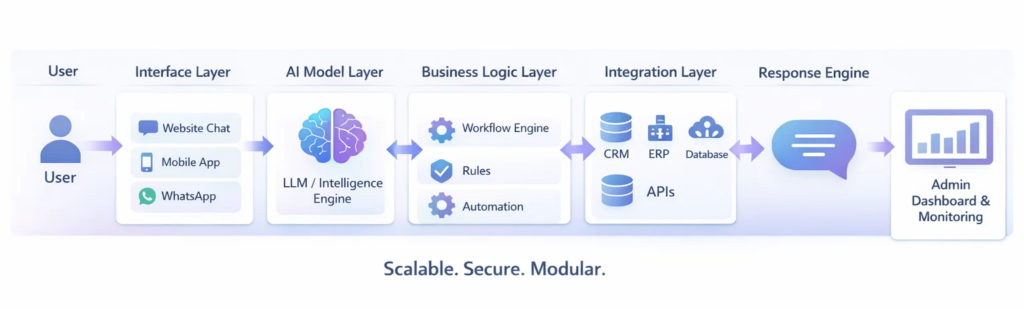
An AI agent is not just a chatbot. It is a complete software system made up of several layers working together:
- AI intelligence layer — the LLM, reasoning loop, and prompt orchestration
- Memory & knowledge layer — vector store, RAG, long-term memory
- Tool / action layer — function calling, APIs, browser, code execution
- Business logic layer — rules, guardrails, escalation policies
- Integration layer — CRM, ERP, databases, ticketing, messaging
- Interface layer — chat UI, dashboard, voice, mobile, admin console
Once you understand these layers, the AI agent development cost becomes much easier to reason about. As an AI development company, we have built everything from early-stage prototypes for YC-backed startups to enterprise automation systems handling millions of monthly conversations. After dozens of projects, one pattern is consistent.
The cost to develop an AI agent is mainly determined by three factors:
- How autonomous and complex the agent needs to be
- How many systems it must connect with — and the quality of those APIs
- What role it plays inside your business (assistant vs. operator vs. decision-maker)
In this guide, we break down the numbers in a practical, no-fluff way — covering agent types, the full development pipeline, technical challenges, hidden costs, region-by-region pricing, and a realistic ROI model. By the end you will have a defensible budget, not a guess.
Build AI Infrastructure That Scales With You
From MVP to enterprise automation, Triple Minds designs AI agents that are modular, secure, and built for real business impact.
Speak With Our AI Development TeamAI Agent Development Cost at a Glance (2026 Benchmarks)
Before we go deep, here is the short answer most founders are looking for. These ranges reflect production-grade builds delivered by mid-to-senior engineering teams in 2026.
| Build Tier | Typical Use Case | Timeline | Cost to Develop AI Agent |
|---|---|---|---|
| Basic AI Agent (MVP) | FAQ bot, lead capture, single-channel | 6–8 weeks | $12,000 – $18,000 |
| Investor-Ready Prototype | Demoable agent with 1–2 integrations | 8–10 weeks | $15,000 – $25,000 |
| Business AI Agent | CRM-connected, workflow automation | 10–14 weeks | $25,000 – $45,000 |
| Enterprise Support Agent | Multi-system, dashboards, security | ~4 months | $45,000 – $60,000 |
| Multi-Channel Enterprise System | Web + WhatsApp + voice + analytics | 4–6 months | $65,000 – $85,000 |
| Autonomous / Agentic Platform | Multi-agent, custom-trained, RAG at scale | 6–9 months | $90,000 – $150,000+ |
Key Takeaways
- The type of AI agent determines roughly 60% of the total cost.
- Integrations with legacy CRMs/ERPs are the #1 cause of budget overrun.
- LLM API spend is rarely the biggest line item — engineering effort is.
- Phased development reduces risk and protects ROI.
- Operating costs ($800–$5,000+/month) must be planned alongside development.
- Custom fine-tuning is rarely needed for v1 — RAG + good prompting handles most use cases.
Types of AI Agents (And Why Each One Costs Differently)
Before talking about timelines or pricing, the most important question is what kind of AI agent you actually need. This single decision determines most of the total investment. From an engineering standpoint, AI agents fall into six recognized classes — each with its own cost profile.
| Agent Type | How It Works | Real-World Example | Relative Build Cost |
|---|---|---|---|
| Simple Reflex Agent | If-this-then-that rules on current input | Auto-reply bot, FAQ widget | $ |
| Model-Based Reflex | Maintains internal state of the world | Order-status assistant | $$ |
| Goal-Based Agent | Plans steps toward a defined goal | AI scheduling assistant | $$$ |
| Utility-Based Agent | Optimizes across competing objectives | Pricing or routing optimizer | $$$$ |
| Learning Agent | Improves from feedback & data | Personalized recommender | $$$$ |
| Multi-Agent System | Multiple specialized agents collaborate | Autonomous research / ops platform | $$$$$ |
From a business perspective, those six classes collapse into three practical buckets. This is the framing we use when scoping projects at Triple Minds.
1. Basic AI Agent (Entry-Level Automation)
The starting point for most startups. A smart assistant that handles repetitive conversations and routine tasks but does not deeply interact with internal systems. Runs on existing models (GPT-4o-mini, Claude Haiku, Gemini Flash) and solves surface-level problems quickly.
- Answering frequently asked questions
- Capturing and qualifying leads
- Booking appointments or demos
- Providing basic product or service information
Cost to build an AI agent at this level: $12,000 – $25,000. Good fit if your goal is to launch fast, validate an idea, or take pressure off a small support team.
2. Business AI Agent (Operational Intelligence)
This is where AI starts delivering real business value. The agent connects with your CRM, database, or internal tools and acts more like a digital team member — performing actions, retrieving real data, and updating records.
- Checking order or delivery status
- Updating customer records in the CRM
- Assisting sales reps with lead insights and call summaries
- Pulling reports or business data on demand
- Creating and routing support tickets
Cost to develop AI agent at this level: $25,000 – $60,000. Most serious SaaS companies and scaling businesses start here because it directly impacts efficiency and customer experience.
3. Advanced Autonomous AI Agent (High-Complexity Systems)
The most powerful category. These agents handle multi-step tasks, run workflows automatically, use multiple tools, and operate with minimal human supervision. Often built as a network of specialized agents (planner, retriever, executor, verifier) coordinating through a shared memory.
- Multi-step reasoning and task execution
- Automatic workflow management across systems
- Long-term memory and learning from interactions
- Custom-trained or fine-tuned models for specific industries
- Self-correction loops and confidence-based escalation
Enterprise AI agent cost at this level: $85,000 – $150,000+. These systems require domain training, complex integrations, and rigorous evaluation infrastructure.
Don’t Miss This Guide: What is a Database Chatbot and How Does it Work?
The Anatomy of a Production AI Agent (Architecture Diagram)
To understand cost, you need to understand what is actually being built. Below is the reference architecture we deploy for most production-grade AI agents. Each block is a real engineering deliverable — and each one adds development hours.
Short-term ctx
Long-term store
Vector DB
Embeddings
Functions
APIs · Code
Rules · Auth
Escalation
Every layer above is a measurable line item in the budget. Skipping observability or evaluation infrastructure is the most common reason agents launch successfully and then quietly degrade in production.
AI Agent Development Cost — Breakdown by Component
Within a typical $50,000 enterprise build, here is roughly where the money goes. These percentages are drawn from our last 20 production projects.
| Component | % of Budget | What’s Included |
|---|---|---|
| Discovery & Architecture | 8–10% | Use-case validation, system design, data audit |
| LLM & Prompt Engineering | 10–15% | Model selection, prompt design, tool spec, guardrails |
| Backend & Integrations | 30–35% | API work, CRM/ERP connectors, auth, business logic |
| RAG & Knowledge Pipeline | 10–12% | Chunking, embeddings, vector DB, retrieval tuning |
| Frontend / Chat UI | 10–12% | Chat widget, admin dashboard, mobile responsiveness |
| QA & Evaluation | 8–10% | Test datasets, regression suite, red-teaming |
| DevOps & Deployment | 5–7% | CI/CD, infra-as-code, monitoring, secrets |
| Project Mgmt & Buffer | 5–8% | Coordination, scope changes, risk buffer |
Where the Budget Actually Goes (Enterprise Build)
Typical allocation across a $50K production AI agent project.
Integrations
Insight: integrations consume more budget than the AI itself. Plan for it early.
Typical Tech Stack (And What Each Costs)
| Layer | Common Choices | Indicative Cost / Month |
|---|---|---|
| Foundation Model | GPT-4.1, Claude Sonnet/Opus, Gemini 2.5, Llama 3.x (self-hosted) | $200 – $4,000 (usage-based) |
| Agent Framework | LangGraph, CrewAI, OpenAI Agents SDK, Claude Agent SDK | Open-source / included |
| Vector Database | Pinecone, Weaviate, Qdrant, pgvector | $0 – $500 |
| Orchestration | LangChain, Temporal, n8n, Zapier (light) | $0 – $300 |
| Observability | LangSmith, Langfuse, Helicone, Arize | $50 – $400 |
| Hosting | AWS, GCP, Azure, Vercel, Cloudflare Workers | $100 – $1,500 |
| Voice / Telephony | Twilio, Vapi, Retell, ElevenLabs | Usage-based |
How AI Agent Development Actually Works (6-Phase Pipeline)
An AI agent is not built in a single step. It is developed in structured phases to ensure clarity, performance, and long-term scalability.
1. Discovery & Use Case Validation
Every successful AI project starts by defining the exact problem. The focus is on identifying repetitive workflows, decision points, and system dependencies. The goal is to determine where automation creates measurable business impact and where human involvement is still necessary. Without this clarity, projects either over-expand or fail to deliver value.
2. Architecture Planning
Once the use case is validated, the technical foundation is designed: how the model connects to internal systems, how data flows, where state lives, how secrets are handled, and how security layers are enforced. A well-planned architecture lets the system scale without a rewrite later.
3. Model Selection & Intelligence Design
Not every AI agent requires custom training. In many cases, structured prompt engineering combined with well-organized RAG is enough. For more advanced systems this phase covers domain-specific fine-tuning, multi-step reasoning design, memory configuration, and confidence-based escalation logic. This step decides how intelligently the agent behaves in real-world scenarios.
4. Backend Development & Integrations
Where the AI moves from theory to operational capability. The system gets integrated with CRMs, databases, ticketing systems, internal APIs, and third-party tools. These integrations are what allow the agent to retrieve real data, update records, trigger workflows, and perform actions instead of simply generating text. This is what separates an AI agent from a basic chatbot.
5. Interface & Control Layer
An AI agent must be usable and manageable. This typically includes a website interface, application embed, and an internal dashboard for monitoring performance, reviewing conversations, managing prompts, and controlling permissions. Adoption depends on usability — not just intelligence.
6. Testing, Deployment & Continuous Monitoring
Before launch, the system is tested for response accuracy, workflow reliability, integration stability, and security compliance. After deployment, performance monitoring becomes essential. AI agents improve over time through structured analysis, evaluation harnesses, and prompt/data refinement. A properly built AI agent is not a one-time launch — it is an evolving operational system.
Here’s Something Similar: Major Differences Between RPA and Agentic Workflows
Real Technical Challenges That Drive Up AI Agent Development Cost
This is the section most pricing articles avoid — because it requires honesty. Below are the recurring technical problems that quietly inflate the cost to develop an AI agent. If a vendor’s quote does not address these, the number is incomplete.
1. Hallucination Control
LLMs confidently invent facts. In customer-facing systems this is a legal and reputational risk. Mitigation requires retrieval grounding, structured outputs, citation enforcement, and an evaluation harness that catches regressions when prompts or models change. Adds 8–12% to the budget.
Read Also: How to Fix Hallucinations in AI Agents?
2. Context Window & Memory Management
Long conversations and large knowledge bases blow past context limits. Engineering effort goes into smart chunking, summarization loops, hierarchical memory, and retrieval that returns the right 4 KB instead of every 4 KB. Done wrong, accuracy drops and token costs explode.
3. Tool-Use Reliability
Function calling looks simple in a demo. In production, the agent must handle malformed tool outputs, partial failures, retries with backoff, idempotency, and recovery from a half-completed action. This is plain backend engineering — and where most “demo to production” gaps live.
4. Latency vs. Cost vs. Quality Tradeoffs
A frontier model gives the best answers but is slow and expensive. A small model is fast and cheap but misses nuance. Production agents use a router — small model for easy turns, large model for hard ones — plus caching, streaming, and parallel tool calls. Building this correctly takes real effort.
5. Security & Prompt Injection
Any agent that reads untrusted content (emails, documents, web pages) is exposed to prompt injection. Defending against it means input sanitization, tool-call allowlists, capability scoping, audit logging, and red-team testing. Skipping this is not an option for enterprise deployments.
6. Evaluation & Regression Testing
Traditional unit tests don’t capture LLM behavior. Teams need golden-set evals, LLM-as-judge scoring, A/B harnesses, and automated regression detection so a prompt tweak does not silently break 5% of conversations. Without this, every release is a coin flip.
7. Data Privacy & Compliance
HIPAA, GDPR, SOC 2, and PCI introduce data-residency, retention, redaction, and audit obligations. PII redaction in logs, regional model deployment, BAAs, and consent flows are non-negotiable in regulated industries — and they materially add to engineering hours.
8. Legacy System Integration
Older CRMs and ERPs ship with weak APIs, rate limits, undocumented edge cases, and authentication quirks. Half of integration work is reverse-engineering and stabilizing these surfaces. This is the #1 source of timeline slippage in enterprise AI projects.
Enterprise AI Customer Support Agent Cost (Realistic 4-Month Build)
Let’s walk through a realistic scenario so you can clearly understand enterprise AI agent cost. Imagine a company wants a production-ready AI customer support agent that can actually handle real traffic — not just demo conversations. The agent must:
- Answer customer queries instantly with cited sources
- Check order or ticket details from internal systems in real time
- Create and update support cases automatically
- Escalate complex issues to human agents with full context
- Remember past conversations for continuity
- Provide an admin dashboard for monitoring, prompt edits, and analytics
- Meet enterprise-level security, SSO, and access requirements
At this level you are not building a chatbot — you are building core support infrastructure. A typical enterprise build takes around four months because multiple specialists are involved: AI engineers, backend engineers, frontend developers, UI/UX designers, QA, DevOps, and a project manager.
| Role | Allocation | Approx. Cost (4 months) |
|---|---|---|
| AI / LLM Engineer | Full-time | $15,000 – $20,000 |
| Backend Engineer | Full-time | $12,000 – $16,000 |
| Frontend Developer | Part-time | $6,000 – $9,000 |
| UI/UX Designer | Part-time | $3,000 – $5,000 |
| QA Engineer | Part-time | $4,000 – $6,000 |
| DevOps | Part-time | $3,000 – $5,000 |
| Project Manager | Part-time | $2,000 – $4,000 |
| Total Development | $45,000 – $65,000 |
Add multi-channel support (WhatsApp, email, voice), advanced analytics, or custom training and the cost rises to $85,000+. This is why AI development company pricing varies so much — two projects that sound similar can require very different engineering effort behind the scenes.
Cost to Develop an AI Agent by Region (2026)
Hourly rates vary dramatically. The same enterprise-grade build costs very different amounts depending on where the team is based.
| Region | Senior AI Engineer Rate | Same Enterprise Agent Build |
|---|---|---|
| United States / Canada | $150 – $250 / hr | $110,000 – $180,000 |
| Western Europe / UK | $110 – $180 / hr | $80,000 – $140,000 |
| Eastern Europe | $60 – $110 / hr | $50,000 – $90,000 |
| India / South Asia | $35 – $80 / hr | $30,000 – $65,000 |
| Latin America | $50 – $90 / hr | $40,000 – $75,000 |
Lower hourly rates are not automatically cheaper. Quality of architecture, evaluation discipline, and integration experience matter far more than headline rate — a poorly built $30,000 agent often costs $80,000 to fix.
This Might Be Useful to You: Average Cost to Build and Deploy Enterprise AI Agents For Small Business
Build vs. Buy vs. Hybrid — Which Is Right for You?
| Approach | Best For | Pros | Cons |
|---|---|---|---|
| Off-the-shelf SaaS (Intercom Fin, Zendesk AI, etc.) | Standard support, fast launch | No build cost, instant value | $0.50–$2 per resolution adds up; limited customization |
| No-code platforms (Voiceflow, Botpress, Relevance AI) | Marketing teams, simple flows | Cheap, fast iteration | Hits a ceiling on complex integrations |
| Custom build with frameworks | Differentiated product, deep workflows | Full control, owns the IP, fits your data model | Higher upfront cost, requires engineering team |
| Hybrid (custom on top of SaaS) | Most growing companies | Best of both worlds | Vendor lock-in risk, requires planning |
What Increases AI Agent Development Cost the Fastest
Many businesses begin with a simple requirement but expand scope during planning. Each new feature adds development time, testing effort, and integration work. The biggest cost drivers, ranked:
| Cost Driver | Typical Impact on Budget |
|---|---|
| Multi-channel support (web + WhatsApp + voice + app) | +20% to +30% |
| Custom model fine-tuning or domain training | +15% to +35% |
| Large knowledge base (10k+ documents) with high-accuracy RAG | +10% to +20% |
| Enterprise security, SSO, audit logging, compliance (SOC2/HIPAA) | +10% to +25% |
| Real-time analytics dashboard with drilldowns | +8% to +15% |
| Human-in-the-loop review & ticket escalation workflows | +5% to +12% |
| Voice (STT + TTS + telephony) capability | +15% to +25% |
| Multilingual support (5+ languages) | +8% to +15% |
Got a project in mind? Let’s build it together.
We work with founders and product teams across consulting, development, and growth marketing. Tell us what you’re building and we’ll show you how we’d ship it.