
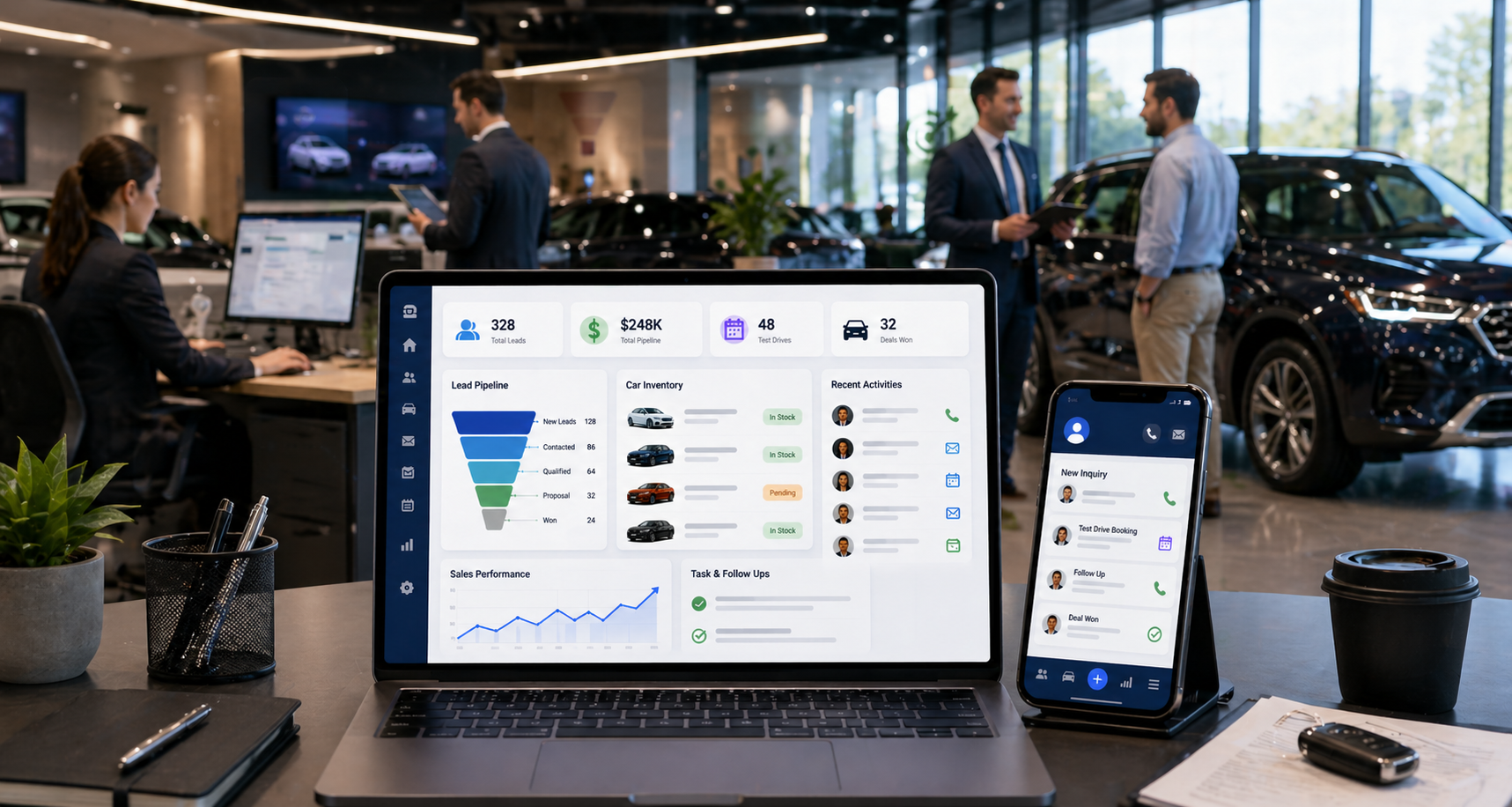
If you run a dealership, you already know the truth — selling the car is the easy part. The real money is lost between the first enquiry and the test drive. Leads cool off, follow-ups slip, your sales reps work from WhatsApp screenshots, and the customer who was ready to buy on Monday goes to a competitor by Thursday.
A car dealer CRM website fixes exactly that. It is not a digital brochure. It is a sales engine that captures every enquiry, routes it to the right rep, automates follow-ups, books test drives, and tells you precisely where each deal stands — all from one dashboard.
Quick proof: Triple Minds has already built a full car dealership platform with lead management, vehicle listings, test drive booking, and 30+ advanced features. Book a free live demo → No signup. No commitment.
This guide walks you through every decision — business model, must-have features, tech stack, integrations, cost, timeline, and how to pick the right development partner — so you do not waste budget rebuilding what should have been done right the first time.
Key Takeaways
- A car dealer CRM website is a complete sales system, not a digital brochure.
- Choose your business model first — single dealer, multi-vendor marketplace, or lead-gen platform — before writing a single line of code.
- Revenue-driving features: smart listings, instant lead capture, automated follow-ups, test drive booking, and a unified dealer dashboard.
- Budget ranges from $3K (single dealer) to $50K+ (full Auto Trader-style marketplace) — the difference is scale, not quality.
- Dealerships running a real CRM website respond 3–5x faster, retain more customers, and close more deals than those still relying on spreadsheets and WhatsApp.
What Is a Car Dealer CRM Website?
A car dealer CRM website is a business website + customer relationship management system built specifically for automotive sales. It does three jobs at once:
- Attracts buyers — SEO-optimized vehicle listings, filters, photos, finance calculators.
- Captures intent — every enquiry, call, WhatsApp message, and test drive request is logged automatically.
- Closes deals — sales reps see every lead in their pipeline, get follow-up reminders, and never lose a hot buyer to a slow response.
The difference vs. a regular dealership website? A regular site has a contact form. A CRM website runs your sales process for you.
Why Dealerships Cannot Ignore This in 2026
- 76% of car buyers start their research online before ever visiting a showroom.
- The dealership that responds within 5 minutes is 9x more likely to convert that lead.
- Manual lead tracking via spreadsheets and WhatsApp loses an estimated 30–40% of enquiries to missed follow-ups.
- Google now ranks dealership sites with structured vehicle data and local SEO above generic catalog sites — making proper SEO architecture non-negotiable.
If your competitor has a CRM website and you do not, the math is brutal. They are closing leads you both paid for.
Step 1: Choose Your Business Model First
This is the single most important decision you will make. The model decides your features, tech stack, monetization, and budget. Get it wrong and you will pay twice.
A. Inventory-Based Model (Single Dealer Website)
A site for one dealership showcasing its own stock and managing enquiries in one place. The CRM is built around your inventory — a customer enquires about a specific vehicle, the lead is auto-tagged to that car, assigned to a sales rep, and tracked until it closes (or is lost).
Best for: Independent dealers, single-location showrooms, and dealerships moving from manual spreadsheets to a proper digital system for the first time.
B. Multi-Vendor Marketplace (Auto Trader / CarDekho Style)
A platform where multiple dealers list cars under one roof. Your website itself becomes the product. The CRM is more complex — you are managing leads across many sellers, tracking dealer performance, and earning via commissions or subscriptions.
Best for: Entrepreneurs building a car listing marketplace, established dealer groups onboarding other dealers, and businesses targeting recurring revenue in the automotive space.
C. Lead Generation Model
You do not sell cars at all. You attract high-intent buyers via SEO and ads, qualify them, and sell those leads to dealerships on a per-lead or monthly retainer basis. Pure data and intent — no inventory.
Best for: Performance marketing teams, automotive media properties, affiliate businesses, and agencies that want to monetize traffic without holding inventory.
Must-Have Features of a Car Dealer CRM Website
A pretty website does not sell cars. The system underneath does. Here are the features that separate a working CRM website from an expensive brochure.
1. Smart Car Listing System
Your listing page is your digital showroom floor. It must show model, year, KMs, fuel type, transmission, ownership, condition, multiple photos (and ideally a 360° walkaround), location, and price — all filterable in seconds.
Pro tip: Use Vehicle schema markup so Google can display your listings as rich results. This is one of the highest-ROI SEO wins specifically available to dealerships.
2. Lead Capture System (Built Into Every Page)
Most dealership sites lose leads because contact forms are too long, too generic, or buried on a “Contact” page. A real lead capture system has:
- Inline enquiry forms on every car listing (not just the contact page).
- Click-to-call button for mobile (60%+ of dealership traffic is mobile).
- WhatsApp Business API integration with auto-responder.
- Instant callback request widget.
- Exit-intent popup offering a finance calculator or brochure download.
Keep forms short: name, phone, preferred car. That is it. You can collect more once they are in your CRM.
3. Built-In CRM & Lead Management
This is the heart of the system. Every enquiry that comes in via the website auto-flows into the CRM:
- Auto-assignment to the right sales rep (round-robin or by location).
- Lead scoring so reps prioritize hot buyers first.
- Full conversation and interaction history per customer.
- Automated follow-up reminders so no lead goes cold.
- Stage tracking: New → Contacted → Test Drive → Negotiation → Closed/Lost.
4. Dealer / Seller Dashboard
The control room. Your team sees active leads, top-performing listings, real-time inventory updates, and customer interactions without switching between five tools. In multi-vendor or franchise setups, each dealer gets their own dashboard while the platform admin sees everything across the network.
5. Test Drive Booking System
Test drive = final mile before purchase. Friction here kills deals. The booking system should:
- Show real-time slot availability per vehicle and rep.
- Send instant SMS + WhatsApp + email confirmation.
- Remind both customer and rep before the appointment.
- Log the booking directly inside the CRM lead record.
6. Trust-Building Features
Buyers spend lakhs (or tens of thousands of dollars). They need confidence before they pick up the phone:
- Verified dealer badges.
- Customer reviews & ratings on each listing.
- Transparent, no-hidden-cost pricing.
- HD photos + video walkarounds.
- RC, insurance, and inspection report visibility on used cars.
- Google Reviews widget pulling live social proof.
7. Finance & EMI Tools
A working EMI calculator on every listing, plus optional integration with loan partners for instant pre-approval. Buyers who see “EMI from ₹X/month” convert at meaningfully higher rates than buyers who only see the on-road price.
8. AI Chatbot (The Modern Edge)
This is where most dealership sites are still behind. A trained AI chatbot can:
- Answer 80% of pre-sales questions instantly (mileage, availability, finance, comparisons).
- Qualify leads 24/7 — even at 2 AM.
- Hand off hot buyers to a human rep with full context.
- Book test drives directly inside the chat.
Triple Minds specializes in this exact layer — see our AI Database Chatbot Development work.
9. Local SEO & Vehicle Schema
Dealership traffic is hyper-local. The site must be built with:
- Location-based landing pages (“Used Honda City in Pune”, etc.).
- Google Business Profile integration.
- Vehicle schema (
schema.org/Vehicle) on every listing. - Local business schema with hours, address, and reviews.
- Fast Core Web Vitals — Google rewards speed for local searches.
Our Automotive SEO team handles this end-to-end alongside the build.
10. Reporting & Analytics
Vanity metrics do not matter. The dashboard must answer:
- Which listings drive the most enquiries?
- Which sales rep has the best close rate?
- Which traffic source produces the highest lifetime value?
- Where are leads dropping off in the pipeline?
Tech Stack & Integrations You Will Need
A list of the integrations a serious dealership CRM website should support — most clients underestimate this.
| Layer | Common Tools |
|---|---|
| Frontend | Next.js / React, or WordPress with a custom theme |
| Backend | Node.js, Laravel, or Django |
| Database | PostgreSQL or MySQL |
| Hosting | AWS, Google Cloud, or DigitalOcean |
| Messaging | WhatsApp Business API, Twilio (SMS + voice) |
| SendGrid, Postmark, or Amazon SES | |
| Payments | Razorpay, Stripe, PayU |
| Loan APIs | Bank/NBFC partner APIs for pre-approval |
| Insurance | Insurance partner APIs for on-the-spot quotes |
| KYC | Aadhaar/PAN verification APIs (India) or equivalent |
| DMS | Dealer Management System integration if you already use one |
| Analytics | GA4, Hotjar, server-side tracking |
| AI | OpenAI / Claude APIs for chatbot + lead scoring |
How Much Does It Cost to Build a Car Dealer CRM Website?
The honest answer: it depends on what you are building. A single-dealer site and an Auto Trader-style marketplace are different products at different price points.
Want a precise estimate for your scope? Use our Mobile App Cost Calculator — same logic applies to web builds.
Tier 1 — Single Dealer CRM Website
Price: $3,000 – $8,000
For independent dealers and single-showroom owners going digital for the first time. You get:
- Responsive website with car listings + search filters
- Basic lead capture (forms, WhatsApp, click-to-call)
- Simple CRM dashboard for enquiries and follow-ups
- Inventory management (up to a few hundred vehicles)
- EMI calculator + transparent pricing
- Mobile-optimized, SEO-ready foundation
Tier 2 — Multi-Location / Franchise Network
Price: $10,000 – $22,000
For dealer groups and franchise networks across multiple locations. You get everything in Tier 1, plus:
- Individual dashboard per dealer / location
- Central admin panel with full network visibility
- Automated lead routing by location or buyer preference
- Advanced CRM (lead scoring, pipeline automation, sales forecasting)
- Full test drive booking system with reminders
- Per-location and consolidated reporting
- Email marketing, payment gateway, and loan partner integrations
Tier 3 — Full Marketplace Platform (Auto Trader Style)
Price: $25,000 – $50,000+
For entrepreneurs and dealer groups building a real platform business. You get everything in Tier 2, plus:
- Dealer registration + onboarding with profile pages
- Subscription or pay-per-lead monetization built in
- Advanced search across thousands of listings
- Verified dealer & listing badge system
- Customer reviews and ratings
- Dual CRM (platform admin + per-dealer)
- SEO-optimized listing architecture engineered to rank at scale
- Optional companion mobile app for dealers (see our Mobile App Development Services)
- Dedicated support + maintenance infrastructure
At Triple Minds, we deliver each tier at the prices listed above — no bait-and-switch, no surprise change orders.
What Moves the Final Price?
- Number of features at launch vs. phase 2.
- Whether you need a mobile app alongside the web build.
- Depth of CRM automation and AI features.
- Third-party integrations (loan partners, insurance, KYC, DMS).
- Experience and location of the development team.
A poorly-built CRM costs 3–5x more to fix than it would have to build correctly. Always pick the right partner over the cheapest quote.
This Might Be Useful: How to Create Used Car Marketplace & App?
How Long Does It Take to Build?
| Tier | Timeline |
|---|---|
| Single Dealer CRM | 6–10 weeks |
| Multi-Location / Franchise | 3–5 months |
| Full Marketplace Platform | 6–12 months |
Timeline depends on feature scope, integration count, and how fast your team can give feedback during reviews.
How To Choose the Right Development Partner
This is where most dealerships get burned. Watch for these green flags:
- Domain experience — they have built dealership/automotive products before, not just generic websites.
- A live demo you can click through — not just a portfolio of screenshots.
- Fixed scope and fixed price — vague hourly billing on long projects always blows the budget.
- Source code ownership — you own the code, not them.
- A maintenance plan — what happens after launch is just as important as the build.
- SEO baked into the architecture — not added as an afterthought.
Red flags: agencies that will not show working products, refuse fixed pricing, lock you to their hosting, or treat SEO and AI features as “phase 2.”
Post-Launch: Maintenance & Growth Costs
A CRM website is not “build it and forget it.” Plan for:
- Hosting & infrastructure: $50–$500/month depending on traffic
- Maintenance & updates: 10–15% of build cost annually
- SEO & content: $500–$5,000/month based on competitive market
- Paid ads: entirely scope-dependent
- AI/chatbot API usage: typically $50–$500/month at moderate scale
This is where the Automotive SEO services become a multiplier — the build captures leads, the SEO brings them in.
Why Triple Minds for Your Car Dealer CRM Website?
- Live, working dealership platform — book a demo and see it before you commit.
- 30+ advanced features pre-built — you are not paying us to learn the domain.
- AI-first — chatbot, lead scoring, automated follow-ups built in, not bolted on.
- In-house automotive SEO team — your site ranks because it is engineered to.
- Fixed-price tiers — same prices listed above, no creep.
- Proven delivery — see our case studies for how we ship.
Ready to Build?
If your dealership is still tracking leads in WhatsApp groups and Excel sheets, every week you wait is real revenue going to a competitor with a proper system.
Two ways to start with Triple Minds today:
🚗 Book a Free Demo — see our live car dealership CRM platform in action. No signup. No card. 15 minutes.
💰 Get a Custom Quote — tell us your model and scale, get a fixed price within 24 hours.
Quick Answers to Common Questions
How long does it take to build a car dealer CRM website?
A basic website takes around 6 to 10 weeks while a mid-level franchise network can take 3 to 5 months. A full marketplace platform like Auto Trader can go up to 6 to 12 months depending on complexity and decision-making speed.
Do I need a custom built CRM or can I use an existing one like Salesforce or HubSpot?
Off the shelf, CRMs are built for general business use and need heavy customization to work for a dealership. A custom-built CRM gives you features designed specifically around how car dealerships operate from day one.
Can my car dealer CRM website integrate with third party tools?
Yes. A properly built CRM website can integrate with WhatsApp Business, email marketing platforms, payment gateways, loan partner APIs and insurance providers to reduce manual work across your entire team.
What is the difference between a car dealer website and a car dealer CRM website?
A regular dealer website is a digital catalogue with a contact form. A CRM website captures leads automatically, tracks every customer interaction, assigns follow-ups and gives you full visibility into your sales pipeline.
Do I need a mobile app alongside my CRM website?
Not at the start. A mobile responsive CRM website covers most needs in the early stages but as your business scales, a mobile app becomes a valuable addition especially for franchise networks and marketplace platforms.
How do I make sure my car dealer CRM website ranks on Google?
SEO needs to be built into the website from the beginning with fast loading speeds, structured listing pages and location-based content. A website built with SEO in mind from day one will always outperform one where it is treated as an afterthought.
Got a project in mind? Let’s build it together.
We work with founders and product teams across consulting, development, and growth marketing. Tell us what you’re building and we’ll show you how we’d ship it.