AI Companion Industry: CAC, LTV, and Churn Benchmarks
AI companion apps have unique unit economics, with strong monetization but challenging retention and acquisition constraints. This guide examines CAC, LTV, churn, retention, and contribution margins in the AI companion market. It also explains what founders and investors should consider when evaluating sustainable growth and long-term profitability.

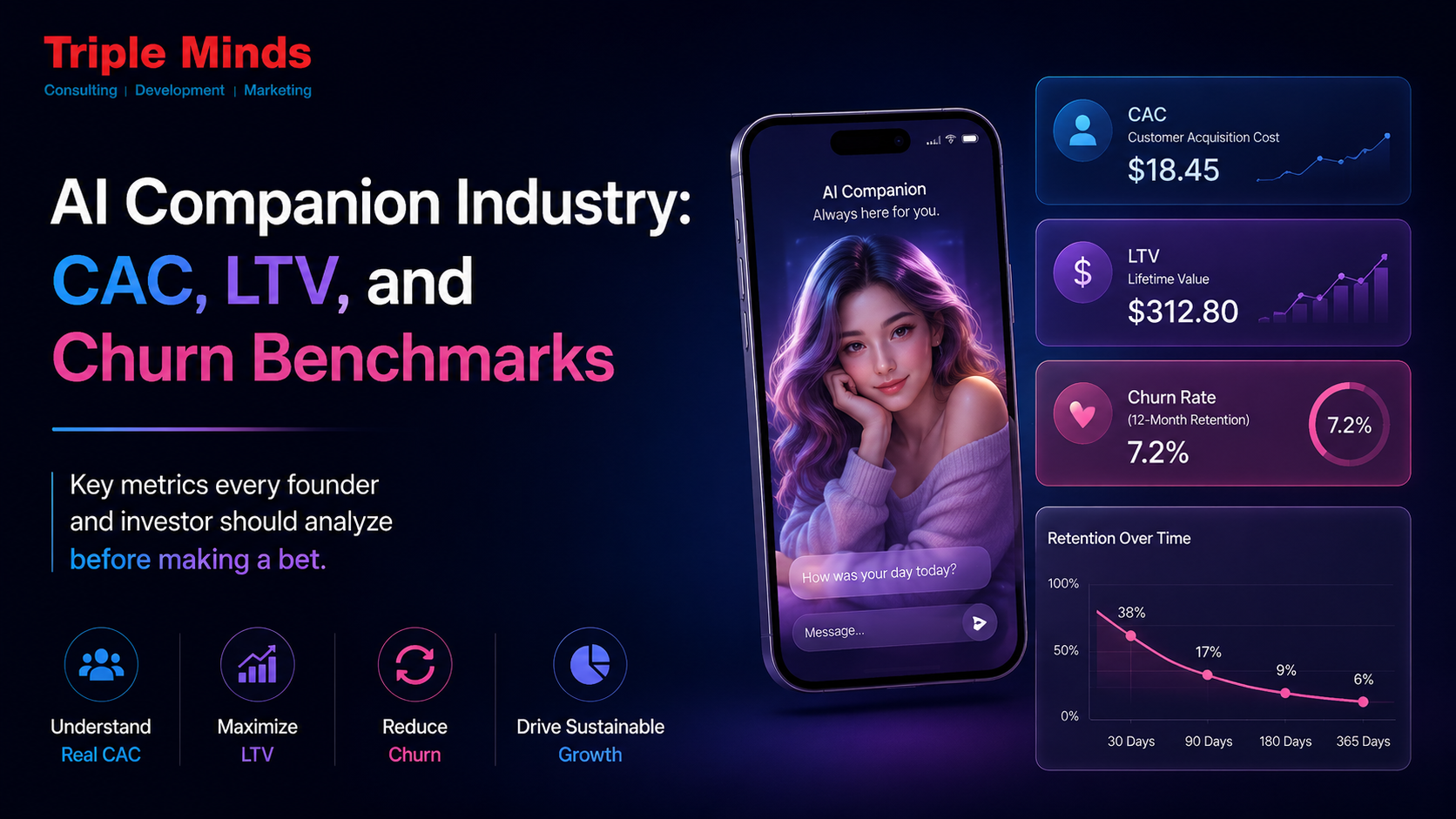
The top 10% of AI companion apps capture 89% of the category’s revenue. Everyone else is fighting over the remaining 11%.
That single number should change how investors underwrite the AI companion category.
The question is no longer:
“Is AI companion a good market?”
The downloads and consumer spend already answer that.
The real question is:
“Does this specific target have a realistic path into the top decile — or is it one of the hundreds of apps quietly bleeding cash to acquire users it can’t retain?”
And retention is where this category gets structurally difficult.
AI companion apps monetize their payers more aggressively than almost any other subscription vertical. Realized LTV per payer is roughly 40% higher than for non-AI subscription apps.
But there is a catch.
AI companion apps also lose subscribers faster than almost any other subscription category. For monthly plans, 12-month retention falls into the single digits.
In other words:
High value per survivor. Low survival rate.
Most diligence mistakes in this category come from underwriting the first half of that equation while ignoring the second.
Then there is an acquisition problem that most consumer subscription categories simply don’t face.
Paid advertising and app-store distribution are heavily constrained. As a result, customer acquisition is driven disproportionately by organic reach, creators, and affiliate networks rather than a marketing budget that can simply be increased.
CAC, therefore, is not just a dial an operator can turn.
It is partly a function of how effectively the company can access and monetize distribution partners — a much harder capability to diligence than the efficiency of a Meta or Google ad account.
That is why even exponential category growth does not automatically translate into a sustainable business.
For founders entering the space — and investors evaluating them — three metrics matter disproportionately:
- CAC: How much does it cost to acquire a paying customer?
- LTV: How much revenue or contribution does that customer generate over their lifetime?
- Churn: How quickly do paying users leave?
There is no single publicly reported benchmark for CAC, LTV, or churn specifically across AI companion apps.
So we analyzed subscription-app data from 2026 to estimate what these metrics actually look like in the category — and, more importantly, why conventional SaaS and DTC benchmarks can misread all three.
The result is a framework for understanding what the numbers really mean and what investors should ask before underwriting an AI companion target.
At Triple Minds, we help founders and businesses enter the AI companion market securely — from training and deploying AI models to launching products built for the realities of this category. We’ve successfully trained 40+ AI models and worked with teams navigating the technical, product, safety, and go-to-market challenges involved in bringing AI products to market.
1. Why AI Companion Apps Break the Standard Subscription Playbook
Every investor evaluating a consumer subscription business reaches for the same toolkit:
- CAC by channel
- LTV:CAC
- Cohort retention
- Payback period
Those metrics still matter.
But applying conventional SaaS or DTC benchmarks to an AI companion app without adjusting for the category’s underlying mechanics can produce a dangerously distorted picture.
The problem isn’t the metrics themselves. It’s the mechanics generating them.
Two structural differences drive almost everything that follows.
A. Acquisition is a distribution problem, not simply a spending decision
In most consumer categories, CAC is heavily influenced by how much a company is willing to spend on Meta, Google, TikTok, and other performance channels.
AI companion apps have far less access to that lever.
The category faces significant restrictions across paid advertising and app-store distribution, pushing companies toward organic search, social content, creator partnerships, and affiliate networks.
Character.AI illustrates the point. The category’s best-known consumer brand derives well under 1% of its traffic from paid advertising, with the overwhelming majority coming from organic and social channels.
That isn’t simply a strategic preference.
It is a constraint imposed by the distribution environment.
For an investor, this changes what CAC actually tells you.
A low CAC may not mean the company has discovered a highly scalable paid acquisition engine. It may mean the company has unusually strong organic distribution or exceptional affiliate relationships.
Conversely, a high CAC may not be fixable by simply increasing spend.
The relevant question becomes:
How repeatable and scalable is the company’s access to distribution?
That is a fundamentally different diligence exercise from evaluating paid-media efficiency.
Customer acquisition is one of the biggest factors shaping AI companion app economics. Learn how to approach paid acquisition, choose the right media channels, manage advertising constraints, and build a more efficient growth strategy in our guide on Media Buying Strategy for AI Companion Apps.
B. Retention decays faster than revenue per user suggests
AI companion apps extract meaningfully more revenue from the users who stay than comparable non-AI subscription apps.
But significantly fewer users stay long enough to generate that value.
This creates the central tension in AI companion unit economics:
High realized value per surviving user, combined with a low survival rate.
That distinction matters because a headline LTV number can look excellent while masking a fundamentally weak retention curve.
If the users who survive generate $X of LTV, but only a small percentage of the original cohort survives to month 12, the headline LTV can obscure the economic reality of acquiring the initial cohort.
This is why LTV cannot be evaluated in isolation.
An investor needs to see the retention curve, monetization curve, and acquisition cost together.
That is the purpose of the analysis that follows: to translate these two structural characteristics — constrained distribution and unusually fast retention decay — into CAC, LTV, and churn benchmarks that can actually be used to underwrite an AI companion business.
Launch Your AI Companion Business With a Ready-Made Foundation
Entering the AI companion market requires more than understanding CAC, LTV, and churn. You also need a product capable of delivering the personalization, AI interactions, monetization, and engagement needed to build lasting user relationships. Triple Minds’ white-label AI companion platform gives startups and businesses a customizable foundation to launch faster, validate their business model, and focus on building sustainable growth.
Explore Our White-Label AI Companion Solution
2. CAC: The Acquisition Bottleneck
Before narrowing to AI companion apps specifically, it’s worth anchoring on the broader AI-app pattern, since it’s the best-evidenced dataset available and companion apps sit inside it:
| Metric | AI Apps | Non-AI Apps |
| Median trial start rate | 8.5% | 5.6% |
| Median download-to-paid | 2.4% | 2.0% |
| 30-day realized LTV per payer | $18.92 | $13.59 |
| 1-year realized LTV per payer | $30.16 | $21.37 |
| 12-month monthly-plan retention | 6.1% | 9.5% |
| 12-month annual-plan retention | 21.1% | 30.7% |
| Median refund rate | 4.2% | 3.5% |
The pattern that matters for an investor: AI apps convert better and monetize better, but retain worse and refund more. Every other number in this piece needs to be read against that baseline, and an AI companion app that reports a strong LTV figure without a retention figure sitting next to it is showing you half the picture.
The paid-channel ban is the single fact that matters most
Ask a generic CAC benchmark report what “good” looks like for a consumer subscription app, and it will hand you a blended figure built on the assumption that a meaningful share of new users are coming through paid social and search. That assumption doesn’t hold here.
Apple and Google reject or heavily restrict most AI companion apps, which pushes many operators toward web-first distribution and a responsive or installable web app that sidesteps app-store gatekeeping but also forfeits app-store discovery entirely. Combine that with the absence of Google and Meta ads as a channel, and acquisition becomes something operators have to manufacture themselves, almost entirely through organic search, content, creators, and affiliates.
This matters for diligence because it inverts who wins. In a paid-acquisition category, the best-funded operator usually buys the most users. Here, the operator with the strongest affiliate and creator network wins, regardless of how much dry powder they’re sitting on. That’s a different kind of moat to underwrite — relationship and reputation-based rather than balance-sheet-based — and it’s worth asking any operator you’re evaluating to show you their partner program, not just their ad account.
3. LTV: High Revenue-Per-User, But Fragile
The AI-app LTV premium is real — $30.16 median one-year realized LTV per payer versus $21.37 for non-AI apps, a 41% gap. But that’s revenue and not profit. The gap between the two is wider in this category than almost anywhere else in consumer subscription.
Work through a simplified example on a $50 revenue-LTV customer:
| Item | Amount |
| Customer revenue | $50 |
| App-store / payment fees | -$8 |
| AI inference costs | -$12 |
| Storage and infrastructure | -$3 |
| Moderation and support | -$2 |
| Contribution before CAC | $25 |
| CAC | -$15 |
| Contribution after CAC | $10 |
Half the revenue LTV disappears before CAC is even subtracted. The AI inference line is the one that doesn’t exist, or exists at a fraction of the size, in a normal SaaS or DTC cost stack — every message, image, or voice response a companion generates has a variable cost attached, and that cost scales with the exact engagement behavior the product is trying to maximize.
This is the single most important adjustment to make to any LTV figure a target shows you: ask whether it’s revenue LTV or contribution LTV, and if it’s the former, ask for the AI cost per active user and per paying user before you do anything with the number.
Where the companion-specific value actually comes from
Inside that contribution number, three mechanics are doing most of the work of pushing AI companion-app LTV above the general AI-app baseline:
- Persistent relationship, not task completion. Users return to continue an ongoing thread rather than to accomplish something once, which is structurally closer to a media/entertainment retention model than a utility-app one.
- Personalization as a moat. Memory, personality customization, and relationship history compound over time — the longer a user stays, the more costly it becomes (in relationship terms) to switch to a competitor and start over.
- A wide monetization surface. Beyond the base subscription, companion apps layer in premium characters, voice, image and video generation, expanded memory, and consumable credits. Apps using a token/credit model alongside or instead of flat subscriptions report meaningfully higher revenue per user than flat-subscription-only competitors, because heavy users can be charged in proportion to the (expensive) engagement they’re actually generating.
That last point cuts both ways for diligence: a credit-based model can look like better monetization while really just being a more honest pass-through of variable AI cost. Ask which effect you’re looking at.
Understanding the economics of an AI companion business also means understanding how long it takes to bring the product to market. Explore the key development phases, timeline drivers, and differences between white-label and custom AI companion platforms in our guide on How Long Does It Take to Build an AI Companion App?
4. Churn: The Category’s Defining Weakness
Retention in this category is weak by any subscription-app standard, and weaker still relative to the LTV premium these apps command. Monthly-plan subscribers show roughly 6% retention at 12 months against a ~9.5% non-AI baseline; annual-plan subscribers roughly 21% against a ~31% baseline; weekly subscribers — a common trial-style entry point — fall to around 1% retained at 12 months. Every plan type underperforms its non-AI equivalent, and the gap doesn’t close as commitment length increases.
Why users leave and why “WHY” matters more here than elsewhere
Generic churn analysis treats cancellation as roughly homogeneous: price sensitivity, better competitor, no longer needs the product. AI Companion apps have all of that plus failure modes that don’t really exist in utility software:
- Novelty churn. The product is interesting for the first several conversations and then isn’t, absent deeper personalization to sustain engagement.
- Personality churn. Users form something like a relationship with a specific character, and changes to that character’s behavior — tone shifts, new safety restrictions, memory resets — can trigger a reaction closer to loss than to product disappointment. Research on Replika users specifically has documented this pattern following identity/behavior changes to the companion.
- Quality churn. Latency, repetition, broken memory, and inconsistent personality erode trust in a product where trust is the entire value proposition.
- Competition churn. Switching costs are low relative to the emotional stakes users describe — a competitor with better memory or voice can pull users with minimal friction.
The operational implication: a target that reports “churn” as one blended number is telling you less than you need to know. A business losing users primarily to novelty churn has a product-depth problem; one losing users primarily to personality/quality churn has an engineering and moderation problem; one losing users primarily to competition has a differentiation problem. Same headline churn rate, three completely different investment theses.
Measure by cohort, or the number lies to you
Blended monthly churn averages over organic, paid, influencer, referral, free-to-paid, and engagement-tier cohorts into a single figure — and those cohorts do not behave alike. A cohort acquired through an influencer push can show a lower apparent CAC than an organic cohort while carrying meaningfully worse retention, which means the “cheaper” acquisition channel is often the one generating less real value once churn is accounted for.
CAC and churn have to be evaluated together, by channel, or neither number means much on its own.
One more trap specific to this category: paying-subscriber retention and free-user retention are different funnels, and public figures sometimes conflate them. Character.AI, for instance, has been reported at roughly 47% subscriber retention at six months — a figure describing people who already converted to paid, not the broader free user base, and it should never be benchmarked directly against a 30-day install-to-active retention number. Always confirm which population a retention figure describes before comparing it across targets.
Ready to Build a Sustainable AI Companion Business?
Building a successful AI companion business requires more than an engaging product. You need the right AI architecture, scalable infrastructure, monetization strategy, retention-focused experiences, and technology foundation to support sustainable growth. Triple Minds helps startups and businesses turn AI companion ideas into scalable, market-ready products—from product strategy and AI development to deployment and ongoing optimization.
Connect With Our AI Product Experts
Conclusion: Underwrite the Survivor, Not the Story
The AI companion category is already large enough to prove that consumers will pay for persistent AI relationships. The question is no longer whether demand exists.
The harder question is whether a particular company can build a business around that demand.
The data points to a category with unusually asymmetric economics. Revenue per surviving payer is high, conversion is strong, and monetization can expand with engagement. But retention is weak, acquisition is distribution-constrained, and AI inference costs make revenue LTV a poor proxy for actual contribution.
That combination explains why the top of the market looks so attractive while the median company can be economically fragile.
The 89% revenue concentration is therefore more than a market-share statistic. It is a warning about how difficult it is to become a durable winner.
For investors, the underwriting framework should consequently be different from a conventional SaaS or DTC subscription business.
Don’t start with LTV:CAC. Start with the cohort.
Ask:
- Who is being acquired, and through which distribution partner?
- What does CAC look like after accounting for affiliate payouts, refunds, and early churn?
- How much of reported LTV remains after inference, payment, moderation, and infrastructure costs?
- What percentage of the original cohort is still paying at 30, 90, 180, and 365 days?
- Why are users churning — and is the company actually fixing the underlying reason?
- How quickly does cumulative contribution recover CAC?
- Are newer cohorts retaining and monetizing better than older ones?
Ultimately, the opportunity in AI companions is not simply about building another AI application. It is about building a product capable of creating durable relationships, repeat engagement, and sustainable unit economics within a uniquely constrained distribution environment.
This is also where Triple Minds comes in.
We work with founders and businesses looking to enter the AI companion market securely and with the infrastructure required to scale. Having successfully trained 40+ AI models, we help teams move beyond the idea stage — from model training and product development through deployment and launch.
In a market where most of the revenue is already concentrated among a small group of winners, the underwriting question becomes remarkably simple:
Can this company become one of the survivors — and can its economics improve as it scales?
If the answer is yes, the category’s unusual monetization profile creates a potentially exceptional consumer subscription business.
If the answer is no, a large TAM, cheap installs, impressive engagement, or headline LTV will not save the model.
In AI companions, growth gets you into the game. Distribution gets you users. Retention determines whether they matter. And contribution margin determines whether the business survives.
The market is moving quickly, but speed alone isn’t an advantage if the underlying economics don’t work.
The most important distinction is between a product that monetizes engagement and a product that creates durable relationships.
The former can produce impressive early LTV and still collapse under churn. The latter has the potential to compound: better memory, personalization, character consistency, voice, and relationship history can increase engagement, willingness to pay, and switching costs simultaneously.
That is ultimately what investors should be looking for.
A strong AI companion business isn’t simply one with a high LTV. It is one where LTV is rising because retention is improving, contribution margins are holding as engagement increases, and acquisition remains scalable despite the category’s distribution constraints.
Quick Answers to Common Questions
What are CAC, LTV, and churn in AI companion apps?
CAC is the cost of acquiring a paying customer, LTV represents the revenue or contribution generated by that customer over their lifetime, and churn measures how quickly paying users leave. The article identifies these three metrics as especially important for evaluating AI companion businesses.
Why is customer acquisition difficult for AI companion apps?
AI companion apps face significant restrictions across paid advertising and app-store distribution. As a result, businesses often rely more heavily on organic search, social content, creators, affiliates, and other distribution partnerships to acquire users.
Why can a high LTV be misleading for an AI companion business?
A high revenue LTV does not necessarily mean strong profitability. AI companion apps have variable costs for AI inference, storage, infrastructure, moderation, support, and payment processing. Investors therefore need to distinguish revenue LTV from contribution LTV and consider retention alongside the headline figure.
Why is churn particularly important for AI companion apps?
AI companion apps can generate high value from users who remain engaged, but retention can decline quickly. Churn can also result from novelty, personality changes, quality issues such as latency or poor memory, and competition. Understanding why users leave is therefore as important as measuring the overall churn rate.
What should investors evaluate before investing in an AI companion app?
Investors should examine acquisition channels, CAC after affiliate payouts and refunds, contribution LTV after AI and infrastructure costs, cohort retention at 30, 90, 180, and 365 days, churn reasons, CAC payback, and whether newer cohorts are improving in retention and monetization.
Got a project in mind? Let’s build it together.
We work with founders and product teams across consulting, development, and growth marketing. Tell us what you’re building and we’ll show you how we’d ship it.