One of the most common questions businesses ask is: How much does it cost to develop an AI hospital management system?
The answer isn’t straightforward. The cost of developing an AI-powered hospital management system depends on several factors, including the number of hospital modules, AI capabilities, EHR and third-party integrations, regulatory compliance requirements, cloud infrastructure, security standards, and the overall complexity of the solution.
Generally, AI hospital management software can be categorized into three types, each with a different investment range:
Basic AI Hospital Management System: A solution with essential administrative features and basic AI capabilities typically costs between $30,000 and $60,000.
Custom AI Hospital Management System: A tailored solution with advanced workflows, automation, and AI-driven features generally ranges from $50,000 to $100,000+, depending on the project’s scope and customization requirements.
Enterprise AI Hospital Management Platform: A large-scale platform featuring advanced AI capabilities, predictive analytics, real-time decision support, intelligent automation, multi-hospital management, and seamless integrations can cost $300,000 or more.
It’s important to understand that AI introduces additional development and operational costs beyond traditional hospital management software.
Building intelligent healthcare solutions requires investments in machine learning models, large language models (LLMs), data engineering pipelines, AI infrastructure, model training, continuous monitoring, and ongoing optimization. These components significantly impact both the initial development budget and long-term maintenance costs.
If you’re wondering why the cost of an AI hospital management system can range from $30,000 to over $300,000, the breakdown becomes much clearer once you understand the technologies, integrations, and compliance requirements involved.
Key Takeaways
- The cost of developing an AI Hospital Management System typically ranges from $30,000 for a basic solution, starting from $50,000 for a custom solution, and up to over $300,000 for an enterprise-grade platform. All costs depend on its features, AI capabilities, integrations, and compliance requirements.
- Advanced AI features such as clinical decision support, AI medical scribes, predictive analytics, intelligent scheduling, and medical image analysis significantly increase both development complexity and overall project cost.
- Factors including EHR/EMR integration, HIPAA compliance, cloud infrastructure, AI model selection, data migration, and third-party APIs have a major impact on the total development budget.
- Choosing the right development approach, prioritizing high-impact AI features, and building an MVP before scaling can help reduce development costs without compromising functionality.
- Partnering with an experienced healthcare AI development company ensures your hospital management system is secure, scalable, compliant, and capable of delivering long-term business value.
Build a Smarter AI Hospital Management System with Triple Minds
Modern healthcare platforms require more than digital records—they need intelligent automation, secure patient data management, AI-driven workflows, and seamless integrations. Triple Minds develops custom AI hospital management systems that help healthcare providers improve operational efficiency, enhance patient care, and build scalable, future-ready healthcare platforms.
Explore Our AI Hospital Management System Development Services
AI Hospital Management System Market Statistics
The growing adoption of artificial intelligence across the healthcare sector reflects a broader shift toward intelligent automation, data-driven decision-making, and personalized patient care. Hospitals worldwide are investing in AI-powered technologies to improve operational efficiency, reduce costs, and deliver better clinical outcomes.
Interesting Facts & Statistics
- The global AI in healthcare market is projected to grow from approximately $26.6 billion in 2024 to more than $187 billion by 2030, at a CAGR of over 38%. (Grand View Research)
- According to McKinsey, AI technologies could generate between $200 billion and $360 billion in annual value for the healthcare industry through improved clinical productivity and operational efficiency. (McKinsey & Company)
- The World Health Organization (WHO) recognizes artificial intelligence as a transformative technology capable of improving diagnosis, clinical decision-making, healthcare accessibility, and administrative efficiency when implemented responsibly. (WHO)
- The global Hospital Information System (HIS) market continues to grow as healthcare providers accelerate digital transformation and invest in integrated, AI-enabled hospital management platforms. (Fortune Business Insights)
These trends highlight why hospitals are moving beyond traditional management software and investing in AI-powered systems that automate repetitive tasks, support clinical staff, optimize resource utilization, and improve the overall patient experience.
Read Also: AI Medical Scribe Development Cost & Features List
Factors Affecting AI Hospital Management Software Development Cost
The cost of developing an AI hospital management system depends on far more than the number of features you include. Factors such as AI capabilities, system integrations, regulatory compliance, deployment architecture, and scalability all play a major role in determining the overall investment. Below are the key factors that influence the development cost.
Scope and Complexity of Features
A basic AI HMS may include patient registration, appointment scheduling, billing, and electronic medical records. A more advanced platform can incorporate AI-powered diagnostics, clinical decision support, predictive analytics, medical image analysis, automated documentation, virtual assistants, and remote patient monitoring.
The more intelligent workflows you automate, the higher the development effort, testing requirements, and infrastructure costs.
Basic Features
- Patient registration
- Appointment scheduling
- Billing and invoicing
- Electronic Medical Records (EMR)
- Doctor and staff management
Advanced AI Features
- AI symptom checker
- Medical image analysis
- AI medical transcription
- Predictive analytics
- Smart scheduling
- AI-powered chatbot
- Automated claims processing
- Personalized treatment recommendations
Artificial Intelligence Capabilities
The type of AI capabilities you implement significantly impacts the overall development cost. Simple machine learning models for appointment prediction or resource optimization are relatively inexpensive compared to advanced AI solutions, such as large language models (LLMs) for generating discharge summaries or computer vision systems for analyzing radiology scans. The complexity of AI directly affects development time, model training, infrastructure requirements, and ongoing operational costs.
Electronic Health Record (EHR) and EMR Integration
Hospitals rarely operate on a single software platform. An AI hospital management system often needs to integrate with existing Electronic Health Record (EHR) and Electronic Medical Record (EMR) systems to access patient history, prescriptions, lab reports, diagnoses, and treatment plans.
These integrations require standardized healthcare protocols such as HL7 and FHIR, secure APIs, extensive testing, and compliance validation, all of which add to development costs.
Third-Party Integrations
Modern hospitals rely on multiple third-party systems to streamline clinical, administrative, and financial operations. As a result, your AI hospital management system may need to integrate with:
- Laboratory Information Systems (LIS)
- Radiology Information Systems (RIS)
- Pharmacy management software
- Insurance verification systems
- Payment gateways
- Telemedicine platforms
- IoT-enabled medical devices
- Wearable health monitoring devices
- Government healthcare portals
Every additional integration increases development complexity, API implementation, data synchronization, security requirements, and testing efforts, ultimately increasing overall project costs.
Healthcare, AI Compliance, and Security
Developing an AI hospital management system requires compliance with both healthcare regulations and emerging AI governance frameworks. Since these systems process sensitive patient data and use AI to support clinical or administrative decisions, meeting regulatory and security requirements is critical.
Depending on your target market, compliance may include:
Healthcare Compliance
- HIPAA (United States)
- GDPR (European Union)
- HITECH Act
- HL7 & FHIR interoperability standards
- FDA guidance for AI-enabled Software as a Medical Device (SaMD), where applicable
- Local healthcare regulations
AI Governance & Security
- ISO/IEC 42001 (AI Management System)
- NIST AI Risk Management Framework (AI RMF)
- ISO/IEC 23894 (AI Risk Management)
- SOC 2
- ISO 27001
- OWASP Top 10 for Large Language Model (LLM) Applications (if using generative AI)
- EU AI Act (for organizations operating in or serving the European Union)
Implementing these compliance and security controls increases the overall development cost but is essential for protecting patient data, ensuring trustworthy AI outputs, meeting regulatory requirements, and reducing legal and operational risks.
AI Model Development and Training
Organizations can either use pre-trained AI models or build custom healthcare AI models. Using APIs from providers like OpenAI, Anthropic, or Google can significantly reduce development time.
However, hospitals with specialized requirements often invest in custom AI models trained on proprietary healthcare datasets for improved accuracy and domain-specific performance. Custom model development involves – data collection, data labeling, model training, validation, fine-tuning, and continuous retraining. Using this approach offers greater control but ends up increasing the overall AI software development budget.
Read Also: How AI Therapy Chatbots Are Making Mental Healthcare?
Cloud Infrastructure and Deployment
AI-powered hospital systems require reliable infrastructure capable of handling sensitive healthcare data and computationally intensive AI workloads.
Deployment options include:
- Public cloud
- Private cloud
- Hybrid cloud
- On-premise infrastructure
Infrastructure costs depend on:
- GPU resources
- Storage requirements
- Backup systems
- Disaster recovery
- High availability
- AI inference workloads
- Database performance
Hospitals handling thousands of daily patients typically require significantly more infrastructure than smaller clinics.
User Roles and Access Management
Hospital management software serves multiple stakeholders, each requiring customized dashboards and permissions. For AI healthcare management software the common panels include: Doctors, Patients, Healthcare Providers, Admin, Insurance coordinators, and more.
Designing secure role-based access with customized workflows increases development complexity but is essential for operational efficiency and compliance.
Mobile Applications
Many hospitals require mobile applications alongside the web platform. Separate applications may be developed for:
- Patients
- Doctors
- Nurses
- Hospital administrators
Features like appointment booking, teleconsultation, prescription access, notifications, and AI-powered virtual assistants improve patient engagement but also increase development costs. Cross-platform development frameworks can reduce costs compared to building separate native Android and iOS applications.
Reporting and Analytics
Hospitals generate enormous amounts of operational and clinical data. Advanced reporting dashboards help management monitor:
- Bed occupancy
- Patient flow
- Revenue
- Operational efficiency
- Resource utilization
- Treatment outcomes
- Readmission rates
- Staff productivity
Adding AI-powered predictive analytics and interactive dashboards requires additional backend engineering and visualization capabilities.
UI/UX Design
Healthcare software should be intuitive and easy to use because medical professionals work in time-sensitive environments.
An effective UI should:
- Reduce clicks
- Simplify workflows
- Minimize data entry
- Support accessibility
- Improve response times
Investing in user-centered design improves adoption and productivity but requires additional design and usability testing effort.
Maintenance and Continuous Improvement
Developing an AI hospital management system is only the first step, as ongoing maintenance is essential to ensure the system remains secure, reliable, compliant, and efficient over time.
Regular maintenance activities include implementing security updates to protect sensitive healthcare data, fixing bugs to improve system stability, optimizing AI models for greater accuracy and performance, and monitoring the underlying infrastructure to maintain high availability. Organizations must also keep the system aligned with evolving healthcare regulations through compliance updates while introducing new features to meet changing user needs.
In addition, maintaining third-party API integrations and continuously optimizing system performance help ensure a seamless user experience. To support these ongoing improvements, most organizations typically allocate approximately 15% to 25% of the initial development cost each year for maintenance and continuous enhancements.
Development Team Location
The location and expertise of your development partner can significantly impact the total investment.
| Region | Average Hourly Rate |
| North America | $120–$250 |
| Western Europe | $90–$200 |
| Eastern Europe | $50–$120 |
| India | $25–$80 |
While offshore development can reduce costs, choosing an experienced healthcare AI development company is often more important than selecting the lowest hourly rate. Expertise in AI, healthcare regulations, interoperability standards, and enterprise software development can help reduce long-term risks and implementation challenges.
Hidden Costs of AI Hospital Management System Development
The initial development cost is only one part of the total investment. Many healthcare organizations focus on building the platform but underestimate the ongoing expenses required to keep an AI hospital management system secure, compliant, accurate, and scalable.
Planning for these hidden costs helps avoid budget overruns and ensures the system continues to perform reliably after deployment.
AI API Usage
If your hospital management system uses third-party AI models like OpenAI, Anthropic, Google Gemini, or Azure AI, you’ll pay based on API usage.
Costs increase as the number of users, AI requests, document processing tasks, and chatbot interactions grow. Features such as medical report summarization, AI assistants, and clinical decision support can generate substantial monthly API expenses.
For high-volume hospitals, these recurring costs should be included in long-term budgeting.
Cloud Infrastructure
AI-powered healthcare applications require significantly more computing resources than traditional hospital management systems.
Ongoing cloud expenses may include:
- Application hosting
- GPU servers for AI inference
- Database hosting
- File storage
- Backup systems
- Load balancing
- Disaster recovery
- Monitoring services
As patient records and AI workloads increase, infrastructure costs typically grow alongside system usage.
Regulatory Compliance
Healthcare regulations are constantly evolving, making it essential for organizations to regularly update their AI hospital management systems to remain compliant with applicable legal and industry standards.
Maintaining compliance involves conducting routine security audits, performing penetration testing to identify vulnerabilities, carrying out comprehensive risk assessments, obtaining and renewing compliance certifications, updating privacy policies in line with regulatory changes, and reviewing system documentation to ensure accuracy and completeness.
Failing to meet regulatory requirements can lead to significant legal penalties, financial losses, and reputational damage, making regulatory compliance an ongoing operational investment rather than a one-time effort.
AI Model Monitoring and Optimization
AI models gradually become less accurate as medical knowledge, clinical guidelines, and patient data evolve. To maintain performance, organizations need continuous:
- Model evaluation
- Prompt optimization
- Dataset updates
- Accuracy testing
- Bias detection
- Performance monitoring
Without regular optimization, AI recommendations may become outdated, increasing the risk of inaccurate outputs and reduced user trust.
System Maintenance and Support
Like any enterprise software, an AI hospital management system requires ongoing maintenance after launch. Typical maintenance activities include:
- Bug fixes
- Feature enhancements
- Security patches
- Performance optimization
- Operating system updates
- Third-party API maintenance
- Database optimization
Many organizations allocate around 15–20% of the initial development cost annually for software maintenance and support.
Staff Training and Change Management
Successfully implementing an AI hospital management system involves more than deploying the technology; it also requires preparing healthcare professionals to use it effectively in their daily workflows.
Organizations often need to invest in comprehensive user onboarding sessions, administrator training, detailed technical documentation, workflow and process redesign, and dedicated internal support teams to facilitate a smooth transition.
These initiatives help employees understand the system’s capabilities, minimize resistance to change, and encourage consistent adoption across departments. Even the most advanced AI platform is unlikely to deliver its full value if doctors, nurses, administrators, and other healthcare staff are not confident and comfortable using it.
Read Also: How to Make Mental Health App Like Elomia Clone?
How to Reduce AI Hospital Management System Development Cost
Developing an AI hospital management system can be expensive, but the right approach helps control costs while maintaining quality and scalability.
Start with an MVP: Build only the essential features, such as patient registration, appointment scheduling, EHR, billing, and an AI chatbot. Expand the platform based on user feedback and business needs.
Use Pre-trained AI Models: Integrate pre-trained AI models through APIs instead of building custom models from scratch to reduce development time and costs.
Prioritize High-Value AI Features: Focus on AI capabilities that deliver the greatest business impact, such as appointment scheduling, medical documentation, patient support, and predictive analytics.
Choose a Modular Architecture: Develop a modular system that allows new features, departments, and integrations to be added without rebuilding the entire platform.
Build for Cloud Scalability: Use cloud infrastructure to scale resources as needed, reducing upfront hardware costs and improving flexibility.
Partner with an Experienced Development Company: Working with a healthcare AI development expert helps accelerate development, ensure regulatory compliance, and avoid costly implementation mistakes.
Ready to Modernize Your Hospital with AI?
From patient registration and appointment scheduling to AI-powered analytics, EHR integrations, and workflow automation, Triple Minds builds secure, scalable AI hospital management systems tailored to the needs of hospitals, clinics, and healthcare enterprises.
Talk to Our Healthcare AI Experts
Conclusion
The cost of developing an AI hospital management system depends on several factors, including the platform’s features, AI capabilities, integrations, compliance requirements, infrastructure, and overall complexity.
Basic AI hospital management systems typically start at around $30,000, custom solutions generally begin at $50,000 and can exceed $100,000 depending on the level of customization, while enterprise-grade platforms with advanced AI capabilities and multi-hospital support can cost $300,000 or more.
Beyond the initial development investment, organizations should also budget for ongoing expenses such as cloud infrastructure, AI model optimization, regulatory compliance, maintenance, and staff training to ensure long-term performance and scalability.
By starting with an MVP, leveraging pre-trained AI models, prioritizing high-impact features, and partnering with an experienced healthcare AI development company, hospitals can optimize costs while building a secure, scalable, and future-ready solution.
With the right strategy, an AI-powered hospital management system can streamline operations, improve patient care, enhance clinical decision-making, and deliver long-term value for healthcare organizations.
If you’re planning to develop an AI-powered hospital management system, Triple Minds can help. Our team specializes in building secure, scalable, and AI-driven healthcare software tailored to your operational goals. From strategy and UI/UX design to AI integration, cloud deployment, and long-term support, we help healthcare organizations transform their digital infrastructure with future-ready solutions.
Quick Answers to Common Questions
The cost of developing an AI hospital management system typically ranges from $30,000 to over $300,000, depending on the platform’s features, AI capabilities, integrations, compliance requirements, and overall complexity.
Development timelines vary by project scope. A basic solution usually takes 4–6 months, a custom platform 6–10 months, and an enterprise-grade AI hospital management system 10–18 months.
An AI hospital management system can include features such as AI-powered appointment scheduling, medical chatbots, clinical decision support, medical transcription, predictive analytics, patient risk assessment, and medical image analysis.
Yes. AI hospital management systems can integrate with EHR/EMR platforms, laboratory and pharmacy systems, billing software, insurance providers, telemedicine platforms, and other healthcare applications using standards like HL7 and FHIR.
After deployment, organizations should budget for cloud hosting, AI API usage, system maintenance, security updates, compliance, and AI model optimization. Annual maintenance typically costs around 15%–25% of the initial development cost.
Since you’ve landed on this post, it’s safe to assume that you have already built a digital product and now you need an AI ethics consultant.
But now the question you are actually trying to answer is how to find the right AI ethics consultant. And we can understand your dilemma.
The right AI ethics consultant will genuinely make your product safer, fairer, and more defensible. On the other hand, the wrong AI consultant will produce a framework document, invoice you, and leave your engineering team exactly where they started.
The gap between the two is enormous — and it is rarely obvious from a proposal document or an introductory call.
According to EY, AI compliance failures cost organisations approximately $4.4 billion in 2025. Non-compliance limits market access for 68% of global AI firms. Strong compliance frameworks cut penalties by 80%.
You are not hiring a consultant for philosophical reasons. You are hiring one because the cost of getting this wrong is real and measurable. This post will guide you with the specific criteria, questions, and red flags you need to make the right hiring decision for your product and your situation.
Key Criteria to Choose the Right AI Ethics Consultant
Finding the right AI ethics consultant can have a significant impact on the success of your digital product. To help you choose the right partner, we’ve outlined the key criteria to guide your decision and make the selection process easier. Today, many consultants claim expertise in responsible AI. The difference lies in their ability to turn AI ethics, regulatory compliance, bias testing, and audit readiness into practical product controls that work in real-world deployments.
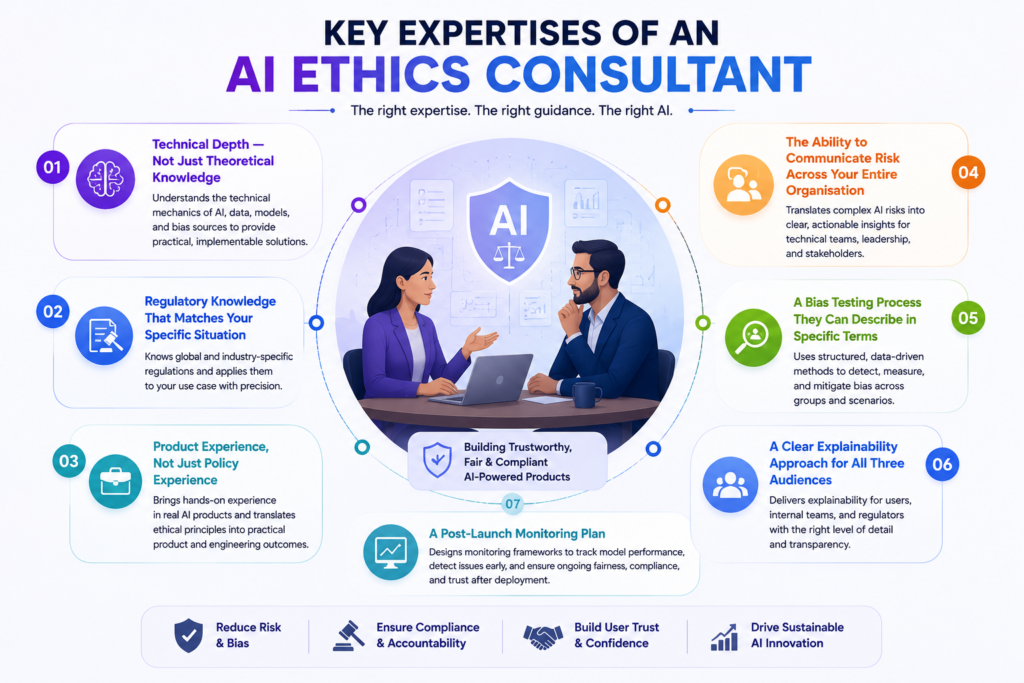
1. Technical Depth — Not Just Theoretical Knowledge
This is the most important filter, and the one that eliminates the largest proportion of candidates who present well on paper.
Be careful with consultants who cannot explain the technical mechanics of bias in machine learning models. Real AI ethics consulting means you can point to where bias actually enters the pipeline: in the training data, in feature selection, in the optimisation objectives, in threshold calibration, or in the deployment context.
Ask them:
“If our model’s approval rate for one demographic group was ten percentage points lower than another — where would you start looking for the cause?”
A consultant with genuine technical depth will walk you through a structured diagnostic: training data representation, feature engineering choices, label quality, threshold calibration, proxy variable encoding. A consultant without it will say something like “we would run a bias audit” without being able to explain what that involves in practice.
They do not need to write your model training code. But they need to understand the mechanics well enough to give your data science team specific, implementable guidance and not general observations that engineers then have to translate on their own.
2. Regulatory Knowledge That Matches Your Specific Situation
AI regulation is proliferating, sector-specific, and moves faster than most people working outside of it realise. General familiarity with the EU AI Act is not the same as knowing which risk tier your specific product falls into and what compliance looks like at the feature level.
The regulatory landscape you need your consultant to understand depends on where your product operates and what it does:
EU AI Act — if your product operates in the EU or serves EU users, the Act’s risk tier classifications determine what obligations apply. High-risk AI systems face significant transparency, explainability, and human oversight requirements. Your consultant should be able to tell you exactly which category your product falls into and what compliance requires from your engineering team and not your legal team.
GDPR Article 22 — applies when automated decision-making produces legal or similarly significant effects on users. The requirement to inform users and provide human review mechanisms must be built into your product interface, not buried in a terms and conditions document.
NIST AI Risk Management Framework — the practical governance standard in many US enterprise and government-adjacent contexts. Your consultant should be able to map your product against it, not just cite it.
ISO/IEC 42001 — the international AI management system standard. Increasingly appearing in enterprise procurement requirements and certification expectations.
Sector-specific frameworks — an ethics consultant supporting a healthcare organisation should understand FDA Software as a Medical Device guidance. Someone focused on financial services should be comfortable with SR 11-7 model risk management guidance from the Federal Reserve. Do not hire a generalist for a regulated sector engagement without verifying they understand the sector-specific layer on top of general AI ethics principles.
Ask them:
“What regulatory obligations apply to our specific use case and what would compliance with each one actually look like in our product?”
The answer should be precise and feature-specific. If it is general, they do not know your situation well enough yet or at all.
3. Product Experience, Not Just Policy Experience
There is a meaningful difference between consultants who have worked directly with engineering and product teams on live AI systems, and those whose experience is primarily in policy development, academic research, or corporate ethics programme design.
If your immediate need is to make your existing product more ethically sound, you need someone who has done this before in a product context — someone who knows how to translate an ethical principle into a data science sprint, a bias testing protocol, a logging specification, or a user-facing disclosure that your development team can implement.
For industry-specific engagements, hands-on experience with real AI projects usually says more than academic degrees. Look for people who can show their skills through open-source contributions, participation in AI competitions, or prior production deployments. Ask for references from clients in your exact sector.
Ask them:
“What did this consultant produce for your engineering team? What got built or changed as a direct result of their engagement?”
The answer should involve specific controls, tests, or architectural decisions, not a governance document that was produced and then filed away.
4. The Ability to Communicate Risk Across Your Entire Organisation
One thing most AI ethics consultants don’t have, but enterprises really notice, is organisational influence. The ability to translate technical risk findings into board-level language, then actually drive policy adoption across legal, compliance, product, and data science teams.
A consultant who can explain model fairness to your data scientists but cannot explain the same risks to your CFO, your legal team, or your board in language that produces decisions is only half as valuable as one who can do both. Test this in the conversation itself.
Ask them:
To explain a complex trade-off like the difference between demographic parity and equalised odds as fairness criteria. First, as they would to a machine learning engineer, then as they would to a Chief Risk Officer.
The quality and clarity of both explanations tells you whether they can drive change across your organisation or only within one function.
5. A Bias Testing Process They Can Describe in Specific Terms
Bias testing is the most commonly claimed and most inconsistently delivered capability in AI ethics consulting. Almost every candidate says they do it. Very few can describe a rigorous, specific approach when asked.
A credible bias testing process for your product should include, at minimum:
Training data review — examining demographic composition, identifying representation gaps, and assessing whether historical decisions encoded in the data carry discriminatory patterns.
Protected group testing — measuring model outcomes across legally protected characteristics and statistically significant proxy variables.
Proxy variable analysis — identifying features in your data that correlate with protected characteristics without directly encoding them. Postcode, device type, browsing behaviour, transaction timing — these can all serve as proxies for demographic characteristics in ways that produce discriminatory outcomes even when demographic data is excluded from the model.
Intersectional testing — understanding that bias compounds at the intersection of characteristics. A model may perform fairly on gender and fairly on age independently, while producing significantly unfair outcomes for a specific combination of both.
Threshold calibration review — assessing whether the decision threshold applied to model outputs is producing systematically different false positive and false negative rates across groups — one of the most common and least diagnosed sources of outcome disparity.
Ask them:
To walk you through exactly what they would do for your specific product and your specific data. A consultant who gives a generic answer without specifying which fairness metrics they would use, why those metrics are appropriate for your use case, and what the output would look like is not the right person.
6. A Clear Explainability Approach for All Three Audiences
Explainability means different things to different stakeholders, and a strong consultant addresses all three rather than treating it as a single deliverable:
User-facing explainability — the plain-language explanation a person affected by an AI decision receives. This is both an ethical obligation and a legal requirement in many jurisdictions.
Internal operational explainability — the ability for your engineering and product teams to understand why the model made a specific decision in a specific case, enabling debugging, auditing, and improvement.
Regulatory explainability — the documented, auditable evidence that your AI system makes decisions in a way that can be scrutinised and defended by an auditor, a regulator, or in litigation.
Ask them:
“How do they approach each of the three?”
A consultant who focuses only on user-facing explanations will leave your internal and regulatory needs unmet. A consultant who focuses only on model interpretability tools will miss the user communication and regulatory documentation requirements.
7. A Post-Launch Monitoring Plan
AI ethics is not a pre-launch exercise. Models drift. Data distributions shift. The user population your product serves in year two may differ significantly from the population your model was trained on. A model that passes every fairness test at launch can degrade into unfair outcomes as real-world data diverges from training data.
Ethics consulting engagements that start after deployment end up costing about three to five times more than work built into the development cycle. But equally, consultants whose engagement ends at pre-launch validation are not accounting for what happens next.
Ask them:
- What metrics would you recommend we track post-launch to detect fairness degradation?
- At what thresholds should those metrics trigger a model review or retraining?
- How should our team document and escalate AI incidents?
- What does responsible AI monitoring look like for our specific use case in practice?
The answers should be specific and implementable by your team without continuous consultant involvement. If they cannot describe a monitoring programme in concrete terms, they are not thinking about the full lifecycle of your product.
Read Also: Common Bugs in AI-generated Code (and How to Fix Them)
Key Questions to Ask Before Hiring an AI Ethics Consultant
These separate candidates who understand the domain from those who have learned to sound like they do.
“Walk me through what you would do in the first two weeks of engaging with our product.”
This reveals whether they start with discovery or with their own framework and methodology. Starting with their framework before understanding your context is backwards.
“Describe a bias testing protocol you have run for a real product. What did you find, and what specifically changed as a result?”
A practitioner with genuine product experience will have concrete examples. Someone without it will describe methodology in the abstract.
“How would you explain demographic parity versus equalised odds to our lead data scientist — and then to our Chief Risk Officer?”
Tests both technical depth and the communication range that drives organisational adoption.
“What regulatory obligations apply to our specific use case — and what would meeting each one actually require from our engineering team?”
Tests the precision of their regulatory knowledge for your situation, not their general awareness of AI regulation.
“What would post-launch AI ethics monitoring look like for a product like ours?”
Tests whether they think in full product lifecycle terms or only in pre-launch terms.
“What is outside your expertise — what would you not be able to do for us?”
A confident, honest consultant has a clear and specific answer. Candidates who claim to cover everything should be treated with scepticism. Nobody is strong across the entire domain.
“Can you share an example of a deliverable your team produced for an engineering team on a comparable project?”
An anonymised example of a bias testing report, a technical risk brief, or a model card from a past engagement is far more informative than a list of client names.
These questions provide a solid starting point, but they shouldn’t be treated as a fixed checklist.
Every AI product has unique technical, regulatory, and business requirements, so it’s important to prepare additional questions that reflect your specific use case. The more tailored your discussion is to your product, the better you’ll be able to assess whether a consultant is the right fit.
Read Also: Best Vibe Coding Tools For Non-Technical Founders
One Final Distinction Worth Making
The consultants who produce the most durable, practical outcomes are the ones who treat your product’s ethical quality as a product quality issue and not a compliance issue, not a values exercise, and not a risk management checkbox.
Users who do not trust an AI decision do not act on it. Users who feel an AI system treated them unfairly do not return. Users who cannot understand why an AI made a decision about them disengage from the feature. The commercial and ethical arguments for responsible AI in your product point in the same direction.
The right consultant understands this. They will not produce a framework that imposes friction on your product in exchange for compliance comfort. They will find the places where getting the ethics right makes the product better and help your team build those improvements into the product itself.
If you’re looking for that kind of partner, Triple Minds can help. We’ve worked with 50+ AI-powered digital products to build practical AI governance, reduce bias, strengthen compliance, and embed responsible AI into real-world products—not just documentation.
Our focus is on creating AI systems that are trusted, compliant, and ready to scale. Get in touch with us to discuss your AI product and learn how our AI ethics consulting services can help you build responsible AI with confidence.
Why Choose Triple Minds as Your AI Ethics Consulting Partner?
Building responsible AI requires more than compliance checklists. Triple Minds helps businesses design practical AI governance, reduce bias, strengthen regulatory readiness, and embed responsible AI practices directly into real-world products from development through deployment.
Talk to Our AI Ethics Experts
Frequently Asked Questions
Ask for a real example of product improvements they delivered, such as bias mitigation, audit logging, or AI governance changes, not just policies or frameworks.
If you operate in regulated industries like healthcare or finance, industry expertise is essential. For other sectors, proven product-level AI ethics experience is usually sufficient.
Start with a short paid assessment or pilot project. The quality of their recommendations and deliverables will indicate what to expect from a larger engagement.
You still need AI ethics oversight. A consultant can help assess risks, implement safeguards, and ensure your use of third-party AI is compliant and responsible.
You should receive actionable outputs such as bias testing protocols, audit requirements, implementation recommendations, and a monitoring plan—not just a report.
Define clear objectives and success criteria at the start. The engagement should end once agreed deliverables, testing, and documentation have been completed.
In this blog, we’ll walk you through practical, real-world ways to make money by producing and selling carbon offsets. No fancy theories, no unrealistic promises—just actionable insights based on what’s actually working for businesses already operating in this space.
Making your business eco-friendly is no longer optional. Customers expect it, investors prioritize it, and governments are enforcing stricter regulations. Businesses worldwide are actively working to reduce carbon emissions, and many have already committed to reaching net-zero in the coming decades.
This shift is creating a real business opportunity. Companies need reliable ways to offset their emissions, and that demand is opening the door for startups and growing businesses to step in, provide solutions, and generate revenue.
This is where carbon offsets become a powerful business model.
At Triple Minds, we’ve seen that many founders focus only on producing carbon offsets. However, the real opportunity lies in how you sell, position, and scale them. You don’t always need to build projects from scratch—you can enter the market in multiple ways and still build a profitable business.
The concept is simple: companies cannot eliminate all emissions immediately, so they look for ways to balance them. By offering verified carbon offset solutions, your business becomes a key part of their sustainability journey.
The demand is growing fast—but success depends on more than just supply. It comes down to distribution, visibility, and building trust in the market. In this blog, we’ll break down the most practical ways to enter the carbon offset space and turn it into a revenue-generating business.
Turn Your Carbon Offset Idea Into a Real Revenue Business
If you’re planning to sell carbon offsets but don’t know how to structure your model or bring in buyers, the challenge isn’t the idea—it’s execution. At Triple Minds, we help businesses build carbon offset platforms, define the right selling models, and create systems that generate revenue.
Start Building Your Carbon Offset Business Today
The 3 Practical Ways to Sell Carbon Offsets
1. Work as a Carbon Broker
You don’t need to own projects. You connect buyers and sellers and earn margins. This is one of the fastest ways to enter the market.
2. Sell Through a Marketplace (or Build One)
You can list carbon credits on existing platforms or create your own marketplace. With the right SEO, this becomes a scalable revenue system.
3. Produce Offsets Using Land or Projects
Own or manage land (like forests) and generate credits yourself. This is a long-term, high-value model with stronger control and profits.
At Triple Minds, we help businesses build visibility around all three models so they can consistently attract buyers instead of chasing them. Now let’s understand what exactly are carbon offsets.
You May Also Find This Useful: A Complete Guide On How to Build a Carbon Offset Tracking System?
What Are Carbon Offsets?
A carbon offset is one metric ton of CO₂ that was either avoided, removed, or reduced from the air. Instead of directly reducing emissions, businesses invest in projects elsewhere that achieve the same goal. This allows them to balance out the emissions that they cannot eliminate immediately.
Consider this: if a company emits a certain amount of carbon through its operations, it can “offset” that impact by funding a project that reduces an equivalent amount of carbon elsewhere. The end result is a more balanced environmental footprint.
Some of these projects include restoring forests, making clean energy, and making energy use more efficient. The most important thing is that the impact is real, measurable, and verified through a proper carbon credit issuance system.
Businesses are using carbon offsets more and more as part of their strategies for being environmentally friendly and building their brands. And for new businesses, they give them a chance to build something that people want more and more of while also making the world a better place.
Read Also: Climate Tech Startup Ideas That Actually Make Money
Choose the Right Selling Model (This Decides Your Revenue)
Once you understand how carbon offsets work, the next step is not just choosing a project, but deciding how you want to sell in this market.
This is where most businesses get confused. They try to do everything at once. Instead, you should focus on one clear model and build from there.
Here’s a simple breakdown:
| Selling Model | Investment | Speed to Revenue | Control | Profit Potential |
| Broker | Low | Fast | Low | Medium-High |
| Marketplace | Medium | Medium | Medium | High |
| Own Projects/Land | High | Slow | High | Very High |
- Broker model is best if you want quick entry and faster cash flow
- Marketplace model works if you want to build a scalable platform
- Land/project model is ideal for long-term asset building
At Triple Minds, we usually recommend starting with one model, validating demand, and then expanding. Because in this space, clarity beats complexity.
Build Trust So Buyers Actually Pay You
Once you decide your selling model, the next step is what actually makes people buy from you. Not just availability. Not just pricing. But trust. Buyers today are more careful than ever. They don’t just want carbon credits. They want confidence that what they’re buying is real and credible. Here’s what builds that trust in real scenarios:
- Clear project transparency
Explain where your offsets come from and how they work
- Proof of impact
Show measurable results, not just claims
- Strong positioning
Your website, content, and messaging should look reliable and professional
- Third-party validation (if applicable)
If you work with verified credits, highlight that clearly
But here’s the part most businesses miss.
Even if you have all this, it doesn’t matter if no one sees it. At Triple Minds, we help businesses turn trust into visibility by ranking their brand on Google for high-intent searches. So when buyers are already looking for carbon offsets, your business shows up first. That’s what converts interest into actual revenue.
Build Your Sales Strategy
Once your carbon offsets are verified, the real opportunity begins turning those credits into revenue. Many startups make the mistake of stopping at production, but the real game is in how you sell and position your offsets in the market. Companies today are actively looking for reliable partners who can provide credible and transparent carbon credits. This is where having a clear sales approach makes a difference. You can begin by listing your credits on marketplaces, but over time, developing direct relationships with companies will provide you with higher margins. This is also where SEO becomes critical.
At Triple Minds, we help carbon offset businesses rank for high-intent searches like:
- buy carbon credits
- offset business emissions
- verified carbon offset providers
This means instead of chasing clients, clients find you when they are already ready to buy. If your project involves tech or platforms, building a marketplace combined with SEO can turn your business into a consistent lead generation system.
Manage Costs & Scale
You don’t have to make a large initial investment to launch a carbon offset business. The best strategy is to start small, get a sense of your numbers, and then gradually increase. Keeping track of your project expenses, verification costs, and revenue per carbon credit is crucial. This gives you insight into what is actually working. As your operations grow, having the right systems in place becomes essential.
At Triple Minds, we often see businesses scale faster when they combine:
- strong project fundamentals
- clear sales strategy
- and SEO-driven visibility
Scaling is about doing things more effectively, not just more.
Read Also: Cost to Build a Carbon Credit Marketplace
Marketing & Partnerships
Even with a fantastic project and verified credits, your success depends on how well you market your offsets and build the right partnerships. Buyers are looking for more than just carbon credits. They want trust, transparency, and a clear story. This is why branding and positioning are extremely important.
Your project should clearly communicate:
- what it does
- where it operates
- how it delivers measurable impact
At Triple Minds, we help businesses build this visibility using SEO strategies, content, and authority-building strategies so they don’t depend only on marketplaces or intermediaries. Partnerships with ESG consultants, sustainability brands, and enterprises can also help you scale faster.
Build, Launch, and Scale Your Carbon Offset Marketplace
Whether you want to act as a broker, list credits, or build your own marketplace, growth depends on having the right system in place. At Triple Minds, we help you develop platforms, streamline operations, and create a scalable setup that brings consistent transactions.
Talk to Our Experts & Get Started
Final Thoughts
What truly makes a difference is how well you execute and sell. Carbon offsets, when approached correctly, become a long-term revenue stream and brand asset rather than just a compliance tool. The biggest shift you need to understand is this: Production creates supply. But SEO and positioning create demand.
At Triple Minds, we work with businesses that want to do both. Whether it’s choosing the right model, building a marketplace, or ranking on Google to attract buyers, we make sure your carbon offset business is not just built but actually grows.
If you’re ready to turn sustainability into a real business opportunity, now is the time to take the first step.
Quick Answers to Common Questions
You make money by selling carbon credits to businesses. This can be done as a broker, through marketplaces, or by producing your own credits.
Becoming a broker is the fastest way since you don’t need to create projects.
Yes. Many businesses operate purely as brokers or marketplace platforms.
The most effective way is through SEO. Businesses actively search for offset solutions online.
Yes. Without verification, your credits won’t be trusted or easily sold.
Yes. It brings high-intent buyers who are already searching, making conversions much easier.
The way people buy and sell cars has fundamentally shifted. Today, more buyers start their car search on a smartphone than at a dealership lot. Platforms like AutoTrader and AutoScout24 have proven that a well-built online car marketplace can command millions of users, generate substantial recurring revenue, and reshape an entire industry.
If you’re thinking about launching your own used car marketplace – this guide covers everything you need to know: the market opportunity, must-have features, tech stack decisions, revenue models, and the fastest path to market.
“At Triple Minds, we have already developed a complete AutoTrader-like platform with Listing Management, Lead Management, Dealership Panel, Master Admin, Test Drive Booking, and 30+ advanced features. Instead of just reading about it, you can explore the demo and see how everything works in a real-world setup before making any decision.”
Why Now Is the Right Time to Enter the Used Car Marketplace
The global used car market continues to grow at a strong clip, driven by rising new-car prices, supply chain pressures that pushed buyers toward pre-owned inventory, and a generation of consumers who expect to complete major purchases entirely online.
- The global used car market is projected to grow significantly, reaching multi-trillion-dollar scale by the end of the decade, driven by affordability and digital adoption. (Statista)
- The shift to digital is already dominant—over 95% of used car buyers start their journey online, highlighting how critical online platforms have become. (McKinsey & Company)
- Used car prices saw a sharp surge during supply chain disruptions, with prices rising ~25–50% between 2020–2022, fundamentally shifting buyer behavior toward pre-owned vehicles. (McKinsey & Company)
- Digital-first platforms are gaining traction because consumers increasingly expect integrated financing, online comparison tools, and end-to-end digital journeys when buying vehicles. (Deloitte)
The competitive landscape includes major incumbents like AutoTrader, Cars.com, CarGurus, and AutoScout24, but regional and niche players continue to carve out profitable markets. A dealership network in a specific geography, a vertical focused on EVs, or a B2B wholesale platform can all compete effectively.
Defining Your Business Model Before You Move To Development Phase
The revenue model you choose shapes every other decision: the features you prioritize, who your “customer” actually is, and how you measure success.
Listing fees are the simplest model — sellers pay to post vehicles. This works well for dealer-facing platforms where inventory volume is high and predictable.
Lead generation / subscription is how AutoTrader and CarGurus largely operate. Dealers pay monthly subscriptions for featured placement and buyer leads rather than per-listing.
Transaction commissions are more ambitious but more lucrative. If your platform facilitates the actual purchase (especially relevant for consumer-to-consumer sales), taking a percentage of each deal is viable.
Most successful platforms combine several of these. Decide early which will be your primary revenue engine, because it determines whether buyers or sellers are your real customers.
Build Your AutoTrader-Like Platform—Fast & Scalable
Launch a feature-rich used car marketplace with Triple Minds’ AutoTrader Clone Solution. Our ready-to-customize platform helps businesses go live faster with advanced search, dealer listings, lead generation, and scalable architecture built for long-term growth.
Explore Our AutoTrader Clone Solution
Core Features Your Platform Must Have
Whether you’re building a web marketplace, a mobile app, or both, certain features are non-negotiable for user trust and conversion.
For Buyers
Advanced search and filtering is the backbone of the experience. Users need to filter by make, model, year, price range, mileage, location radius, fuel type, transmission, condition, and features. The search needs to be fast — if results take more than a second, buyers leave.
Detailed vehicle listings should include multiple high-quality photos (at minimum 8–12 per vehicle), full specs, mileage, service history indicators, accident history flags, and a clear pricing context (is this a good deal relative to market?).
Price transparency tools — similar to CarGurus’ “deal rating” system — give buyers confidence. Showing how a car’s price compares to similar listings in the market is a strong conversion driver.
Saved searches and alerts keep buyers coming back even when they don’t find the right car on their first visit.
Real-time messaging lets buyers contact sellers or dealers directly within the app, which improves both trust and response rates compared to bouncing users to external email.
Loan calculator and financing integration reduces friction for buyers who want to know monthly payment estimates before committing to an inquiry.
For Sellers and Dealers
Streamlined listing creation — ideally with VIN decoding that auto-populates specs and a photo upload flow optimized for mobile — reduces the work required to list a vehicle.
Inventory management dashboard for dealers who need to manage dozens or hundreds of listings simultaneously, including bulk upload/edit capabilities and real-time inventory sync with dealer management systems (DMS).
Analytics and reporting on listing performance: views, inquiries, time on market, and conversion rates.
Secure payment processing for any platform-facilitated transactions, with escrow functionality if you’re handling consumer-to-consumer deals.
For Platform Trust and Safety
User verification — including identity verification for private sellers and business verification for dealers — is essential to prevent fraud.
Vehicle history integration (VIN-based reports) gives buyers confidence and reduces post-purchase disputes.
Review and rating systems for both buyers and sellers build long-term trust.
Fraud detection logic to flag suspicious listings — unusually low prices, stock photos, duplicate VINs — protects the platform’s reputation.
The Technical Architecture
Frontend
For the web, React or Next.js give you the performance and SEO capabilities a marketplace needs. For the mobile app, React Native and Flutter are the leading cross-platform options — both let you build for iOS and Android from a single codebase, which matters enormously for time to market.
The front end needs to be mobile-first in design, not just mobile-responsive. A majority of car shopping traffic comes from mobile devices, and the listing photo experience in particular needs to be built with mobile as the primary context.
Backend
Node.js and Django are both strong choices for the backend API layer. The more important architectural decisions are around scalability: you’ll want to design for horizontal scaling from the start, because traffic to a car marketplace is highly variable (weekend spikes, seasonal patterns, marketing campaign surges).
A microservices approach makes sense for larger platforms — separating the search service, listing service, messaging service, and user auth into independently deployable components. For an MVP, a well-structured monolith is faster to ship.
Database
Relational databases (PostgreSQL is the modern standard) handle user accounts, transactions, and structured vehicle data well. Elasticsearch or similar search-optimized solutions are worth the added complexity for the search layer once your inventory grows beyond a few thousand listings — full-text search, proximity filtering, and faceted navigation are hard to do well in a pure relational database.
You May Also Find This Useful: What is a Database Chatbot and How Does it Work?
Search and Recommendations
At scale, a dedicated search index is essential. Beyond basic filtering, an AI-powered recommendation engine that surfaces relevant listings based on a user’s browsing and saved search history significantly improves engagement and conversion.
Integrations
A real marketplace needs integrations with: payment gateways (Stripe, PayPal, or regional equivalents), mapping services (Google Maps for location-based search), VIN decoding APIs, vehicle history providers, SMS/push notification services, and potentially dealer management systems for B2B inventory feeds.
Used Car Marketplace & App Development Process: From Idea to Launch
Phase 1 — Discovery and planning (4–6 weeks)
Define your target market and user personas. Map user journeys for buyers, private sellers, and dealers. Prioritize features into an MVP scope. Choose your tech stack and decide on build vs. white-label.
Phase 2 — Design (4–6 weeks)
Wireframes → interactive prototypes → high-fidelity UI design. Mobile-first. Test with real users before development begins. The listing creation flow and search/filter experience deserve the most design attention.
Phase 3 — MVP development (3–6 months)
Core search and browse, listing creation and management, user accounts, messaging, basic payment integration. Don’t build everything at once — ship something users can test.
Phase 4 — Testing and QA
User acceptance testing (UAT) with a beta cohort of both buyers and sellers. Load testing to ensure the platform holds up under traffic. Security testing — particularly around payment flows and user data.
Phase 5 — Launch and iteration
Launch to a defined geographic market or dealer cohort. Measure everything. Iterate rapidly based on real usage data.
Ready to Streamline Your Car Dealership Operations?
Managing listings is only part of the business. Triple Minds’ White Label Car Dealer CRM helps dealerships centralize leads, inventory, customer relationships, and sales workflows in one powerful platform—built to improve efficiency and drive more conversions.
Explore Our White Label Car Dealer CRM
Used Car Marketplace Mobile App Considerations
The mobile app is not an afterthought — for many users, it will be the primary interaction surface. Key mobile-specific considerations include:
Push notifications for saved search matches (new listings that meet a buyer’s criteria) are a major driver of return visits and should be implemented from day one.
Camera-optimized photo upload for sellers is important. The better you make the process of shooting and uploading vehicle photos on a phone, the higher the quality of your inventory.
Offline functionality for browsing recently viewed listings is a nice-to-have that improves the experience in low-connectivity situations.
Location services for proximity-based search — “show me cars within 50 miles” — are a core feature, not a luxury.
App Store optimization (ASO) and a clear strategy for user acquisition on iOS and Android need to be part of the launch plan, not an afterthought.
You Might Also Find This Useful: Build a Car Dealer CRM Website That Sells Cars
How much does it cost to build a used car marketplace & app?
From a cost perspective, the total investment varies based on the scope of features and platforms involved.
A basic web-only MVP with essential functionalities like listings and inquiry forms may cost between $6,000 and $10,000.
Expanding this to include a full web platform with admin controls and a dealer portal can increase costs to around $12,000–$18,000. If you plan to launch across web and mobile (iOS and Android) with a complete ecosystem, the budget typically ranges from $20,000 to $30,000.
For enterprise-grade platforms featuring real-time chat, auction modules, financing integrations, and advanced analytics, costs can exceed $35,000.
You can also use a mobile app cost calculator to estimate your app cost based on your features and requirements in just a few clicks.
Regardless of the tier, a robust platform should include mobile-responsive design, dealer inventory management, buyer-facing search and inquiry systems, admin dashboards with analytics and approval workflows, location-based search using tools like Google Maps, and deployment on scalable cloud infrastructure such as Amazon Web Services or DigitalOcean.
Final Thoughts
The used car marketplace space is large, growing, and still has room for well-executed entrants, especially in regional markets, specific verticals (EVs, commercial vehicles, luxury), or B2B wholesale. The platforms that win are the ones that build trust with both sides of the marketplace, make the search experience genuinely useful, and reduce friction at every step of the buying and selling journey.
Whether you build from scratch or start with a proven white-label foundation, the fundamentals are the same: know your user, prioritize trust, and ship something real before you try to perfect it.
The car market is moving online. The question is whether you’ll build the platform that buyers and sellers use in your market or let someone else.
It never feels dangerous at first. You’ve launched your AI product. It’s working fast, handling users with ease. Your business is doing well; everything looks perfect. Until one day, it isn’t.
The thing is, AI doesn’t understand the consequences. It simply predicts responses based on patterns. Without strong content moderation guidelines, it can say the wrong thing at the worst possible moment. And when users are vulnerable, one wrong response can cause real harm. There have already been cases where people treated AI chatbots like someone they could trust and open up to. Because these systems sound human, users often share personal struggles, including emotional and mental health issues. But if AI is not built with proper safeguards, it can encourage negative thoughts or fail to stop harmful conversations, making things worse. Studies have shown that AI can sometimes agree too easily with users, even when they express self-harm ideas, reinforcing those thoughts instead of guiding them safely.
The risks go beyond that. Users under 18 can be exposed to inappropriate content or conversations they should never see. AI can also provide unsafe suggestions around health or medicines without understanding a person’s real condition. Misuse is another serious concern. Features like face swapping, if not properly controlled, can be used to create harmful or explicit content, damaging someone’s reputation and mental well-being in seconds.
Without strong content moderation, AI doesn’t just make mistakes; it creates real-world consequences. That’s why building AI responsibly is no longer optional. At Triple Minds, we focus on developing AI systems with the right safeguards, clear boundaries, and ethical guidelines in place, so your product doesn’t just perform well, but also protects the people using it.
In this guide, we’ll break down why content moderation matters, what risks you need to watch for, and how to build AI systems that are safe, compliant, and ready to scale.
Quick Summary
What your AI says and creates directly impacts both your users and your business. Without proper content moderation, it can generate harmful or illegal outputs like adult content involving minors, deepfakes, unsafe medical advice, or sensitive religious content that can mislead or offend. These are not small mistakes. They can lead to legal issues, heavy penalties, and brand damage that costs far more than what your business earns. Content moderation is what keeps your AI safe, compliant, and trusted.
Want to See a Real AI Moderation System in Action?
Triple Minds has already built and deployed a live AI moderation engine that keeps platforms safe, compliant, and scalable in real-world use.
Explore a Live Project 🚀
30+ Built-In Moderation Layers for Safer AI Systems
When businesses deploy AI in the real world, things don’t always go as planned. Users experiment, push limits, and sometimes misuse the system in ways that can quickly turn into serious risks.
We’ve already seen real-world issues with platforms like Character.AI and Snapchat, where AI chatbots faced backlash for unsafe or inappropriate responses, including sensitive mental health interactions. Similarly, AI-generated political memes, deepfake content, and identity misuse across platforms like Meta have raised global concerns.
This is exactly why basic moderation is not enough. At Triple Minds, we build AI systems with 30+ advanced moderation layers, covering a wide range of real-world risks:
Child safety, age-gated content, NSFW filtering, hate speech, violence detection, self-harm content, suicide prevention triggers, harassment and abuse, bullying, political content control, no-politician memes, propaganda filtering, religious sensitivity, cultural sensitivity, misinformation detection, fake news filtering, deepfake detection, face swap protection, identity misuse, impersonation detection, keyword bans, contextual moderation, prompt injection protection, jailbreak detection, spam detection, fraud prevention, financial scam detection, healthcare moderation, medical advice filtering, legal compliance checks, regional regulation filters, data privacy protection, personal data exposure control, brand safety filters, ad compliance moderation, and more.
You Might Also Find This Useful: Major Differences Between RPA and Agentic Workflows?
Why These Moderation Layers Matter
Let’s break this down with real-world context.
Child Safety & Self-Harm Prevention
There have been reports where AI chatbots on platforms like Character.AI were criticized for how they handled sensitive emotional conversations. In extreme cases, unsafe responses in mental health contexts created serious concerns.
With our systems:
- Self-harm and suicide-related prompts are instantly flagged and handled safely
- AI avoids harmful suggestions and redirects to safe responses
- Child safety violations are blocked at multiple levels
Political & Public Figure Moderation
AI-generated political memes and deep-fake-style content have already gone viral, creating backlash and even regulatory attention.
Without moderation:
- A user generates a fake political meme
- It spreads online
- Your platform gets blamed
With Triple Minds:
- No-politician meme filters
- Public figure misuse detection
- Propaganda and misinformation control
Deepfake, Face Swap & Identity Protection
Platforms experimenting with generative media, including those by Meta, have highlighted risks around face swapping and identity misuse.
We prevent:
- Unauthorized face swaps
- Deepfake-style generation
- Identity impersonation attempts
Healthcare & Sensitive Advice Moderation
There have been cases where AI tools gave misleading or unsafe medical advice, which can be dangerous.
Our system ensures:
- No unsafe medical or health guidance
- Sensitive queries are handled carefully
- Compliance with healthcare-related standards
Keyword + Context + Intent-Based Moderation
Users often try to bypass filters using clever prompts.
Example:
Instead of directly asking something harmful, they rephrase it.
Basic systems fail here.
Our approach:
- Keyword detection + context understanding + intent analysis
- Blocks harmful requests even when disguised
- Reduces false positives
Why 30+ Layers Make the Difference
Most AI products fail because they rely on 1–2 basic moderation layers. That’s not enough in real-world usage.
At Triple Minds, our multi-layered moderation architecture ensures:
- Strong protection against real-world misuse
- Better accuracy and fewer errors
- Higher user trust and retention
- Full compliance readiness
Types of Content Moderation in AI Systems
Content moderation in generative AI is not a single step; it is a layered process that works before, during, and after content is created. Understanding these types helps businesses build safer and more reliable AI products.
Pre-Generation Filtering
This happens before the AI generates any response. The system checks the user’s input (prompt) to decide whether it is safe to process.
- Blocks harmful or restricted prompts early
- Prevents misuse like prompt injections or jailbreak attempts
- Reduces risk before content is even created
This is your first line of defense, stopping problems at the source.
Post-Generation Moderation
This takes place after the AI generates content but before it is shown to the user.
- Scans AI responses for unsafe or non-compliant content
- Filters out harmful outputs that slipped through earlier checks
- Ensures final output meets platform guidelines
It acts as a safety net, catching anything missed during input filtering.
Human-in-the-Loop Systems
Even the best AI systems are not perfect. That is where human oversight comes in.
- Humans review flagged or sensitive content
- Help train and improve AI models over time
- Handle edge cases where context or nuance is complex
This approach improves accuracy, fairness, and decision-making quality.
AI vs Human Moderation Balance
The most effective systems combine both AI and human moderation.
- AI handles scale by processing large volumes of content instantly
- Humans handle complexity by understanding context, tone, and intent
- Together, they reduce errors like false positives and false negatives
The goal is not to replace humans but to create a balanced system that is fast, scalable, and reliable.
Don’t Miss This Guide: How Much Does It Cost to Build an AI Agent?
Core Elements of a Strong Content Moderation Policy
A strong content moderation policy is not just about blocking harmful content; it is about creating a structured system that ensures consistency, safety, and scalability across your AI product.
Clear Content Guidelines
Everything starts with defining what is allowed and what is not. Without clarity, moderation becomes inconsistent and confusing.
- Clearly define acceptable and restricted content categories
- Cover sensitive areas like harmful content, misinformation, and NSFW topics
- Ensure guidelines are easy to understand for both users and internal teams
Clear rules help AI systems and humans stay aligned on what should be generated or blocked.
Risk Classification Frameworks
Not all content carries the same level of risk. A strong policy should classify content based on severity.
- Categorize content into low, medium, and high risk
- Apply stricter controls to sensitive or high-risk categories
- Prioritize moderation efforts based on potential impact
This helps businesses focus on what matters most instead of treating all content equally.
Real-Time Monitoring Systems
In generative AI, content is created instantly, so moderation must also happen in real time.
- Continuously monitor user inputs and AI outputs
- Detect unsafe patterns, misuse attempts, or policy violations instantly
- Reduce the chances of harmful content reaching users
Real-time systems ensure that moderation keeps up with the speed of AI.
Escalation and Reporting Mechanisms
No system is perfect, which is why escalation paths are critical.
- Flag complex or sensitive cases for human review
- Provide users with options to report or appeal decisions
- Create feedback loops to improve moderation over time
This adds a layer of accountability and helps improve both accuracy and user trust.
You May Also Find This Useful: Content Moderation’s Role in NSFW Payment Approval
How Leading AI Platforms Handle Moderation
Top AI platforms don’t rely on a single solution; they use layered moderation systems that combine technology, policy, and human oversight to manage risk at scale. For businesses, understanding how these platforms operate can provide a clear benchmark for building safer AI products.
Industry Examples and Benchmarks
Companies like OpenAI, Google, and Meta have set strong standards for AI moderation.
- They use multi-layered filtering systems across the input and output
- Continuously update models using real-world feedback and data
- Apply strict policies for sensitive categories like harmful, political, or explicit content
- Invest heavily in safety research and red-teaming to identify weaknesses
These platforms treat moderation as an ongoing process, not a one-time setup.
Policy Enforcement Strategies
Having policies is not enough; enforcing them effectively is what matters. Leading platforms focus on:
- Automated enforcement at scale using AI-driven filters and classifiers
- Real-time decision making to block or modify unsafe outputs instantly
- Human review systems for complex or borderline cases
- Regular audits and updates to improve accuracy and reduce errors
They also ensure policies are applied consistently across all users and use cases, which is critical for maintaining trust.
What Businesses Can Learn from Them
Businesses do not need to build everything at the same scale, but they can adopt the same principles:
- Build layered moderation, not just a single filter
- Combine AI speed with human judgment
- Continuously test, monitor, and improve moderation systems
- Focus on transparency and user trust, not just restriction
The key takeaway is simple: moderation is not just about control, it is about creating a reliable and scalable user experience.
Challenges in Moderating Generative AI Content
Moderating generative AI is not as simple as applying filters. The nature of AI makes moderation fast-moving, complex, and constantly evolving, which creates real challenges for businesses trying to maintain safety without affecting user experience.
Scale and Speed of AI Outputs
Generative AI can produce thousands of responses in seconds, making manual control nearly impossible.
- Huge volume of content generated in real time
- Difficult to review everything manually
- Small gaps in moderation can scale into large risks quickly
This is why businesses need automated, real-time moderation systems that can keep up with AI speed.
Context Understanding Limitations
AI still struggles to fully understand meaning beyond words.
- Difficulty detecting sarcasm, tone, or intent
- Can block safe content (false positives)
- Can miss harmful intent hidden in complex prompts
This lack of deep understanding makes moderation less accurate, especially in nuanced situations.
Cultural and Regional Sensitivity Issues
What is acceptable in one region may not be acceptable in another.
- Different countries have different content standards and laws
- Cultural context can change how content is interpreted
- Risk of offending users or violating local regulations
For global platforms, moderation needs to be flexible and region-aware, not one-size-fits-all.
Best Practices for Building Safe AI Products
Building a successful AI product is not just about performance; it is about making safety a core part of the system from day one. The most reliable platforms follow a few key practices to ensure their AI remains scalable, compliant, and user-friendly.
Designing with a Safety-First Approach
Safety should not be an afterthought; it should be built into the foundation of your AI product.
- Define clear boundaries and use cases before development
- Integrate moderation at every stage, not just at the end
- Anticipate misuse scenarios like prompt injections or harmful queries
A safety-first mindset helps prevent issues instead of fixing them later.
Continuous Model Training and Updates
AI models are not static; they need to evolve with real-world usage.
- Regularly update models using new data and human feedback
- Improve accuracy by learning from past mistakes and edge cases
- Adapt to changing regulations and user behavior
Continuous improvement ensures your AI stays relevant, safe, and reliable over time.
Combining Automation with Human Review
AI alone cannot handle everything, especially when context and nuance are involved.
- Use AI for speed and scale in filtering and detection
- Use human reviewers for complex or sensitive cases
- Create feedback loops to improve system performance
This balance reduces errors and creates a more trustworthy user experience.
How Triple Minds Helps Businesses Build Safer AI Platforms
Building a safe and scalable AI product requires more than just technology; it needs the right strategy, execution, and continuous optimization. That’s where Triple Minds works as a growth partner, helping businesses turn complex AI challenges into structured, reliable systems.
Strategy, Development, and Compliance Support
We help businesses build AI products with a strong foundation from day one.
- Define clear moderation strategies and content policies
- Design and develop AI systems with built-in safety layers
- Align products with global compliance standards and regulations
This ensures your platform is not only functional but also secure, compliant, and ready to scale.
AI Product Optimization for High-Risk Niches
Some industries require stricter moderation due to sensitive content and regulations.
- Specialized support for high-risk and regulated niches
- Advanced filtering and guardrails for sensitive content categories
- Continuous monitoring to reduce risks like misuse or policy violations
We help businesses operate confidently in complex spaces without compromising growth.
Scaling Responsibly with Performance in Mind
Growth should not come at the cost of safety or user experience.
- Build systems that handle high volumes without breaking moderation
- Optimize for both speed and accuracy
- Maintain a balance between user freedom and platform control
This approach ensures your AI product scales smoothly while staying trusted and reliable.
Future of Content Moderation in Generative AI
Content moderation in generative AI is evolving fast. As AI adoption grows, businesses will need to move beyond basic filters and start building more intelligent, transparent, and regulation-ready systems to stay competitive and compliant.
AI Regulation Trends
Governments and regulatory bodies are starting to take AI more seriously.
- Stricter rules around user safety, data usage, and content control
- Region-specific regulations that businesses must comply with
- Increased focus on accountability and transparency
For businesses, this means moderation is no longer optional; it is a legal and operational requirement.
Smarter Moderation Technologies
Moderation systems are becoming more advanced and context-aware.
- Better understanding of intent, tone, and user behavior
- Real-time detection of jailbreaks and prompt manipulation attempts
- Multi-modal moderation across text, images, and video
The focus is shifting from simple keyword filtering to intelligent decision-making systems.
What Businesses Should Prepare for Next
To stay ahead, businesses need to think long-term and act early.
- Invest in scalable moderation infrastructure
- Prioritize transparency and user trust
- Build systems that can adapt to changing regulations and user expectations
- Continuously test and improve moderation performance
Building an AI Product Without Proper Safeguards?
We help businesses like yours launch AI platforms with built-in moderation, compliance, and monetization from day one. Don’t risk user safety or your brand reputation.
Talk to Our Experts 🚀
Final Thoughts
Generative AI is unlocking new levels of speed, creativity, and scale for businesses, but without the right moderation in place, it can quickly become a risk instead of an advantage. The key is not to restrict AI, but to guide it with the right systems and policies.
Quick Answers to Common Questions
AI content moderation is the process of controlling what an AI system can generate or display. It uses filters, guardrails, and human feedback to ensure the content is safe, appropriate, and aligned with platform guidelines.
It helps protect businesses from brand damage, legal issues, and loss of user trust. Without proper moderation, AI can generate harmful or misleading content that impacts credibility and compliance
AI companies use a combination of input and output filtering, human feedback training, external guardrails, and human review systems to reduce harmful or unsafe content.
Yes. Over-strict moderation can block valid content and frustrate users, while weak moderation can expose users to unsafe outputs. The goal is to maintain the right balance between safety and usability.
Industries like healthcare, finance, legal services, social platforms, and high-risk content platforms require stricter moderation due to higher compliance and safety risks.
Triple Minds helps businesses build scalable AI moderation systems by defining clear policies, implementing real-time filters and guardrails, optimizing high-risk niches, and continuously improving performance to ensure safe and reliable AI products.
Drive-thru restaurants were built to deliver fast and convenient service, but as demand has grown, managing speed and accuracy during peak hours has become a challenge. Today, nearly 70% of restaurant orders come from drive-thru, takeaway, or mobile channels, which makes efficiency more important than ever.
AI is helping solve this by automating the most critical parts of the drive-thru process. It can take orders through voice systems, understand customer requests using natural language processing, send orders directly to the kitchen in real time, and even predict demand to reduce waiting time. This reduces human error, speeds up service, and allows restaurants to handle more customers without compromising accuracy.
At Triple Minds, we help restaurants work smarter and faster using AI technology.
AI-powered voice assistants can take orders at drive-thrus quickly and accurately, reducing waiting time by around 30 seconds. This means customers get their food faster and businesses can serve more people.
We also use AI tools like computer vision to suggest additional items (upselling), track inventory automatically, and help manage staff more efficiently.
With these solutions, restaurants can increase their revenue while also providing a smoother and better experience for their customers.
What Is AI in Drive-Thru Restaurants?
What AI in drive-thru restaurants means is simply smart technology to help them take orders, understand customers and manage the whole ordering system more seamlessly. Because AI systems listen to what you say, understand the request (probably), and send the order directly to the restaurant system, they don’t need staff passively waiting for customers to come in. The aim is to speed up the drive-thru experience, as well as to make it more — accurate.
These AI systems work quietly in the background while the customer is placing the order. They help restaurants handle more customers during busy hours, reduce waiting time, and avoid small order mistakes that can happen when things get rushed.
Upgrade Your Drive-Thru with AI Automation
Discover how Triple Minds helps restaurants implement AI-powered drive-thru systems to automate order taking, improve accuracy, reduce wait times, and enhance overall customer experience—streamlining operations and boosting efficiency.
Explore AI Drive-Thru Solutions
How Technology Enables Smart Drive-Thru Systems
Voice AI allows customers to speak their orders naturally through the drive-thru speaker. The system listens and processes the order just like a human staff member would.
Natural Language Processing (NLP) helps the system understand how people normally talk. Customers may order in different ways or change their mind while ordering, and NLP helps the system understand those requests clearly.
Machine learning helps the system get better over time. As it handles more orders, it learns common ordering patterns and improves its accuracy.
Predictive analytics helps restaurants prepare for demand. By looking at past order trends, time of day, or even weather, the system can predict what customers are likely to order.
In a drive-thru workflow, AI usually helps at the ordering stage. It takes the order, confirms it with the customer, and sends it directly to the kitchen system. This helps restaurants keep the line moving faster and serve customers more efficiently.
How a Drive-Thru Restaurant Works
A drive-thru system is designed to keep the ordering process smooth, fast, and continuous without requiring customers to leave their vehicles. While the setup may look simple from the outside, it follows a well-defined flow to handle multiple customers efficiently.
The process usually includes 3–4 key steps:
Entry Lane
The customer enters a dedicated drive-thru lane that is designed to guide vehicles in a single direction. This lane is often structured to manage traffic flow efficiently, especially during peak hours, ensuring cars move forward without confusion or delays.
Order Point
At the order point, the driver stops near a speaker system or a digital display. This is where the order is placed. In traditional setups, a staff member takes the order through a headset, while in modern systems, digital screens or AI-based voice systems can assist in capturing the order more accurately.
Payment Window
After placing the order, the vehicle moves forward to the payment window. Customers can complete the transaction using cash, cards, or mobile payment options. This step ensures that the ordering and payment processes remain separate, helping maintain speed and order flow.
Pickup Window
At the final window, the prepared food or beverage is handed to the customer. The goal at this stage is to ensure that orders are delivered quickly and accurately so the line keeps moving without delays.
When Drive-Thru Success Becomes Difficult to Manage
A long waiting line at any drive-thru means the food is amazing, and this restaurant actually has a good following. More cars in the line mean more customers are choosing this brand, which is a sign of a successful business. But success also comes with challenges. When customers start rushing in at once, managing everything smoothly and making sure no one goes unsatisfied can be tough. If businesses choose to keep old-school, staff-dependent services at drive-thrus, there are chances of getting orders delayed, and customized orders might miss out on minor things that impact the overall order and impression. In easy wording, rush hours can become overwhelming and can slow down communication between staff and can lead to extended waiting times.
In traditional drive-thru setups, staff members handle most of the process. They take orders, communicate with the kitchen, confirm requests, and keep the line moving. During rush hours, this can become overwhelming. Orders pile up, communication slows down, and waiting times start getting longer.
The main reason people choose a drive-thru is convenience. They want to order quickly, stay in their car, pick up their food, and be on their way. When the process becomes slow or orders are not accurate, the experience can quickly turn frustrating for customers. This is the reason making sure you are managing drive-thrus properly is so important. They need to deliver exactly what they were asked to, at correct times without compromising taste and quality. And AI ensures that all these things are being taken care of.
Why Drive-Thru Restaurants Are Adopting AI
Drive-thru restaurants are built around one simple promise: fast and convenient service. Customers expect to order quickly, stay in their car, and receive their food without long waits. But as demand grows and customer expectations rise, managing drive-thru operations the traditional way is becoming more difficult. This is one of the main reasons many restaurants are now turning to AI-powered systems to improve speed, accuracy, and overall efficiency.
Here are some key reasons why AI adoption is growing in drive-thru restaurants.
Rising Customer Expectations for Faster Service
Today’s customers are used to fast digital experiences. Whether it is online shopping, food delivery apps, or mobile ordering, everything happens quickly. Because of this, customers expect the same level of speed when they visit a drive-thru.
If the line moves slowly or customers have to repeat their order multiple times, the experience can quickly feel frustrating. AI helps restaurants process orders faster, keep the line moving smoothly, and deliver the quick service customers expect.
Staff Shortages in Restaurants
Many restaurants face challenges when it comes to hiring and retaining staff. During busy hours, employees often need to manage several tasks at once, such as taking orders, coordinating with the kitchen, and handling payments.
AI systems can assist with repetitive tasks like order taking or menu guidance. This reduces pressure on employees and allows them to focus more on food preparation and customer service.
Need for Higher Order Accuracy
Drive-thru environments can be noisy, and communication between customers and staff is not always perfect. This sometimes leads to incorrect orders or missing items.
AI systems can capture orders clearly and confirm them with customers before sending them to the kitchen. This helps reduce mistakes and improve overall customer satisfaction.
Competitive Pressure in the Quick Service Industry
The quick-service restaurant industry is highly competitive. Customers have many options, and they often choose brands that offer the fastest and most convenient experience.
Restaurants that adopt smart technologies like AI can improve service speed and create smoother ordering experiences, which helps them stay competitive in the market.
Growing Demand for Automation
Businesses across many industries are adopting automation to improve efficiency. Restaurants are no different. With AI-powered tools, restaurants can automate routine tasks, reduce manual work, and manage operations more effectively.
For drive-thru restaurants, automation helps handle large numbers of orders without slowing down service, making it easier to maintain a consistent customer experience even during peak hours.
AI Voice Ordering (Replacing Manual Order Taking)
One of the most impactful ways AI is improving drive-thru operations is through automated voice ordering systems.
Current Pain Point
At most drive-thrus:
- Staff take orders through headsets
- Noise from traffic causes miscommunication
- Accents or fast speech create wrong orders
- Restaurants need 1–2 employees only for order taking
AI Solution
AI voice assistants listen to customers and automatically process orders in real time.
Example flow:
- Car stops at speaker
- AI greets the customer
- Customer speaks order naturally
- AI confirms the order
- Order goes directly to the kitchen POS
Why AI is Required
Traditional systems cannot understand natural speech, handle different accents, or correct incomplete orders. AI uses speech recognition and natural language processing to solve these problems.
Companies like IBM, Google, and Presto Automation are already working on such systems.
AI Predictive Menu (Dynamic Menu Boards)
AI is also transforming how menus are displayed in drive-thru systems.
Current Pain Point
Menu boards show the same items to everyone, even though:
- Morning customers prefer coffee
- Evening customers prefer burgers
- Weather affects demand
Example:
Rain → more coffee
Hot weather → more cold drinks
AI Solution
AI analyzes:
- Time of day
- Weather
- Past sales data
- Current queue
Menus automatically adjust based on this data.
Example:
- Morning → coffee combos highlighted
- Evening → burger meals promoted
Why AI is Required
Traditional systems cannot predict demand patterns. AI learns from large datasets and adjusts menus in real time.
Improving Order Accuracy with AI
AI Camera Order Verification
Current Pain Point
Wrong orders happen frequently.
Example:
Customer orders: 2 burgers, fries, coke
But receives: 1 burger, fries, coke
This leads to refunds, unhappy customers, and slower service.
AI Solution
AI-powered cameras verify orders before handing them to customers.
The system compares:
- Order data
- Actual items on the tray
If there is a mismatch, staff are alerted instantly.
Why AI is Required
Only computer vision AI can automatically recognize food items and reduce such errors.
Reduced Communication Errors
Drive-thru environments can be noisy, and communication between customers and staff may not always be perfect. AI systems process orders digitally, reducing miscommunication.
Automated Order Confirmations
AI systems repeat the order back to customers, allowing them to confirm or correct it before it reaches the kitchen.
Digital Order Processing
Orders are directly converted into digital entries, removing manual errors.
Reduced Food Waste
Accurate orders ensure correct preparation, reducing waste and improving efficiency.
How AI Improves Restaurant Staff Efficiency
AI Queue Management
Current Pain Point
Drive-thru lines become long and difficult to manage. Restaurants cannot predict order time or queue flow.
AI Solution
AI analyzes:
- Number of cars
- Order complexity
- Kitchen load
- Preparation time
It helps optimize lane flow, manage rush hours, and improve overall efficiency.
Some restaurants are also testing AI-powered dual-lane systems.
AI Handling Repetitive Tasks
AI handles routine tasks like order taking and menu guidance, reducing staff workload.
Staff Focusing on Customer Experience
Employees can focus more on food quality and service.
Improved Workflow Coordination
Orders move instantly from ordering systems to the kitchen, improving speed and coordination.
Data and Insights from AI Systems
AI Demand Forecasting
Current Pain Point
Restaurants often face sudden rush hours, food shortages, or over-preparation.
AI Solution
AI predicts demand 30–60 minutes in advance.
This allows restaurants to:
- Prepare ingredients early
- Pre-cook high-demand items
- Allocate staff efficiently
Understanding Customer Preferences
AI identifies frequently ordered items to help improve menus.
Identifying Peak Hours
Restaurants can prepare better for busy times.
Tracking Menu Performance
AI helps identify top-performing and underperforming items.
Improving Operational Efficiency
These insights help optimize staffing, inventory, and service speed.
AI Personalized Ordering
Current Pain Point
Restaurants do not recognize repeat customers, so every order starts from zero.
AI Solution
AI uses:
- Loyalty programs
- Mobile apps
- License plate recognition
to identify returning customers.
Example:
“Welcome back. Would you like your usual order?”
This improves customer experience and increases repeat orders.
AI Fraud Detection
Restaurants can lose revenue due to fake refunds, order manipulation, or internal misuse.
AI helps detect:
- Unusual refund patterns
- Suspicious employee activity
- Abnormal order edits
This improves operational security and reduces losses.
Future of AI in Drive-Thru Restaurants
AI technology in the restaurant industry is evolving quickly. In the coming years, drive-thru systems will become even more advanced.
Future systems may include fully automated drive-thrus where:
- AI takes orders
- AI processes payments
- AI verifies food
- AI supports kitchen automation
This can reduce operational costs by up to 30–40% while improving speed and consistency.
Restaurants may also offer highly personalized experiences and smarter analytics for better decision-making.
Real-World Adoption
A real-world example is Wendy’s, which tested AI voice ordering in drive-thrus. The result was faster service, reduced staff workload, and improved order accuracy.
How Triple Minds Helps Restaurants Implement AI
At Triple Minds, we work closely with restaurant brands to turn traditional drive-thru systems into intelligent, automated workflows. Instead of adding disconnected tools, we build AI solutions that fit directly into your existing operations.
Our approach focuses on solving real operational challenges like long queues, order inaccuracies, and high staff dependency. We develop AI voice ordering systems that can take and process orders in real time, reducing communication gaps and improving speed.
We also help restaurants implement smart automation across the workflow, from order capture to kitchen coordination. This ensures that orders move instantly to the right systems without delays.
Beyond automation, we integrate AI with your existing POS, kitchen display systems, and customer platforms, so everything works as one connected ecosystem. This not only improves efficiency but also gives you better visibility into your operations.
Our solutions are built to handle high-volume environments, helping restaurants serve more customers without compromising accuracy or experience.
Take Your Food Business Beyond Drive-Thru
From quick-service restaurants to large-scale food enterprises, Triple Minds builds AI-powered solutions tailored to every type of food business—helping you streamline operations, enhance customer experience, and scale delivery with confidence.
👉 Get Your AI Food Delivery App Built
Conclusion
AI is transforming drive-thru restaurants by making them faster, more accurate, and easier to manage at scale. From automated ordering to smarter decision-making, it helps businesses handle growing demand without compromising customer experience. For restaurants looking to stay competitive, adopting AI is becoming a practical step toward more efficient and scalable operations.
Quick Answers to Common Questions
AI in drive-thru restaurants uses voice recognition, natural language processing, and automation to take orders, process requests, and improve service speed.
AI is designed to assist staff rather than replace them. It automates repetitive tasks so employees can focus on food preparation and customer service.
AI speeds up order taking, predicts popular menu items, and helps restaurants prepare food more efficiently during busy hours.
Yes. AI systems confirm orders automatically and convert voice requests into digital orders, reducing communication errors.
The cost varies depending on the system, but many restaurants see long-term benefits such as faster service, lower operational costs, and improved customer satisfaction.
Yes. AI can recommend menu items, promote combos, and personalize suggestions, which can increase the average order value.
Common technologies include voice AI, natural language processing, machine learning, predictive analytics, and automated ordering systems.
Restaurants can partner with AI solution providers to implement voice ordering systems, automation tools, and data analytics platforms.
Artificial Intelligence (AI) is a hot topic everywhere. You’ve probably heard discussions about AI-generated blogs or AI-created images, but understanding how AI actually works is a different story. In simple terms, artificial intelligence refers to machines using technology to perform tasks similar to humans. AI operates by utilizing algorithms that analyze data, learn from patterns, and improve over time.
An AI agent is a program designed to perform tasks such as problem-solving and interacting with humans using AI-driven techniques. These agents collect information from their environment and use Natural Language Processing (NLP) and Machine Learning (ML) to analyze data. Over time, AI agents enhance their performance by learning from past mistakes.
There are 5 different types of AI agents, including:
- Simple Reflex Agents
- Model-Based Reflex Agents
- Goal-Based Agents
- Utility-Based Agents
- Learning Agents
| AI Agent Type | Decision-Making | Complexity | Learning Capability | Real-World Example |
|---|---|---|---|---|
| Simple Reflex Agent | Condition-action rule | Low | No | Thermostat |
| Model-Based Reflex Agent | Uses internal model | Medium | Limited | Autonomous vacuum cleaner |
| Goal-Based Agent | Evaluates actions to achieve goals | High | No | Self-driving car navigation |
| Utility-Based Agent | Chooses best outcome | Higher | No | Stock trading AI |
| Learning Agent | Improves through experience | Very High | Yes | ChatGPT, AlphaGo |
In this blog, we’ll dive deeper into AI agents and their types, with a focus on goal-based agents in artificial intelligence.
Don’t Miss This Guide: How Much Does It Cost to Build an AI Agent?
5 Types of AI Agents and Their Complexity Levels

Let’s Learn More About 5 Types of Agents in Artificial Intelligence
AI agents are software programs that use Artificial Intelligence (AI) to assist humans in performing daily tasks efficiently. These agents collect information from their surroundings and provide recommendations based on their analysis. AI agents utilize Natural Language Processing (NLP) to understand data better and improve their performance over time.
In our daily lives, we interact with various AI-powered tools such as Alexa, Siri, navigation apps, customer service chatbots, and smart home devices. These virtual assistants and intelligent systems help automate tasks, making life easier.
Read Also: How to Fix Hallucinations in AI Agents?
1. Simple Reflex Agents
Simple Reflex Agents are a type of AI agent that functions based on condition-action rules, meaning they follow predefined instructions to make decisions. These agents respond to the current state of their environment without storing past data. They perform well in structured, detectable tasks.
Real-World Applications of Simple Reflex Agents
Automated Doors
Automatic doors detect human motion and signal the control system to open. These doors also incorporate safety features to prevent accidental closures if someone is too close.
Vending Machines
Vending machines operate based on customer input. When a button is pressed, the AI agent processes the selection and dispenses the chosen product. The entire process relies on real-time inputs from users.
Thermostat Devices
Thermostats regulate room temperature by adjusting heating or cooling settings. If the temperature drops, the system increases the heat. If it rises, it activates cooling to maintain a comfortable environment.
Traffic Lights
Traffic lights use sensors, cameras, and radars to monitor vehicle movement, speed, and direction at intersections. AI-based traffic lights dynamically adjust signals to optimize traffic flow and reduce congestion.
2. Model-Based Reflex Agents
Model-Based Reflex Agents are a type of AI agent that utilize internal memory and historical data to make informed decisions. Unlike Simple Reflex Agents, these agents can handle partially observable environments, meaning they can process and respond to complex situations by storing and analyzing past experiences. Their ability to retain and use memory allows them to function effectively in dynamic and unpredictable environments.
Real-World Applications of Model-Based Reflex Agents
Autonomous Cars
Self-driving cars rely on multiple sensors, including cameras, LiDAR, radars, and ultrasonic sensors, to gather environmental data. AI agents use this data to create real-time maps for safe navigation, detecting road conditions, traffic flow, and obstacles to ensure smooth driving.
Robotic Vacuum Cleaners
Smart vacuum cleaners use AI-powered sensors to map the room’s layout and identify obstacles such as furniture, beds, and walls. They efficiently detect dirt, avoid hurdles, and adjust their navigation paths accordingly. These devices continuously update their mapping system to improve cleaning performance
3. Goal-Based Agents
Goal-Based Agents are AI agents designed to achieve specific objectives. Unlike Model-Based Reflex Agents, these agents plan their actions and make informed decisions by using an internal model of the environment. They analyze data, execute tasks efficiently, and continuously improve based on input. Compared to Simple Reflex Agents and Model-Based Reflex Agents, Goal-Based Agents exhibit a higher level of intelligence and adaptability.
Real-World Applications of Goal-Based Agents
Driverless Cars
Self-driving cars rely on AI agents to navigate roads, avoid traffic, and reach destinations safely. They use sensors such as cameras, LiDAR (Light Detection and Ranging), radars, ultrasonic sensors, and GPS. By utilizing Convolutional Neural Networks (CNNs), a deep learning algorithm, AI processes real-time data to handle tasks like braking, accelerating, and steering with precision.
Warehouse Robots
Warehouse robots lift, sort, and transport goods with high efficiency. They perform real-time data analysis, learn from past experiences, and use computer vision to identify and pick the correct products, enhancing warehouse operations.
Autonomous Delivery Drones
Autonomous drones use cameras and LiDAR sensors to navigate flight paths and detect obstacles. They leverage SLAM (Simultaneous Localization and Mapping) technology to create real-time maps while tracking their position, ensuring smooth and accurate deliveries.
Personal Assistants
Voice assistants like Siri, Alexa, and Google Assistant use AI to process human commands. They assist with setting reminders, making calls, answering questions, chatting, and providing personalized suggestions based on user behavior.
Gaming AI
AI agents enhance gaming experiences by acting as virtual opponents or guides. Chess AI, such as Stockfish and AlphaZero, analyzes game moves and suggests the best strategies to win. Many online multiplayer games also use AI to adjust difficulty levels and optimize player engagement.
Why Goal-Based AI Stands Out?
The biggest advantage of Goal-Based AI is its flexibility and adaptability based on inputs. Whether in autonomous vehicles, robots, assistants, drones, or gaming AI, these intelligent agents continue to evolve, making human tasks more efficient and seamless.
Read Also: Average Cost to Build and Deploy Enterprise AI Agents For Small Business
4. Utility-Based Agents
Utility-Based Agents are intelligent AI agents similar to Goal-Based Agents, but with a key difference—they prioritize efficiency while considering risks and preferences. These agents aim to maximize output while minimizing time, cost, and potential errors, making them highly effective for complex decision-making.
Real-World Applications of Utility-Based Agents
Google Maps
Google Maps assists with navigation by analyzing real-time traffic data and suggesting the fastest routes. It provides accurate estimates for travel time based on different modes of transportation, whether by car, bike, or on foot.
Stock Trading Bots
AI-powered stock trading bots analyze market trends, historical data, and live stock prices to recommend buying and selling strategies that maximize profits. These bots execute trades automatically based on risk assessment and market predictions.
Recommendation Systems
AI-driven recommendation engines suggest content based on user behavior and past interactions. Platforms like Netflix, Amazon Prime, ZEE5, and Hotstar analyze watch history to recommend movies and shows, providing a personalized experience for users.
You Might Also Find This Useful: Major Differences Between RPA and Agentic Workflows?
Flowchart of AI Agent Decision-Making
Here is a flowchart representing AI agent decision-making. It visually explains how different types of AI agents process information and make decisions.
Conclusion
AI agents are powerful software programs that help save human effort, time, and money. Different types of AI agents are designed for different tasks:
- Simple Reflex Agents and Model-Based Reflex Agents excel in detectable and immediate-response scenarios.
- Goal-Based Agents and Utility-Based Agents focus on achieving long-term objectives and ensuring optimal results while maintaining safety.
These AI agents are widely used in industries such as robotics, healthcare, finance, and entertainment. However, it is crucial to use AI responsibly and ethically to ensure fairness and security.
The 5 types of AI agents are Simple Reflex Agents, Model-Based Reflex Agents, Goal-Based Agents, Utility-Based Agents, and Learning Agents. Each type has different decision-making abilities.
A goal-based agent in AI selects actions based on achieving a specific objective. It evaluates multiple possibilities before making a decision, unlike reflex agents that respond immediately.
A self-driving car is an example of a goal-based agent in AI. It calculates the best route to reach a destination while avoiding traffic and obstacles, optimizing for safety and efficiency.
A goal-based agent considers future consequences and selects actions to achieve a goal, while a reflex agent reacts instantly to conditions without considering long-term outcomes.