How Much Does It Cost to Build a Vertical Drama App? A Complete Guide
Building a vertical drama app from scratch typically costs $40,000–$250,000 or more. A white-label approach can be cheaper. At Triple Minds, we deliver a complete vertical drama platform like Dramabox Clone and ReelShort Clone at $15,400.

Today, vertical drama apps are becoming more popular option when user look for entertainment or binge watch. Businesses and Entrepreneurs can benefit, spiking their revenue growth by leveraging vertical drama applications like DramaBox and ReelShort.
For example, vertical drama apps have monetized bite-sized dramas through subscriptions, in-app purchases, and paid episodes. This model shows entrepreneurs how short-form storytelling can turn high user engagement into recurring revenue while creating opportunities to scale globally.
There is no single factor that contributes to the development cost of vertical drama app. The features, complexity and business needs have huge impact on the developing cost.
Wait, the cost factor doesn’t end here, there is much more and to know that you will have to go through this cost plan guide.
What Factors Affect the Cost of Building a Vertical Drama App?
The development cost of a vertical drama app depends on features, streaming infrastructure, app platforms, UI/UX design, monetization, security, etc.
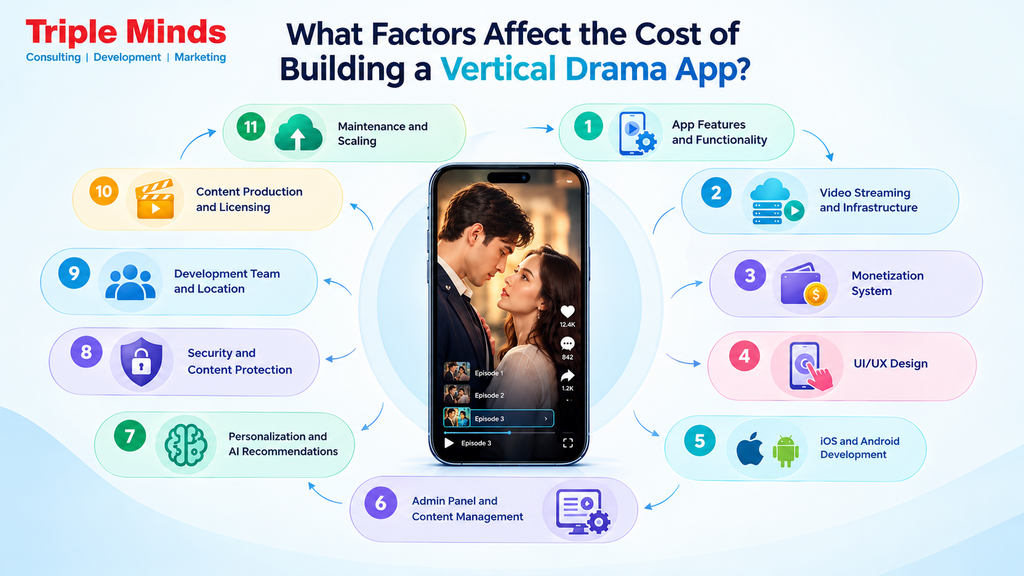
1. App Features and Functionality
The number of features you want to add and their complexity directly affect the development cost of a vertical drama app. If you are choosing a basic app, you may only require elements like user registration, a vertical video player, episode searching, and an admin panel.
Whereas in an advanced vertical drama platform, along with these features, you will also need to include personal recommendations, watch history, social features, push notifications, offline viewing, multilingual support, and performance analytics. Therefore, both have different costs.
If you are choosing to add more components- swipe-based video navigation, episode unlocking, coin wallets, subscriptions, and personalized feeds- they will cost you extra money.
2. Video Streaming and Infrastructure
Vertical drama apps aren’t like conventional content apps; they rely on high-quality videos that need to load quickly and reliably. Your budget may need to cover the following factors:
- Video storage
- Video transcoding and compression
- CDN integration
- Adaptive streaming
- Video preloading
- Bandwidth
- Content protection and DRM
- Scalable cloud infrastructure
As the number of viewers and viewing hours increases, infrastructure becomes an ongoing operating expense rather than just a one-time development cost.
3. Monetization System
If your business is entirely dependent on paid episodes, coins, subscriptions, or rewarded ads, the platform will demand additional payment and access-control functionality.
For example, a typical model can give users the first few episodes for free and then require coins or a subscription to unlock premium episodes. Platforms like our ReelShort clone use this type of freemium monetization approach.
Read More: How Short Drama Apps Like DramaBox and ReelShort Make Money?
4. UI/UX Design
Designing a vertical drama app goes beyond just placing elements. They lean heavily on the viewing experience. The interface needs to make it easy for users to swipe between episodes, discover new dramas, continue watching, and unlock premium content without friction.
The cost is lower when you use an existing template, but it spikes when you opt for custom UI/UX design.
5. iOS and Android Development
When you build an app to target a single platform, it generally costs less, but in case of launching it on both IOS and Android, the amount becomes 2X.
Before budgeting to develop a vertical app, you need to decide whether to use native development or a cross-platform framework like Flutter or React Native.
A cross-platform approach can reduce duplicated development work, while native development may make sense when you require highly platform-specific functionality or optimization.
6. Admin Panel and Content Management
The user-facing app is only one part of the platform. Your team also needs a backend dashboard to manage the content and business operations. An admin panel may include:
- Uploading and organizing dramas
- Managing episodes and seasons
- Setting free and paid episodes
- Managing users
- Managing coins and subscriptions
- Viewing revenue and analytics
- Managing banners and promotions
- Moderating content
The more control you want over content and operations, the more development effort is required.
7. Personalization and AI Recommendations
Basic recommendations based on genres, viewing history, and popular dramas are relatively concise. But going a level up, personalization is more complex and may use user behavior, watch duration, episode completion, and engagement signals to determine what content to recommend.
For a growing platform, recommendation technology can become an important investment because keeping users watching more episodes directly supports retention and monetization.
8. Security and Content Protection
Multiple users register on vertical drama platforms, make payments, and therefore, security becomes obvious. Depending on your licensing and business model, you may need secure authentication, encrypted video delivery, DRM, payment security, anti-fraud measures, and restrictions on unauthorized downloads or screen capture. These requirements can substantially increase the cost compared with a basic video-streaming MVP.
9. Development Team and Location
The cost to build a vertical drama app is not the same everywhere. Who builds your app, and where they’re based – all these have a real impact on your final payment. A development team based in the US or Western Europe will cost more than that of a vertical drama app development company in the Indian region.
For entrepreneurs, however, the cheapest hourly rate isn’t necessarily the best choice. What matters more is whether the team has actually worked on video streaming, OTT platforms, payment systems, and apps built to scale. That experience can save you from costly technical fixes down the road.
10. Content Production and Licensing
There is another cost that entrepreneurs often overlook: the content itself. Building the app doesn’t give you a library of episodes to stream. You may need to budget for scriptwriting, actors, filming, editing, dubbing, subtitles, licensing, or purchasing existing vertical drama content. Production costs swing widely depending on the cast, locations, story, and overall quality, so it’s worth getting real quotes early.
11. Maintenance and Scaling
Launch day isn’t the finish line. After going live, you’ll have to keep paying for bug fixes, OS updates, server management, security patches, new features, customer support, and monitoring. As your users grow, elements like cloud storage, CDN bandwidth, and video delivery costs also increase. This is why entrepreneurs should calculate both the initial development budget and monthly operating costs.
Read More: DramaBox Business Model and Funding: How the Short-Drama Platform Works
Market Your Vertical Drama App Faster with Our White-Label Solution
Triple Minds offers white-label solutions like DramaBox Clone, a ready-to-market app for businesses looking to enter the vertical drama market faster. Launch with a fully functional, pre-built platform featuring established monetization models, allowing you to focus on content, audience growth, and business expansion.
Explore DramaBox Clone
How Much Does It Cost to Hire an App Development Agency?
There are multiple ways to build an app; you can choose a professional mobile app development agency or simply hire a mobile app developer.
When hiring an app development agency, you can expect the development cost to range from $40,000 to $250,000 or more. This approach is different from hiring a freelancer who charges you on an hourly basis. An agency employee-certified team that consists of –
- UI/UX designers
- Mobile Developers
- Backend Developers
- QA testers
- Project Managers
This means the amount that you are paying to a vertical drama app development agency is not just for coding, but for planning, design, testing, project management, deployment, and technical expertise.
What Determines an Agency’s Cost?
The most common way in which agencies calculate project cost depends on estimated development hours, team composition, technology stack, and complexity of the project.
Fixed-price development: You agree with your partnering agency on a defined scope and price before the development process.
Time and materials: You track the time and pay based on the team’s actual development time.
Dedicated development team: You hire an ongoing team of developers and specialists for continuous product development.
Why Hiring a Vertical Drama App Development Agency Can Be Worth the Investment
The lowest development quote doesn’t mean that your application will be ready to launch at a lower cost. The companies that claim to provide a low price might ask for more later to scale your product. An experienced agency like Triple Minds that offers consultation services along with development can help entrepreneurs avoid technical mistakes and select the right architecture for their application.
When comparing agencies, entrepreneurs should therefore look beyond the initial quotation.
- You should evaluate their experience with video-streaming apps.
- Go through their online portfolio.
- See what development process they follow.
- Verify their technology expertise,
- Ask whether they provide post-launch support and security practices.
Ultimately, the right agency should not simply build your vertical drama app—it should provide the technical foundation needed to launch, monetize, and scale it successfully.
How to Remove Unwanted Cost Factors?
One of the best ways to control development costs is to identify which features are essential for launch and which can be introduced later.
Start With Essential Features
Do not overload the application with various functionalities; limit the MVP to a basic set of tools, including the registration system, video streaming in portrait mode, drama search, navigation within episodes, payment system, and an administrative panel. The AI-powered and user-oriented features can be added in subsequent updates.
Make Sure to Develop the App Cross Platform
If you are planning to launch the product on two platforms, iOS and Android, you may want to go with the same codebase for both, thus cutting development costs in half. This way, your agency will be able to maintain one application instead of two.
The app should be developed in a cross-platform, not native, framework. A cross-platform version will require less maintenance and cost compared to developing two separate apps for iOS and Android.
Use Third-Party Services Where Appropriate
Designing each technological component from scratch is expensive, as is clear to any experienced developer. The ready solutions for payments, analytics, authentication, cloud storage, notifications, and video editing allow you to build the product faster and avoid unnecessary complexities.
However, before choosing a particular service, it is essential to analyze the target audience and consider what options provide the best value for money and are easy to scale.
Do not Overbuild the Admin Panel.
The admin panel is the central system for content management and should have a set of tools necessary to perform daily tasks. It is essential to start with a smaller set of capabilities, including uploading television series, managing episodes and subscriptions, regulating payment rules, and moderating users. The admin panel can also include advanced analytics and automation tools if the team wants to scale its operations and be able to manage more data efficiently.
Avoid Unnecessary Custom Design
Designing every detail of the user interface is not always required, especially if the time spent on it could be invested in simpler but no less effective solutions. A skilled developer can recommend a set of intuitive icons and optimize the system for fast searching and one-click browsing to keep the user engaged.
Build in Phases
Perhaps the most effective way to eliminate unnecessary costs is to divide development into phases.
Phase 1: Launch the MVP with core viewing and monetization features.
Phase 2: Study how users behave and work on retention.
Phase 3: Add advanced personalization, gamification, social features, and automation.
This approach allows you to spend money on features that have demonstrated business value rather than paying upfront for assumptions.
Don’t Pick an Agency on Price Alone
A common mistake that entrepreneurs or businesses make is selecting the cheapest development quotation. A low upfront price can balloon if the app needs major fixes, has weak architecture, or can’t handle growing traffic.
Compare agencies on the basis of their technical expertise, relevant experience, development process, scalability, security, maintenance, and long-term support.
The goal isn’t to build the cheapest vertical drama app. It’s to cut unnecessary expenses and put your budget into what drives engagement, monetization, and growth.
Why Invest in a Vertical Drama App?
It can be not only a platform for entertainment but also a recurring-revenue business, depending on the content and monetization strategy. A commercial standout is already evident: Sensor Tower announced that short drama apps were earning $750 million in global in-app purchase revenues in Q1 2026 while downloads increased to $850 million units, growing 140% year over year.
1. Multiple Ways to Make Money
The main strength of vertical drama apps is the availability of several monetization strategies at once:
- Unlock paid episodes: The user watches the first episodes for free and pays in coins to proceed.
- Subscriptions: VIP or premium access with unlimited content viewing.
- In-app purchases: Selling virtual coins or credits for watching the episodes.
- Advertising: Monetizing the free audience via rewarded videos, banners, etc.
- Exclusive content: Releasing exclusive or early access series for the paying audience.
2. High Engagement Rate Means More Money
The vertical format of such shows entails the creation of shorter episodes, cliffhangers, and mobile optimization. It means that there will be many more chances to get users interested in watching more of the material.
3. You Can Create an International Audience
In contrast to a traditional TV show, a vertical dramas app isn’t limited by the geographical availability of its content. Using subtitles, dubbing, local content, and regional pricing, you can make your application available to viewers from different countries. That is the core factor that attracts more downloads from startups and emerging markets.
4. You Will Have Your Audience and Payment Channel Under Control
Publishing the videos directly to the social network will give you only limited control over your material. An app will provide you with all the necessary tools to control user accounts, their behavior, subscriptions, content, etc. The best way out would be using social networks to grow the audience of your platform. For instance, an entrepreneur can use TikTok, Instagram, and YouTube Shorts to promote their dramatic videos and draw the attention of viewers to the app.
5. Recurring Revenue Creates Long-Term Potential
A vertical drama platform can earn from the same viewer again and again. Someone who subscribes for one month may continue paying if new dramas are released regularly. And a user who buys coins to unlock episodes will often come back for more when the next batch drops.
That’s a big advantage over a one-time digital product sale. The stronger your content library gets, the more chances you have to keep users around and grow what each one is worth to you over time.
6. The Opportunity Is Growing, but Execution Matters
The numbers show vertical drama is a fast-growing category. But a growing market doesn’t always guarantee profit. Content quality, user acquisition costs, retention, localization, monetization design, and app performance all determine whether an investment succeeds.
Start with a focused MVP, back it with strong original content, and build a smart monetization strategy. Do that, and the platform can bring in multiple revenue streams while growing into a scalable entertainment brand.
White-Label vs. Building a Vertical Drama App from Scratch
| Factor | White-Label App | Built From Scratch |
| Initial development cost | ~$9,500–$15,000+ | ~$40,000–$250,000+ |
| Launch time | 2–4 weeks | 3–9+ months |
| UI/UX | Pre-built, customizable | Designed from scratch |
| Video streaming | Usually pre-integrated | Built and configured separately |
| Coins & subscriptions | Often included | Developed from scratch |
| Admin panel | Pre-built | Custom-developed |
| Customization | Limited to extensive, depending on provider | Almost unlimited |
| Scalability | Depends on the platform | Designed around your requirements |
| Source-code ownership | Depends on the agreement | Typically yours |
| Best for | Fast market entry & validation | Long-term differentiated products |
To know how much it will exactly cost you to build a vertical drama app, you can use our app development cost calculator. The tool will ask you about your requirements and on that basis it will provide you with an estimated cost.
Why A White-Label Vertical Drama App Development is Cheaper Than Custom?
White-label vertical drama app development services are affordable because you will not pay an agency to build fundamental components from scratch. The platform comes pre-built with a vertical video player, user authentication, a coin wallet, episode unlocking, etc. These components already exist and are adapted to your brand and requirements.
This significantly reduces both development time and engineering hours. For example, at Triple Minds, we currently offer a ready white-label vertical drama platform starting at $9,500, with Android and iOS apps, an admin dashboard, creator panel, coin system, subscriptions, and streaming infrastructure included.
Plan Your Vertical Drama App Monetization Strategy with Us
Triple Minds provides consulting services for businesses entering the vertical drama market, helping them plan monetization strategies that align with their audience and business goals. Get expert guidance on revenue models, episode unlocks, subscriptions, in-app purchases, and other monetization opportunities.
Consult with Our Experts
Conclusion
Building a vertical drama app can be a profitable opportunity, but the right development approach can make a major difference to your investment and time to market. Ready to launch your own vertical drama app? Partner with Triple Minds to build a scalable, monetization-ready platform tailored to your business goals.
Quick Answers to Common Questions
How much does a white-label vertical drama app cost?
A white-label vertical drama app can typically cost $9,500–$15,000+, depending on the provider and included features. It can be a cost-effective option for entrepreneurs who want to launch quickly without developing the entire platform from scratch.
How long does it take to develop a vertical drama app?
A white-label solution can potentially be launched within a few weeks, while a custom vertical drama app can take 3–9 months or longer, depending on its complexity, number of platforms, integrations, and customization requirements.
How can a vertical drama app make money?
A vertical drama app can generate revenue through paid episode unlocking, subscriptions, in-app coin purchases, advertising, premium content, and sponsorships.
Is it better to build a vertical drama app from scratch or use a white-label solution?
It depends on your business goals. White-label development is better for entrepreneurs who want to lower upfront costs and faster market entry. Custom development is more suitable when you need unique features, complete control over the technology, or a highly differentiated product.
Got a project in mind? Let’s build it together.
We work with founders and product teams across consulting, development, and growth marketing. Tell us what you’re building and we’ll show you how we’d ship it.