How Short Drama Apps Like DramaBox and ReelShort Make Money?
Short drama app monetization depends on more than paid episode unlocks. Explore strategies including coins, subscriptions, advertising, rewards, brand partnerships, and content licensing. This guide also covers key features, operating costs, and metrics that can shape revenue. Learn how businesses can build a sustainable monetization strategy for short drama platforms.

Entertainment applications like DramaBox and ReelShort are popular mobile streaming apps, featuring vertical drama series. These applications earn revenue by charging users to watch bite-sized, serialized video episodes through a multi-stream monetization model.
If you are considering launching a similar platform, you can also use us app development cost calculator to get an estimate based on your required features and app scope. Want an affordable option? You can explore our DramaBox clone and ReelShort clone development services to launch a similar short drama platform with bespoken monetization features.
Idea Behind Short Drama Apps
A viewer does not always need a 45-minute episode to get hooked on a story. Give them a few minutes, a dramatic twist, and a cliffhanger, and they may be ready to watch the next episode immediately. That’s how Short Drama apps come into the picture.
These platforms turn serialized, vertical video into a mobile-first entertainment experience where viewers can discover a story. The business opportunity is no longer theoretical.
According to Sensor Tower’s 2026 report, global short drama app downloads surpassed 850 million in Q1 2026, while in-app purchase revenue reached approximately $750 million during the quarter. DramaBox and ReelShort remained the two leading short drama apps by in-app revenue in Q1 2026, with each generating close to $140 million.
So, how exactly do short drama apps make money?
The answer is not a single revenue stream. Their business model combines content, engagement, payments, advertising, subscriptions, and retention mechanisms into one monetization funnel.
Let’s break down how it works and what entrepreneurs need to consider when launching their own short drama platform.
Explore Reelxia — Our Live Micro Drama Platform
Explore Reelxia, our live micro drama platform, on the web and Google Play. Try it yourself and see what’s possible: the features, the viewing experience, the monetization options, and the platform capabilities you could have in your own micro drama app built with Triple Minds. Let a real, working product spark ideas, then let’s talk about how to adapt it to your next project.
Explore Reelxia
Why Is the Short Drama Industry Growing at A High Pace?
Instead of asking users to commit to an entire 30- or 60-minute episode, Short Drama platforms divide a story into numerous bite-sized episodes. Each episode moves the plot forward quickly and often ends with a cliffhanger designed to encourage the viewer to continue.
The format is particularly suited to mobile users because viewers can watch an episode during a commute, lunch break, or a few spare minutes.
But the real business advantage is not simply that episodes are short. It is that short episodes create many opportunities for engagement and monetization throughout a single story.
How Do Short Drama Apps Make Money?
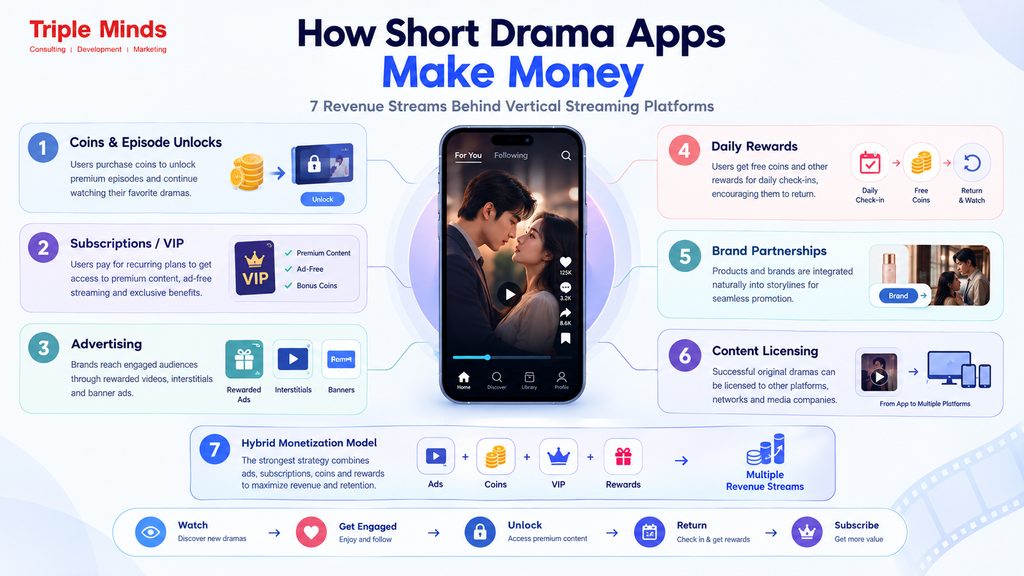
Short drama platforms typically use a combination of monetization models rather than depending on one source of income. The major revenue streams include:
1. Coins and Pay-Per-Episode Unlocks
One of the most recognizable monetization mechanisms in short drama apps is the virtual coin economy.
The basic model is not complex.
A user starts watching a drama for free. After a few episodes, some episodes become locked. If the audience wants to view them, they can purchase coins and spend them to unlock the next episode or a group of episodes.
This model connects revenue directly to content consumption.
The viewer is not necessarily asked to pay for the entire series upfront. Instead, they pay progressively as their interest in the story increases.
2. Subscriptions or VIP Memberships
Subscriptions create another route to recurring revenue.
Instead of purchasing individual episodes, users can pay for a defined subscription period and receive benefits such as access to premium content, ad-free streaming, bonus coins, etc.
Short drama businesses can also experiment with different subscription durations.
The subscription duration can vary across this category. An estimated 70% of revenue from the short drama apps came from seven-day subscriptions. This illustrates how different this category’s subscription behavior can be from traditional annual-subscription streaming services.
However, this does not mean every new app should use weekly subscriptions. It means entrepreneurs should think about subscription design around their audience’s actual viewing behavior.
3. Advertising
Not every viewer will become a paying customer. But that does not mean that a user streaming your Shortdrama app has no commercial value.
Advertising allows short drama platforms to monetize users who do not want to purchase coins or subscriptions. Common advertising formats can include:
Rewarded Video Ads
A viewer watches an advertisement and receives something in return. It can be a free episode, coins, additional viewing time, and bonus rewards.
Interstitial Ads
These advertisements can appear at natural transitions between viewing sessions or episodes.
Banner Ads
Banner placements can generate additional advertising revenue without interrupting the video, although their commercial value depends heavily on traffic and engagement.
4. The Hybrid Monetization Model
The strongest opportunity is often not choosing between ads, subscriptions, and paid unlocks. It is using them together. For better understanding, consider three users.
User A: The casual viewer
They watch a few episodes but do not want to pay.
→ Monetize through advertising.
User B: The binge watcher
They become invested in a particular story and want to continue immediately.
→ Monetize through coins and episode unlocks.
User C: The heavy viewer
They watch several series every week.
→ Give them a subscription or VIP membership.
This is why monetization should be considered at the product architecture stage rather than added after the app has already been developed.
5. Daily Rewards
Revenue is closely connected to retention. If users open the application once and disappear later, there are stills ways you can monetize them. Short drama platforms like Dramabox and ReelShort can use engagement mechanics such as: daily check-ins, free coins, spin and win etc.
For example, a user might receive a small reward for opening the app several days consecutively. The objective is not simply to give away free currency.
It is to create another reason for the viewer to return because a returning user has more opportunities to discover another drama, purchase coins, or subscribe.
6. Brand Partnerships
Once a short drama platform has a meaningful audience, brands can become another potential source of revenue. Products can be integrated into storylines through fashion, beauty products, food, beverages, and other promotions.
Instead of placing a conventional advertisement between two episodes, a product can become part of the viewing experience. The commercial model needs to be handled carefully. If product placement disrupts the story, it can hurt the viewing experience. The strongest integrations generally fit naturally into the content.
7. Content Licensing
The content library itself can become an asset. A platform that owns or controls successful original dramas may eventually have opportunities to license that content to:
- Other streaming platforms
- Regional entertainment applications
- International distributors
- Television networks
- Digital media companies
This creates a second layer of monetization beyond the platform’s own users.
Instead of earning only when someone watches an episode inside the application, the content can potentially generate revenue through external distribution agreements.
For businesses investing heavily in original productions, this can make content ownership strategically important.
How the Free-to-Paid Monetization Funnel Works?
The revenue model becomes easier to understand when you look at the complete user journey. As an entrepreneur or business owner, your first objective should be acquisition. The platform needs to get the drama in front of potential viewers through app stores, social media, paid advertising, creators, search, and other discovery channels.
Then comes activation.
The user needs to start watching quickly so that you can engage them. At this part the story must give the viewer enough reason to continue.
Then comes monetization.
The user encounters a point where they can pay, watch an advertisement, purchase a subscription, and use available rewards.
Finally comes retention.
The platform wants the viewer to return for another episode, another series, or another content drop. You can send them notifications or emails.
Why Do Viewers Pay Short Dramas?
A short drama platform does not make money simply because episodes are short.
It makes money when the content creates enough perceived value for users to continue watching.
Several characteristics support that behavior.
Cliffhanger-Driven Storytelling
A major revelation or unanswered question at the end of an episode gives the viewer a reason to continue.
Short Episodes
Because episodes are relatively brief, starting another episode feels like a small commitment.
Serialized Stories
The viewer is not consuming isolated videos. They are following a continuing narrative.
Strong Genre Hooks
Romance, revenge, family conflict, fantasy, and status-reversal stories can create clear emotional stakes that are easy to communicate in advertisements and thumbnails.
Personalized Discovery
A recommendation system can surface another series based on what the viewer has already watched.
Together, these elements can create a powerful loop:
Watch → become invested → continue → discover another story → return → watch again.
What Does It Cost to Run a Short Drama App?
Revenue is only one side of the equation. A short drama platform like DramaBox and ReelShort can have significant costs across technology, content, marketing, infrastructure, and payment operations. The major cost categories include:
Content Production
Scripts, actors, directors, production crews, editing, locations, costumes, voiceovers, subtitles, and localization can all contribute to production costs.
User Acquisition
Paid advertising can become a major expense because entertainment apps compete aggressively for attention.
App Development
The technology layer includes mobile applications, backend infrastructure, video delivery, payment systems, user accounts, content management, analytics, and monetization.
Streaming and Infrastructure
Video consumes substantially more infrastructure resources than many conventional application features.
A platform needs suitable storage, content delivery, encoding, bandwidth management, and scaling capabilities.
Payment and Platform Fees
App-store commissions, payment processing, currency conversion, refunds, taxes, and regional payment requirements can affect net revenue.
Customer Support and Operations
As the user base grows, businesses also need support systems for payment issues, subscriptions, account management, content reporting, and technical problems.
Features That Turn a Short Drama App into a Monetization Platform
If you are planning to launch your own short drama application, the product should be designed for both viewing and revenue. A vertical drama app development service can help you bring these viewing and monetization requirements together on one platform. Here are the core features to consider.
Vertical Video Player
The viewing experience should be optimized for portrait-oriented mobile video, with smooth playback, adaptive streaming, subtitles, playback controls, and content discovery.
Coin Wallet
A virtual currency system can support paid episode unlocking, promotional rewards, bonus coins, and transaction history.
Episode Paywalls
The platform should allow administrators to decide which episodes are free and which require coins, subscriptions, or other unlock mechanisms.
Subscription Management
Users should be able to select available plans, manage their subscriptions, and access premium benefits.
Payment Integration
Multiple payment options can make purchasing easier across different regions.
Rewarded Advertising
Ad SDK integration can allow users to exchange an ad view for coins, episode access, or other rewards.
Recommendation Engine
Personalized recommendations can help viewers discover their next series and increase content consumption.
Push Notifications
Notifications can alert users about new episodes, new series, rewards, and personalized content.
Content Management System
An admin team needs to be able to upload dramas, organize seasons and episodes, manage thumbnails and metadata, schedule releases, and control content availability.
Analytics Dashboard
Revenue, watch time, retention, episode performance, user activity, subscription activity, and other business metrics should be visible to administrators.
Referral Features
Daily rewards, referral programs, achievement systems, and promotional events can create additional engagement opportunities.
The important thing is that these features should not operate independently.
Which Metrics Should a Short Drama Business Track to Measure Progress?
A short drama platform can generate dozens of data points, but only performance metrics show whether the business is actually healthy. Track these eight, and you’ll know where you’re growing, where you’re leaking users, and where your revenue is coming from.
Growth and Revenue Metrics
Customer Acquisition Cost (CAC)
CAC is what you spend to bring in one new user. Because short drama apps rely heavily on paid marketing, this is often the biggest cost in the business. If CAC climbs faster than revenue per user, growth quickly becomes unprofitable.
Conversion Rate
This is the percentage of users who move from free viewing to paying, whether by buying coins or subscribing. A low rate usually points to problems with paywall placement, pricing, or content quality, not a lack of traffic.
Average Revenue Per User (ARPU)
ARPU shows how much revenue the average user generates over a set period, such as a month. It tells you whether your mix of coins, subscriptions and ads is monetizing your audience effectively.
Lifetime Value (LTV)
LTV is the total revenue a user generates from install to platform use. Compare it with your CAC. A profitable platform earns back double times what it spends to acquire each user.
Engagement Metrics
Retention
Retention measures how many users come back after Day 1, Day 7, Day 30 and beyond. Drama is episodic, so returning viewers are the ones who finish storylines and spend money.
Watch Time
Watch time is how long users spend consuming content per session and per day. Higher watch time means stronger content and more chances to show ads or reach a paywall.
Episode Completion Rate
This shows whether viewers actually finish the episodes they start. If many drop off partway through, your pacing, opening hook or episode length may need adjusting.
Monetization Metrics
Paid Unlock Rate
This is the share of viewers who reach a locked episode and decide whether they want to pay for access or not. It’s the clearest signal of how well your cliffhangers and paywall placement work together. Even a small improvement here can lift revenue noticeably without adding a single new user.
Should You Build a DramaBox or ReelShort-Style App from Scratch?
Starting an application like DramaBox or ReelShort already a big job. Investing the process from scratch is not the smartest idea in the town when there already exist clone development service.
Although developing an application from scratch gives entrepreneurs maximum control, but it also means developing and testing every major component before reaching the market.
A clone-based or white-label approach can provide a different route. Instead of recreating the business model from the ground up, a ReelShort clone app development solution can begin with established mechanics such as vertical video feeds, coin-based unlocks, subscription management, etc.
The product can then be customized around the entrepreneur’s brand, content, geographic markets, pricing and monetization rules.
This does not mean copying another company’s branding, content, intellectual property, or proprietary assets. The goal is to use a proven product concept while creating an independently branded platform around your own business model.
How Triple Minds Can Help You Launch a Short Drama App?
Triple Minds is the best white label app development agency, helping businesses to launch their own short-form enternment platforms.
We provide DramaBox clone app development and ReelShort clone development services, useful for entrepreneurs who understand the opportunity but do not want to spend months recreating the platform from scratch. The development approach can be adapted around your intended market, content strategy, monetization model, branding, and growth plans.
Thinking about launching your own short drama platform?
Discuss your content strategy, monetization model, and app requirements with the Triple Minds team to determine the right development approach for your idea.
Plan Your Micro Drama Monetization With Triple Minds
Get expert consultation on monetization, marketing, and development strategies for your next short drama platform. Triple Minds helps businesses build revenue models around subscriptions, paid episodes, in-app purchases, advertising, and retention.
Talk to Our Experts Now
Conclusion: Short Drama Is More Than Short-Form Video
Short drama apps have turned bite-sized storytelling into an interesting mobile entertainment business. The money does not come from one feature. It comes from connecting several pieces of compelling content, frequent viewing, smart monetization, retention, and scalable technology.
- Coins allow highly engaged viewers to unlock episodes.
- Subscriptions create recurring revenue opportunities.
- Advertising monetizes users who prefer not to pay.
- Rewards and notifications encourage users to return.
- Recommendations keep viewers moving from one story to another.
If you are considering launching one, the next step is to work backward from the business model: decide what your audience will watch, how they will discover it, where the paywall should sit, how free users will be monetized, and which features you actually need at launch.
Once those decisions are clear, the technology becomes much easier to plan.
Quick Answers to Common Questions
Is the short drama app business profitable?
Yes. Short drama app business is profitable as it produces massive revenue. profitability depend on factors like monetization model, content quality. Customer acquisition and much more.
Can I create a short drama app with a different monetization model?
Yes. The DramaBox and ReelShort-style model is a reference point, not a requirement. You can create a platform around subscriptions, advertising, paid content, creator revenue sharing, licensing, or a combination of models.
Can a short drama app target multiple countries?
Yes, but international expansion requires more than translating the interface.
You may need localized content, subtitles or dubbing, regional payment methods, currencies, pricing strategies, content rights, marketing creatives, and market-specific compliance considerations.
Can an OTT platform launch short drama services?
Yes. Many OTT platforms are launching short drama services, setting a strong customer base to attract mobile viewers and create new monetization opportunities.
Got a project in mind? Let’s build it together.
We work with founders and product teams across consulting, development, and growth marketing. Tell us what you’re building and we’ll show you how we’d ship it.