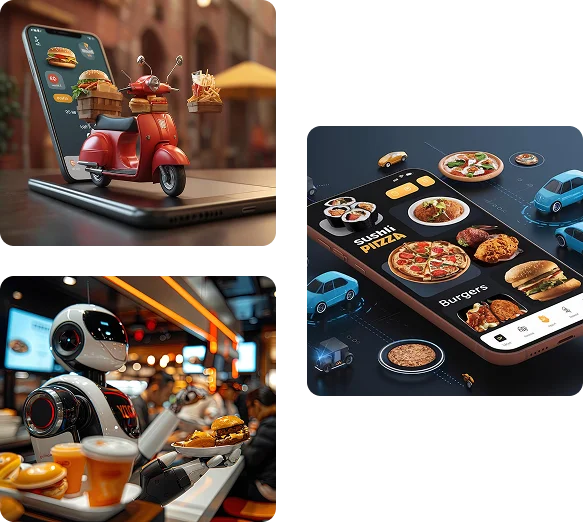
Why Businesses Build Their Own Food Delivery App
-
Global online food delivery is projected to surpass $1.89 trillion by 2029.
-
AI through highly personalized recommendations is expected to boost revenue by 6% to 10%.
-
AI-enabled route optimization and fleet management can improve delivery efficiency by 15%-20%
-
Personalized recommendations can increase average order value by up to 35%-37%
-
Apps that use AI for real-time traffic analysis have improved delivery speeds by 84%.
The stats are clear—AI is changing food delivery. Connect with our experts to discover how investing in an AI food delivery app development can be the smartest move for your business growth.
What Food Delivery App Development Actually Involves
Food delivery app development means building four connected applications, not one: a customer app for ordering, a restaurant app for accepting and preparing orders, a driver app for pickup and navigation, and an admin panel that runs commissions, payouts, disputes and analytics across all three. They share one backend, one order state machine and one live map. Projects that go wrong almost always underestimated the three apps nobody demos.
A food delivery platform is a real-time logistics product wearing a shopping app's clothes. The catalogue and the checkout are the easy part. The hard parts are assigning the right driver in under a second, keeping an ETA honest when the kitchen is twenty minutes behind, settling money three ways after every order, and doing all of it while thousands of locations move on a map at once.
Types of Food Delivery Apps We Build
The business model decides the architecture, not the other way round. Settle this before anyone designs a screen, because it determines whether you need a dispatch engine and a commission ledger at all, and those two subsystems are a large share of any budget.
| Model | Who it suits | Examples | What it needs |
|---|---|---|---|
| Aggregator marketplace | Many restaurants, many customers, your own delivery fleet | Uber Eats, DoorDash, Swiggy, Zomato | Dispatch engine, driver app, commission splits, three-way payouts, surge logic The hardest and most expensive model. You are running a logistics company that happens to have an app. |
| Restaurant-to-customer | One brand or chain delivering its own orders | A pizza chain or regional group going direct | Customer app, POS and kitchen integration, store-level menus, own riders or a courier API No commission engine needed, so it is far cheaper — and it keeps the margin an aggregator would take. |
| Cloud kitchen and virtual brands | Delivery-only kitchens running several brands from one site | Multi-brand operations cooking four menus in one kitchen | Multi-brand catalogue on shared inventory, kitchen capacity routing, per-brand analytics The complexity sits in the kitchen layer, not the consumer app. Most teams scope this backwards. |
| Hyperlocal and grocery hybrid | Food plus groceries, pharmacy or convenience in one basket | Multi-category quick commerce | Batch and slot delivery, substitution flows, perishables handling, variable basket sizes Catalogue scale and substitution logic are the real work here, not the delivery itself. |
How to Develop a Food Delivery App: Eight Steps
This is the sequence we actually run, and the order matters. Teams that jump straight to design usually rebuild the dispatch layer later, which is the most expensive mistake in this category.
-
01
Pick the business model before the features
Aggregator, single-brand, cloud kitchen or hybrid. This one decision sets whether you need a dispatch engine and a commission ledger at all.
-
02
Map the order state machine
Placed, accepted, rejected, preparing, ready, picked up, en route, delivered, cancelled, refunded, plus every failure path. Write it down before any screen exists. Nearly every late bug in a delivery app is a state nobody defined.
-
03
Design the four apps around one order
Customer, restaurant, driver and admin are four audiences looking at the same order. Design them together, so a status change makes sense from all four sides instead of being retrofitted into three of them.
-
04
Build the backend and the dispatch layer
Catalogue, pricing, carts, payments, and the assignment algorithm that picks a driver by distance, direction of travel, current load and kitchen ready-time. Dispatch is what decides whether your unit economics work.
-
05
Wire real-time tracking honestly
Live driver location over websockets, routing and ETA from a maps provider, and an ETA that updates when the kitchen slips. An ETA that quietly stays wrong loses more customers than a longer one that is accurate.
-
06
Integrate payments, POS and payouts
A gateway for customers, a split-payout rail for restaurants and riders, and POS or kitchen-display integration so orders are not retyped by hand. Retyping is where restaurants quietly abandon a platform.
-
07
Test the failure paths, not the happy path
Driver cancels mid-delivery, restaurant rejects after payment, address is wrong, GPS drops in a basement car park, payment succeeds but the order does not. Each needs a defined outcome and a refund rule.
-
08
Launch one area, then expand
Go live in a single neighbourhood with a small restaurant set, watch the dispatch and ETA data, and fix the economics before adding a second city. Supply density beats coverage in the early months.
How to Build an App Like Uber Eats, DoorDash or Swiggy
Build me an Uber Eats clone is the most common brief we receive, and it usually means one of three very different things. Being precise about which saves a great deal of money.
The consumer app is not the product
The customer-facing app could be rebuilt by a competent team in weeks. What took years is the dispatch engine, the fraud systems, the payout rails and the supply density. Copying the screens gets you a small fraction of the thing.
Dispatch is the moat
Assigning the right rider in under a second across thousands of live orders, accounting for direction of travel, batching, kitchen ready-time and rider acceptance rates, is the actual engineering. Budget for it as a first-class subsystem.
You will not win on coverage
A new platform beats an incumbent by owning one city, one cuisine or one underserved category, not by listing every restaurant in town. A narrow launch is a strategy, not a limitation.
What a clone script gets you
A licensed white-label script goes live in weeks for a few thousand dollars and is the right answer for validating demand. It is the wrong answer if the platform is the business, because you cannot change the dispatch logic or fully own the data.
Our Food Delivery App Development Tech Stack
Chosen per project rather than by habit. These are the stacks we have shipped delivery platforms on.
How Food Delivery Apps Make Money
Most platforms run four or five of these at once. Commission alone rarely covers the cost of delivery.
Restaurant commission
A percentage of order value, usually the largest line. Rates vary sharply by market and by what the restaurant gets in return.
Customer delivery fee
Charged per order, often distance-banded or waived above a basket threshold to lift average order value.
Subscription membership
A monthly fee for free or reduced delivery. The most dependable line, because it recurs and it raises order frequency.
Promoted listings and ads
Restaurants pay for placement in search and category pages. High margin, and it scales with the number of restaurants rather than orders.
Surge and peak pricing
Dynamic fees when demand outruns rider supply. It has to be visible in the interface or it reads as a bait and switch.
White-label licensing
Licensing your platform to chains or operators in other regions. Turns a cost centre into a product line.
Not Sure Which Delivery Model Fits Your Business?
Aggregator, single-brand, cloud kitchen or hybrid — the model decides whether you need a dispatch engine and a commission ledger, and those two subsystems drive most of the budget. Tell us how you plan to operate and we will tell you which model fits, what it costs to build, and when buying off the shelf is the better answer.
Key Deliverables: Everything You Need to Run a Successful Food Delivery Platform
-

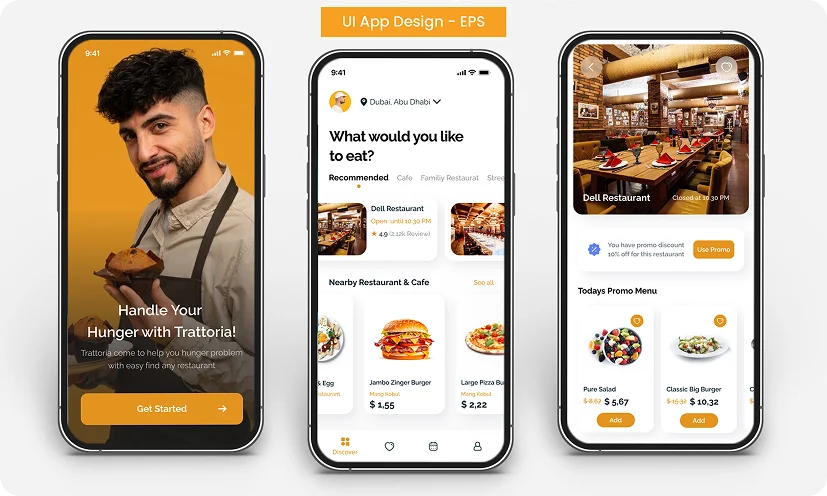
User App
-

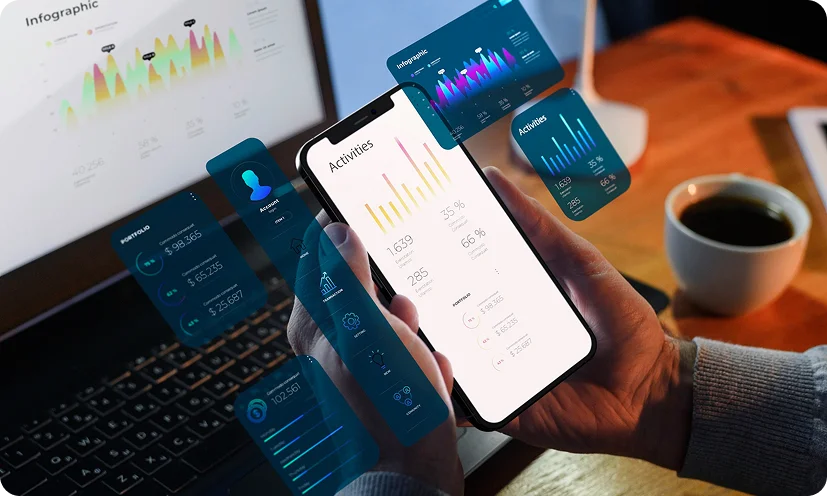
Admin App
-

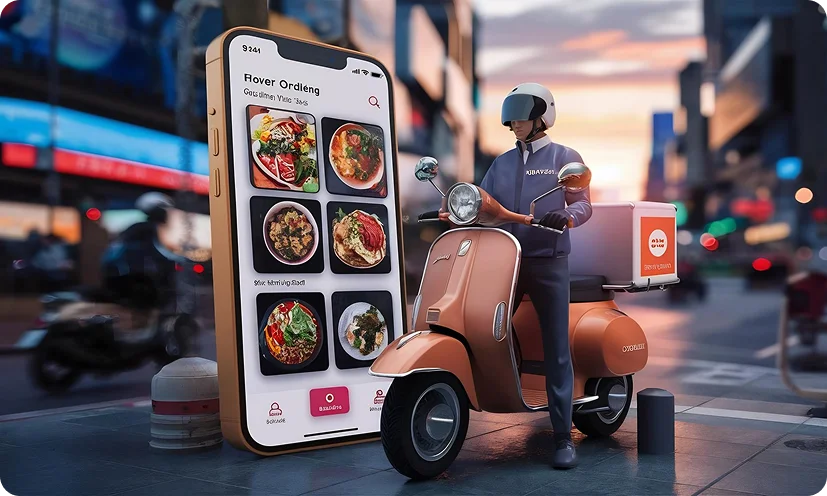
Driver App
-

Restaurant App
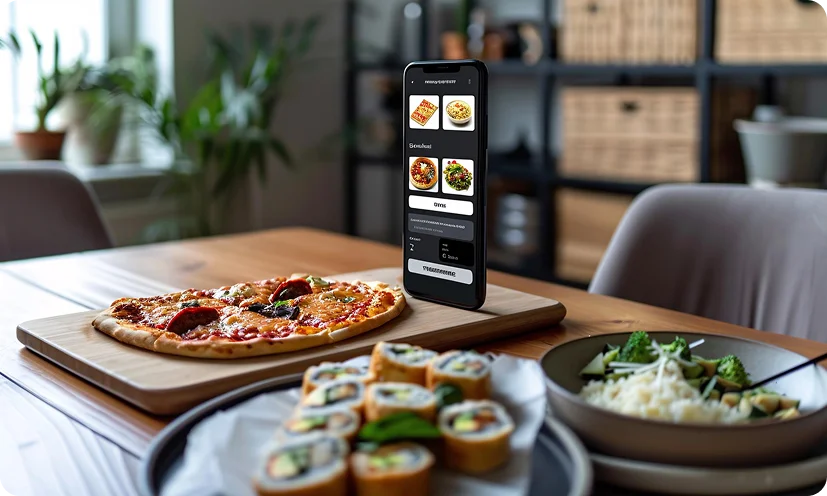
The AI Layer, Panel by Panel
As a leading AI development company, we can help you design an AI food delivery app capable of taking your food delivery business to new heights. Our
custom app is designed to solve real-world challenges and position your business for sustainable growth in the digital food economy.
User Panel Features
Our AI-based food delivery app integrates intelligent features that enhance the overall food ordering experience, making it smarter, faster, and more convenient.
Restaurant Panel Features
Our AI food delivery app includes smart features that help restaurants manage orders, track inventory, analyze performance, optimize operations, and more.
Delivery Partner Panel
The AI-powered features, like route optimization and shift recommendations helps delivery partners manage deliveries efficiently and earn more.
Admin Panel Features
For Admins, our AI food delivery app includes features that simplify the administration, monitoring, and management of the entire system.
Where AI Adds Real Value in a Food Delivery App
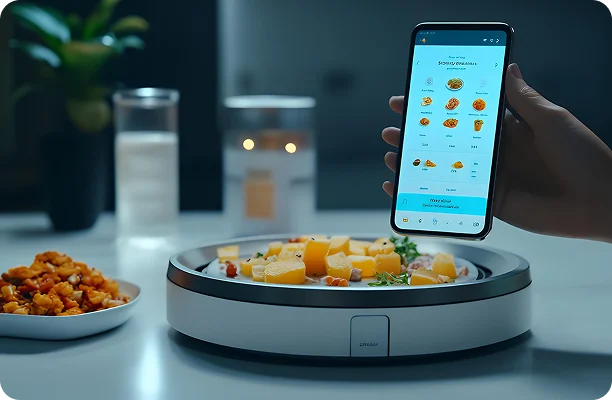
AI food delivery apps are transforming the food businesses by making them smarter, faster, and more personalized. The integration of AI in food delivery apps helps analyze large amounts of data and improve decision-making across the entire platform.
-
Deliver a personalized experience to customers.
-
Predict demand and optimize preparation time.
-
AI chatbots for instant responses and reducing support workload.
-
Detect suspicious transactions, fake accounts, or unusual activity.
-
Valuable insights for better strategic decisions.
-
Intelligent pricing and targeted promotions.
Our Food Delivery App
Development Process
At Triple Minds, we follow a structured and agile development approach to build scalable, intelligent, and user-friendly AI-powered food delivery applications. We have crafted a six stage development process that focuses on performance, security, and a seamless user experience.

Requirement Analysis & Strategy
We begin by understanding your business goals, target audience, and platform requirements to define a clear development strategy and feature roadmap.

UI/UX Design
Our design team creates intuitive and engaging user interfaces that ensure smooth navigation and an excellent user experience across all panels.

AI Integration & Feature
We integrate AI-powered features such as personalized recommendations, smart delivery assignments, demand forecasting, and predictive analytics to make the platform smarter.

App Development
Our developers build robust and scalable applications for users, restaurants, delivery partners, and admins using modern technologies.

Testing & Quality Assurance
We conduct rigorous testing to ensure the app is secure, bug-free, and performs smoothly across devices and platforms.

Deployment & Launch
Once the application is ready, we deploy it on the desired platforms and ensure a smooth launch.
Know What Your Food Delivery App Will Cost Before You Commit
Bring us your model, your region and your delivery setup, and we will come back with a fixed scope, a timeline and a number.
If an off-the-shelf platform is the right answer for where you are, we will say so on the first call rather than
quote you for a build you do not need yet.
How Much Does It Cost to Develop a Food Delivery App?
A lean single-brand MVP generally lands between $25,000 and $45,000, a full multi-restaurant marketplace between $60,000 and $120,000, and an enterprise build with advanced dispatch runs higher. Published industry estimates span roughly $20,000 to $300,000 depending on scope and region, which is precisely why no one should quote you a figure before scoping. The spread is driven by business model and dispatch complexity far more than by how many screens you want.
| Scope | Typical cost | Timeline | What is included |
|---|---|---|---|
| Single-brand MVP | $25,000 – $45,000 | 10 – 14 weeks | Customer app, restaurant app, basic admin, one payment gateway, your own riders or a courier API. No commission engine. |
| Multi-restaurant marketplace | $60,000 – $120,000 | 4 – 7 months | All four apps, dispatch engine, commission splits and three-way payouts, live tracking, promotions, analytics. |
| Enterprise / multi-city | $120,000+ | 7 months+ | Advanced dispatch and batching, multi-region payments, fraud tooling, POS integrations, reporting warehouse. |
| AI layer (optional) | add $12,000 – $30,000 | built in parallel | Recommendations, demand forecasting, route optimisation, dynamic pricing, menu and inventory intelligence. |
| White-label script | under $10,000 | 2 – 4 weeks | Licensed platform with your branding and limited customisation. Right for validating demand, wrong if the platform is the business. |
What actually moves the number: whether you need a dispatch engine, how many payment and POS integrations you require, whether the riders are yours or a third party's, and how many regions you launch in. Screen count and design polish move it far less than people expect.
Why Choose Triple Minds for Food Delivery
App Development?
We combine AI development expertise with deep industry knowledge to deliver innovative, scalable food delivery solutions tailored to
modern business needs. Here’s what makes us the right partner for AI food delivery app development;

Food Delivery Domain Expertise
We have built the parts that decide whether a delivery platform works: driver dispatch, live tracking, three-way payouts and POS integration. An AI layer is added where it earns its place, not as the headline.

Custom-Built Solutions
We develop fully customized applications designed specifically for your business model and operational requirements.

Dedicated Support Team
Our team provides continuous support and updates to ensure your application remains efficient, secure, and up to date.

Scalable and Future-Ready Platforms
Our solutions are built with scalability in mind, ensuring your platform can grow as your business expands.

Focus on Performance and Security
We prioritize performance optimization and data security to deliver reliable and secure applications.

End-to-End Development Services
From ideation and design to development, deployment, and maintenance, we handle the complete development lifecycle.
Ready to Start Your Food Delivery App
Development Project?
From the first scoping call to launch we build the customer app, the restaurant app, the driver app and the admin panel
on one backend, with live tracking, dispatch and payouts working before you go live. An AI layer sits on top
when it earns its place.
Our Recent Blogs

Frequently Asked Questions
A single-brand MVP typically costs $25,000 to $45,000 and takes 10 to 14 weeks. A multi-restaurant marketplace with a dispatch engine, driver app and commission payouts runs $60,000 to $120,000 over four to seven months. Enterprise and multi-city builds go beyond $120,000. An optional AI layer adds roughly $12,000 to $30,000. The biggest cost drivers are the business model and the dispatch logic, not the number of screens, which is why a fixed figure only becomes meaningful after a scoping call.
Ten to fourteen weeks for a single-brand MVP, four to seven months for a multi-restaurant marketplace with dispatch and payouts, and seven months or more for an enterprise or multi-city platform. A licensed white-label script can be live in two to four weeks if the goal is to validate demand rather than own the technology.
Choose the business model first, because it decides whether you need a dispatch engine. Map the order state machine including every failure path. Design the customer, restaurant, driver and admin apps together around a single order. Build the backend and the driver-assignment algorithm. Wire real-time tracking and an ETA that updates when the kitchen slips. Integrate payments, split payouts and POS. Test the failure paths rather than the happy path. Then launch in one neighbourhood and fix the economics before expanding.
Typically React Native or Flutter for the mobile apps, Node.js, NestJS, Laravel or Go on the backend, PostgreSQL with PostGIS for geospatial queries, Redis for live state, WebSockets for driver tracking, and Google Maps or Mapbox for routing and ETAs. Payments and split payouts run through Stripe Connect, Razorpay Route or a regional equivalent. The right combination depends on your region, your payout rails and the team that will maintain it.
Yes, with one caveat worth saying plainly. The customer-facing app is the straightforward part. What made those platforms hard was the dispatch engine, the fraud and payout systems, and years of accumulated supply density. We build the full four-app platform including dispatch, but a new entrant wins by owning one city, cuisine or category rather than by matching an incumbent's coverage.
Our AI models for food delivery apps are trained on specific data such as user ordering behavior, restaurant menus, delivery locations, traffic patterns, and more. Get in touch with the Triple Minds team for more information about the AI food delivery application.
AI food delivery apps help businesses increase revenue by analyzing customer preferences and behavior to deliver personalized recommendations, targeted promotions, and dynamic pricing strategies.
Yes, we can develop a fully customized AI-powered food delivery application tailored specifically to your restaurant business. Get in touch with our subject matter experts to discuss your AI food delivery app requirement and features in detail.
Partnering with Triple Minds - a leading AI food delivery app development company usually begins with a consultation where you discuss your business idea, requirements, and goals. The development team then evaluates the project, suggests the best technology approach, and creates a roadmap for building and launching your project.