
Whatnot-like platforms are live streaming shopping experiences that make shopping more interactive by bringing live video, real-time bidding, and seller-led communities together. Imagine creating a platform where sneaker lovers compete for limited-edition releases. The opportunity goes beyond selling products; it is about giving buyers a reason to watch, participate, and return.
So, how much should you invest to launch your own platform?
Should you build everything from scratch or choose a white-label Whatnot clone? And more importantly, how many sales would you need each month to recover your investment?
A report by Grand View Research estimated the global live commerce market at $172.9 billion in 2025 and projected it to reach $230.3 billion in 2026.
In this guide, we will explore how to turn the idea into a business by launching a live streaming platform like Whatnot. By the end, you will have a clearer picture of what it takes to launch a Whatnot-like platform—and what needs to happen for that investment to pay off.
Steps Involved in Launching a Whatnot Clone
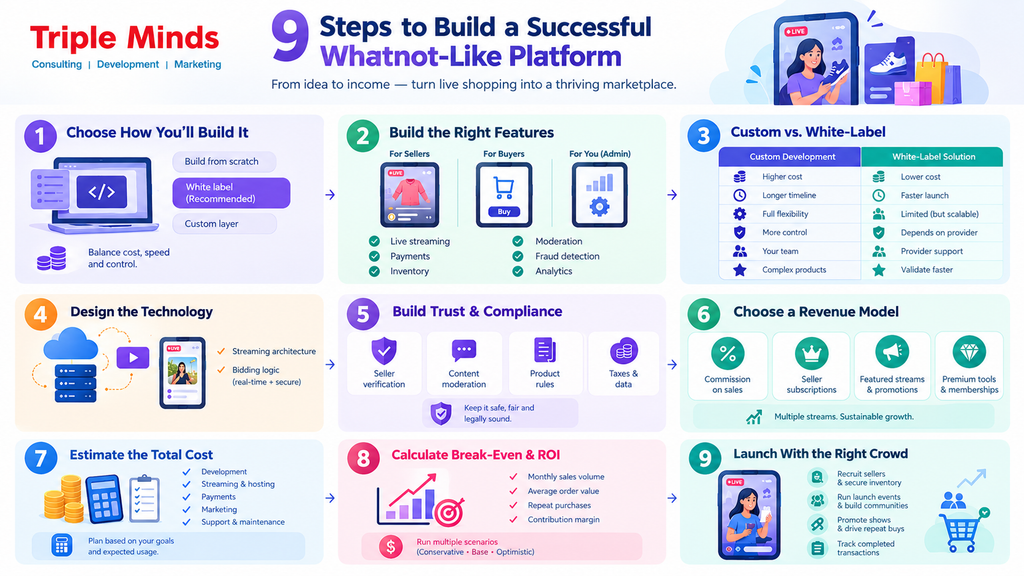
Step 1: Choose How You’ll Build It
You have three realistic routes, and the right one depends on how much you are willing to spend on developing an application like Whatnot and how fast you need to move.
Build from scratch: In this approach, you will have full control, but you will need to pay each month to resolve issues. Real-time bidding, low-latency video, escrow payments and fraud rules all take time to get right. Expect a long runway before your first live show.
White label with a custom layer. This is the middle path, and for most founders it’s a smart investment. You know why? It is because in a white-label approach, you will start from a tested codebase, then adapt branding, features, and monetization to your niche.
At Triple Minds, we provide a white-label Whatnot clone – a ready-to-launch live streaming platform at just $13000.
Step 2: Build the Features That Make Money
A successful and most effective version of live streaming platforms is not the one that has a large list of features. It is the one that frictionlessly supports the customer journey.
For sellers, the core features include live broadcast console where they can pin their product the core, run auctions, or add listings, and manage inventory.
For buyers, the buyer side features cover secure checkout, multiple payment methods, saved-search alerts, make-an-offer, Wishlist, and a floating mini player so people can keep watching while they browse.
For you as the owner, you need an admin console with seller application review, live show monitoring, commission and fee controls, content moderation, fraud detection, audit logs, and role-based access. It’s easy to underinvest here because buyers never see it. However, you can compromise on design but not on the functionality because this is where your margins and your reputation live.
Step 3: Decide Between Custom Development and a White-Label Whatnot Clone
One of the most important financial decisions is whether to develop the entire platform from scratch or use a white-label solution.
| Factor | Custom development | White-label development |
| Initial investment | Usually higher | Can be lower, depending on scope |
| Time to market | Longer because more components are built | Potentially shorter using existing functionality |
| Feature flexibility | High when properly scoped | Depends on source code and customization rights |
| Technical control | Defined by your architecture and contract | Depends on code access, infrastructure, and licensing |
| Maintenance | Your team or contracted partner maintains the system | Depends on the support agreement and ownership model |
| Best suited for | Highly differentiated or complex products | Founders validating a focused marketplace faster |
Step 4: Design the Technology Around Live Auctions and Transactions
One of the most complex tasks is to design the technical factors of a Whatnot clone. Your system should be powerful enough to blend video, bidding, inventory, and payment processes. Although this part is becomes challenging when a popular stream attracts multiple buyers at once.
Select the right streaming architecture: Depending on video input, view time, resolution, and delivery region, live streaming services charge fees. Therefore, audience size and viewing time becomes two critical factors that you should consider when building infrastructure costs.
Build bidding logic that can withstand disputes: The auction’s timer should not rely just on the client’s browser. The server should also check validity of every bid, record the time of its arrival, apply the minimum step logic, and determine the winner in accordance with a particular set of rules.
Step 5: Build Trust and Compliance In, Not On
Live commerce moves fast, and fast marketplaces attract bad behavior. Plan for it before launch.
Seller verification. KYC checks and a seller application review keep out the obvious bad actors. Add account health tracking so sellers see how they’re doing on shipping times, cancellations and policy compliance.
Moderation. Live chat needs filters for spam and abuse, muted-word controls, two-way blocking and moderators who can pull a stream quickly.
Product rules. This one is serious. Whatnot itself faced legal allegations earlier this year tied to randomized box breaks and repack breaks, which critics argued resembled illegal gambling. Whatever your view on that, the lesson is practical: if you allow mystery or randomized sales formats, talk to a lawyer in each market you operate in before you launch them.
Taxes and data. Sales tax handling, seller tax documents and GDPR-style data export if you serve Europe.
None of this is exciting. All of it protects your ROI, because one viral scam or one fraud ring can undo months of seller recruitment.
Step 6: Choose a Revenue Model That Supports Profitability
There are many ways you can make money with a clone of Whatnot. At first, you need to pick the model that both your sellers know about and your buyers can accept.
1. Commission on sales made
You keep some percentage of all eligible deals made.
As an example, with an 8% commission, your seller will earn $8,000 of gross commission revenue from $100,000 GMV per month.
This kind of monetization is aligned with the interests of the seller but still needs to be profitable after covering all the product cost, shipping, payment fee, and returning goods expenses.
2. Seller subscriptions
Provide your sellers with monthly or yearly subscription that gives additional analytics, improved storefront, more listings allowed, promotion features, or reporting tools for sellers.
This type of monetization can help you generate stable recurrent revenue but may be harder to sell if sellers don’t see the value in your marketplace yet.
3. Featured streams and promoted listings
Let sellers buy additional exposure during particular events or during the launch of their products.
Promotional placements should be clearly identified and designed to preserve the usefulness of the discovery feed. Selling visibility before the platform has meaningful traffic is unlikely to generate substantial revenue.
4. Premium tools and memberships
Over time, consider paid seller analytics, automated promotional tools, premium buyer memberships, exclusive events, or advanced listing capabilities.
Introduce these options in response to demonstrated demand rather than adding complexity before the core marketplace works.
Step 7: Estimate the Total Cost of Launching the Platform
Your actual expenses will depend on launch geography, traffic, stream duration, video quality, feature complexity, and the amount of work handled internally. You can use a mobile app calculator to know the exact cost of a Whatnot-like platform.
| Cost category | What it covers | Budgeting approach |
| Platform development | Buyer, seller, and admin applications | Obtain a feature-based quote |
| Streaming infrastructure | Video delivery, transcoding, recording, and bandwidth | Model expected viewing hours |
| Hosting and storage | Databases, media storage, backups, and monitoring | Estimate from expected usage |
| Payment processing | Transaction processing and marketplace payouts | Apply provider rates to expected sales |
| Marketing and seller acquisition | Outreach, incentives, events, and paid campaigns | Set a monthly acquisition budget |
| Support and moderation | Buyer assistance, seller disputes, and content review | Estimate staffing and service coverage |
| Maintenance | Bug fixes, security updates, and enhancements | Agree on an ongoing support arrangement |
Step 8: Calculate Break-Even GMV and Potential ROI
This is the stage where your business plan needs to move beyond market-size statistics. A large live commerce market does not guarantee that a new platform will attract enough buyers or retain enough revenue to become profitable.
- Monthly sales volume, average order value, and repeat purchases
- Contribution margin after transaction-related costs
- Break-even sales volume and investment payback
- Conservative, base, and optimistic financial scenariost
Step 9: Launch With Enough Sellers and Buyers to Make Auctions Work
A marketplace can be technically ready and commercially inactive. But, without enough relevant products and credible sellers, buyers will not find it worthy.
- Recruiting the first sellers and securing initial inventory
- Scheduling launch events and building category-specific communities
- Promoting shows and encouraging repeat purchases
- Tracking completed transactions rather than downloads alone
Launch Your Live Shopping Platform Faster with Whatnot Clone
Enter the live commerce market faster with Triple Minds’ Whatnot Clone, a ready-to-launch platform featuring live streaming, real-time bidding, product listings, secure payment workflows, and marketplace management. Build your own branded live shopping marketplace and focus on attracting sellers, engaging buyers, and growing your business.
Explore Whatnot Clone
The ROI Math: What Launching Actually Costs and Earns
Time for the part most blogs skip. The numbers below are an illustrative model, not a forecast. I built them from the Triple Minds starting price and typical marketplace take rates, and every other figure is an assumption you should replace with your own.
Year-one costs (base case):
| Item | Assumption | Year-one cost |
| Platform build | White label starting price | $13,000 |
| Hosting and streaming | About $1,200 per month | $14,400 |
| Seller acquisition and marketing | About $2,500 per month | $30,000 |
| Moderation, support and operations | About $2,000 per month | $24,000 |
| Legal, app store and miscellaneous | One-time | $5,000 |
| Total | about $86,400 |
Why Launch a Live Shopping Platform in 2026?
Live shopping provides an alternative solution to common problems associated with eCommerce: low product engagement, purchasing uncertainty, poor customer relationships, and price wars.
1. Make Product Exploration More Interactive
Non-interactive listings cannot necessarily convey the look and functionality of a product. A live stream will allow a seller to demonstrate and describe a product in great details.
For instance, a vintage watches dealer can talk about the item’s condition, explain its origin, and answer all questions which a buyer may have in real-time. Likewise, a fashion label can provide multiple styling options to attract more buyers.
In such a way, a live streaming platform provides a seller with business opportunities and helps buyers make an informed decision and purchase a product.
2. Create a Repeatable Audience of Sellers and Categories
A marketplace becomes more valuable when customers return for certain hosts, auctions, or product drops.
A marketplace becomes more reputable and valuable when customers return to it. You can use followers, wishlists, reminders, loyalty rewards, and personalized recommendations to encourage them. In such a way, sellers will keep broadcasting their products through your platform.
3. Create a Specialized Marketplace
Competing with established general-purpose marketplaces can require substantial investment in inventory breadth, brand awareness, logistics, and customer acquisition.
A focused live shopping platform can begin with a narrower opportunity, such as authenticated sneakers, trading cards, independent fashion labels, or regional artisan products.
Specialization makes it easier to recruit relevant sellers, organize useful live events, and build a community around shared interests. It also helps you develop category-specific features, such as authenticity verification, condition grading, or specialized auction rules.
4. Develop Multiple Revenue Streams
A live shopping marketplace can earn revenue from transaction commissions, seller subscriptions, promoted streams, sponsorships, and premium seller tools.
This flexibility is valuable because a platform does not have to depend exclusively on transaction volume. Nevertheless, secondary revenue streams usually become meaningful only after the marketplace has attracted an active base of sellers and buyers.
Which Business Niches Can Invest in a Whatnot Like Platform?
A Whatnot-like platform can work for any business niche where products are visually engaging, buyers value interaction, and sellers can create urgency through live auctions, limited-time deals, or exclusive drops.
| Potential niche | Live shopping opportunity | Important consideration |
| Collectibles and trading cards | Auctions, rarity reveals, collector communities | Authentication and condition disputes |
| Sneakers and vintage fashion | Product drops, styling, limited inventory | Counterfeit prevention and returns |
| Jewelry and watches | Detailed demonstrations, premium auctions | Authenticity, insurance, and high-value payments |
| Electronics | Live demonstrations and comparisons | Warranty, returns, and technical support |
| Art and handmade products | Creator-led selling and storytelling | Seller quality and product consistency |
How Triple Minds Can Help You Launch a Whatnot-Like Platform
Releasing a live shopping platform requires coordination between marketplace software, streaming infrastructure, transaction workflows, and commercial strategy.
Triple Minds provides white-label Whatnot clone development solution to businesses who want to establish their own live auction platform with build once from scratch.
The published features are specifically designed for buyer, sellers and admins that includes –
- Live broadcasts
- Real-time bidding
- Fixed-price purchases
- Product and inventory management
- Payment workflows
- Marketplace management
For entrepreneurs evaluating this approach, the next step is to map the solution against the business requirements that will affect launch and ROI:
- Business model: Confirm the commission structure, subscription options, and category-specific workflows.
- Technical requirements: Review streaming latency, expected concurrent viewers, auction integrity, integrations, and scalability.
- Ownership: Verify source-code and intellectual-property transfer, licensing, deployment rights, and third-party dependencies in the contract.
- Launch budget: Request a complete scope covering development, integrations, infrastructure, testing, and support.
- Commercial readiness: Plan seller onboarding, initial events, marketing, customer support, and the first six to twelve months of operating costs.
A right technology partner should help you establish what is included, what requires customization, and what will cost extra. Planning to launch your own live shopping marketplace? Explore the Triple Minds Whatnot clone solution and discuss the features, integrations, and budget required for your business model.
Choose Triple Minds as Your End-to-End Live Shopping Partner
From monetization strategy and platform development to marketing and customer acquisition, Triple Minds supports businesses at every stage of launching a live shopping platform. Our consulting, development, and marketing services help you build the right business model, launch confidently, attract your first customers, and create a foundation for long-term growth.
Consult with Our Experts
Final Takeaway
If you have a niche, a handful of sellers, and the patience to run the marketplace like a community and not a software product, then a Whatnot clone is for you. The strongest starting point is a well-defined niche, a credible group of sellers, a dependable live buying experience, and a revenue model that works after transaction and operating costs.
Quick Answers to Common Questions
How much does it cost to build a live shopping platform like Whatnot?
At Triple Minds, our Whatnot clone can cost you $13000. Developing a live stream app from scratch can be more expensive and can go up to $250,000 or even more.
Can I launch a Whatnot-like platform for a specific niche?
Yes. You can focus on collectibles, sneakers, vintage clothing, jewelry, electronics, art, or another category where live demonstrations and interactive selling provide value. A focused launch can make seller recruitment, community building, and product discovery more manageable.
How can I calculate the ROI of a live shopping platform?
Estimate monthly GMV, the commission or other revenue retained by the platform, transaction-related costs, fixed operating expenses, and initial investment. Use these inputs to calculate contribution margin, break-even GMV, monthly operating surplus, and payback time.
How long does it take to launch a Whatnot-like app?
The timeline depends on whether you use a white-label solution or develop a platform from scratch. A white label Whatnot clone is ready to launch in 15 days.
Got a project in mind? Let’s build it together.
We work with founders and product teams across consulting, development, and growth marketing. Tell us what you’re building and we’ll show you how we’d ship it.