DoorLoop Clone Development Cost: A Complete Property Management Software Cost Breakdown
The development of property management software like a DoorLoop clone can cost you from $30,000 to $100,000 or even more. This cost is not just a guess; it is a well calculated estimate made depending on your product scope, user roles, automation, integrations, monetization, and other platform capabilities.

The development cost of a DoorLoop clone depends on whether you choose to build your property management software from scratch or use an existing solution as a starting point. For example, Triple Minds offers a DoorLoop clone priced at $11,900, giving businesses an alternative to a fully custom development project. This can be worth considering if your goal is to launch a property management platform with a defined starting point and allocate your budget toward customization, integrations, and business-specific requirements. Below is the cost estimate of how much your DoorLoop like platform can cost.
| Product Scope | Estimated Development Cost | Approx. Timeline |
| Basic MVP | $30,000–$50,000 | 3–5 months |
| Mid-level DoorLoop clone | $50,000–$90,000 | 5–8 months |
| Advanced platform | $90,000–$150,000+ | 8–12+ months |
| Enterprise-grade platform | $150,000–$300,000+ | 12–18+ months |
The cost we mentioned above is a general price. The actual cost depends on what you want to replicate and, more importantly, what you want to improve.
And that distinction matters.
DoorLoop is not simply a dashboard where landlords collect rent. It is a property management platform that combines property operations, accounting, tenant communication, maintenance, leasing, payments, reporting, portals, automation, and integrations into one ecosystem.
So if you are searching for a “DoorLoop clone cost,” you have just landed on the right page. This guide breaks down the DoorLoop-like app’s development cost feature by feature, explains what makes it expensive, and helps you find affordable and profitable ways to make a similar platform.
DoorLoop Clone Development Cost: Feature-by-Feature Breakdown
Other than using a software cost calculator, the most accurate and reliable way to estimate development cost is to break the product into functional modules.
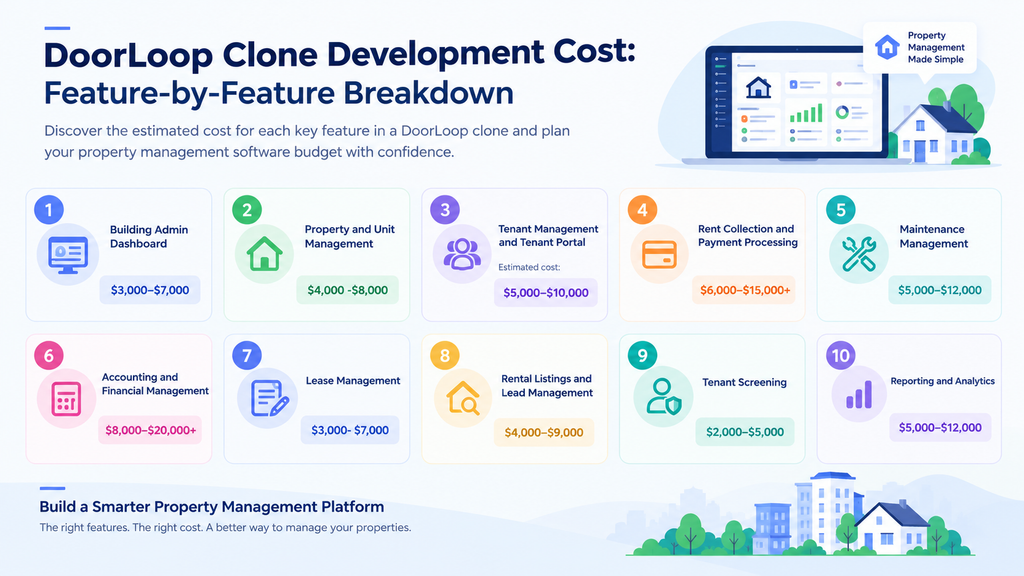
1. Building Admin Dashboard
Estimated cost : $3,000–$7,000
The admin dashboard becomes the command center of the platform and can cost you from $3,000–$7,000. The typical functionality includes the following-
- Portfolio overview
- Property statistics
- Occupancy metrics
- Revenue summaries
- Pending maintenance requests
- Outstanding rent
- Upcoming lease expirations
- Notifications
- User management
- System configuration
However, if you want to build a basic dashboard, the cost can be relatively inexpensive. Cost rises the moment you decide to introduce customizable widgets and advanced filtering.
2. Property and Unit Management
Your app users should be able to create and manage properties, buildings, units, rent, security deposits, and their property documents without any complexity. All these functionalities make this module the core of a DoorLoop-like property management platform. Therefore, the estimated cost of developing the property and unit management module is $4,000 -$8,000. The database structure matters here. A typical hierarchy might look like:
Portfolio → Property → Building → Unit → Lease → Tenant
Getting this architecture right early can save significant redevelopment costs later.
If the app development company like Triple Minds gets this architecture right at the early stage, you can save the redevelopment cost of your DoorLoop clone app.
3. Tenant Management and Tenant Portal
Estimated cost: $5,000–$10,000
The tenant portal is one of the most important components of a DoorLoop-style application. A tenant may need to perform the following tasks:
- View lease information
- Pay rent
- Download documents
- Submit maintenance requests
- View payment history
- Communicate with management
- Receive announcements
- Upload documents
- View notices
- Manage profile information
Therefore, the tenant management portal should connect directly with the property manager’s dashboard so that when a tenant submits a request, the manager receives it and assigns a vendor. After that, the vendor can update the status, the tenant receives notification, and the manager closes the work order.
4. Rent Collection and Payment Processing
Payment processing is one of the most crucial parts because it is technically sensitive. A property management platform supports ACH payments, debit cards, credit cards, recurring payments, automatic payment reminders, refunds, and much more. Therefore, this module can be more expensive- estimated cost: $6,000–$15,000+.
Rather than building payment processing from scratch, you can integrate providers like Stripe, Plaid, Dwolla, or some specialized property management payment infrastructure. The development cost is therefore influenced by both integration complexity and compliance requirements.
5. Maintenance Management
Estimated cost of maintenance is $5,000–$12,000. A complete module dedicated to maintenance can include-
- Tenant submits request.
- Manager reviews request.
- Request is categorized.
- Priority is assigned.
- Vendor is selected.
- Vendor receives notification.
- Work is scheduled.
- Vendor uploads updates/photos.
- Manager approves completion.
- Cost is recorded.
- Tenant receives completion notification.
There are some additional features like work orders, vendor management, maintenance categories, priority levels, attachments, scheduling, internal notes, vendor communication, etc., that you can opt to include.
6. Accounting and Financial Management
The estimated cost of building an accounting and financial management unit is $8,000–$20,000+. This is where a basic rental application starts becoming a serious property management product. Accounting functionality may include: chart of accounts, incoming tracking, expense tracking, rent ledgers, property statements, bank reconciliation, and much more.
Financial data needs to remain consistent across properties, units, tenants, owners, and transactions. That’s why accounting should not be treated as a cosmetic reporting feature.
7. Lease Management
It is a feature that automates the end-to-end lifecycle of a rental contract, serving as a connection between your physical rental unit, tenants, financial ledger, and legal documentation. The estimated cost of lease management is $3,000- $7,000, and it includes the following:
- Lease creation
- Lease start/end dates
- Rent schedules
- Deposits
- Renewal dates
- Uploaded agreements
- Automated reminders
- Tenant association
- Property association
- Document management
More advanced versions can introduce electronic signatures, lease templates, automated renewal workflows, clause management, AI -assisted lease analysis, etc.
8. Rental Listings and Lead Management
What will be a property management platform without lead management? Nothing right? If your goals is to make the product cometitive with established property management platforms, the leasing function becomes the heartbeat. Its evaluated cost can be from $4,000–$9,000. The possible features include:
- Property listings
- Unit availability
- Lead capture
- Applicant management
- Showing scheduling
- Application tracking
- Listing syndication
- Prospect CRM
- Communication history
Raad More: How AI Agents Are Changing Lead Follow-Up in Real Estate
9. Tenant Screening
Estimated cost of tenant screening in DoorLoop clones is $2,000–$5,000 for integration. The application can connect with a screening provider to obtain:
- Identity information
- Credit information
- Background checks
- Eviction records
- Screening status
The development cost is therefore mostly related to API integration, consent workflows, status handling, error handling, secure data management, and reporting.
Note: Legal and compliance requirements vary by jurisdiction, so these workflows should be reviewed before launch.
10. Reporting and Analytics
The basic reports might include rent roll, income statement, expense report, occupancy report, tenant ledger, maintenance report, and owner statement. Advanced reporting costs $5,000–$12,000 and could include the following-
- Custom report builder
- Saved reports
- Scheduled reports
- Export to CSV/PDF
- Portfolio comparisons
- Financial dashboards
- Custom date ranges
Launch Your Property Management Software Faster with Triple Minds
Enter the property management market faster with Triple Minds’ DoorLoop Clone, a ready-made solution equipped with modern features for managing properties, tenants, leases, rent collection, maintenance, and financial operations. Launch your own property management platform with a strong functional foundation and customize it to your business needs.
Explore DoorLoop Clone
DoorLoop Clone Development Cost by Development Phase
| Development Phase | Estimated Cost |
| Discovery & business analysis | $2,000–$6,000 |
| UI/UX design | $4,000–$10,000 |
| Backend development | $12,000–$30,000 |
| Web application | $10,000–$25,000 |
| Payment integrations | $4,000–$10,000 |
| Third-party integrations | $4,000–$15,000 |
| QA & security testing | $4,000–$10,000 |
| DevOps & deployment | $2,000–$6,000 |
| Project management | $3,000–$8,000 |
These categories overlap depending on the development methodology, so they should not simply be added together as independent line items.
A realistic mid-level DoorLoop clone generally falls around $50,000–$90,000 when developed as a focused SaaS product rather than an enterprise replica.
The Hidden Costs of Building a DoorLoop Clone
The development invoice is not the complete budget.
This is where many software cost estimates become misleading.
Cloud infrastructure
You may need to pay for:
- Servers
- Database
- File storage
- Backups
- CDN
- Monitoring
- Logging
Costs can start relatively low for an MVP and increase as usage grows.
Third-party APIs
Your platform may depend on external services for:
- Payments
- Banking
- SMS
- Maps
- Identity verification
- Tenant screening
- E-signatures
- AI
These often have usage-based pricing.
Security
A property management platform stores sensitive financial and personal information.
Budget for:
- Encryption
- Secure authentication
- Role-based permissions
- Audit logs
- Backups
- Vulnerability testing
- Security monitoring
Maintenance
Software development does not end when version one launches.
Budget for:
- Bug fixes
- OS/browser compatibility
- Dependency updates
- Security patches
- Cloud infrastructure
- API changes
- New features
- Customer support
A useful planning approach is to reserve 15–20% of the initial development budget annually for ongoing maintenance and improvements, with infrastructure and third-party usage budgeted separately.
What Makes DoorLoop-Like Software Complex to Build?
At surface level, a property management platform may appear simple. But, as soon as the reality hits, you realise that a DoorLoop-like platform connects multiple users, properties, financial transactions, and documents while ensuring isolation and consistency. Therefore, it is a complex development. The complexity usually comes from eight interconnected areas.
1. Multi-Tenant Architecture
A property management software serves multiple businesses from the same application.
For example, Property Manager A might manage 100 units, while Property Manager B manages 500 units. Both use the same software, but their properties, tenants, financial records, documents, and users must remain completely isolated.
2. Multiple User Roles
A DoorLoop-like platform isn’t built for a single user. Depending on the product scope, it supports property managers, property owners, tenants, leasing agents, maintenance vendors, accountants, and administrators.
For each user, the roles and responsibilities are also different.
A tenant may need to pay rent and submit a maintenance request, while an owner may need financial statements and property performance reports. Similarly, property managers will have different responsibilities. This means developers will have to create different functionalities such as-
- Dashboards
- Navigation structures
- Workflows
- Data views
- Actions
- Notifications
- Permissions
3. Financial Workflows
Property management software is also responsible for financial activities. Collecting rent is one side of the coin. A well-developed platform needs to manage rent charges, security deposits, late fees, payment transactions, vendor payments, refunds, and much more.
The story doesn’t end here. These transactions may also have relationships with other entities. For example, when a tenant pays rent, the platform may need:
- Record payment
- Update tenant ledger
- Update property income
- Calculate applicable fees
- Generate receipts
- Update reporting data
- Notify relevant user
4. Real-Time Notifications and Communication
Property management involves constant communication. That means, when a tenant submits a maintenance request, a manage assign it to a vendor, and the vendor updates the work, and simultaneously the tenant receives a status notification. All these events need to move through the system reliably. Therefore, a DoorLoop clone may support the following:
- Email notifications
- SMS
- Push notifications
- In-app notifications
- Automated reminders
- Internal messaging
The complexity of the platform increases when notifications are triggered by different events and user preferences.
For example:
Lease expires in 60 days → notify manager
Lease expires in 30 days → notify manager and tenant
Rent payment fails → notify tenant and manager
Maintenance request assigned → notify vendor
5. Third-Party Integrations
A modern property management platform doesn’t always operate entirely on its own. It may need to connect with payment gateways, banking services, accounting platforms, e-signature platforms, SMS services, and other integrations.
Every integration introduces additional development work. Therefore, mobile app developers need to handle the following:
- API authentication
- Data synchronization
- Webhooks
- Error handling
- Rate limits
- Failed transactions
- API changes
- Security
- Data mapping
Integrating a payment provider isn’t simply a matter of connecting an API. The application also needs to understand successful payments, failed payments, refunds, disputes, duplicate transactions, and asynchronous payment notifications. As the number of integrations increases, the development and ongoing maintenance effort also hikes.
6. Permission Management
To understand this concept, let’s consider a property manager who manages 100 properties but has an accountant who only accesses financial information for 20 properties.
Now consider an owner who should see the performance of their own properties but should not see another owner’s tenants or financial records.
Therefore, the property management software needs granular access controls based on factors like- users, organization, role, property, unit, data, and action. Permissions may determine whether someone can:
- View information
- Create records
- Edit records
- Delete records
- Approve transactions
- Export reports
- Access financial data
- Manage users
7. Data Security
Property management platforms can store highly sensitive information. This may include personal data, lease documents, payment information, financial records, tenant communications, etc. Therefore, security needs to be incorporated into the architecture. Important considerations include:
- Encryption
- Secure authentication
- Role-based access
- Session management
- Secure file storage
- Audit logs
- Database security
- Backups
- Vulnerability testing
- Monitoring
- Disaster recovery
Rather than storing payment information directly, it should be managed through appropriate payment providers. Security also isn’t a one-time development expense. It requires continuous monitoring, updates, testing, and maintenance after launch.
8. Automation
Automation is one of the features that can make property management software genuinely valuable—but it also adds another layer of complexity.
Instead of requiring managers to perform every action manually, the platform can automate repetitive workflows from rent due reminders to receiving payment, generating receipts, and updating the ledger.
These workflows require a reliable event and rules engine. As automation becomes more sophisticated, developers need to account for:
- Trigger conditions
- Multiple actions
- Scheduling
- Exceptions
- User permissions
- Failed actions
- Retries
- Dependencies
- Audit trails
How Long Does It Take to Build a DoorLoop Clone?
| Stage | Timeline |
| Discovery | 2–4 weeks |
| UX/UI design | 3–6 weeks |
| MVP development | 12–20 weeks |
| Testing & stabilization | 3–6 weeks |
| Deployment | 1–2 weeks |
| Total MVP | 4–7 months |
What Should Be Scalable From Day One?
You don’t need enterprise infrastructure on the first day. But there should be certain architectural decisions to anticipate growth.
1. Database Architecture
The data model should be designed to support multiple organizations, properties, units, tenants and transactions without creating unnecessary duplication or performance bottlenecks.
2. Multi-Tenant Isolation
Each customer’s data needs clear logical separation, with access controlled at the organization and user level.
3. Background Processing
Tasks such as report generation, bulk notifications, document processing and certain integrations should not unnecessarily block the main application.
4. API Architecture
A well-designed API layer makes it easier to add mobile applications, external integrations, and future services.
5. File Storage
Property management systems can accumulate large numbers of leases, images, inspection reports, and other documents. These should generally be handled through scalable object storage rather than relying entirely on the application server.
6. Monitoring
As the number of customers increases, knowing that something has failed is no longer enough. The development team needs visibility into where, why, and for whom it failed.
Still Unclear About Pricing? Get a Custom Cost Estimate!
Every property management platform has different requirements, features, and workflows. Meet with Triple Minds’ consultants to discuss your custom features, development scope, and business goals, and get a more personalized pricing estimate for your project.
Book Your Free Session Now
Final Thoughts
Building a DoorLoop clone is not about reproducing a collection of screens. It is about building a connected property-management ecosystem where properties, units, tenants, owners, leases, payments, maintenance, documents, and financial transactions work together.
Answers to Frequently Asked Questions
How much does it cost to build a DoorLoop clone?
A DoorLoop-inspired property management MVP typically costs around $30,000–$50,000. A more advanced platform can cost $50,000–$100,000+.
How long does it take to develop a DoorLoop clone?
A focused MVP generally takes about 4–7 months. A comprehensive platform with advanced accounting, mobile apps, integrations and AI can require 8–12 months or longer. But a white-label platform is pre-built and is ready to launch in 15 days.
What are the most expensive features in a DoorLoop clone?
Accounting, payment processing, advanced reporting, third-party integrations, mobile applications, AI, security and multi-role workflows generally have the greatest impact on development cost.
Can Triple Minds build a DoorLoop clone?
Yes. A development team can approach the project in phases, beginning with product discovery and UI/UX, followed by the core MVP, integrations, testing and subsequent feature expansion.
Got a project in mind? Let’s build it together.
We work with founders and product teams across consulting, development, and growth marketing. Tell us what you’re building and we’ll show you how we’d ship it.