How AI Agents Are Changing Lead Follow-Up in Real Estate
AI agents are changing how real estate businesses manage and follow up with leads. From instant responses and conversational qualification to lead scoring and CRM updates, these systems automate high-volume sales workflows. This guide explains how AI agents support continuous lead nurturing, intelligent routing, and seamless human handoffs. It also explores practical implementation, scalability, and the guardrails real estate businesses need when deploying autonomous AI workflows.

A buyer fills out a form on a listing at 11:47 PM on a Saturday. The agent sees it Monday morning. By then, that buyer has already toured three other homes with agents who called back within the hour.
This scenario used to be the norm in real estate, and it’s the single biggest reason deals slip through an agent’s fingers before a conversation even starts. Industry data consistently shows that most sales require five or more follow-up attempts to convert, yet a huge share of agents give up after just one. The math is brutal: speed and persistence are the two things that decide whether a lead becomes a client, and they’re also the two things overworked human agents are worst at delivering consistently.
That gap is exactly what AI agents are now closing. Not chatbots. Not autoresponders. Actual autonomous systems that qualify leads, hold real conversations across text and voice, update the CRM, and know when to hand a hot prospect straight to a human.
This is a fundamentally different category of tool than what “real estate automation” meant even two or three years ago, and it’s reshaping how brokerages think about lead follow-up from the ground up. Triple Minds in one such AI Agent development company that can help you build an AI agent for your real estate business to help you grow your business by streamlining lead generation. But, before you make a choice, let’s first understand “How AI agents can change lead follow-up in real estate.”
The Problem AI Agents Were Built to Solve
Before looking at the technology, it’s worth being precise about the problem, because it explains why this shift is happening now rather than five years ago.
Speed to lead is the single strongest predictor of conversion. Responding to a new lead within five minutes, rather than an hour or a day later, has been shown to increase contact rates by roughly 21 times compared to slower response windows. Most agents simply cannot hit that window consistently — they’re in showings, in negotiations, at dinner, asleep — while leads keep arriving around the clock from Zillow, Facebook ads, open houses, and their own website.
Follow-up persistence is just as important, and just as hard to sustain manually. Most buyers and sellers need to be touched multiple times before they’re ready to act, but the average agent’s attention and bandwidth run out long before the lead does. The result is a huge volume of leads that were never actually bad — they were simply never followed up with enough times, or fast enough, to convert.
The cost of fixing this with people doesn’t scale. A dedicated inside sales agent to handle lead qualification and follow-up runs a brokerage several thousand dollars a month in salary alone, before benefits, training, and turnover are factored in — and even a well-trained ISA still sleeps, takes days off, and can only be in one conversation at a time.
AI agents solve all three problems simultaneously: they respond in seconds, they never get tired of following up, and they cost a fraction of a human hire while handling volume no single person could match.
Turn Real Estate Lead Follow-Up Into an Always-On Sales Engine
Real estate leads can arrive at any hour, but sales teams cannot always respond instantly. Triple Minds can help real estate businesses build AI agents that qualify leads, automate follow-ups, update CRMs, nurture prospects, and hand high-intent opportunities to human agents at the right moment. Build an AI-powered workflow designed around your sales process, CRM, communication channels, and business goals.
Build Your Real Estate AI Agent with Triple Minds
What Makes an “AI Agent” Different from Older Automation
It’s worth being clear-eyed about terminology here, because “AI in real estate” has meant very different things at different points. Older tools were essentially generative — you prompted them, and they drafted something. A chatbot answered a scripted FAQ. An email autoresponder sent the same templated message to everyone who filled out a form. These tools were reactive: they did nothing unless triggered.
What’s changed in 2026 is the shift toward genuinely agentic systems — autonomous, proactive software that monitors inboxes and lead sources continuously, decides what action a given lead needs next, executes that action across connected tools, and only loops in a human when a decision actually requires one. The difference isn’t philosophical — it shows up directly in behavior. A generative tool waits for you to ask it to draft a follow-up email. An agentic system notices a new lead arrived, decides the right first move is a text message, sends it, reads the reply, decides whether that reply signals real buying intent, updates the CRM with what it learned, and either continues the conversation or flags the lead for a human agent to call — all without anyone opening the tool.
That autonomy is the actual innovation, and it’s why AI-enhanced CRMs are projected to be in use by the large majority of top-performing agents in 2026 — not because the underlying language models are new, but because they’re now wired directly into the tools and workflows agents already use every day.
Not just real-estate, the same principle extends when AI agents are connected to an industry-specific CRM. They can turn lead capture, qualification, follow-ups, and handoffs into a coordinated workflow rather than a collection of disconnected tasks. For example, the same workflow-driven approach can be applied to a white-label real estate CRM, where timely lead responses and automated follow-ups are equally important.
Read More: How Much Does It Cost to Build an AI Agent?
How AI Agents Actually Handle Lead Follow-Up
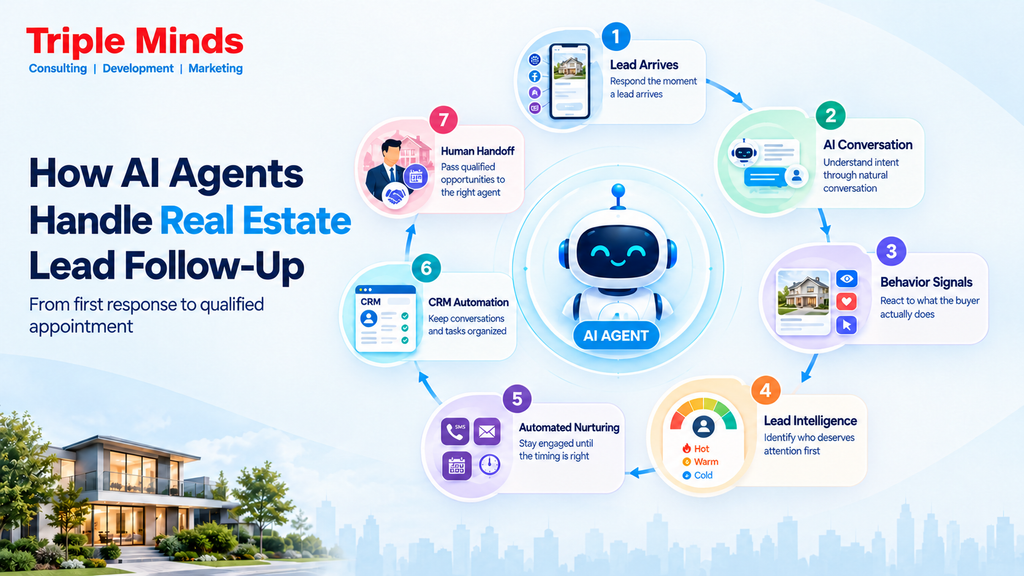
1. Instant First Response, Every Time
The moment a lead comes in — from a listing portal, a website form, a Facebook ad, or an open house sign-in sheet — an AI agent can respond within seconds, at any hour, every day of the week. This alone closes the single biggest gap in traditional follow-up: the hours-long or overnight delay between a lead raising their hand and someone actually reaching out.
2. Structured, Natural-Feeling Qualification
Rather than a rigid multiple-choice form, modern AI agents hold what feels like a normal text or voice conversation to establish the basics that actually matter: timeline (are they looking now or in six months?), budget and pre-approval status, property preferences, and motivation. This is done through natural, structured dialogue rather than a form dump, which keeps leads engaged instead of scaring them off with an interrogation.
Voice-based AI agents take this further, actually placing or answering calls, discussing property details pulled live from MLS data, and handling objections in real time — functionally replacing the first-call screening an ISA would otherwise do, and doing it for hundreds of leads a month with the same consistency on lead #500 as on lead #1.
3. Behavioral Triggers, Not Just Scheduled Messages
The more advanced platforms don’t just run a fixed drip sequence — they react to what a lead actually does. If a lead views several listings in a specific neighborhood, they get a targeted text about similar homes. If they save a property, they receive a follow-up email with comparable listings. This behavioral responsiveness makes follow-up feel personal and relevant rather than like a generic newsletter, and it’s a meaningful step beyond the “send email 1, wait 3 days, send email 2” automation of the past.
4. Intelligent Lead Scoring and Routing
As an AI agent gathers information through conversation, it scores leads on buying readiness and routes them accordingly. The hot, qualified prospects get pushed immediately to a human agent’s calendar or phone, while cooler leads are automatically enrolled in a longer nurture sequence. This solves a quieter but equally costly problem — agents wasting their limited time chasing unqualified leads while a genuinely ready buyer sits unanswered in the same inbox.
5. Continuous, Multi-Touch Nurture
For leads that aren’t ready today, AI agents run the multi-touch sequences that most humans simply don’t have the discipline to sustain — text, email, and sometimes direct mail, spaced out intelligently and adjusted based on engagement, over the months it often takes a lead to become sales-ready. This is precisely where the “five-plus touches” statistic from earlier gets solved structurally instead of relying on an individual agent’s memory and willpower.
6. Automatic CRM Updates and Task Creation
Every conversation detail — what the lead said, what they’re looking for, how they responded — flows automatically into the CRM, triggering the right follow-up tasks and agent assignments without anyone manually logging a call or typing notes. This closes a second major leak in traditional pipelines: leads and context that quietly get lost because no one updated the system after a call.
7. Seamless Handoff to a Human
The best implementations are explicit about where AI stops and a person takes over. Once a lead is qualified and ready, the AI agent hands the conversation to a human for the relationship-building, negotiation, and closing work that still benefits enormously from a real person — booking the appointment directly on that agent’s calendar so no additional coordination step is needed.
The Numbers Behind the Shift
The impact shows up in measurable outcomes, not just workflow diagrams. Brokerages that have adopted AI-driven lead follow-up report meaningfully higher revenue per agent and a notable increase in qualified appointments booked. Much of that improvement comes from eliminating the delay between a lead arriving and the first contact, while sustaining a follow-up volume that no individual could manage alone. On the cost side, AI-driven lead management can cut costs dramatically compared to staffing an equivalent human inside sales function, while still handling hundreds to over a thousand leads a month with the same consistency regardless of volume.
There’s also a trust dimension worth noting: a large majority of buyers say they’d be open to using AI tools somewhere in their home search process, which suggests the friction here is much more about agents adopting these tools than about consumers resisting them.
What This Looks Like in Practice: The Modern Tool Landscape
The tooling in this space has matured into a few distinct categories, and most brokerages end up combining more than one.
AI-enhanced CRMs are the foundation for many teams — platforms that layer behavioral lead scoring, automated nurture, and AI-suggested “next best action” directly on top of the contact database an agent already lives in, so agents get a prioritized list instead of a flat pile of leads to guess through.
Conversational and voice AI agents specialize purely in the qualification conversation itself — answering inbound calls, texting new leads within seconds, and conducting the structured qualification dialogue before ever involving a human — often plugged into whatever CRM a brokerage already uses rather than replacing it.
Workflow and multi-agent automation platforms sit a layer above both, connecting lead sources, CRMs, and communication channels together so that one agent can research a prospect, another can draft a personalized outreach message in the brokerage’s own voice, and a third can monitor for replies and route the conversation — all coordinated without a human manually stitching the steps together.
Choosing between these isn’t really an either/or decision for most brokerages; it’s a question of which layer needs automating first, based on where leads are actually being lost today.
Getting Started Without Overcomplicating It
Working with a AI agent development agency can make it easier to introduce agentic workflows without trying to automate your entire lead operation overnight. The brokerages that succeed with this technology tend to follow a deliberately narrow rollout rather than automating everything at once:
- Start with one lead source and one AI tool. Connect a single channel — say, your website’s contact form — to one AI follow-up tool rather than trying to automate every lead source simultaneously.
- Run it for a defined test period. Thirty days is a common benchmark, tracking average response time and contact rate before and after, so the impact is measurable rather than anecdotal.
- Feed it your actual voice and local knowledge. An AI agent is only as good as what it’s given — brokerages that upload past emails, local market data, school information, and common objections get responses that sound like a real local agent instead of a generic assistant.
- Expand only after the first workflow proves itself, adding lead sources, channels, and automation depth incrementally rather than replacing an entire follow-up process overnight.
The Guardrails That Actually Matter
Handing conversations with prospective buyers and sellers to an autonomous system isn’t a decision to make casually, and the more serious guidance in this space is explicit about where human oversight has to remain non-negotiable.
Fair Housing compliance is the biggest risk. Any AI system generating outbound messages to prospects needs guardrails to avoid language or targeting that could run afoul of fair housing rules — this is an area where industry guidance increasingly calls for brokerage-level AI-use policies covering accuracy, privacy, approved tools, and clear escalation paths, precisely because an autonomous system operating without oversight can create liability at a speed and scale a single agent never could.
A human should remain responsible for consequential decisions. AI can handle tasks like drafting messages, summarizing conversations, personalizing follow-ups, and sorting leads. But decisions involving money, contracts, pricing, or legal disclosures should always be reviewed and handled by a licensed human agent.
Test the failure modes, not just the happy path. Before letting any AI agent send messages unattended, brokerages are increasingly advised to deliberately try to break the workflow with edge cases and fictional records, rather than assuming a system that works in a demo will behave correctly on the messy leads it will actually encounter.
Want More Qualified Leads for Your Real Estate Business?
Whether you run a rental listing website, real estate marketplace, or promote new residential projects, Triple Minds builds SEO strategies around your business goals. Our approach adapts to the latest search and AI updates to improve your visibility across search engines, AI chatbots, and LLM-powered discovery platforms—helping your properties reach the right audience.
Explore SEO Services
Where This Is Heading
The trajectory is clear even in how quickly the terminology itself has shifted. Two years ago, “AI in real estate” mostly meant a tool that helped write a listing description. Today it can mean a system that responds to a lead in seconds, holds a full qualifying conversation by voice, updates the CRM, and books an appointment. And the best part? It can do it all before a human agent has even seen the lead name. The next stage already visible in the tooling is coordination across the entire funnel. From lead generation, nurturing, showings, to transaction paperwork, and follow-up, real estate AI agents can manage as one connected workflow under human agents’ supervision.
For agents and brokerages, the practical takeaway isn’t that AI is replacing the relationship-building, negotiation, and trust that still close deals — it’s that AI is finally solving the mechanical, high-volume, always-on part of the job.
Quick Answers to Common Questions
Can AI agents follow up with leads 24/7?
Yes. One of their biggest advantages is continuous availability. An AI agent can respond to leads even when you run out of business hours. This helps brokerages reduce the delay between lead capture and first contact.
Will AI agents replace real estate agents?
AI agents cannot completely replace real estate agents as both are responsible for different roles. AI can help humans streamline their operations. AI agents are better suited to handling repetitive, high-volume tasks. Human agents should remain responsible for relationship building, negotiations, contracts, pricing decisions, and other consequential decisions.
How much does it cost to develop an AI agent for real estate?
The cost to develop an AI agent for real estate typically ranges from $20,000 to $250,000+. It can vary depending on agent’s capabilities, integrations, communication channels, CRM connectivity, voice functionality, and level of autonomy.
I want an AI agent for my real estate CRM. Who should I hire?
If you want an AI agent that can work directly with your real estate CRM, look for an AI agent development agency with experience in CRM integrations, lead qualification, automated follow-ups, and real estate workflow. The right partner should be able to connect the agent with your existing CRM, understand your sales process, and define when AI can act independently versus when a human agent needs to step in.
Got a project in mind? Let’s build it together.
We work with founders and product teams across consulting, development, and growth marketing. Tell us what you’re building and we’ll show you how we’d ship it.