Cost to Develop a Curri like On-Demand Uber for Construction Materials App
The development of an on-demand construction materials delivery app like Curri can cost you from $20,000 to $10,000 or more. This cost is not fixed and can change depending on the number of applications, delivery management features, third-party integrations, and automation features.

Curri-like uber application connects businesses that need construction and industrial materials transported with delivery services suited to user requirements. There is no fixed development cost for this app. The cost depends on the business model you choose, whether you own a fleet or work with independent carriers, and how much automation you need at launch.
How Much Does It Cost to Build a Curri-Like App?
The following estimates provide a starting point for planning a custom construction materials delivery platform.
| Development package | Estimated cost | Estimated timeline |
| Basic MVP | $30,000–$45,000 | 3–5 months |
| Advanced delivery platform | $45,000–$85,000 | 4–6 months |
| AI-powered logistics platform | $85,000–$150,000+ | 6–9+ months |
1. Basic MVP
A basic MVP can cost you less. Its cost can lie anywhere between $20,000 -$35,000 and is suitable for startups and construction suppliers that want to validate their delivery business model before investing in a larger platform.
A basic MVP of a Curri-like application can typically include the following modules:
- Customer registration and business profiles.
- Material delivery requests and booking management.
- Pickup and delivery address entry.
- Basic delivery pricing and payment integration.
- Driver registration and job assignment.
- GPS-based tracking and delivery status updates.
- An admin dashboard for orders and drivers.
- Basic notifications and proof of delivery.
At this level of development, the dispatching tasks are manual. Therefore, an administrator is responsible for assigning drivers, resolving delivery exceptions, and monitoring orders from a central dashboard.
Read More: What Does It Cost to Make an AI-Built MVP Production Ready?
2. Advanced Platform
An advanced Curri like Uber for construction materials functions beyond registration and bookings. Along with the basic functionalities, it can coordinate multiple suppliers, delivery partners, vehicle categories, and customer accounts. This type of development can cost you from $35,000–$75,000.
- Separate customer and driver applications.
- A dedicated supplier portal.
- Automated driver assignment.
- Real-time delivery tracking with estimated arrival times.
- Vehicle and load matching.
- Multiple delivery stops and scheduled orders.
- Business pricing, commissions, and invoicing.
- Inventory or ERP integrations.
- Advanced reporting and operational analytics.
In advanced development, the need for manual coordination decreases. Dispatchers can manage exceptions while the platform seamlessly handles routine tasks.
3. AI-Powered Logistics Platform: $85,000–$150,000+
An AI-powered platform is a future-proof investment, and its cost is much higher. You can expect $75,000 to $10,000. These applications add more sophisticated decision-making to delivery operations. It can be more productive in cases when a business handles large order volumes, several vehicle types, multiple service areas, or complex delivery schedules.
- AI-assisted driver and vehicle matching.
- Advanced route optimization.
- Delivery demand forecasting.
- Automated document processing.
- Predictive estimated arrival times.
- Anomaly detection for delayed or failed deliveries.
- Logistics performance recommendations.
- AI-assisted customer and dispatcher support.
Launch Your Construction Delivery App Faster with a White-Label Solution
Skip the long development cycle and bring your construction materials delivery app to market faster with Triple Minds’ white-label app development solutions. Get a ready-made platform customized to your brand, helping you launch sooner, reduce upfront development costs, and focus on growing your business.
Explore White-Label App Solutions
What Factors Affect the Cost of Developing a Curri-Like App?
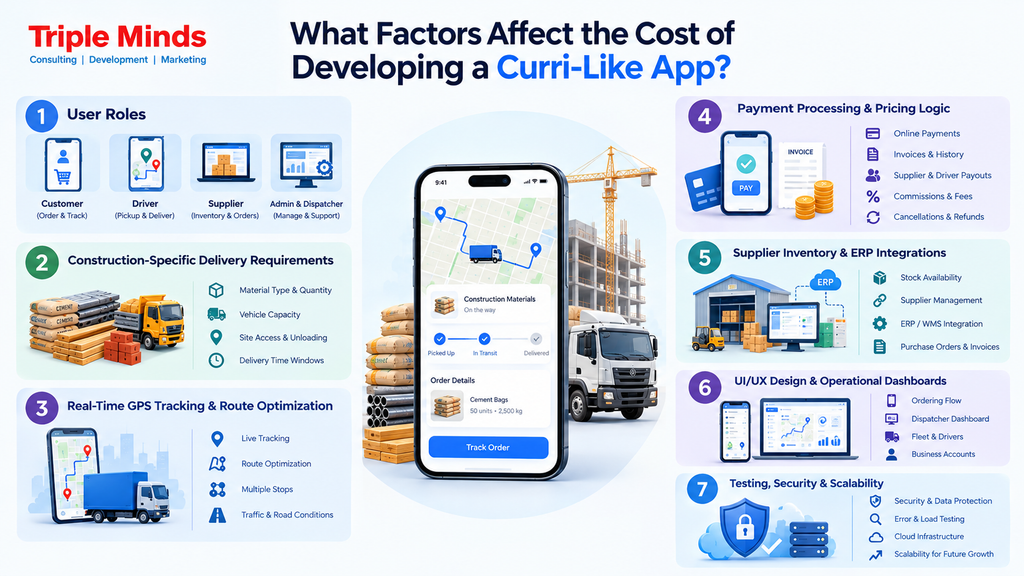
1. Number of User Roles
The construction material delivery software caters to multiple user roles that have their own unique set of responsibilities.
Customer App
Contractors tend to be at the job site rather than their desks. They can order the delivery of the item by a few clicks and even track the delivery process from dispatching the order to its final delivery. They can manage more than one job sites and access any invoice at will without needing to make any phone call.
Driver App
They receive the task assignment right away with clear directions for both pickup and drop-off. Route calculation in the application enables them to reach the destination faster, and once they deliver the item, they take proof of delivery immediately.
Supplier Web App
The supplier uses a browser interface and thus works from either an office at the yard or warehouse. He updates product availability, confirms orders, loads the goods ready for delivery, and makes sure that orders aren’t made for products not available in the inventory.
Admin & Dispatcher Dashboard
This is the control center for operators. They manage bookings, allocate drivers, maintain the price list, and customer accounts. In the event of any problems such as delays by trucks or failed deliveries, they sort them out and have reports on performance.
The more distinct interfaces and workflows you require, the greater will be design, development, testing, and maintenance costs.
2. Construction-Specific Delivery Requirements
Construction materials are not interchangeable packages. A load of drywall has different transportation requirements from a shipment of steel beams, lumber, roofing sheets, or cement bags. Therefore, the app may need to capture:
- Material type, quantity, weight, and dimensions.
- Vehicle capacity and equipment requirements.
- Pickup location and warehouse loading instructions.
- Job-site access restrictions and unloading conditions.
- Delivery time windows and urgency.
- Special handling instructions.
- Multiple pickup points or delivery destinations.
3. Real-Time GPS Tracking and Route Optimization
GPS tracking helps customers and dispatchers see where a delivery is and monitor its progress. Basic tracking can use third-party mapping and location services, but advanced route optimization requires additional logic.
A more sophisticated system may consider:
- Current traffic and road conditions.
- Vehicle dimensions and restrictions.
- Delivery deadlines.
- Multiple stops and pickup locations.
- Driver availability and working schedules.
- Load capacity and unloading time.
The cost depends on whether you need basic location updates, optimized multi-stop routes, automatic reassignment, or a customized routing engine.
A startup may begin with map-based tracking and manual dispatch, then introduce more advanced optimization after it has collected sufficient delivery data.
4. Payment Processing and Pricing Logic
The delivery of construction material can be priced according to the distance, vehicle choice, and urgency needs etc. Therefore, the Curri like construction material app delivery platform may need to support the following:
- Online payments.
- Business invoices and transaction histories.
- Supplier pricing and delivery partner payouts.
- Platform commissions and service fees.
- Cancellation charges and refunds.
- Recurring orders and agreed business rates.
- Purchase orders and consolidated billing.
5. Supplier Inventory and ERP Integrations
A marketplace with multiple suppliers need accurate information about materials, stock availability, pricing, and pickup readiness. That’s why, if your application is not integrated with the right capabilities, you will lose your customers.
Manual confirmation can also work, but not for large orders. It becomes difficult to manage orders. Integrations with enterprise resource planning (ERP), warehouse management, and order management systems can synchronize inventory, purchase orders, invoices, and delivery statuses.
6. UI/UX Design and Operational Dashboards
A good application is the one where customers can easily place an order, and dispatchers need a clear view of active delivers, availability of vehicles, delays status and other activities.
As the number of user journeys, custom map interfaces, dashboard files, business account workflows, and accessibility requirements increases, design complexity also becomes massive.
A consistent design system can help you reduce future development effort when new modules are added.
7. Testing, Security, and Scalability
A delivery platform must handle real-world failures, not just successful bookings. Testing should cover location errors, driver cancellations, failed payments, duplicate orders, delayed deliveries, and interrupted network connections.
Security requirements include role-based access controls, secure authentication, protected business information, and appropriate handling of location data.
The backend should also be designed to support increasing numbers of orders, drivers, suppliers, and simultaneous tracking sessions without compromising reliability.
Development Cost Breakdown by Component
For an advanced platform, the following estimates illustrate how the budget might be distributed across major components.
| Development component | Estimated cost |
| Product discovery and UI/UX design | $4,000–$8,000 |
| Customer mobile application | $7,000–$12,000 |
| Driver mobile application | $6,000–$10,000 |
| Admin and dispatcher dashboard | $7,000–$12,000 |
| Backend, APIs, and database | $8,000–$15,000 |
| Maps, payments, and notifications | $3,000–$7,000 |
| Testing, deployment, and launch | $4,000–$8,000 |
Ongoing Cost After the Launch of Curri like Uber for Construction Material
The initial development investment is only one part of the budget. A live platform also requires infrastructure, maintenance, third-party services, and operational support.
| Expense | Indicative monthly budget |
| Cloud hosting and backend infrastructure | $100–$1,000+ |
| Maps and location services | $100–$1,500+ |
| Maintenance and software updates | $500–$3,000+ |
| SMS, email, and notifications | $50–$500+ |
| Monitoring, backups, and security services | $100–$500+ |
How to Reduce the Cost of Developing a Curri-Like App?
The problem that most businesses face is that they spend money on all aspects of the service right away. This would not work well for you. You should go with a phased approach. It will ensure that you minimize upfront costs and at the same time make your app ready for further scaling in the future.
- Focus on one location: It will prove that there is a demand, drivers available, and deliveries are economically sound in that particular area.
- Think about your core flow: It will make sure that your app has all the necessary booking, pricing, dispatching, tracking, payments, and delivery confirmation features.
- Go with cross-platform development: Technologies such as Flutter or React Native might lower efforts on developing separate codebase for both iOS and Android.
- Use existing services: Make use of already established mapping, payment, authentication, and notification services.
- Solve bottlenecks automatically: Prior to spending money on optimization models, find solutions for simpler dispatch rules.
Think ahead: Your app development company should use a modular approach, so other platforms like suppliers, ERPs, and additional vehicle types can be added in the future.
Hidden Cost of Curri Clone Development
The forthcoming development cost is only one side of the story. The actual development cost begins when your app is launched and start to operate in real-world environment. After product launches, there comes the role of ongoing and hidden costs that contributes to making your application better and compliant.
Cloud Hosting
Your Curri clone must run smoothly under varying user loads. This means that your applications infrastructure should also scale with your business.
- Small scale: $1,000 – $2,000 per year
- Medium scale: $5,000 – $10,000 per year
- Large scale: $10,000 – $30,000 per year
Third-Party API Fees
Most of the third-party app integration, like Google maps and payment gateways, charge per transaction.
- Maps and navigation: $200 – $2,000+ monthly
- Payment gateways: transaction fees 2.9% + $0.30 per payment
- SMS and notification services: $100 – $1,500 monthly
App Store Costs
Listing your app on app store or play store also requires a fees. The platforms will cost you service fees depending on their revenue model. Below we are mentioning the details:
- Apple Developer Program can cost you $99 per annum.
- Google Play Developer Account has a one time registration fee of $25.
- GDPR, CCPA, PCI DSS, and local transport regulations can add $5,000 – $20,000+
Marketing and User Acquisition
Even the best application fails if they are not marketed well. What is the point of having an app that no one knows exists? Therefore you must invest in marketing your application to attract more users. Marketing Companies can cost you anywhere from $1200 to $4000/month or more, depending on your business goals and marketing requirements. Also, this cost can increase if you switch your marketing strategy.
There are many other factors that silently cost you’re after the launch such as- customer support operations, legal, insurance and risk management, ongoing maintenance etc. For more accurate cost estimate, you can also use mobile app development cost calculator.
How Can You Earn from Construction Materials Delivery App?
A construction delivery platform can combine transaction-based revenue with recurring business income.
1. Delivery Commissions
The platform can charge a service commission on completed deliveries.
2. Urgency Fees
Charges can vary according to distance, vehicle category, load requirements, delivery windows, and urgent requests.
3. Supplier Subscriptions
Suppliers can pay recurring fees for access to order management, delivery coordination, inventory integrations, and other operational tools.
4. Enterprise Contracts
Construction companies and distributors may enter negotiated agreements covering recurring deliveries, consolidated billing, dedicated logistics support, and volume-based pricing.
5. Fleet and Logistics Software Fees
The platform can offer dispatch management, route planning, fleet visibility, reporting, and integrations as paid software services.
Comparing Development Cost: Custom v/s White Label Curri-like App Development
| Cost factor | Custom app development | White-label app development |
| Initial investment | $30,000–$150,000+ | $5,000–$40,000+ |
| Time to launch | Approximately 3–9+ months | Approximately 2–8 weeks |
| Design and branding | Designed around your business | Existing interface adapted to your brand |
| Construction-specific features | Built to your requirements | Depends on available modules and customization |
| Third-party integrations | Can be developed for required systems | Limited to supported integrations unless extended |
| Source code ownership | Usually available under agreed contract terms | Depends on the license and provider |
| Ongoing costs | Hosting, maintenance, APIs, and support | Subscription or license fees, hosting, support, and customization |
| Scalability | Architecture can be designed for planned growth | Depends on the platform’s architecture and licensing |
| Best suited for | Businesses developing a differentiated logistics product | Startups validating demand or launching quickly |
Why Choose Triple Minds for Construction Delivery App Development?
Custom mobile app development is smart solution if you want to build an application from scratch. What if we say you do not need to spend $10000 on a custom Curri-like uber for construction material? Sounds good! Along with custom mobile app development, we also provide other low-cost solutions.
You can save up to 70% by trusting Triple Minds and our white label app development solutions. Get a pre-built, error free and fully functional white label Curri like application is customized to meet your brand needs. Want to know more? You can explore ours white label mobile app development solutions.
Ready to Build Your Construction Delivery App Without Overspending?
Turn your construction logistics idea into a scalable digital solution with Triple Minds’ mobile app development services. From custom delivery workflows and real-time tracking to supplier portals and AI-powered logistics, build an app tailored to your business goals and budget.
Get Your App Development Quote
Conclusion
Developing a Curri-like on-demand construction materials delivery app can cost approximately $30,000 for a focused MVP and exceed $150,000 for a sophisticated platform with advanced logistics automation and AI capabilities.
The most practical approach is to launch with reliable booking, dispatch, tracking, and delivery confirmation workflows. Validate the business model in a defined service area, monitor operational performance, and expand the platform as demand grows.
This allows development investment to follow actual business requirements rather than a long list of features built before launching.
Quick Answers to Common Questions
Is a Curri-like app suitable for B2B construction suppliers?
Yes. It can serve building-material distributors, electrical and plumbing suppliers, lumber yards, roofing suppliers, industrial distributors, and construction companies that need reliable job-site deliveries.
What is the biggest cost driver in a construction materials delivery app?
The main cost drivers are the number of applications, backend and dispatch complexity, third-party integrations, and real-time logistics requirements.
Does a Curri-like app need a supplier inventory system?
Not necessarily, it depends on your requirements. An MVP can allow customers to enter material details and pickup locations manually. Inventory integrations become valuable when you need accurate stock availability, automated order preparation, negotiated pricing, and fewer pickup errors.
Can the app support both small deliveries and heavy construction materials?
Yes. The platform can support different vehicle categories, including pickup trucks, cargo vans, box trucks, and flatbeds. It should capture load dimensions, weight, handling requirements, and unloading conditions so orders can be matched with suitable vehicles.
Got a project in mind? Let’s build it together.
We work with founders and product teams across consulting, development, and growth marketing. Tell us what you’re building and we’ll show you how we’d ship it.