How to Make Uber for Construction Materials App like Curri?
Want to build an Uber-like app for construction material deliveries similar to Curri? This guide explains the complete development process, business model, role-based modules, dispatch engine, vehicle matching, technology stack, scalability, and essential features required to build a construction logistics platform. Learn how contractors, suppliers, and drivers can be connected through a single on-demand delivery ecosystem.

Building an Uber-like app for construction materials similar to Curri requires more than replicating an already existing on-demand delivery interface. That is exactly what we do at Triple Minds. We approach building construction material apps like Curri by looking beyond the app interface and focusing on the technology ecosystem that works behind construction logistics.
An Uber-like app for construction material can make a huge change to the ways a contractor, supplier, and delivery provider manage material transportation. Inspired by platforms like Curri, this model streamlines the construction logistics into a single digital ecosystem that allows construction businesses to book deliveries and align the required shipments with suitable vehicles.
This guide explains how to turn the concept into a scalable construction logistics platform, covering its development process, business model, essential features, user workflows, role-based modules, technology stack, benefits, challenges, and scalability options.
Steps to Develop an Uber for Construction Materials App
Building an application like Uber from a separate perspective is not an easy task. You require more than designing an attractive mobile interface. Here is a practical development process.
Step 1: Define Your Business Model
First, analyze your requirements and understand what you are actually building. Define what you want to operate- a driver marketplace, a dedicated fleet, a SaaS logistics platform, or a hybrid model. This will help you choose the right technology, architecture, and revenue model.
Step 2: Identify Your Target Users
Define the initial customer segment; you can target construction contractors, building-material suppliers, manufacturers, distributors, plumbing companies, electrical contractors, or roofing companies. Start with a clearly defined audience group to make product development and market validation easier.
Step 3: Define Delivery Types
Create the delivery logic before development. Before stepping into the development process, create clear logic and define delivery types such as rush delivery, same-day delivery, scheduled delivery, recurring delivery, or a multi-stop delivery.
Step 4: Design the UX/UI
The interface should be convenient and prioritized for speed because users may be ordering materials while managing an active construction project. There, you should keep your booking process simple and follow:
- Enter pickup
- Enter destination
- Add materials
- Select vehicle
- Choose delivery time
- View price
- Confirm
Step 5: Develop the Backend
The backend is where your platform’s core functionality will be layered. It manages the business logic behind user accounts, delivery orders, driver identification, pricing, dispatch, payments, and analytics. A scalable architecture is important because delivery volume can increase significantly as more suppliers and drivers join the network.
Step 6: Integrate Maps and Geolocation
Location technology is fundamental to the application. When building a construction material app like Uber, you need location technology for searching addresses, tracking GPS, calculating distance, planning routes, calculating ETA, geofencing, delivery verification, and much more.
Step 7: Build Dispatch and Matching Logic
This is one of the most technically important parts, as it aligns two requests to match the needs of the user and the availability of the driver. The matching engine can consider driver location, vehicle capacity, cargo requirements, availability, delivery deadline, route, and driver’s eligibility. The goal is not simply to find the nearest driver but to find an eligible driver with the appropriate vehicle and capacity.
Step 8: Integrate Payment Infrastructure
Ensure that your payment system supports customer payments, driver payouts, platform commission, refunds, cancellation fees, invoices, transaction history, and other financial activities. For B2B customers, you may also need account-based billing rather than requiring payment for every individual delivery.
Step 9: Test With Realistic Construction Scenarios
Don’t test your Uber for construction materials like Curri with only simple point-A-to-point-B deliveries. Consider testing it for situations like oversized cargo, multiple stops, wrong material quantity, delays, cancellations, closed job site, heavy traffic, vehicle breakdown, and other unpredictable circumstances. Construction delivery software must be designed around exceptions, not just the ideal workflow.
Ready to Build a Smarter Construction Materials Delivery Platform?
Want to launch an Uber-like construction materials delivery app built for real-world logistics? Triple Minds brings expertise in mobile app development, helping businesses build scalable delivery platforms with the right technology, workflows, and features for their market.
Explore Our Mobile App Development Services
What Features Do You Need to Build an App Like Curri?
Rather than treating the whole application as a single product, an Uber for construction material delivery should be divided into role-based modules.
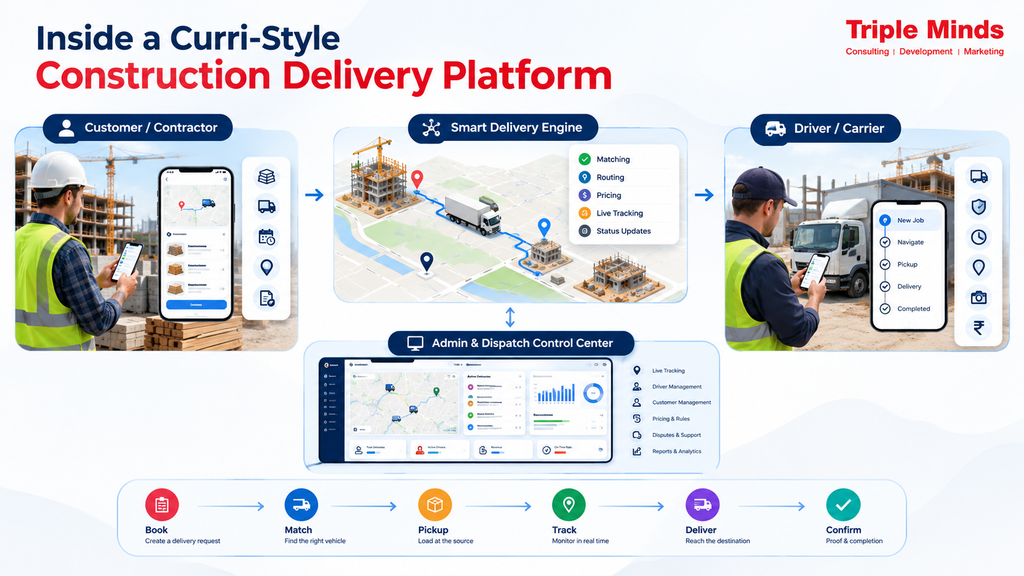
Customer & Contractor App
The customer-facing application should make it easy for contractors and businesses to request, manage, and monitor deliveries.
Registration & Business Profiles
Users can create individual or business accounts and add information such as company name, billing details, contact information, authorized users, and preferred payment methods.
Delivery Booking
Customers can enter the pickup location, destination, material details, preferred delivery time, and other special instructions. You can also consider a construction-specific booking form to capture more information than a standard courier app. Depending on your requirements, users can provide material type, quantity, weight, pickup instructions, additional contact details, and much more.
Vehicle Selection
Instead of simply presenting a list of vehicles, your application can recommend a suitable vehicle based on cargo characteristics.
For example:
- Cargo Van for smaller construction materials and equipment.
- Sprinter Van for larger or taller loads requiring enclosed space.
- Box Truck for palletized or higher-volume shipments.
- Flatbed for long, oversized, or materials requiring open loading.
Delivery Priority
Your app can support different delivery options, such as urgent, same-day, scheduled, recurring, etc. Currently, the Curri application offers Rush, same-day, and scheduled delivery options that illustrate how delivery urgency can be incorporated into the booking models.
Multi-Stop Deliveries
A supplier may need to collect materials from one location and deliver them to multiple job sites. Your platform can allow users or dispatchers to add multiple stops and optimize their sequence based on distance, delivery windows, and vehicle constraints.
Real-Time Tracking
Once a driver accepts the delivery request, customers can track the shipment through an interactive map. The app can have status updates like driver assigned, heading to pickup, arrived, material picked up, almost reached, and delivered successfully.
Digital Proof of Delivery
For a better experience, you can also integrate a feature that allows drivers to capture photographs, signatures, timestamps, location information, and delivery notes after completing the job.
Driver & Carrier App
The driver-side application mimicking Curri needs to do more than show delivery requests. It should help drivers manage their complete delivery lifecycle.
Driver Registration & Verification
Drivers can submit their personal and vehicle information along with required documents such as licenses, registration, insurance, and other applicable certifications so that the admin can review these documents before activating the driver’s account.
Vehicle Management
Drivers or carrier companies can add vehicle details such as category, payload capacity, dimensions, registration information, availability, etc. This information can help foster customer trust
Availability Management
Drivers can switch between available and unavailable statuses, allowing the system to understand which resources can currently accept deliveries.
Delivery Requests
Eligible drivers can receive available jobs based on their location, vehicle, capacity, route, availability, and other rules. You can implement a seamless workflow in which active drivers can receive delivery alerts when the user enters a request.
Navigation
After accepting a job, drivers can navigate to the pickup point through in-app navigation features and reach the pickup and delivery location without any delays.
Pickup Confirmation & Delivery Completion
Drivers can confirm arrival, loading, pickup, and other statuses from the app. At the jobsite, the driver can also capture proof and mark the status as delivery completed.
Earnings Dashboard
You can create a separate dashboard where drivers can view their completed deliveries, earnings, payouts, pending amounts, and transaction history.
Admin & Dispatcher Dashboard
The admin module is the control center of the entire platform, as it can manage customers, suppliers, drivers, vehicles, delivery requests, pricing, payments, disputes, and other reports.
Live Delivery Management
Dispatchers can monitor active deliveries and see driver locations, statuses, ETAs, delays, and exceptions.
Driver Management
Admins can approve drivers, verify documents, assign vehicle categories, suspend accounts, and review driver activity.
Customer Management
The platform can provide access to customer accounts, business profiles, booking history, invoices, payment records, and support requests.
Pricing Configuration
Admins can configure pricing rules based on the distance, vehicle type, cargo, priority, waiting time, etc. If needed, you can also include dynamic pricing later on.
Dispute Management
The admin panel can manage disputes relating to missing materials, damaged goods, incorrect delivery, failed pickup, delays, payment issues, refunds, etc.
Analytics
The dashboard can track delivery volume, revenue, driver utilization, cancellation rates, average delivery time, customer activity, and geographic demand.
What Business Model Can You Use for a Construction Delivery App?
There isn’t one mandatory monetization model for a Curri-like platform. Your revenue strategy can depend on whether you own vehicles, work with independent drivers, serve suppliers, or operate as a technology provider.
Commission-Based Model
The platform charges a percentage or fixed fee from each completed delivery. This model works well for a marketplace connecting customers with independent drivers or carriers.
Delivery Fee Model
In this model, customers pay a delivery charge based on variables such as distance, vehicle type, cargo requirements, urgency, and additional services.
Subscription Model
Frequent business customers can receive monthly or annual plans that provide benefits such as discounted delivery rates, priority booking, analytics, or consolidated billing.
Enterprise Logistics Model
Large suppliers or distributors can receive dedicated delivery management services, customized pricing, recurring routes, fleet management, and integrations with their existing systems.
What Technology Stack Is Needed to build a construction material delivery app like Uber?
An Uber-for-construction-materials app like Curri does not rely on a single technology stack. It is built by leveraging many technologies that work in collaboration to ensure a seamless workflow. The right architecture depends on expected traffic, geography, integrations, development budget, and operational complexity. First, analyze the current features that you need along with future integrations and finalize your tech stack.
Mobile Applications: Flutter or React Native for cross-platform customer and driver apps.
Web Applications: React.js or Next.js for admin, supplier, dispatcher, and business portals.
Backend: Node.js, Python, Java, or another backend framework selected according to project requirements.
Database: PostgreSQL, MySQL, MongoDB, or a combination depending on transactional and operational data requirements.
Real-Time Infrastructure: WebSockets or comparable technologies for location and delivery status updates.
Maps & Location: Mapping APIs for geocoding, distance calculations, routes, navigation, and GPS tracking.
Cloud: AWS, Azure, Google Cloud, or another scalable cloud infrastructure.
Payments: Payment gateway integrations appropriate to the target market.
Notifications: Push notifications, SMS, and email for booking confirmations, driver assignments, delivery updates, and alerts.
Analytics: Business intelligence and analytics infrastructure for operational and financial reporting.
How to Make Your Construction Delivery App Scalable?
Rather than considering scalability after the platform has accumulated, make it a must-have aspect of your Uber app for construction materials. Start by logically separating major services that include: user management, booking management, driver management, dispatch, payments, notifications, location tracking, integration, and much more.
With this modular architecture, the future expansion of your Curri-like application becomes easier and more convenient. For better scalability, if your platform has the future potential of connecting with supplier ERP systems, warehouse software, accounting platforms, and third-party logistics providers, you can consider API-first development. However, you can also consider caching, database optimization, cloud infrastructure, background processing, monitoring, logging, and automated testing.
Benefits of Developing a Construction Material Delivery App
An Uber for construction material app like Curri can help contractors, builders, and suppliers manage their material procurement quickly and effectively. It allows construction businesses to use a construction material delivery app to simplify their construction material delivery process.
Improved Efficiency and Streamlined Operations
A construction material Uber app can help you streamline your operations because it automates the process by eliminating the need to wait for drivers to deliver for long periods. Contractors can directly use this app to hire a fleet and driver to transport their construction materials from one place to another without impacting the quality of work. Real-time tracking helps you prevent delays while reducing manual paperwork and communication.
Better Fleet Utilization & Real-Time Visibility
Businesses can provide their existing fleet with third-party capacity instead of maintaining vehicles that may remain underutilized during slower periods. Moreover, customers, suppliers, and administrators can see real-time delivery progress- no need for random phone calls.
Reduced Manual Coordination & Operational Cost
Automated booking, dispatch, tracking, notifications, and documentation reduce repetitive administrative work. The application will help drivers find optimized delivery routes that will reduce fuel costs and minimize unnecessary trips while improving delivery planning.
Current Challenges in Construction Material Delivery Apps
1. Heavy and Oversized Materials
Construction materials aren’t standardized parcels. A shipment might consist of small fittings, long pipes, pallets of drywall, lumber, steel components, or other bulky cargo. Therefore, vehicle matching must be significantly more sophisticated than standard courier delivery.
2. Job-Site Accessibility
There is a possibility that construction sites may not have a conventional street address. In that case, drivers may need to find an entrance. Therefore, your application should support GPS coordination, delivery instructions, site photos, and other coordinating features.
3. Delivery Windows
Construction activities often operate around tightly planned schedules. A missed delivery window can create operational problems. Your platform therefore needs accurate ETA calculations and exception management.
4. Driver Availability & Material Handling
A marketplace needs qualified drivers and suitable vehicles to fulfill demand. This creates a classic supply-and-demand challenge. Certain construction materials may require special loading, unloading, securing, or handling procedures. The platform must clearly communicate those requirements during booking.
Why Choose Triple Minds to Build a Curri-Like Construction Delivery App?
Once you’ve defined the business model, user roles, delivery workflows, and MVP scope, the next challenge is choosing a development partner capable of bringing all those pieces together. Triple Minds is the best mobile app development agency that can help you build your own construction material app like Curri.
Triple Minds can help structure the project around an MVP-first roadmap, allowing the essential booking and delivery infrastructure to launch first and more advanced capabilities to be introduced as the platform’s operational requirements become clearer.
Want to Estimate Your Construction Material App Cost?
Try the Triple Minds App Development Cost Calculator to get a quick estimate for building an app like yours. Built on hands-on experience from real-world app projects, it goes beyond theoretical calculations to provide a practical starting point for your development budget.
Try the App Cost Calculator Now
Final Thoughts
An Uber for construction materials app like Curri is basically a logistics technology platform. The most important components are the systems operating behind the interface to ensure your application performs every task in a blink. Ready to build your construction material delivery platform?
If you are planning a Curri-like construction delivery marketplace, supplier delivery platform, or on-demand building-material logistics app, Triple Minds can help you turn the concept into a structured product roadmap and development plan. Let’s talk more.
Frequently Asked Questions
How much does it cost to build an Uber for construction materials app like Curri?
The cost depends on the number of user roles, delivery features, real-time tracking, payment integrations, and other features that you want to integrate. Want to know the exact cost? Request a quote.
How long does it take to develop a construction material delivery app?
A white-label Uber app for construction materials like Curri can take a few days or weeks, depending on your customization. Whereas a custom app will take more than 3 months.
How does driver matching work in a construction delivery app?
The system can consider driver location, vehicle type, cargo capacity, availability, delivery deadline, distance, and other eligibility criteria before assigning a delivery.
Can contractors schedule recurring construction material deliveries?
Yes. Recurring delivery functionality can allow businesses to schedule deliveries daily, weekly, or according to a project-specific schedule.
Can I integrate my construction delivery app with ERP or existing business software?
Yes. APIs can connect the platform with ERP, CRM, inventory, order management, accounting, transportation management, and other business systems.
Got a project in mind? Let’s build it together.
We work with founders and product teams across consulting, development, and growth marketing. Tell us what you’re building and we’ll show you how we’d ship it.