Taxi Booking App Revenue Models: How Ride-Hailing Platforms Actually Earn
A taxi booking app can earn from far more than a cut of each ride. This guide explains how ride-hailing platforms make money through ride commissions, driver and passenger subscriptions, booking fees, surge pricing, corporate contracts, premium services and local partnerships. It also covers the asset-light, fleet-based and hybrid business models, and compares commission against subscription so you can choose the right revenue mix for your market.

The idea of launching a taxi booking app may look like a simple platform that connects passengers with drivers, but the revenue generation model is more complex. Every completed taxi ride creates an opportunity to generate revenue. However, new-age taxi booking platforms do not always depend on a single income source.
Today’s ride-hailing apps support multiple revenue generation models such as commissions, subscriptions, booking fees, corporate contracts, advertising, and other services to build a sustainable business. But that doesn’t mean you should integrate every revenue model within your taxi booking platform.
As an entrepreneur planning to launch a taxi booking app, choosing the right revenue model is an important decision. It affects how drivers earn, what passengers pay, how the platform manages transactions, and how much money the business retains after operating expenses. Further, the revenue model needs to suit the target market.
A startup operating in a smaller city may begin with a commission on completed rides. A platform with an established driver network may introduce monthly subscriptions. A business serving hotels, airports, and corporate clients may generate additional income through scheduled transportation contracts.
At Triple Minds, we empower entrepreneurs to turn their ride-hailing business ideas into reality with customized taxi booking app solutions. Whether you’re looking to launch a white-label ride-hailing app or build a fully customized solution from the ground up, our experienced team has the technical expertise to bring your vision to life.
Partner with us to create a feature-rich, scalable app tailored to your business goals and revenue model. Connect with our experts today and take the first step toward launching your taxi booking business!
Taxi Booking App Business Models
A taxi booking app generally operates as a digital marketplace connecting passengers who need transportation with drivers who provide it. The platform manages the booking process, helps match passengers with available drivers, provides fare estimates, enables payments, and supports communication between both parties. The business can operate in different ways depending on who owns the vehicles and how drivers are engaged.
Asset-Light Marketplace Model
In an asset-light model, the platform typically earns by charging a commission on completed trips or collecting a subscription fee from drivers. This model reduces the need to invest in a large vehicle fleet, although the business still needs to spend on technology, marketing, driver acquisition, customer support, and operations.
Fleet-Based Model
In a fleet-based model, the business owns or leases vehicles and manages the drivers operating them. Revenue comes primarily from passenger fares, corporate contracts, airport transfers, and other transportation services. This business model gives more control over vehicle availability, service quality, and pricing. However, it also introduces additional costs, such as vehicle purchases or leases, insurance, maintenance, fuel, permits, and driver salaries.
Hybrid Model
Some taxi businesses combine both approaches. They may operate their own fleet while allowing independent drivers or third-party fleet operators to join the platform. With this, they create multiple revenue generation opportunities. The business can collect fares from its own vehicles, commissions from partner drivers, and fees from corporate transportation services. The right structure depends on the target market, available investment, operating capabilities, and long-term business goals.
Launch Your Taxi Booking App Faster with Triple Minds
Get a head start in the ride-hailing market with Triple Minds’ white-label taxi booking app, equipped with built-in features for passenger bookings, driver management, live tracking, payments, and more. Customize the platform with your branding and business requirements to launch faster without building everything from scratch.
Explore Our Taxi Booking App Solutions
Revenue Generation Models for Taxi Booking Apps
Ride-hailing mobile applications can generate income from several sources. Some are directly connected to ride bookings, while others come from subscriptions, partnerships, and additional services. Check out different revenue models that business owners can consider.
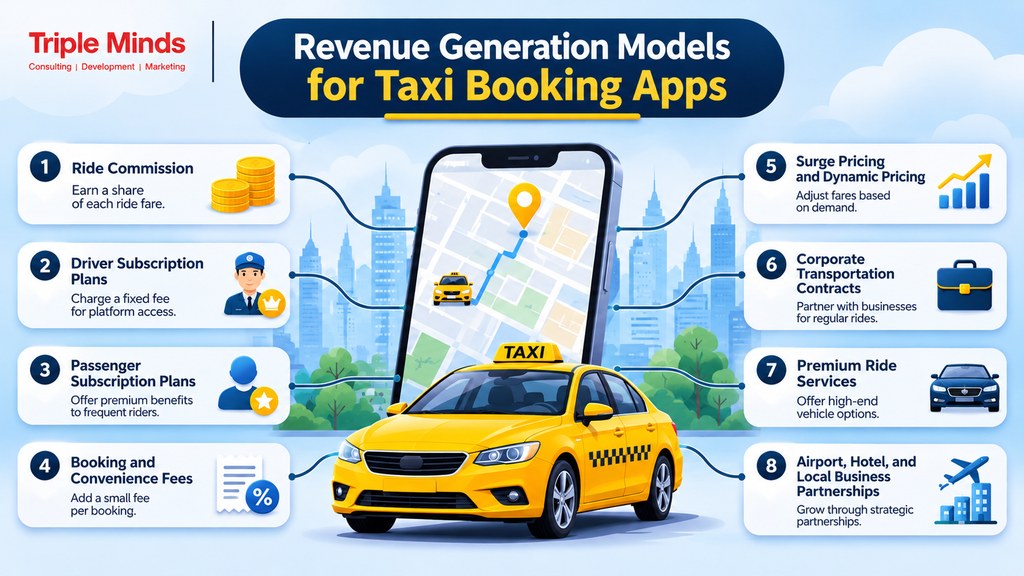
1. Ride Commission
A ride commission is one of the most widely used revenue models in the taxi booking industry. Under this approach, the platform deducts a percentage of the fare from each completed ride and transfers the remaining amount to the driver.
The main advantage of this model is that platform revenue grows with completed ride volume. Drivers do not necessarily need to pay an upfront subscription fee to start accepting bookings.
However, commission rates need to be competitive. If drivers feel that too much of their earnings are being deducted, they may reduce their activity or move to another platform.
Features required to support this model:
- Configurable commission percentages
- Automatic fare calculation
- Driver earnings dashboard
- Digital trip receipts
- Payment and payout management
- Commission reports for administrators
2. Driver Subscription Plans
Instead of taking a percentage from every ride, a taxi booking app can charge drivers a fixed fee to access the platform. Drivers may pay daily, weekly, or monthly subscriptions. Once they purchase a plan, they can accept eligible ride requests without paying a commission on every completed trip. The exact arrangement depends on the platform’s pricing structure.
A subscription model offers more predictable revenue for the platform. It can also appeal to drivers who complete many rides because they know their platform access cost in advance. However, the model may be difficult to introduce when a taxi app is new. Drivers may not want to pay for access before the platform can provide enough bookings.
Features required to support this model:
- Driver subscription packages
- Recurring and one-time payments
- Plan activation and expiry
- Renewal reminders
- Subscription history
- Access controls based on plan status
3. Passenger Subscription Plans
Taxi booking apps can also introduce subscription packages for frequent passengers. Instead of paying for individual benefits each time, users pay a recurring fee to access selected advantages. These subscription plans could include:
- Reduced booking fees
- Discounts on eligible rides
- Priority booking access
- Promotional ride credits
- Special offers for airport transfers
- Benefits from partner businesses
This model works best when the app has regular users who book rides frequently. Occasional passengers may not see enough value in paying a recurring fee.
4. Booking and Convenience Fees
As a ride-hailing platform owner, you can charge passengers a separate booking or convenience fee in addition to the ride fare. This fee may cover platform access, booking management, payment processing, customer support, or other service-related costs. It can be a fixed amount or a percentage of the booking, depending on local rules and the business model.
The platform may retain all or part of this fee, depending on its payment and operating arrangements. Booking fees can create an additional revenue stream without changing the driver’s agreed fare. However, passengers may compare the total price with competing apps, so the fee should be reasonable and transparent. Further, you can display the fee before the passenger confirms the booking. Hidden charges can damage trust and increase booking abandonment.
Features required to support this model:
- Configurable booking fees
- Fee rules based on location or service type
- Fare breakdown before confirmation
- Tax calculation where applicable
- Digital invoices and receipts
5. Surge Pricing and Dynamic Pricing
During office rush hours, heavy rain, public events, holidays, or late-night periods, passengers may request more rides than the available drivers can fulfil. Dynamic pricing allows the platform to adjust fares based on demand and supply conditions. When demand increases in a particular area, the fare may rise to encourage more drivers to become available. Dynamic pricing can help balance supply and demand, but it needs careful implementation. Large or unexpected fare increases can frustrate passengers and create reputational risks.
Features required to support this model:
- Real-time demand monitoring
- Driver availability tracking
- Location-based pricing zones
- Configurable fare multipliers
- Peak-hour pricing rules
- Passenger fare notifications
- Admin controls and pricing reports
6. Corporate Transportation Contracts
Corporate transportation is another potential source of recurring revenue for taxi booking platforms. Companies often need transportation for employees, business visitors, airport transfers, client meetings, and official travel. Instead of asking employees to book individual rides and claim reimbursements, a business can partner with a taxi platform to manage transportation through a centralized account.
The taxi app can offer corporate clients:
- Monthly billing
- Employee ride accounts
- Pre-approved travel limits
- Department-wise expense tracking
- Scheduled rides
- Airport pickup and drop-off
- Centralized invoices
- Business travel reports
7. Premium Ride Services
Not every passenger looks for the lowest possible fare. Some customers are willing to pay more for comfort, convenience, vehicle quality, or specialized transportation. A taxi app can introduce premium service categories to serve these customers. Possible premium ride services categories include:
- Luxury sedans
- Premium SUVs
- Executive transportation
- Chauffeur-driven vehicles
- Business-class airport transfers
- Larger vehicles for families or groups
The platform can charge higher fares for these services. It may earn through a higher commission, a service fee, or the margin between the passenger fare and the amount paid to the driver or fleet partner.
8. Airport, Hotel, and Local Business Partnerships
Taxi platforms can build partnerships with businesses that regularly need transportation services. Hotels, airports, travel agencies, event venues, and tour operators may need reliable transportation for customers and visitors. A taxi app can become a preferred booking partner and earn through referral fees, agreed service charges, or contracted ride arrangements.
Other opportunities include:
- Airport pickup and drop-off services
- Hotel-to-airport transfers
- Tourist transportation packages
- Event transportation
- Travel agency bookings
- Local business ride arrangements
Partnerships can help the app reach passengers beyond its direct marketing channels. They may also create repeat booking opportunities. The business needs clear agreements covering pricing, service availability, cancellations, payment responsibility, and customer support.
Commission vs. Subscription: Which Revenue Model Is Better?
Commission and subscription models are two common ways to monetize a taxi booking platform. Both can work, but they create different financial incentives for the platform and its drivers.
| Factor | Commission model | Subscription model |
| How the platform earns | Percentage of completed ride fares | Fixed driver access fee |
| Driver payment | Deducted from each eligible ride | Paid daily, weekly, or monthly |
| Revenue pattern | Changes with ride volume and fare value | More predictable while subscriptions remain active |
| Driver appeal | Lower upfront commitment | Attractive to drivers with frequent bookings |
| Startup suitability | Often easier to test at launch | Usually stronger after demand is established |
| Main challenge | High commissions may affect driver retention | Drivers may not subscribe if bookings are low |
When Should You Choose a Commission Model?
A commission model can be a practical starting point for a new taxi booking app. Drivers pay the platform only when they complete eligible rides. This reduces the need for an upfront subscription and makes it easier to onboard drivers who are still evaluating the platform.
It also allows the business to earn more as ride activity increases. However, commission rates should be based on local market conditions. A rate that looks attractive in a financial forecast may become difficult to sustain if drivers have high fuel, maintenance, or vehicle financing costs.
When Should You Choose a Subscription Model?
A driver subscription model may be more suitable when the platform has consistent booking demand and an established driver network. Drivers can estimate their platform access costs in advance. Those who complete many rides may find a fixed fee more economical than paying a percentage on every trip.
For the platform, subscriptions can make revenue easier to forecast. However, the business must maintain enough demand to justify the subscription fee. Charging drivers before the app can deliver meaningful booking opportunities may make onboarding difficult.
Worried About the Cost of Developing a Custom Taxi Booking App?
Planning your taxi booking app but unsure about the development budget? Use Triple Minds’ App Development Cost Calculator to estimate the cost of building a custom taxi booking app. The estimates are informed by Triple Minds’ hands-on app development experience, not just theoretical calculations, helping you plan your investment with greater clarity.
Get Your Cost Estimate Now
Conclusion
Building a profitable taxi booking platform requires more than choosing the right revenue model. It takes a clear business strategy, a seamless user experience, and reliable technology that can support your platform as it grows. From commission-based earnings and driver subscriptions to corporate partnerships and premium services, the right revenue mix can help you create a sustainable and scalable ride-hailing business.
At Triple Minds, we help entrepreneurs turn their ride-hailing business ideas into reality with customized taxi booking app development solutions. Whether you want to launch a white-label taxi booking app or build a fully customized platform from scratch, our team has the expertise to develop a solution aligned with your business goals and revenue strategy.
Are you ready to start your taxi booking business? Get in touch with Triple Minds today to discuss your idea, explore the right development approach, and take the first step toward launching your ride-hailing platform.
Answers to Frequently Asked Questions
What is the most common revenue model for taxi booking apps?
Commission on completed rides is one of the most common taxi app revenue models. The platform deducts an agreed percentage from the passenger’s fare and transfers the remaining amount to the driver. Some platforms also use subscriptions, booking fees, and corporate contracts to diversify their income.
How do taxi apps make money without charging drivers commission?
A taxi app can earn without charging a per-ride commission by introducing fixed driver subscriptions. Drivers pay a daily, weekly, or monthly fee to access the platform and accept ride requests. The business can also earn through passenger booking fees, corporate accounts, advertising, and additional transportation services, depending on its operating model and local regulations.
Is a subscription model better than a commission model for a taxi app?
Neither model is automatically better. Commission-based pricing can be easier to introduce when a platform is new because drivers pay in proportion to completed rides. Subscriptions can offer more predictable revenue and may appeal to drivers with consistent booking volumes. The right choice depends on driver demand, ride frequency, local competition, and the platform’s operating costs.
Can a taxi booking app use multiple revenue models?
Yes. A taxi booking platform can combine commissions, driver subscriptions, passenger memberships, booking fees, corporate contracts, and premium services. A hybrid model allows the business to serve different driver and passenger segments. However, each revenue stream should have clear pricing rules, payment workflows, and reporting.
How much commission should a taxi booking app charge?
There is no universal commission rate for every taxi booking app. The rate should consider local taxi fares, driver expenses, competitor pricing, payment costs, incentives, and the platform’s operating requirements. Business owners should test different rates and make sure drivers can earn sustainably after platform deductions.
Does surge pricing increase a taxi app’s profit?
Not necessarily. Surge pricing increases the passenger fare during periods of high demand, but the additional amount may be shared with drivers or allocated according to the platform’s pricing rules. The platform’s actual earnings depend on its commercial arrangement and applicable regulations. Dynamic pricing should also be transparent and should not undermine passenger trust.
Got a project in mind? Let’s build it together.
We work with founders and product teams across consulting, development, and growth marketing. Tell us what you’re building and we’ll show you how we’d ship it.