How Candy.ai Built its AI Girlfriend Technology
Ever wondered how Candy.ai actually works behind the scenes? This guide breaks down the technical architecture of an AI girlfriend platform, including conversational AI, memory systems, personality modeling, RAG, vector databases, voice AI, image generation, moderation, and enterprise infrastructure. Learn how a production-ready AI companion platform is engineered beyond a simple chatbot.

Ever wondered what happens between the moment you hit “send” on an AI girlfriend app? From the user end, the process seems simple – You pick a character, type a message, get a response, switch over to voice. It feels nothing more like a straightforward back-and-forth with an AI character.
But when you look at the backend of this interface, you’ll realize there’s a lot more going on than a chat box talking to a language model. An AI companion platform combines conversational AI, personality modeling, memory, content generation, user profiling, moderation, media processing, payments, and real-time application infrastructure into one coordinated system.
However, there is no exact proprietary architecture revealed publicly behind Candy.ai. But as one of the top AI development companies, we have carefully analyzed how it works. Therefore, this article focuses on the technical architecture and engineering principles that demonstrate how a platform with Candy.ai’s capabilities can be built. Let’s get started.
What is the Role of Natural Language Processing in AI Chatbots?
NLP is the basic foundation for AI girlfriend applications like Candy AI. You know why? Because NLP enables the chatbot to understand what the user is inputting. It analyzes context and generates human-like responses. Key NLP tasks in Candy AI Clone development include:
- Tokenization and parsing to break down sentences into meaningful units that can be processed.
- Intent recognition to understand the purpose behind the query entered by the user.
- Sentiment Analysis to detect emotions and customize responses accordingly.
- Context Management to maintain the conversational flow and avoid repetitive or irrelevant replies.
5 Components Required to Build Candy AI-Like Platforms
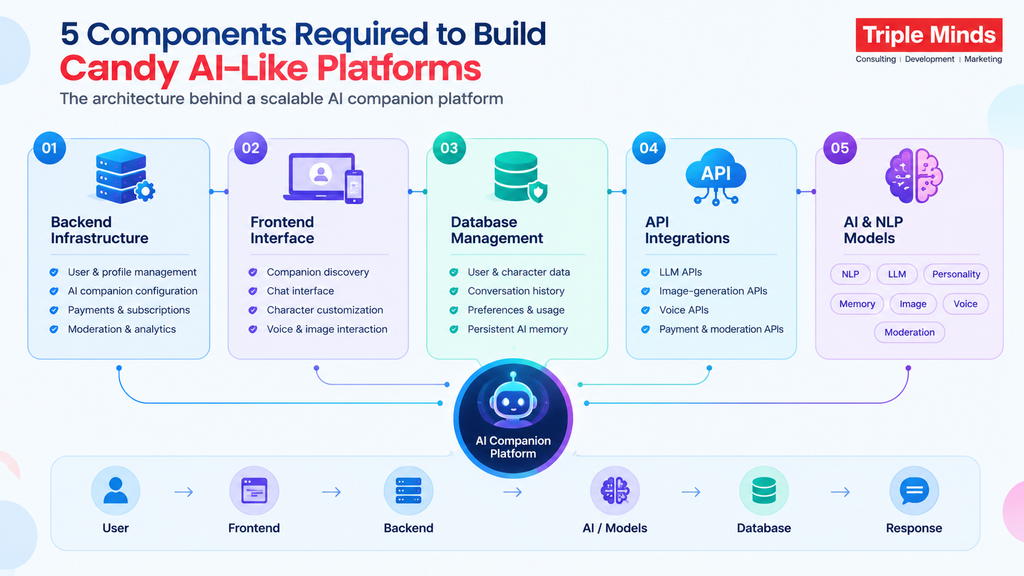
Backend Infrastructure
For any platform, the backend is the engine that powers the entire application. While the frontend helps users interact, the backend handles the complex logic and coordinates different services. In Candy AI, the backend manages the following:
- User registration, authentication, and profiles
- AI companion creation and configuration
- Conversation processing
- Session management
- Image, voice, and other media-generation requests
- Notifications
- Usage limits and credits
- Analytics and admin operations
Frontend Interface
The frontend is the part that users actually see and interact with. AI companion platforms need an interface to initiate conversations and discover characters. Top features such as streaming responses, typing indicators, message status, media previews, and conversation history can make the experience feel more interactive. An intuitive interface includes;
- AI companion discovery
- Character profiles
- Chat interface
- Character customization
- Image-generation interface
- Voice interaction controls
- User dashboard
- Settings and privacy controls
Database Management
Candy AI generates and manages structured and unstructured data; therefore, a database layer is essential for securely storing and retrieving the information. For persistent AI memory, the architecture can also incorporate a vector database or another semantic retrieval system that allows the application to retrieve relevant information from previous conversations based on meaning rather than matching exact words.
- User accounts
- Character profiles
- Subscription information
- Conversation metadata
- User preferences
- Usage records
- Payment-related records
- Platform settings
API Integrations
Integrating API into a Candy AI-like platform makes it possible to combine multiple specialized technologies into one product. So, the application doesn’t need to develop every technology from scratch. APIs allow the application to connect with third-party services, depending the requirements of the final product.
- LLM APIs for conversational responses
- Image-generation APIs for AI-generated visuals
- Speech-to-text APIs for converting voice into text
- Text-to-speech APIs for generating AI voice responses
- Payment APIs for subscriptions and transactions
- Cloud storage APIs for generated media
- Email/SMS APIs for notifications
- Moderation APIs for content safety
- Analytics APIs for tracking user behavior
AI and NLP Models
A Candy AI-like application can use large language models (LLMs) for generating conversational responses, but the AI layer needs more than an LLM. It can include:
Natural Language Processing
NLP helps the system understand user messages, identify intent, analyze context, and determine how the conversation should proceed.
Large Language Models
An LLM generates natural-language responses based on the character’s personality, conversation history, user information, and retrieved memories.
Personality System
Character-specific instructions and attributes help maintain a consistent identity, communication style, and behavioral pattern.
Memory System
Relevant information from previous interactions can be retrieved and supplied to the model when needed.
Image Models
Image-generation models can create visuals based on user prompts and character specifications.
Voice Models
Speech-to-text and text-to-speech models enable voice-based conversations.
Moderation Models
Automated safety systems can evaluate user inputs, AI-generated responses, and generated media against the platform’s policies.
What Makes Candy.ai’s Technology Different from a Normal AI Chatbot?
Talking about a conventional chatbot, it follows a simple path. User input goes to the application, the application calls an LLM, and the LLM’s response comes straight back. But an AI girlfriend platform needs more context and an accurate flow, like: User Input → Identity & Session Layer → Conversation Orchestrator → Context Builder → LLM → Safety Layer → Response Generator → User. Several supporting systems like long-term memory, user profiles, character personality, content moderation, image generation, voice processing, etc. sit around this core.
The Conversational AI Engine
At the center of an AI girlfriend platform is a conversational AI engine. The obvious approach — sending the user’s message straight to an LLM and returning the answer — breaks down quickly. If a user has been talking with the same companion for weeks, the system can’t send the entire conversation history with every request; that increases token consumption, latency, and infrastructure costs. Instead, the application needs to construct a carefully selected context window like:
- User message
- Character identity
- Personality instructions
- Relevant memories
- Recent conversation
- User preferences
- Safety rules → LLM → Generated response
This context-building process is one of the most important pieces of candy.ai’s architecture. Consider a user who says, “I told you last week that I was nervous about my interview.” The model can’t give a convincing reply without access to that earlier detail, so the system needs a way to check whether the new message connects to something already stored.
- New message → Embedding → Similarity Search → Relevant Memories → Context Builder → LLM
- Previous messages or important events get converted into vector embeddings and stored in a vector database.
- New messages are searched against that store for semantically related memories.
- Example: stored memory “User has an important job interview on Friday” connects to current message “I’m getting nervous about tomorrow” even though the wording doesn’t match.
- The relevant memory is inserted into the model’s context, so the companion appears to remember without the full history sitting in every prompt.
Character Personality
One of the biggest differences between a generic chatbot and an AI companion is character consistency. Users aren’t just interacting with an AI model — they’re interacting with a defined character, and that character carries a specific set of attributes that need to be represented as structured data.
- Name, age, personality traits
- Interests and communication style
- Backstory and preferences
- Relationship status and speaking style
- Emotional tendencies and behavioral boundaries
The application transforms this structured data into system instructions or context before calling the LLM, effectively creating a personality layer between the application and the underlying model. This matters because an LLM has no inherent knowledge that it’s supposed to behave like one particular fictional character — the application has to keep supplying those behavioral constraints on every call.
Personality Consistency
Generating one convincing message is relatively easy. Generating thousands of messages that consistently feel like they came from the same character is much harder, and that’s where AI companion engineering gets interesting. If a character is defined as sarcastic, energetic, affectionate, and interested in photography, a single response that suddenly reads as formal or corporate breaks the illusion immediately. To reduce that risk, the system typically needs several layers of personality control working together.
- Character Profile — defines who the companion is
- System Instructions — define how the model should behave.
- Conversation Context — provides immediate interaction history
- Memory — provides persistent information about the user.
- Behavioral Rules — controls specific responses and boundaries
- Output Validation — checks whether a response violates system or safety requirements
Long-Term Memory
Memory is arguably one of the most important technologies behind AI companionship. Without it, every conversation feels like a fresh interaction. But with memory, the system can build real continuity. Remember, “memory” doesn’t mean storing every conversation permanently — a scalable architecture separates memory into distinct categories, each serving a different purpose.
- Short-Term Memory — The immediate conversation that can last several messages, current topic, recent emotional context, and current request.
- Long-Term Memory — Information that is worth preserving across sessions: user preferences, important dates, favorite activities, relationship milestones, frequently discussed topics, character-specific interactions.
- Semantic Memory — It is the information stored and retrieved based on meaning rather than exact wording, typically via a vector database
A typical memory pipeline runs like this:
- Conversation → Memory Extraction → Importance Scoring → Embedding Generation → Vector Database → Future User Message → Semantic Retrieval → Relevant Memories → LLM Context
The important decision is to choose what actually deserves to become a memory. When you store everything, retrieval gets difficult- store too little, and the companion seems to forget the information. Therefore, a memory-ranking system is essential that assigns importance scores before deciding what to retain.
Retrieval-Augmented Generation
Long-term memory can be implemented using principles similar to Retrieval-Augmented Generation (RAG). Instead of asking the LLM to remember everything internally, the system retrieves relevant information from an external knowledge store and provides it context for each request.
For example, if a user asks “Do you remember what movie I wanted to watch?” the system searches the memory store, finds something like “User said they wanted to watch Interstellar this weekend,” and injects that into the prompt so the LLM can build a natural response around it. This is what allows memory to scale beyond the underlying model’s context window.
Conversation Orchestrator
For AI girlfriend platforms, the conversation orchestrator functions as the traffic controller of the system that determines exactly what happens after a user sends a message.
- Receive message
- Authenticate user
- Load character
- Retrieve recent conversation
- Retrieve relevant memories
- Analyze intent
- Apply safety policies
- Construct model context
- Call LLM
- Validate response
- Save conversation
- Update memory
- Return response
This structure is far more impactful than wiring a frontend chat interface directly to an AI API. It also lets developers swap models, add new capabilities, and introduce additional safety checks without redesigning the entire application.
Intent Detection
Every message is identical. Different queries entered by a user, like
“Tell me a joke,” “Generate a picture of you at the beach,” “Can you remember my birthday?” and “Send me a voice message” require different processing. An intent classification layer determines what the user is actually trying to accomplish.
- Casual conversation
- Question answering
- Emotional support
- Image generation
- Voice interaction
- Memory request
- Role-play
- Character customization
- Account request
- Subscription request
Once intent is identified, the orchestrator routes the request to the appropriate service — another reason an AI companion platform is closer to an AI application platform with multiple specialized services than it is to a simple chatbot.
AI Image Generation
Text conversations are only one part of the AI companion experience. AI-generated images bring a realistic feel and an entirely separate technical pipeline into the picture.
User Prompt → Prompt Processor → Character Identity / Visual Profile → Image Model → Safety & Moderation → Image Processing → Storage/CDN → User
The difficult part of an AI companion platform isn’t generating an attractive image — it’s maintaining character consistency. A user’s character might have specific facial characteristics, a hairstyle, body characteristics, clothing preferences, and a visual style. Therefore, a random text-to-image request can easily produce a different-looking person. Developers reduce this risk with techniques such as:
- Reference images
- Character embeddings
- LoRA-style personalization
- Fine-tuned models
- Consistent prompt templates
- Seed management
- Image-to-image generation
- Identity-preserving pipelines
Understanding User’s Character Requirements
The most interesting development challenge shows up when aligning conversational identity with visual identity. The character described in the chatbot should ideally be the same character shown in generated media. That requires a shared character identity model.
- Character Profile
- Personality data
- Prompt configuration
- Visual identity
- Voice identity
- Memory
- Content preferences
This creates a common source of truth for the companion.
Instead of treating chat, images, and voice as separate products, the platform treats them as different interfaces to the same underlying character.
Voice AI – Real-Time Layer
Voice interaction introduces two major technologies working together: Speech-to-Text (STT) and Text-to-Speech (TTS).
User Voice → STT → Conversation Engine → LLM → TTS → Audio Response
Latency becomes critical here. A text response taking two seconds might feel acceptable; a voice interaction with several seconds of silence can feel broken. Therefore, it becomes important to optimize production voice systems:
- Speech recognition latency
- LLM inference time
- Voice synthesis latency
- Network latency
- Audio streaming
- Connection stability
Streaming responses can make the experience feel faster, since audio can start playing before the entire response has finished generating.
Detecting Emotions & Tone
A well-optimized AI companion can analyze the emotional context of a message — “I had a terrible day today” shouldn’t necessarily get the same response strategy as “Guess what happened today! 😄” An emotion or sentiment analysis layer classifies the signals in a message. This helps the AI conversation engine adapt the emotions like:
- Happiness
- Frustration
- Sadness
- Excitement
- Anger
- Anxiety
- Curiosity
However, it doesn’t mean that AI “feels” the emotion. Instead, the system uses language signals to adjust its response behavior, and from the technical pov, that distinction matters the most.
Recommendations AI Engine
Once a platform has multiple AI companions, discovery becomes important — with hundreds or thousands of characters, which one should a user see first? A recommendation engine ranks characters using signals such as:
- Previous interactions
- Character preferences
- Session behavior
- Search activity
- Popularity and engagement
- User retention
- Character categories
- Language
A basic AI system might start with simple rules, but platforms like Candy.ai with more than $25M in annual recurring revenue can use machine-learning ranking models. The key point is that recommendation engines operate separately from conversational intelligence — the LLM generates the conversation, while the recommendation engine determines which characters users are likely to engage with.
Safety and Moderation
Adult platforms like AI companion platforms require strong safety architecture. Relying solely on a language model’s built-in safety mechanisms isn’t enough for a production application. AI girlfriend platform typically layers multiple moderation checks.
- Input Moderation — It analyzes the user’s request before it reaches the model or media-generation system.
- Output Moderation — It analyzes generated responses before they’re displayed.
- Image Moderation — It checks generated images for prohibited content.
- Account-Level Controls — Apply restrictions based on account status, age verification, geography, or platform rules.
- Abuse Detection — Identifies suspicious patterns, automated abuse, or attempts to circumvent safeguards.
Prompt Injection and Jailbreak Resistance
Before exposing an AI application to users, know that there is a high possibility that users will try to manipulate its instructions. That’s why the application shouldn’t rely solely on the model to reject attempts like this.
- Prompt isolation
- System instruction separation
- Input classification
- Policy checks
- Output validation
- Rate limiting
- Abuse detection
- Model-specific safety controls
This matters especially for AI companion platforms, where conversations are highly open-ended and give users far more surface area to attempt manipulation.
Data Architecture
Data architecture is as important as AI models. Therefore, when building a Candy AI clone, analyze whether the underlying architecture is scalable. Rather than depending on a single database, a production system typically needs several distinct types of storage, each serving a specific purpose.
- Relational Database — For users, accounts, subscriptions, characters, permissions, transactions
- Document or NoSQL Storage — For conversation metadata, flexible character configurations, event data
- Vector Database — For long-term memories, semantic retrieval, character knowledge
- Object Storage — For generated images, audio, video, user-uploaded media
- Cache — For sessions, frequently accessed character data, temporary context, rate limiting
Asynchronous Processing
Text responses are typically interactive, but image and video generation can take longer, and processing everything synchronously delivers poor user experiences. A job queue can resolve this problem.
- User requests image
- API accepts request
- Job added to queue
- GPU worker processes generation
- Moderation
- File storage
- Notification
- Image displayed
This lets the application handle many generation requests without blocking the primary API, and workers can scale horizontally as demand increases.
CDN Infrastructure
Generated images, audio, and video can become large files, and serving everything directly from the application server is inefficient. A typical setup instead routes media through dedicated delivery infrastructure.
- AI Generation Service → Object Storage → CDN → User
- The application stores the generated asset in object storage
- A CDN distributes it closer to users geographically
This improves media load times, scalability, and bandwidth management, and it keeps AI generation infrastructure cleanly separated from content delivery infrastructure.
Candy AI Technology vs. Traditional Chatbot Architecture
| Capability | Traditional AI Chatbot | AI Companion Platform |
| Basic LLM chat | ✓ | ✓ |
| Character personality | Limited | Core component |
| Long-term memory | Limited | Essential |
| User personalization | Basic | Advanced |
| Image generation | Optional | Integrated |
| Voice | Optional | Integrated |
| Character identity | Usually absent | Central |
| Recommendation engine | Sometimes | Often important |
| Moderation | Required | Multi-layered |
| Media processing | Limited | Significant |
| Relationship state | No | Important |
| Multimodal orchestration | Limited | Core architecture |
How Much Does It Take to Build This Technology?
The answer depends heavily on how much of the technology is built from scratch.
A basic AI companion can be assembled relatively quickly using existing LLM, image, speech, database, and payment APIs.
A refined platform requires significantly more development around memory, character consistency, AI orchestration, Image generation, infrastructure, etc.
For a detailed breakdown of development budgets and infrastructure considerations, you can go through our Candy AI chatbot development cost guide.
Want to Launch an AI Companion With Features Like Candy AI?
Triple Minds helps businesses launch AI companion platforms with our white-label Candy AI Clone solution. It replicates key Candy AI-like capabilities, including AI conversations, character personalities, memory, image generation, voice interaction, and personalization. The solution also comes with pre-built monetization strategies, compliance architecture, and scalable infrastructure to help you launch faster.
Explore Candy AI Clone 🚀
Build a Candy AI-Like AI Companion With the Right Architecture
Developing an AI girlfriend platform isn’t about plugging an LLM into a chat interface and calling the product finished. A production-ready system needs a carefully designed architecture that connects LLMs, memory, personality, user profiles, voice, infrastructure, real-time API and other technical aspects.
At Triple Minds, we work on AI companion platforms across development, personalization, multimodal AI, monetization, and scalable infrastructure. If you are exploring a similar product, our Candy AI Clone solution provides another starting point for understanding the technology, features, and architecture involved. To know more, get in touch with us.
Frequently Asked Questions about Tech Stack of Candy.ai like Application
Are there any age restrictions for using platforms like Candy AI?
Yes. The platforms like Candy AI include terms of service that explicitly restrict access to users 18 years and older. During account creation, AI companion platforms implement age verification due to adult content.
Does an AI girlfriend app need a vector database?
Vector databases are valuable for semantic memory and retrieval, but it is not necessary. They allow the system to find conceptually related information even when the user’s current wording differs from the original conversation.
What is the biggest technical challenge in building an AI companion?
One of the biggest challenges is maintaining consistency across conversations and modalities. The character should ideally relevant memories, preserve its personality, respond naturally, and remain visually or vocally consistent while the system manages latency, cost, safety, and scale.
Can an AI companion platform use third-party AI APIs?
Yes. An early-stage platform can combine third-party APIs for LLMs, image generation, speech recognition, and text-to-speech. As the product scales, teams may introduce model routing, self-hosted models, or hybrid infrastructure to gain more control over performance and costs.
Is building an AI companion the same as building a chatbot?
No. A chatbot primarily focuses on generating responses. An AI companion requires additional systems for persistent identity, memory, personalization, multimodal interaction, safety, recommendation, and relationship continuity.
Got a project in mind? Let’s build it together.
We work with founders and product teams across consulting, development, and growth marketing. Tell us what you’re building and we’ll show you how we’d ship it.