How to Build a Netflix Clone in 2027: Cost, Technology Stack, and Timeline
Building a streaming platform is not as simple as developing any other mobile app. You need reliable infrastructure, an engaging interface, secure payment processing, and content management. We will discuss all in this blog

Netflix is one of the most loved OTT platform across the world. In 2025, the platform surpassed 325 million paid memberships and achieved approximately $45.2 billion in revenue. These figures highlight the importance of building a Netflix Clone for entrepreneurs, media companies, and startups who want to earn profit through entertainment platforms.
In this guide, we will explain how to build a Netflix clone, what technologies you can use, and how much development may cost.
Netflix Clone App Development Process: Step-by-Step Guide
To develop a Netflix clone, you need a complete ecosystem that connects users, content, payment systems, video processing services, and cloud infrastructure.
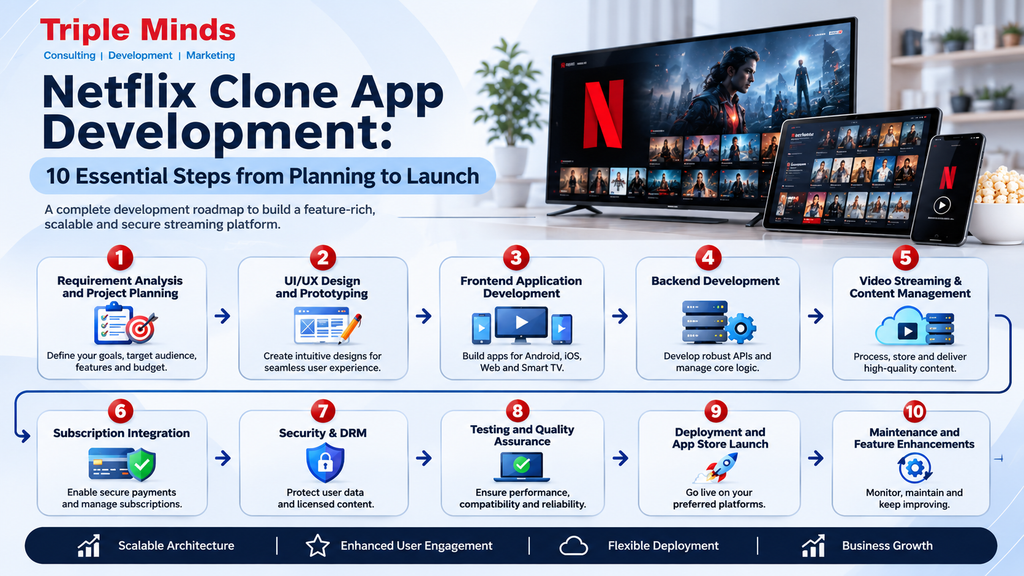
1. Requirement Analysis and Project Planning
Prior to starting with technical processes, you need to specify the goal, target audience, content strategy, and monetization strategies.
But why are these points important?
It is because they influence the technical stack involved in the development of a Netflix clone. During the requirement analysis stage, your app development team will search for the following-
- Target audience and user personas
- Business and monetization models
- Required application platforms
- Essential and advanced features
- Third-party integrations
- Security and scalability requirements
- Estimated development budget and timeline
2. UI/UX Design and Prototyping
Once you have analyzed the requirements, it’s time to move forward. The next stage is to design the interface and user experience of your Netflix-like platform. These platforms are supposed to manage large content libraries. This makes seamless navigation and easy content discovery obvious.
The design team creates wireframes and interactive prototypes to establish how users will interact with the application. The screen design includes the following-
- Splash screen and onboarding
- Login and registration
- User profile selection
- Homepage and content categories
- Movie and series details
- Search and discovery
- Video player
- Watchlist and viewing history
- Subscription and payment screens
3. Frontend Application Development
Frontend development turns the approved designs into a working application. Depending on your project requirements, the frontend may include:
- Android application: Developed using Kotlin or a suitable cross-platform framework.
- iOS application: Developed using Swift or a suitable cross-platform framework.
- Web application: Developed using React.js or Next.js.
- Smart TV application: Developed using platform-compatible technologies for supported TV ecosystems.
4. Backend Development
The backend powers the operations and handles user authentication, profile management, subscription validation, content information, payment requests, and communication between application components. The backend development process generally includes:
- Building RESTful or GraphQL APIs
- Implementing user authentication and authorization
- Creating user and profile management systems
- Developing content catalog services
- Integrating payment gateways
- Managing subscriptions and renewals
- Implementing watch history and progress tracking
- Connecting notification and analytics services
Launch a Netflix-Like OTT Platform Faster with Triple Minds
Enter the streaming market faster with Triple Minds’ Netflix Clone, featuring user profiles, personalized recommendations, content management, multi-device streaming, and secure video playback. Support multiple monetization models, including subscriptions, ads, pay-per-view, and hybrid plans, to build a streaming business around your goals.
Explore Netflix Clone
5. Video Streaming & Content Management
Streaming applications need to deliver large video files at speed. The development team will create a video processing pipeline for this. The process is:
1. Upload video files: An administrator uploads raw video files.
2. Transcode video: Video is transcoded into different resolutions such as 360p, 480p, 720p, 1080p, and different bitrates.
3. Package video: Processed videos are then packaged into HLS or MPEG-DASH streaming formats.
4. Store in the cloud: Raw and processed video files will be stored in the cloud.
5. Deliver via CDN: The content delivery network will host the video segments so they can be delivered from a closer location.
6. Play video: Request the correct video stream in the application and play using a compatible player.
6. Subscription Integration
If your Netflix clone uses a subscription payment model, integrating payments is crucial. The development team will connect your application to a suitable payment provider. Subscriptions can be handled by adding subscription management. Depending on your business model, you can allow the following:
- Monthly/Yearly Subscriptions
- Free/Membership plans
- Advertising subscriptions
- Pay per view
- Subscription upgrades/downgrades
- Auto-renewals
- Payment history/invoices
- Cancel/refund
7. Security & DRM
As your streaming application will have sensitive user data, payments and possibly licensed content, you need to ensure your application is secure. Measures put in place by the development team include:
- Secure login
- HTTPS & TLS encryption
- Role-based access
- API security & rate limiting
- Secure payment
- Session management
- Signed playback URLs/tokens
- Data protection
8. Testing and Quality Assurance
Before launching your Netflix clone, test every major application component.
A streaming application can experience problems that ordinary applications may not encounter, such as playback failures, audio synchronization issues, and buffering under heavy traffic.
The QA team should perform:
| Testing type | What it verifies |
| Functional testing | Registration, login, subscriptions, search, and playback |
| UI/UX testing | Navigation, screen layouts, and usability |
| Performance testing | Application responsiveness and loading times |
| Load testing | Platform behavior under concurrent traffic |
| Streaming testing | Playback quality, buffering, and adaptive bitrate switching |
| Security testing | Authentication, APIs, payment security, and access control |
| Compatibility testing | Performance across supported browsers and devices |
9. Deployment and App Store Launch
After successful testing, the application is prepared for deployment. The backend and associated services are deployed to the selected cloud environment. The deployment process includes:
- Configuring production servers
- Setting up databases and cloud storage
- Configuring CDN delivery
- Enabling monitoring and logging
- Setting up domain names and SSL certificates
- Preparing app store listings
- Submitting Android and iOS applications for review
- Verifying production functionality
10. Maintenance and Feature Enhancements
The development process does not end after launch. Your platform needs regular maintenance to remain secure, reliable, and compatible with evolving devices and operating systems.
The development team should monitor:
- Application crashes and errors
- Video startup time and buffering
- CDN performance
- Active subscribers
- Subscription renewals and cancellations
- Popular content categories
- Payment failures
- User engagement
Why Invest in Netflix Clone Development in 2027?
As the preference for on-demand entertainment platforms increases in the community, business opportunities also expand. But while making a debut in the entertainment industry, you require a clear strategy that goes beyond developing a general-purpose entertainment app. Here are some reasons why entrepreneurs are exploring Netflix-like platforms.
1. Growing Demand for On-Demand Entertainment
Modern viewers want to choose what to watch, when to watch it, and which device to use. OTT platforms like Netflix provide users with the flexibility by making entertainment accessible from any device with an internet connection.
2. Multiple Revenue Opportunities
By creating a Netflix clone, you can generate maximum revenue through monetization models. You are not restricted to monthly subscriptions. Depending on your audience and content type, you can earn money through the following monetization:
- Subscription Video on Demand (SVOD)
- Advertising Video on Demand (AVOD)
- Transactional Video on Demand (TVOD)
- Hybrid monetization models
3. Opportunities in Niche Streaming Markets
For new businesses, it becomes difficult to compete with established platforms. A more practical approach that you can follow is to focus on a specific audience group.
For instance, you could develop a platform dedicated to independent films, regional entertainment, documentaries, and other niche-based programs. A focused content strategy can help your platform establish a unique identity.
4. Expansion Across Multiple Devices
A streaming business does not have to depend on one application.
You can start with a website and mobile applications, then expand to Android TV, Apple TV, Fire TV, and other supported smart TV ecosystems.
This allows viewers to access your content through their preferred devices and gives your business more opportunities to reach subscribers.
Key Features of a Netflix Clone App
A successful Netflix-like streaming platform needs more than video playback. It should make content discovery easy, provide a smooth viewing experience, and give administrators complete control over the platform.
Here are six essential features to consider when developing a Netflix clone.
1. User Authentication and Profiles
User authentication allows viewers to create accounts and securely access the streaming platform. You can offer email registration, phone number verification, social login, and password recovery options.
Multiple user profiles under one account are another important feature. Each profile can maintain its own watchlist, viewing history, language preferences, and personalized recommendations.
You can also introduce parental controls to help parents restrict access to age-inappropriate content.
2. Intuitive User Interface
A clean and easy-to-navigate interface makes content discovery effortless. Your Netflix clone should have a well-organized homepage where users can explore trending movies, recently added shows, popular genres, and personalized content suggestions.
Include features such as:
- Content banners and thumbnails
- Horizontal scrolling carousels
- Easy navigation menus
- Movie and series descriptions
- Watchlist shortcuts
- Continue watching sections
- Responsive video player controls
Pay attention to loading speed and navigation across different screen sizes. A clutter-free interface encourages users to explore more content.
3. Content Management System (CMS)
A content management system allows administrators to manage the platform’s video library without making changes to the application code.
Through the admin dashboard, authorized users should be able to upload videos, add descriptions, manage categories, update thumbnails, and schedule content releases.
Essential CMS capabilities include:
- Video upload and management
- Movie and series categorization
- Content scheduling
- Subtitle and audio track management
- Thumbnail and metadata management
- Content visibility controls
- User and subscription management
- Content performance analytics
A well-built CMS simplifies daily operations, particularly when your streaming library starts expanding.
4. Search and Recommendation Engine
Users should be able to find their favorite content without scrolling through hundreds of titles.
An advanced search system can help viewers discover movies and shows using keywords, genres, actors, languages, and release years.
You can also integrate a recommendation engine that suggests content based on viewing history, watchlists, ratings, and user preferences.
For example, if a subscriber frequently watches thriller movies, the platform can recommend similar titles.
Initially, you can use rule-based recommendations and gradually introduce machine learning models as your platform collects sufficient viewing data.
5. Multilingual and Multi-Currency Support
If you plan to target audiences across different countries, multilingual and multi-currency support can make your platform more accessible.
Multilingual functionality allows viewers to navigate the application in their preferred language. You can also provide multiple audio tracks and subtitles for supported content.
Multi-currency support allows subscribers to view subscription prices in their local currencies, making payment information easier to understand.
Consider supporting:
- Multiple interface languages
- Localized content descriptions
- Subtitles and audio tracks
- Regional date and time formats
- Local currency display
- Region-specific subscription pricing
- Supported local payment methods
Remember that displaying prices in different currencies and actually processing payments in those currencies are separate capabilities.
6. Multiple Device Compatibility
Viewers expect to access entertainment across different devices. Your Netflix clone should support the platforms that your target audience uses.
Depending on your business requirements, you can develop applications for:
- Android smartphones and tablets
- iPhones and iPads
- Web browsers
- Android TV
- Apple TV
- Amazon Fire TV
- Compatible smart TVs
Cross-device synchronization is equally important. Users should be able to pause a movie on their smartphone and continue watching from the same point on their television.
Make sure the video player, navigation, and interface are optimized for each supported device rather than simply replicating the mobile layout everywhere.
Differentiating a Netflix Clone from the Original Platform
A Netflix clone does not necessarily mean that it has to be similar to Netflix. What is more interesting is creating something unique for your potential viewers. There are several aspects you can focus on when trying to develop a Netflix clone that would have some distinctive features.
Some possible ways to make your Netflix different include the following:
Focus on Niche Content: Aim at specific target groups and provide them with local movies, indie films, documentaries, anime, or educational videos.
Provide AI-Based Recommendations: Make use of AI and machine learning algorithms to recommend videos based on user behavior and interests.
Offer Flexible Subscriptions: Provide subscribers with affordable plans, free trials, advertisements support, and other possible options.
Use Local Languages: Offer multi-language support and translations for better adaptation to a broader audience.
Increase Users’ Engagement: Allow watching parties, video sharing, interactive video experience, and community recommendations.
Optimize Streaming Quality: Provide users with adaptive quality control, fast download speed, and offline mode.
Implement Distinctive Features: Think of live streaming, creator profiles, exclusive content, and interactive videos.
How to Choose the Right Development Approach
There are two popular approaches to developing a Netflix-style solution.
1. Custom Development
Custom development is an approach that allows you to transform your raw clone development idea into a fully functional platform. In this way, you will have more control over your app. From unique features to business models, you will be able to build a platform that belong to you.
For businesses who want to grow in the long term, custom Netflix clone development can be a good option.
2. White-Label OTT Solutions
White-label provides an off-the-shelf streaming solution that allows you to brand the application to suit your business identity. Whilst you may save time to launch, there are some considerations to make. This could include: subscription costs, limited features, and reliance on the vendor.
Which is the Best Option?
If you want more control over your product and want to add unique features, then custom development may be the best option. However, if you are looking for something fast to get up and running and are concerned about the initial costs then a white-label solution or carefully considered off the shelf solution could be a good option.
How Does Triple Minds Approach Netflix Clone Development?
Triple Minds is one of the best cross-platform mobile app development companies that focus on building OTT solutions aligning with your business goals. We provide Netflix clone development services to help businesses develop streaming solutions. Our clone development approach can cover the complete product lifecycle, from requirement analysis and UI/UX design to application development, streaming integrations, testing, and deployment.
Planning to build your own Netflix-like streaming platform? Connect with Triple Minds to discuss your requirements and get a development estimate.
Worried About Your Custom OTT App Development Budget?
Get a clearer picture of your investment with Triple Minds’ App Development Cost Calculator. Select your desired features and functionality to estimate the cost of building a custom OTT streaming platform that fits your business requirements.
Get an Estimate Now
Turn Your Streaming Platform Idea into Reality in 2027
Building a Netflix-like streaming platform in 2027 is a compelling opportunity. Turning the idea into a successful product takes the right planning, technology, and investment. That is why Triple Minds exists. For the best outcome, you can partner with a reliable Netflix clone app development company. With the right development team, it becomes less hectic, and everything goes as per the plan.
Frequently Asked Questions About Netflix Clone
Which business model is best for a Netflix-like app?
You can choose from different monetization models, including Subscription Video on Demand (SVOD), Advertising Video on Demand (AVOD), Transactional Video on Demand (TVOD), or a hybrid model. The right choice depends on your target audience and business goals.
Can I use AI in my Netflix clone app?
Absolutely! AI can improve your streaming platform through personalized content recommendations, intelligent search, automated content tagging, viewer behavior analysis, and customer support chatbots.
Do I need content licensing to launch a Netflix-like platform?
Yes, if you plan to stream copyrighted movies, TV shows, or other third-party content, you need the appropriate distribution and streaming rights. Alternatively, you can start with original, public-domain, or properly licensed content.
How much does it cost to build a Netflix clone in 2027?
A Netflix clone development can cost you $13,000 USD or more, depending on features of app, complexity of design and development team. Advanced features like AI-powered recommendations, live streaming, and multi-device support can increase the overall cost.
Got a project in mind? Let’s build it together.
We work with founders and product teams across consulting, development, and growth marketing. Tell us what you’re building and we’ll show you how we’d ship it.