How To Create a Depop Like Clothes Buy & Sell App?
Creating a Depop-like clothes buy-and-sell app involves combining a marketplace where users can list, discover and purchase fashion items. From seller storefronts and product listings to secure payments, messaging and order management, the right features and technology can help turn your idea into a scalable fashion resale business.

The way people buy and sell clothes is changing. Instead of purchasing everything from traditional retail stores, shoppers are turning to resale platforms like Depop. To develop such platform you need to count on a reputable mobile app development company. Developing an app like Depop creates great opportunities for entrepreneurs looking to earn revenue.
A Depop clone app brings growth to market, allowing customers to resell their goods; traders set up their own fashion retail outlets; and consumers purchase goods at good value for money. So, how do you actually develop an app like Depop, and what is needed to effectively grow a business around it?
A Complete Business and Development Guide to a Depop-like App
You will need to define a business model, ascertain your ideal customer base and decide on essential functionality. Furthermore, consideration must be given to the technology which you will use, alongside implementing payment and shipping processes. Finally, strategies must be developed for both sourcing and encouraging traders and customers.
Having decided upon your business model and MVP functionality, you can then begin to build your application. You will need to implement a systematic development process ensuring that business, design and technology, all are streamlined.
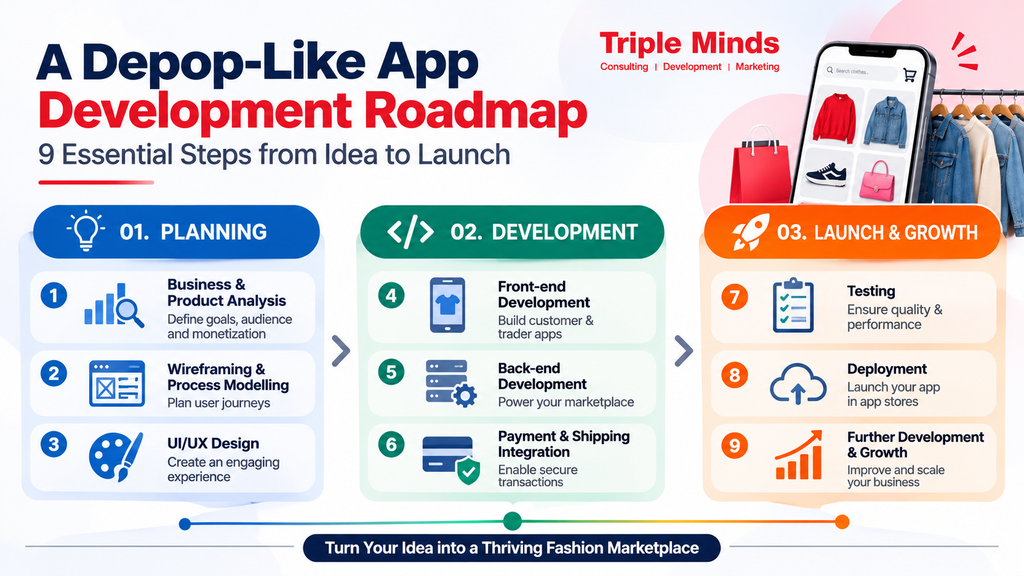
Step 1 – Business and Product Analysis
Initially, you should clearly understand your business goals. Your developer should analyze:
- Customers
- Market place
- Functionality of competing apps
- Monetization strategy
- Technology
- Customer, trader and admin processes
- Integration needs
- Data protection and legal issues
Using this analysis, you can then formulate a Product Requirement Document.
This should outline product functionality along with customer, trader and admin personas together with processes and technology requirements.
It acts as the central guide for your project.
Step 2 – Wireframing and Process Modelling
Wireframes graphically show how a customer interacts with an application. Model the processes undertaken by customers, traders and admins. These might include:
Customers – Browse, inspect, check trader details, add to favorites or buy, and then manage their order.
Traders – Sign up, form retail outlet, add goods, accept orders, dispatch items and then collect monies.
Modelling these processes enables you to streamline and analyze them for any potential issues.
Step 3 – UI/UX Design
Utilizing the wireframes, you can then design a full application.
As a fashion trading app, visual appeal is key. Alongside this, ease of use and an interesting browsing experience should be emphasized.
A cohesive design should be created including aspects such as:
- Fonts
- Color scheme
- Buttons
- Menus
- Product displays
- Entry forms
- Icons
- Alerts
- General UI elements.
Clickable designs should then be produced to present to interested parties.
Step 4 – Front-End Application Building
This refers to the section of an application with which customers and traders engage.
Develop front-end functionality for both customer and trader interfaces for the relevant technology or technologies.
Depending on your needs, this could be in the form of native iOS and Android apps or alternatively cross-platform apps.
Develop a Depop-Like App with Triple Minds
Turn your fashion marketplace idea into reality with Triple Minds’ mobile app development services. From intuitive UI/UX design and custom features to secure payments and scalable backend development, build an app tailored to your business needs.
Explore Mobile App Development Services
Step 5 – Back-end Application Building
An application’s back-end is where its core functioning and data-handling occur.
Within a fashion trading application this must include:
- Login
- Trader profiles
- Product database
- Search and sorting
- Communication
- Order handling
- Payment
- Fees
- Trader monies collection
- Alerts
- Admin functions
The back-end should be flexible so that additional functionality can subsequently be introduced.
Step 6 – Payment and Shipping Integration
Introduce relevant external payment and shipping services.
Payment integration needs to facilitate customer to trader payments, plus the charging of marketplace fees, refund processes and trader monies collection.
- Shipping integration can be used for order tracking, dispatch and delivery management.
- Choice of payment and shipping service will depend on both your geographic area and business needs.
Step 7 – Testing
Prior to deploying your application, it is important to thoroughly test it.
This should involve testing sign-up, product addition, searching, communication, buying, payment errors, refund and shipping status. Furthermore, performance and data protection should be analyzed to detect any factors which may adversely impact either customers or business processes.
Testing should also be performed on a variety of devices and in differing connectivity situations.
Step 8 – Deployment
Set up production resources. Install analytics and monitoring systems. Then upload your mobile applications to relevant app stores.
Typically, it is better to initially deploy an application to a limited extent rather than attempting to reach mass market penetration right away.
Deploy to a small number of traders and customers. Collect feedback and then refine the application in response to real world use.
Step 9 – Further Application Development and Business Growth
Following deployment, ongoing analysis of customer activity, application performance and business data should be undertaken.
As trading escalates, further development may be required in areas such as search efficacy, product suggestion accuracy, trader functionality and anti-fraud measures. In general, application building should continue to develop in tandem with business progression.
Why Should Entrepreneurs Consider Building a Depop-Like Marketplace?
Before you start investing in app development, you must understand the business opportunity behind developing a Depop like cloth sell & buy app. It is the resale model that will create for multiple participants.
- Sellers can generate income from unused clothing
- Buyers gain access to alternative fashion options
- Marketplace owners can earn revenue by facilitating transactions.
Here are some reasons why entrepreneurs may consider entering this segment.
A. Multiple Customer Segments
A clothing resale marketplace can attract different types of users:
- Individuals interested in selling unused clothes.
- Consumers looking for affordable fashion.
- Vintage clothing enthusiasts.
- Independent fashion resellers.
- Thrift stores and boutique owners.
- Sustainable fashion communities.
- Collectors searching for rare fashion items.
B. Opportunities for Niche Positioning
You don’t necessarily need to build a marketplace that competes directly with every existing fashion platform. Instead, you can create a more focused business around a specific category. For example, you can develop:
- A luxury pre-owned fashion marketplace.
- A vintage streetwear buying and selling app.
- A thrift clothing marketplace.
- A children’s clothing resale platform.
- A local community-based clothing exchange platform.
C. Opportunities to Build Recurring Revenue
A Depop-like app can generate revenue through multiple mechanisms like transaction commissions, seller subscriptions, paid product promotions, and value-added services.
As the marketplace grows, you can introduce premium tools for professional sellers and businesses. That means you can develop any revenue strategy that supports your marketplace and niche.
How Does a Depop-Like Marketplace Work?
- A seller registers on the platform.
- The seller creates a shop profile.
- Products are uploaded with images, descriptions, sizes, conditions, and prices.
- Buyers browse the marketplace through search, categories, and personalized feeds.
- Buyers communicate with sellers when additional information is needed.
- The buyer completes the purchase through the integrated payment system.
- The seller receives the order and arranges fulfillment.
- The buyer receives the shipment and can submit feedback.
- The marketplace processes applicable seller payouts and platform fees.
What Makes This Model Different from Traditional eCommerce?
| Traditional eCommerce Store | Peer-to-Peer Fashion Marketplace |
| Usually sells inventory owned by the business | Enables independent sellers to list products |
| Business manages product sourcing | Sellers generally manage their own inventory |
| Revenue primarily comes from product margins | Revenue can come from commissions and seller services |
| Inventory management is a major responsibility | Seller inventory management is distributed |
| Business controls most product listings | Marketplace manages listing standards and moderation |
| Focuses mainly on product transactions | Can combine shopping with social discovery |
What Features Your Depop-Like Clothes Marketplace Should Have?
There are three sides of a Depop like clothes buy or sell app and each panel has its own functionalities that we ave explained below:
A. Buyer-Side Features
User Account Creation
Accounts can be created by users via email, phone number and/or social media account logins.
Product Search
Products can be searched through the app. This can be based on area of clothing, favorite items, previous searches and favored vendors.
Search & Filtering
Users should not have to endlessly scroll through products when searching for something. Filtering capabilities can include type of clothing, brand, size, colour and price. Further, additional ways to sort products can be implemented e.g. most recent, price and popularity.
Product Information
Product pages should provide sufficient information so that customers can make suitable purchasing decisions. Information can encompass visual representations of products, along with details of type, size, state and cost. Further, delivery and vendor information can be supplied.
Wishlist
Similar to Depop, your social commerce app should permit users to create wishlists. Furthermore, in order to improve the service offered, alerts can be sent to users regarding price alterations and fresh products.
Communication Function
Customers can chat to vendors in order to enquire about products. Efficient chat functionality can incorporate immediate response, the ability to send pictures, alerts and access to past conversations. There should also be reporting facilities.
Secure Payment System
Clearly illustrate the costs of goods, delivery, and tax. Apply correct procedures for processing payments, handling refunds and providing updates on payment status.
Order Monitoring
Customers should be able to track their orders. Alerts can be issued regarding order confirmation, dispatch, shipping and delivery.
Product Ratings and Reviews
Customers should be able to rate and review products. Vendor ratings and authentic customer reviews can then be utilized by future customers to determine the trustworthiness of those within the marketplace.
B. Seller-Side Features
For sellers, the platform should make it easy to create listings, manage products, process orders, and monitor earnings.
1. Seller Storefront
Allow sellers to create customized profiles with shop names, photographs, descriptions, and product collections.
2. Product Listing Management
Sellers should be able to upload photographs, write descriptions, select categories, specify clothing sizes, mention product conditions, and set selling prices.
3. Inventory Management
Provide an overview of active, reserved, and sold products. Professional sellers may also benefit from bulk listing and inventory management tools.
4. Order Management
Allow sellers to view incoming orders, confirm transactions, update fulfillment statuses, and access ]shipping information.
5. Sales Analytics
Provide insights into sales volume, revenue, product views, popular listings, and conversion rates. This information can help sellers make better decisions about pricing and inventory.
6. Seller Earnings and Payouts
Give sellers visibility into pending balances, completed payouts, platform commissions, processing fees, and transaction history. Ensure that the payout process follows the selected payment provider’s requirements and applicable regulations.
C. Admin-Side Features
The admin dashboard is the operational control center of the marketplace. It should allow the business owner and authorized team members to manage:
- Buyer and seller accounts.
- Seller verification.
- Product listings.
- Product categories.
- Orders and transactions.
- Platform commissions.
- Seller payouts.
- Refunds and disputes.
- Ratings and reviews.
- Reported content.
- Notifications and announcements.
- Revenue and performance analytics.
As an admin, you should also implement role-based access controls to protect sensitive operational information.
Plan Your MVP Before Investing in Full-Scale Development
Entrepreneurs often make the mistake of trying to build every possible feature in the first version of their Depop like clothes buy & sell app. This increases development cost, extend the launch timeline, and introduce unnecessary complexity.
Therefore, a better approach is to either choose a Depop clone or start with a Minimum Viable Product (MVP).
What Should Your Fashion Marketplace MVP Include?
| Module | Essential MVP Functionality |
| User accounts | Registration, login, profile management |
| Seller module | Storefront and seller profile |
| Product listings | Upload, edit, delete, and manage products |
| Product discovery | Search, categories, and basic filters |
| Buyer module | Wishlist and product details |
| Communication | Basic in-app messaging |
| Payments | Suitable payment integration |
| Order management | Purchase history and order status |
| Notifications | Essential transaction alerts |
| Admin panel | User, listing, and order management |
Advanced features such as AI recommendations, visual search, automated pricing, and sophisticated seller analytics can be introduced later.
Which Technology Stack Should You Choose to Develop Depop Like Clothes Buy & Sell App?
The right stack depends on your product requirements and expected growth. Here is one possible technology combination for a Depop-like marketplace.
| Component | Technology Options | Purpose |
| Android app | Kotlin | Native Android development |
| iOS app | Swift | Native iOS development |
| Cross-platform app | Flutter / React Native | Shared mobile development |
| Web frontend | React.js / Next.js | Marketplace website |
| Backend | Node.js / NestJS / Python | Application business logic |
| Database | PostgreSQL | Structured marketplace data |
| Caching | Redis | Faster data retrieval |
| Search | Elasticsearch / OpenSearch | Product discovery |
| Cloud | AWS / Azure / Google Cloud | Hosting and infrastructure |
| Image storage | Amazon S3 or equivalent | Product image storage |
| Messaging | WebSockets or managed services | Real-time communication |
| Payments | Stripe Connect or regional alternatives | Marketplace transactions |
| Notifications | Firebase Cloud Messaging / APNs | Push notifications |
What Determines the Development Cost of Depop Like Clothes Sell & Buy App?
1. Application Platforms
Building for Android alone will generally involve a different investment from developing Android, iOS, and web applications.
2. Number of Features
Basic product listings and checkout require less development effort than advanced messaging, AI-powered recommendations, real-time analytics, and sophisticated seller management.
3. UI/UX Complexity
Custom designs, animations, interactive interfaces, and extensive prototyping can increase design costs.
4. Backend Architecture
The complexity of user management, inventory, payments, payouts, and transaction processing affects backend development effort.
5. Third-Party Integrations
Payment gateways, logistics providers, identity verification, notifications, and analytics services may introduce integration and recurring service costs.
6. Security and Testing
Payment security, performance testing, vulnerability assessments, and quality assurance should be included in the budget.
7. Maintenance and Infrastructure
After launch, you must account for hosting, storage, monitoring, technical support, updates, and ongoing improvements.
Want to know how much will it cost you to develop an app like Depop? You can use our app cost calculator. Also, if you are curious about how much time will it take to develop Depop like cloth buy & sell app, Triple Minds can build a Depop clone for $12,000 to $15,000 in 20 to 30 days with Triple Minds.
Why Partner with Triple Minds for Depop Clone App Development?
If you’re planning to launch a fashion resale marketplace, selecting the right technology partner is an important business decision. At Triple Minds, we approach app development with an understanding that every business has different objectives, customers, and operational requirements.
- Custom Marketplace App Development
- Android and iOS App Development
- Backend and API Development
- UI/UX Design
- Payment and Third-Party Integrations
- MVP Development
- Ongoing Technical Support
Take Your Fashion Marketplace Further with Triple Minds’ Whatnot Clone
Want to bring live shopping into your fashion marketplace? Triple Minds’ Whatnot Clone comes with live streaming, multi-vendor selling, real-time auctions, in-stream purchases, and secure payments to create an engaging live commerce experience.
Explore Whatnot Clone
Final Thoughts: Turn Your Fashion Marketplace Idea into a Business
Developing a Depop-like clothes buy and sell app can be an interesting opportunity for entrepreneurs who want to start the fashion resale and social commerce market.
However, the success of your platform will depend on more than its technical features. Once the platform is launched, focus on attracting quality sellers, building a relevant product catalog, and earning buyer trust.
Planning to launch your own Depop-like clothes marketplace? Connect with Triple Minds to discuss your business idea and explore development possibilities.
Answers to Frequently Asked Questions
How long does it take to develop an app like Depop?
Development timelines depend on the scope, complexity, platforms and integrations. A basic MVP generally takes less time than a feature-rich marketplace with advanced social and commerce functionality.
How does a Depop-like clothes resale app make money?
A resale marketplace can generate revenue through transaction commissions, seller subscriptions, promoted listings, service fees and premium seller tools.
Can I add social commerce features to a clothes buy-and-sell app?
Yes. Features such as interactive feeds, following sellers, likes, comments, content-led product discovery and sharing can make the shopping experience more engaging and help build a community around your marketplace.
Why should I hire a development company to build a Depop-like app?
A development company can help with business analysis, UI/UX design, app development, backend architecture, integrations, testing, deployment and ongoing maintenance, helping you turn your marketplace concept into a functional product.
Got a project in mind? Let’s build it together.
We work with founders and product teams across consulting, development, and growth marketing. Tell us what you’re building and we’ll show you how we’d ship it.