AI Girlfriend App Development Cost Breakdown: Costs to Build in 2026
Planning to build an AI girlfriend app in 2026? This complete cost breakdown explains how much it costs to develop an AI companion platform, from MVP and white-label solutions to premium and enterprise builds. Learn how features, AI models, voice, image generation, compliance, hosting, and monetization impact your total development budget before you start building.

The AI girlfriend app market is expected to reach USD 11.06 billion by 2032, growing at a CAGR of 20% over the forecast period (2025-2032). And that’s why budding entrepreneurs from around the world are planning to develop their own AI girlfriend app.
And what’s the first thing someone will search if they are thinking about building their own AI girlfriend platform?
Yes, you have guessed it right – how much does it actually cost ot build an AI girlfriend app?
AI girlfriend apps let users create and customize a virtual partner, then interact through text, voice, images, and even video calls. Behind this seemingly simple experience is a complex technology stack involving AI models, real-time communication, personalization, media generation, and a polished UI/UX designed to keep users engaged.
Building all of this requires serious development resources, especially if you want to support thousands of active users without compromising performance. And all of this comes at a cost … but how much?
The honest, unpadded answer:
- A production-ready AI girlfriend app starts around $15,000–$20,000 for a core build with chat, image generation, and subscriptions.
- A differentiated platform with voice calling, avatars, and gamification runs $25,000–$45,000.
- A full first-year budget — development, hosting, compliance, and marketing — typically lands between $35,000 and $55,000+.
But this is just the tip of the iceberg. In this post, we break down AI girlfriend app development cost and exactly where that money goes:
- The feature set that defines the category,
- A stage-by-stage cost table,
- Tech stack decisions that make or break scalability,
- Compliance work most cost estimates conveniently skip,
- Monetization models that determine whether the investment pays back in months or never.
We at Triple Minds have successfully shipped AI girlfriend platforms like Candy AI clone, DreamGF Clone, and many other similar platforms. We have published a Candy AI case study showing exactly how we cut development time in half, and we now ship white-label clones in a guaranteed 21 days. Launch your own white label AI girlfriend app in just $15,000 – get in touch to know more!
Why AI Girlfriend Apps Are Expensive to Get Right
On the surface, an AI girlfriend app looks like “a chatbot with a face.” But in reality it’s way more than just a virtual character. AI girlfriend platform is a multi-model AI product stitched together from several expensive, independently scaling systems:
- A conversational engine that maintains personality and memory across thousands of messages
- Image (and increasingly video) generation for a customized character
- Voice synthesis and, for premium tiers, real-time voice calling
- A subscription and micro-transaction payment system
- Content moderation and age-verification infrastructure that most consumer apps never need
Each of the above-mentioned features of an AI girlfriend app has its own engineering discipline. And that’s what drives the cost of an AI girlfriend app. The cost is the sum of five or six specialized systems working together in real time, which is exactly why estimates that only price out “an AI girlfriend chatbot” tend to be wildly optimistic.
Launch Your AI Girlfriend App with Triple Minds
Launch your AI companion platform with a team that understands development, compliance, monetization, and growth. Triple Minds offers white-label and custom AI girlfriend app solutions, backed by experience across the AI companion ecosystem—including working with Candy AI as a marketing partner—so you get consulting, development, and marketing under one roof.
Schedule a Session With Our Experts
AI Girlfriend App Development Cost at a Glance
As demand for AI girlfriend platforms continues to grow, entrepreneurs have several development options to choose from based on their budget, goals, and desired level of customization. The table below outlines the estimated cost ranges for white-label, standard, premium, and enterprise AI girlfriend platforms, helping you understand the investment required for each approach.
| Build Tier | What’s Included | Timeline | Cost (USD) |
| White-Label | Pre-built core, custom branding, ready to deploy | 2–3 weeks | $9,000 – $12,000 |
| Standard Build | Text chat, image generation, voice notes, subscriptions, real-time voice calls, gamification, custom avatars | 10–12 weeks | $25,000 – $35,000 |
| Premium Build | + 3D/animated avatars, video calling, fine-tuned models | 14–18 weeks | $40,000 – $60,000 |
| Enterprise Platform | Multi-tenant, custom LLM, full global compliance | 5–7 months | $75,000 – $130,000+ |
These ranges hold up across most of the market data and agency pricing currently public for the category. Further, the spread mainly comes down to how much of the stack is custom-built versus assembled from existing AI APIs, and how much compliance work a given target market requires.
Detailed AI Girlfriend Platform Cost Breakdown by Development Stage
Zooming into a standard $25,000–$35,000 build, here’s roughly how the budget is typically allocated stage by stage:
| Development Stage | Cost Range (USD) | What It Covers |
| Discovery & Product Strategy | $1,500 – $2,500 | Competitor teardown, use-case validation, scope lock |
| UI/UX Design | $2,500 – $4,500 | Character builder flow, chat UI, onboarding, mobile + web |
| Conversational AI Engine | $5,500 – $8,000 | LLM integration, personality prompting, memory system |
| Image/Video Generation Module | $4,500 – $6,000 | Generation pipeline, character consistency, gallery |
| Voice Integration | $2,500 – $4,000 | Text-to-speech, voice notes, optional real-time calling |
| Subscription & Payments | $2,000 – $2,500 | Tier logic, token/credits wallet, payment processor wiring |
| Gamification & Retention Features | $2,500 – $4,000 | Streaks, milestones, relationship progression system |
| Compliance & Moderation | $2,500 – $3,500 | Age verification, content filters, audit logging |
| QA & Testing | $1,000 – $2,500 | Functional, load, edge-case, and payment testing |
| Deployment & Launch Support | $1,000 – $1,800 | Infrastructure setup, monitoring, post-launch fixes |
| Total | $25,500 – $39,300 | Production-ready platform, fully branded |
Two line items consistently surprise first-time founders: the image/video generation module and compliance. Text chat is now a commoditized capability thanks to modern LLMs, but generating consistent, on-brand character images at scale- that too, without blowing the GPU budget takes real engineering. Compliance, meanwhile, isn’t optional polish; it’s what keeps the app bankable and off the front page of a regulatory takedown notice.
Where the Money Actually Goes?
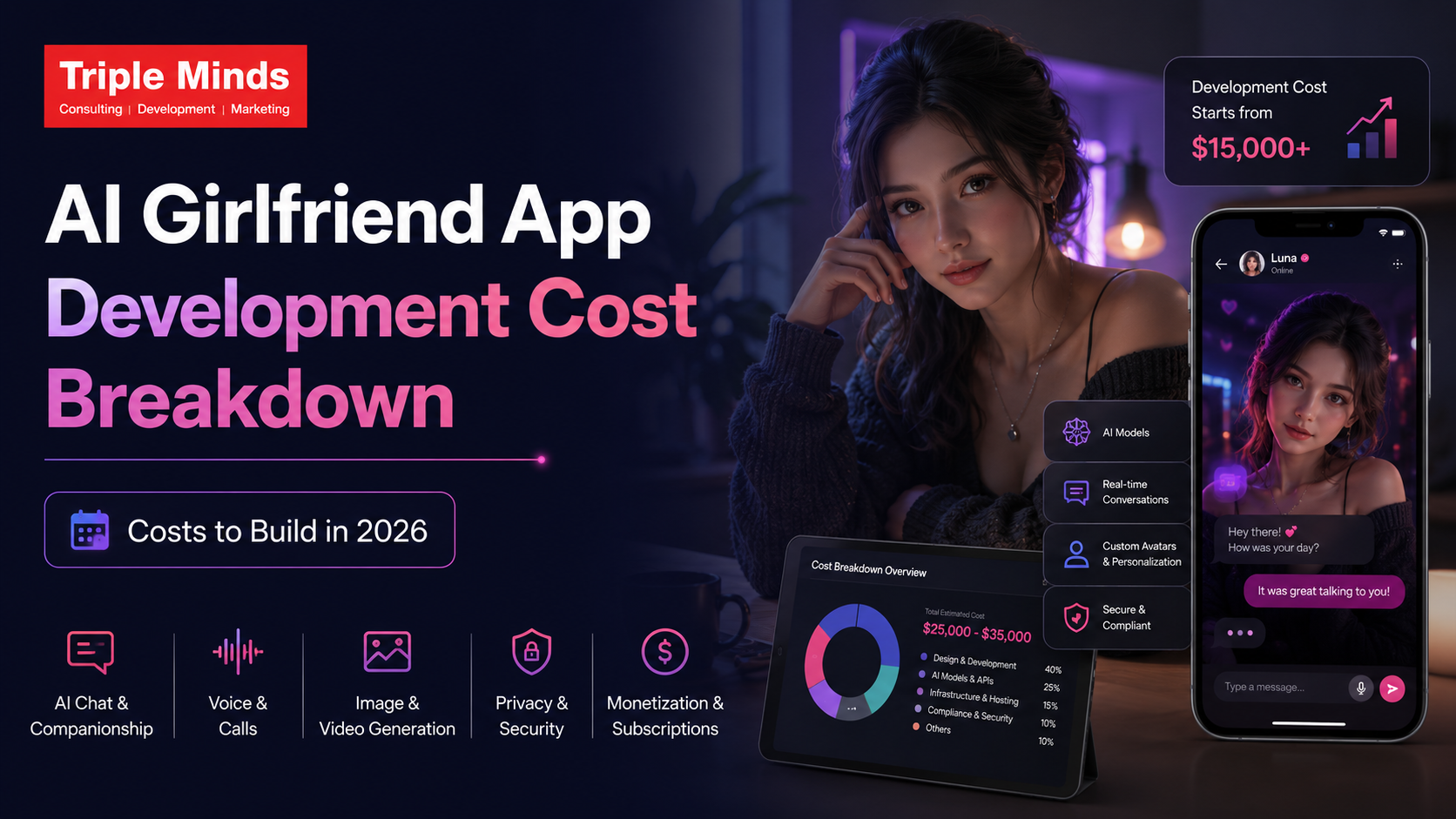
Now let’s break down AI girlfriend app cost based on a typical $25,000 build by percentage of total spend:
- Conversational AI & memory engine — ~25%. This is the product. Personality consistency, long-term memory, and natural conversational flow are what determine whether users come back on day 30.
- Image/video generation — ~18%. Character customization and visual content are the single biggest engagement and upsell driver in the category.
- UI/UX & frontend — ~15%. The character-builder experience alone often gets more design iteration than the rest of the app combined.
- Voice & gamification — ~12%. Increasingly table stakes rather than a differentiator.
- Compliance & moderation — ~12%. Non-negotiable, and consistently underestimated in DIY cost estimates.
- Payments & subscriptions — ~10%. Standard subscription logic plus non-standard payment processor integration.
- QA & deployment — ~8%. Higher than typical consumer apps because of the payment and moderation edge cases involved.
Core AI Girlfriend Platform Features That Define the Cost Floor
Regardless of budget tier, a competitive AI girlfriend app in 2026 needs to ship with a baseline feature set. Anything less and the product will struggle against the established players users are already comparing it to.
- Character customization: Appearance, personality traits, voice, and backstory, set during onboarding and editable later. This is the first-impression feature and directly affects activation rate.
- Persistent memory: The AI should remember names, preferences, and prior conversations across sessions. This is consistently cited as the single biggest driver of retention in the category — users churn fast when the AI “forgets” who they are.
- Multi-modal conversation: Text as the baseline, with voice notes and image generation as expected premium features rather than nice-to-haves.
- Tiered subscriptions plus microtransactions: A free tier to drive acquisition, a mid-tier subscription for expanded features, and a credits or token system for one-off purchases like extra images or voice minutes. Stacking these monetization layers is what gives the category its unusually high ARPU compared to typical consumer subscription apps.
- Mood and tone adaptation: The AI should adjust its responses based on conversational context and user sentiment — this is what separates a “companion” from a static chatbot.
- Cross-platform access: Web and mobile, ideally from a single codebase, so users aren’t locked into one device.
AI Girlfriend App Features That Push the Budget Higher
Once the baseline is covered, these are the features that meaningfully differentiate an AI girlfriend platform and meaningfully raise the price:
- Real-time voice calling. Requires sub-second round-trip latency across speech-to-text, the language model, and text-to-speech, which means streaming architecture rather than simple request/response calls.
- Animated or 3D avatars with lip-sync. Genuinely expensive — real-time rendering and lip-sync pipelines are GPU-intensive and require specialized engineering separate from the core chat stack.
- Fine-tuned or custom-trained personality models. Off-the-shelf models with strong prompting get most platforms 80% of the way there; custom fine-tuning is a real cost multiplier best reserved for platforms with enough usage data to justify it.
- Gamification and relationship progression systems. Streaks, milestones, and unlockable content meaningfully improve retention but require their own reward-economy design and balancing work.
- Multilingual support. Each additional language typically needs its own voice model and translation QA pass, not just a translated UI.
Tech Stack: The Decisions That Determine Whether It Scales
Two platforms with an identical feature list can have wildly different costs and reliability depending on stack choices. Here’s what a production-grade build typically looks like:
| Layer | Common Choices | Why It Matters |
| Language model | Frontier APIs (Claude, GPT) for safe-mode conversation; self-hosted open models for less restricted flows | Balances output quality against cost and content flexibility |
| Image generation | Diffusion-based models (SDXL, Flux) via managed or self-hosted GPU pipelines | Self-hosting lowers per-image cost at scale but requires GPU ops expertise |
| Voice (TTS/STT) | ElevenLabs, Cartesia, Whisper, Deepgram | Latency and voice quality directly affect how “real” the companion feels |
| Memory / vector database | Pinecone, Qdrant, Weaviate, or pgvector | Enables persistent, per-user memory without ballooning the context window |
| Frontend | Next.js, React Native, or Flutter | A shared codebase across web and mobile cuts long-term maintenance cost significantly |
| Backend | Node.js or Python (FastAPI), PostgreSQL, Redis | Proven for high-concurrency chat workloads |
| GPU hosting | RunPod, Lambda Labs, or major cloud GPU instances | Spot/on-demand pricing keeps inference costs predictable |
| Payments | Standard processors for safe-mode content; specialized adult-friendly processors if content skews explicit | Mismatched processor choice is one of the most common reasons launches get shut down mid-flight |
The single biggest scaling mistake founders make is architecting the chat and image-generation pipelines as synchronous, unthrottled calls. Without caching, request queueing, and per-tier rate limits, a handful of heavy users can quietly consume a disproportionate share of the GPU budget — turning a profitable subscriber into a money-losing one.
The Compliance Work Most Estimates Leave Out
This is where AI girlfriend app development diverges sharply from typical consumer app development, and it’s the reason a “just wire up an LLM” estimate is almost always too low.
- Age verification. A growing list of jurisdictions such as UK, EU, and several US states now require robust age-verification flows for platforms with mature or sensitive content, not just a checkbox.
- Content moderation. Every generated message and image needs to pass through a moderation layer, both to enforce platform policy and to prevent the generation of any content involving minors. A zero-tolerance requirement with legal as well as reputational consequences.
- Payment processor approval. Mainstream processors have strict content policies; platforms that skew toward explicit content typically need specialized payment processors built for adult-adjacent businesses, along with a healthy chargeback rate to keep that relationship intact.
- Data privacy. Conversations with an AI companion are often deeply personal. GDPR- and CCPA-aligned data handling, clear retention policies, and user data export/delete tools aren’t optional extras in this category, but they’re baseline trust infrastructure.
- Prompt injection and jailbreak defense. Companion apps are a frequent target for users attempting to bypass content guardrails. Layered safety checks are not a single system-prompt instruction; they are required to hold up under sustained adversarial use.
Budgeting 10–15% of total development cost toward compliance and moderation isn’t a nice-to-have; it’s what keeps the platform operating past its first few months.
Ongoing Costs After Launch
Development cost is only the first bill. Running the platform carries its own recurring costs that scale with usage:
- AI inference (LLM + image + voice APIs): Typically the largest recurring line item, scaling directly with active users and how heavily they use image/voice features.
- Hosting and infrastructure: Servers, CDN, and database hosting, generally modest until the platform reaches meaningful scale.
- Vector database / memory storage: Grows with the number of active users and the depth of memory retained per user.
- Payment processing fees: Often higher than standard e-commerce rates, particularly with specialized processors.
- Content moderation tooling: Either a licensed moderation API or the ongoing engineering cost of maintaining a custom classifier.
- Customer support and community management: Companion apps generate a disproportionate volume of support tickets tied to billing and content preferences, which is easy to underbudget.
Early-stage platforms typically see monthly operating costs in the $1,000–$3,000 range, scaling to $5,000–$10,000+ per month once the user base reaches meaningful five-figure territory.
Factors That Move the Price Up or Down
| Cost Driver | Impact on Budget |
| Real-time voice or video calling | +15% to +30% |
| Custom-trained or fine-tuned models | +20% to +35% |
| 3D or animated avatars | +25% to +40% |
| Native iOS/Android apps vs. single web app | +15% to +25% |
| Multi-language support | +10% to +20% |
| Advanced gamification and progression systems | +8% to +15% |
| Multi-jurisdiction compliance | +10% to +18% |
| White-label, multi-tenant architecture | +25% to +50% |
Regional development costs also shift the total significantly — the same feature set built in North America or Western Europe can run two to four times what it costs through an offshore development partner with proven experience in the category, without a meaningful difference in the finished product’s quality when the team has the right specialization.
Monetization: What Determines Whether the Budget Pays Back
Development cost only matters relative to what the platform earns back, and this category has unusually strong unit economics when the monetization stack is built correctly from day one:
- Tiered subscriptions — the baseline recurring revenue engine, typically structured across free, standard, and premium tiers.
- Credit or token-based microtransactions — users purchase credits for extra messages, images, or voice minutes, layering flexible spend on top of the subscription base.
- Premium content unlocks — one-off purchases for special scenarios, outfits, or interactions.
- Voice/video call minutes — a high-margin add-on once the real-time infrastructure exists, since the underlying cost per minute is a fraction of what it can be charged at retail.
- Referral programs — particularly valuable in this category since mainstream ad networks heavily restrict advertising for companion apps, making organic and referral-driven growth disproportionately important.
Platforms that stack multiple revenue streams rather than relying on subscriptions alone consistently report blended ARPU well above typical consumer subscription products — which is exactly why, despite the higher upfront development cost, well-executed AI girlfriend platforms tend to reach payback faster than most comparable app categories.
Build vs. White-Label: Choosing the Right Starting Point
Founders generally have two paths in:
White-label / pre-built platforms get to market in two to three weeks at the lowest cost, trading some customization flexibility for speed. This is the right call for founders validating demand in a specific niche or market before committing to a fully custom build. At Triple Minds, we have already shipped fully working Candy AI clone, DreamGF clone, and similar AI girlfriend platforms.
Custom development costs more and takes longer but produces a defensible, fully owned product — the right call once there’s confidence in the business model and a clear differentiation strategy beyond “another companion app.”
A common and effective middle path: launch on a white-label foundation to validate the market and start generating revenue, then reinvest that revenue into custom differentiation such as voice calling, avatars, or a fine-tuned personality model, once the core product-market fit is proven.
Want to Launch Your AI Girlfriend App Faster?
Skip months of development and launch with Candy AI Clone — Triple Minds’ most popular white-label AI companion solution. It comes with pre-built AI chat, image generation, subscriptions, monetization flows, and compliance-ready architecture, so you can focus on launching and growing your business instead of building everything from scratch.
Explore Candy AI Clone
The Bottom Line
A competitive AI girlfriend app costs $15,000–$20,000 for a standard build, $25,000–$45,000 for a differentiated platform, and a realistic first-year all-in budget — development, compliance, hosting, and initial marketing — of $35,000–$55,000+. The categories that most often blow past these estimates are image/video generation infrastructure and compliance, both of which are frequently underscoped in early planning.
At Triple Minds, we’ve built and scaled AI companion platforms end-to-end — development, hosting, and the specialized marketing this category requires. We know exactly where founders overspend and where they dangerously underspend. If you’re evaluating what it would cost to build your own AI girlfriend app, talk to our team for a roadmap and quote tailored to your specific feature set and target market.
Quick Answers to Common Questions
How much does it cost to build an AI girlfriend app in 2026?
A production-ready AI girlfriend app typically costs $15,000–$20,000 for a core build, while premium platforms with voice, avatars, and advanced AI features can cost $25,000–$45,000 or more.
What features increase AI girlfriend app development cost the most?
Real-time voice calling, AI image and video generation, persistent memory, 3D avatars, custom AI models, multilingual support, and gamification are among the biggest cost drivers.
Is a white-label AI girlfriend app cheaper than custom development?
Yes. White-label AI girlfriend apps can launch in 2–3 weeks at around $9,000–$12,000, while fully custom platforms require significantly larger budgets and longer development timelines.
What ongoing costs should founders budget after launching an AI girlfriend app?
Founders should budget for AI inference APIs, cloud hosting, GPU infrastructure, vector databases, payment processing, moderation tools, and customer support after launch.
Why do compliance and moderation add significant cost to AI companion apps?
AI companion apps require age verification, content moderation, privacy compliance, payment processor approval, and jailbreak protection, making compliance a core development expense rather than an optional feature.
Got a project in mind? Let’s build it together.
We work with founders and product teams across consulting, development, and growth marketing. Tell us what you’re building and we’ll show you how we’d ship it.