How Much Does It Cost to Develop a Nutrition Planning Application?
Planning to build a nutrition tracking app? This guide explains nutrition app development costs for MVPs, AI-powered meal planning apps, calorie trackers, wearable-integrated platforms, and enterprise nutrition solutions. Learn how features, AI recommendations, food databases, nutritionist panels, security, and third-party integrations affect your overall development budget before building your app.

Health-conscious consumers have turned calorie counting, macro tracking, meal planning, food logging, and fitness monitoring into everyday habits. As more people use smartphones and wearable devices to manage their health, nutrition tracking apps have become an increasingly attractive opportunity for startups, fitness businesses, dietitians, gyms, and health-tech companies.
According to Grand View Research, the global diet and nutrition app market is projected to grow to USD 4.6 billion by 2030, at a CAGR of 13.4% from 2025 to 2030. Making it a lucrative business opportunity for budding entrepreneurs worldwide.
For someone planning to enter this market, the biggest question is often how much it will cost to build a nutrition tracking application in 2026.
And the answer is: there is no fixed development price.
A nutrition planning app can cost anywhere from $10,000 to more than $300,000, depending on its features, platforms, design complexity, integrations, AI capabilities, security requirements, and development team.
For instance, a simple calorie tracker with manual food logging may sit toward the lower end of the range. On the other hand, a sophisticated platform with AI-generated meal plans, wearable integrations, computer vision, personalized recommendations, nutritionist dashboards, analytics, and multiple applications can move well beyond $200,000.
At Triple Minds, we can help you turn your nutrition app concept into a fully functional, scalable product. From developing core features such as food and calorie tracking, personalized meal planning, and progress monitoring to integrating AI, wearables, panels, and third-party health platforms, our team can build a solution tailored to your business goals. Contact our subject matter expert to discuss your idea and explore the right technology, features, and development approach for your product.
This guide explains why the development cost can range from $10,000 to $200,000 or more. If you’re planning to build your own diet tracking app, you’ll get a clear breakdown of the key cost factors, helping you estimate your development budget before approaching an app development company.
Nutrition Tracking Application & Different Panels
A nutrition planning application helps users monitor and improve their dietary habits through digital tools. Depending on the product concept, users may be able to record meals, count calories, track macronutrients, create meal plans, discover recipes, monitor weight, set nutrition goals, and receive personalized recommendations.
More advanced applications can connect nutrition data with activity, sleep, heart rate, and other health information collected through smartphones and wearable devices. A modern nutrition platform may include three primary components:
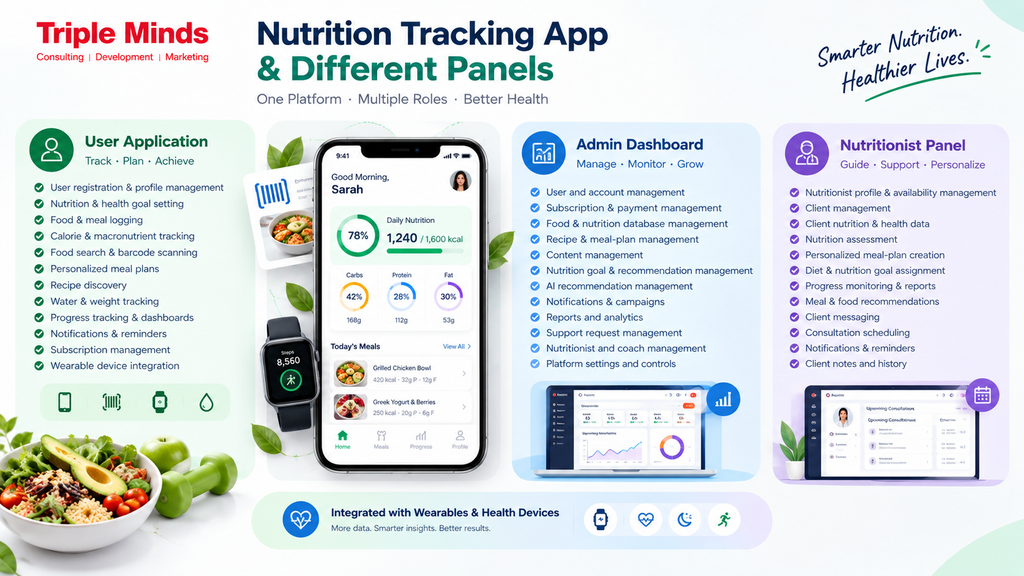
User Application
- User registration and profile management
- Nutrition and health goal setting
- Food and meal logging
- Calorie and macronutrient tracking
- Food search and barcode scanning
- Personalized meal plans
- Recipe discovery
- Water and weight tracking
- Progress tracking and dashboards
- Notifications and reminders
- Subscription management
- Wearable device integration
Admin Dashboard
- User and account management
- Subscription and payment management
- Food and nutrition database management
- Recipe and meal-plan management
- Content management
- Nutrition goal and recommendation management
- AI recommendation management
- Notifications and campaigns
- Reports and analytics
- Support request management
- Nutritionist and coach management
- Platform settings and controls
Nutritionist Panel
- Nutritionist profile and availability management
- Client management
- Client nutrition and health data
- Nutrition assessment
- Personalized meal-plan creation
- Diet and nutrition goal assignment
- Progress monitoring and reports
- Meal and food recommendations
- Client messaging
- Consultation scheduling
- Notifications and reminders
- Client notes and history
Based on how many features you’re planning to add, the overall nutrition app development cost varies.
Cost of Popular Diet and Nutrition Tracking Applications
Looking at established nutrition and fitness applications provides a useful benchmark for understanding the potential cost ceiling of this category.
| App | Estimated Rebuild Cost |
| MyFitnessPal | $17,000–$90,000 |
| Noom | $20,000–$60,000 |
| MyPlate Calorie Counter | $25,000–$120,000 |
| Lifesum | $19,000–$100,000 |
| 8fit | $80,000–$180,000 |
| Peloton | $120,000–$250,000+ |
These are estimated rebuild costs rather than the cost of reproducing every aspect of an established company’s business. The final price depends heavily on how closely the new product attempts to replicate the original.
Nutrition Planning App Development Cost by Complexity
Most nutrition applications can be grouped into three broad complexity levels. Evaluate your business idea and your app complexity to get an estimated app development budget in mind before talking to a freelance developer or development company.
| App Complexity | Estimated Development Cost |
| Simple | $10,000–$91,000 |
| Medium | $55,000–$131,000 |
| Complex | $91,000–$211,000+ |
| Advanced AI-native platform | $250,000–$350,000+ |
Simple Nutrition App
A simple nutrition app generally focuses on core tracking functionality. It may include registration, user profiles, manual food logging, calorie calculations, basic progress tracking, notifications, and an admin panel.
Estimated cost: $10,000–$91,000
The large range reflects differences in design quality, platform count, backend complexity, development location, and customization.
Medium-Complexity Nutrition App
A medium-complexity application may introduce barcode scanning, wearable integrations, subscriptions, social sharing, richer dashboards, secure payments, recipes, and multimedia content.
Estimated cost: $55,000–$131,000
This is often the most practical category for businesses that want a commercially viable product without attempting to replicate every feature of a market leader.
Complex Nutrition App
A complex application can combine AI recommendations, advanced analytics, wearable data, personalized meal plans, coaching, computer vision, real-time data processing, and multiple platforms.
Estimated cost: $91,000–$211,000+
Fully AI-native, multi-platform applications can move toward $250,000–$350,000 or more, particularly when they include sophisticated machine-learning systems and enterprise-level infrastructure.
Key Features of a Nutrition Planning App
The feature set is one of the biggest factors affecting the cost of development.
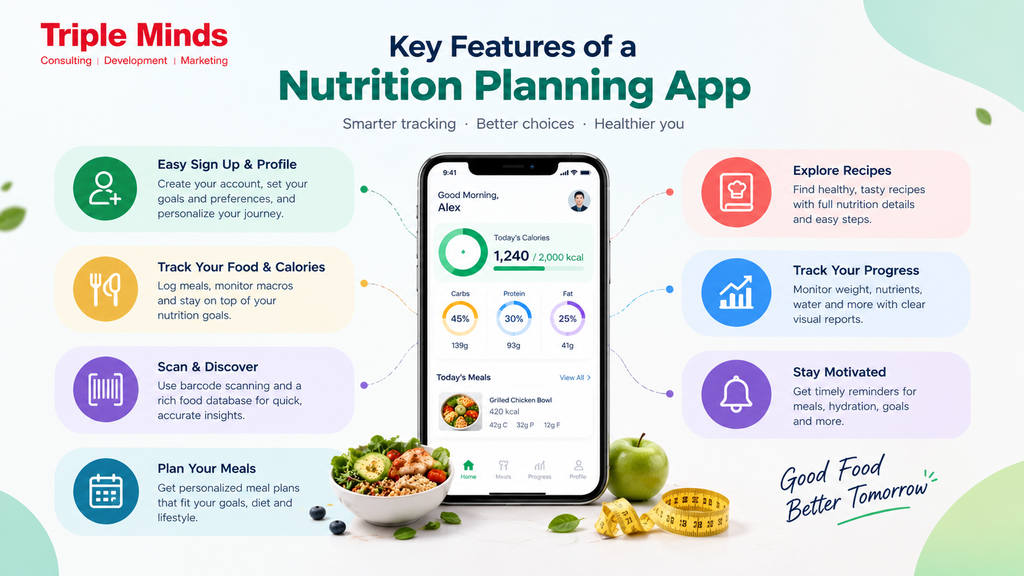
User Registration and Profile
Users should be able to create an account and provide relevant information such as age, weight, activity level, dietary preferences, goals, and other inputs required by the application. Social login, email verification, two-factor authentication, and profile management can be added depending on security and product requirements.
Nutrition and Calorie Tracking
The core functionality of many nutrition applications is food and calorie tracking. Users can search for foods, record portions, and monitor calories and macronutrients throughout the day. More advanced applications can calculate nutritional targets based on the user’s goals and display daily, weekly, or monthly progress.
Food Database
A comprehensive food database is essential for applications centered around nutrition tracking. The database can contain calories, proteins, carbohydrates, fats, serving sizes, ingredients, and other nutritional information. Businesses can integrate third-party databases rather than creating everything from scratch.
Barcode Scanner
Barcode scanning allows users to quickly identify packaged foods rather than manually searching for them. The feature requires camera functionality, barcode recognition, database matching, and appropriate error handling when products cannot be identified.
Meal Planning
Meal planning allows users to organize breakfast, lunch, dinner, and snacks according to their nutritional goals. A basic implementation may allow users to select meals manually. A more advanced version can automatically generate plans based on calorie targets, dietary preferences, allergies, available ingredients, and nutritional requirements.
Recipe Management
Recipe functionality can make a nutrition application more engaging by allowing users to discover meals based on their goals. Recipes can include ingredients, nutritional information, preparation instructions, serving sizes, and calorie breakdowns.
Progress Tracking
Users can monitor weight, calorie intake, macros, water consumption, exercise, and other relevant metrics through dashboards and visual reports. Advanced analytics can identify trends and provide users with actionable insights.
Push Notifications
Notifications can remind users to log meals, drink water, follow their meal plans, complete goals, or check their progress. Personalized notifications can be particularly useful for improving engagement and retention.
Key Factors That Directly Impact The Overall Nutrition App Development Cost
1. Feature List
The feature list is the single biggest cost lever. A basic application with registration, manual food logging, a calendar, and an admin panel may cost approximately $4,000–$50,000.
Standard-plus features such as barcode scanning, push notifications, social sharing, and wearable synchronization can bring the budget to around $50,000–$120,000. Advanced features including AI diet suggestions, live coaching, predictive analytics, and AR/VR can push development toward $120,000–$300,000+.
2. UI/UX Design
Nutrition applications are used frequently, so the interface needs to make logging and tracking as simple as possible.
A template-based design can cost around $5,000–$10,000, while a fully custom interface with bespoke illustrations, animations, and motion design can reach $10,000–$30,000 or more.
UX decisions also affect retention. If users have to navigate through several screens just to log a meal, they may stop using the application.
3. Backend Development
The backend manages authentication, user profiles, nutrition records, meal plans, subscriptions, analytics, notifications, and integrations. Basic backend development involving databases, authentication, APIs, and a limited number of integrations may cost $10,000–$30,000.
Advanced backend systems involving multiple integrations, scalable cloud infrastructure, extensive health-data handling, and stronger security requirements can cost $30,000–$70,000+.
4. Third-Party APIs and Data
Nutrition applications often depend on external services rather than building every capability internally.
Typical costs can include:
- Nutritionix: approximately $50–$500/month depending on usage
- USDA FoodData Central and Open Food Facts: free to integrate, with data-seeding and implementation work required
- Wearable data aggregators such as Terra: around $299/month at a startup tier
- Other API and third-party subscriptions: approximately $1,000–$5,000+/year
The exact costs depend on usage, commercial licensing, API limits, and the provider selected.
5. Development Team Location
Development rates differ substantially by region.
| Region | Typical Hourly Rate |
| USA & Canada | $80–$150/hr |
| Western Europe | $60–$130/hr |
| Eastern Europe | $40–$80/hr |
| India & South Asia | $25–$50/hr |
Outsourcing to lower-cost regions can reduce the overall development budget considerably, although project management, communication, technical quality, and delivery experience should also be evaluated when selecting a development partner.
iOS, Android, or Cross-Platform: Which Costs More?
Platform strategy directly affects the initial budget.
| Platform Strategy | Estimated Cost |
| Single platform | $20,000–$50,000 |
| Native iOS + Android | $40,000–$120,000 |
| Cross-platform | $30,000–$100,000 |
Launching separately on iOS and Android generally requires additional development and testing resources. Cross-platform frameworks such as React Native and Flutter can reduce development effort because much of the application logic and interface can be shared.
For an MVP, launching on a single platform or using cross-platform development can help control costs. Businesses can then expand after validating demand. An exception may be applications that rely heavily on computer vision or platform-specific machine-learning capabilities. In such cases, a native approach can provide advantages depending on the technical requirements.
How Much Does AI Nutrition App Development Cost?
AI is becoming one of the biggest differentiators in nutrition applications. Instead of simply recording what users eat, AI can analyze user information and provide personalized recommendations. Potential AI functionality includes:
- Personalized meal recommendations
- AI-generated meal plans
- Nutrition coaching
- Food recognition from images
- Personalized calorie targets
- Adaptive recommendations
- Voice-based coaching
- Predictive analytics
- Lifestyle recommendations
Estimated costs for individual AI features include:
| AI Feature | Development Cost | Monthly Cost |
| AI nutrition recommendations | $12,000–$30,000 | $300–$800 |
| Personalization engine | $15,000–$40,000 | $200–$1,200 |
| Computer-vision recognition | $20,000–$50,000 | Minimal if on-device |
| Voice coaching | $10,000–$20,000 | $500–$2,000 |
| Full AI stack | $67,000–$165,000 | $1,000–$5,000/month |
An AI-enabled nutrition application with personalization, adaptive meal planning, and analytics can typically fall within the $60,000–$150,000 range, compared with approximately $30,000–$60,000 for a basic non-AI calorie tracker covering the same core use case.
Cloud AI costs also need to be considered. Applications with frequent AI interactions can generate significant inference expenses. One practical strategy is to use on-device models for frequent, lower-risk tasks while reserving cloud-based AI for more complex recommendations.
Nutritionist and Coach Features
Businesses targeting professional nutrition services can add a dedicated coach or nutritionist panel.
The panel can allow professionals to:
- View assigned clients
- Review nutrition history
- Create meal plans
- Set nutrition goals
- Monitor progress
- Send messages
- Share recommendations
- Schedule consultations
- Review reports
Live chat and telehealth-style functionality can further expand the platform. A coach dashboard and associated functionality may form part of a $10,000–$35,000 feature set depending on scope.
This model can also support B2B use cases for gyms, clinics, wellness providers, and independent dietitians.
Security and Compliance Considerations
Nutrition applications can handle sensitive personal and health-related information. Security should therefore be considered from the beginning rather than added after development. Depending on the target market and functionality, requirements may include:
- Secure authentication
- Data encryption
- Role-based access
- Secure API communication
- Audit logs
- Data retention controls
- Privacy management
- GDPR-related requirements
- HIPAA-related requirements where applicable
Compliance-related development can add approximately $5,000–$15,000, while ongoing audits and related expenses may range from $2,000–$10,000 per year.
The exact compliance obligations depend on the application, business model, geographic market, data being processed, and relationships with healthcare providers.
Nutrition App Development Cost by Development Stage
A practical budget can be divided across the development lifecycle.
| Development Stage | Approximate Share |
| Research & MVP validation | 10–15% |
| UI/UX design | 15–20% |
| Frontend & backend development | 35–45% |
| Integrations & QA testing | 15–20% |
| Deployment & launch | 5–10% |
| Ongoing maintenance | 15–25% annually |
Research helps define the target audience, core problem, competitors, business model, and MVP scope before development begins.
Design then establishes the user journey and interface. Development represents the largest portion because it includes the frontend, backend, database, APIs, business logic, and core functionality.
Testing is particularly important for nutrition applications because incorrect calculations, broken integrations, inaccurate data mapping, or synchronization issues can directly affect the user experience.
Custom vs. White-Label Nutrition Planning App Development Cost
Businesses planning to enter the nutrition app market generally have two development options: custom nutrition app development or a white-label nutrition app. The right approach depends on your budget, launch timeline, desired level of customization, and long-term product strategy.
Custom Nutrition Planning App
A custom nutrition planning app is built from the ground up according to your business requirements. You have complete control over the application’s design, features, technology stack, integrations, and user experience.
Custom development is ideal if you want to offer unique functionality such as AI-generated meal plans, personalized nutrition recommendations, food recognition, wearable synchronization, advanced analytics, nutritionist dashboards, or proprietary algorithms.
The cost can typically range from $50,000 to $300,000+, depending on the complexity and number of features.
White-Label Nutrition Planning App
A white-label nutrition app is based on an existing, pre-built platform that can be customized with your brand identity and selected functionality. Instead of developing the entire application from scratch, businesses can launch using an established technical foundation.
White-label solutions are generally more affordable and faster to launch, making them suitable for startups, gyms, fitness businesses, nutrition coaches, and wellness brands that want to test the market.
Depending on the platform and customization requirements, costs can typically start around $9,000 and go up to $30,000+.
Key advantages include:
- Lower initial development cost
- Faster time to market
- Pre-built nutrition and tracking features
- Reduced development effort
- Easier MVP validation
- Branding and feature customization
Hidden Costs of Developing a Nutrition App
The initial development quotation does not necessarily represent the total first-year investment. Several additional expenses should be included in the budget.
App Store and Platform Fees
Businesses selling subscriptions or digital services through mobile stores may incur platform fees. Developer accounts also carry registration costs.
Cloud Infrastructure
A small application may operate on approximately $50–$200/month in infrastructure costs at lower usage levels, while applications serving tens or hundreds of thousands of users can require significantly larger infrastructure budgets.
Video and CDN Costs
Applications that provide workout or nutrition videos need to account for video storage, processing, and content delivery. Video delivery can cost approximately $0.01–$0.05 per minute, depending on the infrastructure and provider.
API Usage
Third-party APIs may initially appear inexpensive but can become a major operational cost as user activity increases.
Scope Creep
Changing requirements during development can significantly increase costs. Scope changes can commonly add 20–40% to an original budget. The best way to reduce this risk is to finalize the MVP scope, feature priorities, technical requirements, and acceptance criteria before development begins.
How Can You Reduce Nutrition App Development Costs?
Building every possible feature from the beginning is rarely necessary. A more practical approach is to develop an MVP containing the features that directly support the core business proposition. For example, a first release might include:
- Registration
- User profile
- Nutrition goals
- Food database
- Manual food logging
- Calorie and macro tracking
- Meal planning
- Progress dashboard
- Notifications
- Basic admin panel
Once users begin interacting with the product, additional features can be introduced based on actual usage. AI coaching, computer vision, wearable integrations, social functionality, nutritionist dashboards, and advanced analytics can then be added in later phases. This approach helps businesses validate product-market fit before committing to a large technology investment.
Ready to Launch a Nutrition Planning App That Users Actually Stick With?
Whether you’re building a calorie tracker, AI meal planner, wellness platform, or dietitian marketplace, Triple Minds helps startups and healthcare businesses launch scalable nutrition applications faster. From AI-powered recommendations and wearable integrations to subscription models and nutritionist dashboards, we build solutions designed for engagement, personalization, and long-term growth.
Contact with Expert Right Now
Bottom Line: Cost to Develop a Nutrition Tracking App
The cost of developing a nutrition tracking app depends on its features, platforms, integrations, AI capabilities, design, and scalability. A simple tracking app can cost significantly less than an AI-powered platform with personalized meal plans, wearable integration, and advanced analytics.
For startups, launching with a focused MVP is often the most practical approach. Core features such as food logging, meal planning, calorie tracking, and progress monitoring can be introduced first, with AI, wearables, coaching, and advanced analytics added as the product grows.
At Triple Minds, we help businesses build nutrition and fitness applications tailored to their goals, from MVPs and white-label solutions to fully customized, AI-powered platforms. Our team can help you select the right features and technology stack while keeping development costs aligned with your business objectives.
Ready to build your nutrition tracking app? Get in touch with Triple Minds to discuss your idea and development requirements.
Quick Answers to Common Questions
How much does it cost to develop a nutrition tracking app?
A nutrition tracking app can cost anywhere from $10,000 to $300,000+, depending on features, AI capabilities, wearable integrations, platforms, security, and overall product complexity.
What features increase nutrition app development cost the most?
AI meal planning, barcode scanning, wearable integrations, nutritionist dashboards, computer vision food recognition, personalized recommendations, and advanced analytics are among the biggest cost drivers.
How much does an AI-powered nutrition app cost compared to a basic calorie tracker?
A basic calorie tracker typically costs $30,000–$60,000, while an AI-powered nutrition app with personalization, meal planning, and analytics can range from $60,000–$150,000+.
Is it cheaper to build a nutrition app with a white-label solution?
Yes. A white-label nutrition app generally starts around $9,000–$30,000+ and provides a faster, lower-cost alternative to building a custom nutrition platform from scratch.
What are the hidden costs of launching a nutrition tracking app?
Hidden costs include cloud infrastructure, third-party API usage, app store fees, video hosting, ongoing maintenance, security compliance, and future feature enhancements.
Got a project in mind? Let’s build it together.
We work with founders and product teams across consulting, development, and growth marketing. Tell us what you’re building and we’ll show you how we’d ship it.