Travel Budget App Development Cost: A Complete Cost Breakdown Guide
Planning to build a travel budget app? This guide breaks down the complete travel budget app development cost, from MVP to enterprise-level platforms with AI, OCR receipt scanning, multi-currency support, and group expense management. Learn which features increase development costs, hidden infrastructure expenses, monetization options, and whether a white-label or custom travel budget app is the right choice for your business.

To develop a travel budget app, you can expect to spend anywhere from $15,000 to $90,000. However, if you need an advanced platform with AI, real-time currency data, receipt of scanning, group expense management, financial analytics, and multiple integrations, this cost can exceed $100,000. The development cost depends on the core functionality of the app, and you can calculate the estimate through the app development cost calculator.
Travelers want more than bookings and itineraries. They want to control over every dollar they spend. That’s what makes a travel budget application a prominent tool to invest in. From setting up a trip budget, track expenses, to categorize spending, a travel budget app takes everything into consideration. It sits at the intersection of personal finance and travel tech, and as more people prioritize financial awareness while they travel, the demand for travel budget apps continues to increase.
But, before you make a decision to develop a travel budget app, you have all the right to know what it’s true development cost is. At Triple Minds, we provide the most reliable consultancy services to help entrepreneurs find a revenue generating solution. If you are looking for an expert trip budget development solution, you can talk to our development team. Drawing from industry analyses and current market data, this guide breaks down realistic cost ranges, key drivers, tech choices, timelines, and strategies to keep your budget under control.
What Makes a Travel Budget App Different from a Regular Travel App?
A conventional travel app often focuses on discovery, booking, itinerary management, transportation, hotel inventory, or travel services but, a travel budget app has a different purpose. It helps people understand, control, and optimize their spending during a trip.
Its core experience revolves around the following user-queries:
- How much should I budget for this trip?
- How much have I already spent?
- How much money is left?
- Which category is consuming the biggest portion of my budget?
- What will the trip cost in another currency?
- Can my group split expenses?
- Am I likely to exceed my planned spending?
- Where can I reduce costs?
Launch Your Travel Budget App with Triple Minds
Turn your travel app idea into a scalable product with Triple Minds. We build AI-powered travel budget apps with expense tracking, OCR receipt scanning, multi-currency support, group trip budgeting, itinerary management, and real-time analytics. Choose a white-label solution for a faster launch or a fully custom app built around your business model.
Explore Mobile App Development Solutions
How Much Does It Cost to Build a Travel Budget App?
Being the top mobile app development company, we have jotted some planning ranges that you can consider while developing a travel budget app. But remember, your actual quote will depend on the platforms, UI/UX requirements, backend architecture, integrations, security requirements, development location, and the advanced features involved.
For example, a travel budget app with manual expense tracking and budget alerts might fall into a lower range. But, when you add OCR receipt scanning, AI-powered spending recommendations, budget grouping and other advances features can significantly increase both development hours and testing requirements.
| Travel Budget App Type | Estimated Development Cost | Required Timeline |
| Basic MVP | $15,000–$25,000 | 2–3 months |
| Mid-Level App | $25,000–$50,000 | 3–5 months |
| Advanced App | $50,000–$90,000+ | 5–8 months |
| Enterprise-Level Platform | $90,000–$150,000+ | 8–12+ months |
Core Features of a Travel Budget App and Their Cost Impact
Be it any app, feature selection is the biggest determinant of development cost. Instead of looking only at the overall project price, it is useful to understand where the budget goes. Here is a practical breakdown of common capabilities and how they influence budget:
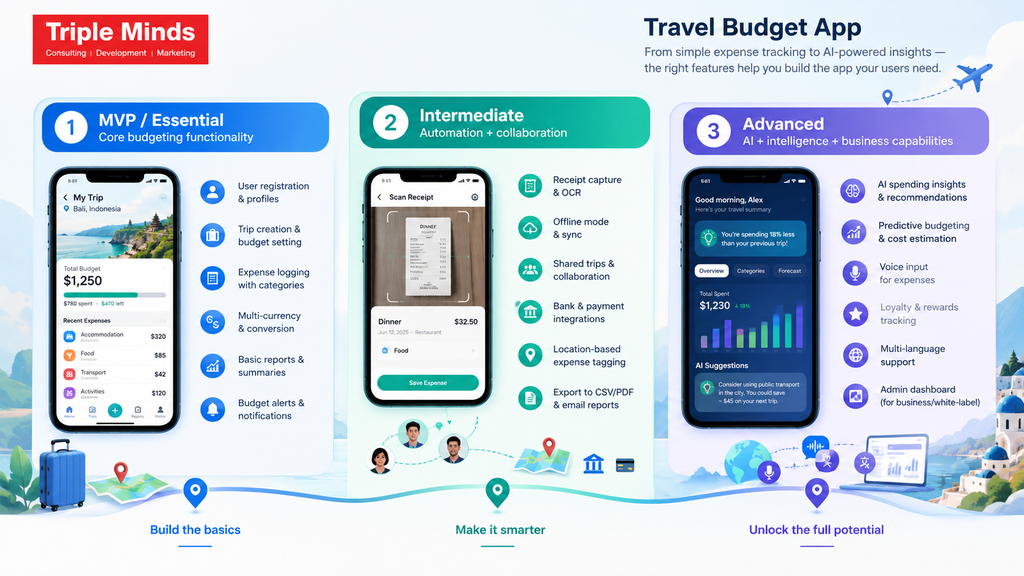
Essential (MVP) features
- User registration and profiles (email, social login, or guest mode)
- Trip creation and budget setting (overall or category-based)
- Expense logging with categories (food, transport, accommodation, activities)
- Multi-currency support and automatic conversion
- Basic reports and spending summaries
- Simple notifications (budget alerts)
Intermediate features
- Receipt photo capture and OCR for automatic data entry
- Offline mode with later sync
- Shared trips and collaborative budgeting (for couples or groups)
- Integration with bank accounts or popular payment apps for automatic imports
- Maps or location-based expense tagging
- Export to CSV/PDF or email reports
Advanced features
- AI-powered spending insights and recommendations
- Predictive budgeting based on past trips or destination costs
- Voice input for expenses
- Loyalty or rewards tracking
- Multi-language support
- Admin dashboard for analytics if the app includes a business or white-label version
Travel Budget App Development Cost Breakdown by Feature
| Feature | Estimated Cost |
| UI/UX design and prototype | $2,000–$5,000 |
| Registration and user profiles | $2,000–$5,000 |
| Trip and budget planner | $3,000–$7,000 |
| Expense tracking | $3,000–$7,000 |
| Currency converter | $1,000–$3,000 |
| Budget analytics and dashboards | $2,000–$5,000 |
| Push notifications and alerts | $1,000–$2,500 |
| Maps/location integration | $2,000–$5,000 |
| Group expense splitting | $3,000–$8,000 |
| Receipt scanning/OCR | $2,500–$6,000 |
| Admin dashboard | $3,000–$8,000 |
| AI recommendations | $4,000–$12,000+ |
| Backend/API development | $5,000–$12,000 |
| QA and security testing | $2,000–$6,000 |
1. User Registration and Profile Management
The first layer includes account creation, login, password recovery, social authentication, profile settings, preferred currency, travel preferences, and notification preferences.
A basic authentication system is relatively straightforward, but when you add multiple login methods, biometric authentication, account verification, profile personalization, privacy control across devices, the cost automatically rises.
2. Trip and Budget Planning
Users should be able to create a trip, select destinations, define travel dates, establish a total spending limit, and divide the budget into categories such as transportation, accommodation, food, shopping, activities, etc. The app can then compare planned spending with actual spending throughout the trip. You can also invest in features that allow users to create daily limits, category-level limits, and flexible budgets.
3. Expense Tracking
Manual expense tracking can begin with simple entries: amount, category, date, payment method, and notes. A more advanced version of travel budget app could allow users to photograph a receipt, automatically recognize the amount and merchant, assign a category, and add the transaction to the trip. You can also incorporate OCR services, image processing, validation logic, backend processing, and testing, increasing the development cost.
4. Currency Conversion
Currency conversion is particularly important for international travelers. The basic version can retrieve exchange rates from a third-party API and convert expenses into the traveler’s selected currency. A more advanced implementation may include historical rates, multiple currencies within the same trip, offline conversion, exchange-rate alerts, and automatic conversion.
5. Budget Analytics
A useful budget app should do more than just representing a single number. It should have interactive dashboards that can display many elements like travel budget, amount spent, remaining budget, daily spending, category breakdown, and spending alerts. Charts and visual reports help users quickly identify where their money is going. Adding advanced analytics features can help users estimate whether the user is likely to exceed the planned budget or not.
Advanced Features That Increase Travel Budget App Development Cost
AI-Powered Travel Budget Recommendations
AI can analyze destination, trip duration, accommodation preferences, historical spending, group size, and user-selected activities to generate a personalized budget.
Instead of manually setting every category, a traveler could enter a simple query like
“10 days in Japan for two people with mid-range hotels.” The application could then generate suggested spending ranges for accommodation, transportation, food, attractions, shopping, and miscellaneous expenses.
Receipt Scanning and OCR
Nobody wants to type out every hotel bill and dinner receipt by hand. With receipt scanning, users just snap a photo, and OCR technology takes it from there — pulling out the merchant name, total, date, and often the individual line items too. The app then sorts the transaction into the right category.
Group Expense Management
Anyone who’s traveled with friends or family knows the headache of fairly splitting costs. This feature lets users set up a group trip, add fellow travelers, log shared expenses, note who paid what, and split the bill — with the app doing the math on who owes whom.
For example:
John paid $180 → Maria owes $60 → Kally owes $60 → John owes nothing
The travel budget app can simplify settlements, so people aren’t stuck making five different payments when one or two would clear up the whole group.
Offline Mode
Connectivity isn’t guaranteed when you’re on the road. An offline-first setup means travelers can log expenses, access their saved budget, pull up trip details etc. Once the connection comes back, everything syncs automatically.
However, building solid offline syncs isn’t an easy task. It adds real complexity around data storage and resolving conflicts when the same trip gets edited from multiple devices — which is why most travel-app development estimates flag offline support as an advanced feature.
Maps and Location Services
Location features give travelers a visual sense of where their money is going and what’s around them — nearby restaurants, attractions, ATMs, transit options, and more, all mapped out.
Under the hood, this means bringing in mapping APIs, GPS, permissions handling, location data processing, and possibly geofencing to make it all work smoothly.
Hidden Costs You Should Include in Your Budget
The development quotation is not always the full cost of launching the application.
You should also account for:
Cloud Hosting
Your infrastructure costs can increase as users, transactions, images, OCR processing, and API requests grow.
API and Software Fees
Currency, maps, AI, OCR, analytics, communication, and other services may use monthly, annual, or consumption-based pricing.
App Store Costs
Publishing and maintaining applications on mobile app marketplaces involves platform requirements and account-related costs.
Security and Compliance
Data encryption, authentication, secure API architecture, penetration testing, privacy controls, and compliance requirements may increase development costs.
Post-Launch Maintenance
A travel application requires regular updates for bugs, operating-system changes, security patches, API changes, performance optimization, and new devices.
Strategies to Optimize Travel Budget App Development Cost
If you are a first time investor in an app development project, you should know the importance of optimizing your budget. Smart planning can meaningfully reduce spend without sacrificing quality.
1. Start with a strongly scoped MVP focused on the core problem (expense tracking + multi-currency + budgets). Validate with real users before adding advanced features.
2. Choose cross-platform development.
3. Leverage proven open-source libraries and pre-built components where possible.
4. Partner with experienced teams in cost-effective regions that still maintain high process maturity.
5. Prioritize features ruthlessly using user research and analytics.
6. Use agile delivery so you can release early and iterate based on actual usage data.
7. Negotiate clear milestones and fixed-price or hybrid contracts for predictability.
Travel Budget App Development Process: From Idea to Launch
The development cost of a travel budget app is also influenced by the process that app development companies follow. A structured development process can help you prevent scope creeping and ensure that every feature added to the final product has a clear purpose.
1. Market Research and Requirement Analysis
The first stage is to understand the audience for whom this application is designed, that is who will use the application and what problem it needs to solve. A leisure traveler planning a family vacation may need different functionality than a business traveler managing the budgets of multiple trips.
At this stage, the team defines the target audience, core use cases, monetization strategy, competitor gaps, user journeys, and MVP scope.
2. Wireframing and UI/UX Design
Once the requirements are clear, designers create wireframes and interactive prototypes. You should pay special attention to the budget dashboard because app users need to understand the financial information without any complexity.
The design can include screens for trip creation, expense entry, category management, spending reports, notifications, group expenses, profile settings, and subscription management.
3. Frontend and Backend Development
Developers then focus on building the mobile application and its backend infrastructure. The frontend manages the user experience, while the backend handles accounts, trips, expenses, calculations, APIs, notifications, cloud data, and other business logic.
The development complexity increases when the application requires real-time synchronization, multiple devices, collaborative budgeting, offline functionality, or AI-powered services.
4. API Integration and Testing
As the application focuses on designing or managing travel expenses, application may need integrations for currency conversion, maps, OCR, payments, analytics, AI, or travel services. Therefore, every integration must be tested for reliability, authentication, errors, data accuracy, and performance.
5. Deployment and Post-Launch Improvements
After testing, the app is be launched through the relevant app stores. Development does not end at launch. User feedback, analytics, crash reports, and feature usage should guide future updates.
This process allows a business to launch the most important functionality first instead of spending its entire budget building features that users may never need.
How Much Does a Travel Budget App Cost Based on the Development Team?
The team you hire can have a significant impact on the final cost of your travel budget application. An in-house team, freelancers, and a specialized development agency can produce the same broad product category, but their pricing structures, resources, and project management capabilities can differ.
Freelance Development
Hiring individual freelancers can reduce initial development expenses, particularly for a small MVP. However, complex projects may require separate specialists for mobile development, backend engineering, UI/UX, QA, DevOps, and AI.
Managing multiple freelancers can also add coordination overhead, particularly when integrations and technical dependencies become complicated.
In-House Development
Building an internal team gives you direct control over development and product decisions. However, salaries, recruitment, infrastructure, software licenses, benefits, training, and management can make this approach considerably more expensive for an early-stage product.
Development Agency
A specialized development agency generally provides access to a broader team under one engagement. This can include designers, developers, QA engineers, project managers, and technical specialists.
For a travel budget app with multiple integrations and ongoing development, Triple Minds can simplify coordination because the technical responsibilities remain within one project structure. Want to know more? Get in touch with us.
How Can a Travel Budget App Generate Revenue?
Development cost is only one side of the business equation. Before investing in an application, entrepreneurs should also determine how the product can generate recurring revenue.
Freemium Model
Users can access basic trip and expense tracking for free while advanced functionality remains available through a paid subscription.
Premium features could include unlimited trips, AI recommendations, advanced analytics, receipt scanning, group budgeting, offline access, and detailed spending reports.
Subscription Plans
A monthly or annual subscription can provide predictable recurring revenue. Different plans can be created for individual travelers, families, frequent travelers, or business users.
Affiliate Partnerships
The application can recommend hotels, flights, activities, travel insurance, rental cars, or other travel services and potentially earn commission when users complete qualifying transactions through partner programs.
Business and Corporate Plans
A travel budget app can also target organizations that need employees to manage business-trip budgets, expenses, receipts, and reports.
Sponsored Travel Offers
Relevant travel businesses can promote services within the application, provided that advertising does not interfere with the budgeting experience.
A clear monetization strategy can also influence development priorities. For example, a subscription-based product may require payment processing, entitlement management, premium feature controls, invoices, and subscription analytics from the beginning.
Cost of Developing a Travel Budget App from Scratch vs. White Label
When developing a travel budget app, the choice between building from scratch and using a white-label solution can affect the upfront investment, launch timeline, customization options, and long-term development costs.
A custom app is developed specifically around your business model, workflows, branding, and feature roadmap. Whereas a white-label travel budget app starts with an existing software that can be branded and configured for your business.
| Development Approach | Estimated Cost | Approx. Timeline | Customization |
| White-Label Travel Budget App | $10,000–$40,000+ | 1–3 months | Moderate to High |
| Custom App From Scratch | $25,000–$90,000+ | 3–8+ months | Very High |
| Enterprise Custom Platform | $90,000–$150,000+ | 8–12+ months | Full |
From-Scratch vs. White Label: Cost Comparison
| Cost Factor | From Scratch | White Label |
| Initial development | Higher | Lower |
| UI/UX customization | Full | Usually configurable |
| Backend architecture | Built specifically for you | Existing foundation adapted |
| Development timeline | Longer | Shorter |
| Feature flexibility | Very high | Depends on platform |
| Branding | Full control | Usually supported |
| Third-party integrations | Custom | Existing + additional integrations |
| Maintenance | Fully managed custom stack | Depends on provider/arrangement |
| Scalability | Designed around your requirements | Depends on underlying architecture |
| Ownership and licensing | Can be fully customized/owned | Governed by agreement |
| Future feature additions | Highly flexible | Limited by platform architecture |
Get a Personalized Cost Estimate for Your Travel Budget App
Every travel app has different requirements based on features, platforms, AI integrations, and user experience. Use the Triple Minds App Cost Calculator to get a tailored development estimate based on your project scope—without the guesswork.
Try App Cost Calculator Now
Conclusion
The cost of developing a travel budget app can range from $15,000 for a focused MVP to $90,000+ for an advanced platform, while enterprise-level products with extensive AI capabilities, integrations, and travel services can require an even larger investment.
Ultimately, a successful travel budget app is not the one with the largest feature list. It is the one that makes managing travel expenses simple, accurate, and useful enough for travelers to keep coming back. For more information, get in touch with us.
Quick Answers to Common Questions
What third-party APIs are commonly required for a travel budget app?
The APIs you need depend on your feature set. A travel budget application may use currency exchange APIs, map APIs, authentication services, analytics tools, integrate OCR, AI, payment gateways, flight APIs, hotel APIs, activity APIs, or financial data services.
What security features should a travel budget app include?
Depending on the product, security features can include secure authentication, encrypted data transmission, protected APIs, access controls, secure cloud storage, session management, regular security testing, and privacy controls.
How long does it take to launch a travel budget app?
A focused MVP can generally take around 2–3 months, while a mid-level application may require 3–5 months. Advanced applications with AI, OCR, group functionality, offline synchronization, extensive integrations, and complex admin capabilities may take 5–8 months or longer.
Should I build a travel budget app from scratch or use a white-label solution?
The decision is yours. A custom app can be more suitable when you need complete control over the architecture, branding, user experience, integrations, and long-term roadmap. A white-label solution can reduce initial development effort and accelerate launch when your requirements can be supported by an existing platform.
Got a project in mind? Let’s build it together.
We work with founders and product teams across consulting, development, and growth marketing. Tell us what you’re building and we’ll show you how we’d ship it.