Cost to Make an Uber-Like Tow Truck Booking App
Planning to build an Uber-like tow truck booking app? This guide explains the complete development cost, including MVP, marketplace, AI-powered dispatch, GPS tracking, payment integration, fleet management, and white-label vs custom development. Learn what features impact your budget, how AI increases development costs, and how to launch a roadside assistance platform faster.

Do you want to build an Uber-like tow truck booking app but don’t know how much budget you need?
You have landed on the right page.
This blog is exactly what you were looking for.
Businesses and entrepreneurs are investing in an on-demand digital platform that connects stranded motorists with nearby tow truck operators. An estimated cost to build an Uber-like tow truck booking app can range from $8,000 to $120,000+.
However, this cost can vary depending on the app complexity, integrated features, and development team. At Triple Minds, we provide white-label app development solutions, allowing you to own a pre-built and ready-to-launch Uber-like application.
Quick Answer: How Much Does an Uber-Like Tow Truck App Cost?
| Development Level | Estimated Cost | Approx. Timeline | Best For |
| Basic MVP | $25,000–$50,000 | 3–5 months | Local towing startup |
| Mid-Level Platform | $50,000–$100,000 | 5–8 months | Regional towing marketplace |
| Advanced Platform | $100,000–$180,000+ | 8–12+ months | Multi-city roadside assistance |
| Enterprise Platform | $180,000–$300,000+ | 12–18+ months | Large-scale towing/fleet network |
These are planning ranges rather than fixed quotes. Current Uber-like app benchmarks vary substantially depending on platforms, real-time tracking, dispatch logic, payment infrastructure, design, integrations, and scalability requirements. However, for an exact cost, you can use a mobile app cost calculator.
Ready to estimate your tow truck app development cost? Talk to our experts and get a customized quote based on the features, platforms, and business model you want to launch.
What Features Will You Be Paying For?
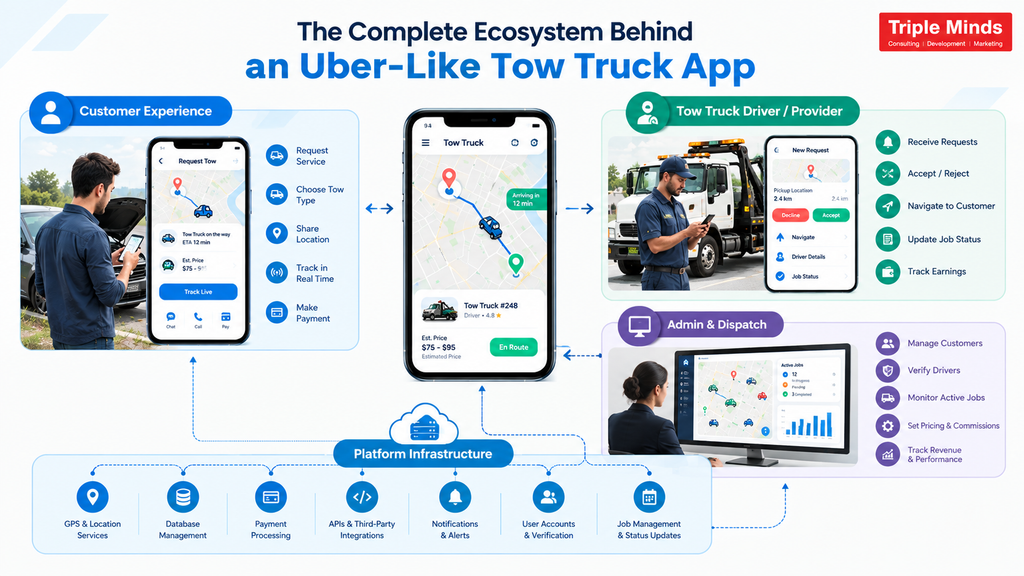
Before discussing costs, it is important to understand what an Uber-like tow truck app consists of and what features you are actually paying for. An Uber-like tow trucking application is not simply a mobile application. It is an on-demand towing marketplace and dispatch ecosystem.
1. Customer App
Customers can use the application to request towing, select towing type, share pickup location, choose destination, view estimated pricing, track the tow truck, communicate with the driver, make payments, and perform similar operations.
2. Tow Truck Driver App
Drivers or towing providers will have a separate interface that allows them to register, upload verified documents, set their available hours, accept or reject customer requests, offer custom prices, navigate to the customer location, and upload service evidence, etc.
3. Admin & Dispatch Dashboard
The business owner needs a centralized control system to manage their customers, verify drivers, manage two trucks, monitor active jobs, configure pricing, manage commissions, track revenues, and analyze business performance.
4. Backend Infrastructure
The backend infrastructure is important because it connects everything and manages major tasks like booking requests, driver verification, GPS coordination, payments, user accounts, job status, API’s and much more.
Read More: How To Create Uber Like Safety App?
Breaking Down the Cost of an Uber-Like Tow Truck Application
UI/UX Design
Estimated cost: $4,000–$12,000
Design can include different interfaces for customer screens, driver screens, admin dashboard, booking flows, maps, payment screens, notifications, service selection, tracking interfaces, and responsive web dashboards.
For applications like Uber Tow Truck, design plays an important role. A customer whose vehicle has broken down does not want to navigate through 10 complicated screens.
Customer App Development
Estimated cost: $12,000–$30,000
The customer app is where your platform actually makes money. Therefore, you must invest well in this module. You should include easy signups, location tracking, saved vehicle info, upfront pricing, and flexible payment.
Real-Time GPS & Dispatch
Estimated cost: $8,000–$20,000+
This is one of the most important components of an Uber-like towing application. When a customer requests help, your system needs to identify suitable drivers.
The basic matching logic could be considered: ETA, distance, availability, vehicle type, service capability, etc. For example, if a customer needs a heavy-duty tow, the system should not simply select the nearest motorcycle recovery vehicle. It should identify the nearest qualified vehicle.
Tow Truck Driver App Development
Estimated cost: $10,000–$25,000
The driver app is another contributor to the overall tow truck white label app development budget. The development cost of this side can vary depending on how much functionality you want to give your towing partners.
A basic driver application may include registration, profile management, document submission, availability status, booking requests, accept/reject functionality, navigation, job status updates, and earnings. However, if you want to go to an advanced level, you can add document verification features, custom offers, job scheduling, and much more.
Admin Panel & Dispatch Management
Estimated cost: $8,000–$20,000
If you want to efficiently manage your Uber-like tow truck marketplace, you require an admin panel. It gives business owners a centralized place to control customers, drivers, bookings, pricing, payments, service areas, and platform operations.
An admin panel can include various modules such as customer management, driver management, booking management, tow truck management, service management, etc. If you are planning a larger towing marketplace, you may require more advanced administrative functionality. The cost increases when the dashboard moves from basic CRUD-based management to real-time operational control.
Backend Development
Estimated cost: $10,000–$25,000+
One cannot see the backend, but it is still the most important part of your Uber-like tow truck application. Customers cannot see the backend, but every action that is performed is processed by the complex logic implemented by app developers in the backend. From user authentication, driver matching, pricing calculations, and payment processing to API integrations, the backend holds everything. Therefore, it needs a less budget-specific approach.
Payment Gateway Integration
Estimated cost: $2,000–$6,000
Imagine a user finding it difficult to make a seamless payment due to a poor interface or slow processing; what do you think would happen? They will not make a booking, and that is what makes payment functionality another important cost component while calculating the total Uber-like tow truck application’s development budget.
However, the development cost can increase if you require more efficient payment workflows.
Push Notifications, SMS & Communication
Estimated cost: $2,000–$5,000
Communication and notifications features may appear small in comparison to customer and driver applications, but they are still important for an on-demand towing platform.
The application can send notifications about bookings, confirmations, arrival status, and payment completion. You can also opt to add in-app chat or calling functionality, so customers and drivers can communicate without exposing their personal contact details.
How Much Do Advanced Features Add to the Development Cost?
Once the core application is ready, you may want to add advanced functionality. These features can significantly affect the final quotation.
| Advanced Feature | Estimated Additional Cost |
| Scheduled Towing | $2,000–$5,000 |
| Dynamic Pricing | $3,000–$8,000 |
| Multiple Service Categories | $2,000–$5,000 |
| Fleet Management | $5,000–$12,000 |
| Corporate Accounts | $4,000–$10,000 |
| Subscription/Membership | $4,000–$9,000 |
| Advanced Analytics | $3,000–$8,000 |
| Multi-Currency | $2,000–$5,000 |
| Multi-Language | $2,000–$6,000 |
| AI-Based Dispatch | $8,000–$20,000+ |
| Insurance/Enterprise Integrations | $5,000–$15,000+ |
*Note*
The information we have explained in the table above is an incremental planning range, not prices that should automatically be added together. Some features share backend infrastructure, so the actual increase in project cost depends on the overall architecture.
How Much Does the Development Team’s Location Affect Cost?
The same two truck application can receive significantly different development quotations depending on the country from which you are hiring your development team. Typical hourly development ranges may look approximately like this:
| Development Region | Approx. Hourly Rate |
| India | $20–$50/hour |
| Eastern Europe | $35–$70/hour |
| Western Europe | $60–$120/hour |
| North America | $80–$150+/hour |
White-Label vs Custom Tow Truck App: Which Costs Less?
A white-label tow trucking app has less upfront cost compared to a custom-built platform.
White-Label Tow Truck App:
The upfront cost can range from $10,000 to $25,000 (can vary from company to company). In this cost, you will receive a pre-built and rebranded product with standard dispatch, tracking, and payment features. However, there can be ongoing costs for monthly licensing fees, server costs, or extra charges if you want custom features.
Custom Tow Truck App:
The upfront cost of a custom tow truck app ranges from $25,000 to $95,000+ for a basic MVP (Minimum Viable Product), and can exceed $100,000 for complex, feature-rich enterprise platforms. You will get software built entirely from scratch to meet your unique requirements, business logic, and workflow. In-house or contracted maintenance, security updates, and infrastructure management can be the ongoing cost for a custom Uber-like tow truck application.
At Triple Minds, our white-label mobile app development approach allows businesses to start with a pre-built, ready-to-launch tow truck application that can be customized around your brand and operational requirements.
Cost of Building an Uber-Like Tow Truck App from Scratch vs White Label
Building an Uber-like tow truck booking app from scratch gives you complete control over the product, but that flexibility comes with a higher initial investment. Whereas a white-label solution uses an existing application foundation with standard functionality, allowing you to reduce development time and control upfront costs.
| Cost Factor | From Scratch | White Label |
| Initial development | Higher | Lower |
| UI/UX customization | Fully custom | Customizable |
| Standard features | Built from scratch | Already available |
| Time to market | Longer | Faster |
| Custom functionality | High flexibility | Depends on the solution |
| Maintenance | Usually higher | Lower or managed, depending on provider |
| Initial investment | Higher | More controlled |
| Feature development cost | Paid individually | Many standard features included |
| Testing & deployment | More extensive | Reduced development effort |
| Scalability | Designed specifically for your requirements | Depends on the underlying solution |
Where Does White Label Actually Save Money?
The cost advantage is not simply that a white-label application has a lower price tag. The larger savings can come from reducing the amount of development work required before launching the final product.
For example, a scratch-built application may require separate development efforts for developing various modules. But with a white-label solution, much of the standard functionality can already exist. Your development budget can instead be allocated toward customization and business-specific requirements. That means you are potentially paying for modification rather than recreation.
How Can You Reduce the Cost of Making an Uber-Like Tow Truck App?
Reducing the cost does not mean removing the features that make your business viable.
Instead, you can focus on spending your initial budget on the functionality required to generate and manage bookings.
- Start with an MVP consisting of a core customer, driver, and admin workflow.
- No need to implement multi-city functionality; launch in one market.
- Prioritize revenue-generating features like booking, dispatch, payments, and tracking.
- Choose your platform by analyzing your target audience through a cross-platform application, reducing development efforts.
- Opt for white-label solutions as they can reduce the cost and timeline associated with developing standard functionality from scratch.
- Introduce advanced features like subscriptions, corporate accounts, analytics, and advanced feature management after validating the core platform.
How Much Should You Budget for Your Tow Truck App?
Your budget should ultimately depend on your business objectives. If you are an entrepreneur, a $25,000–$50,000 MVP may provide enough functionality to launch and validate your idea.
If you want to establish a regional towing marketplace, you may need approximately $50,000–$100,000 for a more comprehensive platform.
If your goal is to create a multi-city roadside assistance ecosystem with advanced dispatch, fleet management, corporate accounts, automation, and integrations, your investment can move toward $100,000–$180,000+.
On the other hand, for an enterprise-grade platform, the budget can exceed $200,000 due to extensive customization and integration.
Tow Truck App Development Cost: In-House vs Development Agency
| Factor | In-House Team | Development Agency |
| Initial hiring cost | Higher | Lower |
| Development expertise | Depends on team | Available immediately |
| Project management | Internal | Agency-managed |
| Scalability | Requires hiring | Easier to scale |
| Maintenance | Internal team | Can be outsourced |
| Initial investment | Higher | Usually more predictable |
Cost of Adding AI to a Tow Truck Booking App
AI can make an Uber-like tow truck booking app more intelligent, but it also adds another layer to your development cost. The cost depends on what you want AI to do.
For a basic AI implementation, you may only need an AI-powered customer support assistant. More advanced systems can use historical bookings, driver availability, location data, traffic conditions, service types, cancellations and other operational data to make predictions and automate dispatch decisions.
| AI Feature | What It Does | Potential Development Cost* |
| AI-powered driver matching | Selects suitable drivers based on location, availability, vehicle capability and historical performance | $5,000–$15,000+ |
| Demand prediction | Forecasts where and when towing requests are likely to increase | $5,000–$15,000+ |
| ETA prediction | Estimates more accurate driver arrival times using historical and real-time data | $4,000–$12,000+ |
| Intelligent dispatch | Automates or assists dispatch decisions using multiple operational signals | $8,000–$20,000+ |
| Customer support chatbot | Handles common booking, pricing, status and support questions | $3,000–$10,000+ |
| Fraud detection | Identifies suspicious bookings, payments, accounts or location patterns | $5,000–$15,000+ |
| Pricing recommendations | Suggests prices based on demand, service type, distance and other factors | $5,000–$15,000+ |
| Driver performance analytics | Identifies patterns in acceptance, cancellations, response times and service performance | $3,000–$10,000+ |
How Much More Does AI Add Your Tow Truck App Development Cost?
You should not simply add the cost of every AI feature to your development budget. Some AI capabilities can share the same data infrastructure, APIs, dashboards, and machine-learning components. A practical AI investment could therefore look like this:
| AI Development Level | Approximate Additional Investment |
| Basic AI integration | $3,000–$10,000 |
| AI chatbot + analytics | $8,000–$20,000 |
| Predictive ETA + matching | $10,000–$25,000+ |
| AI dispatch + demand prediction | $15,000–$35,000+ |
| Advanced AI-powered platform | $30,000–$80,000+ |
These ranges are intended for budgeting rather than quoting. The actual cost depends on whether the AI is API-based, rule-assisted, machine-learning-based or fully custom.
Launch Your Uber-Like Tow Truck Booking App Faster
Build a modern roadside assistance platform with Triple Minds. From customer booking, real-time GPS tracking, AI-powered dispatch, and driver management to payments, fleet operations, and admin dashboards, we develop custom and white-label tow truck booking applications designed for faster launch and long-term scalability.
Launch Your Tow Truck App with Triple Minds
Final Cost to Make an Uber-Like Tow Truck Booking App
So, how much does it cost to make an Uber-like tow truck booking app?
The development cost can start at around $25,000–$50,000 and can exceed $50,000–$100,000. Advanced platforms can require $100,000–$180,000+, while large-scale enterprise solutions can move beyond $200,000. Therefore, the best approach is to define your business model first and then select the technology investment that supports it.
If you’re planning to launch an Uber-like tow truck business but don’t want to spend months building standard functionality from the ground up, Triple Minds can help you launch with a white-label tow truck booking solution customized to your business requirements.
Quick Answers to Common Questions
Can I build an Uber-like tow truck app for under $20,000?
With a budget under $20,000 you can invest in a white label uber like tow truck app solution. For a fully customized platform with separate customer and driver applications, you need a higher budget.
Which feature increases tow truck app development cost the most?
Advanced real-time functionality such as GPS tracking, automated dispatch, complex pricing, fleet management, AI-based matching, and third-party integrations can increase the development costs of uber-like tow truck applications.
How much does it cost to maintain a tow truck booking app?
App maintenance can take up to 15–25% of the initial development cost per year, although your actual maintenance expenses will depend on the technology stack, infrastructure, integrations, traffic, support requirements, and frequency of updates.
What information is required to calculate the exact development cost?
A development company will typically need information about your target market, platforms, user roles, required features, towing services, pricing model, payment methods, integrations, number of locations, customization requirements, and expected scale before providing an accurate quotation.
Got a project in mind? Let’s build it together.
We work with founders and product teams across consulting, development, and growth marketing. Tell us what you’re building and we’ll show you how we’d ship it.