How to Make Mental Health App Like Elomia Clone?
Looking to build a mental health app like Elomia? This guide covers everything you need to know, from essential AI-powered therapy features and technology stack to development process, compliance requirements, and estimated costs. Whether you're building an MVP or a scalable AI mental wellness platform, you'll learn the key considerations for creating a secure, engaging, and user-centric solution.

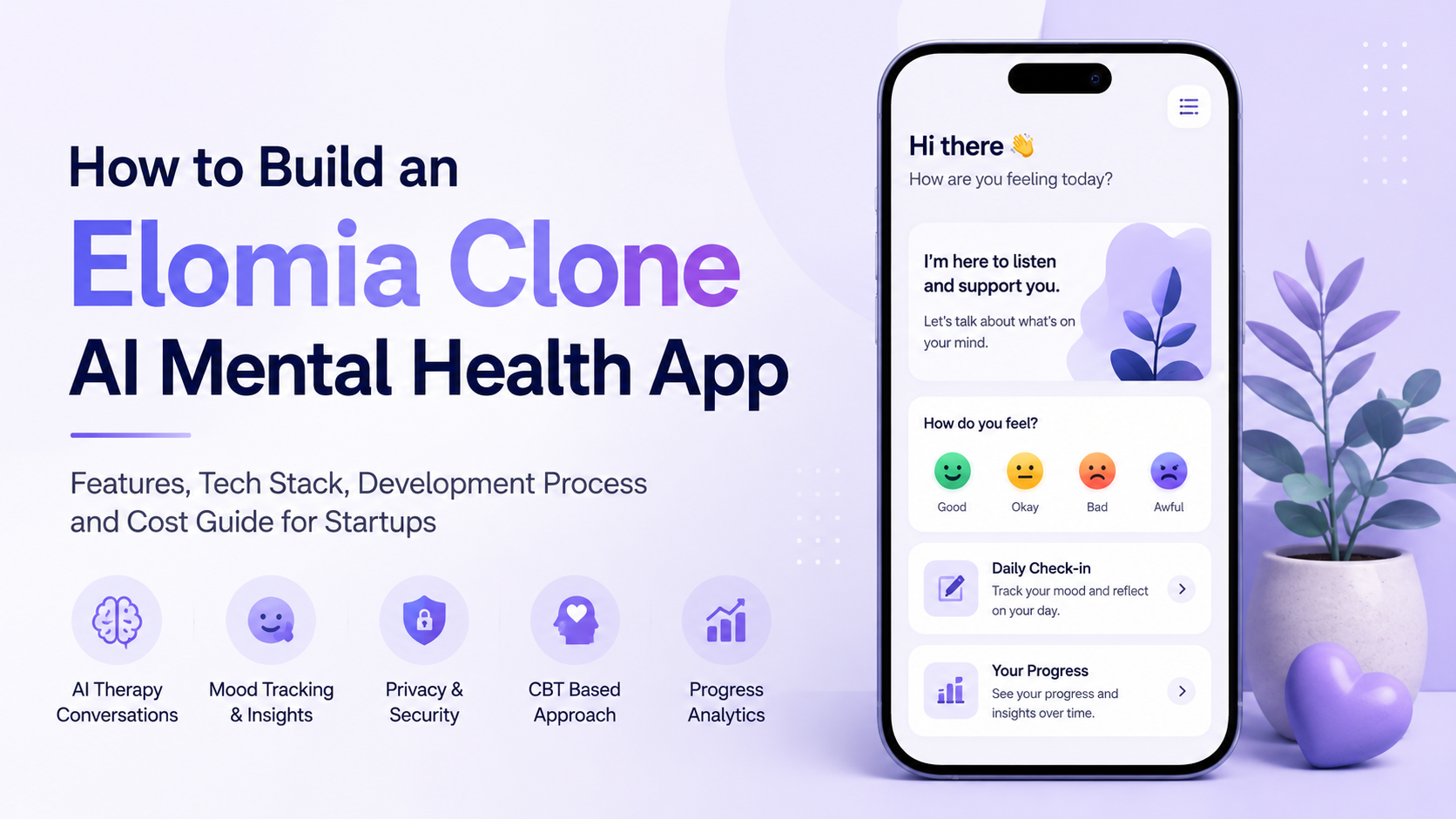
Mental health apps have emerged as one of the fastest growing categories in mobile technology. More people are shifting to AI powered therapy tools to manage anxiety, stress and emotional burnout from the comfort of their phones.
The market size of AI mental health apps was estimated at USD 1.71 billion in 2025 and is projected to reach USD 9.12 billion by 2033, at a CAGR of 23.29% from 2026 to 2033. The market growth is driven by factors such as the increasing rate of mental health disorders and heightened awareness regarding mental health as a significant health concern.
Elomia is one of the most widely known when it comes to AI powered therapy tools. It uses conversational AI to simulate CBT (Cognitive Behavioral Therapy) and help users work through emotional challenges without needing to book any therapist.
If you are a startup, product manager or investor exploring how to build a mental health app like Elomia clone then this guide contains everything you need to know. From features and tech stack to development and cost, you will find it all here.
At Triple Minds, we specialize in AI agent development and custom chatbot development including emotional intelligent, conversation driven apps.
If you are ready to explore your idea then talk to our consultant and we will help you choose the smartest path forward.
Key Takeaways
1) The most critical technical investment in a mental health app is the AI conversation engine. An empathetic, context aware AI is what separates a useful product from a frustrating one.
2) Crisis detection is not optional. Any app that handles mental health conversations must have built in safety protocols to detect distress signals and respond appropriately.
3) Session memory is what makes users come back. An AI that remembers previous conversations creates a sense of continuity and trust that drives long term retention.
4) HIPAA and GDPR compliance should be built in from day one, not added as a patch after launch. Retrofitting security is far more expensive than building it right the first time.
5) You do not have to build from zero. White label AI chatbot platforms can significantly reduce your time to market while still giving you a fully branded, customizable product.
Planning to Launch an AI Mental Health App Like Elomia?
Whether you’re building for a healthtech startup, clinic, rehab center, or enterprise, Triple Minds develops secure AI therapy chatbot solutions with custom and white-label options. Our platforms combine NLP-powered conversations, compliance-ready architecture, and proven therapeutic frameworks like CBT and DBT.
Build Your AI Therapy Chatbot
What is Elomia Clone?
Elomia clone is a pre-build and ready to deploy AI therapy assistant which is funtional replica of the popular Elomia. It uses natural language conversations to support people dealing with anxiety, stress, low mood and loneliness. Unlike traditional therapy apps that simply connect users to licensed therapists, our Elomia clone uses a trained AI model to conduct structured conversations guided by CBT principles.
What makes it so attractive is it’s simplicity. Users open the app, start a conversation and feel heard. The AI asks follow up questions, helps users reframe their thoughts and tracks emotional patterns over time. There is no appointment booking, no waiting room. That is what makes this app so wanted in the market.
Read Also: How AI Therapy Chatbots Are Making Mental Healthcare?
Who Actually Uses Apps like Elomia Clone?
Before writing a single line of code, understanding your target user is essential. Apps like Elomia typically serve three core groups:
1) People dealing with everyday mental health struggles like anxiety, overthinking or mild depression who either cannot afford therapy or are not ready to speak with a human therapist. This is the largest audience.
2) Professionals in high pressure environments such as tech, healthcare or finance who want a quick daily emotional check in without committing to weekly therapy sessions.
3) Corporate wellness programs that embed mental health tools as an employee benefit. This is a growing B2B use case where companies pay for app access on behalf of their teams.
Note: Defining your target user upfront shapes every product decision from the tone of the AI conversations to how you handle crisis situations within the app.
Core Features Your Mental Health App Like Elomia Must Have
Making a basic AI mental health app is not enough. To compete with or improve on Elomia, your app needs a thoughtful set of features that balance engagement, safety, and emotional intelligence.
Here are the features that matters most:
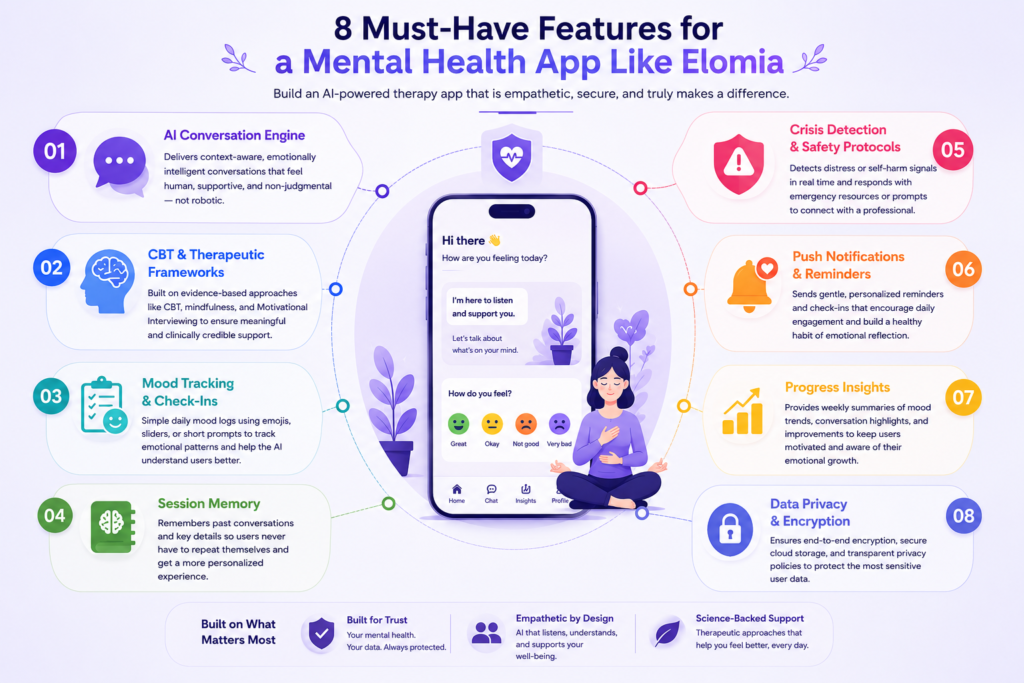
1) AI Conversation Engine
The heart of the app. The AI must be able to hold contextually, emotionally sensitive conversations and respond in a way that feels human and supportive not robotic.
2) CBT and Therapeutic Frameworks
The conversation logic should be guided by evidence-based approaches like Cognitive Behavioral Therapy, mindfulness based stress reduction, or Motivational Interviewing. This gives the product clinical credibility.
3) Mood Tracking And Check Ins:
Daily mood logs with simple inputs (emoji, sliders, short prompts) help users track their emotional patterns and give the AI more context for future conversations.
4) Session Memory
The AI must remember previous conversations. A user who shared that they are stressed about a job interview should not have to repeat that context on day two.
5) Crisis Detection with Safety Protocols
If a user expresses thoughts of self-harm then the app must detect the signal and respond with emergency resources or a prompt to contact a professional. This is non-negotiable from both an ethical and legal standpoint.
6) Push Notifications And Reminders
Gentle, personalized check in reminders improve daily engagement and help users build a habit around emotional reflection.
7) Progress Insights
Weekly summaries showing mood trends, conversation highlights and areas of improvement give users a sense of movement and motivate continued use.
8) Data Privacy And Encryption
Mental health data is among the most sensitive data users can share. End-to-end encryption, secure cloud storage, and transparent privacy policies are mandatory.
Tech Stack Behind An App Like Elomia Clone
You do not need to build everything from scratch. Here is a practical tech stack breakdown for a production ready mental health app
1) AI, NLP Layer
GPT 4 or a fine-tuned open-source model (like LLaMA or Mistral) forms the conversational core. The model needs to be fine-tuned, or system prompted for empathetic, therapeutic dialogue. At Triple Minds, we have trained custom AI models across 25+ use cases.
2) Backend
Node.js or Python (FastAPI or Django) for API management, session handling and data logic. A secure REST or GraphQL API connects the mobile app to the AI engine.
3) Database
PostgreSQL for structured data (user profiles, mood logs, session summaries) and a vector database like Pinecone or Weaviate for sorting and retrieving semantic conversation memory.
4) Mobile Frontend
React Native for a single codebase that runs on both iOS and Android reducing development time and cost significantly.
5) Cloud Infrastructure
AWS, GCP or Azure for scalable hosting. Use HIPAA compliant cloud configurations if you are targeting users in the United States.
6) Security And Compliance
AES 256 encryption for stored data, TLS for data in transit and HIPAA or GDPR compliance depending in your target market.
Development Guide To Make A Mental Health App Like Elomia Clone
Building an app like Elomia is not just a development project. It is a product journey that starts with strategy and ends with a system that continuously improves after launch.
Here is how the process should look
1) Discovery and Consulting
Before any design or development begins, you need a product strategy session. What problem are you solving? Who is your user? What is your monetization model? These questions if answered early, prevent expensive rebuilds later.
2) UX and UI Design
Mental health apps require a calm, safe, and trustworthy visual experience. The design should reduce cognitive load with soft colors, clean typography and minimal friction in every user flow from onboarding to daily check ins.
3) AI Model Selection And Prompt Engineering
Choose your base model and build a detailed system prompt that defines the AI’s personality, safety guardrails, therapeutic approach and response style. This step is where most teams underinvest and pay for it later with a product that feels generic.
4) Core Development
Build the backend APIs, mobile app, conversation engine, mood tracker, session memory system and admin dashboard in parallel sprints. Use agile methodology to ship testable increments every two weeks.
5) Safety And Compliance Testing
Run end to end tests specifically for crisis detection scenarios. Have mental health consultants review the AI’s responses across a range of emotional inputs. Ensure all data handling is compliant with relevant regulations.
6) Launch and Post Launch Optimization
Release to a limited beta audience first. Collect real usage data, identify conversation drop off points, retrain or re-prompt the model where needed and iterate before a full public launch.
Read Also: AI Medical Scribe Development Cost & Features List
How Much Does Elomia Clone Costs
Development cost depends on scope, team location and whether you use a white label foundation or build everything custom.
Here is an estimated breakdown:
| Development phase | Estimated cost |
| Discovery and strategy | $2,000 – $5,000 |
| UX and UI design | $5,000 – $12,000 |
| AI model integration and prompt engineering | $8,000 – $20,000 |
| Mobile app development (iOS and Android) | $20,000 – $45,000 |
| Backend and database infrastructure | $10,000 – $20,000 |
| Security, compliance, and testing | $5,000 – $10,000 |
| Total estimated range (production ready MVP) | $50,000 – $110,000 |
If you want to move faster and at a lower initial cost, a white label chatbot foundation can reduce your time to launch from 6 months down to 6 to 8 weeks, with full custom branding and feature configuration.
Our Elomia clone cost starts from $9,000 and is tailored to your specific business requirements. The final pricing depends on the features, AI capabilities, integrations, and level of customization you need. Whether you’re building an MVP or a fully scalable mental wellness platform, we deliver a solution designed to match your goals and budget.
Read Also: How Much Does an AI Hospital Management System Development Cost
Why Choose Us?
1) AI Agent and Chatbot Development teams with 5 or more emotionally intelligent conversational AI products shipped.
2) 25 or more custom AI models trained across industries, with over 150 apps and chatbot systems delivered.
3) White label AI chatbot solution ready to adapt into a mental health platform and launch in weeks, not months.
4) Full service support across consulting, development, and growth so you have one team from idea to launch.
Whether you need strategic consulting to validate your idea before investing, a dedicated development team to build your MVP, or a white label solution you can launch in weeks, we have the right model for where you are in your journey.
Talk to our consultant today.
Have an AI Mental Health App Idea? Validate It Before You Build
The fastest way to test an idea isn’t by building a full platform. Triple Minds helps founders and healthcare innovators turn concepts into interactive AI prototypes, allowing you to validate user experience, refine features, and gather feedback before investing in full-scale development.
Prototype Your AI Mental Health App
Conclusion
Building a mental health app like Elomia Clone is one of the most profitable product bets a founder can make right now.
The demand is real, the technology is mature and the gap between what people need emotionally and what existing apps deliver is still wide open.
Success in this space comes down to building an experience that removes friction and making safety a core product value not an afterthought. With the right development partner and a clear product strategy, you can go from idea to a live, clinically credible mental health companion faster than you think.
Quick Answers to Common Questions
Do I need a licensed therapist to build a mental health app like Elomia?
No, Apps like Elomia position themselves as AI companions or emotional wellness tools, not licensed therapy. However, having mental health professionals review your AI’s responses and safety protocols is strongly recommended.
Is it possible to build this app without training a custom AI model?
Yes, You can use GPT 4 or another foundation model with a well-designed system prompt to create a highly effective mental health conversation experience without full model training.
What regulations apply to mental health apps?
In the US, HIPAA applies if you collect and store protected health information. In Europe, GDPR applies. Apps that do not position themselves as medical devices generally have more flexibility, but legal review for your specific market is advisable.
How long does it take to build a mental health app from scratch?
A production ready MVP typically takes 4 to 6 months with a full team. Using a white label foundation can bring that timeline down to 6 to 8 weeks.
What is the best monetization model for a mental health app like Elomia?
A freemium model with a subscription upgrade is the most proven approach. Free users get limited daily conversations, while paid subscribers get unlimited sessions, session memory, and progress tracking.
Got a project in mind? Let’s build it together.
We work with founders and product teams across consulting, development, and growth marketing. Tell us what you’re building and we’ll show you how we’d ship it.