Digital Product Passport Software: Use Cases and Features
Digital Product Passport software helps businesses create a digital identity for products and manage product information across the entire lifecycle. This guide explores the key use cases, features, user roles, QR code integration, supply chain traceability, compliance workflows, and lifecycle management capabilities of a modern DPP platform. Learn how manufacturers, suppliers, retailers, repair providers, and recyclers can use DPP software to improve transparency, sustainability, and regulatory readiness.

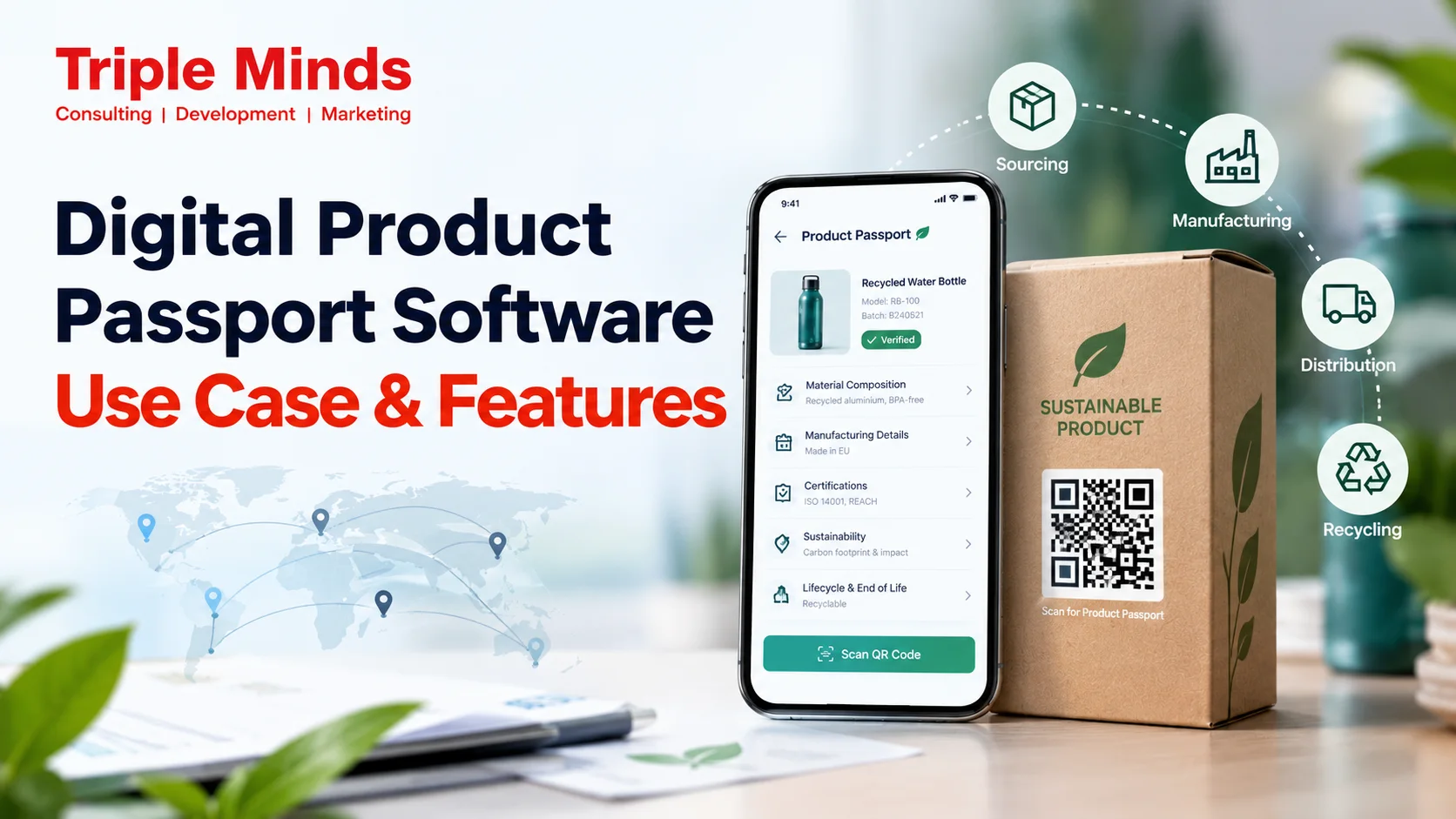
What does a Digital Product Passport platform actually need to offer? Which industries can use it? What business processes can it support? And which features should you consider if you are planning to invest in or develop DPP software? In this blog, we will learn it all.
Product information is becoming more than something businesses keep in spreadsheets, PDFs, and internal systems. Manufacturers and suppliers increasingly need a structured way to collect, manage, verify, and share information about a product across its entire lifecycle. This is where Digital Product Passport (DPP) software comes into the picture.
A Digital Product Passport is a digital record that gives a physical product its own identity. Digital Product Passport software is the platform that lets businesses collect, organize, verify, update, and share that information throughout the product lifecycle. The passport can carry important information such as its materials, components, manufacturing details, supplier data, certifications, sustainability attributes, repair history, and end-of-life information.
This guide explores the key use cases and features of Digital Product Passport software, along with its user roles, workflows, technology requirements, benefits, and development considerations.
Why Is Digital Product Passport Software Important?
A product may contain materials sourced from one country, components manufactured in another, assembly performed somewhere else, and finally be sold across multiple markets.
Regulation is adding urgency. According to the European Commission timeline, Digital Product Passports become mandatory for electric vehicle, light means of transport, and industrial batteries on 18 February 2027, with textiles, tyres, and aluminium scheduled for 2027, furniture for 2028, and mattresses and ICT products for 2029.
Without a centralized digital information system, product data can become fragmented across spreadsheets, ERP systems, supplier portals, certificates, PDFs, and internal databases. Digital product passport software brings relevant information into a structured digital environment and helps businesses:
- Improve product traceability
- Organize sustainability information
- Share product data with authorized stakeholders
- Support regulatory and compliance requirements
- Improve supply-chain transparency
- Make repair and maintenance information easier to access
- Support resale and refurbishment
- Improve recycling and end-of-life processes
- Reduce dependence on disconnected product documentation
- Build stronger relationships with customers and supply-chain partners
Build Your Digital Product Passport Software With Triple Minds
Turn complex product data into a connected DPP platform built for your business. From product registration and QR/NFC connectivity to supplier data, compliance tracking, ERP/PLM integrations, and audit trails, build a solution that supports product transparency and lifecycle management.
Build Your DPP Software
Essential Features of Digital Product Passport Software
Well-built digital product passport software is more than a product database. It combines data gathering, product identity, access control, lifecycle management, validation, analytics, and integration.
A Digital Product Passport (DPP) is a structured, machine-readable record that follows the physical product through its lifecycle. Under the Ecodesign for Sustainable Products Regulation (ESPR), in force in the EU since 18 July 2024, the Digital Product Passport provides transparent data on the origin of the product, material composition, sustainability performance, reparability, and end-of-life. People usually access it by scanning a QR code built on the GS1 Digital Link standard.
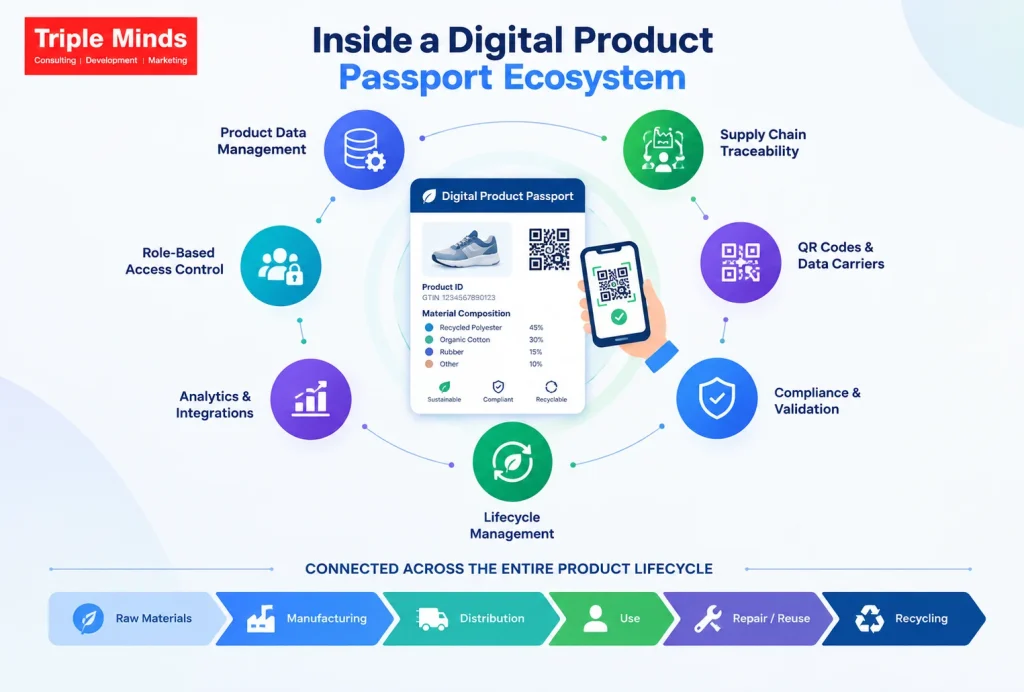
1. Product Data Management and Import
Instead of starting from scratch, modern digital product passport platforms allow you to bring in product data from existing systems.
- Flexible imports from CSV, Excel, JSON, ERP, PIM, or PLM systems
- AI-assisted column mapping and automatic classification (e.g., to GS1 GPC)
- Support for hierarchical structures: product model → components → materials
- Handling of variants, batches, and item-level serialisation
- Validation that material compositions add up correctly and required fields are complete
This turns scattered product information into a clean, structured passport record.
2. Supply Chain Traceability and Supplier Collaboration
Strong digital product passport software depends on data that often lives with suppliers. It includes:
- Tools to map production stages, facilities, and supplier locations
- Supplier portals or invitation workflows so partners can contribute data directly
- Automated document extraction (certificates, declarations) with human review
- Cascade requests down multiple tiers of the supply chain
- Evidence linking so every claim is backed by supporting documentation
This reduces manual chasing and creates an auditable trail.
3. GS1 Digital Link QR Codes and Data Carriers
The most visible part of digital product passport software is the scannable code on the product. Key capabilities include:
- Generation of GS1 Digital Link QR codes (the preferred international standard)
- Support for model-, batch-, or item-level identifiers
- Print-ready formats (SVG, PNG, ZPL) for packaging and labels
- Optional NFC/RFID support
- Stable links that remain valid even when passport content is updated
Consumers, repairers, recyclers, and authorities simply scan to access the right information.
4. Compliance Validation and Readiness Scoring
Because DPP requirements are product-group specific and evolving, software must help teams stay compliant:
- Automated checks against ESPR, sector-specific delegated acts, and emerging data models (e.g., CIRPASS-2 pilots, SHACL validation shapes)
- Completeness and readiness scoring that highlights missing or incomplete fields
- Support for multi-language passports (including all 24 official EU languages)
- Role-based views so different stakeholders (consumers, customs, market surveillance) see only permitted data
- Cryptographic signing (e.g., W3C Verifiable Credentials) for authenticity and integrity
Some platforms also offer AI-powered regulatory research assistants that cite official sources.
5. Passport Generation, Publishing, and Lifecycle Management
A DPP is not a static PDF. Good software treats it as a living record:
- Template-based or brand-customisable public passport pages
- One-click or scheduled publishing with automatic QR activation
- Version history and controlled updates (the QR stays the same; the content evolves)
- Machine-readable exports (JSON-LD, CSV, XML, AAS) for systems and authorities
- Lifecycle event tracking (repair, resale, recycling, end-of-life)
This supports circular business models and long-term regulatory needs.
6. Analytics, Integrations, and Scalability
Enterprise-ready platforms add:
- Scan analytics (location, device, frequency) to understand engagement
- REST APIs and webhooks for automation with existing systems
- Bulk operations for large catalogues
- White-label options and custom domains so the passport stays on-brand
- Secure, region-specific hosting and audit-ready archiving
7. Role-Based Access Control
Not everyone should see the same information. That is why digital product passport software provides role-based access control to its users.
- Customer: Product and sustainability information
- Manufacturer: Complete product and manufacturing data
- Supplier: Relevant component information
- Repair provider: Technical and repair information
- Recycler: Material and end-of-life information
- Regulator: Required compliance information
Role-based access allows the business to control who can see, add, edit, or verify specific information.
Major Digital Product Passport Software Use Cases
DPP software can be used across multiple industries. Its role changes depending on the product, supply chain, regulatory requirements, and lifecycle.
1. Fashion and Textile Product Passports
Fashion is one of the most common applications for Digital Product Passports. A clothing brand can create a digital passport for garments containing information about:
- Fiber composition
- Material origin
- Manufacturing location
- Recycled content
- Certifications
- Care instructions
- Repair options
- Resale information
- Recycling instructions
This allows a customer to scan a QR code attached to a garment and access selected information about its production and lifecycle.
2. Automotive Digital Product Passports
Vehicles contain multiple components and materials, making traceability particularly valuable. An automotive DPP system could manage information about:
- Vehicle identification
- Components
- Battery information
- Materials
- Manufacturing
- Maintenance
- Repairs
- Replacement parts
- Ownership-related lifecycle events
- End-of-life processing
Battery-related information can be important because batteries have their own traceability, performance, sourcing, and recycling considerations, and the same data can later feed a battery recycling platform. A digital product passport ecosystem can connect manufacturers, suppliers, service centers, dealers, owners, recyclers, and other authorized participants.
3. Electronics and Consumer Appliances
Smartphones, laptops, televisions, refrigerators, washing machines, and other electronic products can benefit from digital product records. A digital product passport can provide:
- Product specifications
- Component information
- Warranty details
- Repair instructions
- Spare-part information
- Software or firmware information
- Maintenance records
- Refurbishment history
- Recycling instructions
For consumers, repair companies, and recyclers, this software makes product ownership easier, gives access to relevant technical information, and provides details about materials and components that may require specialized handling.
4. Battery Passports
Battery products are another major DPP use case. A battery passport can contain information related to:
- Battery identification
- Manufacturer
- Manufacturing location
- Composition
- Materials
- Capacity
- Performance
- State-of-health information
- Carbon footprint information
- Responsible sourcing information
- Recycling and end-of-life data
The platform can provide different data views for manufacturers, regulators, vehicle owners, service providers, and recyclers.
In the EU, the battery passport becomes mandatory on 18 February 2027 for electric vehicle batteries, light means of transport batteries, and industrial batteries above 2 kWh.
Read More: A Complete Guide To Build A Battery Recycling Management Software
5. Furniture and Home Products
Furniture manufacturers can use DPP software to document their materials, wood sources, components, manufacturing information, product dimensions, repair instructions, replacement components, recyclability, and refurbishment information. This is useful for products designed to have long lifespans.
A customer purchasing a premium chair, table, or sofa could scan the product’s passport to understand its materials and access care or repair information.
6. Industrial Equipment
Industrial machinery can have long operational lifecycles and multiple service events. A DPP platform can store:
- Machine specifications
- Serial numbers
- Components
- Installation information
- Maintenance schedules
- Service history
- Replacement parts
- Safety documentation
- Certifications
- Repair records
- Decommissioning information
Instead of searching through old paper manuals or disconnected databases, authorized service teams can access the product’s digital record.
7. Construction Materials
Construction products such as insulation, steel, windows, flooring, tiles, and other building materials can also benefit from product passports. A passport can provide information about:
- Material composition
- Manufacturer
- Production location
- Environmental characteristics
- Certifications
- Installation instructions
- Maintenance
- Reuse
- Recycling
- End-of-life handling
This information can support more transparent and circular construction processes.
Read More: How to Make Uber for Construction Materials App like Curri?
8. Luxury Goods and Product Authentication
DPP technology can also support product authenticity.
Luxury brands can associate products with unique digital identities and provide information about:
- Product model
- Manufacturing details
- Authenticity
- Ownership history, where appropriate
- Warranty
- Repairs
- Resale
- Certification
When a customer purchases a pre-owned product, its digital identity can provide additional information about its provenance and lifecycle.
This does not automatically guarantee authenticity, but a properly designed system can make product verification more structured.
Read More: Climate Tech Startup Ideas That Actually Make Money
How Does Digital Product Passport Software Work?
A standard process flow for digital product passports involves product creation, data entry, data validation, digital identity, physical connectivity, stakeholder access, and lifecycle updates. To make this clearer, let us assume a clothing manufacturer is making a jacket.
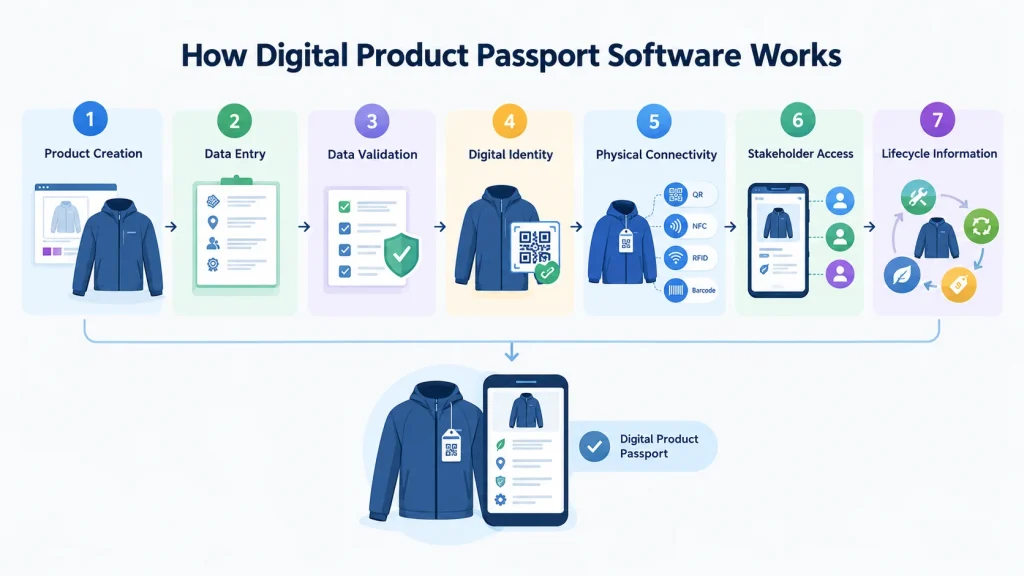
Product Creation
The manufacturer registers the jacket as a product model in the DPP platform, along with its size and color variants.
Data Entry
Data related to fabrics used, materials, manufacturing locations, suppliers, certifications, and other related attributes are entered into the software.
Data Validation
The platform checks whether the required attributes have been filled in and whether supporting documents, certificates, and supplier information have been validated.
Digital Identity
The platform creates or links a distinct identifier to each product, ensuring that every item can be easily recognized and tracked throughout its lifecycle.
Physical Connectivity
The ID can be represented by means of a QR code, NFC tag, RFID, barcode or any other medium.
Stakeholder Access
Various stakeholders access the passport using this identifier and get the information authorized for their view.
Lifecycle Information
Information regarding repair, refurbishment, resale, maintenance and recycling can be added when it is enabled in the business model and data architecture of the system.
The result is a digital record that can stay connected to the physical product throughout its useful life.
Benefits of Digital Product Passport Software
Better Product Transparency
Businesses can provide structured information about products instead of relying entirely on disconnected documents.
Improved Traceability
Companies can connect product information across suppliers, manufacturing, distribution, ownership, service, and end-of-life processes.
Support for Circular Business Models
Product passports can support repair, refurbishment, resale, reuse, and recycling workflows. Recyclers can combine passport data with waste management software to plan collection and material recovery.
Better Customer Experience
Customers can scan a product and quickly access relevant information without searching through multiple documents.
More Efficient Compliance Processes
Centralized product data can make it easier to organize information needed for applicable regulatory requirements.
Stronger Supply-Chain Visibility
Manufacturers can understand where product components and materials originate and identify gaps in their information.
Challenges in Implementing DPP Use Cases
Digital Product Passports can create significant opportunities for product traceability, supply-chain transparency, and lifecycle management. However, turning a DPP strategy into a working system across multiple products and suppliers is not as simple as it sounds.
The biggest challenges usually come down to where product data lives, how reliably it can be collected, and whether different stakeholders can work with the same data structure.
Fragmented Product Data
Product information doesn’t sit in one place. A manufacturer may have material specifications in a PLM system, production details in an ERP, supplier information in separate portals, and sustainability data sitting in spreadsheets or documents.
Bringing all of this information together to create a complete Digital Product Passport can require a lot of manual effort. Teams may have to repeatedly collect, compare, clean, and reconcile data before it is ready to be published.
Digital product passport software therefore needs to connect with existing business systems and create a centralized product-data layer rather than forcing businesses to replace every system they already use.
Limited Supplier and Sub-Supplier Visibility
A product’s story begins before it reaches the manufacturer. Materials and components can pass through multiple suppliers and sub-suppliers, making it difficult to maintain visibility across the entire supply chain.
For DPP use cases, businesses may need information about material origin, processing, certifications, recycled content, or sustainability practices from upstream suppliers. However, collecting this information consistently across multiple tiers can be challenging.
A DPP solution provides supplier portals, data-submission workflows, validation mechanisms, and permission-based access that make it easier to collect and maintain information across the supply chain.
Inconsistent Data Standards
Scaling a digital product passport becomes more complicated when different suppliers, business units, industries, or markets use different data formats and definitions.
One supplier may provide material information in one format, while another uses a completely different structure. If these datasets cannot communicate with one another, businesses may face additional data-cleaning work, integration problems, and difficulties maintaining consistent product information.
For this reason, digital product passport software needs a flexible and standardized data model that can accommodate different product categories while supporting interoperability with existing enterprise systems and external data ecosystems.
Data Accuracy and Verification
Collecting product data is only one part of the challenge. Businesses also need confidence that the information entering a Digital Product Passport is accurate, current, and supported by appropriate evidence.
Incorrect supplier information, outdated certifications, incomplete records, or inconsistent sustainability data can reduce the reliability of a digital product passport.
Features such as automated validation, document verification, approval workflows, audit trails, and data-quality checks can help businesses establish greater control over the information published through their product passports.
Scaling Across Large Product Portfolios
Creating a digital product passport for a handful of products may be manageable manually. The challenge becomes much greater when a company has thousands of SKUs, multiple product variants, global suppliers, and frequent product updates.
Businesses need automation to generate passports, import product information, update records, manage identifiers, and monitor data completeness at scale.
This makes API integrations, bulk data management, automated workflows, and centralized administration important considerations when investing in DPP software.
Not Sure Where to Start With Digital Product Passports?
Get expert guidance from Triple Minds to understand your DPP requirements, define the right platform approach, map product and supply-chain data, and plan integrations before development begins.
Talk to a DPP Consultant
How to Choose the Right Digital Product Passport Software?
When choosing a technology partner for developing digital product passport software, know that not all software development agencies understand manufacturing data at the same depth. Therefore, before investing in an agency, you should look at its experience, request a demo, and check its portfolio and case studies before you decide whether to choose it or move to another development agency. At Triple Minds, we help businesses and entrepreneurs develop custom software as well as white label software such as digital product passport systems. For more information, you can book a free consultation call so that we can understand your requirements and provide reliable solutions.
Digital Product Passport Software FAQs
Is a QR code required for a Digital Product Passport?
No. A QR code is one possible way to connect a physical product with its digital passport, but DPP implementations can use other identification technologies such as NFC, RFID, or barcodes depending on the product and business requirements.
Can DPP software integrate with ERP and PLM systems?
Yes. Integration with ERP, PLM, CRM, inventory, manufacturing, supply-chain, and e-commerce systems can help businesses automatically exchange product information instead of entering the same data into multiple platforms. APIs are commonly used to support these integrations.
How does DPP software help with supply-chain traceability?
DPP software can connect product information with supplier and sub-supplier data, helping businesses understand where materials and components originate and maintain relevant information throughout the supply chain. The depth of traceability depends on the product, available data, and the organization’s supply-chain structure.
What user roles are required in DPP software?
Common roles include manufacturers, suppliers, distributors, retailers, customers, repair providers, recyclers, compliance teams, and platform administrators. Each role can be given different permissions to view, submit, edit, or verify product information.
Is a Digital Product Passport mandatory, and when does it start?
In the European Union it is becoming mandatory one product group at a time. The Ecodesign for Sustainable Products Regulation has been in force since 18 July 2024, and the European Commission timeline starts with batteries on 18 February 2027, followed by textiles, tyres, and aluminium in 2027, furniture in 2028, and mattresses and ICT products in 2029.
What products need a Digital Product Passport?
The first groups named by the European Commission are batteries, textiles, tyres, steel and aluminium, furniture, mattresses, ICT products, and energy-related products. Separate EU laws also bring passports to toys, construction products, detergents, and packaging. The rules cover products placed on the EU market, including imports, so manufacturers outside Europe that sell into the EU are affected too.
How much does Digital Product Passport software cost?
The cost depends on how many products and variants you manage, how many supplier tiers contribute data, which systems you integrate (ERP, PLM, PIM), and whether you need item-level serialization and multi-language passports. A white label platform is usually faster to launch, while custom development suits complex data models. Triple Minds can scope both options in a free consultation.
Got a project in mind? Let’s build it together.
We work with founders and product teams across consulting, development, and growth marketing. Tell us what you’re building and we’ll show you how we’d ship it.