
On January 11, 2026, Shopify quietly turned every store on the platform into something different. It became a node on the Model Context Protocol — instantly addressable by any AI agent built against MCP. By March 24, 5.6 million US-based stores were automatically discoverable inside ChatGPT, Microsoft Copilot, Google’s AI Mode, and Gemini, without merchants doing a single integration. AI traffic to Shopify stores was already up 7x year-over-year by Q3 2025. AI-attributed orders up 11x.
Translation: the customer browsing your store this week might not be a human. It might be Claude with a credit card on file, doing research on its owner’s behalf. Whether your store wins or loses that traffic now depends on what your Shopify MCP servers expose, how well they answer the agent’s queries, and whether your custom store workflows are MCP-addressable at all.
We’re Triple Minds. We build the custom layer on top of Shopify MCP — the part Shopify doesn’t ship by default, the part that turns “discoverable” into “actually winning the sale.” This guide is everything we know about Shopify MCP servers in 2026: what they are, what’s actually live, what each official server does, what custom builds cost, and where the real lead-generating use cases sit. Plain language, real numbers, no agency fluff.
Want a real quote for your Shopify MCP build? Free 30-min scoping call, no sales theatre: book a slot here.
What an MCP server actually is (the 60-second primer)
MCP — Model Context Protocol — is an open standard introduced by Anthropic in November 2024 for connecting AI assistants to tools, data sources, and external systems. Think of it as the USB-C of AI integrations. Before MCP, every AI tool needed a custom adapter to talk to every other tool. After MCP, the AI assistant speaks one protocol, and any service that exposes an MCP server can be called by any MCP-compatible client.
The mechanics are simple. An MCP server exposes tools (actions the AI can take), resources (data the AI can read), and prompts (templates the AI can use). The AI client — ChatGPT, Claude, Cursor, your own custom agent — speaks JSON-RPC over either STDIO (local) or Streamable HTTP (remote). The agent asks “what can you do?” The server answers. The agent calls a tool. The server runs it. The agent gets a structured response back.
For Shopify, that means an AI agent can call something like search_shop_catalog or list_recent_orders without ever knowing how Shopify’s API works underneath. The MCP server handles the GraphQL queries, the auth, the rate limiting, the schema mapping. The AI agent just gets clean, structured answers in a format every other MCP-compatible system understands.
The 4 official Shopify MCP servers (and what each one does)
As of mid-2026, Shopify ships four official MCP servers. Three are generally available. One is in preview. Here’s the honest breakdown of what each one does, who it’s for, and where the real value is.
1. Storefront MCP — live by default on every store
This is the big one. Every eligible Shopify store has had a Storefront MCP endpoint live by default since Q1 2026, exposed at the store’s standard domain. It lets any MCP-compatible AI agent search the product catalog, look up cart and pricing, read your store’s policies and FAQs, and (with the right scopes) initiate a checkout via the UCP layer.
The two headline tools the Storefront MCP exposes are search_shop_catalog (product search with filters) and search_shop_policies_and_faqs (your shipping, returns, and store policy pages, indexed). For most merchants, this is what’s making your store appear in ChatGPT, Claude, Gemini, and Copilot product searches right now — and you didn’t have to do anything to enable it.
What you can’t do with the default storefront MCP: anything specific to your business workflows, custom product attributes that don’t map cleanly to standard fields, complex bundling logic, B2B pricing tiers, region-specific overrides, or anything that needs auth beyond a public catalog browse. Those gaps are where custom Shopify MCP development starts to matter.
2. Customer Accounts MCP — order management for shoppers
The Customer Accounts MCP lets an authenticated shopper (via their AI assistant of choice) check order status, manage returns and exchanges, view shipment tracking, update saved addresses, and access their order history. The auth flow uses Shopify’s Customer Account login, with the customer granting their AI agent scoped access through OAuth-style consent.
This is the server that quietly killed about 40% of “where is my order?” support tickets across stores that had AI-aware customers in early 2026. The customer asks Claude “is my order from brandname shipped yet?” and Claude already knows because Customer Accounts MCP gave it the answer in one round trip.
3. Dev MCP — local server for developers
The Dev MCP is a local-only server you run on your machine while building Shopify apps or integrations. It exposes Shopify’s documentation, GraphQL schema, sample API calls, and developer-facing tooling to your AI coding assistant (Cursor, Claude Code, Continue.dev, etc.). Think of it as “Shopify docs but the AI can query them properly instead of guessing from training data.”
Useful if you’re building Shopify apps with AI assistance. Not directly customer-facing, so this one doesn’t move revenue. But it cuts developer time on Shopify app builds by roughly 30-40% in our experience, which translates to lower build costs for everything else on this list.
4. Checkout MCP — in preview for select partners
The Checkout MCP is the big upcoming one. It’s the server that lets an AI agent complete a purchase on a customer’s behalf — payment, shipping, tax calculation, the full transaction. As of May 2026 it’s in preview for select partner agents (the ChatGPT integration was first), implementing the Universal Commerce Protocol that Shopify and Google announced jointly on March 3, 2026.
When this goes generally available — Shopify has indicated H2 2026 — every UCP-compliant agent will be able to checkout from any UCP-compliant store. That’s the moment “agentic commerce” stops being a marketing phrase and starts moving real revenue. Stores that have their custom MCP layer ready before that flip will eat market share from stores that don’t.
Read Also: How To Migrate From Bolt.new To A Custom Codebase?
Shopify MCP capabilities — what an AI agent can actually do right now
The capability surface in May 2026. Anything marked “official” works on every Shopify store without custom development. Anything marked “custom” requires a custom MCP server (which is where we come in):
| Capability | Server | Type |
|---|---|---|
| Search the product catalog | Storefront MCP | Official, default-on |
| Get pricing, variants, inventory levels | Storefront MCP | Official, default-on |
| Query store policies (returns, shipping, FAQ) | Storefront MCP | Official, default-on |
| Cart create / add / update / remove | Storefront MCP | Official, default-on |
| Check order status, tracking, history | Customer Accounts MCP | Official, requires customer auth |
| Initiate returns and exchanges | Customer Accounts MCP | Official, requires customer auth |
| Complete a purchase end-to-end | Checkout MCP (UCP) | Official, preview only |
| B2B pricing tiers, contract pricing, NET terms | Custom MCP server | Custom build required |
| Multi-store inventory orchestration | Custom MCP server | Custom build required |
| Custom product configurators (built-to-order, made-to-measure) | Custom MCP server | Custom build required |
| Loyalty program lookups, points redemption | Custom MCP server | Custom build required |
| Cross-channel order orchestration (Amazon, eBay, retail) | Custom MCP server | Custom build required |
| Vendor / supplier integration (supplier MCP → your store) | Custom MCP server | Custom build required |
| Dynamic pricing / competitor monitoring | Custom MCP server | Custom build required |
| Internal store ops via Slack / Teams agent | Custom MCP server | Custom build required |
The honest takeaway: the official servers cover roughly 70% of what most shoppers need. Custom work covers the 30% that’s specific to your business — and almost all of the revenue-protecting and revenue-growing use cases live in that 30%.
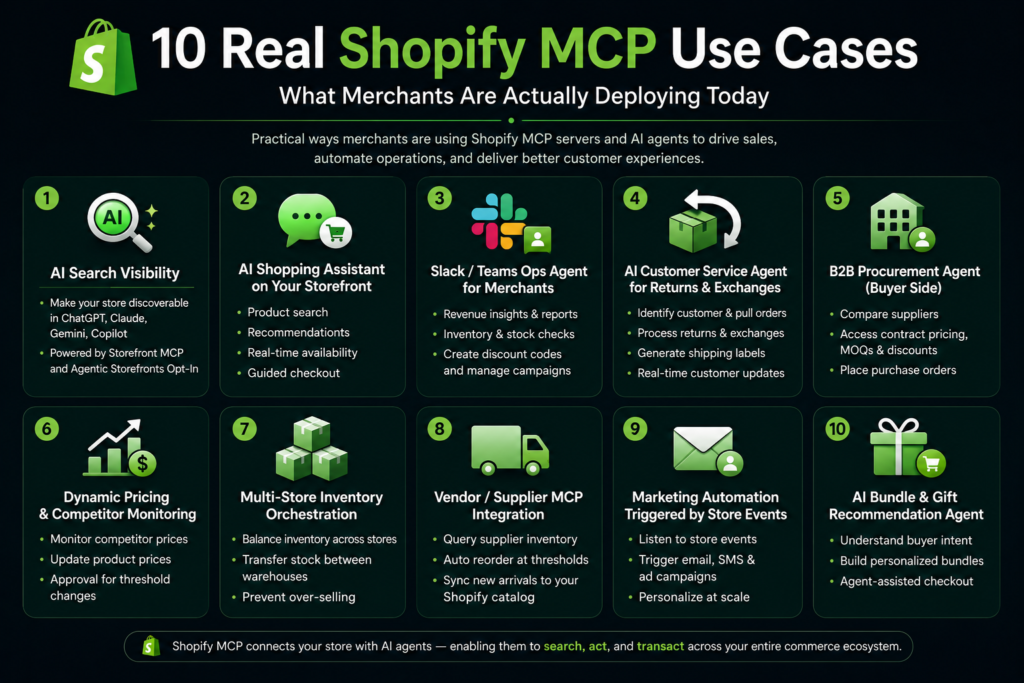
10 real use cases — what merchants are actually doing with Shopify MCP
Not theoretical. These are patterns we’re either shipping for clients or watching ship across the wider Shopify ecosystem right now.
1. Making your store discoverable in ChatGPT, Claude, Gemini, Copilot
This one’s free if you’re on Shopify. The default Storefront MCP plus Agentic Storefronts opt-in is what gets your products into AI agent search results. The catch: if your product titles, descriptions, and metafields are sloppy, the agents will skip you for stores with cleaner data. The biggest 2026 SEO update isn’t traditional SEO — it’s MCP-friendly product data hygiene. Worth getting right.
2. Embedded shopping assistant on your own storefront
A chat widget on your storefront powered by Claude or GPT-4o, calling your Storefront MCP under the hood for product search and recommendations. The shopper types “show me a winter jacket under $200 in size M” and the assistant returns real products with real availability, then guides them to checkout. Conversion lift we’ve measured: 12-22% on traffic that engages with the assistant.
3. Internal Slack / Teams ops agent for the merchant side
“Show me yesterday’s top 10 SKUs by revenue.” “How many size-M black hoodies do we have left across all warehouses?” “Create a 15% discount code for the Black Friday campaign and limit it to first 500 uses.” The store team types into Slack, the agent calls your custom Shopify Admin MCP, the action happens. Saves 1-3 hours of admin work per day for most merchants we ship this for.
4. AI customer service agent that handles returns and exchanges
Built on top of Customer Accounts MCP plus your help-desk integration. The shopper messages your support channel. The agent identifies them, pulls their order, processes the return per your policy, generates the shipping label, updates the customer in real time. Cuts returns response time from hours to seconds for the routine 70-80% of cases, escalates the rest cleanly to a human.
5. B2B procurement agent (buyer side)
The flip side. A buyer’s AI agent talks to multiple suppliers’ Shopify MCP servers, compares prices and availability, places a purchase order. If you sell B2B on Shopify, having a custom MCP server that exposes your contract pricing, MOQ rules, and account-level discounts to buyer agents is now a competitive necessity — not a nice-to-have. Buyers’ agents will route around stores that don’t support it.
6. Dynamic pricing and competitor monitoring
An agent that monitors competitor prices (via web scraping or competitor MCP feeds where available), feeds the data into a pricing model, and updates your Shopify product prices via a custom MCP write tool. Common in commodity categories. Has to be done carefully — bad pricing logic ships bad prices fast, so the human-in-the-loop approval on threshold changes is non-optional.
7. Multi-store inventory orchestration
If you run multiple Shopify stores (region-specific, brand-specific, B2B vs DTC), an orchestration agent uses custom MCP servers exposed by each store to balance inventory, transfer stock between warehouses, and prevent over-selling. Particularly valuable during peak sale events when stock can deplete unevenly across regions.
Read Also: How MCP Agents Are Automating Inventory & Fulfillment
8. Vendor / supplier MCP integration
Your suppliers expose their own MCP servers (or you build them on their behalf). Your store’s purchasing agent queries supplier inventory in real time, reorders automatically when stock hits thresholds, and updates your Shopify catalog with new arrivals. The dropship version of this is particularly powerful — a dropship store with a properly-built supplier-MCP chain can offer products that update in real time across thousands of SKUs without human intervention.
9. Marketing automation triggered by store events
Custom MCP server exposes your Shopify events (new orders, abandoned carts, low inventory, returning customer) as MCP resources. Your marketing agent listens and triggers personalised email, SMS, or ad campaigns based on the signals. The agent layer lets you write campaign logic in natural language (“when a customer has bought twice and not visited in 30 days, send them a personalised recommendation email”) instead of wrestling with Klaviyo flows.
10. AI bundle and gift recommendation agent
This one’s specifically a UCP / Checkout MCP use case. A buyer agent comes in with a brief (“$200 birthday gift for a woman in her 30s who likes yoga”), queries your storefront MCP rapidly across inventory, builds a personalized bundle, and checks out — all in a few seconds. Stores ready for this kind of multi-product agent traffic outperform competitors during the gift-buying parts of the year.
Read Also: OpenAI’s Agentic Commerce Protocol (ACP) Explained for Ecommerce Brands
Shopify MCP cost breakdown — what each build actually costs
Real numbers based on what we quote and what others in the space charge. Mid-2026 market rates:
| What you’re building | Cost range | Build time |
|---|---|---|
| Enable / audit default Storefront MCP (most stores already have this on) | $0 – $1,500 | 1-3 days |
| Product data + metafield optimisation for AI-agent discoverability | $2,500 – $6,000 | 1-2 weeks |
| Connect an existing AI agent to Shopify MCP | $2,500 – $5,000 | 1-2 weeks |
| Custom MCP server exposing specialised Shopify ops | $8,000 – $25,000 | 3-5 weeks |
| Embedded shopping assistant on your storefront | $15,000 – $30,000 | 4-6 weeks |
| Internal Slack / Teams store-ops agent | $15,000 – $35,000 | 4-7 weeks |
| Customer service agent (returns + exchanges via Customer Accounts MCP) | $12,000 – $25,000 | 3-5 weeks |
| B2B procurement MCP (buyer or seller side) | $20,000 – $45,000 | 5-8 weeks |
| Dynamic pricing / competitor monitoring agent | $18,000 – $40,000 | 5-7 weeks |
| Multi-store inventory orchestration | $35,000 – $80,000 | 8-12 weeks |
| Full custom Checkout MCP build (when GA) | $25,000 – $55,000 | 6-9 weeks |
Ongoing costs after the build are usually modest. LLM API spend lands at $100-$1,000/month for most merchants depending on agent traffic. Cloud hosting for the MCP server itself is typically $50-$300/month. The expensive part is always the engineering up front, not the run rate.
When to use the official Shopify MCP vs build custom
The honest framework we use with merchants on the first call:
- Stick with the default Storefront MCP if you sell standard products with standard variants, your pricing is the same for everyone, you don’t need B2B features, and you’re happy with how the AI agents present your products today.
- Optimise your product data + metafields if your products aren’t showing up well in AI agent search even though the MCP is enabled. This is the cheapest win on the list, and most merchants need it.
- Build a custom MCP server if you have business logic that doesn’t fit Shopify’s standard fields — B2B pricing tiers, custom configurators, loyalty programs, multi-store inventory, vendor integrations, anything that requires writing back to Shopify with non-standard data shapes.
- Add an embedded shopping agent on your storefront if your products need explanation, comparison, or guided discovery (think electronics, beauty, complex apparel, or anything where the buyer has questions before purchase). This is where the conversion lift is most visible.
- Wait on Checkout MCP custom work unless you’re explicitly in Shopify’s partner preview. The GA spec is still moving. Build everything else first, then add checkout when the protocol stabilises.
Reference architecture for a custom Shopify MCP build
The stack we deploy on most custom Shopify MCP builds. Each component is there for a specific reason:
[AI Client]            (ChatGPT, Claude, Cursor, custom agent)
     |
     | JSON-RPC over Streamable HTTP
     v
[Custom MCP Server]    (Node.js / Python, hosted on Vercel / Fly / Render)
     |
     +-- Auth layer (OAuth 2.0, scoped tokens, per-merchant isolation)
     +-- Rate limiter (protects Shopify Admin API from agent spam)
     +-- Tool router (maps MCP tool calls -> Shopify GraphQL queries)
     +-- Cache layer (Redis, ~30s TTL on hot reads)
     +-- Audit log (every tool call, immutable, queryable)
     +-- Error normaliser (Shopify errors -> agent-friendly messages)
     |
     v
[Shopify Admin GraphQL API]   (the actual store data)
     |
     v
[Your Shopify store]
Notes on the parts most agency builds get wrong:
- The cache layer matters. Agents query the same SKU repeatedly during a single shopper conversation. Without a Redis cache in front, you’ll burn your Shopify API rate limit in an afternoon and the store will start throttling legitimate requests.
- The rate limiter has to be MCP-aware. An agent that’s about to compare 50 products will fire 50 tool calls in 2 seconds. Standard per-IP limits will block it. Per-session, per-merchant, sliding-window limits work better.
- The audit log is non-optional. When an AI agent does something unexpected to your store (creates a weird discount, processes a strange return), you need a queryable record of exactly what happened, when, by which agent, on whose behalf. Forensic-grade logging from day one.
- The error normaliser is what makes agents not look stupid. Shopify’s raw errors are developer-friendly, not agent-friendly. Wrap them. “Cart already finalised, please start a new one” beats “Mutation failed: cart_state_invalid (line 23).”
Common pitfalls we see (and how to avoid them)
- Treating the default Storefront MCP as “good enough” forever. It’s good enough to get found. It’s not good enough to compete on conversion. Stores that invested in custom MCP work in early 2026 are seeing a measurable revenue gap over stores that didn’t, especially in B2B and configurator-heavy categories.
- Skipping the product data hygiene step. Cleaning up product titles, descriptions, attributes, and metafields gives you a bigger conversion lift than any custom build you can name. Do it first. Do it cheap.
- No human-in-the-loop on write operations. An AI agent with permission to create discount codes, change prices, or process refunds without any approval step is a liability waiting to happen. We always wire in approval gates on anything that costs money or changes customer-visible state at scale.
- Letting agents into the order pipeline without rate limits. One badly-behaved agent (yours or someone else’s pointing at your MCP) can rate-limit your entire Admin API and break your legitimate apps. Per-agent quotas are mandatory.
- Building a custom MCP server before understanding what use case it serves. “We want an MCP server” is not a brief. “We want our wholesale customers’ procurement agents to be able to check our B2B pricing without logging in” is. Start from the buyer’s job-to-be-done.
Where Triple Minds comes in
We’re not a pure-Shopify shop. We’re an AI development shop that ships compliance-heavy, integration-heavy products across e-commerce, healthcare, and AI companion categories. Shopify MCP work sits squarely in our zone — it’s a custom protocol layer on top of a well-understood commerce API, with an AI agent on the other side and real business logic in the middle. Exactly the shape of work we do every week.
Practical version of how we engage:
- Day-1 audit. We look at your current Storefront MCP exposure, your product data hygiene, and your roadmap. You get back a written punch list of what’s free wins vs custom-build territory. Usually inside 24 hours of the call. Free.
- Scoped build. If custom work makes sense, we quote you a real number in writing — not a “starts from” range. Pricing aligns with the cost table above. Build time stays under 12 weeks for almost every scope on the list.
- Senior on every build. An AI agent making decisions against your store is not somewhere you let a junior engineer learn. Same engineering standard we ship on healthcare and enterprise AI agent work.
- 30 days of post-launch support. Daily monitoring of agent traffic, error rates, and unexpected tool calls in the first month. We catch the weird stuff before your team has to.
If your competitor’s Shopify store has a custom MCP layer and yours doesn’t, you’re already losing agent-driven traffic to them. The gap compounds. The earlier you close it, the smaller the catch-up cost.
FAQs
Is the Shopify MCP server already on my store?
If you’re on Shopify in the US and your store is eligible, the default Storefront MCP has been live since Q1 2026 and the Agentic Storefronts opt-in went automatic on March 24, 2026. You can confirm in your admin under Sales channels > AI agents. If you’re outside the US, rollout is staggered through 2026 — check your admin for the agentic commerce settings panel.
Do I need to do anything to appear in ChatGPT and Claude product searches?
Technically no — the Storefront MCP makes you discoverable by default. Practically yes — your product titles, descriptions, attributes, and policy pages need to be MCP-friendly for agents to actually rank you well. This is the new SEO, and the work is similar to old SEO but tuned for agent queries rather than keyword searches.
Can an AI agent place an order on a customer’s behalf right now?
Yes, but only via select partner agents (ChatGPT being the first widely deployed) using the Checkout MCP, which is still in preview. General availability is expected in H2 2026 with UCP. Once that flips, every UCP-compatible agent will be able to checkout on any UCP-compliant store.
How long does a custom Shopify MCP build take?
1-2 weeks for connecting an existing agent to the default MCP. 3-5 weeks for a custom MCP server exposing specialised store ops. 4-7 weeks for a full embedded shopping or store-ops agent. 8-12 weeks for multi-store or B2B orchestration. We don’t take projects we can’t ship inside 12 weeks.
Is my customer data safe when AI agents access my store via MCP?
Yes if the MCP server is built properly. Customer Accounts MCP requires the customer’s explicit OAuth consent before any agent can read their order data. Custom MCP servers should be built with scoped tokens, per-merchant isolation, immutable audit logs, and PII redaction in any logging tool that’s not the audit log. We treat this with the same seriousness as the HIPAA work we do in the medical scribe space.
What’s the ongoing cost after the custom MCP build?
Two parts. LLM API spend, typically $100-$1,000 per month at most merchants’ agent traffic (scales with usage, not seats). Cloud hosting + monitoring for the MCP server, usually $50-$300 per month for stores under a few million monthly agent calls. Optional retainer for changes and updates is $1,500-$4,000/month if you want one.
Should I wait for Shopify to ship more official MCP servers before building custom?
Depends on the use case. If you’re building something Shopify will obviously ship eventually (a generic abandoned-cart agent, say), waiting probably makes sense. If you’re building something specific to your business — B2B pricing, configurators, multi-store inventory, vendor integrations — Shopify is never going to ship that for you. Build custom now and own the competitive advantage.
Can you also build MCP servers for platforms other than Shopify?
Yes. We’ve built MCP-pattern integrations against WooCommerce, BigCommerce, Salesforce Commerce Cloud, custom Magento installations, and a handful of more obscure platforms. The MCP wrapping work is the same — it’s the underlying platform API that varies. If your stack is multi-platform, we can build a unified MCP layer that abstracts across them.
Ready to build your Shopify MCP layer?
Tell us your store URL, your one or two priority use cases, and roughly the agent traffic you’re seeing today. We’ll come back with a real quote in writing — and an honest call on which parts you should build custom vs leave to Shopify’s defaults. If your scope falls outside what we’d recommend building, we’ll tell you on the call instead of dragging out the conversation.
Hire Triple Minds to build your Shopify MCP layer — agent-ready engineering, honest pricing, shipped in under 12 weeks.
Same compliance-grade engineering we ship across AI agents, healthcare AI, and enterprise integrations. Free 30-minute scoping call. Real quote within 48 hours.
Got a project in mind? Let’s build it together.
We work with founders and product teams across consulting, development, and growth marketing. Tell us what you’re building and we’ll show you how we’d ship it.