How MCP Agents Are Automating Inventory & Fulfillment
MCP agents are transforming inventory and fulfillment by enabling AI to reason, access live business data, and automate operational decisions across multiple enterprise systems. This guide explains how MCP agents work, their real-world use cases, business benefits, implementation strategies, and why they are becoming a key building block for agentic commerce.

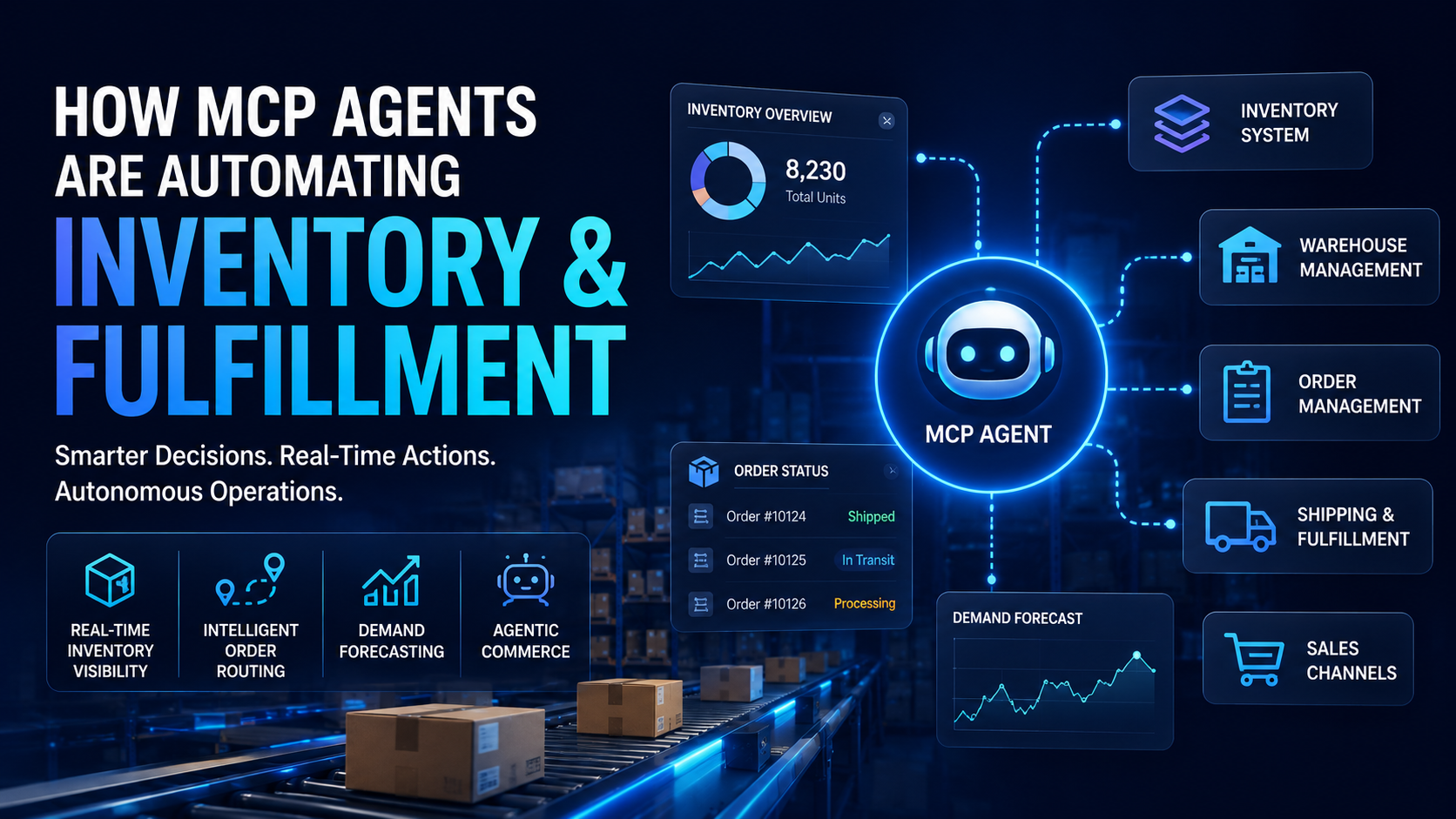
MCP agents solve one of the biggest limitations of traditional inventory and fulfillment automation: the inability to reason, adapt, and act across multiple systems. While conventional automation can transfer data between applications, every new workflow typically requires custom integrations, brittle scripts, or manually maintained rules.
MCP agents replace these isolated automations with a standardized way for AI to access business context and interact with enterprise systems. Now, they can execute actions across inventory, warehouse, and order management platforms. Rather than simply moving data, the MCP agents understand operational context, make informed decisions, and coordinate end-to-end workflows.
This now eliminates the need for a developer team to connect inventory, order management, and fulfillment systems for better decision-making. Now, an AI agent can directly connect these tools using a standard protocol.
The result is a shift from passive automation to agentic operations, where AI systems can read live data, make context-aware decisions, and execute approved actions on their own.
We at Triple Minds have assisted over 15+ businesses worldwide in implementing production-ready ecommerce MCP servers & agents. As agentic shopping becomes the new standard, we ensure you are ready to automate inventory & fulfillment through AI.
In this post, we break down what MCP agents are, how they apply specifically to inventory and fulfillment, the real use cases already in production, the benefits businesses are seeing, and what to consider before rolling this out in your own operations.
How MCP Agents Turn Inventory Systems into Autonomous Operations
Most existing inventory tools are read-only from an AI perspective. They can generate a report, flag a low-stock SKU, or send an alert, but a human still has to interpret that information and act on it. However, this is where MCP agents change the equation. As these agents have both read and write access to the underlying systems.
With an MCP-connected inventory system, an AI agent can access live stock levels across every warehouse and sales channel, reorder triggers based on sales velocity and lead time, and allocation logic that determines which orders should be fulfilled from which location.
The practical difference this makes is significant. If a flash sale causes a SKU to sell out unexpectedly, an agent with write access can pause the related ad campaign automatically, without anyone needing to notice the stockout first and manually intervene.
That is the core distinction between traditional automation and agentic automation: the system does not just tell you something happened, rather it responds to it.
Turn Your Ecommerce Platform into an AI-Ready Commerce Ecosystem
MCP servers enable AI agents to securely access inventory, fulfillment, orders, customer data, and business tools in real time. Triple Minds develops custom Ecommerce MCP Servers that connect your existing systems, helping you automate workflows and power the next generation of AI-driven commerce.
Explore Our Ecommerce MCP Server Development Services
How MCP Agents Work in an Inventory and Fulfillment Stack
At a technical level, the architecture involves three main components.
- First is the AI agent itself, which could be a general-purpose assistant or a purpose-built agent trained for a specific operational role such as replenishment or order routing.
- Second is the MCP server, which exposes specific tools from your business systems, such as getInventory, placeOrder, updateStock, or checkSupplierLeadTime.
- Third are the underlying platforms themselves: your order management system, warehouse management system, ERP, supplier portals, and sales channels.
When a request arrives, the MCP agent first understands the task. The request could come from a customer asking about product availability or from an internal event such as a low-stock alert. Based on the available context, the agent selects the appropriate MCP tool and sends a real-time request to the connected system. The response is returned through the same standardized interface. The agent then interprets the result and decides the next action. It can answer the customer, update inventory records, trigger another workflow, or escalate the task to a human when approval is required.
This is a meaningfully different approach from older middleware or robotic process automation tools, which follow fixed, pre-programmed steps. An MCP agent can weigh multiple data points at once, such as recent sales trends, promotional calendars, and supplier lead times, before deciding what action to take. That contextual reasoning is what makes the automation feel less like a rigid script and more like a capable operations assistant working around the clock.
Read Also: OpenAI’s Agentic Commerce Protocol (ACP) Explained for Ecommerce Brands
Core Use Cases for Inventory Automation
Real-Time Stock Visibility Across Channels and Locations
One of the most immediate applications of MCP agents is unifying inventory visibility. Many businesses sell across multiple channels, such as their own website, Amazon, a wholesale portal, and a physical store, but their stock data lives in disconnected systems. An MCP-connected agent can pull live stock levels from every location and channel into a single, consistent view, and just as importantly, write updates back to each platform when stock changes. This reduces the classic problem of overselling a product that was already sold out on another channel.
Automated Reorder Triggers and Replenishment
Instead of a warehouse manager manually reviewing spreadsheets to decide what to reorder, an MCP agent can continuously monitor stock against configured thresholds, factoring in sales velocity, seasonality, and supplier lead times. When a SKU approaches a reorder point, the agent can generate a purchase order recommendation, or in more mature setups, place the order directly with an approved supplier within pre-set spending rules. This turns replenishment from a periodic manual task into a continuous background process.
Intelligent Order Routing and Fulfillment Logic
When an order comes in, deciding which warehouse or fulfillment center should ship it is rarely a simple question. It depends on stock availability, shipping cost, delivery speed promises, and sometimes product-specific handling requirements. MCP agents can evaluate all of these factors in real time and route the order to the optimal location automatically. Some implementations go further, generating specific fulfillment instructions, for example flagging a perishable item for expedited shipping or a fragile item for reinforced packaging, and passing those instructions directly to the warehouse system.
Demand Forecasting and Inventory Optimization
Because MCP agents can pull historical sales data, current trends, and external signals like upcoming promotions, they are well suited to support more accurate demand forecasting. Rather than static reorder points set once and rarely revisited, agents can continuously adjust recommendations based on what is actually happening in the business, helping prevent both stockouts and excess inventory that ties up capital.
Returns and Reverse Logistics
Returns are one of the more operationally messy parts of fulfillment, involving inspection, restocking decisions, and refund processing. Agents connected through MCP can automate parts of this workflow, such as updating inventory counts once a return is received and inspected, flagging items that need to be written off rather than restocked, and triggering refunds or replacement orders based on predefined rules.
Supplier and Procurement Coordination
Beyond internal inventory, MCP agents can also interact with supplier-facing systems, checking lead times, comparing pricing across vendors, and even submitting purchase orders. This creates a more responsive procurement process, where sourcing decisions are informed by live data rather than outdated spreadsheets or infrequent manual reviews.
Multichannel and Marketplace Synchronization
For businesses selling on Shopify, WooCommerce, Amazon, or other marketplaces, keeping product data, pricing, and stock levels consistent across every platform is a constant challenge. MCP servers built for specific platforms allow agents to read and write directly to each one, keeping listings synchronized without the delays that come from batch syncs or manual updates.
Customer Service Tied to Live Inventory Data
Customer service agents built on MCP can answer questions about product availability, delivery estimates, and order status by pulling directly from the same live inventory and order systems used internally, rather than relying on static FAQ content or outdated product pages. This reduces the volume of manual lookups support teams need to perform and speeds up resolution times for common questions.
Read Also: What is a Database Chatbot and How Does it Work?
Real-World Platforms Bringing MCP to Inventory and Fulfillment
The shift toward MCP-based automation is not theoretical. Major commerce and ERP platforms have begun building MCP servers specifically for inventory and fulfillment use cases.
Retail and order management platforms have introduced MCP servers that let AI agents access unified inventory across store locations, generate accurate delivery promises, and support customer service interactions with real-time data. Enterprise ERP and commerce platforms have gone further, connecting agents to both the selling side, covering product discovery and checkout, and the operational side, covering merchandising, demand planning, procurement, and fulfillment, so that agents can reason across the full order lifecycle rather than a single narrow function.
E-commerce-focused MCP servers for platforms like Shopify and WooCommerce allow agents to manage inventory, process orders, and handle support tasks directly within existing store infrastructure, without requiring merchants to rebuild their tech stack from scratch. Commerce networks that connect brands, suppliers, and marketplaces have also introduced MCP layers specifically to make catalog, pricing, and fulfillment data discoverable to AI agents while maintaining strict governance controls, such as role-based access and audit logging, over what agents are allowed to do.
Across these examples, the common thread is the same: businesses are not replacing their existing inventory and fulfillment systems, they are adding an AI-accessible layer on top of them that allows agents to operate within those systems safely and efficiently.
Business Benefits of MCP-Driven Inventory Automation
Faster Response to Demand Changes
MCP-powered agents continuously monitor inventory levels, sales trends, and demand fluctuations in real time. This allows businesses to react immediately to sudden demand spikes, stock shortages, or changing customer behavior instead of waiting for scheduled reports, reducing delays and improving inventory availability.
Fewer Manual Errors
By automating data exchange between inventory, sales, and fulfillment systems, MCP minimizes manual data entry and repetitive lookups. This significantly reduces the risk of human errors, ensuring more accurate inventory records and smoother business operations.
Lower Integration Overhead
Traditional system integrations often require custom APIs and significant development effort for every new application. MCP provides a standardized communication layer, making it easier and faster to connect new tools, suppliers, and platforms while reducing engineering costs.
Improved Customer Experience
With real-time access to inventory and order data, businesses can provide customers with accurate product availability, delivery estimates, and order updates. This helps prevent overselling, shipping delays, and inaccurate information, leading to higher customer satisfaction.
Better Use of Working Capital
MCP enables more accurate inventory forecasting and automated reorder decisions based on live business data. This helps companies maintain optimal stock levels, reducing the costs associated with excess inventory while minimizing revenue loss from stockouts.
Scalability Without Proportional Headcount Growth
As businesses expand into new sales channels, warehouses, or supplier networks, MCP agents can seamlessly manage the increased operational complexity. This allows organizations to scale efficiently without needing to hire additional staff for routine inventory monitoring and coordination tasks.
Getting Started: A Practical Path
Businesses do not need to automate everything at once. A practical approach starts with identifying the systems that already have, or can be given, an MCP-compatible interface, such as an order management system, warehouse management system, or e-commerce platform. From there, most teams begin with read-only use cases, like giving an agent access to live stock and order data for reporting or customer service purposes, before moving into write-enabled use cases such as automated reordering or order routing.
It is worth evaluating any inventory or fulfillment tool being considered by asking a simple question: does it expose MCP endpoints natively, or does it at least have a robust API that a custom MCP wrapper could sit on top of? Systems without either will require more upfront engineering work before agents can be connected.
Governance should be built in from the start rather than added later. This means defining clearly which actions an agent is allowed to take autonomously, such as adjusting reorder quantities within a set budget, versus which actions require human approval, such as placing a large purchase order with a new supplier. Role-based access controls and audit logging are not optional extras in this context; they are what makes agentic automation safe to run in a live operational environment.
Read Also: How Much Does It Cost to Build an AI Agent?
The Shift Toward Agentic Commerce
- From AI Assistants to AI Agents: Businesses are moving beyond AI tools that simply answer questions or generate content toward autonomous AI agents that can monitor operations, identify issues or opportunities, and execute approved actions with minimal human intervention. This evolution is driving the rise of agentic commerce.
- Ideal for Inventory and Fulfillment: Inventory management and fulfillment processes are well suited for AI agents because they rely on structured data, predictable workflows, and clearly defined business rules. This allows agents to make accurate, data-driven decisions while reducing manual oversight.
- High Impact Through Automation: Errors such as stockouts, overselling, or shipping delays directly affect revenue and customer satisfaction. By continuously monitoring operations and responding in real time, AI agents help minimize these issues, delivering measurable business value.
- Growing Adoption of MCP: As more commerce platforms introduce native MCP support and businesses become more comfortable with AI governance, autonomous inventory and fulfillment management is expected to become a standard operational capability rather than an emerging technology.
Organizations that start implementing MCP-driven automation with focused, well-governed use cases today will be better positioned to expand AI-driven operations as the technology matures and business confidence grows.
Build AI Agents That Do More Than Answer Questions
Modern AI agents should be able to retrieve live business data, execute workflows, interact with enterprise systems, and make context-aware decisions. Triple Minds develops production-ready AI agents with secure integrations, MCP architecture, RAG, GraphRAG, and enterprise-grade guardrails for scalable business automation.
Discover Our AI Agent Development Services
Final Thoughts
MCP agents transform inventory and fulfillment management from manual monitoring to intelligent systems that observe, reason, and act within defined rules.
The goal is not to replace operations teams. Instead, MCP agents automate routine tasks, allowing people to focus on strategy, exceptions, and critical decisions.
Businesses managing inventory across multiple channels, warehouses, or suppliers should consider MCP-based automation. The technology is maturing rapidly, platforms are adding native support, and benefits include better cash flow, fewer stockouts, and faster fulfillment. Early adopters are already gaining a competitive advantage.
At Triple Minds, we have helped 15+ businesses worldwide design and deploy production-ready ecommerce MCP servers and agents. If you are exploring how MCP agents could fit into your inventory and fulfillment stack, our team can help you assess your existing systems, identify the right starting use cases, and build an implementation roadmap suited to your business. Get in touch today to start automating your inventory and fulfillment with MCP agents.
Quick Answers to Common Questions
What are MCP agents in inventory and fulfillment?
MCP agents are AI-powered systems that use the Model Context Protocol (MCP) to connect with inventory, warehouse, ERP, and order management platforms. They can access live business data, reason over operational context, and execute approved actions such as inventory updates, order routing, and replenishment.
How are MCP agents different from traditional inventory automation?
Traditional automation follows predefined rules and workflows, while MCP agents can interpret context, choose the appropriate tools, and make informed decisions across multiple connected systems. This enables more adaptive and intelligent inventory and fulfillment operations.
What business processes can MCP agents automate?
MCP agents can automate real-time inventory visibility, stock replenishment, intelligent order routing, demand forecasting, marketplace synchronization, supplier coordination, returns management, and customer support by working directly with connected business systems.
What are the benefits of using MCP agents for inventory management?
Organizations can reduce manual work, improve inventory accuracy, minimize stockouts, optimize working capital, enhance customer experience, simplify system integrations, and scale operations more efficiently through AI-driven automation.
How can businesses start implementing MCP agents?
A practical approach is to begin with read-only use cases such as inventory visibility and reporting, then gradually expand to write-enabled workflows like automated replenishment or order routing. Strong governance, role-based permissions, and human approvals for critical actions are essential for safe deployment.
Got a project in mind? Let’s build it together.
We work with founders and product teams across consulting, development, and growth marketing. Tell us what you’re building and we’ll show you how we’d ship it.