Should I Hire a Vibe Coder or a Senior Developer?
Should you hire a vibe coder or a senior developer? This guide compares AI-assisted vibe coding with senior software engineering across speed, cost, scalability, security, maintenance, and production readiness. Learn when a vibe coder is enough, when senior engineering is essential, and why combining AI coding tools with experienced developers is the smartest long-term strategy.

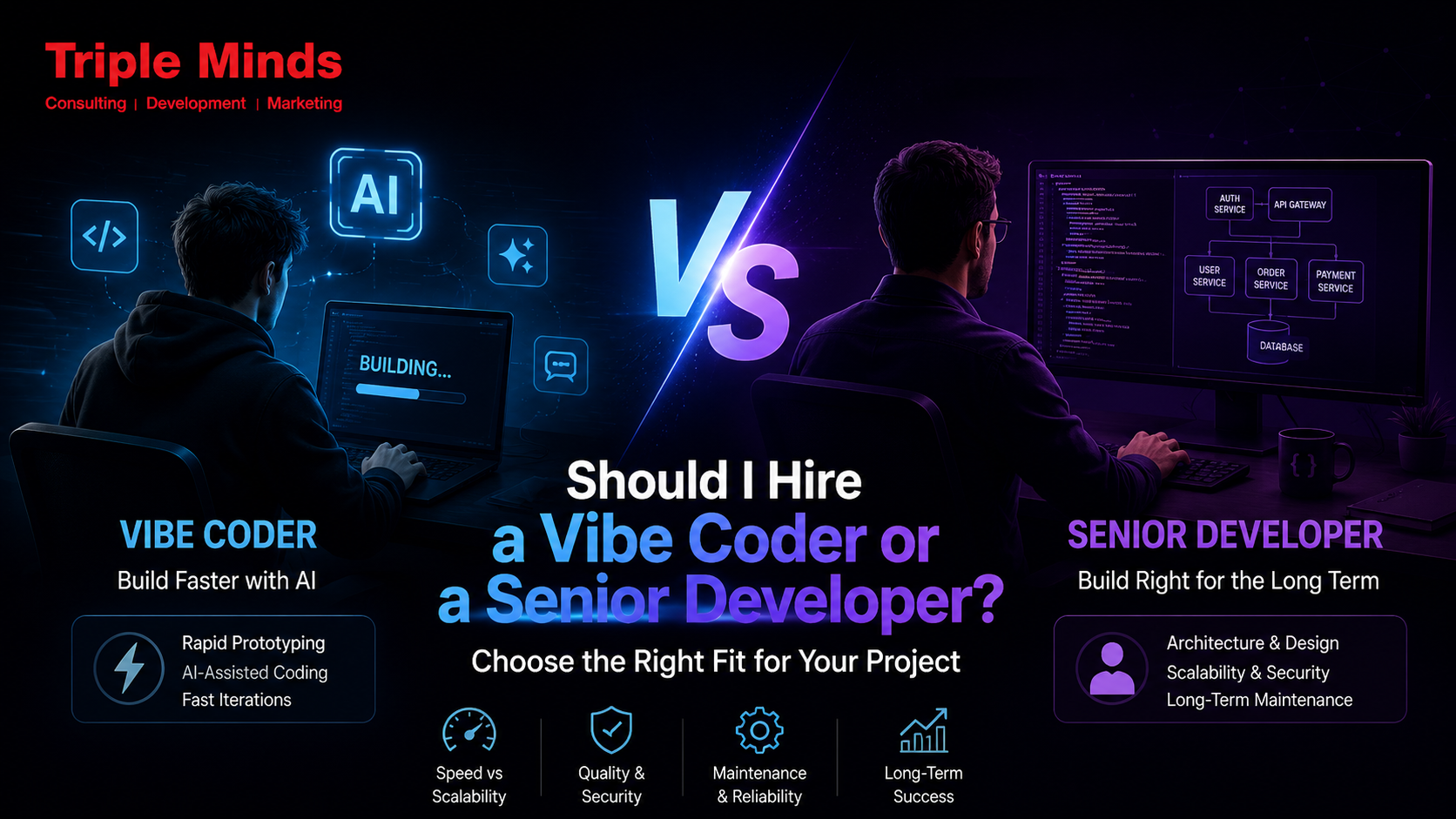
You need a quick prototype? Hire a vibe coder. Your software needs security, scalability, reliability, and long-term maintenance? Senior developers can make the right choice for you.
The decision about whether you should hire a vibe coder or a senior developer depends less on how much you need and more on what happens if that code fails. AI-powered coding tools can compress weeks of work into days. That part isn’t in dispute. But production software still needs architecture, testing, security review, and someone with the judgment to make hard calls when things get complicated.
At Triple Minds, we combine AI-powered development with senior engineering expertise to help businesses move fast without compromising the quality, security, or scalability of their software. Therefore, in such cases, the best strategy is not to choose one amongst the two but to combine vibe coding speed with senior engineering expertise.
Vibe Coder vs. Senior Developer: What’s the Real Difference?
AI has genuinely changed what’s possible. With tools like Cursor, Claude Code, GitHub Copilot, Lovable, Bolt, v0, and Replit Agents, developers and non-developers alike can describe a feature in plain English and watch working software come together in a fraction of the time it used to take.
That creates an obvious question for founders, startups, product managers, and businesses: what is the best vibe coder or hiring a senior developer? The answer depends on the complexity of your product, risk, users, budget, timeline, and future plans.
- A vibe coder typically uses AI coding tools to describe what they want in natural language and then relies heavily on AI to generate, modify, debug, and iterate on the code.
- A senior developer uses software engineering knowledge to define architecture, make technical decisions, write and review code, test systems, solve complex problems, and plan for long-term maintenance.
A Crucial Consideration
The distinction is not simply: AI vs. human.
It is more accurately, AI-led implementation vs. engineering-led development.
A skilled developer can also be a vibe coder. In fact, some of the most effective modern development teams combine senior engineers with AI coding agents.
The real question is therefore:
Do you need someone who can quickly generate working software, or someone who can take ownership of the software’s technical future?
Looking to Hire Vibe Coding Services? Build Smarter with Triple Minds
AI can generate code quickly, but production-ready software needs expert engineering. Triple Minds helps businesses build faster, audit AI-generated code, fix technical issues, and turn prototypes into secure, scalable applications.
Explore Vibe Coding Development Services
AI Reshaping the Coding Workflow
A vibe coder builds software through AI-assisted workflows. Instead of writing every function by hand, they’ll hand the AI something like: build a SaaS dashboard with user authentication, role-based access, Stripe payments, analytics, and an admin panel. The tool generates a first pass, the person tests it, finds the rough edges, prompts again, and keeps iterating until it works. A vibe coder may use AI to generate UI components, create APIs, build database models, write CRUD functionality, generate forms, add authentication, and perform other time-consuming tasks within a blink.
The only limitation is that generating functional code is not the same as engineering a production system. If the person using the AI cannot evaluate architecture, security, database design, performance, dependencies, and edge cases, they may have difficulty determining whether the generated application is actually good.
AI-generated code can speed up development, but working code is not always ready for real-world use. Learn more about evaluating security, testing, scalability, and maintainability in our guide on Is Vibe-Coded Code Production-Ready? and find out what it takes to move from a fast prototype to reliable, production-ready software.
What Does a Senior Developer Actually Bring to the Table?
A senior developer does much more than write code; they evaluate the complex product requirements and determine:
- What technology should be used
- How the system should be structured
- How the database should be designed
- How APIs should communicate
- How authentication should work
- How permissions should be implemented
- How the application should scale
- How security risks should be reduced
- How the code should be tested
- How infrastructure should be configured
- How future features can be added without breaking existing functionality
On top of all this, senior developers can also use AI coding tools to streamline their tasks and obtain more optimized and refined output as compared to a self-operating AI tool.
A senior engineer working with AI will typically outperform both a traditional developer working the old way and an inexperienced person leaning on AI without any engineering oversight at all.
At Triple Minds, we follow this AI-assisted model, positioning senior engineers alongside AI coding tools while keeping architecture, quality, testing, security, and production decisions under engineering control.
So, Whom Should I Hire – a Vibe Coder or a Senior Developer?
If your primary objective is to drive rapid experimentation, go with Vibe Coder. If your software is designed to handle real users, sensitive data, payments, complex integrations, and long-term business operations, Hire a vibe coder if your primary objective is rapid experimentation. Hire a senior developer if your software will handle real users, sensitive data, payments, complex integrations, or r if you’re building something meant to stick around — bring in a senior developer.
A simple decision framework is:
| Condition | Better choice |
| Landing page or basic prototype | Vibe coder |
| Proof of concept | Vibe coder |
| Simple internal tool | Vibe coder |
| Testing an early product idea | Vibe coder |
| Customer-facing SaaS | Senior developer |
| Payment processing | Senior developer |
| Sensitive customer data | Senior developer |
| Complex API integrations | Senior developer |
| High-traffic application | Senior developer |
| Long-term product | Senior developer |
| Existing AI-generated app that needs productionization | Senior developer + AI |
| Fast MVP that may become a serious product | AI-assisted senior developer |
This table is a starting point, not the whole answer. Let’s get into the details.
Speed: Who Can Build Faster?
Vibe coding has a major advantage when it comes to initial development speed. AI can instantly spit out boilerplate, interfaces, API endpoints, database schemas, forms, and other repetitive scaffolding. A founder can go from idea to prompt to working prototype in an afternoon instead of a sprint. That’s why it’s such a natural fit for startup founders validating an idea, hackathons, proofs of concept, internal experiments, and quick UI prototypes.
That speed is real. But there’s a catch worth sitting with: fast to build isn’t the same as fast to launch. An app that takes two days to generate and then six weeks to debug, secure, and get production-ready hasn’t actually saved you any time compared to building it properly from the start.
Cost: Is a Vibe Coder Cheaper?
AI coding tools may cost considerably less than hiring a developer. Many operate through relatively inexpensive subscriptions or usage-based pricing. But a business building software with AI will spend money on AI tools, hosting, APIs, databases, cloud infrastructure, debugging, testing, security, and ongoing maintenance. And there is another hidden cost: Your own time.
If a founder spends 100 hours prompting an AI, investigating bugs, fixing dependencies, learning a framework, and trying to understand generated code, that time has an opportunity cost.
Wondering what you’ll actually pay to hire a vibe coding developer? Explore our complete pricing guide on Cost to Hire a Vibe Coding Developer to compare freelance rates, agency pricing, regional hiring costs, hidden expenses, and the factors that influence the total budget for AI-assisted software development.
Code Quality: Who Actually Produces Better Software?
Quality is where the distinction becomes more important. Even though AI has the ability to write impressive code, it can also generate code that only works in easy circumstances, contains duplicate logic, pulls in unnecessary dependencies, handles errors poorly, opens up security holes, runs inefficient database queries, and quietly becomes a nightmare to maintain the moment the requirement shifts.
Therefore, we can say that AI-generated code still needs someone to evaluate it. Software produced by vibe coder needs someone who’ll ask why this architecture was chosen, whether the database structure holds up, what happens if the user input increases in bulk, what happens if this API call fails, and can another developer understand this six months from now?
These aren’t the potential questions that the AI platform will ask by itself. They’re the kind of judgment a senior developer makes by habit.
AI can generate code quickly, but it can also introduce hidden bugs, security issues, duplicate logic, and errors that become difficult to manage as software grows. Learn more in our guide on Common Bugs in AI-Generated Code and see why reviewing AI-generated code is essential for building reliable, secure, and maintainable software.
Scalability: Will the Application Grow Your Business?
One of the most crucial factors to choose a senior developer is scalability. A prototype may work perfectly with 10 users, but what happens when the user count increases to 10,000? In this situation, the prototype has a higher probability of falling apart.
Scalability requires real decisions around database indexing, query optimization, caching, load balancing, stateless services, background jobs, queues, rate limiting, CDN usage, storage, observability, and horizontal scaling.
A vibe-coded prototype usually isn’t built with any of that in mind, because the immediate goal was just “make it work.” That doesn’t mean AI can’t build scalable software — it can — but scalable architecture has to be designed on purpose, not discovered after the app starts falling over.
Moving an AI-built MVP beyond the prototype stage can involve significant technical improvements and planning. Our breakdown of the Cost to Make an AI-Built MVP Production-Ready covers the engineering work, costs, and key factors businesses should consider before preparing an application for growth and real-world usage.
Security: Can You Trust AI-Generated Code?
If your application handles sensitive information, security should not be optional, and this is where unreviewed AI-generated code tends to show its weak points. The most common issues in poorly reviewed products or software are exposed API keys, weak authentication, broken authorization, thin input validation, SQL injection, cross-site scripting, unsecured endpoints, missing rate limiting, unsafe dependencies, sloppy data storage, and misconfigured cloud infrastructure.
This is particularly important when your application handles: customer information, payment information, healthcare data, financial information, business-critical data, and proprietary information. The real question was never “can AI write secure code?” It can. But who will verify this? That’s the part experienced developers are for.
Maintenance: Who Fixes This Six Months from Now?
Building software is only the beginning. After launching, you’re fixing bugs, adding features, upgrading dependencies, improving performance, patching vulnerabilities, updating infrastructure, adjusting database schemas, and keeping up with whatever new browser or device just broke your layout.
This is where a vibe-coded application built through hundreds of loosely connected prompts can turn into a real headache. A senior developer approaches the codebase with a different question in mind: A senior developer approaches the codebase differently. They think about: “How will another engineer understand this code next year?”
That mindset shows up in the naming, the documentation, the modularity, the tests, and how dependencies are managed — the unglamorous stuff that makes a codebase survivable long-term.
Technical Decision-Making
Ask an AI which database to use, and it’ll give you an answer. But a senior developer looks at the actual requirements and figures out whether that answer fits or not. For example, the application might require: relational transactions, high write volume, full-text search, vector search, geospatial queries, multi-tenant isolation, or real-time updates — and maybe the right answer involves more than one technology working together. That’s the value senior developers bring even in an AI-first world.
Complex Integrations: Where Engineering Expertise Really Pays Off
The more external systems your app needs to talk to, the more these matters. Think Stripe, Salesforce, HubSpot, Twilio, Google APIs, AWS, OpenAI, Anthropic, an ERP system, internal databases, payment gateways — each one is a new place for something to quietly fail.
A senior developer designs that: proper authentication, webhooks, retry logic, error handling, rate-limit handling, data synchronization, logging, monitoring, fallback paths. A vibe coder can often get an integration working. A senior developer is the one who makes it reliable when Stripe has an outage at 2 a.m.
When Should You Hire a Vibe Coder?
- You don’t know whether customers actually want the product.
- You need something functional to demonstrate the concept.
- The application has limited users and low business risk.
- You want to test several UX approaches quickly.
- The consequences of failure are relatively low.
- You want to experiment before committing to a larger development budget.
When Should You Hire a Senior Developer?
- The application is customer-facing, and your reputation depends on it working reliably.
- Payment systems require careful security and error handling.
- You handle sensitive data, and therefore security and privacy become critical.
- You expect significant traffic, and the architecture needs to account for growth.
- The application is business-critical; downtime directly affects operations or revenue.
- You have complex integrations; multiple external systems need to communicate reliably.
- Regulated industries require additional controls and documentation.
- If you cannot evaluate what AI has created, relying entirely on it introduces unnecessary risk.
The Best Option: Hire a Senior Developer Who Uses Vibe Coding
Here’s the option a lot of businesses overlook entirely: you don’t have to choose between vibe coding and senior developers when you can have both.
A senior developer working with AI coding agents gets the best of each side. AI brings speed, code generation, boilerplate automation, fast iteration, refactoring help, documentation support, test generation, and debugging assistance. Triple Minds provides the best vibe code development services. Our senior developers bring architecture, technical judgment, security awareness, code review, a real testing strategy, scalability thinking, an understanding of the business logic, and — ultimately — accountability for what ships.
How Triple Minds Combines Vibe Coding with Senior Engineering?
Triple Minds builds its vibe-coding model around senior engineers working with AI tools. The process starts with specification and architecture before any AI implementation begins, followed by engineering review, testing, security, and DevOps.
The workflow can be understood as:
1. Define
Clarify the product, users, requirements, workflows, and business objectives.
2. Architect
Determine the technology stack, database, APIs, infrastructure, security model, and scalability requirements.
3. Vibe Build
Use AI coding tools to accelerate implementation and repetitive development work.
4. Review
Senior engineers inspect the generated code for correctness, maintainability, security, and architectural consistency.
5. Test
Validate functionality, integrations, edge cases, performance, and critical workflows.
6. Secure
Perform security checks, dependency reviews, API hardening, and other appropriate controls.
7. Deploy
Move the application into a controlled production environment.
8. Improve
Monitor the application, fix issues, optimize performance, and continue development.
This approach allows businesses to capture the speed of AI without accepting the risks of uncontrolled AI-generated code.
10 Scenarios You Must Consider Before Choosing a Development Approach
1. Are you validating an idea or building a product for real users?
In case of validating an idea, Vibe coding can help you build and test a prototype quickly.
But when building a product for real users, you can consider professional engineering from the start.
2. Will real customers use it?
If yes, you can consider professional engineering that combines both AI development and senior development experience.
3. Will it process payments?
Payments, personal data, financial information, or confidential business data? Prioritize experienced engineering and security review.
4. Will it store sensitive information?
Use professional engineering and security review. No sensitive information? You may have more flexibility with your AI development approach.
5. Does it need to scale?
For small user bases and limited traffic, Vibe coding can be a practical starting point.
But, growing users, transactions, or data volumes need architecture designed for scalability and experienced technical oversight.
6. Will you maintain it for years?
Prioritize maintainability and architecture for long-term products. Invest in clean architecture, documentation, testing, and maintainable code.
7. Is failure relatively harmless?
Little or no business impact? A lightweight vibe-coded solution may work. For lost revenue, unhappy customers, or operational disruption, you should invest in professional development and testing.
8. Would failure cost you revenue or reputation?
Yes. Therefore, professional development is a safer choice.
9. Do you already have an AI-generated prototype?
Consider productionization, refactoring, and security review rather than starting over.
10.Do you want to launch your application quickly without compromising quality?
Consider an AI-assisted senior development team that combines the speed of AI coding tools with expert oversight for architecture, security, testing, and production readiness.
Not Sure Whether Your Project Needs Vibe Coding or Custom Development?
Every project has different requirements. Some products are perfect for AI-assisted Vibe Coding, while others need custom software engineering from day one. Triple Minds helps founders, startups, and businesses evaluate their product goals, timeline, budget, scalability, security, and long-term maintenance requirements to recommend the right development approach for the next stage of growth.
Schedule a Free Project Consultation
Stop Picking Sides — Start Picking Both
Notice something: not once in this entire guide did we actually tell you to pick a lane and stay in it. You know why?
Because the honest answer is that when executed together, both deliver valuable output. So, skip the either/or. Build fast, then build right. Prototype with AI, then bring in someone who knows exactly where AI cuts corners before those corners cut you. Looking for an expert developer who can seamlessly integrate Vibe Code to streamline workflows? Count on Triple Minds.
Got a project in mind? Let’s build it together.
We work with founders and product teams across consulting, development, and growth marketing. Tell us what you’re building and we’ll show you how we’d ship it.