AI-Based Scoring Models: How They Work, Benefits, Types & Use Cases
AI-based scoring models use machine learning to analyze business data, identify patterns, and generate predictive scores for different outcomes. This guide explains how AI scoring models work, the data and algorithms they use, key types and benefits, CRM integration, and the development process.

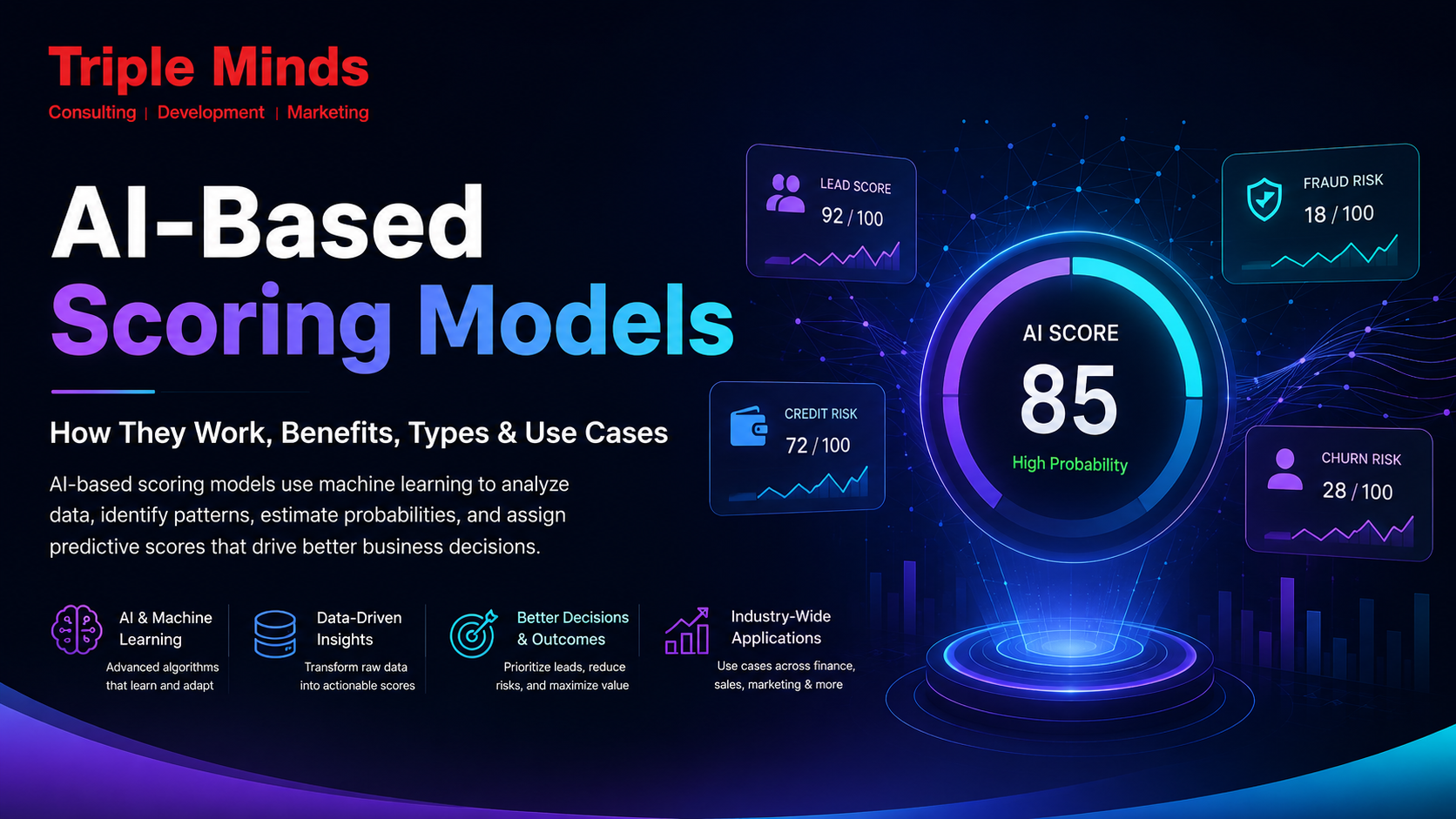
AI-based scoring models use artificial intelligence and machine learning methods to analyze considerable data points to identify patterns, estimate probabilities, and assign a numerical score that predicts the possibility of an action. Do you want to develop an AI-based scoring model for your CRM platform? Triple Minds holds proven AI experience in providing AI development services to businesses that want to develop a custom AI-scoring model.
AI-Based Scoring Model: Key Takeaways
An AI-based scoring model is essentially a prediction engine converted into a usable score. It can help businesses answer questions such as:
- Which lead should sales contact first?
- Which customer is likely to churn?
- Which transaction looks suspicious?
- Which applicant presents higher credit risk?
- Which customer has the greatest lifetime-value potential?
- Which business event requires immediate attention?
If you own a large-scale enterprise, you must know that every day, businesses generate massive data. Customers scroll websites, and depending on the business type, they submit forms, make purchases, interact with your ads, or take some action. Financial institutions process transactions, sales teams track leads across channels, and insurers assess risk from numerous variables. In all such cases, the real challenge is not to collect the information but to convert large volumes of data into informed insight. That is where an AI-based scoring model comes into play.
Instead of relying entirely on fixed rules such as “if X happens, assign 10 points,” AI can learn relationships from historical data and update predictions as new information becomes available. But what exactly is an AI scoring model? How does it work? What data does it use? How is it different from traditional scoring? And how can a business build one?
Let’s break it down.
Ready to Build an AI Scoring Solution for Your Business?
AI scoring models can help businesses turn complex data into measurable predictions and better decisions. Triple Minds helps businesses plan, develop, integrate, and scale AI solutions tailored to their specific data, workflows, and business objectives.
Talk to Our AI Development Experts
What Is an AI-Based Scoring Model?
An AI-based scoring model is a machine-learning system that analyzes historical and real-time data. It calculates a score that represents the likelihood, quality, risk, value, or suitability of a particular outcome.
The score can mean different things depending on the application.
For example:
- A credit scoring model can estimate the probability that a borrower will default.
- A lead scoring model can estimate the likelihood that a prospect will convert.
- A fraud scoring model can estimate whether a transaction is suspicious.
- A customer scoring model can estimate customer lifetime value or churn probability.
- A risk scoring model can estimate the probability or severity of a future risk.
- An employee assessment model may help predict suitability for a particular role.
The important distinction is that rather than being assigned solely through a manual pattern, the score is generally derived from patterns in data. Suppose a lender receives an application. The system might analyze the income, existing obligations, repayment history, credit history, transaction behavior, loan amount, or other permitted data. The model could estimate a probability of default and translate that prediction into an internal risk score.
AI scoring models rely on business data to identify patterns and generate meaningful predictions. Want to learn how AI can interact directly with business databases and turn stored data into actionable insights? Explore What Is a Database Chatbot and How Does It Work? to understand how businesses can query and analyze database information using natural language.
How Does an AI-Based Scoring Model Work?
Define the Scoring Objective
The first step is not choosing an algorithm but defining what the score should predict. The objective can be anything relevant to your long-term business objectives, for example:
- Will this lead become a customer within 30 days?
- What is the probability that this applicant will default within the next 12 months?
- How likely is this transaction to be fraudulent?
This target is often called the target variable, outcome variable, or label. If the goal is not defined accurately, even the most well-developed AI model can produce a score that has little value.
Collect Relevant Data
The AI-based scoring model needs historical data from which it can learn. Depending on the use case, this data collection could include customer data, financial data, and other similar constraints mentioned below:
Customer data
- Demographics where legally appropriate
- Purchase history
- Engagement
- Website behavior
- Customer-service interactions
- Subscription information
Financial data
- Income
- Transaction history
- Repayment behavior
- Existing liabilities
- Credit history
- Cash-flow information
Behavioral data
- Login frequency
- Session duration
- Product interactions
- Browsing behavior
- Response to offers
Contextual data
- Geography
- Device
- Time
- Channel
- Market conditions
- Transaction characteristics
It is not mandatory that if you have large data sets, your model will be better. For valuable outcomes, data must be relevant, accurate, and lawful to use.
Clean and Prepare the Data
Raw business data may contain missing values, duplicate records, incorrect entries, outliers, inconsistent formats, data leakage, and is not ready for machine learning. Before you can build an AI/ML model (like a credit or business scoring model), ensure the data you feed it is clean and error-free. Therefore, data preparation becomes a substantial portion of the development effort.
A model should not accidentally acquire information that would only become available after the event it is supposed to predict. If your model gets access to this information before the analysis, data leakage will happen and your model will appear to be accurate during testing but will perform poorly in production.
Transforming Data into Features
A machine-learning model doesn’t just look at raw data — it looks at “features,” which are the specific variables it uses to make predictions. The trick is that raw data on its own is often not very useful, and you need to reshape it into something meaningful.
Let’s say you have raw data about a customer that states the number of purchases, date of purchase, date of latest purchase, and total spending. These are just facts sitting in a database. They don’t tell the model much about the customer’s behavior. So, you need to transform them into more insightful “features”:
- Purchase frequency
- Customer tenure
- Recency
- Average order value
- Total lifetime spending
Training the AI Model
The prepared or treated historical data is used to train the machine-learning algorithm through common approaches like logistic regression, decision trees, random forest, gradient boosting, neural networks, and deep learning for the following purposes:
- Interpretability and a clear relationship between variables
- Decisions can be represented through hierarchical conditions.
- Combines multiple decision trees to improve predictive robustness.
- Used for structured business data through methods such as XGBoost, LightGBM, and related algorithms.
- For complex relationships and large datasets, although they can be more difficult to interpret.
Converting Prediction into Action
AI-based scoring systems produce a probability and then convert it into a business-friendly score. This score becomes valuable when it drives an appropriate action.
Score Interpretation Potential action
| Score | Interpretation | Potential Action |
| 90–100 | Very high propensity | Prioritize immediately |
| 70–89 | High propensity | Sales follow-up |
| 40–69 | Moderate | Automated nurturing |
| 0–39 | Low propensity | Lower-priority campaign |
Comparison Table: AI-Based Scoring Model vs Traditional Scoring Model
Traditional scoring generally relies on predefined rules, statistical formulas, or manually selected variables. AI-based scoring models emphasize learning complex patterns from historical data.
| Factor | Traditional scoring | AI-based scoring |
| Logic | Rules/statistical relationships | Learned patterns |
| Data volume | Often structured datasets | Structured + potentially unstructured data |
| Pattern detection | More limited | Can capture complex nonlinear relationships |
| Adaptability | Usually requires manual updates | Can be retrained/recalibrated |
| Explainability | Often easier | Can be more challenging |
| Real-time processing | Possible | Highly suitable |
| Alternative data | More difficult to incorporate | Can potentially incorporate diverse signals |
| Model complexity | Usually lower | Can range from simple to highly complex |
| Governance | Established | Requires strong AI governance |
Core Categories of Machine Learning Scoring Engines
AI-Based Credit Scoring
Credit scoring models are designed to evaluate whether an individual or business will repay the borrowed money. AI can help these models potentially analyze the conventional financial variables alongside permitted alternative data. For example, an AI lending model could evaluate:
- Repayment history
- Cash flow
- Income stability
- Existing liabilities
- Transaction patterns
- Loan characteristics
AI-Based Lead Scoring
Lead scoring models powered by AI help sales and marketing teams determine which one of their prospects has high potential to convert. These models are based on predictive analysis and use large datasets, historical data, and real-time behavior to determine the most promising leads.
AI-Based Customer Scoring
Customer scoring is a way of evaluating customers based on things like how engaged they are, how often they buy, how much revenue they bring in, how actively they use the product, and how likely they are to stay. Using AI, a company can take all of this information and automatically sort customers into meaningful groups.
- Customers who are highly valuable and loyal
- Customers who are valuable but at risk of leaving
- Customers who don’t spend much yet but show strong growth potential
- Customers who simply aren’t very engaged.
Once customers are grouped this way, a business can create a different strategy for each group — like rewarding loyal customers, offering special attention to at-risk ones, and nurturing those with growth potential.
AI-Based Fraud Scoring
Fraud scoring estimates whether an event or transaction appears suspicious. AI-based fraud scoring model can examine transaction amount, location, device, account behaviors, transaction frequency, historical pattern, network relationships, and timing. Ig the fraud score is high, it could trigger the following:
- Additional authentication
- Manual review
- Transaction blocking
- Account monitoring
Real-time scoring is particularly important here because a fraud detection system may need to produce a decision in milliseconds.
What Data can be Useful for an AI Scoring Model?
One of the biggest and most talked-about advantages of an AI-based scoring model is that it can process different datasets. However, depending on your application or software, these data points can include:
- First-party data collected by the business.
- Behavioral data that is collected from the user’s actions.
- Data from purchases, payments, orders, and account activity.
- Historical information data from previous conversations, defaults, and fraud events.
The Future of AI-Based Scoring Models
The next generation of scoring systems is likely to be more dynamic, explainable, multimodal, and integrated into automated decision workflows.
Real-Time Scoring
Scores will increasingly update as new information becomes available.
Explainable Scoring
Businesses will need stronger mechanisms for understanding and communicating why a score was generated.
Alternative Data
Organizations will continue exploring additional signals, particularly in markets where conventional data is incomplete.
AI Agents + Scoring
AI agents may eventually interact directly with scoring engines. For example:
Agent collects information, scoring engine evaluates risk, agent requests missing information, score updates, and decision workflow continues.
What are the key benefits of AI-Based Scoring Models?
Eliminates Errors
AI scoring models minimize human errors. As traditional methods involve subjective assessment, leading to inconsistencies and mistakes, AI scoring models minimize human errors while improving accuracy.
Faster Decision Making
AI scoring models immediately process volumes of complex data and automate the tasks. This process converts raw inputs into clear, objective risk score which removes the bottlenecks and helps you make effective decisions.
Personalization & Scalability
Marketing, sales, finance, and customer-service teams can use the predicted scores to personalize actions to individual circumstances. Also, once deployed, a scoring engine can evaluate thousands or millions of entities without increasing manual analysis.
Seamless CRM Integration
An integrated AI scoring model streamlines your tasks. Teams don’t need to jump between tools just to check lead scores. All information such as real-time scores, lead behaviors, and suggestions will show up in your customer relationship management system.
Integrating AI scoring into an existing CRM can help businesses automate predictions and make data-driven decisions without disrupting their current workflows. Our guide, How to Integrate AI into an Existing Business Platform explains how to connect AI with existing systems while addressing key considerations around data, APIs, workflows, security, and AI architecture.
How Does Triple Minds Build an AI-Based Scoring Model?
Triple Minds is among the top AI agent development companies that help businesses keep up with innovation and technology. Want to know how we build your custom AI scoring model? Below, we mention a few steps involved in the AI scoring model development process:
Step 1: Define the Business Problem
We start by deciding the actual decision that you want to improve in your business ecosystem. Don’t just say “we want to use AI”. Instead, be specific, like “we want to predict which leads are likely to convert” or “we want to flag transactions with a higher risk of fraud.”
Step 2: Define What the Score Represents
Decide exactly what your score is measuring. It could be a conversion probability, a default probability, churn risk, fraud risk, customer value, or a general risk level. Being precise here shapes everything that follows.
Step 3: Gather and Connect Your Data
Pull together data from the systems that matter — your CRM, ERP, payment systems, data warehouse, customer database, website analytics, transaction systems, and any relevant external sources.
Step 4: Clean and Prepare the Data
Before the data is usable, it needs to be cleaned up — fixing inconsistencies, handling missing values, spotting outliers, and making sure no “future” information accidentally leaks into the training data.
Step 5: Build the Right Features
Turn raw data into meaningful variables that actually help predict the outcome. Not every variable is useful, so part of this step is also narrowing down to the ones that genuinely add value — this keeps the model simpler and more effective.
Step 6: Try Different Algorithms
Don’t assume one model will automatically be the best fit. Options include logistic regression, decision trees, random forests, gradient boosting, and neural networks. Tree-based models often work well for structured business data, while simpler models are better when you need to clearly explain decisions (especially in regulated industries).
Step 7: Train and Test the Model
Split your data into training, validation, and test sets, then measure performance using metrics that actually matter for your use case — things like accuracy, precision, recall, F1 score, ROC-AUC, or calibration. The right metric depends on what kind of mistakes are most costly. For example, a fraud model cares about different errors than a marketing lead-scoring model.
Reliable AI predictions depend on accurate data, proper validation, and safeguards that help prevent unreliable outputs. Learn more about improving AI reliability in our guide on How to Fix AI Agent Hallucinations and discover approaches for grounding AI systems, validating outputs, and improving their reliability.
Step 8: Check for Explainability and Fairness Early
Don’t leave this until the end. Check how the model makes decisions (feature importance, individual explanations), how it performs across different customer groups, its error rates, and whether it’s treating any group unfairly. Fairness and explainability are big themes in 2026’s AI credit-scoring research — not optional extras.
Step 9: Deploy the Model
Once ready, the model can go live through an API or be built directly into your existing platform. For example: CRM → AI Scoring → Score → CRM, or Transaction → Fraud Model → Risk Score → Decision Engine. It’s also important to keep records of the model version, inputs used, scores given, and explanations behind each decision.
Step 10: Monitor and Improve Over Time
Launching the model isn’t the finish line. Keep an eye on things like accuracy, data drift, false positives/negatives, fairness, and system performance. If something starts slipping, retrain or recalibrate the model to keep it accurate and reliable.
Make Informed Decisions – Incorporate AI Scoring Models
As development and innovation continue, scoring models are becoming less static and more dynamic through updated intelligence systems. The organizations that gain the most value will not necessarily be those with the most complicated models. They will be those that can turn predictions into transparent, measurable, and responsible decisions. Let’s see what AI model development can do for you. Book your consultation with us.
Build AI Models That Learn From Your Business Data
Generic AI models may not understand the patterns, signals, and requirements unique to your business. Triple Minds helps businesses develop and train AI models using relevant data, carefully selected algorithms, evaluation frameworks, and production-ready infrastructure to deliver reliable predictive outcomes.
Explore AI Model Training Services
Quick Answers to Common Questions
Can AI scoring models make decisions in real time?
Yes. AI scoring models have the ability to make real-time decisions and generate predictions within milliseconds. These systems can be valuable for fraud detection, online lending, lead qualification, and transaction monitoring, etc.
How accurate are AI-based scoring models?
There is no universal accuracy rate. Performance of an AI scoring model depends on the quality and quantity of training data, the prediction objective, selected algorithm, feature quality, and changing real-world conditions. You can evaluate your scoring models using metrics such as precision, recall, ROC-AUC, calibration, lift, or F1 score.
Can AI scoring models be biased?
Yes. An AI model can reproduce or amplify biases present in its training data, feature selection, or decision process. Therefore, businesses should conduct bias and fairness testing.
How much does it cost to develop an AI scoring model?
There is no fixed cost in developing an AI scoring model. You can expect a budget between $50,000 and $300,000. Each company has its own package, varying depending on the model’s complexity, data volume, integrations, infrastructure, and security requirements.
Got a project in mind? Let’s build it together.
We work with founders and product teams across consulting, development, and growth marketing. Tell us what you’re building and we’ll show you how we’d ship it.