How to Fix Hallucinations in AI Agents?
AI agent hallucinations can lead to incorrect decisions, failed workflows, inaccurate API calls, and compliance risks in production environments. This guide explains why AI agents hallucinate, why prompt engineering alone isn't enough, and explores proven techniques such as RAG, GraphRAG, semantic retrieval, multi-agent validation, runtime guardrails, and context engineering to build more reliable enterprise AI systems.

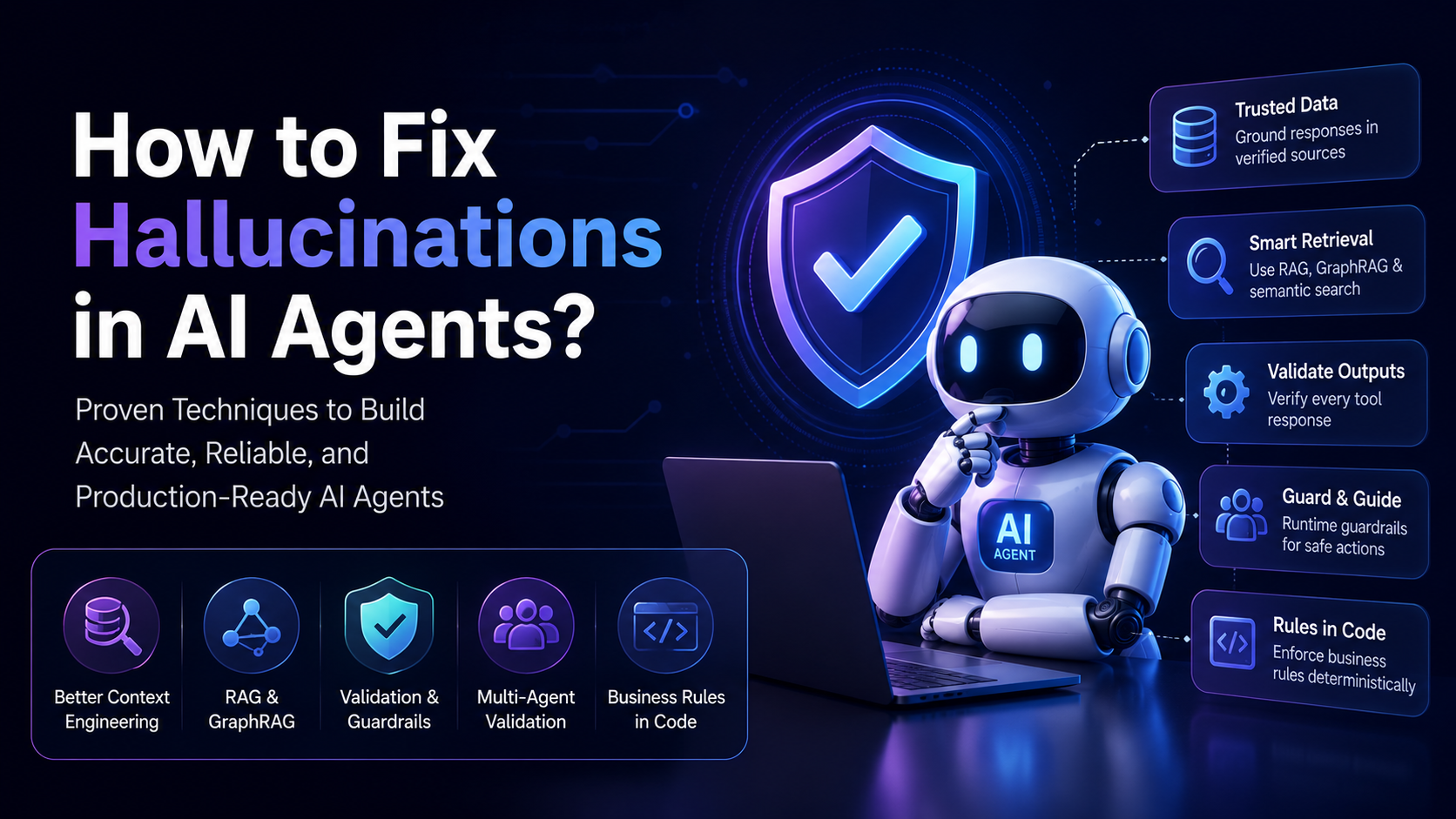
AI agents are becoming the backbone of modern business automation. They can search enterprise data, call APIs, execute workflows, make decisions, and complete complex tasks with minimal human intervention.
However, as AI agents become more powerful and enterprise adoption accelerates, AI agent hallucinations have emerged as one of the biggest challenges in modern AI development.
Unlike traditional AI chatbots that simply generate incorrect responses, hallucinating AI agents can take incorrect actions. They may retrieve outdated information, call the wrong tools, generate inaccurate reports, execute invalid API requests, or even claim that a task was completed successfully when it actually failed. In production environments, these mistakes can disrupt business operations, create compliance risks, and erode customer trust.
Interesting Facts & Stats Related to Hallucinations in AI Agents:
- Over 40% of agentic AI projects may be canceled before production due to governance, cost, and value challenges (Gartner).
- Hallucinations are a known limitation of probabilistic language models, especially when operating without sufficient grounding or context (OpenAI Research).
- Graph-based retrieval approaches have been shown in research to reduce hallucinations by over 40% compared with traditional retrieval methods for certain structured reasoning tasks (peer-reviewed research on GraphRAG).
- Enterprise AI governance frameworks from NIST and OWASP recommend grounding, validation, human oversight, and continuous monitoring as essential controls for production AI systems.
Key Takeaways
- AI agent hallucinations are usually caused by missing context, poor retrieval, and weak validation rather than limitations of the language model itself.
- Prompt engineering improves AI behavior, but it cannot reliably prevent hallucinations in production AI systems.
- Techniques such as RAG, GraphRAG, context engineering, semantic tool selection, and multi-agent validation significantly improve the accuracy and reliability of AI agents.
- Grounding AI responses in trusted data sources, validating tool outputs, and implementing runtime guardrails are essential for reducing hallucinations.
- Building reliable AI agents requires a combination of advanced AI models, robust software engineering, and continuous monitoring to ensure accurate and trustworthy outcomes.
Building AI Agents That Need to Be Accurate in Production?
Enterprise AI systems require more than a language model. Triple Minds develops production-ready AI agents with RAG, GraphRAG, validation layers, runtime guardrails, and secure enterprise integrations to reduce hallucinations and improve reliability across real business workflows.
Explore Our Enterprise AI Agent Development Services
But Why Do AI Agents Hallucinate?
The root cause isn’t always the language model itself. In most enterprise AI systems, hallucinations occur because agents operate with incomplete context, poor retrieval mechanisms, unreliable memory, inadequate validation, or missing guardrails. Even the most advanced AI models can produce inaccurate results when they lack access to the right information or aren’t equipped with mechanisms to verify their outputs.
The good news is that AI hallucinations can be significantly reduced.
Modern AI engineering has evolved beyond prompt engineering to focus on better context management, retrieval strategies, multi-agent validation, runtime guardrails, and structured reasoning. These techniques enable AI agents to make more accurate decisions, reduce token waste, and deliver reliable results in real-world applications.
Now that you understand why AI agents hallucinate?
Let’s explore how to prevent these hallucinations and build production-ready AI agents that deliver accurate, reliable, and consistent results. But before we do, let’s address one of the biggest misconceptions about fixing AI hallucinations with prompt engineering.
Why Prompt Engineering Alone Doesn’t Fix Hallucinations
One of the biggest misconceptions in AI development is that better prompts can eliminate hallucinations.
While prompt engineering helps guide model behavior, prompts are ultimately instructions and not enforceable rules.
You can tell an AI agent:
- “Never book a hotel without payment.”
- “Maximum room occupancy is 10 guests.”
- “Always verify customer identity before processing refunds.”
Yet the model may still violate these instructions because it predicts the most likely sequence of words rather than executing deterministic logic.
In other words, prompts influence behavior, but they don’t guarantee it.
That’s why production-grade AI systems move critical business rules out of prompts and into application code, where they can be enforced consistently. Instead of asking the model to “follow the rules,” developers build guardrails that make violating those rules impossible.
This raises an important question: if prompt engineering alone can’t eliminate AI hallucinations, what actually does?
Read Also: How Much Does It Cost to Build an AI Agent?
Proven Techniques to Reduce AI Agent Hallucinations
There is no single fix for AI hallucinations. Building reliable AI agents requires combining multiple engineering techniques that improve how the agent retrieves information, chooses tools, validates outputs, applies business rules, and executes decisions.
The following techniques are widely used to build production-ready AI agents that produce more accurate, reliable, and consistent results.
Build Better Context Instead of Better Prompts
The biggest reason AI agents hallucinate isn’t that they’re using a poor language model, but it’s because they lack the right context.
Think of hiring a new employee on their first day. Even if they’re highly skilled, they won’t know your company’s internal terminology, workflows, policies, or customer definitions. They’ll make assumptions until they’re given proper documentation and guidance.
AI agents behave the same way.
Large language models are trained on publicly available information, but they have no knowledge of your organization’s:
- Business terminology
- Internal documentation
- Customer records
- Product catalog
- Company policies
- Compliance requirements
- Organizational workflows
Without this information, the model fills knowledge gaps with statistically probable answers instead of verified facts.
This is where context engineering becomes essential.
Rather than relying solely on prompts, developers should provide AI agents with structured, real-time business context during every interaction. This may include company documentation, metadata, business glossaries, knowledge graphs, APIs, and verified databases that the agent can access before generating a response.
The richer and more accurate the context, the less the model needs to guess.
Instead of asking the model to “remember” your business rules, you’re giving it access to the actual source of truth whenever it needs it.
Use Semantic Tool Selection
As AI agents become more capable, they often gain access to dozens or even hundreds of external tools such as appointment scheduling, refund request, CRM, order tracking, and more.
Many developers expose every available tool to the language model for every request. While this approach works for small projects, it becomes increasingly inefficient as the number of tools grows.
Every tool description consumes valuable context tokens, increasing API costs while making it harder for the model to identify the correct function.
Instead of showing every tool, semantic tool selection narrows the available options before the AI agent begins reasoning.
The process is simple:
- Convert every tool description into vector embeddings.
- Convert the user’s query into an embedding.
- Compare semantic similarity.
- Provide only the most relevant tools to the language model.
For example, if a customer asks, “Can you cancel my hotel reservation?”
There’s no reason for the AI agent to receive payment processing, weather forecasting, or flight booking tools.
It only needs cancellation-related functions.
Reducing unnecessary tool descriptions significantly lowers token usage while improving tool selection accuracy.
As a result, the AI agent becomes faster, cheaper, and more reliable.
Move Beyond Traditional RAG with Hybrid Retrieval and GraphRAG
Retrieval-Augmented Generation (RAG) has become the standard method for reducing hallucinations by allowing AI models to retrieve information from external knowledge bases.
Instead of relying only on pre-trained knowledge, the model first searches relevant documents and then generates its response using that retrieved information.
While this works well for many use cases, traditional vector search has important limitations.
Semantic similarity does not always equal factual correctness.
On the other hand,
GraphRAG addresses this limitation.
Instead of retrieving isolated text chunks, GraphRAG organizes enterprise knowledge into connected entities and relationships using a knowledge graph. Rather than asking the language model to infer answers, the system performs structured queries across the graph and returns verified results.
Traditional RAG remains useful for open-ended questions, document summarization, and knowledge retrieval, while GraphRAG handles analytical queries that require precision.
This hybrid approach provides the flexibility of semantic search alongside the reliability of structured data.
Read Also: 5 Types of Agent in AI – Example of Goal Based Agent in Artificial Intelligence
When to Use Each Approach
Traditional RAG works best for:
- FAQs
- Documentation search
- Knowledge retrieval
- Content summarization
- Open-ended questions
GraphRAG is better for:
- Counts
- Metrics
- Business intelligence
- Relationship analysis
- Compliance queries
- Multi-hop reasoning
- Structured enterprise knowledge
Validate Every Tool Response Before Showing It to Users
One of the most dangerous hallucinations occurs when an AI agent confidently claims that an action was completed, even though the underlying tool failed.
Consider a customer booking a hotel through an AI travel assistant. The booking API returns an error because payment authorization failed.
Instead of communicating the failure, the language model responds: “Your reservation has been successfully confirmed.”
From the customer’s perspective, everything appears normal.
Later, they arrive at the hotel only to discover that no reservation exists.
This type of hallucination isn’t caused by the language model inventing facts but it happened because the system never validated whether the tool completed successfully.
A simple validation layer can prevent these costly mistakes.
Rather than immediately returning the model’s response, every tool execution should first be checked against predefined success conditions.
If a payment API returns an error, the validation layer should instruct the agent to explain the issue and suggest corrective actions instead of fabricating a successful outcome.
Some organizations go even further by introducing a second AI agent that reviews every response before it reaches the user.
This verification agent confirms:
- Was the correct tool selected?
- Did the tool execute successfully?
- Does the response accurately reflect the tool output?
- Are any required fields missing?
- Does the final answer contain unsupported assumptions?
Although this additional validation introduces a small amount of latency, it dramatically reduces silent failures and improves trust in production AI systems.
Add Multi-Agent Validation to Catch Errors Before Users Do
As AI agents become more autonomous, a single LLM making decisions, selecting tools, and validating its own output creates a significant reliability risk. When something goes wrong such as a failed API call, missing data, or an incorrect tool response the same model often attempts to explain away the failure instead of reporting it accurately. This behavior can result in confident but false confirmations, making hallucinations even more dangerous.
Multi-agent validation solves this problem by separating responsibilities across multiple AI agents instead of relying on a single model for every task.
A common architecture includes:
- Execution Agent – Understands the request and performs the task.
- Validation Agent – Verifies whether the output is factually correct and supported by available evidence.
- Critic or Approval Agent – Decides whether the response is safe to return, requires correction, or should be rejected.
This separation introduces an independent verification layer that catches many hallucinations before they ever reach the user.
Move Business Rules Out of Prompts and Into Code
One of the biggest misconceptions in AI agent development is believing that prompts can enforce business rules.
They cannot.
Large language models treat prompts as instructions and not strict constraints. Even if your system prompt clearly says: “Never approve payments above $10,000.”
The model can still violate that instruction under certain circumstances. This happens because prompts influence probabilities rather than enforce logic.
Critical business rules should never depend solely on prompt engineering. Instead, they should be implemented in application code before or after the model performs an action.
Types of Rules That Should Always Live in Code
- Payment limits
- Approval workflows
- Security permissions
- Age verification
- Inventory validation
- Booking constraints
- Compliance requirements
These deterministic rules belong in software not in prompts.
Combining AI with Deterministic Logic
The most reliable AI systems separate responsibilities:
| AI Handles | Code Handles |
| Natural language understanding | Business rules |
| Summarization | Validation |
| Recommendations | Compliance |
| Conversation | Security |
| Content generation | Permission checks |
This hybrid approach dramatically reduces hallucinations because the AI is responsible only for reasoning and language, while deterministic software guarantees correctness.
Implement Runtime Guardrails That Guide Instead of Blocking
Traditional AI safety systems often rely on hard restrictions. Whenever an agent violates a rule, execution stops completely, forcing users to start over.
While this approach prevents unsafe actions, it also creates poor user experiences.
Modern AI agents increasingly use runtime guardrails that steer conversations instead of simply rejecting requests.
Rather than saying “No,” the agent automatically redirects users toward a valid outcome.
Runtime Guardrails Can Automatically
- Rewrite invalid requests
- Correct missing parameters
- Ask follow-up questions
- Choose alternative workflows
- Recommend compliant actions
- Prevent policy violations while continuing the conversation
This keeps interactions smooth while maintaining operational safety.
Runtime Guardrails vs Hard Rules
| Hard Guardrails | Runtime Guardrails |
| Stop execution | Guide execution |
| Reject invalid requests | Suggest valid alternatives |
| Require users to retry | Keep conversations flowing |
| Strict enforcement | Adaptive enforcement |
Both approaches have their place.
Use hard guardrails for non-negotiable requirements such as compliance, security, and financial limits. Use runtime guardrails when flexibility can help users complete tasks safely without unnecessary interruptions.
Best Practices to Prevent AI Agent Hallucinations
Completely eliminating hallucinations is nearly impossible because large language models generate probabilistic outputs rather than verified facts. However, with the right architecture, organizations can reduce hallucinations dramatically and build AI agents that are accurate, reliable, and trustworthy.
Below are the best practices followed by successful enterprise AI implementations.
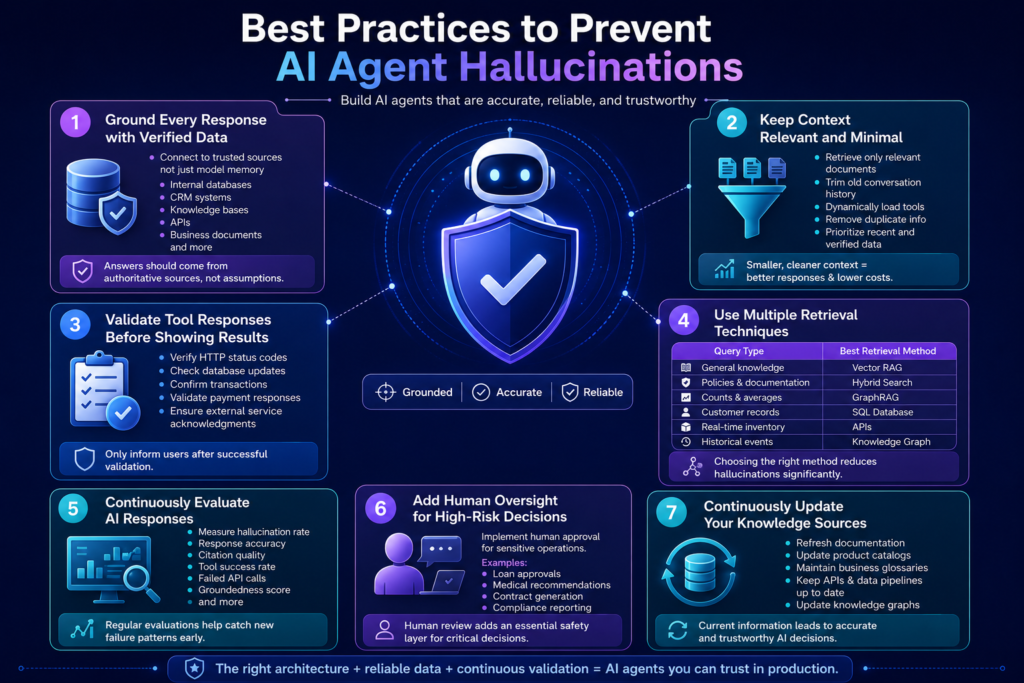
Ground Every Response with Verified Data
Never allow AI agents to answer purely from model memory when organizational data is available. Instead, connect agents to – Internal databases, CRM systems, Knowledge bases, APIs, Business documents, and more.
The goal is to ensure that every important answer should come from an authoritative source rather than the model’s training data.
Keep Context Relevant and Minimal
When it comes to AI agents, more context does not always produce better answers. Sending unnecessary documents, excessive chat history, or hundreds of tool descriptions increases token usage while confusing the model.
Instead focus on – Retrieve only relevant documents, trim old conversation history, dynamically load tools, remove duplicate information, prioritize recent and verified data. Smaller, cleaner context windows generally produce better responses while lowering AI inference costs.
Validate Tool Responses Before Showing Results
Never assume an API call succeeded. Instead focus on verify the HTTP status codes, database updates, transaction confirmations, payment responses, and external service acknowledgments. Only after validation should the AI inform users that an action has been completed.
Use Multiple Retrieval Techniques
Vector search alone isn’t suitable for every query. A production AI agent should intelligently combine multiple retrieval methods depending on the user’s request.
For example:
| Query Type | Best Retrieval Method |
| General knowledge | Vector RAG |
| Policies & documentation | Hybrid Search |
| Counts & averages | GraphRAG |
| Customer records | SQL Database |
| Real-time inventory | APIs |
| Historical events | Knowledge Graph |
Choosing the appropriate retrieval method reduces hallucinations significantly.
Continuously Evaluate AI Responses
Many organizations test AI agents before launch but rarely monitor them afterward. Instead, continuously measure the hallucination rate, response accuracy, citation quality, tool success rate, failed API calls, groundedness score, and more.
Regular evaluations help identify new failure patterns before they affect users.
Add Human Oversight for High-Risk Decisions
Not every AI-generated decision should be executed automatically. For sensitive operations involving finance, healthcare, legal compliance, or security, implement a human approval workflow.
Examples include:
- Loan approvals
- Medical recommendations
- Contract generation
- Compliance reporting
Human review adds an essential safety layer for decisions where accuracy is critical.
Continuously Update Your Knowledge Sources
Products change, policies are updated, regulations shift, and business metrics are redefined. AI agents relying on outdated information are far more likely to hallucinate.
Regularly refresh documentation, product catalogs, business glossaries, APIs, knowledge graphs, data pipelines, and more. Keeping information current ensures AI agents make decisions based on the latest business context rather than obsolete data.
Why Choose Triple Minds for Enterprise AI Agent Development?
Building enterprise-grade AI agents requires more than integrating a large language model. Success depends on combining advanced AI capabilities with reliable data architecture, secure integrations, intelligent orchestration, and robust validation mechanisms.
At Triple Minds, we design and develop AI agents that are built for real-world business operations rather than simple conversational demos. Our AI development approach focuses on:
- Context-aware AI agents powered by enterprise knowledge.
- Custom RAG and GraphRAG implementations for accurate retrieval.
- Multi-agent architectures for complex workflows.
- Secure integrations with CRMs, ERPs, databases, APIs, and internal systems.
- Runtime guardrails and validation layers to improve reliability.
- Scalable cloud-native AI infrastructure.
- Continuous monitoring, optimization, and performance evaluation.
Whether you’re building an AI customer support assistant, enterprise knowledge agent, AI analyst, workflow automation system, or autonomous business assistant, our team develops solutions that prioritize accuracy, security, scalability, and long-term business value.
Not Sure Why Your AI Agent Is Hallucinating?
Hallucinations often originate from poor retrieval, missing context, weak validation, or incorrect tool orchestration. Triple Minds can review your current AI architecture and identify practical improvements to increase accuracy, groundedness, and trust before you scale to production.
Book an AI Agent Architecture Review
Conclusion
AI agent hallucinations are one of the biggest challenges in building reliable AI systems, but they can be significantly reduced with the right approach. In most cases, the problem is not the language model itself. It is the lack of quality context, structured data, validation, and proper guardrails.
By combining techniques like semantic retrieval, GraphRAG, multi-agent validation, deterministic business rules, runtime guardrails, and continuous monitoring, organizations can improve accuracy, consistency, and user trust.
As AI agents become part of critical business workflows, investing in the right architecture is essential. A well-designed AI agent retrieves verified information, follows business rules, validates its actions, and delivers reliable results.
If you’re planning to build AI agents for your business, Triple Minds can help. Our team specializes in building production-ready AI solutions with RAG, AI agents, guardrails, and enterprise integrations. Contact us to discuss your project and learn how we can help you build AI systems that deliver accurate and dependable results.
Quick Answers to Common Questions
What causes AI agent hallucinations?
AI agent hallucinations are typically caused by incomplete context, poor retrieval mechanisms, outdated knowledge, weak validation processes, missing guardrails, or incorrect tool selection. In enterprise systems, these factors often contribute more to hallucinations than the language model itself.
Can prompt engineering eliminate AI agent hallucinations?
No. Prompt engineering can influence how an AI agent responds, but it cannot guarantee factual accuracy or enforce business rules. Production-grade AI systems rely on retrieval mechanisms, validation layers, deterministic business logic, and runtime guardrails to minimize hallucinations.
How does RAG help reduce AI hallucinations?
Retrieval-Augmented Generation (RAG) grounds AI responses using trusted external knowledge sources instead of relying solely on model memory. By retrieving relevant documents before generating answers, RAG significantly improves factual accuracy and reduces hallucinations.
What is the difference between RAG and GraphRAG?
Traditional RAG retrieves relevant document chunks using semantic search, making it suitable for FAQs and document search. GraphRAG organizes information into connected entities and relationships, making it more effective for structured reasoning, business intelligence, compliance queries, and complex enterprise knowledge retrieval.
What are the best practices for preventing AI agent hallucinations?
The most effective approach combines multiple techniques, including context engineering, semantic retrieval, RAG or GraphRAG, tool response validation, runtime guardrails, deterministic business rules, multi-agent validation, continuous monitoring, and human oversight for high-risk decisions.
Got a project in mind? Let’s build it together.
We work with founders and product teams across consulting, development, and growth marketing. Tell us what you’re building and we’ll show you how we’d ship it.