
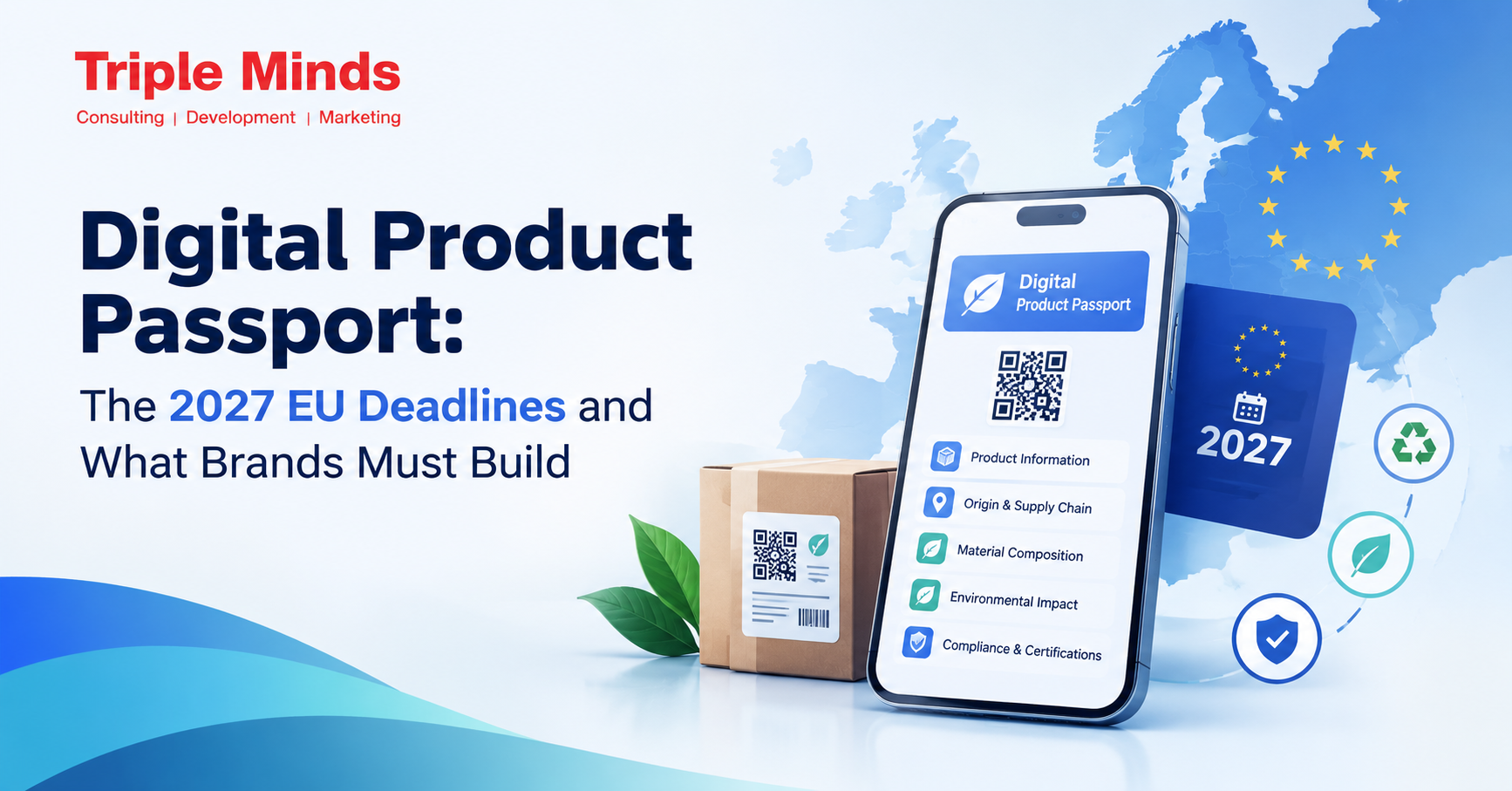
In July 2026, the DPP Registry became operational, while 18 February 2027 marks the first major mandatory DPP milestone for certain battery categories. Other sectors, including textiles, tyres and aluminium, are also scheduled for DPP-related requirements during 2027.
Instead of landing on a generic product page, customers can access information about the product’s materials, origin, repair options, sustainability characteristics, or end-of-life handling.
Now imagine the same product information being useful to a repairer, recycler, supplier, manufacturer, or regulator. That is the idea behind the Digital Product Passport (DPP). If you want to understand how DPP software works in practice, explore our guide on use cases and features of a Digital Product Passport Software.
In this guide, we’ll break down the 2027 EU Digital Product Passport deadlines, the product categories moving toward DPP requirements, and—most importantly—what brands need to build behind the passport to be ready.
A Digital Product Passport isn’t just a QR Code
A product can be perfectly manufactured, labelled, and ready to sell in Europe—and still leave a big question unanswered:
- Can you prove where its materials came from?
- Who supplied them?
- How it should be repaired or recycled, and keep that information accessible throughout its lifecycle?
Product information is often spread across ERP systems, PLM software, supplier spreadsheets, compliance documents, manufacturing databases, and emails. One team may have material data, another may manage certifications, while supplier information sits somewhere else entirely.
The QR code may be what a customer sees. But, behind it, businesses need a system that is capable of collecting product data, connecting suppliers, managing product identifiers, integrating existing business software, and making relevant data available throughout the product lifecycle.
Turn DPP Compliance Into a Competitive Advantage with Triple Minds
Preparing for EU Digital Product Passport requirements takes more than adding a QR code. At Triple Minds, we build custom DPP software with product data management, supplier portals, system integrations, and digital passport workflows to help businesses prepare for evolving requirements.
Explore Digital Product Passport Software
The 2027 DPP Deadlines Brands Need to Know
Before we look at the dates, one thing that you should know is that there is no single DPP deadline in 2027 that applies to every product. However, the EU is introducing DPP requirements by product category and its current indicative timeline includes the following milestones:
| Timeline | DPP Development |
| 20 July 2026 | EU DPP Registry becomes operational |
| 18 February 2027 | DPP becomes mandatory for certain battery categories |
| Q2 2027 | Planned DPP requirements for construction products and service providers |
| Q3 2027 | Planned additional DPP service-provider requirements |
| Q3–Q4 2027 | Planned sector-specific requirements for textiles, aluminium and tyres |
| 2028 | Planned sector-specific requirements for furniture |
| 2029 | Planned requirements for mattresses and certain recycled-content/ICT-related areas |
1. Regulatory Context: The ESPR, CPR, and Battery Regulation Framework
The Digital Product Passport (DPP) is not a stand-alone policy. It is the regulation and data delivery mechanism that enables the wider European Union’s Circular Economy Action Plan (CEAP) and European Green Deal.
While the previously operating Ecodesign Directive focused on energy efficiency of appliances, the ESPR expands this to be about making products more sustainable, durable, repairable, reuseable and transparent.
The regulatory framework relies on three legal pillars:
- Ecodesign for Sustainable Products Regulation (ESPR — Regulation EU 2024/1781): This enforcement has set out a framework of rules around product durability, reusability, upgradability, repairability, microplastic release, recycled content and carbon footprint metrics.
- EU Battery Regulation (Regulation EU 2023/1542): Serving as the trailblazer regulation for the DPP, the regulation explicitly mandates digital passports for high capacity industrial, light means of transport (LMT) and Electric Vehicle (EV) batteries.
- Revised Construction Products Regulation (CPR — Regulation EU 2024/3110): It sets out parallel DPP requirements for building materials, structural products and construction components.
Due to these strict regulations, the burden of proof from post-market regulatory audits has shifted to pre-market digital verification. That means if your product is not compliant and is not DPP registered within the central EU DPP registry, goods will be blocked at customs and barred from the EU single market.
2. Phased Rollout Timeline (2026–2030): Why 2027 is the Turning Point
The European Commission is executing a phased rollout through sector-specific Delegated Acts. These legal acts outline the exact data fields, standards, and access permissions required for each industry.
2026: The Infrastructure & Pilot Phase
- July 19, 2026 — EU Central Registry Operations: The European Commission launches the official EU Digital Product Passport Registry. This registry will manage the Unique Product Identifiers (UPIs) and validate passport authenticity across customs borders.
- July 19, 2026 — Ban on Destruction of Unsold Goods: If major enterprises destroy their unsold products like apparel, clothing accessories, footwear etc., they will suffer an immediate ban. The penalty doesn’t end here. They may also face mandatory disclosure rules.
- Priority Rulemaking Begins: Regulatory draft frameworks advance for primary material streams, including iron, steel, and initial textile guidelines.
2027: The Mandatory Deadline for Batteries & Priority Sector Rulemaking
- Feb 18, 2027 — Mandatory Battery Passports: This is the first hard, and legally enforced Digital Product Passport deadline. From 18 Feb, 2027 LMT batteries, industrial batteries > 2kWh and E-Vehicles batteries in EU market should have an active, and compliant battery passport.
- Textiles, Apparel & Footwear: Draft Delegated Acts for apparel and footwear finalize their adoption stages, and set out data schemas for fiber traceability, recycled content percentages and microplastic shed ratings
- Tyres, Aluminium & Structural Materials: Priority rulemaking sets out baseline durability and carbon footprint calculators for automotive components and raw industrial inputs.
Read More: A Complete Guide To Build A Battery Recycling Management Software
2028–2029: Expansion to Consumer Goods & Construction
- Furniture & Mattresses (2028–2029): The EU maybe require furniture and mattresses to have a DPP containing information such as: chemical toxicity, material used, disassembly documentation and bio-based material certifications.
- Electrical & Electronic Equipment (2029): For products such as washing machines, TVs, laptops, or other electronics, the requirements could focus on governing repairability scores, spare part availability timelines and recycled plastic content.
- Construction Products (2026–2029 CPR Rollout): It indicates the progressive rollout of passports across construction material like concrete, insulation and architectural glass.
However by 2030, it is most expected that the ESPR framework will encompass the majority of manufactured physical goods distributed across the 27 EU member states. Not just this, the revolution can also include imported products manufactured in the US, UK, Asia and Latin-America.
A Complete Product Category Based Map
| Product Category | Regulatory Route | Expected Adoption | Estimated DPP Compliance |
| Batteries (EV, LMT & industrial >2 kWh) | Separate regulation | Adopted | February 2027 |
| Iron & steel | ESPR intermediate product | 2026 | ~2027–2028 |
| Textiles & apparel | ESPR final product | Late 2027 | ~2028–2029 |
| Tyres | ESPR final product | 2027 | ~2028–2029 |
| Aluminium | ESPR intermediate product | 2027 | ~2028–2029 |
| Household dishwashers | ESPR energy-related product | Q3 2027 (planned) | ~2029 |
| Furniture | ESPR final product | 2028 | ~2029–2030 |
| EV chargers | ESPR energy-related product | 2028 | ~2029–2030 |
| Fridges & freezers | ESPR energy-related product | 2028 | ~2029–2030 |
| Electric motors | ESPR energy-related product | 2028 | ~2029–2030 |
| Mattresses | ESPR final product | 2029 | ~2030–2031 |
| Mobile phones & tablets | ESPR energy-related product | 2030 | ~2031–2032 |
What Information Should a Compliant Digital Product Passport Contain?
A compliant Digital Product Passport is not a static PDF upload or an unverified marketing page. It is an interoperable, structured data asset. Depending on the industry-specific Delegated Act, a passport must deliver structured data across four core operational pillars:
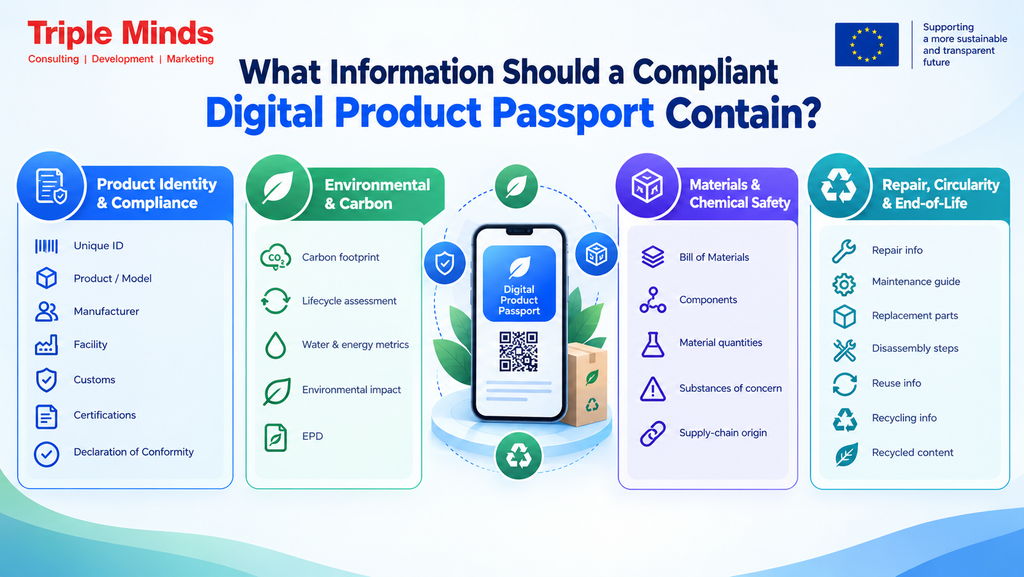
Product Identification and Compliance
First, the passport needs to identify the product. The core purpose behind product identification is to create a reliable connection between the physical product and its digital records. It can include:
- Unique product identifiers
- Product or model information
- Manufacturer details
- Facility information
- Relevant customs information
- Compliance documentation
- Safety certifications
- Declaration of Conformity information
Environmental and Carbon Information
For brands that have already invested in lower-carbon materials or more sustainable manufacturing, the DPP can provide a structured way to communicate and substantiate that information. DPP information can include environmental performance data. This may involve:
- Product carbon footprint information
- Lifecycle assessment indicators
- Water and energy-related metrics
- Environmental impact data
- Environmental Product Declarations
Read More: How Does Carbon Credit Issuance System Work?
Materials, Components and Chemical Safety
A DPP can also bring greater visibility into what a product is actually made of. This is particularly important for complex products where the manufacturer may depend on information from several tiers of suppliers. It can include the following:
- Bill of Materials (BOM)
- Raw materials
- Components
- Material quantities
- Substances of concern
- Relevant chemical information
- Supply-chain origin data
Repair, Circularity and End-of-Life Information
This is where a DPP can become more than a compliance record. DPPs can also support the later stages of a product’s lifecycle. Depending on the applicable requirements, this may include:
- Repair information
- Maintenance guidance
- Replacement-part information
- Disassembly instructions
- Reuse information
- Recycling information
- Recycled-content data
Technical Architecture: What Brands Need to Build for DPP Readiness?
Brands cannot just deploy a standard website landing page and call it a Digital Product Passport. The European Commission demands an open, decentralized technical architecture that will ensure long-term data accessibility without vendor lock-in.
Data Carriers & Open Standards
The first visible component is the data carrier. Every physical product must carry an ergonomic, machine-readable Data Carrier. Depending on the applicable requirements, it can involve a QR code, DataMatrix, NFC tag, or another machine-readable method.
But generating the code is only one part of the process – the data carrier needs to tie to the right product information and be usable throughout the product’s intended lifecycle.
Structured Product Data Layer
Brands need a reliable way to organise the information associated with their products.
That may mean creating a dedicated product-data layer that brings together information from segregated systems. It includes- ERP systems, PLM platforms, PIM systems, supplier portals, manufacturing systems etc.
Interoperability, APIs, and Decentralized Storage
- API-First System Integration: A brand’s DPP system should be able to dynamically aggregate data from the brand’s existing Enterprise Resource Planning (ERP), Product Lifecycle Management (PLM), Supply Chain Management (SCM), and Product Information Management (PIM) platforms.
- Decentralized Data Availability: The data about products should remain available even if the brand goes bankrupt or restructures. It can be achieved through decentralized object storage, web servers, or blockchain.
- ISO/IEC Compliance: The systems should comply with international data exchange standards such as ISO/IEC 15459 (unique identification) and the W3C Verifiable Credentials specifications.
Role-Based Access: Who Gets to See What?
A DPP may contain information for very different audiences. It is not necessary that a customer, repairer, and recycler should have the access to the same data. Therefore, role-based access makes the control an important part of the system design.
| User | Potential Information |
| Consumer | Product information, environmental characteristics, care and repair guidance |
| Regulator / Authority | Compliance documentation and relevant regulatory information |
| Repairer | Technical documentation, repair instructions and spare-part information |
| Recycler | Material composition, disassembly and handling information |
At Triple Minds, we can help manufacturers, importers, and distributors build their Digital Product Passport solution, compliant to their sector’s window.
What Happens When Product Information Changes?
A product passport isn’t necessarily a “create it once and forget it” record. Fluctuations like product changes, supplier changes, component changes, and certifications expiring impact DPP. Therefore, a DPP platform needs a way to manage updates without losing track of what changed. This is where features such as:
- Data versioning
- Approval workflows
- Audit trails
- Change history
- Validation rules
- Role-based editing
How Triple Minds Can Help with DPP Software Development
For Triple Minds, the opportunity isn’t simply to offer a “Digital Product Passport app.”
The bigger opportunity is helping brands build the technology infrastructure behind their DPP strategy. Depending on the business requirements, that can include:
Custom DPP Platforms
A central platform for managing product identities, product information, lifecycle data, users, and passport records.
Supplier Portals
A structured way for suppliers to submit, update, and validate material and component information.
ERP and PLM Integrations
Connecting existing business systems with the DPP environment to reduce duplicate data entry and keep information synchronized.
API Development
Creating secure APIs for exchanging information between internal systems, DPP platforms, service providers, and other relevant infrastructure.
Product Identity and QR Workflows
Connecting physical products with their corresponding digital records through appropriate data carriers.
Admin and Compliance Dashboards
Giving internal teams visibility into missing information, validation status, product records, and DPP readiness.
Role-Based Access
Creating different information views for customers, suppliers, repairers, recyclers, regulators, and internal teams.
Scalable Data Architecture
Designing a system that can handle growing product catalogues, product variants, batches, and lifecycle information.
The right solution will depend on the brand’s products, existing systems, suppliers, data requirements, and applicable regulations. The important thing is to start with the data and workflow, not the software screen.
Get Your Business Ready for EU Digital Product Passport Deadlines
Preparing for EU Digital Product Passport deadlines requires a clear compliance roadmap and the right expertise. Triple Minds offers consulting services to help businesses understand applicable requirements, assess product data readiness, identify compliance gaps, and plan the next steps toward DPP compliance.
Contact Our Experts Now
2027 Deadline is Here. Start Preparing with Your Data
The concept of a digital product passport may seem simple from the outside, but in reality it consists of a complex approach. From collecting and structuring product data to providing information, there are many functionalities. Existing business systems may need to communicate. Product identities need to stay connected to their digital records. Access needs to be controlled. And the information needs to remain accurate as the product moves through its lifecycle.
That’s why the 2027 EU DPP deadlines should be treated as a technology-planning milestone, not a last-minute compliance task.
For brands preparing for the upcoming EU requirements, Triple Minds can help transform DPP requirements into practical software. From custom DPP platforms and supplier portals to ERP/PLM integrations, APIs, product-data systems, and role-based digital experiences, we’ve got your back. Because when the deadline arrives, the question won’t be whether your product has a QR code. It will be whether the technology behind it is ready.
Digital Product Passport Software FAQs
Is a QR code enough to meet DPP requirements?
No. A QR code or data carrier can provide a way to access the digital product information but, the underlying system needs to manage the relevant data, identifiers, access, updates and integration. Therefore, you can consider the QR as the doorway- actual DPP infrastructure is behind the doors.
Is a Digital Product Passport the same as an LCA?
No. An LCA may contribute environmental data to a DPP, but the passport can also contain product identifiers, compliance information, material details, repair guidance, and other product information.
Which products will need a Digital Product Passport in 2027?
Batteries are among the first major product categories facing DPP requirements in 2027. Other sectors, including textiles, tyres, aluminium and construction products, are also part of the broader DPP rollout. The exact requirements and timelines depend on the relevant product category and EU legislation.
Can Digital Product Passports create business value beyond compliance?
Yes. Once product information is structured and connected, brands may be able to use DPP infrastructure to support repair services, resale, spare-parts management, recycling, take-back programs, customer engagement and better supply-chain visibility. This can turn a compliance requirement into a broader digital product-data capability.
Got a project in mind? Let’s build it together.
We work with founders and product teams across consulting, development, and growth marketing. Tell us what you’re building and we’ll show you how we’d ship it.