AI Chatbot Cost Breakdown for SMB vs Enterprise
How much does an AI chatbot cost for an SMB compared to an enterprise? This guide breaks down AI chatbot development costs by business size, pricing model, features, RAG architecture, integrations, security, and deployment. Learn what drives chatbot pricing, compare SMB vs enterprise budgets, and estimate the total cost of ownership before investing in conversational AI.

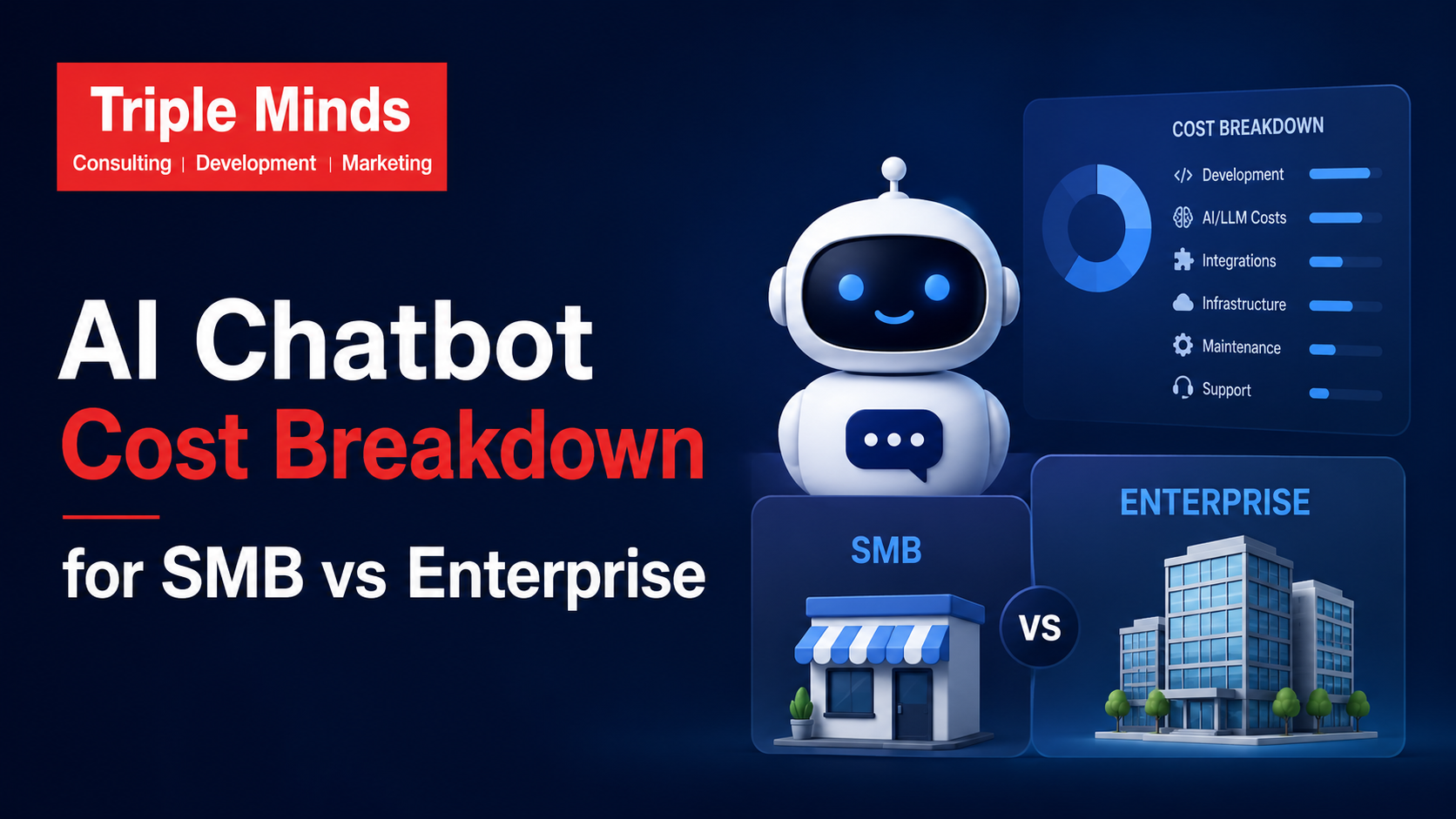
Quick Answer: An AI chatbot can cost you from none to millions. SMBs pay $0 to $499 per month on flat-rate SaaS, while mid-market teams pay more than $500. Talking about enterprises, their AI chatbot costs much higher than SMB up to $100,000 or more.
When you search the internet to compare the AI chatbot cost for SMB vs enterprise, most of the results will only show the initial numbers. No one will tell you what you’re actually paying for. But, as a reliable AI chatbot development agency, Triple Minds will thoroughly explain each aspect that contributes to the cost of your AI chatbot.
How Much Does an AI Chatbot Cost?
The cost of an AI chatbot is made up of many elements such as base subscription, resolution fees, and add-ons that increase with volume. Two pricing models differentiate between the AI chatbot cost of SMB and enterprise: flat rate and per resolution.
Once you add custom knowledge bases, CRM integration, multilingual capabilities, voice, security controls, analytics, human handoff, RAG, or autonomous AI agents, the investment can increase significantly.
For SMBs, the priority is often affordability, speed, and measurable ROI. Enterprises usually have a different set of requirements: security, scalability, integration, governance, compliance, customization, and reliability. In this blog, we will map the pricing structure against real volume scenarios.
| AI Chatbot Type | Estimated Development Cost | Typical Timeline |
| Basic FAQ chatbot | $3,000–$10,000 | 2–4 weeks |
| AI-powered SMB chatbot | $8,000–$25,000 | 4–8 weeks |
| RAG-based chatbot | $15,000–$50,000 | 6–12 weeks |
| Advanced business chatbot | $30,000–$75,000+ | 8–16 weeks |
| Enterprise conversational AI | $50,000–$150,000+ | 3–6 months |
| Enterprise AI platform/agent system | $150,000–$500,000+ | 6–12+ months |
This is not a fixed market price, but just an estimated planning range. The final cost depends heavily on your business requirements and the technology architecture that your potential chatbot development company will execute.
For example, an API-based chatbot using an existing foundation model can be relatively inexpensive to build. A system requiring proprietary model training, complex RAG pipelines, multiple enterprise integrations, private deployment, advanced security, and continuous optimization is a very different project.
Build an AI Chatbot That Actually Delivers ROI
A chatbot should do more than answer FAQs. Triple Minds builds AI chatbots that automate support, qualify leads, retrieve business knowledge with RAG, integrate with CRM and ERP systems, and scale securely across your business. From SMB automation to enterprise conversational AI, we design chatbots built for production—not just demos.
Explore AI Chatbot Development Services
SMB vs. Enterprise AI Chatbot Cost at a Glance
| Cost Factor | SMB AI Chatbot | Enterprise Chatbot |
| Primary objective | Support, leads, automation | Enterprise-wide automation and intelligence |
| Typical budget | $8K–$50K | $50K–$500K+ |
| Deployment | Cloud/SaaS/API | Cloud, private cloud, hybrid or on-premise |
| Integrations | 1–3 systems | Multiple enterprise systems |
| AI model | Existing API/foundation model | Multiple models, fine-tuned or customized models |
| Knowledge base | Basic RAG | Enterprise-grade RAG and data pipelines |
| Security | Standard security | Advanced security and governance |
| Users | Hundreds/thousands | Thousands to millions |
| Channels | Website/mobile | Omnichannel |
| Analytics | Standard dashboards | Advanced monitoring and business intelligence |
| Compliance | Basic requirements | Industry-specific requirements |
| Maintenance | Basic support Continuous | MLOps/AI optimization |
The key point is that enterprise chatbot costs do not increase simply because the company is larger. Instead, they increase because enterprise requirements introduce additional technical and operational complexity.
Now let’s see individual cost plan of both chatbots.
The Cost of AI Chatbot for SMBs
Small and medium-sized businesses generally do not need to build a massive AI platform from day one. Their chatbot may be designed to solve one or two clearly defined problems, such as answering customer questions, qualifying leads, recommending products, booking appointments, or reducing repetitive support requests. Typical SMB AI Chatbot costs can range from $8,000 to $50,000. It may include the following:
- Conversational AI
- Website integration
- Basic customer support
- FAQ automation
- Product or service information
- Lead capture
- Human-agent escalation
- Basic analytics
- CRM integration
- Knowledge base
- RAG
- Multilingual responses
Example: SMB Customer Support Chatbot
Suppose an eCommerce business receives 5,000 customer questions per month.
Instead of hiring additional support personnel to handle repetitive questions, it develops an ecommerce chatbot capable of answering questions about order status, shipping, returns, and refunds. The AI chatbot can retrieve relevant information from the company’s knowledge base and escalate complicated cases to human agents.
| Component | Approximate Cost |
| Discovery & architecture | $1,000–$4,000 |
| Conversational UI | $1,500–$5,000 |
| AI integration | $2,000–$7,000 |
| RAG/knowledge base | $3,000–$10,000 |
| CRM/eCommerce integration | $2,000–$8,000 |
| Testing & deployment | $1,500–$5,000 |
| Estimated total | $11,000–$39,000 |
The Cost of AI Chatbot for Enterprise
Enterprise chatbot development is fundamentally different because rather than remaining isolated customer-support widget, it becomes part of the organization’s technology ecosystem. To resolve issues or answer user queries, it may need to communicate with the following:
- CRM systems
- ERP platforms & HR systems
- Data warehouses
- Customer databases
- Knowledge repositories
- Ticketing systems
- Internal applications
- Identity-management platforms
Talking in general, the enterprise AI Chatbot Cost between $50,000–$500,000+. A relatively focused enterprise chatbot may start around $50,000. If your deployment is more complex, it can reach $150,000, $250,000, $500,000 or more depending on integrations, data requirements, security, AI architecture, user volume, and deployment model.
For businesses building a broader AI ecosystem rather than a standalone chatbot, you can consider working with an enterprise AI development company.
AI Chatbot Pricing Models: Flat Rate vs. Per-Resolution
When you’re trying to estimate what an AI chatbot will actually cost you, development complexity is only half the story. Another aspect is knowing how you’ll be billed for using it, since that decision can swing your budget significantly. Most providers price their chatbots one of two ways: flat-rate or per-resolution.
The right model depends on factors such as your business size, expected conversation volume, level of customization, and whether you need a simple customer-support bot or a completely integrated enterprise AI system.
1. Flat-rate Pricing
With a flat-rate model, you pay a fixed amount for the chatbot, usually either as:
- A one-time development fee
- A monthly subscription
- An annual license
For small and mid-sized businesses, this model tends to make budgeting a lot easier due to predictable costs. A typical setup might look like a custom chatbot development followed by a recurring monthly fee that covers hosting, maintenance, support, and AI infrastructure.
On other side, enterprises can also work with the fixed project fee. The only difference is that the numbers climb fast, because their chatbots usually need custom integrations, strong security, private deployment, robust analytics, and connection to CRM, ERP, HT portals, or internal database etc.
For example: If an SMB spends $15,000 on chatbot development and pays $1,000 per month for hosting, maintenance, and ongoing AI services, its first-year base investment would be approximately $27,000.
2. Per-resolution Pricing
Per-resolution pricing works differently. Instead of a flat fee, you pay based on how many customer conversations or support issues the chatbot successfully resolves.
Say a provider charges $1 per resolution, and your chatbot closes to 3,000 conversations in a month. That’s: 3,000 resolutions × $1 = $3,000
This model can be appealing because the expense is linked directly to chatbot usage. An SMB with a relatively small support volume may therefore avoid paying for excessive capacity that it does not need.
However, for enterprises the economics can change. A company processing hundreds of thousands of customer interactions every month could face substantial recurring costs if every resolution is billed individually.
Flat Rate vs. Per Resolution
| Factor | Flat Rate | Per Resolution |
| Pricing basis | Fixed project/subscription fee | Number of resolved interactions |
| Budget predictability | High | Medium |
| Best suited for | Custom implementations | High-volume support |
| Upfront investment | Usually higher for custom builds | Usually lower |
| Cost as usage increases | May remain relatively stable | Increases with resolutions |
| Customization | Usually higher | Depends on provider |
| Enterprise suitability | Strong for complex systems | Useful for high-volume support |
Which Model is Better for SMBs vs. Enterprises?
If your chatbot usage is fairly steady month to month, flat-rate pricing is usually the easier path as it gives you a clearer view of your tech spending and simplifies planning. Per-resolution pricing can also be a solid option if your support volume runs low, since you’re paying in line with actual usage rather than covering capacity you don’t need
For enterprises, the decision requires more careful analysis. A per-resolution model may become expensive at scale, while a flat-rate/custom development model can provide greater control over integrations, data, security, and functionality.
One thing worth keeping in mind: flat-rate and per-resolution pricing only describe how you’re billed, not what the chatbot actually costs to build and run. You’ll likely still face separate costs for AI model usage, RAG infrastructure, integrations, cloud hosting, security, maintenance, and ongoing optimization.
So rather than judging a chatbot solution by its advertised pricing model alone, it’s worth calculating the total cost of ownership (TCO) to get the real picture.
Which Factors Determine the Cost of AI Chatbot Development?
Before comparing the cost of SMB and enterprise AI chatbots, you need to understand the layers of this cost.
Total AI chatbot cost = Discovery + Design + Development + AI/model costs + Integrations + Infrastructure + Testing + Deployment + Maintenance
Let’s explore different factors that make a big change to the final cost of an AI Chatbot.
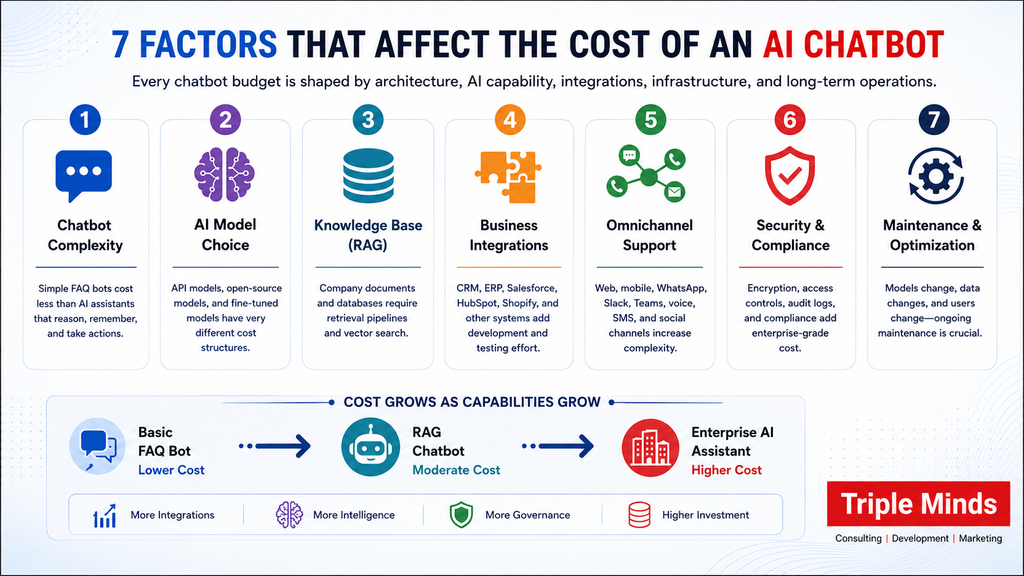
1. Chatbot complexity
A chatbot that answers predefined questions is relatively simple.
A chatbot that understands context, remembers previous conversations, retrieves information from internal documents, accesses customer data, calls APIs, and performs actions requires significantly more engineering.
2. AI model
Businesses can use third-party foundation models through APIs, open-source models, or custom-trained/fine-tuned models. The model choice affects both development effort and recurring inference costs.
3. Knowledge base
If the chatbot needs to answer questions using company documents, product catalogs, policies, manuals, contracts, or internal knowledge, you may need a RAG architecture.
A RAG architecture becomes much more powerful when your chatbot can retrieve answers directly from your company’s databases and internal documents. Learn how a Database Chatbot works and how businesses use natural language to securely query knowledge bases, product catalogs, CRM records, PDFs, and other internal data sources in real time.
4. Integrations
Connecting a chatbot with systems such as Salesforce, HubSpot, SAP, Oracle, Shopify, databases, help desks, ERP systems, or internal applications adds development and testing effort.
Integrating an AI chatbot with CRM, ERP, databases, and internal business tools is often the most complex part of development. Learn how to securely connect AI with your existing technology stack in our guide on How to Integrate AI into an Existing Business Platform and understand the role of APIs, webhooks, authentication, permissions, and enterprise integration layers.
5. Channels
A web chatbot is simpler than an omnichannel conversational AI platform supporting:
- Website
- Mobile applications
- Slack
- Microsoft Teams
- SMS
- Voice
- Social messaging channels
6. Security and compliance
Enterprise applications may require encryption, role-based access control, audit trails, private cloud deployment, data isolation, monitoring, and compliance controls.
7. Maintenance
AI applications are not necessarily “build once and forget.”
Models change. APIs change. Business information has changed. User behavior changes. Your chatbot therefore needs monitoring, evaluation, optimization, and maintenance.
What Makes Enterprise Chatbots More Expensive?
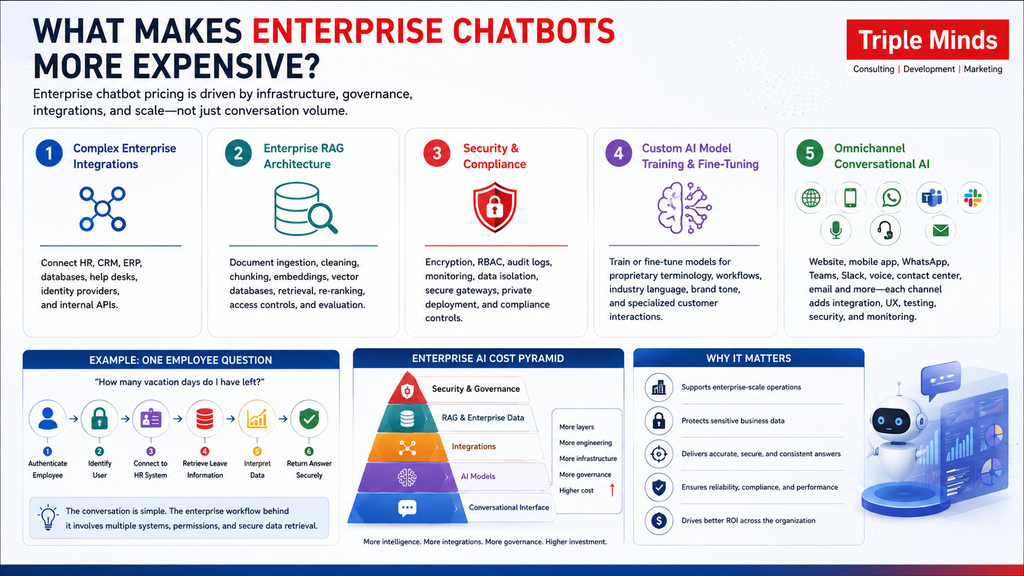
1. Complex Enterprise Integrations
Consider an employee asking: “How many vacation days do I have remaining? “A basic chatbot can only provide a generic answer. But, an enterprise AI assistant needs to:
- Authenticate the employee.
- Identify the user.
- Connect to the HR system.
- Retrieve the employee’s leave information.
- Interpret the data.
- Return the answer securely.
However, the AI conversation itself may be relatively simple. But the integration behind the conversation is not.
2. Enterprise RAG architecture
Enterprise chatbots often need access to large collections of proprietary information such as PDFs, manuals, contracts, product documents, HR policies, knowledge bases, technical documentation, etc. A production-grade RAG system may require:
- Document ingestion
- Data cleaning
- Chunking
- Embedding generation
- Vector databases
- Metadata management
- Retrieval
- Re-ranking
- Access controls
- Evaluation
3. Security and Compliance
Security is often one of the largest differences between an SMB chatbot and an enterprise AI system. An enterprise chatbot may process confidential information such as customer records, financial data, employee information, contracts, intellectual property, etc. Therefore, the system may need the following:
- Encryption
- Identity and access management
- Role-based permissions
- Audit logs
- Data isolation
- Secure API gateways
- Monitoring
- Threat detection
- Private deployment
- Compliance controls
All these requirements can increase both development and infrastructure costs.
4. Custom AI model Training and Fine-tuning
Not every chatbot needs a custom model. Some models have a strong foundation model that combines good prompting, RAG, and application logic to deliver excellent results. However, businesses with highly specialized requirements may benefit from model fine-tuning or custom training. For example, a company may want an AI system trained to understand:
- Highly specialized terminology
- Proprietary workflows
- Industry-specific language
- Brand communication
- Internal classification systems
- Specialized customer interactions
This is where AI model training and fine-tuning services can become part of the overall project architecture.
5. Omnichannel Conversational AI
Enterprise customers increasingly expect consistent experiences across multiple channels. An enterprise conversational AI system may need to operate across:
- Website
- Mobile app
- Microsoft Teams
- Slack
- Voice
- Contact center
Each additional channel introduces integration, UX, testing, security, and monitoring requirements. The objective should not simply be to deploy the chatbot everywhere but to maintain appropriate context and permissions across the channels.
Analyzing the Cost of AI Chatbot by its Features
| Feature | Cost Impact |
| Basic conversational UI | Low |
| FAQ automation | Low |
| Lead capture | Low–Medium |
| CRM integration | Medium |
| RAG knowledge base | Medium–High |
| Multilingual AI | Medium |
| Voice chatbot | Medium–High |
| Payment integration | Medium–High |
| Personalization | High |
| Complex workflow automation | High |
| Multi-agent architecture | High |
| Custom model training | High |
| Private deployment | High |
| Enterprise security | High |
| Advanced analytics | Medium–High |
Note: Features should be evaluated according to business value, not simply added to make the chatbot appear more advanced.
Make Your AI Chatbot Smarter With Custom AI Models
Generic AI models don’t always understand your business, products, or workflows. Triple Minds helps businesses fine-tune and train AI models using proprietary knowledge, industry terminology, internal documents, and brand-specific conversations to improve accuracy, reduce hallucinations, and deliver more relevant responses.
Explore AI Model Training Services
Final Takeaway: How Much Should You Budget for an AI Chatbot?
For Small-Medium businesses, a customized AI chatbot’s approximate cost is $8,000-$50,000. This cost can vary depending on features, integrations and other requirements.
Similarly, enterprises’ chatbots start around $50,000 and can go beyond $150,000, $250,000, $500,000 or more due to the proprietary data, advanced security, custom workflows, multi-agent capabilities, etc.
On the top of all this, the most important question is not: “How much does an AI chatbot cost?” Instead, it is “What should the AI accomplish, and what architecture is required to accomplish it reliably?”
Need Help with Your AI Chatbot?
The smartest approach is to start with your business objective, define the required capabilities, estimate usage, and integration complexity. After that you can select the architecture that delivers the best balance between cost, performance, scalability, and ROI.
If you are planning to build a production-grade chatbot or a broader AI system? Count on Triple Minds. We can help you evaluate the use case, pick the right AI architecture, integrate models into your existing tech stack, and build something that is meant for the real-world deployment. Want to know more? Get in touch with us now.
Quick Answers to Common Questions
Is it cheaper to build or buy an AI chatbot?
Buying a chatbot platform is initially less expensive and can be suitable for businesses with simple requirements. Custom development typically costs more upfront but provides greater control over functionality, integrations, data, security, and scalability.
Does an AI chatbot have ongoing costs after development?
Yes. Businesses may incur recurring expenses for AI model/API usage, cloud hosting, storage, monitoring, maintenance, security, integrations, model optimization, and knowledge-base updates.
Is an AI chatbot or AI agent better for enterprise businesses?
It depends on the use case. A chatbot is primarily designed for conversational interactions, while an AI agent can use tools, access business systems, make decisions, and execute multi-step workflows.
How long does it take to develop an AI chatbot?
A basic chatbot may take a few weeks to develop, while a customized RAG-based chatbot can take several weeks to a few months. Enterprise-grade systems involving complex integrations, security, custom models, and workflow automation can take several months or longer.
Got a project in mind? Let’s build it together.
We work with founders and product teams across consulting, development, and growth marketing. Tell us what you’re building and we’ll show you how we’d ship it.