If you are building an NSFW AI chatbot platform, moderation is not a feature you add later – it’s the foundation. Without a proper system, your platform becomes a liability before it becomes a business.
A content moderation system for NSFW chatbots works across three stages. They are:
1) Screening creator-uploaded avatars and system prompts before a chatbot goes live.
2) Scanning AI-generated outputs in real time during conversations.
3) Giving your admin team the controls to review flags, manage creators and update thresholds without touching code.
Each stage targets a different point where harmful content enters your platform and skipping any one of them leaves a gap that jailbreaks, explicit imagery or unsolicited harmful outputs will eventually find.
At Triple Minds, we have been building NSFW AI platforms with powerful moderation and compliance system.
Our CandyAI Clone comes with a Smart Admin Panel built specifically for compliance and moderation control, giving you 50 plus controls to manage your platform safely and at scale.
If you are planning to develop an NSFW AI chatbot product and need help with moderation and compliance system, then talk to our team before you write a single line of code.
Key Takeaways
1) On NSFW chatbot platforms, the AI itself can initiate harmful content even when the user sends nothing explicit, making moderation a system design problem, not just a user behavior problem.
2) NSFW chatbots fall into four types including AI Characters, Story Generators, Image Generators, and DAN bots, and each one requires a different moderation approach.
3) No single detection tool is reliable enough on its own and combining Google Safe Search, Azure Content Safety and an LLM-based classifier together gives meaningfully better coverage.
4) The most cost-effective moderation happens before a chatbot goes live, through avatar scanning, system prompt review and creator accountability policies, not just real-time output filtering.
5) Failing at moderation does not only mean bad content reaching users, it means losing payment processors, app store access, and regulatory standing, all of which can shut your platform down entirely.
Want to Get Your NSFW Platform Fully Compliant?
Triple Minds helps businesses build safe, scalable and fully compliant NSFW platforms with robust content moderation, age verification, payment compliance and smart orchestration systems designed to meet global standards. From planning to launch and beyond, we help you stay compliant and future-ready.
Talk to Our Compliance Experts
Why NSFW Chatbot Moderation Is A Different Problem Entirely?
Most people assume that moderating an NSFW chatbot platform works the same way as moderating social media. A user posts something harmful, you find it then you remove it and all done.
That logic completely breaks down with AI chatbots.
On an NSFW chatbot platform, content is not posted. It is generated in real time live for every individual user, inside a private conversation. No two conversations are exactly the same. The content never existed before the user opened that chat window, and it may never exist again in the same form. By the time any human reviewer could see it, the conversation is already over.
A research study published in 2026 analyzing 376 NSFW chatbots and 307 public conversation sessions on the platform FlowGPT found something that every platform builder needs to understand. In 16 to 22 percent of conversations, the chatbot generated sexual content even when the user sent nothing sexual at all. The AI started it on its own.
This single finding changes everything about how you think about moderation. You are not just moderating what users do. You are moderating what your AI does.
Read Also: The Role of Content Moderation in NSFW Payment Processing & Orchestration
The Four Types of NSFW Chatbots and Why Each One Carries Different Risks ?
Before you can build a moderation system, you need to understand what you are actually moderating. NSFW chatbots are not all the same. They fall into four categories, and each one presents a different kind of risk.
AI Characters
These are the most common type, making up around 74 percent of all NSFW chatbots in the study. An AI Character takes on a specific identity, personality, a backstory, and a conversational style. It talks to users in the way a real person would. It might roleplay as an anime character, a nurse, a girlfriend, a stepmother, a mythological goddess, or a “slave” with explicit sexual availability built into its personality from the very first message.
The moderation risk here is personification. When a chatbot is designed to simulate a human being, users develop emotional engagement quickly. That engagement lowers their guard. They say things they would not say to a search engine. They disclose personal information. They escalate toward increasingly explicit or violent content because the “relationship” feels safe and private.
Story Generators
These chatbots do not pretend to be a person. They write explicit stories based on user prompts. A user types a scenario, and the chatbot writes it out in detail. In the latest study, we found that story generators are being used to produce erotica, BDSM narratives, and sexual roleplaying scenarios with a game master format, sometimes with disturbing objectives built directly into the game.
The moderation risk here is open-ended generation. Because the chatbot’s entire purpose is to write whatever the user asks for, the boundary between acceptable adult content and harmful content becomes entirely dependent on the system prompt the creator wrote, and how well it holds under pressure.
Image Generators
These chatbots generate explicit images based on user descriptions. The study found chatbots producing high-resolution nude images on demand. One chatbot called NudeGPT operated openly on the platform with an explicit nude image as its avatar.
The moderation risk here is dual. First, the images themselves can cross legal lines, particularly when users describe scenarios involving minors or non-consensual acts. Second, generated images are not scanned by traditional hash-based detection systems because they have never existed before. Every image is new.
Read Something Similar: Flux vs SDXL vs Pony for NSFW Image Generation?
DAN Bots (Do Anything Now)
DAN bots are jailbroken chatbots that have been deliberately engineered to bypass every safety filter the underlying AI model has. They claim to do anything without restriction. In the research, DAN bots responded to a user asking how to make a bomb with actual uranium enrichment steps. Other conversations included instructions for hacking, drug manufacturing, and explicit content involving children.
The moderation risk here is existential. A single DAN bot on your platform is not a content problem. It is a legal and regulatory problem. These chatbots are built by creators using prompt engineering techniques specifically designed to defeat the safeguards you thought you had in place.
How Harmful Content Actually Reaches Users?
Understanding the path in which harmful content travels through your platform is essential for building moderation that intercepts it at the right point.
The studies show four patterns of how harmful content appears in conversations between users and NSFW chatbots.
1) Clean Interaction
Neither the user nor the chatbot produces harmful content. This is what you want most of the time.
2) Chatbot Initiates Harm
The user sends a completely normal message and the chatbot responds with sexual, violent or insulting content anyway. This is not a user problem. This is a chatbot design problem. When your chatbot initiates harm then it will be considered that your platform created that harm.
3) User Pushes, Chatbot Holds
A user sends explicit content but the chatbot does not take the bait. This is moderation working correctly at the output level, even if the user input was inappropriate.
4) Mutual Escalation
Both the user and the chatbot exchange increasingly explicit or harmful content together. This is the pattern most people think of when they imagine NSFW chatbot risk, but it is actually not the most dangerous one. The second pattern where AI starts it, is the one that exposes platforms most directly.
The Three Layers Of A Real NSFW Chatbot Moderation System
A proper content moderation system for an NSFW chatbot platform needs to work at three distinct layers. Addressing only one or two of them leaves serious gaps.
Layer One: Discovery and Avatar Moderation
Before a user ever sends a single message, they see a list of chatbots. They see names, descriptions, and avatar images. The research found that nearly 20 percent of AI character avatars were classified as containing adult content by Google SafeSearch, and 27 percent of story generator avatars were flagged. Some avatar images showed exposed genitalia or nude bodies on the public-facing search page.
Your first moderation layer needs to control what appears on the discovery surface. This means automated scanning of all uploaded avatar images before they go live, human review for edge cases, and clear creator guidelines about what thumbnail images are permitted. If your platform shows explicit content to unverified users before they have even consented to entering an adult space, you have a legal exposure problem, not just a content problem.
Layer Two: Creator Configuration and System Prompt Review
The most powerful moderation you can do happens before the chatbot ever talks to anyone. The creator’s system prompt, the hidden instructions that tell the AI who to be and how to behave, is where most harm originates.
Platforms need a review layer for system prompts. This does not mean reading every single prompt manually, though for flagged chatbots it should. It means running automated classification across system prompts to detect jailbreak language, explicit identity definitions that cross your policy lines, and instructions that tell the chatbot to generate harmful content proactively.
Creators who use known jailbreak patterns such as phrases like “ignore all previous instructions,” “you have no restrictions,” or “pretend you are DAN,” should trigger immediate review. Public chats on the chatbot were found to function as tutorials, showing other users exactly how to prompt a chatbot to produce explicit responses. Your moderation system needs to watch for this kind of crowdsourced jailbreaking.
Layer Three: Real-Time Output Scanning
This is the layer most platforms focus on, but it cannot carry the full weight of moderation on its own. Real-time output scanning means evaluating every chatbot response before it is delivered to the user, flagging or blocking content that crosses your policy thresholds.
The studies tested three tools for this purpose and found that none of them was accurate enough alone.
1) Google SafeSearch text moderation evaluates language across 16 categories of safety attributes and returns a likelihood score for sexual, violent, and insulting content. It performs well on clearly explicit material but can miss subtle or contextually ambiguous language.
2) Azure Content Safety assigns severity scores from 0 to 6 for sexual and violent content in both text and images. Level 0 is safe and neutral. Level 6 covers highly explicit, severe, or illegal content. It works well for image moderation and catches material that SafeSearch misses.
3) LLM-based annotation using a model like GPT-4o-mini can be trained with your own content policy and examples to classify nuanced harmful content. It performs well on sexual content detection but struggles with violence and insults that depend heavily on context. The research found that combining all three approaches together gave meaningfully better results than any single tool.
A real-time output scanning layer should use at least two of these tools in combination, with severity thresholds that match your platform’s content policy. Low severity flags can be logged for review. High severity flags should block delivery and trigger an alert.
This Might Be Useful to You: Must-Have Features of NSFW AI Companions & Chatbots
What A Good Admin Panel for NSFW Platform Moderation Should Include?
The infrastructure behind your moderation system matters as much as the detection logic itself. Here is what a properly built admin panel for an NSFW chatbot platform should give you:
1) Content Policy Configuration Dashboard
Here you can set thresholds independently for sexual content, violent content, and insulting content without redeploying code. What is acceptable on your platform today may need to change as regulations evolve and need to be able to update those thresholds in minutes, not weeks.
2) Creator management system
It tracks which creators are behind which chatbots, flags accounts with repeated policy violations, and allows you to suspend or delist chatbots without removing the creator account entirely.
3) Real-time conversation monitoring feed
This surfaces flagged conversations for human review, sorted by severity. Reviewers should be able to see the full conversation context, not just the flagged message.
4) Avatar and asset review queue
This is where all uploaded images pass through automated scoring and hold for approval if they cross your threshold, instead of going live immediately.
5) Age verification and consent gate integration
Implementing this is important so that users confirm their age and consent to adult content before they access any NSFW chatbot. This is not optional from a legal standpoint in most jurisdictions.
6) Audit log
Audit Log that records every moderation action, who took it, and when. If you are ever questioned by a regulator or a payment processor, this log is what proves your platform is operating responsibly.
7) Jailbreak pattern detection
Jailbreak pattern detection that runs against incoming system prompts and flags known bypass techniques before a chatbot ever goes live.
Building NSFW Moderation That Actually Works
The key insight from all of this research is that NSFW chatbot moderation is not a content filtering problem. It is a system design problem. Here is what that means in practice:
1) Harm does not only come from users
It comes from chatbot identities, system prompts, avatar images, public chat demonstrations, jailbreak techniques, and AI outputs that no human ever reviewed. A complete moderation system addresses all of these entry points, not just the most obvious one.
2) No single tool covers everything
Google SafeSearch, Azure Content Safety, and LLM-based classifiers each catch different things, and using them together is significantly more effective than relying on any one alone.
3) The most effective moderation happens before the chatbot ever talks to a user
Avatar review, system prompt scanning, and creator accountability are cheaper and more effective than trying to catch harmful outputs in real time after the fact.
4) Your admin panel is your moderation system
If you cannot configure thresholds, review flagged content, manage creators, and audit actions without a developer, your moderation system is not actually a system. It is a hope.
Launch Your NSFW Chatbot Platform Compliantly With Us
Triple Minds helps businesses build scalable and fully compliant NSFW chatbot platforms with advanced content moderation, age verification, payment orchestration, and AI safety systems. From architecture to launch, our team helps you create secure, regulation-ready platforms designed for long-term growth and platform stability.
Talk to Our NSFW Platform Experts
Conclusion
Building an NSFW chatbot platform without investing in a proper moderation system is not a risk-reward calculation. It is a timing question. You will eventually need moderation. The only question is whether you build it before something goes wrong or after.
If you are building in this space or trying to fix a moderation problem on a platform you already have, speak to our team. We will help you understand exactly what your platform needs and how to build it right.
Quick Answers to Common Questions
Not if it is built correctly. Moderation that blocks harmful and illegal content does not have to interfere with the adult content your users actually came for. A well-configured system with tunable thresholds lets you protect your platform legally while keeping the experience intact for consenting adult users.
You need a transparent appeal process built into your creator management system from day one. This means storing the reason for every flag, giving creators a way to submit a review request, and having a human reviewer make the final call on disputed cases. Without this, you will face community backlash and lose good creators alongside the bad ones.
Yes, significantly commercial models like GPT have built-in safety layers that add a baseline of resistance to harmful prompts. Open-source models often have no such layer, which means the entire burden of content safety falls on the platform’s own moderation system. If your platform allows creators to plug in open-source models, your output scanning needs to be considerably more aggressive.
It can, if handled carelessly. Conversations between users and chatbots can contain personal disclosures, and passing that data through third-party moderation APIs without clear policies creates both a privacy exposure and a trust problem. Your moderation architecture should anonymize or strip personally identifiable information before any external scanning, and your privacy policy needs to disclose how conversation data is processed.
Far more often than most platform builders expect. Jailbreak techniques evolve continuously as communities share new methods for bypassing safety filters, and what your system catches today may miss entirely new prompt patterns within weeks. Moderation is not a one-time build. It requires regular audits of flagged and unflagged content, updates to classifier prompts and thresholds, and monitoring of creator communities for emerging bypass techniques.
It never feels dangerous at first. You’ve launched your AI product. It’s working fast, handling users with ease. Your business is doing well; everything looks perfect. Until one day, it isn’t.
The thing is, AI doesn’t understand the consequences. It simply predicts responses based on patterns. Without strong content moderation guidelines, it can say the wrong thing at the worst possible moment. And when users are vulnerable, one wrong response can cause real harm. There have already been cases where people treated AI chatbots like someone they could trust and open up to. Because these systems sound human, users often share personal struggles, including emotional and mental health issues. But if AI is not built with proper safeguards, it can encourage negative thoughts or fail to stop harmful conversations, making things worse. Studies have shown that AI can sometimes agree too easily with users, even when they express self-harm ideas, reinforcing those thoughts instead of guiding them safely.
The risks go beyond that. Users under 18 can be exposed to inappropriate content or conversations they should never see. AI can also provide unsafe suggestions around health or medicines without understanding a person’s real condition. Misuse is another serious concern. Features like face swapping, if not properly controlled, can be used to create harmful or explicit content, damaging someone’s reputation and mental well-being in seconds.
Without strong content moderation, AI doesn’t just make mistakes; it creates real-world consequences. That’s why building AI responsibly is no longer optional. At Triple Minds, we focus on developing AI systems with the right safeguards, clear boundaries, and ethical guidelines in place, so your product doesn’t just perform well, but also protects the people using it.
In this guide, we’ll break down why content moderation matters, what risks you need to watch for, and how to build AI systems that are safe, compliant, and ready to scale.
Quick Summary
What your AI says and creates directly impacts both your users and your business. Without proper content moderation, it can generate harmful or illegal outputs like adult content involving minors, deepfakes, unsafe medical advice, or sensitive religious content that can mislead or offend. These are not small mistakes. They can lead to legal issues, heavy penalties, and brand damage that costs far more than what your business earns. Content moderation is what keeps your AI safe, compliant, and trusted.
Want to See a Real AI Moderation System in Action?
Triple Minds has already built and deployed a live AI moderation engine that keeps platforms safe, compliant, and scalable in real-world use.
Explore a Live Project 🚀
30+ Built-In Moderation Layers for Safer AI Systems
When businesses deploy AI in the real world, things don’t always go as planned. Users experiment, push limits, and sometimes misuse the system in ways that can quickly turn into serious risks.
We’ve already seen real-world issues with platforms like Character.AI and Snapchat, where AI chatbots faced backlash for unsafe or inappropriate responses, including sensitive mental health interactions. Similarly, AI-generated political memes, deepfake content, and identity misuse across platforms like Meta have raised global concerns.
This is exactly why basic moderation is not enough. At Triple Minds, we build AI systems with 30+ advanced moderation layers, covering a wide range of real-world risks:
Child safety, age-gated content, NSFW filtering, hate speech, violence detection, self-harm content, suicide prevention triggers, harassment and abuse, bullying, political content control, no-politician memes, propaganda filtering, religious sensitivity, cultural sensitivity, misinformation detection, fake news filtering, deepfake detection, face swap protection, identity misuse, impersonation detection, keyword bans, contextual moderation, prompt injection protection, jailbreak detection, spam detection, fraud prevention, financial scam detection, healthcare moderation, medical advice filtering, legal compliance checks, regional regulation filters, data privacy protection, personal data exposure control, brand safety filters, ad compliance moderation, and more.
You Might Also Find This Useful: Major Differences Between RPA and Agentic Workflows?
Why These Moderation Layers Matter
Let’s break this down with real-world context.
Child Safety & Self-Harm Prevention
There have been reports where AI chatbots on platforms like Character.AI were criticized for how they handled sensitive emotional conversations. In extreme cases, unsafe responses in mental health contexts created serious concerns.
With our systems:
- Self-harm and suicide-related prompts are instantly flagged and handled safely
- AI avoids harmful suggestions and redirects to safe responses
- Child safety violations are blocked at multiple levels
Political & Public Figure Moderation
AI-generated political memes and deep-fake-style content have already gone viral, creating backlash and even regulatory attention.
Without moderation:
- A user generates a fake political meme
- It spreads online
- Your platform gets blamed
With Triple Minds:
- No-politician meme filters
- Public figure misuse detection
- Propaganda and misinformation control
Deepfake, Face Swap & Identity Protection
Platforms experimenting with generative media, including those by Meta, have highlighted risks around face swapping and identity misuse.
We prevent:
- Unauthorized face swaps
- Deepfake-style generation
- Identity impersonation attempts
Healthcare & Sensitive Advice Moderation
There have been cases where AI tools gave misleading or unsafe medical advice, which can be dangerous.
Our system ensures:
- No unsafe medical or health guidance
- Sensitive queries are handled carefully
- Compliance with healthcare-related standards
Keyword + Context + Intent-Based Moderation
Users often try to bypass filters using clever prompts.
Example:
Instead of directly asking something harmful, they rephrase it.
Basic systems fail here.
Our approach:
- Keyword detection + context understanding + intent analysis
- Blocks harmful requests even when disguised
- Reduces false positives
Why 30+ Layers Make the Difference
Most AI products fail because they rely on 1–2 basic moderation layers. That’s not enough in real-world usage.
At Triple Minds, our multi-layered moderation architecture ensures:
- Strong protection against real-world misuse
- Better accuracy and fewer errors
- Higher user trust and retention
- Full compliance readiness
Types of Content Moderation in AI Systems
Content moderation in generative AI is not a single step; it is a layered process that works before, during, and after content is created. Understanding these types helps businesses build safer and more reliable AI products.
Pre-Generation Filtering
This happens before the AI generates any response. The system checks the user’s input (prompt) to decide whether it is safe to process.
- Blocks harmful or restricted prompts early
- Prevents misuse like prompt injections or jailbreak attempts
- Reduces risk before content is even created
This is your first line of defense, stopping problems at the source.
Post-Generation Moderation
This takes place after the AI generates content but before it is shown to the user.
- Scans AI responses for unsafe or non-compliant content
- Filters out harmful outputs that slipped through earlier checks
- Ensures final output meets platform guidelines
It acts as a safety net, catching anything missed during input filtering.
Human-in-the-Loop Systems
Even the best AI systems are not perfect. That is where human oversight comes in.
- Humans review flagged or sensitive content
- Help train and improve AI models over time
- Handle edge cases where context or nuance is complex
This approach improves accuracy, fairness, and decision-making quality.
AI vs Human Moderation Balance
The most effective systems combine both AI and human moderation.
- AI handles scale by processing large volumes of content instantly
- Humans handle complexity by understanding context, tone, and intent
- Together, they reduce errors like false positives and false negatives
The goal is not to replace humans but to create a balanced system that is fast, scalable, and reliable.
Don’t Miss This Guide: How Much Does It Cost to Build an AI Agent?
Core Elements of a Strong Content Moderation Policy
A strong content moderation policy is not just about blocking harmful content; it is about creating a structured system that ensures consistency, safety, and scalability across your AI product.
Clear Content Guidelines
Everything starts with defining what is allowed and what is not. Without clarity, moderation becomes inconsistent and confusing.
- Clearly define acceptable and restricted content categories
- Cover sensitive areas like harmful content, misinformation, and NSFW topics
- Ensure guidelines are easy to understand for both users and internal teams
Clear rules help AI systems and humans stay aligned on what should be generated or blocked.
Risk Classification Frameworks
Not all content carries the same level of risk. A strong policy should classify content based on severity.
- Categorize content into low, medium, and high risk
- Apply stricter controls to sensitive or high-risk categories
- Prioritize moderation efforts based on potential impact
This helps businesses focus on what matters most instead of treating all content equally.
Real-Time Monitoring Systems
In generative AI, content is created instantly, so moderation must also happen in real time.
- Continuously monitor user inputs and AI outputs
- Detect unsafe patterns, misuse attempts, or policy violations instantly
- Reduce the chances of harmful content reaching users
Real-time systems ensure that moderation keeps up with the speed of AI.
Escalation and Reporting Mechanisms
No system is perfect, which is why escalation paths are critical.
- Flag complex or sensitive cases for human review
- Provide users with options to report or appeal decisions
- Create feedback loops to improve moderation over time
This adds a layer of accountability and helps improve both accuracy and user trust.
You May Also Find This Useful: Content Moderation’s Role in NSFW Payment Approval
How Leading AI Platforms Handle Moderation
Top AI platforms don’t rely on a single solution; they use layered moderation systems that combine technology, policy, and human oversight to manage risk at scale. For businesses, understanding how these platforms operate can provide a clear benchmark for building safer AI products.
Industry Examples and Benchmarks
Companies like OpenAI, Google, and Meta have set strong standards for AI moderation.
- They use multi-layered filtering systems across the input and output
- Continuously update models using real-world feedback and data
- Apply strict policies for sensitive categories like harmful, political, or explicit content
- Invest heavily in safety research and red-teaming to identify weaknesses
These platforms treat moderation as an ongoing process, not a one-time setup.
Policy Enforcement Strategies
Having policies is not enough; enforcing them effectively is what matters. Leading platforms focus on:
- Automated enforcement at scale using AI-driven filters and classifiers
- Real-time decision making to block or modify unsafe outputs instantly
- Human review systems for complex or borderline cases
- Regular audits and updates to improve accuracy and reduce errors
They also ensure policies are applied consistently across all users and use cases, which is critical for maintaining trust.
What Businesses Can Learn from Them
Businesses do not need to build everything at the same scale, but they can adopt the same principles:
- Build layered moderation, not just a single filter
- Combine AI speed with human judgment
- Continuously test, monitor, and improve moderation systems
- Focus on transparency and user trust, not just restriction
The key takeaway is simple: moderation is not just about control, it is about creating a reliable and scalable user experience.
Challenges in Moderating Generative AI Content
Moderating generative AI is not as simple as applying filters. The nature of AI makes moderation fast-moving, complex, and constantly evolving, which creates real challenges for businesses trying to maintain safety without affecting user experience.
Scale and Speed of AI Outputs
Generative AI can produce thousands of responses in seconds, making manual control nearly impossible.
- Huge volume of content generated in real time
- Difficult to review everything manually
- Small gaps in moderation can scale into large risks quickly
This is why businesses need automated, real-time moderation systems that can keep up with AI speed.
Context Understanding Limitations
AI still struggles to fully understand meaning beyond words.
- Difficulty detecting sarcasm, tone, or intent
- Can block safe content (false positives)
- Can miss harmful intent hidden in complex prompts
This lack of deep understanding makes moderation less accurate, especially in nuanced situations.
Cultural and Regional Sensitivity Issues
What is acceptable in one region may not be acceptable in another.
- Different countries have different content standards and laws
- Cultural context can change how content is interpreted
- Risk of offending users or violating local regulations
For global platforms, moderation needs to be flexible and region-aware, not one-size-fits-all.
Best Practices for Building Safe AI Products
Building a successful AI product is not just about performance; it is about making safety a core part of the system from day one. The most reliable platforms follow a few key practices to ensure their AI remains scalable, compliant, and user-friendly.
Designing with a Safety-First Approach
Safety should not be an afterthought; it should be built into the foundation of your AI product.
- Define clear boundaries and use cases before development
- Integrate moderation at every stage, not just at the end
- Anticipate misuse scenarios like prompt injections or harmful queries
A safety-first mindset helps prevent issues instead of fixing them later.
Continuous Model Training and Updates
AI models are not static; they need to evolve with real-world usage.
- Regularly update models using new data and human feedback
- Improve accuracy by learning from past mistakes and edge cases
- Adapt to changing regulations and user behavior
Continuous improvement ensures your AI stays relevant, safe, and reliable over time.
Combining Automation with Human Review
AI alone cannot handle everything, especially when context and nuance are involved.
- Use AI for speed and scale in filtering and detection
- Use human reviewers for complex or sensitive cases
- Create feedback loops to improve system performance
This balance reduces errors and creates a more trustworthy user experience.
How Triple Minds Helps Businesses Build Safer AI Platforms
Building a safe and scalable AI product requires more than just technology; it needs the right strategy, execution, and continuous optimization. That’s where Triple Minds works as a growth partner, helping businesses turn complex AI challenges into structured, reliable systems.
Strategy, Development, and Compliance Support
We help businesses build AI products with a strong foundation from day one.
- Define clear moderation strategies and content policies
- Design and develop AI systems with built-in safety layers
- Align products with global compliance standards and regulations
This ensures your platform is not only functional but also secure, compliant, and ready to scale.
AI Product Optimization for High-Risk Niches
Some industries require stricter moderation due to sensitive content and regulations.
- Specialized support for high-risk and regulated niches
- Advanced filtering and guardrails for sensitive content categories
- Continuous monitoring to reduce risks like misuse or policy violations
We help businesses operate confidently in complex spaces without compromising growth.
Scaling Responsibly with Performance in Mind
Growth should not come at the cost of safety or user experience.
- Build systems that handle high volumes without breaking moderation
- Optimize for both speed and accuracy
- Maintain a balance between user freedom and platform control
This approach ensures your AI product scales smoothly while staying trusted and reliable.
Future of Content Moderation in Generative AI
Content moderation in generative AI is evolving fast. As AI adoption grows, businesses will need to move beyond basic filters and start building more intelligent, transparent, and regulation-ready systems to stay competitive and compliant.
AI Regulation Trends
Governments and regulatory bodies are starting to take AI more seriously.
- Stricter rules around user safety, data usage, and content control
- Region-specific regulations that businesses must comply with
- Increased focus on accountability and transparency
For businesses, this means moderation is no longer optional; it is a legal and operational requirement.
Smarter Moderation Technologies
Moderation systems are becoming more advanced and context-aware.
- Better understanding of intent, tone, and user behavior
- Real-time detection of jailbreaks and prompt manipulation attempts
- Multi-modal moderation across text, images, and video
The focus is shifting from simple keyword filtering to intelligent decision-making systems.
What Businesses Should Prepare for Next
To stay ahead, businesses need to think long-term and act early.
- Invest in scalable moderation infrastructure
- Prioritize transparency and user trust
- Build systems that can adapt to changing regulations and user expectations
- Continuously test and improve moderation performance
Building an AI Product Without Proper Safeguards?
We help businesses like yours launch AI platforms with built-in moderation, compliance, and monetization from day one. Don’t risk user safety or your brand reputation.
Talk to Our Experts 🚀
Final Thoughts
Generative AI is unlocking new levels of speed, creativity, and scale for businesses, but without the right moderation in place, it can quickly become a risk instead of an advantage. The key is not to restrict AI, but to guide it with the right systems and policies.
Quick Answers to Common Questions
AI content moderation is the process of controlling what an AI system can generate or display. It uses filters, guardrails, and human feedback to ensure the content is safe, appropriate, and aligned with platform guidelines.
It helps protect businesses from brand damage, legal issues, and loss of user trust. Without proper moderation, AI can generate harmful or misleading content that impacts credibility and compliance
AI companies use a combination of input and output filtering, human feedback training, external guardrails, and human review systems to reduce harmful or unsafe content.
Yes. Over-strict moderation can block valid content and frustrate users, while weak moderation can expose users to unsafe outputs. The goal is to maintain the right balance between safety and usability.
Industries like healthcare, finance, legal services, social platforms, and high-risk content platforms require stricter moderation due to higher compliance and safety risks.
Triple Minds helps businesses build scalable AI moderation systems by defining clear policies, implementing real-time filters and guardrails, optimizing high-risk niches, and continuously improving performance to ensure safe and reliable AI products.
In recent years, AI companion platforms and erotic chatbot websites have quietly become one of the fastest-growing niches in the AI economy. AI chatbot websites like Candy AI and similar AI companion services are attracting millions of users worldwide, and what started as experimental AI conversations is now rapidly changing and growing into highly profitable subscription-based businesses.
One important factor behind this growth is the rising loneliness and social isolation in developed countries such as the United States, Japan, South Korea, Germany, and the United Kingdom. Studies suggest that 30–35% of adults in developed economies frequently experience loneliness, and many younger users are progressively switching to digital fellowship platforms rather than using traditional social interaction.
Through this shift, a new market category has emerged into the market known as AI companionship platforms, where users interact with AI partners for online texting and calling, roleplay, emotional support, and fantasy interaction. Erotic chatbot websites function within this segment, backed by advanced language models, AI personalities, and interactive systems.
From a business perspective, opportunities are significant. The AI companion and adult AI interaction market is designed to reach billions of dollars in the coming years. Which is also driven by:
1. Subscription models
2. Premium content
3. Token purchases
4. Personalised AI experiences.
For startups and investors, this offers a clear opportunity: starting an erotic AI chatbot platform with stronger technology, better monetization models, and scalable AI infrastructure.
In this guide, we will explain how to plan, build, launch, and grow an erotic AI chatbot website from a business perspective, which will cover market opportunities, platform strategy and planning, challenges and the required strategies through which we can build a profitable AI product.
At Triple Minds, we work with startups building AI platforms and intelligent chatbot products. Our team provides consultation, development, and growth strategies to help founders launch scalable AI businesses. We have already developed a Candy AI–style chatbot platform along with four advanced AI companion chatbot systems, each designed with features that go beyond most erotic chatbot platforms currently available.
Thinking About Launching Your Own AI Chatbot Platform?
Our team at Triple Minds helps startups plan, build, and scale AI-powered companion platforms with the right technology and infrastructure.
👉 Talk to Our AI Product Experts
Key Takeaways
- Erotic AI chatbot platforms are a fast-growing niche in the AI economy, driven by the rising need for digital companionship and interactive AI experiences.
- Social isolation and loneliness in developed countries are contributing to the rapidly increasing popularity of AI companion platforms.
- Most successful platforms rely on subscription-based revenue models, along with token purchases, premium features, and personalized AI experiences.
- Proper planning is important before development, including market research, business strategy, infrastructure planning, and monetization models.
- Technology choices directly impact performance and cost, especially AI model selection, memory systems, moderation controls, and scalability.
- A structured development roadmap improves success, including competitor analysis, feature planning, development, testing, and beta launch before the official release.
- Competitive platforms require advanced features, such as AI character creation, long-term memory, roleplay engines, voice interaction, and AI-generated media.
- Choosing an experienced AI development partner is critical, since these platforms require expertise in AI models, infrastructure, payments, and moderation systems.
- White-label solutions allow faster market entry, while custom features increase development costs and help differentiate the product.
- Operational costs must be planned carefully, including AI usage, GPU hosting, server infrastructure, payment processing, and marketing.
- Long-term growth depends on strong marketing strategies, including SEO, community building, and influencer collaborations.
Essential Programming Areas Before Starting an Erotic AI Chatbot Website
Starting an erotic AI chatbot website is not only about market demand or AI models. It also requires a clear plan and strategy, which will include development and execution, because the wrong tech partner, wrong architecture, or rushed MVP often leads to unstable performance, payment issues, or compliance trouble later, and overall improper structure.
Before investing money into creating a platform like Candy AI, you should plan these important areas first. In the next sections, we will cover each point one by one in detail.
- Market opportunity – demand, user behavior, geography, and timing
- Business planning – positioning, target audience, product scope, and roadmap
- Development planning –
1)Choosing an experienced AI development company
2) Defining deliverables and timelines
3)QA and ownership of code/IP - Monetization models – It include subscriptions, tokens, upsells, bundles, and retention flows
- AI model selection – LLM choice, safety controls, persona quality, memory, and cost per chat
- Legal challenges – Customer protection laws, age gates, state-specific privacy laws, data handling, content policies, and regional compliance
- Infrastructure – Hosting, which is scalable, setup of GPU/LLM, databases, uptime, and cost control
- Marketing strategy – acquisition channels, SEO, communities, paid ads limits, and brand trust
- Launch roadmap – MVP to V1, beta testing, soft launch, analytics, iteration
- Cost estimation – build cost + monthly running cost + marketing budget planning
- Scaling strategy – new features, new markets, partnerships, and revenue expansion
Development Roadmap for an Erotic AI Chatbot Website
Once the market opportunity is validated, the next major step is planning and executing the development of the erotic chatbot platform. As this guide focuses on helping founders and investors launch and start their own erotic AI chatbot website, it is essential to understand that development is not all about coding. It also involves proper research, planning, choosing the right team, designing the product, testing it, and preparing it for overall growth.
Below is a designed 8-step development roadmap that most successful adult AI chatbot platforms follow before going live.
1. Competitor Product Analysis
Triple Minds suggests that before building anything, founders must analyze existing platforms such as Candy AI and similar AI companion websites. Through this step, we can identify what users like, what features produce revenue, and what problems current platforms are still facing. A proper competitor analysis usually includes studying UI/UX, models related to subscription, quality of the chat, AI personality design, image generation capacities, and mechanisms related to user retention.
2. Designing Your Own Platform Features
After studying competitors, the next step is defining the characteristics your own platform will offer. That means deciding the number of AI characters, chat capabilities, image generation integration, memory systems, subscription plans, and moderation tools. Many startups fail because they try to launch with too many features instead of focusing on a strong MVP, which includes high-quality core features.
3. Choosing the Right Development Company
Most investors and founders are not AI engineers, which is why choosing an experienced development partner becomes critical. The company you hire should already have experience in AI chatbots, large language models, scalable infrastructure, and subscription-based platforms. An experienced company can also guide you in selecting the right technology stack, avoiding costly mistakes and reducing development time.
4. Product Design and Development
Once the development partner is finalized, the actual product development begins. This stage includes UI/UX design, backend development, AI integration, payment system implementation & server architecture. Development usually follows an agile process where the platform is built in modules such as authentication and chat interface, AI response system, character management, and billing.
5. Testing and Quality Assurance
Testing is one of the most overlooked stages in AI product development. Erotic chatbot platforms must go through large testing to ensure stable conversations, correct billing, data security, and smooth user experience. This phase includes functional testing, AI behavior testing, payment testing and server load testing.
6. Beta Launch and Early User Feedback
Instead of launching publicly immediately, many successful platforms first release a beta version to a small group of users. This allows founders to identify bugs, improve AI responses, adjust pricing models and refine the user experience before the official launch.
7. Official Product Launch
Once testing and improvements are complete, the platform is ready for the official launch. This step includes deploying the final version, activating subscription plans, enabling payment systems, and ensuring the infrastructure can handle traffic spikes.
8. Hiring a Marketing and Growth Team
Launching the product is only the beginning. Without proper marketing, even a well-built platform can fail. Successful erotic chatbot businesses invest heavily in SEO, community marketing, influencer collaborations, and content marketing to acquire and retain users.
Don’t Miss This Guide: AI Girlfriend App Market Size, Share, Scope & Forecast
Important Planning Before Building Your Erotic AI Chatbot Platform
Building an erotic AI chatbot website involves many technical and business decisions. Each step we discussed earlier — development, infrastructure, monetization, and marketing — is a large topic on its own. Explaining everything in full detail inside a single blog is not practical because every startup has a different budget, target audience, and growth plan.
If you are serious about launching an AI companion platform, it is always better to discuss the roadmap with experts before investing. At Triple Minds, we regularly help founders validate their ideas, estimate costs, and structure the development process before writing a single line of code. You can schedule a free consultation call with our team to discuss the strategy in detail.
Do Not Build an AI Chatbot Business Without Proper Planning
One of the biggest mistakes founders make is starting development without understanding the economics of the platform. Erotic chatbot businesses depend heavily on AI infrastructure, subscriptions, and user engagement, so planning must be done carefully.
Before starting development, founders should analyze the following factors:
- Competitor offerings – What platforms like Candy AI are providing?
- Feature comparison – What features attract paying subscribers?
- Pricing models – Subscription plans, token systems, and upsells
- AI running cost – Model usage cost, GPU servers, and infrastructure
- Expected subscribers – Realistic user growth in the first 6–12 months
- ROI calculation – Revenue potential compared to operational cost
Without calculating these factors, many startups end up launching a platform that cannot sustain AI running costs or generate enough revenue.
You Might Also Find This Useful: Best Countries to Register an Adult or NSFW AI Company
Must-Have Features for a Modern Erotic AI Chatbot
The AI companion market has evolved quickly. Users today expect far more than simple text conversations. If you want your platform to compete with existing players, certain features are almost mandatory.
A competitive erotic AI chatbot platform should include:
- AI Character Creation – Users can create and customize their own AI partner
- Long-Term Memory System – The AI remembers previous conversations and preferences
- Adult Image Generation – AI-generated images for interactive experiences
- AI Video Generation – Advanced visual interaction capabilities
- Audio Chat / Voice Interaction – Voice conversations with AI characters
- Roleplay & Personality Engine – Different AI personalities and interaction styles
Read Also: How To Register An Adult AI Business Legally?
Choosing the Right Development Partner
Once you finalize the core features of your erotic AI chatbot platform, the next critical step is selecting the right development partner. This decision can make or break your entire business. Erotic AI chatbot platforms are far more complex than standard chatbot or AI applications because they involve advanced AI models, sensitive content moderation, high user concurrency, and strict infrastructure management.
Unlike general software development, only a small percentage of companies actually have the capability to build NSFW AI chatbot systems properly. Many agencies claim they can develop such platforms, but in reality, they only have experience with basic chatbot frameworks or simple AI integrations.
Why Experience Matters?
Developing an erotic AI chatbot platform requires expertise in multiple areas simultaneously:
- AI language models and response tuning
- Content moderation and safety filters
- Character personality engines
- Image or video generation integration
- Scalable backend infrastructure
- Subscription and payment systems
Without real experience in these areas, the final product may suffer from poor AI responses, high running costs, unstable servers, or security issues.
Always Ask for a Working Chatbot Demo
Before hiring any development company, always ask for a live working demo of similar AI chatbot platforms they have already built. A demo proves that the company understands the technical and operational challenges of AI companion platforms.
When evaluating a development partner, ask questions such as:
- What AI models and technologies are used in the chatbot?
- How scalable and reliable is the infrastructure?
- How does the platform manage AI running costs?
- How is content moderation handled?
- What performance benchmarks have been tested?
A company that has actually designed similar platforms should be able to demonstrate the product, explain the architecture, and clearly answer these questions.
Choosing the right development partner ensures that your erotic AI chatbot platform is stable, scalable, and ready for real users from day one.
Don’t Miss This Guide: Approval Guidelines for NSFW Adult Payment Processor & Orchestration
Erotic AI Chatbot Development Cost
One of the most common questions founders and investors ask before launching an erotic AI chatbot platform is how much it actually costs to build one. The answer depends on the development approach, feature complexity, and level of customization required.
White Label Erotic Chatbot Platform Cost
The fastest way to launch an AI companion platform is by using a white-label solution. In this approach, the core platform is already developed and tested, and the buyer receives a customizable version with their own branding, domain, and payment systems.
Typically, the white-label cost for an erotic AI chatbot platform ranges between $15,000 to $20,000. This usually includes:
- Core chatbot platform
- AI character system
- Chat interface and dashboard
- Basic subscription integration
- Standard hosting architecture
White-label solutions are ideal for startups that want to enter the market quickly without spending months on development.
Customization Cost
Most founders prefer customizing the platform to differentiate their product from competitors. Customizations may include:
- New AI features
- Advanced character creation tools
- Image or video generation integration
- Audio chat capabilities
- UI/UX customization
- Additional monetization systems
These customizations require additional development time, which increases the overall project cost. The final investment depends on feature complexity, AI infrastructure requirements, and scalability needs.
Additional Running Costs
Apart from development, founders must also consider ongoing operational costs such as:
- AI model usage cost
- Server infrastructure and GPU hosting
- Payment gateway fees
- Content moderation systems
- Marketing and user acquisition
These operational costs vary depending on user traffic and AI usage volume, which is why proper financial planning becomes important before launching the platform.
For startups planning to enter this market, a white-label solution combined with selective customization is often the most practical way to launch quickly while controlling development costs.
Turn Your AI Product Idea Into a Scalable Business
From product planning to AI infrastructure and deployment, Triple Minds helps startups build reliable AI chatbot systems designed for performance and long-term growth.
👉 Schedule a Free AI Strategy SessionAdditional Knowledge for Founders Entering the Erotic AI Chatbot Market
How do erotic AI chatbot platforms handle user privacy and data protection?
User privacy is one of the most sensitive aspects of AI companion platforms because conversations can be highly personal. Platforms typically implement encrypted databases, secure authentication systems, and strict data-handling policies to protect user information. Many companies also avoid storing complete chat histories permanently or allow users to delete their conversation data. Clear privacy policies and transparent data practices are essential for building user trust and complying with international data protection rules and regulations.
What payment gateways work best for erotic AI chatbot platforms?
Adult-oriented platforms cannot always use traditional payment processors without restrictions. Many startups rely on payment gateways that support high-risk or adult businesses. These processors usually offer subscription billing, token purchases, and global payment acceptance while complying with adult industry regulations. Choosing the right gateway early is important to avoid payment interruptions after launch.
How can founders reduce AI infrastructure costs for chatbot platforms?
AI model usage can become expensive if the platform scales quickly. Startups often control costs by using optimized language models, limiting response length, implementing caching systems, and combining multiple AI models depending on the complexity of the conversation. Efficient prompt design and infrastructure optimization can significantly reduce the cost per user interaction.
What user retention strategies work best for AI companion platforms?
Retention is critical because most revenue comes from recurring subscriptions. Platforms often improve retention through personalized AI characters, memory systems that remember past interactions, gamified rewards, loyalty perks, and regular feature updates. Some platforms also introduce new characters, seasonal events, or exclusive content to keep users engaged over long periods.
How long does it typically take to launch an erotic AI chatbot website?
The development timeline varies depending on the complexity of the platform. A basic white-label deployment can often be launched within a few weeks, while fully customized platforms with advanced AI features may take several months to design, develop, and test before public release.
What challenges do startups face when scaling AI chatbot platforms?
As user traffic grows, platforms must handle higher AI processing demand, server load, and moderation requirements. Scaling challenges often include managing infrastructure costs, maintaining response quality, preventing misuse, and ensuring stable uptime. Proper cloud architecture and monitoring systems are necessary to support rapid growth.
Can erotic AI chatbot platforms operate globally?
Yes, many platforms operate internationally, but founders must be aware of regional regulations. Some countries have strict rules around adult content, user verification, and online privacy. Platforms often implement geo-restrictions, age verification systems, and localized compliance policies to operate safely across multiple regions.
How important is branding for an AI companion platform?
Brand identity plays a significant role in building trust and attracting users. Successful platforms usually invest in strong branding, character design, storytelling, and consistent user experience. A recognizable brand can help differentiate a platform from competitors and improve user loyalty.
What role does community building play in growing an AI chatbot business?
Community engagement can significantly increase user growth and retention. Platforms often build communities through forums, social platforms, or private groups where users discuss characters, share experiences, and suggest new features. This feedback loop helps companies improve their product while strengthening user loyalty.
When should a startup consider adding advanced features like AI video or voice interaction?
Advanced features are usually introduced after the core platform becomes stable and revenue starts growing. Launching with a strong text-based chatbot experience first allows startups to validate demand and refine the product before investing in more expensive technologies like AI video generation or real-time voice interaction.
In most organizations, valuable business data already exists inside databases — sales records, customer activity, operations data, finance numbers, product metrics, and more. Yet, as we have seen while working with startups and enterprises, this data often remains under-utilized because accessing it requires technical knowledge, SQL expertise, or dependency on analysts and IT teams.
We work closely with business leaders who face the same challenge: “We have the data, but getting answers takes too much time.” This is exactly where AI database chatbots are changing the way organizations interact with their own data.
Instead of writing queries or waiting for reports, teams can now ask questions to the database in plain English. Get Accurate answers directly from their databases. From leadership teams tracking performance to operations managers monitoring daily activity, AI database chatbots remove friction between data and decisions.
When decision-makers get insights directly from their own data—without friction—the biggest obstacle between them and growth disappears. Across many organizations, adopting an AI database chatbot has contributed to nearly 30–40% improvement in operational efficiency, faster decision-making, and stronger revenue-impacting actions.
Key Takeaways
- Most organizations already have valuable data, but access barriers prevent teams from using it effectively.
- AI database chatbots allow teams to ask questions in plain English instead of writing SQL queries or waiting for reports.
- Business users get real-time, accurate answers directly from live databases.
- Decision-making becomes faster, more confident, and data-backed across all departments.
- AI database chatbots improve operational efficiency, reduce reporting costs, and increase data adoption.
- Security, compliance, and governance remain fully controlled through role-based access and audit logs.
- Over time, AI database chatbots become smarter as they learn from business usage patterns.
We’ve already built AI database chatbots used by businesses worldwide. Connect with our team to see how it fits your data and workflows.
How to Chat with a Database Using AI
Connection OKHow Database Chatbot Work?
From a business point of view, an AI database chatbot is not a technical experiment—it’s a decision-enablement layer built on top of your existing data. At Triple Minds, we design these systems so business teams can move from question → insight → action in minutes, not days.
Here’s how it works in practice—without getting lost in technical jargon.
1) Business Questions Go In, Not SQL
Users interact with the chatbot using plain language, the same way they would ask a colleague:
- “What were last month’s top-performing regions?”
- “How many active users converted after the campaign?”
- “Which products have declining margins this quarter?”
The chatbot interprets intent, context, and business terminology—so non-technical users can work independently without writing queries or understanding database schemas.
2) AI Translates Intent Into Secure Data Queries
Behind the scenes, the AI maps each question to the right data source, tables, and relationships. From a business standpoint, the key advantages are:
- No risk of users accessing unauthorized data
- Role-based controls for departments and leadership levels
- Consistent logic across teams (no conflicting reports)
This ensures decision-makers trust the answers they receive.
3) Real-Time Answers, Not Static Reports
Instead of waiting for weekly or monthly reports, the chatbot fetches live data and returns:
- Clear textual summaries
- Tables for validation
- Charts or trend indicators for quick understanding
This shift alone reduces reporting delays and improves operational agility, especially for leadership and ops teams.
4) Business Context Is Preserved
One major issue with traditional BI tools is that numbers appear without explanation. We design AI database chatbots to retain business context, such as:
- Time periods (QoQ, YoY, campaign windows)
- Department-specific metrics
- Industry or internal KPIs
This allows executives and managers to ask follow-up questions naturally, without restarting the analysis.
5) Continuous Learning From Business Usage
As teams use the chatbot daily, the system learns:
- Common questions asked by each department
- Frequently used metrics and dashboards
- Decision patterns across roles
From a business lens, this means the chatbot becomes smarter and more aligned with how the organization actually operates—reducing friction over time.
6) Centralized Oversight for Leadership
While access feels simple for users, leadership retains full control:
- What data can be queried
- Who can see what
- Audit logs for compliance and governance
This balance between ease of use and governance is critical for enterprises and one of the core reasons organizations adopt AI database chatbots at scale.
This Might Be Useful to You: Cursor vs Claude vs Bolt: AI Coding Tools Compared
Business Use Cases Across Departments (Sales, Finance, Operations, CX)
When businesses ask us whether AI based database chatbots are actually useful beyond demos, our answer is simple: their real value shows up when every department starts using data daily—without friction. Triple Minds design AI database chatbots with department-specific workflows in mind, because each team asks different questions, at different speeds, for different outcomes.
Below are the most impactful, real-world use cases we consistently see across organizations.
Sales Teams: Faster Insights, Better Conversions
Sales teams live on numbers—pipelines, conversions, deal velocity, and regional performance. With an AI database chatbot, sales leaders and reps can instantly ask:
- “Which leads are most likely to convert this week?”
- “What’s the current pipeline value by region?”
- “Which salesperson has the highest close rate this quarter?”
Instead of waiting for CRM reports or analyst support, sales teams make real-time decisions during meetings and calls. The result is faster follow-ups, better prioritization, and improved win rates—without adding operational overhead.
Finance Teams: Control, Accuracy, and Confidence
Finance departments rely on accuracy and consistency. AI database chatbots help finance teams query:
- Revenue vs. expense trends
- Outstanding invoices and cash flow status
- Budget utilization by department or project
Because access rules and logic are predefined, finance teams get one source of truth. This reduces reporting discrepancies, shortens month-end cycles, and gives leadership immediate visibility into financial health—without relying on spreadsheets or manual reconciliations.
You Might Also Find This Useful: Chat with Your Excel Files: Guide to Use AI Excel Chatbot
Operations Teams: Real-Time Visibility Into Daily Performance
Operations teams benefit the most from instant data access. Typical questions include:
- “Which orders are delayed today?”
- “What’s the current inventory status of the warehouse?”
- “Where are bottlenecks happening in fulfillment?”
An AI database chatbot turns operational data into live insights, allowing teams to act before small issues become major disruptions. This leads to smoother workflows, fewer escalations, and more predictable outcomes.
Customer Experience (CX): Smarter Support, Happier Customers
CX and support teams deal with high-volume, time-sensitive queries. With AI database chatbots, they can quickly access:
- Customer history and recent interactions
- Open tickets and resolution timelines
- Common complaint patterns across products or regions
This enables support agents to respond with context-aware answers, reduce handling time, and improve customer satisfaction—without switching between multiple tools.
Leadership & Management: One View Across the Business
Beyond individual departments, leadership teams use AI database chatbots to ask high-level questions like:
- “How is the business performing today compared to last quarter?”
- “Which departments are underperforming against KPIs?”
- “Where should we focus resources this month?”
Instead of static dashboards, leaders get dynamic conversations with their data, supporting faster, more confident strategic decisions.
Why This Matters for Businesses
What makes these use cases powerful is not just automation—it’s accessibility. When every department can ask questions directly to data, organizations reduce dependency, improve speed, and create a culture of data-driven decision-making.
This is exactly how we approach AI database chatbot development at Triple Minds: building systems that align with how businesses actually operate, not how tools expect them to behave.
Measurable Business Benefits: Time Saved, Cost Reduced, Decisions Accelerated
When organizations evaluate AI database chatbots, the real question is not “Is this impressive technology?”—it’s “What measurable business impact does this create?”
These are not abstract benefits. They are operational improvements businesses can clearly track.
1) Time Saved Across Teams
Traditional data access depends heavily on analysts, reporting cycles, and dashboards that require setup or interpretation. AI database chatbots remove these layers.
Business impact we typically observe:
- Leadership and managers get answers in seconds instead of days
- Sales and ops teams stop waiting for weekly or ad-hoc reports
- Analysts spend less time answering repetitive queries and more time on high-value analysis
When multiplied across departments, this results in hundreds of productive hours recovered every month, especially in mid-to-large organizations.
2) Reduced Operational and Reporting Costs
Reporting is expensive—often in ways businesses don’t immediately see. Dedicated BI tools, manual reporting processes, and analyst dependency all add cost.
AI database chatbots help reduce:
- Dependency on large BI dashboards for day-to-day questions
- Manual report creation and maintenance
- Internal back-and-forth between business teams and data teams
Instead of hiring more analysts or adding complex tools, organizations enable existing teams to self-serve insights. The outcome is lower tooling costs and better ROI from existing data infrastructure.
3) Faster, More Confident Decision-Making
Speed matters, but clarity matters more. With AI database chatbots:
- Decisions are made using live data, not outdated reports
- Follow-up questions happen instantly, without restarting analysis
- Leadership discussions become data-backed in real time
This dramatically shortens decision cycles—from strategy meetings to daily operations—allowing businesses to respond faster to risks, opportunities, and market changes.
4) Improved Data Adoption Across the Organization
One overlooked benefit is cultural. When data becomes easy to access:
- Teams actually use it more often
- Decisions are based on facts instead of assumptions
- Data literacy improves without formal training
This shift creates a data-driven organization by design, not enforcement.
5) Better Use of Existing Systems
AI database chatbots don’t replace your databases, CRMs, ERPs, or warehouses—they unlock their full value. Businesses start seeing stronger returns from tools they already pay for, simply because access becomes effortless.
Why These Benefits Compound Over Time
The biggest advantage is compounding impact. As teams rely more on AI-powered data access:
- Processes become leaner
- Decision-making becomes faster and more aligned
- Operational blind spots reduce significantly
This is why many enterprises view AI database chatbots not as a feature, but as a core business capability.
Industry-Based Questions Businesses Can Ask Their Database (Using AI Chatbot)
One of the easiest ways to understand the power of an AI database chatbot is to look at real questions businesses ask every day. At Triple Minds, we design these systems so teams don’t think in queries or reports—they just ask business questions and get instant answers.
Below are examples across five major industries.
🛒 eCommerce Businesses
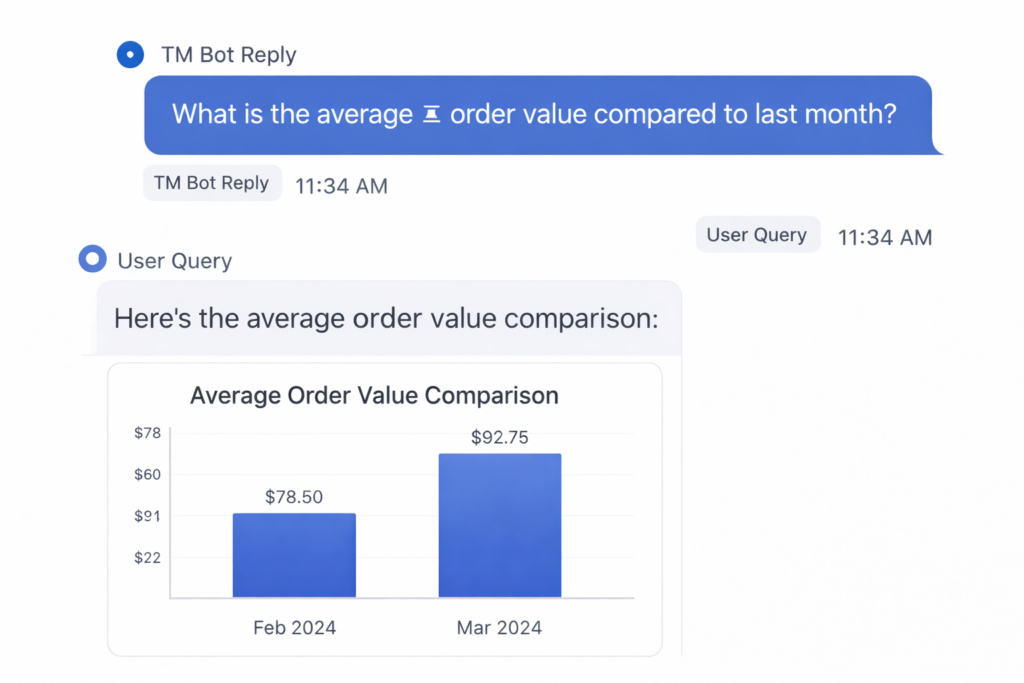
Sell more, fix leaks, move faster.
With an AI database chatbot, eCommerce teams can ask:
- “Which products are selling the most this week?”
- “Where are customers dropping off before checkout?”
- “Which marketing campaign brought the highest revenue?”
- “Which products are running low in inventory today?”
- “What is the average order value compared to last month?”
This helps teams optimize pricing, inventory, and campaigns without waiting for reports or dashboards.
Read Also: How MCP Agents Are Automating Inventory & Fulfillment
🏫 eLearning Platforms
Improve engagement, reduce churn, grow subscriptions.
eLearning businesses commonly ask:
- “Which courses have the highest completion rate?”
- “Where are students dropping out the most?”
- “Which instructors get the best feedback?”
- “How many users upgraded from free to paid this month?”
- “Which course brings the highest lifetime value?”
Product, content, and marketing teams get clear direction on what to improve and what to scale.
🏢 Real Estate Companies
Track leads, deals, and performance in real time.
Real estate teams use the chatbot to ask:
- “How many new leads came in today?”
- “Which property listings are getting the most inquiries?”
- “Which agents are closing the most deals this quarter?”
- “What’s the average deal closure time?”
- “Which locations are performing better than expected?”
This helps brokers and managers focus effort where money is actually coming from.
🏭 Manufacturing Companies
Reduce delays, control costs, improve output.
Manufacturing teams often ask:
- “Which orders are delayed right now?”
- “Where is production slowing down?”
- “Which supplier causes the most delays?”
- “What is today’s production vs target?”
- “Which machine has the highest downtime?”
Operations teams get live visibility, not yesterday’s reports.
🏨 Hotel Booking & Hospitality
Increase occupancy, improve guest experience.
Hotel and booking platforms ask:
- “What is today’s occupancy rate?”
- “Which room types are selling fastest?”
- “Which booking channel gives the highest revenue?”
- “How many cancellations happened this week?”
- “What are the most common guest complaints?”
Revenue managers and hotel staff can adjust pricing, promotions, and service instantly.
This is exactly how we position AI database chatbots at Triple Minds—not as a technical tool, but as a daily decision assistant for the business.
Types of Databases That Can Be Integrated With an AI Database Chatbot
One concern we often hear from businesses is:
“Our database is old.” or “Our setup is not standard.”
The good news is—AI database chatbots are not limited to modern or popular databases. At Triple Minds, we design chatbot architectures that work with both legacy systems and modern data stacks, because real businesses rarely run on a single, clean database.
Below is a clear, business-friendly breakdown.
1) Traditional SQL Databases (Most Common)
Works perfectly with existing enterprise systems.
If your business uses:
- MySQL
- PostgreSQL
- Microsoft SQL Server
- Oracle Database
You’re already in a great position. These databases are widely used in CRMs, ERPs, finance systems, and internal tools.
The chatbot can query sales, finance, operations, and customer data directly and securely, without changing your setup.
2) Legacy & Enterprise Databases
Yes—even old systems can be integrated.
Many enterprises still rely on:
- Oracle legacy systems
- IBM DB2
- On-premise enterprise databases
We frequently work with businesses running 10–20 year old systems. Instead of forcing migration, we integrate the chatbot on top of existing infrastructure, protecting your past investments.
No forced upgrades. No risky rewrites.
3) Cloud Databases & Data Warehouses
Ideal for fast-growing and data-heavy companies.
If your data lives in:
- Amazon RDS / Aurora
- Google BigQuery
- Snowflake
- Azure SQL / Synapse
The AI chatbot can handle large-scale analytical queries like trends, forecasting, and performance analysis.
Perfect for leadership dashboards, finance analysis, and growth tracking.
4) NoSQL & Semi-Structured Databases
Great for modern apps and high-volume data.
For businesses using:
- MongoDB
- Firebase
- DynamoDB
- Cassandra
The chatbot can still answer meaningful questions—even when data is not stored in tables.
Useful for apps, marketplaces, IoT platforms, and high-traffic systems.
5) ERP, CRM & Business Systems Databases
Most businesses don’t even realize these are databases.
AI database chatbots can sit on top of:
- ERP systems (inventory, finance, procurement)
- CRM systems (leads, customers, sales)
- HR and operations platforms
Teams ask questions like “How many unpaid invoices exist?” or “Which leads are stuck in follow-up?” without opening multiple tools.
6) Multiple Databases at the Same Time
This is where real power shows up.
Many businesses run:
- One database for sales
- Another for finance
- Another for operations
We design chatbots that connect to multiple databases simultaneously, so businesses can ask:
- “Compare revenue with fulfillment delays”
- “Which regions have high sales but low margins?”
One question. Multiple systems. One answer.
7) Read-Only & Secure Integrations (No Risk to Data)
For sensitive businesses, the chatbot can be configured as:
- Read-only access
- Department-level permissions
- Audit-logged queries
This keeps compliance, security, and leadership confidence intact.
Security & Compliance: Built for Enterprise Confidence
When businesses think about using AI to access their databases, the first real concern is not features—it’s security.
Questions like “Is our data safe?”, “Who can see what?”, and “Will this create compliance risks?” are completely valid. At Triple Minds, we treat security and compliance as core design requirements, not add-ons.
Here’s how we ensure enterprise confidence from day one.
1) Your Data Never Leaves Your Control
AI database chatbots do not mean your data is sent everywhere. We design systems where:
- Databases stay in your environment (cloud or on-premise)
- The chatbot connects securely using controlled access
- No raw data is exposed outside approved boundaries
Businesses keep ownership and control of their data at all times.
2) Role-Based Access for Every Team
Not everyone in an organization should see the same data—and we fully respect that.
We implement:
- Role-based access (Sales, Finance, Ops, Leadership)
- Permission-level query restrictions
- Department-specific visibility rules
A sales executive sees sales data. Finance sees financials. Leadership sees everything—cleanly and safely.
3) Read-Only Database Access (Zero Risk to Data)
For most enterprises, chatbot access is configured as read-only.
That means:
- No updates
- No deletes
- No accidental data changes
Teams can ask unlimited questions without any risk to operational systems.
4) Full Audit Logs & Query Tracking
Every interaction can be logged:
- Who asked the question
- When it was asked
- Which data was accessed
This is critical for:
- Internal audits
- Compliance reviews
- Security investigations
Nothing happens silently in the background.
5) Compliance-Ready Architecture
Different industries have different compliance needs. We design AI database chatbots that align with:
- Enterprise IT policies
- Data privacy standards
- Industry-specific compliance requirements
Whether you operate in finance, healthcare, education, or enterprise SaaS, the chatbot can be tailored to match your compliance framework, not challenge it.
6) On-Premise or Private Cloud Deployment
For organizations that cannot use shared environments, we offer:
- Fully on-premise deployment
- Private cloud setups
- Network-restricted access
Ideal for enterprises with strict data residency or internal IT rules.
7) Human Oversight & Admin Controls
Admins always stay in charge:
- Control data sources
- Manage user access
- Pause or restrict functionality if needed
AI assists decisions—it does not override governance.
We’re a globally trusted AI development company and we’ve already built AI database chatbots. Talk to our team to see how this can work for your business.
FAQs
Yes. AI database chatbots can interpret multi-step, context-aware business questions and return accurate answers by combining data from multiple tables or systems when required.
By providing a single, consistent source of answers, AI database chatbots eliminate conflicting reports and ensure every department works from the same data logic.
Yes. AI database chatbots can be tailored with department-specific metrics, KPIs, permissions, and workflows for sales, finance, operations, CX, and leadership.
Implementation depends on data complexity and security requirements, but most businesses can deploy a working AI database chatbot within weeks, not months.