
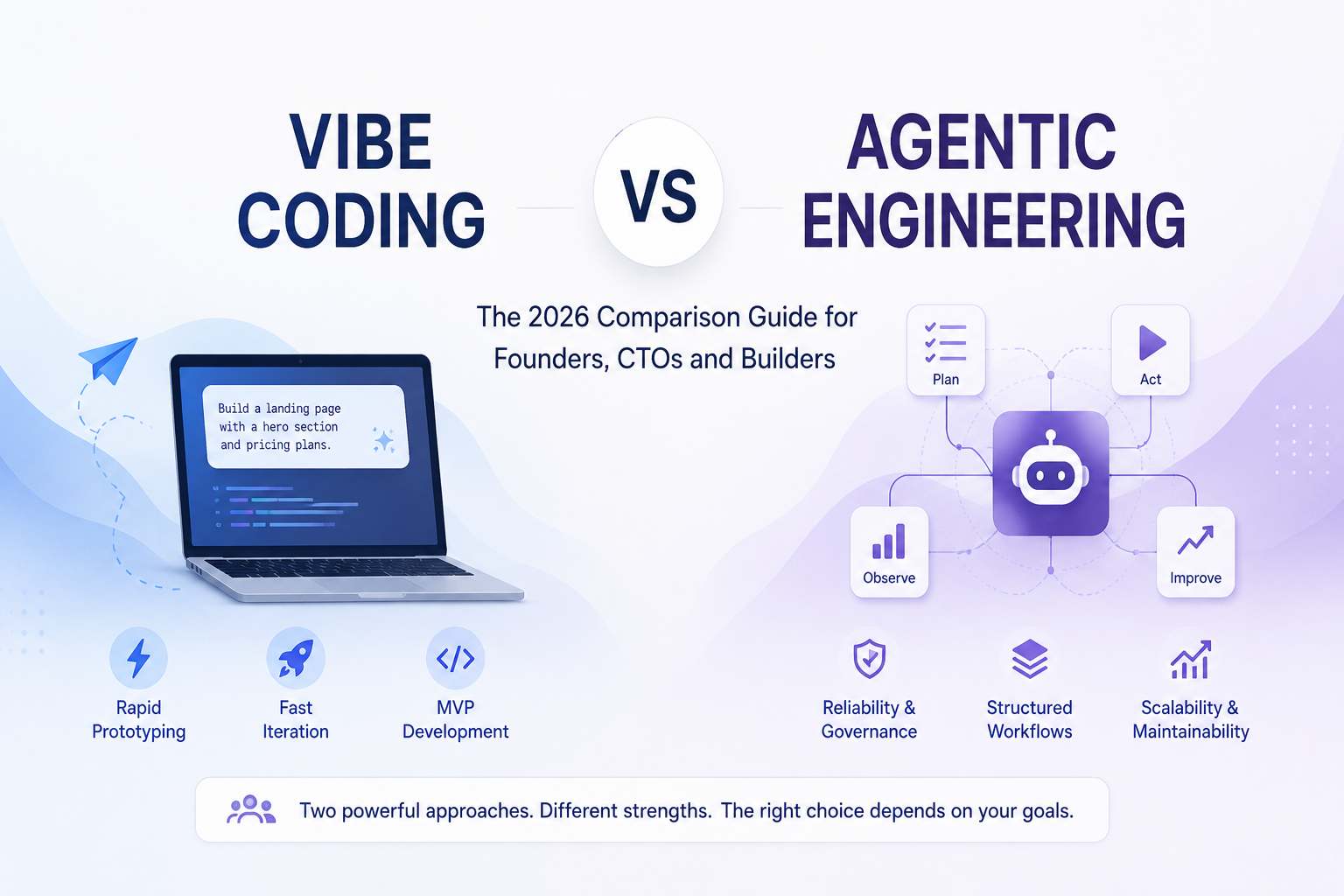
Two phrases are getting used interchangeably in 2026, and it’s costing founders real money. Vibe coding and agentic engineering sound similar. They are not the same thing. Pick the wrong one for your project and you ship either a polished demo that breaks in production, or a fortress that took six months to build for a problem that needed a weekend.
The cleanest framing we’ve seen, going around developer circles for months now, is this: vibe coding raises the floor for beginners; agentic engineering raises the ceiling for professionals. Two different tools, two different jobs. This post is the comparison nobody else writes cleanly — what each actually is in 2026, when to use which, what each costs, and the common ways teams pick wrong.
We’re Triple Minds. We ship both kinds of work every week — vibe-coded MVPs in 5 to 25 days for founders who need to validate fast, and full agentic-engineering builds for clients shipping production systems that have to last. The honest version of this comparison is what we walk new clients through on the scoping call. We’re publishing it here so you don’t need the call to figure out which side you’re on.
Not sure which approach fits your project? Free 30-min scoping call: book a slot here.
Quick definitions — what each one actually means in 2026
Vibe coding
You describe what you want in plain English. The AI writes the code. You don’t read most of it. If it works in the demo, you ship. The “vibe” is that the developer is feeling their way through the build by conversational iteration, not by careful design. Andrej Karpathy coined the term in early 2025. Collins Dictionary made it Word of the Year by November.
Vibe coding is genuinely revolutionary for what it makes possible. A founder with no engineering background can ship a working product in days. A solo developer can do the work of a 3-person team. The cost: the AI owns the code, the human owns only the intent. When the project grows past a certain size — usually around the point where you need a real database schema, a real auth flow, or a real integration with someone else’s system — vibe coding starts to drift, then fall apart.
Read Also: Is Vibe-Coded Code Production-Ready?
Agentic engineering
AI agents handle the engineering work autonomously inside a deliberate human-led process. The agent reads your codebase, plans changes, edits files across multiple directories, runs tests, debugs failures, and submits a pull request. You review the PR. You make the architectural calls. The agent does the typing and most of the grunt work in between.
The key distinction — and the one most people miss — is that the agent is not the process. The agent is a tool inside the process. A senior engineer is still in the loop, still owning the architecture, still making the calls that matter. The agent handles the volume work, the file navigation, the test fixing, the boilerplate. Tools that ship in this mode: Claude Code, Devin, Cursor’s autonomous mode, Codex CLI, Replit Agent 3. All emerged into production-viable form in late 2025.
The 10 differences that actually matter
| Dimension | Vibe Coding | Agentic Engineering |
|---|---|---|
| Who owns the code? | The AI (you describe; it builds) | The human engineer (the agent helps) |
| Who reviews the code? | Mostly no one | The engineer reviews every PR |
| Optimized for | Immediate output, time-to-demo | Correctness, maintainability, confidence |
| Best for | Prototypes, MVPs, single-purpose apps, landing pages, calculators | Production systems, refactors, large feature additions, codebases that will live for years |
| Skill level required | None to low (raises the floor) | Senior engineering judgment required (raises the ceiling) |
| Typical project size | 1 to 50 files, single repo | Any size, including multi-repo / multi-service systems |
| Typical timeline | Hours to a few weeks | Days to months, depending on scope |
| Failure mode | Works in demo, breaks in production at user #50 | Slower to ship, sometimes over-engineered |
| Tools you’d reach for | Cursor (chat mode), Bolt, Lovable, v0, Replit Agent (quick mode) | Claude Code, Cursor (autonomous mode), Devin, Codex CLI, Replit Agent 3 (sustained mode) |
| What you actually buy from us | A working MVP in 1-4 weeks at $5K-$40K | A production build in 6-16 weeks at $25K-$200K+, with a senior on every PR |
Notice the failure modes on row 8. Both have them. The fact that vibe coding breaks under real users doesn’t make it bad — it makes it the wrong tool for that job. The fact that agentic engineering can be over-engineered for a weekend project doesn’t make it bad either. The fix is picking right, not picking sides.
When vibe coding is the right call
Use it when the cost of being wrong is low and the cost of waiting is high. Specifically:
- You’re validating an idea. Throwaway prototype to put in front of 5 prospective customers. The code does not have to survive month 2.
- You’re building a landing page, calculator, or tool that doesn’t store sensitive data. No auth, no payments, no PII. The blast radius if it breaks is “the page is broken for an hour.”
- You’re building internal tooling that only your team uses. Dashboards, scripts, custom Notion-style trackers. If it falls over you can just rebuild it.
- You’re a non-developer founder shipping your first version. Vibe coding is genuinely the cheapest, fastest way to find out if anyone wants your thing. Get the validation. Then hire engineers.
- You’re a senior engineer using it as scaffolding. Generate the boilerplate fast, then go in and harden the bits that matter. This is how seasoned developers actually use Cursor and Bolt — as accelerators, not as the whole engineer.
Almost every site on our recent Top 10 Vibe Coded Websites list shipped in the 3-25 day window — that’s vibe coding doing what it’s good at, with a senior engineer keeping the foundation honest.
Read Also: Best Vibe Coding Tools For Non-Technical Founders
When agentic engineering is the right call
- You’re shipping a production system that will be used by paying customers. Anything that handles money, identity, health data, or anything regulated. The minimum bar here is “actual engineering judgment on every decision.”
- You’re refactoring an existing codebase. Multi-file changes across a real repo. Agentic tools like Claude Code or Devin shine here because they can plan, execute, run tests, and iterate without you babysitting each step.
- You’re adding a feature to a 50K-line codebase. Vibe coding falls apart at this size because the model can’t hold the whole project in context and starts hallucinating about how your code works. Agentic tools actually read the relevant files first.
- You’re writing tests for an existing feature. Agents are remarkably good at this — they explore the code, understand the surface area, write the assertions. A junior engineer would take a week. An agent takes an afternoon.
- You’re shipping a build that needs to be defensible to a regulator, auditor, or buyer. Anything where a real engineer’s name needs to be on the architecture. SOC 2 audits look at “who reviewed this PR” not “what AI generated it.”
Our larger client builds — SugarLab, the AI medical scribes, the enterprise AI agents, the Shopify MCP layers — all ship in agentic-engineering mode. Senior engineer in the loop, agents doing the volume work, every PR reviewed by a human before merge.
The tool landscape in mid-2026
Most of the major tools now have modes that lean toward one approach or the other. Here’s how we actually categorize them when we’re picking the right one for a job:
| Tool | Primary mode | What it’s actually best at |
|---|---|---|
| Cursor (chat / Tab mode) | Vibe coding | Pair-programming with autocomplete on steroids; conversational refactoring inside one file |
| Cursor (Agent / Composer mode) | Agentic engineering | Multi-file edits with planning; the swing tool that does both well |
| Claude Code | Agentic engineering | Terminal-based agent that reads your codebase, makes PRs, runs your tests. Our daily driver for production work. |
| Devin | Agentic engineering | Cloud-based autonomous agent; run multiple in parallel on different tasks. Heaviest of the bunch. |
| Codex CLI / GitHub Copilot Workspace | Agentic engineering | GitHub-native, good for issue-to-PR flows on existing repos |
| Bolt.new | Vibe coding | Fastest 0-to-deployed-app on the internet; demos in 60 seconds |
| Lovable | Vibe coding | Conversation-first full-stack apps for non-developers; portable code export |
| v0 (Vercel) | Vibe coding | UI generation from prompts; designers’ favourite |
| Replit Agent 3 | Both modes | Quick prototype mode + sustained autonomous mode in one tool; up to ~200 min of autonomous work per task |
The interesting trend: the tools are converging. Cursor added autonomous mode in 2025. Lovable started exporting portable code in late 2025 so it could feed into agentic workflows. Claude Code can be invoked from inside Cursor. The hard line between “vibe coding tool” and “agentic engineering tool” is blurring fast — by 2027 it’ll be one continuum.
Cost and timeline — the honest numbers
What you actually pay, what you actually wait, for each approach. Mid-2026 market rates from the work we and our peers ship every day:
| Project type | Vibe coding approach | Agentic engineering approach |
|---|---|---|
| Landing page + form | $500 – $3K, 1-3 days | Overkill — don’t |
| Internal tool / dashboard for a 10-person team | $3K – $8K, 1-2 weeks | $15K – $30K, 3-5 weeks |
| MVP for a new SaaS to validate with 50 users | $8K – $25K, 2-5 weeks | $30K – $60K, 5-9 weeks |
| Production B2B SaaS with paying customers | Risky — code rewrite usually needed within 6 months | $45K – $150K, 8-16 weeks |
| HIPAA / SOC 2 grade healthcare or fintech build | Don’t | $80K – $250K+, 12-24 weeks |
| Refactor of an existing 50K-line codebase | Not possible | $20K – $60K, 4-8 weeks |
| Adding a single well-scoped feature to a real product | Risky — model can’t hold full codebase | $5K – $20K, 1-4 weeks |
The “Don’t” entries are not us being dramatic. The “Risky” entries are not us upselling. We have cleaned up enough vibe-coded production messes in the last twelve months to be tired of doing it. The cleanup costs roughly 1.5-3x what building it right with agentic engineering would have cost the first time around.
The 5 mistakes we see weekly
- Using vibe coding to build something that processes money. Payment flows, refunds, invoicing — these need an engineer who understands idempotency, reconciliation, and what happens when the payment provider’s webhook fires twice. Vibe-coded payment code silently double-charges or loses money. Always.
- Using agentic engineering to build a throwaway prototype. Spending 6 weeks and $40K to build something you’ll know within 2 weeks whether anyone wants. Validate first, engineer second.
- Treating “vibe coding” as a personality and “agentic engineering” as an upgrade. They’re not a hierarchy. They’re different tools for different jobs. Same engineer can use both on the same day. Same company should use both across the same product lifecycle.
- Hiring a vibe-coder for a job that needs an engineer. The cheapest hourly rate isn’t cheap when the production system fails six months in and a senior has to rewrite the whole thing.
- Hiring an engineering shop for a job that wants speed. If you need an MVP shipped in 10 days to prove a hypothesis, the agency that quotes you 12 weeks and $80K of agentic engineering work has misread what you need. Push back, get a vibe-code MVP, validate first.
How we use both at Triple Minds
We don’t pick a side. We pick the right tool for the project on the scoping call. Roughly how the work breaks down across our engagements:
- About 40% of our builds are vibe-coding-led. MVPs, landing pages with calculators, marketing tools, single-purpose apps, internal dashboards. Cursor (chat mode) + Bolt + Lovable + v0 as the primary stack. Senior engineer reviews the foundation but doesn’t write most of the day-to-day code. Examples on the Top 10 Vibe Coded Websites post.
- About 60% are agentic-engineering builds. Production SaaS, AI medical scribes, NSFW companion platforms, multi-tenant systems, Shopify MCP layers, enterprise AI agents. Claude Code + Cursor (Composer mode) as the primary stack. Senior engineer reviews every PR, owns the architecture, makes the calls that matter.
- About 15% of projects use both in sequence. Vibe coding for week 1 (build the demo, validate the design, iterate the UX with the client), agentic engineering for weeks 2 through ship (turn the demo into a real product). This is often the right pattern when the client doesn’t know exactly what they want yet but needs the final product to be production-ready.
The math doesn’t add to 100% because builds overlap categories — some agentic-engineering builds have vibe-coded sub-modules and vice versa. The number that matters: we have ten years of engineering experience deciding which approach fits which problem, and we have shipped both kinds across enough verticals to be honest about what each one can and can’t do.
Which one should you hire us for?
Practical decision tree, in case you skipped the rest of this post:
- Need to validate an idea fast, no real users yet, scope is one focused thing? Hire our vibe coding team. 1-4 weeks, $5K-$40K.
- Shipping something paying customers will use, or anything regulated, or a real refactor? Hire us in agentic-engineering mode. 6-16 weeks, $25K-$200K+. Same scoping process, different team composition.
- Not sure which one applies? Free 30-minute scoping call. We’ll tell you which approach fits your project honestly — including the version where the answer is “you don’t need us yet, validate with a vibe-coded prototype first.”
FAQs
Is agentic engineering just a new name for vibe coding?
No. Vibe coding gives the AI ownership of the code; agentic engineering keeps the engineer in charge and uses the agent as a tool. Different responsibility model, different output quality, different price band, different use cases. They share an underlying model (the AI does most of the typing) but the engineering process around it is what changes.
Can the same tool do both?
Several can. Cursor has both a chat mode (vibe coding leaning) and a Composer / Agent mode (agentic engineering leaning). Replit Agent 3 covers both. Lovable is mainly vibe coding but exports code that can feed into an agentic workflow. By 2027 the tool line is likely to disappear — the workflow choice is what matters.
Can I learn agentic engineering if I’m not a developer?
Partially. The tool side is learnable in a few weeks. The engineering-judgment side — knowing what to ask for, what to push back on, what a “good” PR looks like — takes years of writing code yourself. That’s why agentic engineering still requires a senior engineer in the room; the agent handles the volume work, the human handles the calls that need taste and experience.
If agentic engineering is more reliable, why does vibe coding still exist?
Because most software starts as an idea no one has validated. Spending $40K and 8 weeks on something that turns out to be the wrong product is a worse failure than shipping a fragile prototype in 6 days, putting it in front of customers, and finding out you need to pivot. Vibe coding is the right tool for that phase. Agentic engineering is the right tool for everything after the validation.
How long until agentic engineering replaces traditional dev teams?
It already has, partially. Most dev teams in 2026 do at least some agentic-engineering work — the agent writes a chunk of the code, the engineer reviews and merges. What’s not happening is “agent replaces the engineer entirely.” The judgment calls — what to build, what trade-offs to make, what edge cases matter — still need a person. That’s not changing on a short horizon.
Should I rewrite my vibe-coded MVP using agentic engineering before scaling?
Almost always yes, before you take real customer traffic. The vibe-coded MVP is great for validation. The production version of the same product should be rebuilt — usually 30-50% faster than building from scratch because you already know exactly what you want — using agentic engineering with a senior in the loop. Most of our builds in 2026 are this pattern: client comes in with a vibe-coded prototype, we rebuild the production version.
What’s the biggest mistake startups make with these two approaches?
Sticking with the vibe-coded MVP too long. The right time to switch to agentic engineering is right after product-market-fit signal — say, your first 50 paying customers, or the moment a real outage costs you a customer. Founders who wait until something breaks badly in production end up paying for both the cleanup and the rebuild.
Where can I read more about each approach?
The arxiv paper Vibe Coding vs. Agentic Coding: Fundamentals and Practical Implications of Agentic AI (2505.19443) is the most thorough academic treatment we’ve seen. For the vibe coding side specifically, our own Top 10 Vibe Coded Websites post walks through real builds with timelines. For agentic engineering, Anthropic’s Claude Code documentation and the Devin team’s deep dives are the best primary sources.
Ready to figure out which one your project needs?
Tell us what you’re trying to build, who it’s for, and roughly when you need it live. We’ll come back with a real recommendation — including the version where the answer is “you should vibe-code the v1 yourself and come back to us when you have validation.” We’re not going to sell you 12 weeks of engineering for a problem that needed 6 days of vibe coding. Same way we won’t ship a fragile prototype for a problem that needs production engineering.
Hire Triple Minds for whichever approach fits — vibe coding for speed, agentic engineering for production. Same shop, same standards, honest scoping on day one.
40% of our builds are vibe coding. 60% are agentic engineering. We tell you which one yours is on the first call.
Got a project in mind? Let’s build it together.
We work with founders and product teams across consulting, development, and growth marketing. Tell us what you’re building and we’ll show you how we’d ship it.