How to Start Your Own Live Shopping Platform?
Starting a live shopping platform offers entrepreneurs an opportunity to combine livestreaming, product discovery, and online commerce. Learn how to choose your niche, define a business model, validate market demand, select the right development approach, and plan essential features. Discover how a white-label live shopping solution from Triple Minds can help you launch your own branded live commerce marketplace faster.

Live shopping is changing how people discover and purchase products online. Today, people don’t browse static product pages and rely only on written descriptions. Instead, they watch a host demonstrate products in real time, ask questions, see special offers, and place orders without leaving the live stream.
This new trend brings together livestreaming, social interaction, and e-commerce in one shopping experience. It gives brands and retailers a way to demonstrate products, answer customer questions, and create a more engaging path from product discovery to checkout.
For entrepreneurs, this creates an opportunity to build a dedicated live shopping platform rather than depending entirely on marketplaces or social media channels. However, launching one involves more than adding a live video feature to an online store. You need to plan the business model, seller and host experience, streaming infrastructure, product catalogue, checkout process, and tools for managing live events.
We at Triple Minds help entrepreneurs worldwide dip their toes into the live shopping trend and build their business around this trend. We offer a Whatnot-style live auction marketplace with real-time bidding, slide-to-bid checkout, a seller studio, and an admin console. Connect and launch your live shopping platform within 30 days or less.
Why Should You Start a Live Shopping Platform?
Live shopping offers businesses a different way to connect product discovery with purchasing. It is particularly useful for products that benefit from demonstrations, comparisons, explanations, or visual presentations. For entrepreneurs, the opportunity is not limited to selling products through live video. You can build the technology infrastructure that allows multiple sellers, brands, and creators to host shopping events through one platform.
Growing Interest in Interactive Shopping
Online shoppers want convenient and engaging experiences. Product pages show images and details, but they may not answer questions about how a product looks, feels, or works. Live shopping lets customers watch product demos and ask questions before buying. Shopify’s live shopping guide highlights how live demos, real-time interaction, and product discovery make online shopping more engaging.
Better Product Demonstrations
Some products are easier to understand through live demos. For example, beauty brands can show how to use skincare products. Electronics sellers can explain device features, while furniture sellers can show product size, materials, and assembly. These demos help customers understand products better.
Direct Customer Interaction
Live shopping allows customers to interact with hosts during a session. They can ask about prices, sizes, colours, features, delivery, and availability. Hosts can answer questions instantly. This helps customers make better buying decisions and gives sellers useful feedback.
Opportunities for Brands and Independent Sellers
A live shopping marketplace helps small businesses reach customers without building their own streaming systems. Platform owners can onboard sellers, offer live-selling tools, and help customers explore products from different brands in one place. This creates opportunities to build a marketplace around a specific niche, community, or customer group.
Read More: Why Businesses Are Investing in Live Commerce Platforms in 2027
Steps To Launch Your Own Live Shopping Platform
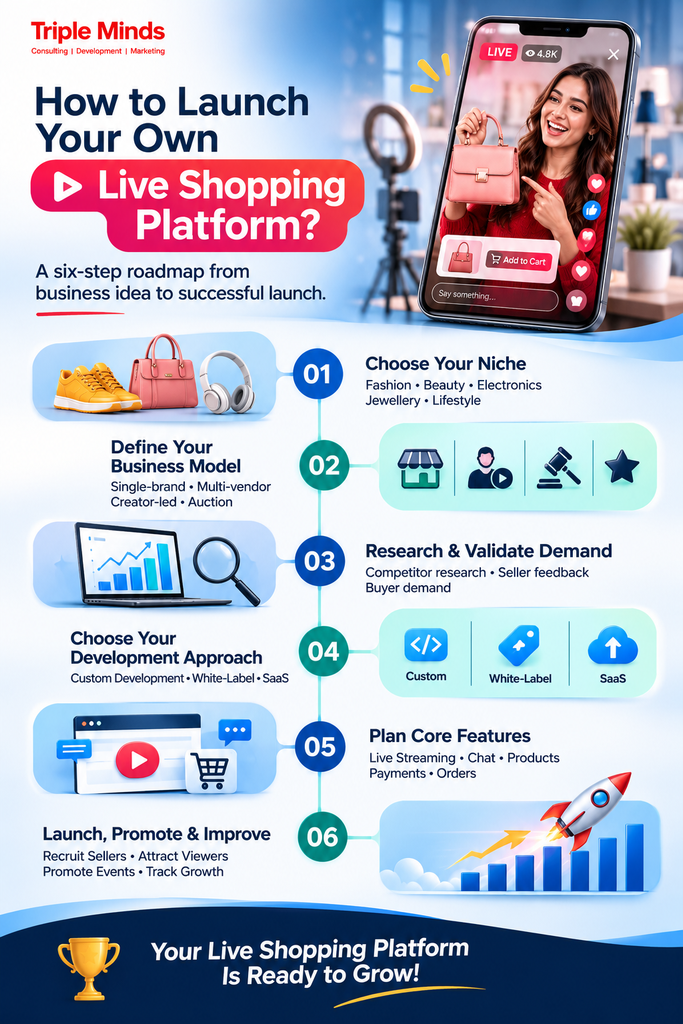
Starting a live shopping business requires decisions about your target market, business structure, technology, monetization, and launch strategy. The following steps provide a practical roadmap.
Step 1: Choose Your Live Shopping Niche
Before developing the platform, decide what type of products and sellers you want to support. Launching a general marketplace that covers every product category may sound attractive, but it can make it difficult to establish a clear identity. You would need to attract different types of sellers, manage diverse inventory requirements, and market the platform to several customer segments. You can consider the following niches for your live shopping platform:
- Fashion and apparel
- Beauty and cosmetics
- Electronics and gadgets
- Jewellery and accessories
- Home and lifestyle
- Collectibles and hobby products
Step 2: Define Your Business Model
After selecting the your live shopping platform niche it’s time to decide how the platform will operate ie business model. There are several ways to structure a live shopping business.
Single-brand platform
A single retailer or brand owns the platform and uses it to host its own live shopping events. This model is suitable for established businesses that want to add livestream commerce to their existing online store. The platform can integrate the brand’s product catalogue, inventory, customer accounts, and payment system.
Multi-vendor marketplace
A multi-vendor live shopping platform allows independent sellers and brands to register, list products, and host their own live sessions. The platform owner manages seller onboarding, product categories, customer accounts, payments, commissions, and marketplace policies. This model creates opportunities to earn from multiple sellers, but it requires stronger administration and marketplace management.
Creator-led shopping platform
In this model, influencers, content creators, and product experts host live shopping sessions featuring products from different brands. Creators may earn commissions or agreed promotional fees from the sales they generate. The platform can also provide tools for tracking sales attribution and managing creator partnerships.
Auction-based live shopping platform
An auction-led platform allows sellers to showcase products and invite viewers to place bids during a live session. Buyers compete for selected items, and the highest eligible bid wins when the auction closes. This model is useful for collectibles, rare products, sneakers, art, and other categories where limited availability or competitive bidding creates interest. It is important to distinguish this model from standard live shopping.
Step 3: Research Your Competitors and Validate Demand
Before investing in development, study how existing platforms approach live shopping. Look at their audience, seller experience, product categories, shopping workflows, monetization methods, and content formats. These platforms offer different approaches to live commerce. You should study them to understand the market, not simply reproduce every feature.
Next, validate the opportunity with potential sellers and buyers.
Speak with retailers, independent brands, creators, and customers in your chosen category. Ask sellers whether they would host regular sessions, what tools they need, and what commission or subscription structure they would consider. Ask potential buyers what would make them attend a live shopping event and complete a purchase. This helps you understand whether your idea solves a real problem and which features should be prioritized.
Step 4: Decide How You Will Build the Platform
After checking your business idea, choose how you want to build the platform. There are three main options.
Build from Scratch
Custom development gives you full control over the platform’s design, features, and future updates. You can build features based on your business needs, such as seller tools, payment options, integrations, and live streaming.
However, it takes more time, money, and technical work. You need to develop or add video streaming, live chat, product listings, payments, inventory, order management, and admin tools.
Use a White-Label Live Shopping Platform
A white-label solution gives you a ready-made platform that you can customize with your brand, features, and business rules. You do not need to build everything from scratch. This saves development time and helps you launch faster. Before choosing a provider, check customization options, source code access, ownership, and licensing terms.
Read More: How to Launch a Live Streaming Shopping Platform Like Whatnot?
Use a SaaS Live Commerce Solution
A SaaS platform offers live shopping tools through a monthly or yearly subscription. It is useful for retailers who want to add live shopping to their existing online store without building a separate marketplace. However, it may offer less control over features, data, and platform ownership. Check the costs, integrations, and limits before choosing one.
Step 5: Plan the Core Features
A live shopping platform typically serves three main user groups: shoppers, sellers or hosts, and administrators. Each group needs a different interface and set of tools. Start by mapping the complete shopping journey:
- A seller creates a live shopping event.
- The seller adds products and schedules the session.
- The platform notifies interested shoppers.
- Viewers join the live stream.
- The host demonstrates products and answers questions.
- Viewers select products and complete purchases.
- The seller receives order information.
- The platform updates inventory, payments, and order status.
Step 6: Launch, Promote, and Improve
Once the platform passes testing, launch it with a focused group of sellers and a clear event calendar. Do not depend only on users discovering the platform organically. Live shopping requires both viewers and sellers to be active at the same time.
Start by recruiting sellers who already have customers or an engaged social media audience. Give them tools to promote their scheduled sessions and invite their followers. Use email, social media, creator partnerships, referral campaigns, and paid advertising to attract viewers.
Launch Your Live Shopping Platform Faster with Triple Minds
Get started with Triple Minds’ white-label live shopping app, featuring live streaming, multi-vendor management, in-stream shopping, seller dashboards, auctions, and secure checkout. Customize it to match your brand and business needs.
Explore Live Streaming Shopping App Solutions
How Triple Minds Can Help You Launch Your Own Live Shopping Platform
Triple Minds offers a WhatNot clone for entrepreneurs and businesses that want to launch their own branded live commerce marketplace. The solution is designed to support multi-vendor streaming, in-stream checkout, seller tools, and platform administration. The platform includes capabilities such as:
- Real-Time Live Streaming: Support interactive live shopping sessions with low-latency video delivery.
- Multi-Vendor Marketplace: Allow multiple sellers and brands to register, manage products, and host live events.
- In-Stream Shopping: Display products during live sessions and let viewers purchase without leaving the broadcast.
- AI Hosts and AR Try-On: Add advanced shopping experiences through AI-powered hosting and virtual product try-on capabilities.
- Shoppable Replays: Keep recorded sessions available so viewers can discover and purchase featured products after the broadcast.
- Admin Management: Control sellers, users, content, transactions, and platform activity from a centralized dashboard.
- Source-Code Ownership: Build on a white-label foundation with full source-code ownership, subject to the agreed project scope and handover terms.
Whether you want to build a single-brand shopping experience, a multi-vendor live commerce marketplace, or an auction-led platform, the right development approach depends on your target audience and business requirements. Planning to launch your own live shopping platform? Connect with Triple Minds to discuss your business model, feature requirements, and development roadmap.
Frequently Asked Questions
How does a live shopping platform work?
A live shopping platform allows sellers or hosts to broadcast product demonstrations in real time. Viewers can watch the session, interact through chat, view featured product cards, and purchase items directly from the stream. The platform then manages payments, orders, inventory updates, and seller information.
How much does it cost to build a live shopping platform?
The development cost depends on the number of applications, streaming requirements, marketplace features, payment integrations, and customization. A single-brand MVP generally requires a smaller scope than a multi-vendor platform with advanced analytics, AI hosts, and AR try-on. A detailed feature list is necessary to estimate the cost accurately.
Can I create a multi-vendor live shopping marketplace?
Yes. A multi-vendor live shopping platform allows multiple sellers to register, list products, and host their own live sessions. It needs seller onboarding, product management, commissions, order processing, payment settlements, and administrative controls.
How do live shopping platforms make money?
Live shopping platforms can earn through commissions on completed sales, seller subscription plans, sponsored streams, featured product placements, premium shopper memberships, and paid seller tools. The right combination depends on the marketplace structure and the value offered to sellers and shoppers.
What is the difference between a live shopping app and a Whatnot clone?
A standard live shopping app focuses on product demonstrations, viewer interaction, and fixed-price purchases during a broadcast. A Whatnot-style platform adds auction functionality, including real-time bidding, countdowns, bid validation, and winner checkout. Some businesses may combine both approaches.
What features should a live shopping app have?
A live shopping app should include live video streaming, interactive chat, product pinning, in-stream checkout, inventory synchronization, seller dashboards, order management, payment integration, and admin controls. Additional features may include shoppable replays, personalized feeds, AI hosts, and AR try-on.
Got a project in mind? Let’s build it together.
We work with founders and product teams across consulting, development, and growth marketing. Tell us what you’re building and we’ll show you how we’d ship it.