How to Find the Right AI Ethics Consultant for Your Digital Product
Choosing the right AI ethics consultant is essential for building trustworthy, compliant, and production-ready AI products. This guide explains how to evaluate consultants based on technical expertise, regulatory knowledge, product experience, bias testing capabilities, and post-launch governance. Learn the key questions to ask, common red flags to avoid, and what to look for when selecting an AI ethics consulting partner.

Since you’ve landed on this post, it’s safe to assume that you have already built a digital product and now you need an AI ethics consultant.
But now the question you are actually trying to answer is how to find the right AI ethics consultant. And we can understand your dilemma.
The right AI ethics consultant will genuinely make your product safer, fairer, and more defensible. On the other hand, the wrong AI consultant will produce a framework document, invoice you, and leave your engineering team exactly where they started.
The gap between the two is enormous — and it is rarely obvious from a proposal document or an introductory call.
According to EY, AI compliance failures cost organisations approximately $4.4 billion in 2025. Non-compliance limits market access for 68% of global AI firms. Strong compliance frameworks cut penalties by 80%.
You are not hiring a consultant for philosophical reasons. You are hiring one because the cost of getting this wrong is real and measurable. This post will guide you with the specific criteria, questions, and red flags you need to make the right hiring decision for your product and your situation.
Key Criteria to Choose the Right AI Ethics Consultant
Finding the right AI ethics consultant can have a significant impact on the success of your digital product. To help you choose the right partner, we’ve outlined the key criteria to guide your decision and make the selection process easier. Today, many consultants claim expertise in responsible AI. The difference lies in their ability to turn AI ethics, regulatory compliance, bias testing, and audit readiness into practical product controls that work in real-world deployments.
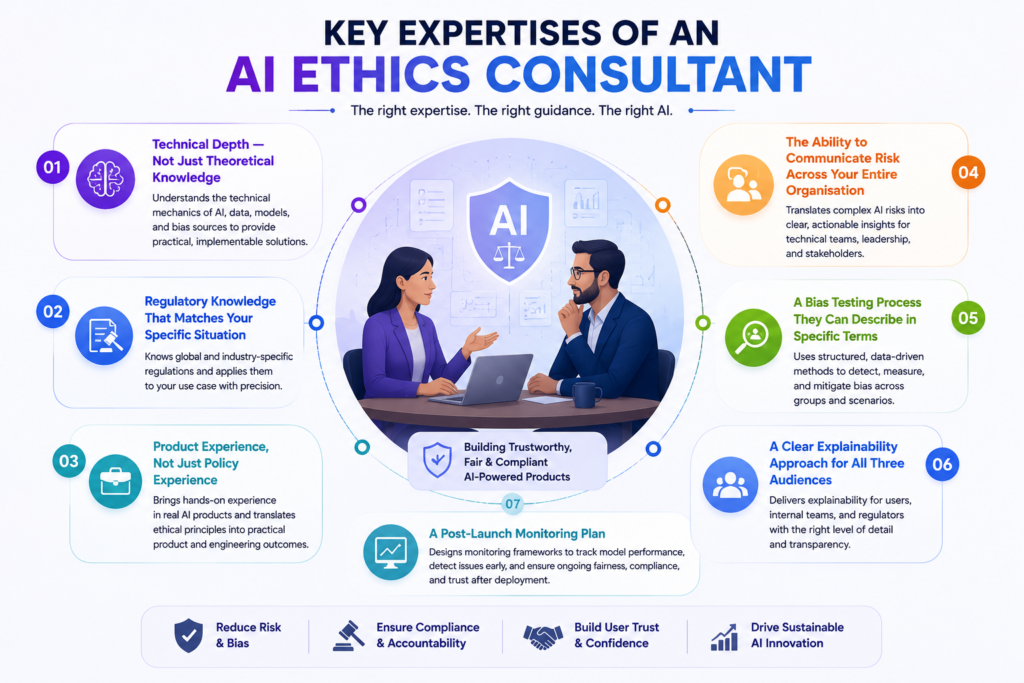
1. Technical Depth — Not Just Theoretical Knowledge
This is the most important filter, and the one that eliminates the largest proportion of candidates who present well on paper.
Be careful with consultants who cannot explain the technical mechanics of bias in machine learning models. Real AI ethics consulting means you can point to where bias actually enters the pipeline: in the training data, in feature selection, in the optimisation objectives, in threshold calibration, or in the deployment context.
Ask them:
“If our model’s approval rate for one demographic group was ten percentage points lower than another — where would you start looking for the cause?”
A consultant with genuine technical depth will walk you through a structured diagnostic: training data representation, feature engineering choices, label quality, threshold calibration, proxy variable encoding. A consultant without it will say something like “we would run a bias audit” without being able to explain what that involves in practice.
They do not need to write your model training code. But they need to understand the mechanics well enough to give your data science team specific, implementable guidance and not general observations that engineers then have to translate on their own.
2. Regulatory Knowledge That Matches Your Specific Situation
AI regulation is proliferating, sector-specific, and moves faster than most people working outside of it realise. General familiarity with the EU AI Act is not the same as knowing which risk tier your specific product falls into and what compliance looks like at the feature level.
The regulatory landscape you need your consultant to understand depends on where your product operates and what it does:
EU AI Act — if your product operates in the EU or serves EU users, the Act’s risk tier classifications determine what obligations apply. High-risk AI systems face significant transparency, explainability, and human oversight requirements. Your consultant should be able to tell you exactly which category your product falls into and what compliance requires from your engineering team and not your legal team.
GDPR Article 22 — applies when automated decision-making produces legal or similarly significant effects on users. The requirement to inform users and provide human review mechanisms must be built into your product interface, not buried in a terms and conditions document.
NIST AI Risk Management Framework — the practical governance standard in many US enterprise and government-adjacent contexts. Your consultant should be able to map your product against it, not just cite it.
ISO/IEC 42001 — the international AI management system standard. Increasingly appearing in enterprise procurement requirements and certification expectations.
Sector-specific frameworks — an ethics consultant supporting a healthcare organisation should understand FDA Software as a Medical Device guidance. Someone focused on financial services should be comfortable with SR 11-7 model risk management guidance from the Federal Reserve. Do not hire a generalist for a regulated sector engagement without verifying they understand the sector-specific layer on top of general AI ethics principles.
Ask them:
“What regulatory obligations apply to our specific use case and what would compliance with each one actually look like in our product?”
The answer should be precise and feature-specific. If it is general, they do not know your situation well enough yet or at all.
3. Product Experience, Not Just Policy Experience
There is a meaningful difference between consultants who have worked directly with engineering and product teams on live AI systems, and those whose experience is primarily in policy development, academic research, or corporate ethics programme design.
If your immediate need is to make your existing product more ethically sound, you need someone who has done this before in a product context — someone who knows how to translate an ethical principle into a data science sprint, a bias testing protocol, a logging specification, or a user-facing disclosure that your development team can implement.
For industry-specific engagements, hands-on experience with real AI projects usually says more than academic degrees. Look for people who can show their skills through open-source contributions, participation in AI competitions, or prior production deployments. Ask for references from clients in your exact sector.
Ask them:
“What did this consultant produce for your engineering team? What got built or changed as a direct result of their engagement?”
The answer should involve specific controls, tests, or architectural decisions, not a governance document that was produced and then filed away.
4. The Ability to Communicate Risk Across Your Entire Organisation
One thing most AI ethics consultants don’t have, but enterprises really notice, is organisational influence. The ability to translate technical risk findings into board-level language, then actually drive policy adoption across legal, compliance, product, and data science teams.
A consultant who can explain model fairness to your data scientists but cannot explain the same risks to your CFO, your legal team, or your board in language that produces decisions is only half as valuable as one who can do both. Test this in the conversation itself.
Ask them:
To explain a complex trade-off like the difference between demographic parity and equalised odds as fairness criteria. First, as they would to a machine learning engineer, then as they would to a Chief Risk Officer.
The quality and clarity of both explanations tells you whether they can drive change across your organisation or only within one function.
5. A Bias Testing Process They Can Describe in Specific Terms
Bias testing is the most commonly claimed and most inconsistently delivered capability in AI ethics consulting. Almost every candidate says they do it. Very few can describe a rigorous, specific approach when asked.
A credible bias testing process for your product should include, at minimum:
Training data review — examining demographic composition, identifying representation gaps, and assessing whether historical decisions encoded in the data carry discriminatory patterns.
Protected group testing — measuring model outcomes across legally protected characteristics and statistically significant proxy variables.
Proxy variable analysis — identifying features in your data that correlate with protected characteristics without directly encoding them. Postcode, device type, browsing behaviour, transaction timing — these can all serve as proxies for demographic characteristics in ways that produce discriminatory outcomes even when demographic data is excluded from the model.
Intersectional testing — understanding that bias compounds at the intersection of characteristics. A model may perform fairly on gender and fairly on age independently, while producing significantly unfair outcomes for a specific combination of both.
Threshold calibration review — assessing whether the decision threshold applied to model outputs is producing systematically different false positive and false negative rates across groups — one of the most common and least diagnosed sources of outcome disparity.
Ask them:
To walk you through exactly what they would do for your specific product and your specific data. A consultant who gives a generic answer without specifying which fairness metrics they would use, why those metrics are appropriate for your use case, and what the output would look like is not the right person.
6. A Clear Explainability Approach for All Three Audiences
Explainability means different things to different stakeholders, and a strong consultant addresses all three rather than treating it as a single deliverable:
User-facing explainability — the plain-language explanation a person affected by an AI decision receives. This is both an ethical obligation and a legal requirement in many jurisdictions.
Internal operational explainability — the ability for your engineering and product teams to understand why the model made a specific decision in a specific case, enabling debugging, auditing, and improvement.
Regulatory explainability — the documented, auditable evidence that your AI system makes decisions in a way that can be scrutinised and defended by an auditor, a regulator, or in litigation.
Ask them:
“How do they approach each of the three?”
A consultant who focuses only on user-facing explanations will leave your internal and regulatory needs unmet. A consultant who focuses only on model interpretability tools will miss the user communication and regulatory documentation requirements.
7. A Post-Launch Monitoring Plan
AI ethics is not a pre-launch exercise. Models drift. Data distributions shift. The user population your product serves in year two may differ significantly from the population your model was trained on. A model that passes every fairness test at launch can degrade into unfair outcomes as real-world data diverges from training data.
Ethics consulting engagements that start after deployment end up costing about three to five times more than work built into the development cycle. But equally, consultants whose engagement ends at pre-launch validation are not accounting for what happens next.
Ask them:
- What metrics would you recommend we track post-launch to detect fairness degradation?
- At what thresholds should those metrics trigger a model review or retraining?
- How should our team document and escalate AI incidents?
- What does responsible AI monitoring look like for our specific use case in practice?
The answers should be specific and implementable by your team without continuous consultant involvement. If they cannot describe a monitoring programme in concrete terms, they are not thinking about the full lifecycle of your product.
Read Also: Common Bugs in AI-generated Code (and How to Fix Them)
Key Questions to Ask Before Hiring an AI Ethics Consultant
These separate candidates who understand the domain from those who have learned to sound like they do.
“Walk me through what you would do in the first two weeks of engaging with our product.”
This reveals whether they start with discovery or with their own framework and methodology. Starting with their framework before understanding your context is backwards.
“Describe a bias testing protocol you have run for a real product. What did you find, and what specifically changed as a result?”
A practitioner with genuine product experience will have concrete examples. Someone without it will describe methodology in the abstract.
“How would you explain demographic parity versus equalised odds to our lead data scientist — and then to our Chief Risk Officer?”
Tests both technical depth and the communication range that drives organisational adoption.
“What regulatory obligations apply to our specific use case — and what would meeting each one actually require from our engineering team?”
Tests the precision of their regulatory knowledge for your situation, not their general awareness of AI regulation.
“What would post-launch AI ethics monitoring look like for a product like ours?”
Tests whether they think in full product lifecycle terms or only in pre-launch terms.
“What is outside your expertise — what would you not be able to do for us?”
A confident, honest consultant has a clear and specific answer. Candidates who claim to cover everything should be treated with scepticism. Nobody is strong across the entire domain.
“Can you share an example of a deliverable your team produced for an engineering team on a comparable project?”
An anonymised example of a bias testing report, a technical risk brief, or a model card from a past engagement is far more informative than a list of client names.
These questions provide a solid starting point, but they shouldn’t be treated as a fixed checklist.
Every AI product has unique technical, regulatory, and business requirements, so it’s important to prepare additional questions that reflect your specific use case. The more tailored your discussion is to your product, the better you’ll be able to assess whether a consultant is the right fit.
Read Also: Best Vibe Coding Tools For Non-Technical Founders
One Final Distinction Worth Making
The consultants who produce the most durable, practical outcomes are the ones who treat your product’s ethical quality as a product quality issue and not a compliance issue, not a values exercise, and not a risk management checkbox.
Users who do not trust an AI decision do not act on it. Users who feel an AI system treated them unfairly do not return. Users who cannot understand why an AI made a decision about them disengage from the feature. The commercial and ethical arguments for responsible AI in your product point in the same direction.
The right consultant understands this. They will not produce a framework that imposes friction on your product in exchange for compliance comfort. They will find the places where getting the ethics right makes the product better and help your team build those improvements into the product itself.
If you’re looking for that kind of partner, Triple Minds can help. We’ve worked with 50+ AI-powered digital products to build practical AI governance, reduce bias, strengthen compliance, and embed responsible AI into real-world products—not just documentation.
Our focus is on creating AI systems that are trusted, compliant, and ready to scale. Get in touch with us to discuss your AI product and learn how our AI ethics consulting services can help you build responsible AI with confidence.
Why Choose Triple Minds as Your AI Ethics Consulting Partner?
Building responsible AI requires more than compliance checklists. Triple Minds helps businesses design practical AI governance, reduce bias, strengthen regulatory readiness, and embed responsible AI practices directly into real-world products from development through deployment.
Talk to Our AI Ethics Experts
Frequently Asked Questions
What is the most important thing to verify before hiring an AI ethics consultant?
Ask for a real example of product improvements they delivered, such as bias mitigation, audit logging, or AI governance changes, not just policies or frameworks.
Do I need an AI ethics consultant who specialises in my industry?
If you operate in regulated industries like healthcare or finance, industry expertise is essential. For other sectors, proven product-level AI ethics experience is usually sufficient.
How can I evaluate a consultant before committing?
Start with a short paid assessment or pilot project. The quality of their recommendations and deliverables will indicate what to expect from a larger engagement.
What if I use a third-party AI model?
You still need AI ethics oversight. A consultant can help assess risks, implement safeguards, and ensure your use of third-party AI is compliant and responsible.
What should your engineering team receive after the engagement?
You should receive actionable outputs such as bias testing protocols, audit requirements, implementation recommendations, and a monitoring plan—not just a report.
How do we know when the engagement is complete?
Define clear objectives and success criteria at the start. The engagement should end once agreed deliverables, testing, and documentation have been completed.
Got a project in mind? Let’s build it together.
We work with founders and product teams across consulting, development, and growth marketing. Tell us what you’re building and we’ll show you how we’d ship it.