Whether a business is developing a safety app for women or for any individual regardless of their gender, developing a safety app is only half the goal.
It doesn’t matter how much you are spending on user interface and the overall development of the app. If the features on your safety app are not up to date then you will not be able to stand out in the market.
When it comes to safety app for women, including must have features like SOS Activation, On demand help, safety score, notify Nearby people, Blood Bank, Real time tracking, 24/7 support and automatic location sharing are non-negotiable.
At Triple minds, we have also developed a safety app like FRIENDO with updated features. Any business or startup looking for a team for the development of a safety app can reach out to us.
In this blog, you will explore the must have features and even the additional features to include in women safety apps while development so that the app can stand out in the market and can also deliver what the user is actually looking for.
Pre – Requisites For Businesses And Startups
1) Including must have features like Nearby Help Feature, Blood Bank, SOS activation, real time tracking, 24/7 support and automatic location sharing are non-negotiable in women safety apps
2) A safety app’s success depends more on real-time, reliable features than just UI or development quality
3) Core features like 3 channel notification, safety score, live tracking, automatic location sharing and rapid response are essential
4) Advanced capabilities such as offline mode, silent triggers and evidence collection significantly improve real-world usability
5) AI integration changes safety apps from reactive tools into proactive systems that can detect, prevent and respond to threats intelligently
This Might Be Useful: How To Create Uber Like Safety App?
Want to Launch Your Women Safety App Faster?
Triple Minds helps businesses bring their app ideas to life with powerful white-label mobile app solutions tailored for speed, scalability, and real-world impact. From essential safety features to advanced AI integrations, we’ve got you covered. Schedule a session with our experts to discuss your vision and get started.
Explore Women Safety App Solutions
Major Features To Include In A Women Safety App
Including safety features is as important as developing a safety app. Here are some must have future ready features which you can use in your safety app while development.
Basic
1) Raise Help Support
Anyone developing a women safety app should add this important feature. Through this feature, any woman can send a help request which will be visible to all the users using the app nearby within a specific radius. This works well when you need an immediate human support around you even before the authorities arrive. This feature can actually be a life saver because authorities might take time to reach at the exact location. But on the other hand, local user can easily access the location and can prevent any kind of incident.
2) Blood Bank
By adding this feature, the user will be able to raise an urgent blood or platelets request for a specific city. Then the request will be instantly notified to all women users of the app in that specific city, increasing the chances of quick donor response during medical emergencies.
3) All Government Helplines
This feature will allow user to access all important government emergency helplines in one place. With a single tap, you can connect to the right authority without searching or remembering numbers.
4) Request Missing People
This feature should be a must have in women’s safety apps. Report a missing person through this feature by directly putting up that individual’s details on the app. While submitting there should also be guidelines given like to attach 3 recent photographs of missing person along with other supporting document which will help the authorities find that individual at faster pace.
5) SOS Activation With Instant Alerts And Voice Feature
SOS activation is the key player of any women safety app. With a single tap or voice command, the app should instantly send an emergency alert to pre -saved contacts along with the user’s live location. Adding a voice activated SOS means that even when a woman cannot reach her phone physically, by simply saying a trigger word can activate the alert. This hands-free approach makes the feature truly reliable in high-stress situations.
6) Real Time Monitoring
Whether a woman is travelling alone at night or is in an unfamiliar area. This feature gives both the user and their family members peace of mind. It can share the live location of the user with his or her family. The tracking should be smooth, accurate and up to date frequently without draining the device battery.
7) Automatic Location Sharing
8) Rapid Response
The time range at the provided help reaches a user matters a lot in women safety. Rapid response integration connects the app directly to emergency services, local police or a dedicated response team. When an alert is raised then the response team is notified immediately with location details so that help can be dispatched without any delay.
9) Fake Call Functionality
A fake call feature enables a user to fake an incoming phone call to get out of an uncomfortable or unsafe situation without letting the other person know anything. They can still set a fake call from a saved contact fully complete with a ringtone and a pre-recorded voice on the other end. It is a simple but smart way to exit a dangerous and threatening situation discreetly. Through this feature in the app, a women can save herself from incidents like robbery.
Advanced
1) Shake To Activate Technology
Not every emergency allows a user to unlock their phone and tap button. Shake to activate technology enables the user to trigger an SOS alert just by shaking their phone. The feature is very useful when the user is in a situation where they need to act quickly and quietly without drawing attention to what they are doing.
2) Silent Activation Option
Similar to shake activation, silent activation allows the user to send an SOS without making any sound or visible action on screen. It enables software licensing or product activation in the background without user interaction or any kind of action.
3) Self Defence Training
A safety app should not only respond to emergencies but also help users prepare for them by giving them fighting lessons. A self-defence training module with short videos, tips and step by step guides empowers women with practical knowledge they can use in real situations. This feature adds long-term value to the app beyond just emergency response.
Don’t Miss This Guide: How to Make Are You Dead Like App?
Key AI Features To Include In Women Safety App
AI in women safety apps is really making a great difference. They are forming the backbone of modern safety apps, transforming reactive alerts into proactive shields through intelligent detection and response. With AI integration, AI features in women safety apps can detect danger before it even realizes, prevent threats and can also respond automatically. Here are some important features a business can include in their women safety app.
AI-Powered Threat Detection
This is the most powerful AI feature a women safety app can have. The app uses machine learning algorithms to analyse the user’s surroundings through sound, movement and behaviour patterns. If the system detects anything unusual such as raised voices, aggressive sounds or sudden changes in movement then it automatically triggers an alert without the user having to do anything. The more the app is used, the smarter it gets at identifying genuine threats versus false alarms.
Predictive Route Safety Analysis
Instead of just tracking where the user is, AI can analyse where they are going and warn them in advance to prevent the incident. Predictive route safety uses real-time crime data, user reports and historical incident records to evaluate how safe a particular route is. If the app detects that the user is heading toward a high risk area it proactively suggests a safer alternative route. This changes the app from being reactive to genuinely preventive.
Anomaly Detection Through Behaviour Analysis
Every person has a routine like the exact time they leave home, the routes they take and the places they visit regularly. AI can learn these patterns and raise an alert when something unusual is detected.
For example, if a user who normally reaches home by 9 PM is still moving at midnight in an unfamiliar area then the app flags this as an anomaly and notifies emergency contacts. This feature works silently in the background without requiring any input from the user.
Voice and Sound Recognition
AI-powered sound recognition can identify and recognize distress signals in real time. The app can be trained to detect sounds like screaming, crying, glass breaking or aggressive tones and automatically activate the SOS feature. Voice recognition can also allow users to set a specific trigger word or phrase that activates an emergency alert even when the phone is locked or in a pocket. This is a critical feature for hands-free emergency response.
AI-Based Facial Recognition for Threat Identification
Using the phone’s camera, AI can scan the surroundings and cross-reference faces against registered offender databases or flagged individuals. If a known threat is detected nearby, the app immediately alerts the user. While this feature requires careful attention to privacy regulations. When implemented responsibly, it adds a powerful layer of proactive protection that no other feature can replicate.
Natural Language Processing (NLP) for Chatbot Support
A 24/7 AI chatbot powered by Natural Language Processing can provide immediate emotional support, safety guidance and connect users to emergency services through a simple conversation by providing proper support. The chatbot understands the user’s message, identifies whether it is a casual query or a distress situation and responds accordingly. In moments of panic, a user may find it easier to type a message than to make a call, making this feature extremely valuable.
Sentiment Analysis for Emotional Distress Detection
AI can analyse the way a user interacts with the app including the words they type, the speed of their inputs and even how they are speaking just to detect signs of emotional distress or fear. If the system picks up on patterns that suggest the user is anxious, scared or in danger then it can proactively check in with the user or notify a trusted contact. This is a subtle but deeply thoughtful feature that shows the app genuinely cares about the user’s wellbeing.
Smart Geofencing with AI Alerts
Traditional geofencing simply notifies when a user enters or exits in a defined area. AI-powered geofencing goes a step further by dynamically adjusting safe zones based on the time of day, crime patterns and user history. For example, a neighbourhood that is safe during the day may be flagged as high-risk after 10 PM. The app automatically updates its alerts and notifications based on these intelligent assessments rather than relying on fixed boundaries just so that the user can stay alert in advance.
AI-Driven Evidence Collection
When audio, video or location data is collected during an emergency, AI can automatically organize, timestamp and categorize this evidence in a structured format that is ready to be submitted to law enforcement. Instead of raw files, authorities receive a clear, AI-organized incident report. This significantly speeds up the legal process and increases the chances of the evidence being taken seriously.
Continuous Learning and Personalization
One of the biggest benefits of having AI in women safety apps is that it improves over time. A women safety app powered by machine learning continuously learns from user behaviour, feedback and incident data to become more accurate and personalized. The app adapts to each individual user’s routine, preferences and risk environment, making the protection it offers more precise and reliable with every passing day.
Have a Women Safety App Idea in Mind?
Turn your concept into a real, testable product with our rapid prototyping services. At Triple Minds, we help you visualize, validate, and refine your app idea before full-scale development—saving time, cost, and effort. Connect with our experts to bring your vision to life.
Start Your App Prototype
Conclusion
Creating a women safety app comes with a serious responsibility. The features you choose define how much real-world impact the app can create. From must-have features like
1) SOS activation
2) Real-time tracking
Also, offline mode to advanced AI-powered capabilities like threat detection, voice recognition and predictive route analysis. Every feature plays a role in making the app a reliable safety companion option for women.
For businesses entering this space, the main objective should not just be to launch an app but to build something that women can genuinely trust in their most vulnerable moments. The right combination of core safety features and intelligent AI integration is what separates an average app from the one that truly makes a difference.
If you are planning to develop a women safety app then start by prioritizing the features that matter the most to your target users and build from there. Because at the end of the day, the best safety app is the one a woman never hesitates to reach for when she needs it the most.
Quick Answers to Common Questions
Core features like SOS alerts, real-time tracking, automatic location sharing and rapid response are essential for immediate help. Without these the app cannot serve its primary purpose during emergencies.
AI enables threat detection, predictive route analysis, and behaviour monitoring to identify risks before they escalate. This makes the app proactive rather than just reactive in critical situations.
Yes, with offline mode, features like SOS via SMS and last known location sharing can still function. This ensures reliability even in low-network or remote areas.
In dangerous situations, users may not be able to access their phone directly. Features like voice commands, shake activation, and silent alerts allow discreet emergency triggering.
They can automatically record and store audio, video, and location data as evidence. AI can also organize this data, making it easier to share with authorities for faster action.
What would it mean for your business if you could monitor thousands of acres of forest in real time, forecast timber yields with AI precision and stay fully compliant with environmental regulations – all done from a single platform?
For forward thinking enterprises in timber, agribusiness, environmental consulting and carbon credit management that is no longer a distant possibility. It is exactly what modern forest management software delivers in 2026.
Yet one question consistently holds B2B decision makers back is that How much does forest management software cost to build?
The answer is not as complex as you might think. Custom Forest management software development starts at $15,000 to $18,000 with advanced customization available for an additional $5,000 and with the right development partner, you can go from concept to fully deployed solution in just 3 to 4 months.
The urgency to act is real. The global forest management software market is projected to reach USD 2.5 billion by 2033 already growing at a steady CAGR of 9.2% from 2026 onwards. Businesses investing in custom solutions today are building the operational infrastructure that will define their competitive edge tomorrow.
In this guide, we break down everything you need to know from core features and cost factors to ROI and what a transparent development process looks like so you can make a confident and an informed decision.
Ready to Upgrade Your Forest Operations with AI-Powered Software?
Triple Minds helps businesses like yours build custom forest management solutions tailored to your workflows, compliance needs, and scalability goals. From AI-driven analytics and GIS mapping to real-time data tracking, we deliver powerful, future-ready platforms.
Connect with Our AI Experts Now 🚀
Key Takeaways
1. Custom forest management software development in 2026 starts at $15,000 to $18,000 — a clearly scoped, predictable investment with a 3 to 4 month delivery timeline.
2. The right features — from GIS mapping and AI analytics to carbon tracking and mobile field tools — are what turn a software investment into a genuine operational advantage.
3. The global forest management software market is growing at a CAGR of 9.2% through 2033 — enterprises that invest in custom solutions in 2026 will lead, not follow.
4. Software-driven optimization of forest operations can reduce business operational expenses by up to 20% — making custom forest management software a high-return investment.
5. Choosing the right development partner — with proven expertise, transparent pricing, and an Agile process — is what determines whether your platform delivers long-term value.
What Is Forest Management Software?
Forest management software is a purpose-built digital platform that enables businesses and organizations to plan, monitor and manage forest resources with precision and efficiency. It consolidates critical operational data from tree inventory and harvesting schedules to environmental compliance and carbon tracking into a single, centralized system accessible in real time.
Unlike generic enterprise tools, forest management software is specifically designed to handle the complexities of forestry operations. It integrates technologies such as GIS mapping, remote sensing, AI powered analytics and IoT-enabled monitoring to give businesses complete visibility over their forest assets – whether they are managing hundreds or hundreds of thousands of acres.
In 2026, as regulatory pressures around sustainability intensify and the demand for data driven decision making grows, forest management software had evolved from an operational convenience yield, meet ESG obligations and make confident, data backed decisions at every level of their operations.
Some of the widely recognized forest management software solutions currently used across the industry include Trimble Forestry, Remsoft Spatial Planning Platform, Forest Metrix, Silvacom’s FORSight and Arbonaut’s MOTTI. While these platforms offer solid foundational capabilities, they are built as one-size-fits-all solutions which means businesses with unique operational workflows, compliance requirements or integration needs often find themselves constrained by the limitations of off-the-shelf tools.
This is precisely where a custom-built solution – designed around your specific business needs – delivers significantly greater long-term value.
Who Needs Forest Management Software?
Forest management software is not limited to a single industry. Any business that owns, manages or depends on forest resources stands to gain significantly from a custom-built solution. The primary B2B segments include:
1. Timber & Logging Companies
Streamline harvesting operations, track timber volumes and optimize supply chain workflows
2. Paper & Pulp Manufacturers
Manage raw material sourcing, forecast supply availability and reduce operational waste
3. Agribusiness & Plantation Enterprises
Monitor large-scale plantations, automate field data collection and improve yield forecasting
4. Environmental Consulting Firms
Deliver accurate forest assessments, biodiversity reports and compliance documentation to clients
5. Carbon Credit & ESG Focused Corporates
Track carbon sequestration data and generate audit ready sustainability reports
6. Government Forest Departments
Oversee conversation programs, enforce regulations and manage public forest land at scale.
7. Timberland Investment Organizations
Monitor asset performance, assess forest health and maximize long term investment returns
If your business operates within or alongside forest ecosystem a tailored forest management software solution is not just a technology upgrade – It is a direct investment in operational efficiency and long-term growth.
Forest Management Software Cost Breakdown 2026
One of the first questions every B2B decision maker asks before committing to a software investment is simple: What will this cost us? The answer depends on several factors like the complexity of features, the level of customization, the technology stack and the development partner you choose. Here is a transparent, straightforward breakdown of what to expect in 2026.
Base Development Cost
For a fully functional, enterprise ready forest management software solution, the base development cost at Triple Minds starts at $15,000 to $18,000. This covers everything your business needs to get up and running:
1) Core forest inventory management module
2) User management & role-based access control
3) Standard reporting & data dashboard
4) Basic GIS mapping integration
5) Mobile responsive interface
6) Quality assurance & Testing
7) Deployment & go live support
This base is ideal for businesses that need a reliable, scalable foundation – built specifically around their workflows – without the bloat of features they will never use.
Customization Add-On Cost
Every forestry operation is different. For businesses that require advanced capabilities beyond the core platform, Triple Minds offers a customization add-on at an additional $5,000, bringing the total investment to $20,000 – $23,000. This unlocks
1) AI-powered predictive analytics & yield forecasting
2) Advanced GIS & satellite/drone data integration
3) Carbon tracking & ESG compliance dashboards
4)Offline-capable mobile field data collection app
5) Third party ERP & IoT sensor integrations
6)Multi location & multi-user management
7) Custom regulatory compliance reporting modules
Full Cost Summary
| Development Type | Cost Range | Delivery Timeline |
| Base Forest Management Software | $15,000 – $18,000 | 3 – 4 Months |
| With Custom Features (Add-On) | $20,000 – $23,000 | 4 – 5 Months |
What Else Should You Budget For?
Beyond the core development cost, B2B buyers should factor in the following additional considerations when planning their total investment:
1) Cloud vs On Premise Hosting
Cloud based deployment reduces upfront infrastructure costs and enables real-time data access across multiple locations while on-premises deployment offers greater data control and security for security for enterprises with strict compliance requirements
2) Ongoing Maintenance & Support
Post-launch updates, bug fixes and feature enhancements are typically scoped separately and recommended for long term platform health
3) User Training
Onboarding your field teams and management staff to use the platform effectively
4) Hardware For Field Teams
Rugged tablets, GPS units and IoT sensors if not already in place
5) Third Party API Licenses
Costs associated with external data services such as satellite imagery providers or weather data feeds
Is It Worth The Investment?
Absolutely, Research shows that software driven optimization of harvesting routes and equipment use alone can reduce operational expenses by up to 20%. When you factor in reduced compliance risk, better yield forecasting and the elimination of manual data collection costs, the ROI on a custom forest management software solution becomes clear and measurable.
For B2B enterprises managing large forest assets in 2026, this is not an overhead cost. It is a strategic infrastructure investment.
Key Features To Include In Forest Management Software
Choosing the right features is the foundation of a successful forest management software investment. A well-built platform does not digitize existing processes – it transforms how your entire operation plans, executes and reports. Below are the most critical features that every enterprise-grade forest management software solution should include in 2026.
1. Forest Inventory Management
At the core of any forest management platform is a robust inventory system. This feature enables businesses to track tree species, timber volumes, growth rates and land parcel data with precision. Real-Time inventory visibility eliminates guesswork from harvesting decisions and ensures your resource planning is always based on accurate, up to date data.
2. GIS & Geospatial Mapping
Geographic Information System (GIS) integration gives your team a live, visual representation of your entire forest estate. From land boundary mapping and road network planning to identifying high yield zones and conversation areas, GIS mapping turns complex spatial data into clear, actionable insights – accessible from both desktop and mobile devices in the field.
3. Harvesting & Operations Planning
Efficient harvesting is directly tied to profitability. This module allows enterprise to schedule harvesting cycles, manage permits and approvals, optimize equipment routing and coordinate field team – all within a single platform. The result is reduced operational waste, lower fuel costs and significantly improved turnaround times.
4. Environmental Compliance & Regulatory Reporting
In 2026, environment regulations are tighter than ever. A built-in compliance module ensures your operations consistently meet FSC, PEFC and regional regulatory standards. It automates audit trail generation, stores certification documentation and produces ready-to-submit compliance reports – reducing the risk of costly penalties and reputational damage.
5. AI-Powered Predictive Analytics
Modern forest management software leverages artificial intelligence to go beyond historical reporting. Predictive analytics models forecast timber yields, assess fire and pest risk and identify growth patterns across your forest assets. This gives B2B enterprises the foresight to make proactive decisions rather than reactive ones – a significant competitive advantage in resource-intensive industries.
6. Carbon Tracking & ESG Dashboard
With carbon credits and ESG performance becoming central to corporate strategy in 2026, this feature is no longer optional for forward thinking enterprises. A dedicated carbon tracking module monitors carbon sequestration levels across your forest estate and generates audit ready ESG reports – helping your business meet investor expectations, regulatory requirements and sustainability commitments simultaneously.
7. Mobile Field Data Collection
Forest operations happen on the ground not in the office. A mobile field data collction app with offline capability for remote areas allows field teams to log tree measurements, upload site photos, record observations and sync data back to the central platform in real time. This eliminates manual paperwork, reduces data entry errors and accelerates decision making across your entire operation.
8. Third-Party Integrations
A forest management platform does not operate in isolation. Seamless integration with your existing ERP systems, IoT sensors, drone feeds, Satellite imagery providers and weather data services ensure your platform becomes the central intelligence hub of your entire operation rather than just another siloed tool.
Building your forest management software with these features from the ground up – rather than adapting a generic off-the-shelf tool – ensures every module is tailored to your specific operational needs, compliance environment and business goals. At Triple Minds, each one of the features is scoped, designed and delivered with enterprise-grade precision within a 3 to 4 months development timeline.
Why Choose Triple Minds For Your Forest Management Software Development?
Building forest management software is a significant business decision and the development partner you choose will directly determine whether your platform becomes a long term operational asset or a costly misstep. At Triple Minds, we do not just write code. We architect purpose-built, AI-powered digital solutions that align precisely with your business goals, compliance environment, and growth trajectory.
Here is what sets Triple minds apart:
1. Agile Development- Faster Delivery, Full Transparency
At Triple Minds, We follow a structured agile development methodology that keeps your project on track, on budget and fully visible at every stage. Instead of delivering a finished product later with no visibility in between, we work in iterative sprints that means you see progress, provide feedback and stay i control throughout the entire development lifecycle.
Our agile process for forest management software is structured as follows
1. Discover & Scoping
Business requirements, compliance mapping, tech stack selection
2. UI/UX Design
Wireframes and prototypes tailored to forestry workflows
3.Core Development
Module by Module build with regualr demo sessions
4. Testing & QA
Field simulation, load testing, compliance verification
5. Deployment & Handover
Go live support, team training, full documentation
This approach ensures your forest management software is delivered within the committed 3 to 4 months of timeline with full responsibility.
2. Not Just Developers — A Team That Understands Your Industry’s Stakes
Triple Minds brings hands-on development experience across Healthcare and Environmental & Sustainability – two industries where data accuracy, regulatory compliance and operational reliability are non-negotiable. This cross-industry expertise directly informs how we build forest management software:
1) From healthcare, we bring rigorous data security practices, audit trail design and compliance first development standards
2) From environment & sustainability projects, we bring a deep understanding of carbon tracking, ESG reporting frameworks and conservation driven workflows
The result is a forest management platform that is not only technically robust but built with a genuine understanding of the regulatory and sustainability pressures your business faces in 2026.
3. Built For Your Business – Not Adapted From A Template
Every forest management software solution Triple Minds delivers is built from the ground up around your specific operational needs. We do not repurpose generic templates or adapt off -the-shelf tools. Your workflows, your compliance requirements, your integrations and your reporting needs are the blueprint and everything we build is designed to reflect that.
4. Transparent Pricing. No Hidden Costs
From day one, Triple Minds operates with complete pricing transparency. Your investment is clearly scoped before a single line of code is written
1. Base forest management software: $15,000 – $18,000
2. Advanced customization add-on: $5,000
3. Delivery timeline: 3-4 months
No hidden cost. Just a clearly defined deliverable at a fixed agreed investment.
When you partner with Triple Minds, you are not hiring a vendor – you are gaining a development team that is a as invested in the success of your forest management platform as you are.
Build Compliance-Ready Forest Operations with AI-Powered Software
Triple Minds empowers timber, agribusiness, and ESG-focused enterprises with custom forest software built for their unique needs. Get your carbon emissions tracked, operations optimized, and compliance managed with intelligent, scalable solutions.
Schedule a Consultation with Our AI Experts 📞
What B2B Businesses Gain From Forest Management Software in 2026
Investing in custom forest management software is not simply a technology decision, it is a measurable business decision. For B2B enterprises managing forest assets in 2026, the returns are tangible, trackable, and directly tied to operational performance and long-term growth.
Here is what your business stands to gain:
1. Significant Cost Reduction & Operational Savings
Manual forest operations are expensive — in time, labor, and resources. A custom forest management platform eliminates inefficiencies across your entire operation. Automated data collection replaces time-consuming fieldwork paperwork, optimized equipment routing reduces fuel and maintenance costs, and centralized data management cuts down on administrative overhead.
Research confirms that software-driven optimization of harvesting routes and equipment use can reduce operational expenses by up to 20% — a substantial saving for any enterprise managing large-scale forest assets.
2. Optimized Timber Yield & Revenue Performance
Knowing exactly what your forest holds and when to harvest it is the difference between leaving money on the table and maximizing every acre. With AI-powered predictive analytics and real-time inventory tracking, your business can:
- Forecast timber yield with significantly greater accuracy
- Identify the optimal harvesting windows for maximum output
- Reduce timber waste through precision planning
- Make data-driven procurement and supply chain decisions
The outcome is a more predictable, more profitable revenue cycle — built on data rather than estimation.
3. Scalability That Grows With Your Business
One of the most underestimated advantages of custom software is scalability. As your forest operations expand — whether across new geographies, additional land parcels, or growing field teams — a purpose-built platform scales with you seamlessly. There are no additional per-user licensing fees, no feature paywalls, and no dependency on a third-party vendor’s product roadmap.
Your software evolves on your terms, at your pace, in alignment with your business strategy.
4. A Measurable Competitive Advantage in 2026
The global forest management software market is growing at a CAGR of 9.2% through 2033 — meaning your competitors are already evaluating or adopting digital solutions. Enterprises that implement custom forest management platforms in 2026 will operate faster, make smarter decisions, and respond to market changes more effectively than those still relying on manual processes or outdated generic tools.
In resource-intensive industries, the businesses that win are those that turn operational data into strategic decisions. Custom forest management software is what makes that possible.
The Bottom Line
| Business Gain | Impact |
| Operational Cost Reduction | Up to 20% savings on harvesting & equipment costs |
| Timber Yield Optimization | Data-driven forecasting for maximum revenue output |
| Scalability | Grows with your operation — no licensing constraints |
| Competitive Advantage | Faster decisions, smarter operations, stronger market position |
In 2026 the enterprises that invest in purpose-built forest management software will not just operate more efficiently, they will actually set the standard that others in the industry will struggle to match.
Quick Answers to Common Questions
Custom forest management software development starts at $15,000 to $18,000 for the base platform with advanced customization available for an additional $5,000. Triple Minds delivers the complete solution within a transparent, committed timeline of 3 to 4 months.
The most critical features include forest inventory management, GIS mapping, AI-powered predictive analytics, harvesting planning, environmental compliance reporting, carbon tracking, and mobile field data collection. The right feature set depends entirely on your specific operational needs and business goals.
With Triple Minds Agile development process, a base forest management software solution is delivered in 3 to 4 months, and a fully customized platform in 4 to 5 months. Every stage is structured into clear sprints with regular progress updates throughout.
Custom software is built entirely around your workflows, compliance requirements, and integrations — unlike off-the-shelf tools that force your operations to adapt to their limitations. It also scales with your business without per-user licensing fees or third-party vendor dependencies.
Custom forest management software can reduce operational expenses by up to 20% through optimized harvesting and equipment management, while AI-powered yield forecasting directly improves revenue predictability. The combined impact of cost savings, scalability, and compliance efficiency makes it one of the strongest technology investments in the forestry sector.
Trustpilot is worth over $1 billion. It doesn’t manufacture or produce anything. It simply lets people talk and build an empire on trust.
That’s the power of a review platform done right.
The limited Competition in this field also becomes a really good opportunity for startups in this industry specific market. Reaching out to a trusted and suitable development company can make a big difference.
At Triple Minds, we already have designed a proper business plan to outrank any established business. Along with that we have also developed a platform like Trustpilot but more efficient and powerful. Keeping the rise of AI in mind, we have designed the platform with AI driven advancements which makes it not only advanced but also future ready to stand out in the market.
Start today by booking your free demo session with us.
Pre-Requisites For Startups Before Building A Review Platform
- Choose your category early — niche or multi category will define your entire growth path
- Decide what you are reviewing — products, services or complete business solutions
- Think about AI Integration if you want to stand out in a competitive market
- Always explore demos before starting development to avoid costly mistakes
- Working with an experienced development team to saves time and effort
- Understand the cost clearly — basic platforms may start around $5,000 and scale with features
Most people assume Trustpilot won because it arrived early. The truth is way more interesting. Trustpilot won because it identified a gaping wound in the B2B world. Businesses struggled to earn credibility, buyers had no reliable way to separate the best from the rest and honest opinions were buried under marketing noise. That’s where Trustpilot stepped in and handed the microphone to real customers and transformed something intangible, trust into a measurable and tradeable business asset.
Imagine what that shift really means for businesses today. Every company on the planet from a SaaS startup in Austin to a logistic firm in Berlin now depends on social proof to survive and grow. A single bad review can quietly derail an entire sales pipeline. A collection of genuine, glowing testimonials can close a six-figure deal without a single cold call. Reviews have evolved and transformed far beyond simple customer opinions. Today reviews are the main currency.
And yet, the market is far from saturated. Niche review platforms are quietly thriving across every industry vertical. G2 has claimed its territory in the software space. Clutch has also become the go to name in the agency world. Zocdoc dominates healthcare decisions. Each of these platforms have made one smart move which is that they identified an undeserved industry, created a trusted space for honest conversations. Then later on they turned that trust into a scalable, high margin business. Every industry still has a trust gap. Every gap is an opportunity and whoever fills it first wins and stands out.
The opportunity is not gone. It is waiting for the suitable builder with the right blueprint. This blog breaks down exactly how to build a review website like Trustpilot from choosing niche and developing your tech stack to designing a monetization model that scales and solving the growth challenges that stop most platforms before they ever find their audience.
Get Your Own Trustpilot-Like Review Platform in Weeks
At Triple Minds, we help founders launch powerful review platforms similar to Trustpilot with scalable architecture, AI-driven moderation, and monetization-ready features. Partner with us to turn your idea into a trusted review ecosystem built for growth, credibility, and long-term market leadership.
Book a Free Demo & Strategy Call
Key Takeaways
- Niching down is your biggest competitive advantage — the real opportunity lies in owning a specific underserved industry before anyone else does.
- Your platform serves two audiences — fail the reviewer or the buyer and the entire platform falls apart.
- Trust is your product — protect it like one because fake reviews are the single biggest threat to your platform’s survival.
- Build for trust first and features second because a great design means nothing if the review engine underneath cannot be trusted.
- Monetization works best when value comes first — build your audience, prove your value and the revenue follows naturally.
Choosing Your Niche And Target Audience
Picking up your niche is the single most important decision you will make when building a review platform. Get it right and everything else, your audience, your growth – falls into place. Get it wrong and even the best technology in the world won’t save you.
Here’s the hard truth most builders ignore. Trying to compete with Trustpilot directly is not a strategy. It’s a shortcut to failure. Trustpilot has millions of users, decade-old domain authority and enterprise level resources. You cannot outrun Trustpilot but you can absolutely out-niche it.
The winning move is to go narrow, deep and to the point.
You should ask yourself three things – Are buyers making high stakes decisions in this space? Is there no single trusted voice yet? Do businesses here care enough about their reputation to eventually pay for it? If the answer to all three is yes, then you are looking at a real opportunity.
But a niche alone is not enough anymore. You need to know exactly who you are building for. Your platform serves two audiences, one is the reviewer who shares their experience and the other is the buyer who uses those experiences to make decisions. Serve both well and the platform falls apart.
Once your niche and audience is clear then make sure to validate before you build. Talk to real users, make sure to check search volumes and look for communities on LinkedIn or reddit where people are already asking for recommendations. If the conversation exists but the platform does not then you have found your gap.
Read Also: How Much Does It Cost to Build a SaaS Startup?
Tech Stack & Architecture
Building a review platform is not all about putting a star rating on a webpage. The technology underneath needs to be reliable, scalable and trustworthy because the moment users question the authenticity of your reviews, your entire platform loses its value. Here is what your tech stack needs to get right from day one.
Frontend & UI
Your frontend is the first impression and it needs to earn trust instantly. A disarranged, slow or confusing interface tells the user that something is off even before they read a single review. Build clean, fast and intuitive. React or Next.js are solid choices for a dynamic, responsive experience that loads quickly and scales well as your traffic grows. Prioritise clear review cards, easy navigation, smart filtering and a search experience that works.
Remember that your buyer is often a busy decision maker and they should be able to find what they are looking for in seconds not minutes.
Review & Rating Engine
This is the main part of your platform and it deserves the most attention. Your rating engine needs to do more than calculate start averages. Build it to capture:
- Structured Data
- Overall ratings
- Category-specific scores
- Verified purchase tags
This depth of data is what separates a serious platform from a basic directory. Use a robust database like PostgreSQL for structured review data and consider Elasticsearch if you want powerful search and filtering capabilities as your review volume grows. Also build in a review moderation layer from the start whether human, automated or both so that quality control is never an afterthought.
Security & Fraud Prevention
This is where most early-stage platforms cut corners and pay for it later. Fake reviews are the single biggest threat to your platform’s credibility. Invest in fraud prevention early. Use email verification and LinkedIn or Google OAuth for reviewer authentication to ensure real people are leaving real reviews. Implement IP tracking and device fingerprint to flag suspicious patterns like ten reviews from the same source in one hour. Build a reporting system so your community can flag suspicious content. On the data security side, ensure that your platform is HTTPS encrypted, GDRP compliant and that user data is stored responsibly. Trust is your product – protect it like one.
The main rule of your tech stack – build for trust first, features second. A beautifully designed platform with a compromised review engine is worthless. Get the foundation right and everything else becomes easier to build on top of it.
Monetization Model
The monetization guide below will help you understand how you can monetize a review website like Trustpilot:
Free Listings: The Gateway To Your Platform
Begin by letting businesses list themselves for free. This removes and filter out all friction from getting companies onto your platform early on, which is critical for building inventory. Once they see traffic leads and inquiries coming through their profile the upgrade conversation becomes easy. Paid plans can unlock premium features like enhanced profile visibility, competitor comparison removal, review and acknowledge response tools and detailed analytics on who is viewing their listing. This is the exact model G2 and clutch use and it works because businesses are paying for something they can directly tie to revenue.
Featured Placements And Sponsored Listings
As your platform grows and so does the value of visibility on it. Businesses will pay to appear at the top category searches, be featured in newsletters or get highlighted in comparison pages. Keep this transparent – always label sponsored content clearly. Your audience’s trust is your most valuable asset and blurring the line between organic and paid results is the fastest way to destroy it.
Subscription Plans For Buyers
On the buyer side, consider offering premium access for power users – procurement teams, analysts or consultants who use your platform regularly. Characteristics like advanced filtering, detailed comparison exports, API access or personalised recommendation engines can justify a monthly or annual subscription for serious B2B buyers.
Data & Insights Packages
This is the most underused revenue stream in the review platform space. The aggregated data sitting inside your platform – industry sentiment, product category trends, buyer behaviour patterns – is incredibly valuable to market researchers, investors, and enterprise sales teams. Package it responsibly and sell it as industry intelligence reports or API data access for businesses that want to benchmark themselves against competitors.
The key to monetization is patience. Do not rush to charge on day one. Build the audience first, prove the value and the revenue flows naturally. A platform with ten thousand engaged users and zero revenue is infinitely more valuable than a half- empty platform with a paywall nobody wants to climb.
That is exactly what Triple Minds is built for. With three core pillars — Marketing, Consultation, and Development — Triple Minds helps businesses turn ambitious digital ideas into platforms that are built to perform, designed to grow, and positioned to lead. If you are serious about building your own review platform, Triple Minds is the team you want in your corner from day one.
Growth Strategy For Startups
While building a review website along with interface design and overall interface, Growth often comes as a biggest challenge. Let’s have a look at our growth strategy plan that business owners and founders can use in order to have a proper growth of a review website like Trustpilot which anyone wants to create.
SEO & Content Marketing
Review platforms have an extraordinary natural advantage when it comes to SEO and most early-stage builders completely waste it. Every review, every business listing and every category page is an indexable piece of content that search engines love. Build your platform architecture with SEO in mind from day one. Create dedicated landing pages for every niche category, every geographic market and every comparison pair your buyers are usually searching for. Terms like “best HR software for small businesses or “top logistics companies in the UK” are high-intent, low competition keywords that a focused review platform can own faster than any generic website. Pair this with a content strategy guides, buying checklists, industry reports that attracts your target audience organically and keeps them coming back.
Community Building
The most defensible review platforms are not just directories, they are communities. When your users feel a sense of belonging, they contribute more, return more often and brings with them. Start building community early even before your platform is fully polished. Create a LinkedIn group or a dedicated forum where your target audience discusses industry challenges, shares experiences and asks for recommendations. Position your platform as the hub of that conversation. Recognise your most active reviewers, featured top contributors and make people feel their voice genuinely matters. An engaged community is something no competitor can copy overnight.
Partnership and Outreach
Organic growth takes time. Partnerships accelerate it. Identify industry associations, newsletters, podcasts and influencers that already have the attention of your target audience and find ways to collaborate. Offer to provide data insights or industry reports in exchange for exposure.
Partner with complementary platforms like if you are building a review site for marketing agencies, partner with tools that agencies already use daily. Reach out directly to businesses in your niche and invite them to claim their free listing a personalised outreach email with a clear value proposition converts far better than waiting for businesses to discover you on their own.
Growth is not a campaign. It is a compounding system. Every review added makes the platform more valuable. Every new business listed attracts more buyers. Every piece of content published brings in more organic traffic. Stack these loops on top of each other consistently and growth becomes inevitable not accidental.
Conclusion
Building a review platform like Trustpilot is about replicating what already exists. It is about finding the space that does not yet exist, the undeserved industry, the frustrated buyer, the business desperate for credibility and owning it before anyone else does.
The blueprint is clear. Start with a sharp and clear niche which should be enough to dominate. Build a tech foundation that puts trust at the centre of every decision. Create a monetization model that grows naturally along with your audience and then fuel it all with a growth engine built on content, community and the right partnerships.
None of this requires a billion-dollar budget. It requires clarity, consistency and the courage to go deep where others have gone broad.
Quick Answers to Common Questions
A focused MVP can realistically be built in three to four months. A fully scaled platform with advanced features will typically take eight to twelve months. The smarter approach is always to launch lean and build iteratively based on real user feedback.
The most effective defence is a layered approach combining user authentication and IP tracking to flag suspicious activity. Pair this with an automated moderation system and a community reporting feature. Transparency in your review guidelines is equally critical from day one.
A bootstrapped MVP can cost anywhere between fifteen thousand to fifty thousand dollars. A fully featured platform with enterprise level security and a custom rating engine can go well above one hundred thousand dollars. Always prioritise spending on technology that protects trust and drives core user experience.
Not at all. What matters far more is a deep understanding of your target audience and the decisions they are trying to make. Some of the most successful review platforms have been built by outsiders who simply spotted a trust gap and moved fast.
Start by reaching out personally to people in your network who have relevant experiences to share. Partner with industry communities and newsletters where your target audience is already active. Personal outreach always converts better than automation at this stage.
Personal safety apps like “Demumu : Are You Dead?” solve a growing problem in today’s increasingly independent and isolated lifestyles. Designed especially for people living alone or far from family, these apps provide a simple yet powerful reassurance system—making sure someone always knows you’re okay.
At its core, the concept is minimal: users are prompted to “check in” at scheduled intervals, and if they fail to respond, the app automatically alerts trusted contacts. Despite its simplicity, this idea has proven incredibly effective, even topping app charts around early 2026 and sparking a surge in interest in creating similar personal safety apps.
Planning to create an “Are You Dead?” like app? Here’s a smarter way to get started.
At its core, the idea is simple yet powerful: “Are you okay?” and making sure that message reaches the right people at the right time. However, modern alternatives like Friendo go a step further by asking “Do you need help?”, transforming a basic check-in tool into a more proactive personal safety solution. Depending on your vision, you can keep the concept minimal or expand it into a more advanced safety ecosystem.
The first step is to clearly define your core features. Most apps in this space include scheduled check-ins, push notifications, emergency alerts, GPS location sharing, and a panic button for instant distress signals. Once your feature set is finalized, the next decision is your development approach—whether to build a fully custom app tailored to your needs or opt for a white-label solution to speed up time-to-market.
Building a personal safety app like “Are You Dead?” involves much more than just a simple check-in feature. From defining the right functionality to ensuring reliability in critical situations, every detail matters. Let’s break down all the key aspects step by step so you can move forward with a clear strategy and a well-informed approach.
Launch Your Own “Are You Dead?” Like App within Weeks
Skip months of development and go live faster. We already have a working personal safety app demo packed with essential features ready to be customized and launched in just 3–4 weeks for $4,000. Let’s help you build and launch your own “Are You Dead?” style app and get to market before anyone else.
Book a Free Strategy Call
How Demumu : Are You Dead? Like Apps Are Solving Global Safety and Isolation Challenges?
The numbers tell a striking story.
- In China, 120 million people live alone, a figure expected to rise to 200 million by 2030.
- In the United States, 36% of adults report frequent loneliness
- In Japan, cases of “lonely death”—people dying alone and remaining undiscovered for weeks or months—have tripled since 2000.
The fear is real: many individuals face life-threatening emergencies without anyone noticing, leaving them isolated in critical moments. As one Demumu user put it, “This is the first time someone cares whether I’m dead or alive.”
Apps like Demumu (“Are You Dead?”) and other personal safety platforms have emerged to address this growing issue.
By providing automated check-ins, emergency alerts, and real-time monitoring, these apps ensure that individuals living alone are never truly isolated, giving peace of mind to users and their loved ones. Beyond personal safety, they tackle the deeper social problem of loneliness by creating a safety net that proactively checks on users’ well-being.
The demand for such solutions is only expected to increase.
With more people living alone globally like Demumu, are not just a convenience—they are becoming essential tools for modern living, offering both security and reassurance in an increasingly isolated world.
This Might Be Useful: How To Create Uber Like Safety App?
Step-by-Step Approach To Launch Are You Dead Like Personal Safety App
1. Core App Idea
The foundation of an “Are You Dead?” like app is built on a simple yet powerful concept: ensuring user safety through timely check-ins. Instead of continuous tracking, the app follows a confirmation-based approach, where users are prompted at scheduled intervals to verify that they are safe.
If a user fails to respond within a defined timeframe, the system automatically treats this inactivity as a potential risk signal and triggers alerts to pre-selected emergency contacts. This transforms silence into actionable insight, enabling friends or family members to respond quickly in situations where every second matters.
For those aiming to build a basic personal safety app, this check-in mechanism forms the core functionality and can serve as a strong starting point.
However, if your goal is to create a more advanced and reliable safety solution, the concept can be expanded further. Modern personal safety apps are evolving beyond passive monitoring to offer proactive assistance in critical situations such as accidents, medical emergencies, harassment, or panic scenarios.
These apps not only notify others when something goes wrong but also focus on actively supporting users during emergencies—through real-time alerts, immediate assistance features, and intelligent safety triggers.
The shift is from simply asking “Are you okay?” to enabling meaningful action when the answer might be no.
2. Key App Features
At the core is a scheduled check-in system, where users receive reminders to confirm they are safe. These interactions should be quick and effortless—ideally requiring just a single tap. The key app features include a confirmation button, add emergency contacts, and email/push notification.
Although the application is extremely popular, the minimal safety features created a whitespace that’s filling fast with better personal safety apps.
If you want to go beyond a basic check-in model, the app can evolve into a proactive personal safety platform that not only detects risk but actively assists users during emergencies. Here’s a list of advanced features to keep in mind, in case you want an app more than are you dead like app.
- One-Tap SOS Alert: Instantly sends your real-time location and emergency message to selected contacts and helplines.
- Live Location Tracking: Allows trusted people to track your movement in real time until you are safe.
- Full-Screen Emergency Mode: Displays an attention-grabbing emergency screen to ensure your alert is noticed.
- Shake to Alert: Trigger an SOS alert silently by shaking your phone (no need to unlock).
- Fake Call Option: Generates a realistic fake call to help you exit uncomfortable or risky situations.
- Loud Panic Alarm: Emits a loud alarm to attract attention in public or dangerous situations.
- Roadside Help Requests: Raise a help ticket and notify nearby users for assistance in emergencies.
- Real-Time Location Sharing (One Tap): Quickly send your exact location to family or authorities.
- Nearby User Alerts (Community Help): Notifies nearby verified users to provide faster real-world assistance.
- Emergency Helpline Integration: Provides quick access to government emergency services.
- Medical Support (Blood & Platelet Requests): Users can request urgent blood or platelet help within their city.
- Missing Person Alerts: Raise alerts with verified details to help locate missing individuals.
Adding these features to a personal safety app transforms the app from a passive alert system into an active safety companion. And capable of supporting users in real-time and providing a much higher level of security and confidence.
Read Also: Must Have Features in a Women Safety App
3. Target Audience for Are You Dead like App
Understanding the target audience is essential for shaping both product features and user experience. Apps inspired by “Are You Dead?” are primarily designed for passive safety monitoring, where users rely on periodic check-ins or inactivity alerts to ensure their well-being. These apps are especially valuable for individuals living alone who want reassurance that someone will be alerted if something goes wrong.
- Individuals living alone
- Students and young professionals in new cities
- Women seeking personal safety tools
- Elderly users who may need regular monitoring
- Travelers and commuters
“Are You Dead?”-style apps provide a strong foundation for basic, passive safety assurance, especially for users who need simple check-ins and inactivity alerts. However, advanced platforms like Friendo significantly enhance this concept by introducing real-time features, community support, and multiple use cases.
While “Are You Dead?”-style apps focus mainly on passive monitoring, advanced personal safety platforms go several steps further by creating a more comprehensive and interactive safety ecosystem. Instead of relying only on periodic check-ins, these apps combine real-time SOS alerts, live location tracking, and smart triggers such as gesture-based activation.
This evolution enables the app to seamlessly support both planned safety check-ins and unforeseen emergencies, making it far more adaptable and effective in real-world situations. As a result, enhanced user safety not only broadens the addressable audience but also drives deeper engagement and long-term retention—positioning the product as a highly scalable and impactful solution.
4. Technology Stack
Choosing the right technology stack ensures your app is scalable, responsive, and reliable.
For the front end, cross-platform frameworks like Flutter or React Native allow you to build apps for both Android and iOS efficiently. If your app requires deeper hardware integration (like sensors or background services), native development (Kotlin/Swift) may be a better choice.
For the back end, services like Firebase are ideal for:
- Real-time databases
- User authentication
- Push notifications
Alternatively, you can use Node.js or Django for more customized backend control.
Key integrations include:
- GPS and maps for location tracking
- Push notification services
- SMS and call APIs for emergency alerts
The focus should be on real-time performance, reliability, and low latency, especially in emergency scenarios.
5. Choosing the Right Development Approach
The development stage largely depends on how quickly you plan to launch your own “Are You Dead?” like app. Your choice at this stage will directly impact your timeline, budget, and long-term scalability. While building from scratch offers a high degree of control, it often requires significantly more time and resources—making it less suitable if speed to market is a priority.
Building an app from scratch gives you complete control over features, design, and overall user experience. It allows you to create a truly unique product tailored to your vision, with the flexibility to scale and innovate as your user base grows. However, this approach demands a larger investment in terms of time, budget, and technical expertise, which can slow down your initial launch.
On the other hand, opting for a white-label solution enables a much faster go-to-market strategy. With pre-built core functionality already in place, you can launch within weeks instead of months, while keeping initial costs relatively low. This approach is particularly useful for validating your idea or entering the market quickly.
Ultimately, the right choice depends on your goals.
If your focus is on quickly testing the market and gaining early traction, a white-label solution is a practical starting point.
6. Monetization Strategy
The final step in creating an “Are You Dead?” like app is determining how to generate revenue. While one approach is to charge for downloads, this can be a barrier for users who are unfamiliar with your app. Instead, a more effective strategy is to adopt a freemium model, which is commonly used in personal safety apps.
Under this model, you offer the app’s basic features—such as check-ins, alerts, and simple notifications—for free. This allows users to get familiar with the interface and build trust with the app. For users who want more advanced functionality, you can provide features like One-Tap SOS Alerts, Live Location Tracking, Full-Screen Emergency Mode, Shake to Alert, Fake Call Options, Loud Panic Alarms, and Roadside Help Requests through monthly or yearly subscriptions.
A sustainable revenue model is crucial for long-term success, and a freemium approach ensures that while basic safety features remain free and accessible, you can still generate income from premium offerings.
Additionally, you can explore B2B opportunities for more diverse revenue streams, such as:
- Corporate Employee Safety Solutions: Offering businesses employee safety packages.
- Partnerships with Travel or Mobility Companies: Collaborating with travel or ride-sharing platforms to provide safety features to their users.
The key to success is ensuring that core safety features remain free and accessible to all users, so monetization doesn’t compromise the app’s primary value: keeping people safe.
Ready to Launch Faster?
We already have a fully functional demo of a personal safety app like “Are You Dead?”. Launch your own advanced safety app in just 3–4 weeks and accelerate your journey from idea to market.
Get Started Today
Bottom Line
“Are You Dead?” app works by asking a simple question after a set period, making it suitable if your goal is to create a limited, basic safety-check app. If that is your vision, a Demumu-style approach may suffice.
However, if you want to build a personal safety app that truly adds value, takes real responsibility the moment a user’s safety is at risk, and addresses both safety and loneliness, then advanced platforms like FRIENDO are a far better option. These apps provide features like real-time alerts, live location tracking, emergency escalation, and community support—ensuring that users are protected in critical situations.
By building a comprehensive safety app, you not only safeguard users but also contribute to solving the global loneliness and safety crisis, offering peace of mind to individuals and their loved ones.
The type of personal safety app you want to create determines the features, scale, and impact. With our expertise, we can turn your idea into a fully functional, profitable mobile app. Book a free consultation with our experts today to discuss your app idea securely under NDA and explore the possibilities.
Quick Answers to Common Questions
A fully custom app may take several months, while a demo-based or white-label solution can be launched in 3–4 weeks.
Yes, we have a fully functional demo that can be customized and launched quickly.
White-label apps are faster and cost-effective for testing the idea. Custom apps offer full control, scalability, and a unique user experience.
The sooner you discuss your idea, the faster you can plan, customize, and launch your app to the market.
Drive-thru restaurants were built to deliver fast and convenient service, but as demand has grown, managing speed and accuracy during peak hours has become a challenge. Today, nearly 70% of restaurant orders come from drive-thru, takeaway, or mobile channels, which makes efficiency more important than ever.
AI is helping solve this by automating the most critical parts of the drive-thru process. It can take orders through voice systems, understand customer requests using natural language processing, send orders directly to the kitchen in real time, and even predict demand to reduce waiting time. This reduces human error, speeds up service, and allows restaurants to handle more customers without compromising accuracy.
At Triple Minds, we help restaurants work smarter and faster using AI technology.
AI-powered voice assistants can take orders at drive-thrus quickly and accurately, reducing waiting time by around 30 seconds. This means customers get their food faster and businesses can serve more people.
We also use AI tools like computer vision to suggest additional items (upselling), track inventory automatically, and help manage staff more efficiently.
With these solutions, restaurants can increase their revenue while also providing a smoother and better experience for their customers.
What Is AI in Drive-Thru Restaurants?
What AI in drive-thru restaurants means is simply smart technology to help them take orders, understand customers and manage the whole ordering system more seamlessly. Because AI systems listen to what you say, understand the request (probably), and send the order directly to the restaurant system, they don’t need staff passively waiting for customers to come in. The aim is to speed up the drive-thru experience, as well as to make it more — accurate.
These AI systems work quietly in the background while the customer is placing the order. They help restaurants handle more customers during busy hours, reduce waiting time, and avoid small order mistakes that can happen when things get rushed.
Upgrade Your Drive-Thru with AI Automation
Discover how Triple Minds helps restaurants implement AI-powered drive-thru systems to automate order taking, improve accuracy, reduce wait times, and enhance overall customer experience—streamlining operations and boosting efficiency.
Explore AI Drive-Thru Solutions
How Technology Enables Smart Drive-Thru Systems
Voice AI allows customers to speak their orders naturally through the drive-thru speaker. The system listens and processes the order just like a human staff member would.
Natural Language Processing (NLP) helps the system understand how people normally talk. Customers may order in different ways or change their mind while ordering, and NLP helps the system understand those requests clearly.
Machine learning helps the system get better over time. As it handles more orders, it learns common ordering patterns and improves its accuracy.
Predictive analytics helps restaurants prepare for demand. By looking at past order trends, time of day, or even weather, the system can predict what customers are likely to order.
In a drive-thru workflow, AI usually helps at the ordering stage. It takes the order, confirms it with the customer, and sends it directly to the kitchen system. This helps restaurants keep the line moving faster and serve customers more efficiently.
How a Drive-Thru Restaurant Works
A drive-thru system is designed to keep the ordering process smooth, fast, and continuous without requiring customers to leave their vehicles. While the setup may look simple from the outside, it follows a well-defined flow to handle multiple customers efficiently.
The process usually includes 3–4 key steps:
Entry Lane
The customer enters a dedicated drive-thru lane that is designed to guide vehicles in a single direction. This lane is often structured to manage traffic flow efficiently, especially during peak hours, ensuring cars move forward without confusion or delays.
Order Point
At the order point, the driver stops near a speaker system or a digital display. This is where the order is placed. In traditional setups, a staff member takes the order through a headset, while in modern systems, digital screens or AI-based voice systems can assist in capturing the order more accurately.
Payment Window
After placing the order, the vehicle moves forward to the payment window. Customers can complete the transaction using cash, cards, or mobile payment options. This step ensures that the ordering and payment processes remain separate, helping maintain speed and order flow.
Pickup Window
At the final window, the prepared food or beverage is handed to the customer. The goal at this stage is to ensure that orders are delivered quickly and accurately so the line keeps moving without delays.
When Drive-Thru Success Becomes Difficult to Manage
A long waiting line at any drive-thru means the food is amazing, and this restaurant actually has a good following. More cars in the line mean more customers are choosing this brand, which is a sign of a successful business. But success also comes with challenges. When customers start rushing in at once, managing everything smoothly and making sure no one goes unsatisfied can be tough. If businesses choose to keep old-school, staff-dependent services at drive-thrus, there are chances of getting orders delayed, and customized orders might miss out on minor things that impact the overall order and impression. In easy wording, rush hours can become overwhelming and can slow down communication between staff and can lead to extended waiting times.
In traditional drive-thru setups, staff members handle most of the process. They take orders, communicate with the kitchen, confirm requests, and keep the line moving. During rush hours, this can become overwhelming. Orders pile up, communication slows down, and waiting times start getting longer.
The main reason people choose a drive-thru is convenience. They want to order quickly, stay in their car, pick up their food, and be on their way. When the process becomes slow or orders are not accurate, the experience can quickly turn frustrating for customers. This is the reason making sure you are managing drive-thrus properly is so important. They need to deliver exactly what they were asked to, at correct times without compromising taste and quality. And AI ensures that all these things are being taken care of.
Why Drive-Thru Restaurants Are Adopting AI
Drive-thru restaurants are built around one simple promise: fast and convenient service. Customers expect to order quickly, stay in their car, and receive their food without long waits. But as demand grows and customer expectations rise, managing drive-thru operations the traditional way is becoming more difficult. This is one of the main reasons many restaurants are now turning to AI-powered systems to improve speed, accuracy, and overall efficiency.
Here are some key reasons why AI adoption is growing in drive-thru restaurants.
Rising Customer Expectations for Faster Service
Today’s customers are used to fast digital experiences. Whether it is online shopping, food delivery apps, or mobile ordering, everything happens quickly. Because of this, customers expect the same level of speed when they visit a drive-thru.
If the line moves slowly or customers have to repeat their order multiple times, the experience can quickly feel frustrating. AI helps restaurants process orders faster, keep the line moving smoothly, and deliver the quick service customers expect.
Staff Shortages in Restaurants
Many restaurants face challenges when it comes to hiring and retaining staff. During busy hours, employees often need to manage several tasks at once, such as taking orders, coordinating with the kitchen, and handling payments.
AI systems can assist with repetitive tasks like order taking or menu guidance. This reduces pressure on employees and allows them to focus more on food preparation and customer service.
Need for Higher Order Accuracy
Drive-thru environments can be noisy, and communication between customers and staff is not always perfect. This sometimes leads to incorrect orders or missing items.
AI systems can capture orders clearly and confirm them with customers before sending them to the kitchen. This helps reduce mistakes and improve overall customer satisfaction.
Competitive Pressure in the Quick Service Industry
The quick-service restaurant industry is highly competitive. Customers have many options, and they often choose brands that offer the fastest and most convenient experience.
Restaurants that adopt smart technologies like AI can improve service speed and create smoother ordering experiences, which helps them stay competitive in the market.
Growing Demand for Automation
Businesses across many industries are adopting automation to improve efficiency. Restaurants are no different. With AI-powered tools, restaurants can automate routine tasks, reduce manual work, and manage operations more effectively.
For drive-thru restaurants, automation helps handle large numbers of orders without slowing down service, making it easier to maintain a consistent customer experience even during peak hours.
AI Voice Ordering (Replacing Manual Order Taking)
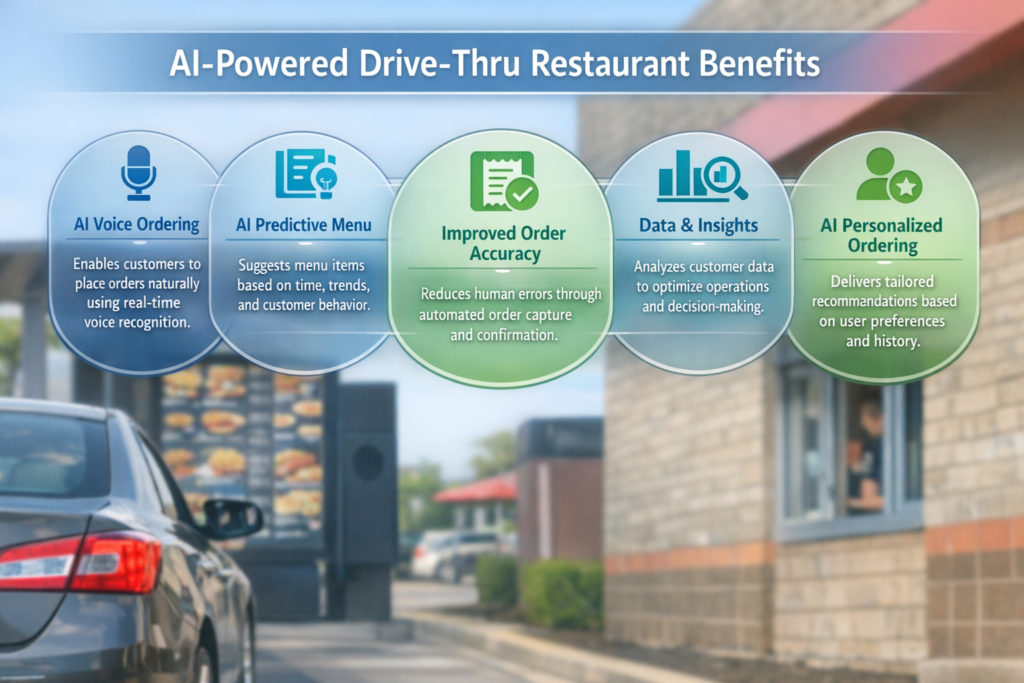
One of the most impactful ways AI is improving drive-thru operations is through automated voice ordering systems.
Current Pain Point
At most drive-thrus:
- Staff take orders through headsets
- Noise from traffic causes miscommunication
- Accents or fast speech create wrong orders
- Restaurants need 1–2 employees only for order taking
AI Solution
AI voice assistants listen to customers and automatically process orders in real time.
Example flow:
- Car stops at speaker
- AI greets the customer
- Customer speaks order naturally
- AI confirms the order
- Order goes directly to the kitchen POS
Why AI is Required
Traditional systems cannot understand natural speech, handle different accents, or correct incomplete orders. AI uses speech recognition and natural language processing to solve these problems.
Companies like IBM, Google, and Presto Automation are already working on such systems.
AI Predictive Menu (Dynamic Menu Boards)
AI is also transforming how menus are displayed in drive-thru systems.
Current Pain Point
Menu boards show the same items to everyone, even though:
- Morning customers prefer coffee
- Evening customers prefer burgers
- Weather affects demand
Example:
Rain → more coffee
Hot weather → more cold drinks
AI Solution
AI analyzes:
- Time of day
- Weather
- Past sales data
- Current queue
Menus automatically adjust based on this data.
Example:
- Morning → coffee combos highlighted
- Evening → burger meals promoted
Why AI is Required
Traditional systems cannot predict demand patterns. AI learns from large datasets and adjusts menus in real time.
Improving Order Accuracy with AI
AI Camera Order Verification
Current Pain Point
Wrong orders happen frequently.
Example:
Customer orders: 2 burgers, fries, coke
But receives: 1 burger, fries, coke
This leads to refunds, unhappy customers, and slower service.
AI Solution
AI-powered cameras verify orders before handing them to customers.
The system compares:
- Order data
- Actual items on the tray
If there is a mismatch, staff are alerted instantly.
Why AI is Required
Only computer vision AI can automatically recognize food items and reduce such errors.
Reduced Communication Errors
Drive-thru environments can be noisy, and communication between customers and staff may not always be perfect. AI systems process orders digitally, reducing miscommunication.
Automated Order Confirmations
AI systems repeat the order back to customers, allowing them to confirm or correct it before it reaches the kitchen.
Digital Order Processing
Orders are directly converted into digital entries, removing manual errors.
Reduced Food Waste
Accurate orders ensure correct preparation, reducing waste and improving efficiency.
How AI Improves Restaurant Staff Efficiency
AI Queue Management
Current Pain Point
Drive-thru lines become long and difficult to manage. Restaurants cannot predict order time or queue flow.
AI Solution
AI analyzes:
- Number of cars
- Order complexity
- Kitchen load
- Preparation time
It helps optimize lane flow, manage rush hours, and improve overall efficiency.
Some restaurants are also testing AI-powered dual-lane systems.
AI Handling Repetitive Tasks
AI handles routine tasks like order taking and menu guidance, reducing staff workload.
Staff Focusing on Customer Experience
Employees can focus more on food quality and service.
Improved Workflow Coordination
Orders move instantly from ordering systems to the kitchen, improving speed and coordination.
Data and Insights from AI Systems
AI Demand Forecasting
Current Pain Point
Restaurants often face sudden rush hours, food shortages, or over-preparation.
AI Solution
AI predicts demand 30–60 minutes in advance.
This allows restaurants to:
- Prepare ingredients early
- Pre-cook high-demand items
- Allocate staff efficiently
Understanding Customer Preferences
AI identifies frequently ordered items to help improve menus.
Identifying Peak Hours
Restaurants can prepare better for busy times.
Tracking Menu Performance
AI helps identify top-performing and underperforming items.
Improving Operational Efficiency
These insights help optimize staffing, inventory, and service speed.
AI Personalized Ordering
Current Pain Point
Restaurants do not recognize repeat customers, so every order starts from zero.
AI Solution
AI uses:
- Loyalty programs
- Mobile apps
- License plate recognition
to identify returning customers.
Example:
“Welcome back. Would you like your usual order?”
This improves customer experience and increases repeat orders.
AI Fraud Detection
Restaurants can lose revenue due to fake refunds, order manipulation, or internal misuse.
AI helps detect:
- Unusual refund patterns
- Suspicious employee activity
- Abnormal order edits
This improves operational security and reduces losses.
Future of AI in Drive-Thru Restaurants
AI technology in the restaurant industry is evolving quickly. In the coming years, drive-thru systems will become even more advanced.
Future systems may include fully automated drive-thrus where:
- AI takes orders
- AI processes payments
- AI verifies food
- AI supports kitchen automation
This can reduce operational costs by up to 30–40% while improving speed and consistency.
Restaurants may also offer highly personalized experiences and smarter analytics for better decision-making.
Real-World Adoption
A real-world example is Wendy’s, which tested AI voice ordering in drive-thrus. The result was faster service, reduced staff workload, and improved order accuracy.
How Triple Minds Helps Restaurants Implement AI
At Triple Minds, we work closely with restaurant brands to turn traditional drive-thru systems into intelligent, automated workflows. Instead of adding disconnected tools, we build AI solutions that fit directly into your existing operations.
Our approach focuses on solving real operational challenges like long queues, order inaccuracies, and high staff dependency. We develop AI voice ordering systems that can take and process orders in real time, reducing communication gaps and improving speed.
We also help restaurants implement smart automation across the workflow, from order capture to kitchen coordination. This ensures that orders move instantly to the right systems without delays.
Beyond automation, we integrate AI with your existing POS, kitchen display systems, and customer platforms, so everything works as one connected ecosystem. This not only improves efficiency but also gives you better visibility into your operations.
Our solutions are built to handle high-volume environments, helping restaurants serve more customers without compromising accuracy or experience.
Take Your Food Business Beyond Drive-Thru
From quick-service restaurants to large-scale food enterprises, Triple Minds builds AI-powered solutions tailored to every type of food business—helping you streamline operations, enhance customer experience, and scale delivery with confidence.
👉 Get Your AI Food Delivery App Built
Conclusion
AI is transforming drive-thru restaurants by making them faster, more accurate, and easier to manage at scale. From automated ordering to smarter decision-making, it helps businesses handle growing demand without compromising customer experience. For restaurants looking to stay competitive, adopting AI is becoming a practical step toward more efficient and scalable operations.
Quick Answers to Common Questions
AI in drive-thru restaurants uses voice recognition, natural language processing, and automation to take orders, process requests, and improve service speed.
AI is designed to assist staff rather than replace them. It automates repetitive tasks so employees can focus on food preparation and customer service.
AI speeds up order taking, predicts popular menu items, and helps restaurants prepare food more efficiently during busy hours.
Yes. AI systems confirm orders automatically and convert voice requests into digital orders, reducing communication errors.
The cost varies depending on the system, but many restaurants see long-term benefits such as faster service, lower operational costs, and improved customer satisfaction.
Yes. AI can recommend menu items, promote combos, and personalize suggestions, which can increase the average order value.
Common technologies include voice AI, natural language processing, machine learning, predictive analytics, and automated ordering systems.
Restaurants can partner with AI solution providers to implement voice ordering systems, automation tools, and data analytics platforms.
In recent years, AI companion platforms and erotic chatbot websites have quietly become one of the fastest-growing niches in the AI economy. AI chatbot websites like Candy AI and similar AI companion services are attracting millions of users worldwide, and what started as experimental AI conversations is now rapidly changing and growing into highly profitable subscription-based businesses.
One important factor behind this growth is the rising loneliness and social isolation in developed countries such as the United States, Japan, South Korea, Germany, and the United Kingdom. Studies suggest that 30–35% of adults in developed economies frequently experience loneliness, and many younger users are progressively switching to digital fellowship platforms rather than using traditional social interaction.
Through this shift, a new market category has emerged into the market known as AI companionship platforms, where users interact with AI partners for online texting and calling, roleplay, emotional support, and fantasy interaction. Erotic chatbot websites function within this segment, backed by advanced language models, AI personalities, and interactive systems.
From a business perspective, opportunities are significant. The AI companion and adult AI interaction market is designed to reach billions of dollars in the coming years. Which is also driven by:
1. Subscription models
2. Premium content
3. Token purchases
4. Personalised AI experiences.
For startups and investors, this offers a clear opportunity: starting an erotic AI chatbot platform with stronger technology, better monetization models, and scalable AI infrastructure.
In this guide, we will explain how to plan, build, launch, and grow an erotic AI chatbot website from a business perspective, which will cover market opportunities, platform strategy and planning, challenges and the required strategies through which we can build a profitable AI product.
At Triple Minds, we work with startups building AI platforms and intelligent chatbot products. Our team provides consultation, development, and growth strategies to help founders launch scalable AI businesses. We have already developed a Candy AI–style chatbot platform along with four advanced AI companion chatbot systems, each designed with features that go beyond most erotic chatbot platforms currently available.
Thinking About Launching Your Own AI Chatbot Platform?
Our team at Triple Minds helps startups plan, build, and scale AI-powered companion platforms with the right technology and infrastructure.
👉 Talk to Our AI Product Experts
Key Takeaways
- Erotic AI chatbot platforms are a fast-growing niche in the AI economy, driven by the rising need for digital companionship and interactive AI experiences.
- Social isolation and loneliness in developed countries are contributing to the rapidly increasing popularity of AI companion platforms.
- Most successful platforms rely on subscription-based revenue models, along with token purchases, premium features, and personalized AI experiences.
- Proper planning is important before development, including market research, business strategy, infrastructure planning, and monetization models.
- Technology choices directly impact performance and cost, especially AI model selection, memory systems, moderation controls, and scalability.
- A structured development roadmap improves success, including competitor analysis, feature planning, development, testing, and beta launch before the official release.
- Competitive platforms require advanced features, such as AI character creation, long-term memory, roleplay engines, voice interaction, and AI-generated media.
- Choosing an experienced AI development partner is critical, since these platforms require expertise in AI models, infrastructure, payments, and moderation systems.
- White-label solutions allow faster market entry, while custom features increase development costs and help differentiate the product.
- Operational costs must be planned carefully, including AI usage, GPU hosting, server infrastructure, payment processing, and marketing.
- Long-term growth depends on strong marketing strategies, including SEO, community building, and influencer collaborations.
Essential Programming Areas Before Starting an Erotic AI Chatbot Website
Starting an erotic AI chatbot website is not only about market demand or AI models. It also requires a clear plan and strategy, which will include development and execution, because the wrong tech partner, wrong architecture, or rushed MVP often leads to unstable performance, payment issues, or compliance trouble later, and overall improper structure.
Before investing money into creating a platform like Candy AI, you should plan these important areas first. In the next sections, we will cover each point one by one in detail.
- Market opportunity – demand, user behavior, geography, and timing
- Business planning – positioning, target audience, product scope, and roadmap
- Development planning –
1)Choosing an experienced AI development company
2) Defining deliverables and timelines
3)QA and ownership of code/IP - Monetization models – It include subscriptions, tokens, upsells, bundles, and retention flows
- AI model selection – LLM choice, safety controls, persona quality, memory, and cost per chat
- Legal challenges – Customer protection laws, age gates, state-specific privacy laws, data handling, content policies, and regional compliance
- Infrastructure – Hosting, which is scalable, setup of GPU/LLM, databases, uptime, and cost control
- Marketing strategy – acquisition channels, SEO, communities, paid ads limits, and brand trust
- Launch roadmap – MVP to V1, beta testing, soft launch, analytics, iteration
- Cost estimation – build cost + monthly running cost + marketing budget planning
- Scaling strategy – new features, new markets, partnerships, and revenue expansion
Development Roadmap for an Erotic AI Chatbot Website
Once the market opportunity is validated, the next major step is planning and executing the development of the erotic chatbot platform. As this guide focuses on helping founders and investors launch and start their own erotic AI chatbot website, it is essential to understand that development is not all about coding. It also involves proper research, planning, choosing the right team, designing the product, testing it, and preparing it for overall growth.
Below is a designed 8-step development roadmap that most successful adult AI chatbot platforms follow before going live.
1. Competitor Product Analysis
Triple Minds suggests that before building anything, founders must analyze existing platforms such as Candy AI and similar AI companion websites. Through this step, we can identify what users like, what features produce revenue, and what problems current platforms are still facing. A proper competitor analysis usually includes studying UI/UX, models related to subscription, quality of the chat, AI personality design, image generation capacities, and mechanisms related to user retention.
2. Designing Your Own Platform Features
After studying competitors, the next step is defining the characteristics your own platform will offer. That means deciding the number of AI characters, chat capabilities, image generation integration, memory systems, subscription plans, and moderation tools. Many startups fail because they try to launch with too many features instead of focusing on a strong MVP, which includes high-quality core features.
3. Choosing the Right Development Company
Most investors and founders are not AI engineers, which is why choosing an experienced development partner becomes critical. The company you hire should already have experience in AI chatbots, large language models, scalable infrastructure, and subscription-based platforms. An experienced company can also guide you in selecting the right technology stack, avoiding costly mistakes and reducing development time.
4. Product Design and Development
Once the development partner is finalized, the actual product development begins. This stage includes UI/UX design, backend development, AI integration, payment system implementation & server architecture. Development usually follows an agile process where the platform is built in modules such as authentication and chat interface, AI response system, character management, and billing.
5. Testing and Quality Assurance
Testing is one of the most overlooked stages in AI product development. Erotic chatbot platforms must go through large testing to ensure stable conversations, correct billing, data security, and smooth user experience. This phase includes functional testing, AI behavior testing, payment testing and server load testing.
6. Beta Launch and Early User Feedback
Instead of launching publicly immediately, many successful platforms first release a beta version to a small group of users. This allows founders to identify bugs, improve AI responses, adjust pricing models and refine the user experience before the official launch.
7. Official Product Launch
Once testing and improvements are complete, the platform is ready for the official launch. This step includes deploying the final version, activating subscription plans, enabling payment systems, and ensuring the infrastructure can handle traffic spikes.
8. Hiring a Marketing and Growth Team
Launching the product is only the beginning. Without proper marketing, even a well-built platform can fail. Successful erotic chatbot businesses invest heavily in SEO, community marketing, influencer collaborations, and content marketing to acquire and retain users.
Don’t Miss This Guide: AI Girlfriend App Market Size, Share, Scope & Forecast
Important Planning Before Building Your Erotic AI Chatbot Platform
Building an erotic AI chatbot website involves many technical and business decisions. Each step we discussed earlier — development, infrastructure, monetization, and marketing — is a large topic on its own. Explaining everything in full detail inside a single blog is not practical because every startup has a different budget, target audience, and growth plan.
If you are serious about launching an AI companion platform, it is always better to discuss the roadmap with experts before investing. At Triple Minds, we regularly help founders validate their ideas, estimate costs, and structure the development process before writing a single line of code. You can schedule a free consultation call with our team to discuss the strategy in detail.
Do Not Build an AI Chatbot Business Without Proper Planning
One of the biggest mistakes founders make is starting development without understanding the economics of the platform. Erotic chatbot businesses depend heavily on AI infrastructure, subscriptions, and user engagement, so planning must be done carefully.
Before starting development, founders should analyze the following factors:
- Competitor offerings – What platforms like Candy AI are providing?
- Feature comparison – What features attract paying subscribers?
- Pricing models – Subscription plans, token systems, and upsells
- AI running cost – Model usage cost, GPU servers, and infrastructure
- Expected subscribers – Realistic user growth in the first 6–12 months
- ROI calculation – Revenue potential compared to operational cost
Without calculating these factors, many startups end up launching a platform that cannot sustain AI running costs or generate enough revenue.
You Might Also Find This Useful: Best Countries to Register an Adult or NSFW AI Company
Must-Have Features for a Modern Erotic AI Chatbot
The AI companion market has evolved quickly. Users today expect far more than simple text conversations. If you want your platform to compete with existing players, certain features are almost mandatory.
A competitive erotic AI chatbot platform should include:
- AI Character Creation – Users can create and customize their own AI partner
- Long-Term Memory System – The AI remembers previous conversations and preferences
- Adult Image Generation – AI-generated images for interactive experiences
- AI Video Generation – Advanced visual interaction capabilities
- Audio Chat / Voice Interaction – Voice conversations with AI characters
- Roleplay & Personality Engine – Different AI personalities and interaction styles
Read Also: How To Register An Adult AI Business Legally?
Choosing the Right Development Partner
Once you finalize the core features of your erotic AI chatbot platform, the next critical step is selecting the right development partner. This decision can make or break your entire business. Erotic AI chatbot platforms are far more complex than standard chatbot or AI applications because they involve advanced AI models, sensitive content moderation, high user concurrency, and strict infrastructure management.
Unlike general software development, only a small percentage of companies actually have the capability to build NSFW AI chatbot systems properly. Many agencies claim they can develop such platforms, but in reality, they only have experience with basic chatbot frameworks or simple AI integrations.
Why Experience Matters?
Developing an erotic AI chatbot platform requires expertise in multiple areas simultaneously:
- AI language models and response tuning
- Content moderation and safety filters
- Character personality engines
- Image or video generation integration
- Scalable backend infrastructure
- Subscription and payment systems
Without real experience in these areas, the final product may suffer from poor AI responses, high running costs, unstable servers, or security issues.
Always Ask for a Working Chatbot Demo
Before hiring any development company, always ask for a live working demo of similar AI chatbot platforms they have already built. A demo proves that the company understands the technical and operational challenges of AI companion platforms.
When evaluating a development partner, ask questions such as:
- What AI models and technologies are used in the chatbot?
- How scalable and reliable is the infrastructure?
- How does the platform manage AI running costs?
- How is content moderation handled?
- What performance benchmarks have been tested?
A company that has actually designed similar platforms should be able to demonstrate the product, explain the architecture, and clearly answer these questions.
Choosing the right development partner ensures that your erotic AI chatbot platform is stable, scalable, and ready for real users from day one.
Don’t Miss This Guide: Approval Guidelines for NSFW Adult Payment Processor & Orchestration
Erotic AI Chatbot Development Cost
One of the most common questions founders and investors ask before launching an erotic AI chatbot platform is how much it actually costs to build one. The answer depends on the development approach, feature complexity, and level of customization required.
White Label Erotic Chatbot Platform Cost
The fastest way to launch an AI companion platform is by using a white-label solution. In this approach, the core platform is already developed and tested, and the buyer receives a customizable version with their own branding, domain, and payment systems.
Typically, the white-label cost for an erotic AI chatbot platform ranges between $15,000 to $20,000. This usually includes:
- Core chatbot platform
- AI character system
- Chat interface and dashboard
- Basic subscription integration
- Standard hosting architecture
White-label solutions are ideal for startups that want to enter the market quickly without spending months on development.
Customization Cost
Most founders prefer customizing the platform to differentiate their product from competitors. Customizations may include:
- New AI features
- Advanced character creation tools
- Image or video generation integration
- Audio chat capabilities
- UI/UX customization
- Additional monetization systems
These customizations require additional development time, which increases the overall project cost. The final investment depends on feature complexity, AI infrastructure requirements, and scalability needs.
Additional Running Costs
Apart from development, founders must also consider ongoing operational costs such as:
- AI model usage cost
- Server infrastructure and GPU hosting
- Payment gateway fees
- Content moderation systems
- Marketing and user acquisition
These operational costs vary depending on user traffic and AI usage volume, which is why proper financial planning becomes important before launching the platform.
For startups planning to enter this market, a white-label solution combined with selective customization is often the most practical way to launch quickly while controlling development costs.
Turn Your AI Product Idea Into a Scalable Business
From product planning to AI infrastructure and deployment, Triple Minds helps startups build reliable AI chatbot systems designed for performance and long-term growth.
👉 Schedule a Free AI Strategy SessionAdditional Knowledge for Founders Entering the Erotic AI Chatbot Market
How do erotic AI chatbot platforms handle user privacy and data protection?
User privacy is one of the most sensitive aspects of AI companion platforms because conversations can be highly personal. Platforms typically implement encrypted databases, secure authentication systems, and strict data-handling policies to protect user information. Many companies also avoid storing complete chat histories permanently or allow users to delete their conversation data. Clear privacy policies and transparent data practices are essential for building user trust and complying with international data protection rules and regulations.
What payment gateways work best for erotic AI chatbot platforms?
Adult-oriented platforms cannot always use traditional payment processors without restrictions. Many startups rely on payment gateways that support high-risk or adult businesses. These processors usually offer subscription billing, token purchases, and global payment acceptance while complying with adult industry regulations. Choosing the right gateway early is important to avoid payment interruptions after launch.
How can founders reduce AI infrastructure costs for chatbot platforms?
AI model usage can become expensive if the platform scales quickly. Startups often control costs by using optimized language models, limiting response length, implementing caching systems, and combining multiple AI models depending on the complexity of the conversation. Efficient prompt design and infrastructure optimization can significantly reduce the cost per user interaction.
What user retention strategies work best for AI companion platforms?
Retention is critical because most revenue comes from recurring subscriptions. Platforms often improve retention through personalized AI characters, memory systems that remember past interactions, gamified rewards, loyalty perks, and regular feature updates. Some platforms also introduce new characters, seasonal events, or exclusive content to keep users engaged over long periods.
How long does it typically take to launch an erotic AI chatbot website?
The development timeline varies depending on the complexity of the platform. A basic white-label deployment can often be launched within a few weeks, while fully customized platforms with advanced AI features may take several months to design, develop, and test before public release.
What challenges do startups face when scaling AI chatbot platforms?
As user traffic grows, platforms must handle higher AI processing demand, server load, and moderation requirements. Scaling challenges often include managing infrastructure costs, maintaining response quality, preventing misuse, and ensuring stable uptime. Proper cloud architecture and monitoring systems are necessary to support rapid growth.
Can erotic AI chatbot platforms operate globally?
Yes, many platforms operate internationally, but founders must be aware of regional regulations. Some countries have strict rules around adult content, user verification, and online privacy. Platforms often implement geo-restrictions, age verification systems, and localized compliance policies to operate safely across multiple regions.
How important is branding for an AI companion platform?
Brand identity plays a significant role in building trust and attracting users. Successful platforms usually invest in strong branding, character design, storytelling, and consistent user experience. A recognizable brand can help differentiate a platform from competitors and improve user loyalty.
What role does community building play in growing an AI chatbot business?
Community engagement can significantly increase user growth and retention. Platforms often build communities through forums, social platforms, or private groups where users discuss characters, share experiences, and suggest new features. This feedback loop helps companies improve their product while strengthening user loyalty.
When should a startup consider adding advanced features like AI video or voice interaction?
Advanced features are usually introduced after the core platform becomes stable and revenue starts growing. Launching with a strong text-based chatbot experience first allows startups to validate demand and refine the product before investing in more expensive technologies like AI video generation or real-time voice interaction.
In 2026, Python is becoming useful when it comes to SEO automation. From web scraping to data extraction, using Python for SEO automation is a game changer. Python helps speed up the automation process to such a large extent.
Search engine optimization is an ongoing process which demands undivided attention. Beyond driving traffic, the goal is to attract the right audience through keyword research, content refinement, technical improvements, and performance tracking. From content audits to data analysis and reporting, each stage forms part of a continuous optimization cycle. Today, these practices extend beyond traditional web results to include images, videos, news platforms, and even AI-assisted search experiences.
As digital competition increases and search platforms evolve, managing these responsibilities manually becomes inefficient. Automation tools, particularly those built with Python, now play a crucial role in streamlining and scaling these processes.
SEO plays an important role in digital marketing because it helps websites improve their technical setup, content quality, and authority so they rank higher in search engine results. The goal is to connect with users who are already searching for specific information, products, or services. However, many SEO tasks such as crawling websites, extracting page data, analyzing keywords, and processing large datasets are repetitive and time-consuming. This is where SEO automation becomes useful. Python libraries like BeautifulSoup are commonly used to extract meta tags and headings from webpages, Requests helps fetch page content for analysis, Scrapy is useful for large-scale website crawling and URL collection, Selenium automates browsers to collect data from JavaScript-heavy pages, and Pandas helps analyze large SEO datasets like keywords, backlinks, or crawl reports quickly and efficiently.
Upgrade Your SEO Strategy with Python Automation
Discover how Triple Minds helps businesses implement Python-powered SEO automation to crawl websites, analyze large datasets, detect technical issues, and generate insightful reports faster—eliminating repetitive manual work and improving optimization accuracy.
Explore Advanced SEO Automation Solutions
Key Takeaways
- Python enables large-scale SEO automation by simplifying tasks like crawling, data extraction, and performance monitoring.
- Libraries such as Requests, Selenium, and Beautiful Soup help collect and structure website data efficiently.
- Scrapy allows full-site crawling and large-scale SEO audits beyond single-page analysis.
- Pandas and NumPy support advanced data processing, enabling deeper insights into rankings, traffic trends, and performance metrics.
- spaCy and OpenAI SDK assist with semantic analysis, keyword clustering, and AI-driven content optimization.
- Visualization tools like Matplotlib help convert complex SEO data into clear performance reports.
- Combining multiple Python libraries creates a complete automation pipeline—from data collection to analysis and reporting.
What is SEO Automation?
In SEO automation we use specific software and AI driven tools to handle multiple tasks like keyword tracking, site audits, backlink monitoring and reporting. Through automation businesses can save time and free resources for high effect strategies like content creation and link building campaigns.
About 70% of professionals use automation tools including AI to manage core workflows like keyword research, ranking checks, and reporting.
In today’s time, using SEO automation alone isn’t going to cut it anymore. Doing automation only can be time-consuming and complex sometimes. That’s where Python becomes useful. With its rich libraries of tools and features, Python helps professionals to automate tasks, analyse broken links, and much more.
Read Also: How to Structure Content for LLM Citation?
Role of Python in SEO Automation
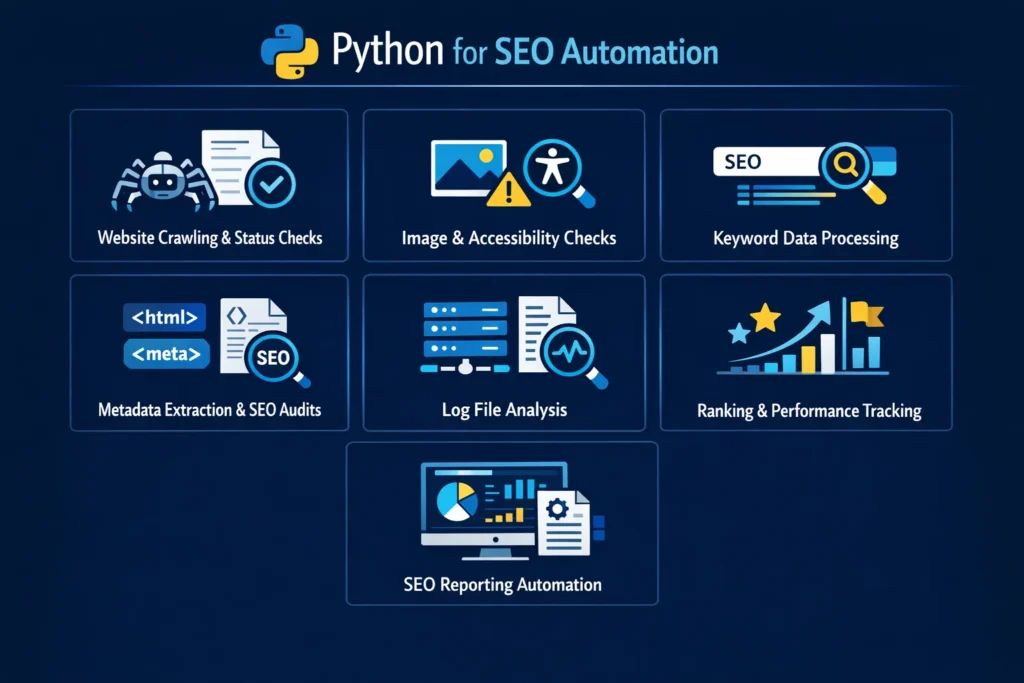
In SEO Automation, Python can be used for the following tasks such as:
1. Website Crawling and Status Checks
Python enables website crawling and status check by visiting the page and extracting internal links. After extracting internal links, it also analyses and checks their response codes such as 200 (successful), 404 (page not found) etc. Through this process, it can automatically identify broken links, server errors and other technical issues across a website.
2. Metadata Extraction and Audits
Python visits the HTML code of a web page and analyses its structure. After examining the code, it extracts important metadata such as titles, meta descriptions, and other relevant tags across multiple pages. By collecting this information, Python can identify common SEO issues, including missing titles, duplicate meta descriptions, absent tags, and inconsistent metadata patterns.
3. Image and Accessibility Checks
After visiting a webpage, Python analyzes the HTML code to look for specific tags such as <img>, <label>, <input>. It then checks for errors like missing alt text, large image file sizes, or incorrect image formats. The same process applies to accessibility. Subsequently, scanning the HTML, it looks for issues such as missing alt attributes in images, improper heading structure, and missing label tags for form inputs.
4. Keyword Data Processing
Finding keywords online, removing repeated words, and structuring the keywords manually might take hours to complete. That’s why giving Python a CSV or Excel file can help because it can automatically remove duplicate keywords, fix messy formatting, remove empty rows, and convert everything to lowercase. So, your messy list becomes clean and organised.
5. Log Files Analysis
Log files are huge in size. Reading them manually is nearly impossible. Taking the help of Python can make a big difference. Python can open files very quickly using Pandas and re (regular expressions). It can automatically calculate 404 errors, report, analyse, and monitor. Because Python can handle large datasets efficiently, it turns raw server logs into actionable SEO insights and enables automated crawl monitoring systems. Thus, making the work a lot easier.
6. Ranking and Performance Tracking
By connecting to platforms like Google Search Console and Google Analytics, it can easily complete tasks like:
- 1. Track daily ranking changes
- 2. Detect performance drops
- 3. Compare time periods
- 4. Identify underperforming pages
- 5. Generate automated reports
That’s how Python helps with fast and reliable SEO performance monitoring.
7. SEO Reporting Automation
Using libraries like matplotlib, seaborn, plotly, Python cleans and analyses the data, calculates performance metrics, generates charts and reports, and can even email the final report automatically. Where manual reporting takes hours to monitor and is often hard to scale, Python only takes some minutes and can easily scale clients.
Python’s rich network of libraries helps in simplifying complex tasks like web scraping, API integration, automation and monitoring.
As Python’s growing demand in SEO automation, knowing the right Python libraries can remarkably increase accuracy and effectiveness.
But before jumping into the best Python libraries, knowing the meaning behind Python libraries matters a lot.
Now, let’s have a look at the meaning behind Python libraries.
Meaning Behind Python Libraries
Python libraries are like handbooks of pre – written code which helps you in completing the tasks with more productivity and efficiency. It can easily handle tasks like data manipulation, math operations, web scraping.
How Do Python Libraries Work in SEO Automation?
Instead of doing everything manually, Python libraries do the work for you. Libraries like Beautiful Soup, Scrapy, requests help you access data from websites. Along with these libraries can manage many more tasks like data cleaning & analysis, technical SEO checks, automated reporting, etc.
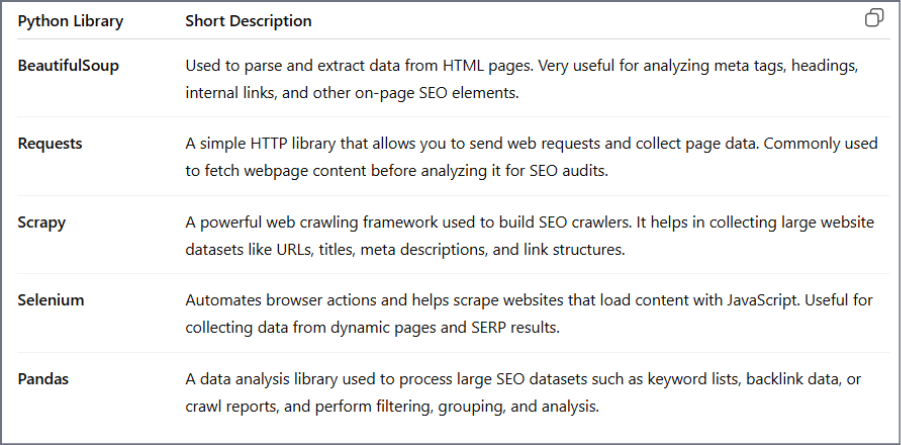
Best Python Libraries for SEO Automation in 2026
1. Requests
The requests module is a library for sending HTTP requests using python. With requests, sending methods like GET, POST, PUT, DELETE becomes easier. It’s the first step towards data extraction.
Step-by-step guide to using the Requests module in SEO automation:
First we need to install requests. Here’s how you do it:
<Bash>
   pip install requests
Import Requests:
</> python
import requests

url = "https://tripleminds.com"

response = requests.get(url)
It sends a GET request to the page and then the server responds with the HTML content, and Python stores it in the response object.
Check Website Status:
Python

Response =
requests.get(“https://example.com”)
print(response.status_code)
Through this you can detect broken pages, redirects, and server errors automatically.
Fetch Page Content:
Python

html = response. Text
print(html [:300])
This gives you raw HTML for monitoring or further processing.
Pull SEO Data from APIs :
Python

url = “API_ENDPOINT”
headers = headers)
data = response.json()

print(data)
Now you can automatically track keywords rankings, monitor impressions, clicks and fetch SEO performance data.
2. Selenium
Selenium helps you interact with JavaScript websites including which are heavy. If content loads dynamically, requests alone won’t make any difference.
Let’s see the guide below to use Selenium for SEO Automation.
Install Selenium:
<Bash>

pip install selenium
Import and Launch the Browser:
Python

from selenium import webdriver
from selenium.webdriver. Common.by import By

# Triple Minds SEO Automation Script
driver . get (“https://example.com" )

print(“Triple Minds SEO Audit Started”)
Extract SEO Elements:
Get Page Title:
Python

print(“Title” , driver . title)

Get Meta Description

Python

meta = driver.find_element(By.XPATH,” //meta[@name=‘description’]”)
print(“Meta Descriptions : ” ,meta.get_attribute(“content”))
Get H1 Tag:
Python

h1 = driver.find_elementry(By.TAG_NAME, “h1”)
print(“H1 :” , h1.text)
This helps in verifying on-page SEO elements on dynamic websites.
Extract Internal Links:
Python

links =
driver.find_elements(By.TAG_NAME, “a”)

print(“Triple Minds Internal Link Audit :”)
for link in links :
            print(link.get_atrribute(“herf”))
Important to check link structure and crawl paths
Run in Headless Mode (for Automation):
Python

from selenium . webdriver . chrome . options  import Options

options = Options()
options.add_argument(“--headless”)

driver =
webdriver . Chrome(options=options)
driver . get(“https://example . Com")

print(“Triple Minds Headless SEO Scan Running”)
This is a good to go option for scheduled audits.
Close the Browser:
Python

driver.quit()
print(“Triple Minds SEO Audit Completed")
3. Beautiful Soup
Beautiful Soup in SEO automation helps with the extraction of SEO elements from raw HTML.
After fetching a page (using requests or Selenium), Beautiful Soup helps you pull structured data like titles, meta tags, headings and links.
it turns unstructured and messy HTML into usable SEO insights.
Here’s how to use it:
Install the Module:
Bash

pip install beautifulsoup4
Import the Library:
Python

from bs4 import BeautifulSoup4
Now it becomes ready to parse HTML.
Load HTML for Audit:
Python

import requests from bs4 import Beautifulsoup

# Triple Minds SEO Page Check
url = “https : //example.com.”
response = requests. get(url)

soup = BeautifulSoup(response.text, “html.parser” )

print(“Triple Minds SEO Audit Started”)
Now the HTML is structured and searchable.
Extract Key SEO Elements:
Page Title:
Python

title= soup.title.string print(“Title:”,title)
Meta Description:
Python

meta_desc = soup.find(“meta”,attrs ={“name” : “description”,

If meta_desc:
     print(“Meta Description:”,meta_desc[“content”])
else:
    print(“Meta Description Missing”)
H1 Tag:
Python

h1= soup.find(“h1”)

If h1 : Useful
    print(“H1 :” , h1.text)
else :
    print(“H1 Missing”)
Now you will be able to quickly detect things like missing tags, duplicate headings, weak on-page structure.
Extract Internal Links:
Python


Links = soup.find_all(“a”)

print(“Triple Minds Internal Links:”)
for link in links :
       print(link.get(“href”))
Useful for internal linking audits and crawl structure checks.
Close The Audit:
Python

print(“Triple Minds SEO Audit Completed”)
4. Scrapy – Large-Scale Crawling
Scrapy helps with:
- Web page crawling
- Extracts key SEO elements
- Saves structured data
- Scales structured data
Scales audits beyond single URLs.
Unlike Beautiful Soup (single page focus), Scrapy handles full site audits efficiently.
Install Scrapy:
Bash id=“s9kl2x”

pip install scrapy
Create Project:
Bash id=“t3mn8p”

scrapy startproject triple_minds_audit cd triple_minds_audit
Create Spider:
Bash id =“q7vz4r”
Scrapy genspider seo_spider example.com
Add SEO Extraction Logic:
Python id= “m2xp9a”

import scrapy

class SeoSpider(scrapy.spider) :

   name = “seo_spider”
   start_urls =

[“https : //example.com”]

  def parse(self, response) :
     Yield {
         “url” : response.url,
         “title”:

response.css(“title : : text” ).get(), “meta”

response.css(‘meta [name = “description”] : :attr(content)’).get(),”h1” :

response.css(“h1 : : text”).get(),}
Run Spider:
Bash id=”w4pl8n”

Scary crawl seo_spider -o results.json
5. Pandas – Data Processing
Pandas helps you with:
- Clean scraped data
- Detect missing metadata
- Filter weak pages
- Generate SEO insights
So, you don’t have to hassle much.
Install Pandas:
Bash id =“pd7xk2”

pip install pandas
Import Pandas:
Python id= “p3kz9va”

import pandas as pd
Python id= “p3kz9va”
Python id= “p3kz9va”
Load Scrapy Results:
(Assuming Scrapy saved results.json)
Python id = “l8mvq1”

# Triple Minds SEO Data Analysis

df = pd.read_json(“results.json”)

print(df.head())
Now your scraped SEO data is structured in a table.
Find Pages Missing Meta Descriptions:
Python id= “z6wn2r”

missing_meta = df[df[“meta”].isna()]

print(“Pages Missing Meta Description : “)

print(missing_meta[“url”])
You can now instantly spot optimization gaps.
Find Pages Missing H1:
Python id= “u4rc8m”

Missing_h1 = df[df[“h1”].isna()
print(“Pages Missing H1 : ”)

print (missing_h1[“url”])
Count Total Issues:
Python id = “y9tb5e”

print(“Total Pages :”, len(df))

print(“Missing Meta:”,

df[“meta’].isna(),sum())

print(“Missing H1 : ‘,

df[“h1”].isna(),sum())
Now you have quick audit metrics.
After the Pandas module structures the SEO data, you may need deeper calculations – growth, CTR changes, performance trends.
That’s where Numpy comes in.
6. How You Can Use NumPy for SEO Automation
NumPy helps with:
- Percentage growth calculations
- CTR computation
- Traffic change analysis
- Forecast modeling basics
Install NumPy:
Bash id=”np3k8x”

Pip install numpy
Import NumPy:
Python id= “nm7v2p”

Import numpy as np
Calculate CTR (Click Through Rate):
Imagine that a company has impressions and clicks data.
Python id=”n5r8zt”

clicks = np.array([120, 85, 601]) impressions = np.array([1000, 950, 800])

ctr = (clicks / impressions) * 100

print (“CTR (%) : , ctr)
Now you have precise CTR values.
Calculate Traffic Growth:
Python id = “n9q2yl”

last month = np.array([5000])

this_month= np.array([6500])

growth = ((this_month - last_month) / last_month) * 100

print(“Traffic Growth (%) ;” , growth)
You can quickly measure SEO performance changes.
Detect Sudden Ranking Drops:
Python id= “n2tw6m”

rank_previous = np.array([3, 5, 2])

Rank_current = np.array([8, 4, 2])


drop = rank_current - rank_previous

print(“Ranking Change :” , drop)
Positive values = ranking drop
Negative values = Improvement
This is a game changer when it comes to calculating SEO metrics accurately, measuring growth trends , detecting performance issues early and supporting data driven decisions.
7. spaCy
After data collection and performance analysis, you can improve content quality and topical relevance using spaCy.
spaCy specifically helps with :
- Entity Extraction
- Keyword context analysis
- Topic Clustering
- Semantic optimization
SEO in 2026 focuses on meaning and relevance, not just keywords.
Install spaCy:
Bash id=”sp4k8x”

pip install spacy
python –m spacy download
en_core_web_sm
Import spaCy:
Python id”sp7m2p”


Import spacy

nlp = spacy.load(“en_core_web_sm”)
Analyze Page Content:
Python id= “sp9r5t”

# Triple Minds Content Analysis
text =” ” ”

Triple Minds provides SEO automation solutions using Python libraries like Scrapy, Pandas , and spaCy for advanced optimization.
” ” ”

doc = nlp(text)
Now the text is processed and structured.
Extract Named Entities:
Python id= “sp2x6m”

Print(“Entities Found :”)

for ent in doc.ents :
       print(ent.text, “-”,ent.label_)
Now you can check:
- Brand mentions
- Tool references
- Location signals
- Organization names
Extract Important Keywords:
keywords = [token.text for token in doc if token.pos_ == "NOUN"]

print("Key Terms:", keywords)
This helps identify:
- Core topics
- Content gaps
- Semantic coverage
What This Does for Your Brand:
- Improves topical authority
- Ensures content includes relevant entities
- Helps with semantic optimization
- Supports AI-driven SEO strategies
8.OpenAI Python SDK
This module helps with:
- Keyword clustering
- Content brief generation
- Meta description suggestions
- Search intent classification
- Competitor content analysis
Step 1: Install OpenAI SDK:
pip install openai Step 2: Import and Set API Key:
from openai import OpenAI

client = OpenAI(api_key="YOUR_API_KEY")
Step 3: Generate SEO-Optimized Meta Description:
# Triple Minds AI SEO Optimization
response = client.responses.create(
   model="gpt-4.1-mini",
   input="Write an SEO-optimized meta description for a blog about Python SEO automation."
)

print(response.output_text)
Triple Minds can now auto-generate optimized metadata.
Step 4: Cluster Keywords by Intent:
keywords = """
python seo automation
best python seo libraries
scrapy for seo
technical seo python
"""

response = client.responses.create(
   model="gpt-4.1-mini",
   input=f"Group these keywords by search intent:\n{keywords}"
)

print(response.output_text)
This helps identify:
- Informational intent
- Transactional intent
- Technical learning intent
Step 5: Generate Content Brief:
response = client.responses.create(
   model="gpt-4.1-mini",
   input="Create a structured blog outline for 'Best Python Libraries for SEO Automation in 2026'."
)
print(response.output_text)
Now your brand can scale content production intelligently.
What This Does for Your Brand
- Speeds up content strategy
- Improves semantic optimization
- Automates repetitive SEO writing tasks
- Enhances data-driven decisions
9. Matplotlib
Matplotlib helps with:
- Visualize traffic trends
- Show ranking improvements
- Track CTR changes
- Create client-ready SEO reports
Step 1: Install Matplotlib:
pip install matplotlib Step 2: Import the Library:
import matplotlib.pyplot as pltStep 3: Plot Traffic Growth:
# Triple Minds SEO Traffic Report

months = ["Jan", "Feb", "Mar", "Apr"]
traffic = [5000, 6200, 7100, 8300]

plt.plot(months, traffic, marker="o")
plt.title("Triple Minds Organic Traffic Growth")
plt.xlabel("Month")
plt.ylabel("Visitors")
plt.show()
This creates a simple traffic trend graph.
Step 4: Visualize Ranking Changes:
keywords = ["Keyword A", "Keyword B", "Keyword C"]
rankings = [8, 4, 2]

plt.bar(keywords, rankings)
plt.title("Triple Minds Keyword Rankings")
plt.ylabel("Position in SERP")
plt.gca().invert_yaxis()  # Lower ranking number is better
plt.show()
Now you can clearly show performance improvements.
What This Does for Your Brand
- Converts raw data into visual insights
- Makes reports client-friendly
- Helps spot trends instantly
- Supports decision-making
Conclusion
SEO automation in 2026 is no longer optional — it’s essential for scale, speed, and precision. From collecting data with Requests, rendering dynamic pages using Selenium, extracting insights through Beautiful Soup and Scrapy, analyzing performance with Pandas and NumPy, enhancing semantic relevance using spaCy, generating AI-powered optimization with OpenAI, and finally visualizing results through Matplotlib — each library plays a strategic role in a complete automation workflow.
For Triple Minds, this ecosystem creates a powerful, end-to-end SEO system: collect, analyse, optimize, and report — all automated.
The real advantage isn’t just using Python.
It’s combining the right libraries in the right order to turn raw data into actionable growth.
SEO in 2026 belongs to those who automate intelligently.
Quick Answers to Common Questions
SEO automation in Python uses scripts and libraries to automate tasks like crawling websites, analyzing keywords, extracting metadata, and generating SEO reports.
Python is widely used because it offers powerful libraries that simplify web scraping, data analysis, automation, and API integration for SEO workflows.
Popular libraries include Requests, Selenium, Beautiful Soup, Scrapy, Pandas, NumPy, spaCy, and Matplotlib.
Yes, Python can crawl websites, detect broken links, analyze response codes, and identify metadata issues automatically.
Python processes large datasets quickly and generates automated reports and visualizations for better SEO insights.
Yes, beginners can start with basic libraries and gradually build more advanced SEO automation workflows.
Almost every founder who reaches out to us at Triple Minds asks the same question first: how much does it cost to develop an AI agent for my business? It is a fair question, but the honest answer is — it depends on what you are actually trying to build.
AI agents are no longer experimental tools used only by tech companies. In 2026, they are becoming the operational backbone of modern businesses — handling customer conversations, qualifying leads, supporting internal teams, automating repetitive workflows, and even powering full digital products. According to Gartner, by 2028 roughly 33% of enterprise software will include agentic AI, up from less than 1% in 2024.
You will hear wildly different numbers in the market. Some vendors promise an AI agent for $1,000, while others quote $25,000, $50,000, or even $150,000+. Both can be technically correct. The difference comes down to scope, depth of integration, autonomy level, and whether the agent is meant for a marketing demo or for serious production traffic.
An AI agent is not just a chatbot. It is a complete software system made up of several layers working together:
- AI intelligence layer — the LLM, reasoning loop, and prompt orchestration
- Memory & knowledge layer — vector store, RAG, long-term memory
- Tool / action layer — function calling, APIs, browser, code execution
- Business logic layer — rules, guardrails, escalation policies
- Integration layer — CRM, ERP, databases, ticketing, messaging
- Interface layer — chat UI, dashboard, voice, mobile, admin console
Once you understand these layers, the AI agent development cost becomes much easier to reason about. As an AI development company, we have built everything from early-stage prototypes for YC-backed startups to enterprise automation systems handling millions of monthly conversations. After dozens of projects, one pattern is consistent.
The cost to develop an AI agent is mainly determined by three factors:
- How autonomous and complex the agent needs to be
- How many systems it must connect with — and the quality of those APIs
- What role it plays inside your business (assistant vs. operator vs. decision-maker)
In this guide, we break down the numbers in a practical, no-fluff way — covering agent types, the full development pipeline, technical challenges, hidden costs, region-by-region pricing, and a realistic ROI model. By the end you will have a defensible budget, not a guess.
Build AI Infrastructure That Scales With You
From MVP to enterprise automation, Triple Minds designs AI agents that are modular, secure, and built for real business impact.
Speak With Our AI Development TeamAI Agent Development Cost at a Glance (2026 Benchmarks)
Before we go deep, here is the short answer most founders are looking for. These ranges reflect production-grade builds delivered by mid-to-senior engineering teams in 2026.
| Build Tier | Typical Use Case | Timeline | Cost to Develop AI Agent |
|---|---|---|---|
| Basic AI Agent (MVP) | FAQ bot, lead capture, single-channel | 6–8 weeks | $12,000 – $18,000 |
| Investor-Ready Prototype | Demoable agent with 1–2 integrations | 8–10 weeks | $15,000 – $25,000 |
| Business AI Agent | CRM-connected, workflow automation | 10–14 weeks | $25,000 – $45,000 |
| Enterprise Support Agent | Multi-system, dashboards, security | ~4 months | $45,000 – $60,000 |
| Multi-Channel Enterprise System | Web + WhatsApp + voice + analytics | 4–6 months | $65,000 – $85,000 |
| Autonomous / Agentic Platform | Multi-agent, custom-trained, RAG at scale | 6–9 months | $90,000 – $150,000+ |
Key Takeaways
- The type of AI agent determines roughly 60% of the total cost.
- Integrations with legacy CRMs/ERPs are the #1 cause of budget overrun.
- LLM API spend is rarely the biggest line item — engineering effort is.
- Phased development reduces risk and protects ROI.
- Operating costs ($800–$5,000+/month) must be planned alongside development.
- Custom fine-tuning is rarely needed for v1 — RAG + good prompting handles most use cases.
Types of AI Agents (And Why Each One Costs Differently)
Before talking about timelines or pricing, the most important question is what kind of AI agent you actually need. This single decision determines most of the total investment. From an engineering standpoint, AI agents fall into six recognized classes — each with its own cost profile.
| Agent Type | How It Works | Real-World Example | Relative Build Cost |
|---|---|---|---|
| Simple Reflex Agent | If-this-then-that rules on current input | Auto-reply bot, FAQ widget | $ |
| Model-Based Reflex | Maintains internal state of the world | Order-status assistant | $$ |
| Goal-Based Agent | Plans steps toward a defined goal | AI scheduling assistant | $$$ |
| Utility-Based Agent | Optimizes across competing objectives | Pricing or routing optimizer | $$$$ |
| Learning Agent | Improves from feedback & data | Personalized recommender | $$$$ |
| Multi-Agent System | Multiple specialized agents collaborate | Autonomous research / ops platform | $$$$$ |
From a business perspective, those six classes collapse into three practical buckets. This is the framing we use when scoping projects at Triple Minds.
1. Basic AI Agent (Entry-Level Automation)
The starting point for most startups. A smart assistant that handles repetitive conversations and routine tasks but does not deeply interact with internal systems. Runs on existing models (GPT-4o-mini, Claude Haiku, Gemini Flash) and solves surface-level problems quickly.
- Answering frequently asked questions
- Capturing and qualifying leads
- Booking appointments or demos
- Providing basic product or service information
Cost to build an AI agent at this level: $12,000 – $25,000. Good fit if your goal is to launch fast, validate an idea, or take pressure off a small support team.
2. Business AI Agent (Operational Intelligence)
This is where AI starts delivering real business value. The agent connects with your CRM, database, or internal tools and acts more like a digital team member — performing actions, retrieving real data, and updating records.
- Checking order or delivery status
- Updating customer records in the CRM
- Assisting sales reps with lead insights and call summaries
- Pulling reports or business data on demand
- Creating and routing support tickets
Cost to develop AI agent at this level: $25,000 – $60,000. Most serious SaaS companies and scaling businesses start here because it directly impacts efficiency and customer experience.
3. Advanced Autonomous AI Agent (High-Complexity Systems)
The most powerful category. These agents handle multi-step tasks, run workflows automatically, use multiple tools, and operate with minimal human supervision. Often built as a network of specialized agents (planner, retriever, executor, verifier) coordinating through a shared memory.
- Multi-step reasoning and task execution
- Automatic workflow management across systems
- Long-term memory and learning from interactions
- Custom-trained or fine-tuned models for specific industries
- Self-correction loops and confidence-based escalation
Enterprise AI agent cost at this level: $85,000 – $150,000+. These systems require domain training, complex integrations, and rigorous evaluation infrastructure.
Don’t Miss This Guide: What is a Database Chatbot and How Does it Work?
The Anatomy of a Production AI Agent (Architecture Diagram)
To understand cost, you need to understand what is actually being built. Below is the reference architecture we deploy for most production-grade AI agents. Each block is a real engineering deliverable — and each one adds development hours.
Short-term ctx
Long-term store
Vector DB
Embeddings
Functions
APIs · Code
Rules · Auth
Escalation
Every layer above is a measurable line item in the budget. Skipping observability or evaluation infrastructure is the most common reason agents launch successfully and then quietly degrade in production.
AI Agent Development Cost — Breakdown by Component
Within a typical $50,000 enterprise build, here is roughly where the money goes. These percentages are drawn from our last 20 production projects.
| Component | % of Budget | What’s Included |
|---|---|---|
| Discovery & Architecture | 8–10% | Use-case validation, system design, data audit |
| LLM & Prompt Engineering | 10–15% | Model selection, prompt design, tool spec, guardrails |
| Backend & Integrations | 30–35% | API work, CRM/ERP connectors, auth, business logic |
| RAG & Knowledge Pipeline | 10–12% | Chunking, embeddings, vector DB, retrieval tuning |
| Frontend / Chat UI | 10–12% | Chat widget, admin dashboard, mobile responsiveness |
| QA & Evaluation | 8–10% | Test datasets, regression suite, red-teaming |
| DevOps & Deployment | 5–7% | CI/CD, infra-as-code, monitoring, secrets |
| Project Mgmt & Buffer | 5–8% | Coordination, scope changes, risk buffer |
Where the Budget Actually Goes (Enterprise Build)
Typical allocation across a $50K production AI agent project.
Integrations
Insight: integrations consume more budget than the AI itself. Plan for it early.
Typical Tech Stack (And What Each Costs)
| Layer | Common Choices | Indicative Cost / Month |
|---|---|---|
| Foundation Model | GPT-4.1, Claude Sonnet/Opus, Gemini 2.5, Llama 3.x (self-hosted) | $200 – $4,000 (usage-based) |
| Agent Framework | LangGraph, CrewAI, OpenAI Agents SDK, Claude Agent SDK | Open-source / included |
| Vector Database | Pinecone, Weaviate, Qdrant, pgvector | $0 – $500 |
| Orchestration | LangChain, Temporal, n8n, Zapier (light) | $0 – $300 |
| Observability | LangSmith, Langfuse, Helicone, Arize | $50 – $400 |
| Hosting | AWS, GCP, Azure, Vercel, Cloudflare Workers | $100 – $1,500 |
| Voice / Telephony | Twilio, Vapi, Retell, ElevenLabs | Usage-based |
How AI Agent Development Actually Works (6-Phase Pipeline)
An AI agent is not built in a single step. It is developed in structured phases to ensure clarity, performance, and long-term scalability.
1. Discovery & Use Case Validation
Every successful AI project starts by defining the exact problem. The focus is on identifying repetitive workflows, decision points, and system dependencies. The goal is to determine where automation creates measurable business impact and where human involvement is still necessary. Without this clarity, projects either over-expand or fail to deliver value.
2. Architecture Planning
Once the use case is validated, the technical foundation is designed: how the model connects to internal systems, how data flows, where state lives, how secrets are handled, and how security layers are enforced. A well-planned architecture lets the system scale without a rewrite later.
3. Model Selection & Intelligence Design
Not every AI agent requires custom training. In many cases, structured prompt engineering combined with well-organized RAG is enough. For more advanced systems this phase covers domain-specific fine-tuning, multi-step reasoning design, memory configuration, and confidence-based escalation logic. This step decides how intelligently the agent behaves in real-world scenarios.
4. Backend Development & Integrations
Where the AI moves from theory to operational capability. The system gets integrated with CRMs, databases, ticketing systems, internal APIs, and third-party tools. These integrations are what allow the agent to retrieve real data, update records, trigger workflows, and perform actions instead of simply generating text. This is what separates an AI agent from a basic chatbot.
5. Interface & Control Layer
An AI agent must be usable and manageable. This typically includes a website interface, application embed, and an internal dashboard for monitoring performance, reviewing conversations, managing prompts, and controlling permissions. Adoption depends on usability — not just intelligence.
6. Testing, Deployment & Continuous Monitoring
Before launch, the system is tested for response accuracy, workflow reliability, integration stability, and security compliance. After deployment, performance monitoring becomes essential. AI agents improve over time through structured analysis, evaluation harnesses, and prompt/data refinement. A properly built AI agent is not a one-time launch — it is an evolving operational system.
Here’s Something Similar: Major Differences Between RPA and Agentic Workflows
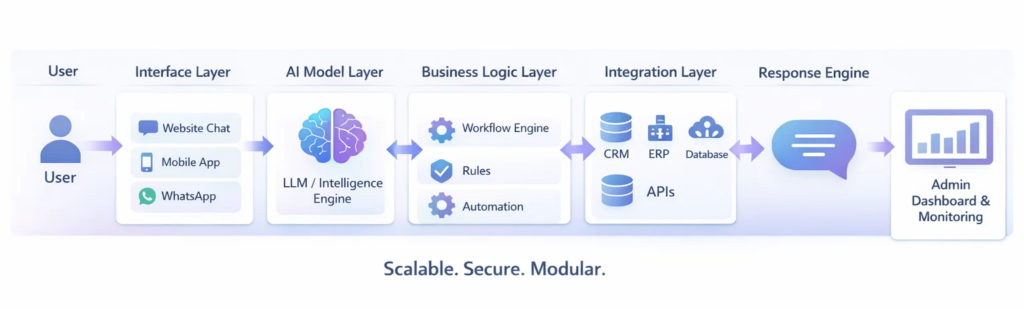
Real Technical Challenges That Drive Up AI Agent Development Cost
This is the section most pricing articles avoid — because it requires honesty. Below are the recurring technical problems that quietly inflate the cost to develop an AI agent. If a vendor’s quote does not address these, the number is incomplete.
1. Hallucination Control
LLMs confidently invent facts. In customer-facing systems this is a legal and reputational risk. Mitigation requires retrieval grounding, structured outputs, citation enforcement, and an evaluation harness that catches regressions when prompts or models change. Adds 8–12% to the budget.
Read Also: How to Fix Hallucinations in AI Agents?
2. Context Window & Memory Management
Long conversations and large knowledge bases blow past context limits. Engineering effort goes into smart chunking, summarization loops, hierarchical memory, and retrieval that returns the right 4 KB instead of every 4 KB. Done wrong, accuracy drops and token costs explode.
3. Tool-Use Reliability
Function calling looks simple in a demo. In production, the agent must handle malformed tool outputs, partial failures, retries with backoff, idempotency, and recovery from a half-completed action. This is plain backend engineering — and where most “demo to production” gaps live.
4. Latency vs. Cost vs. Quality Tradeoffs
A frontier model gives the best answers but is slow and expensive. A small model is fast and cheap but misses nuance. Production agents use a router — small model for easy turns, large model for hard ones — plus caching, streaming, and parallel tool calls. Building this correctly takes real effort.
5. Security & Prompt Injection
Any agent that reads untrusted content (emails, documents, web pages) is exposed to prompt injection. Defending against it means input sanitization, tool-call allowlists, capability scoping, audit logging, and red-team testing. Skipping this is not an option for enterprise deployments.
6. Evaluation & Regression Testing
Traditional unit tests don’t capture LLM behavior. Teams need golden-set evals, LLM-as-judge scoring, A/B harnesses, and automated regression detection so a prompt tweak does not silently break 5% of conversations. Without this, every release is a coin flip.
7. Data Privacy & Compliance
HIPAA, GDPR, SOC 2, and PCI introduce data-residency, retention, redaction, and audit obligations. PII redaction in logs, regional model deployment, BAAs, and consent flows are non-negotiable in regulated industries — and they materially add to engineering hours.
8. Legacy System Integration
Older CRMs and ERPs ship with weak APIs, rate limits, undocumented edge cases, and authentication quirks. Half of integration work is reverse-engineering and stabilizing these surfaces. This is the #1 source of timeline slippage in enterprise AI projects.
Enterprise AI Customer Support Agent Cost (Realistic 4-Month Build)
Let’s walk through a realistic scenario so you can clearly understand enterprise AI agent cost. Imagine a company wants a production-ready AI customer support agent that can actually handle real traffic — not just demo conversations. The agent must:
- Answer customer queries instantly with cited sources
- Check order or ticket details from internal systems in real time
- Create and update support cases automatically
- Escalate complex issues to human agents with full context
- Remember past conversations for continuity
- Provide an admin dashboard for monitoring, prompt edits, and analytics
- Meet enterprise-level security, SSO, and access requirements
At this level you are not building a chatbot — you are building core support infrastructure. A typical enterprise build takes around four months because multiple specialists are involved: AI engineers, backend engineers, frontend developers, UI/UX designers, QA, DevOps, and a project manager.
| Role | Allocation | Approx. Cost (4 months) |
|---|---|---|
| AI / LLM Engineer | Full-time | $15,000 – $20,000 |
| Backend Engineer | Full-time | $12,000 – $16,000 |
| Frontend Developer | Part-time | $6,000 – $9,000 |
| UI/UX Designer | Part-time | $3,000 – $5,000 |
| QA Engineer | Part-time | $4,000 – $6,000 |
| DevOps | Part-time | $3,000 – $5,000 |
| Project Manager | Part-time | $2,000 – $4,000 |
| Total Development | $45,000 – $65,000 |
Add multi-channel support (WhatsApp, email, voice), advanced analytics, or custom training and the cost rises to $85,000+. This is why AI development company pricing varies so much — two projects that sound similar can require very different engineering effort behind the scenes.
Cost to Develop an AI Agent by Region (2026)
Hourly rates vary dramatically. The same enterprise-grade build costs very different amounts depending on where the team is based.
| Region | Senior AI Engineer Rate | Same Enterprise Agent Build |
|---|---|---|
| United States / Canada | $150 – $250 / hr | $110,000 – $180,000 |
| Western Europe / UK | $110 – $180 / hr | $80,000 – $140,000 |
| Eastern Europe | $60 – $110 / hr | $50,000 – $90,000 |
| India / South Asia | $35 – $80 / hr | $30,000 – $65,000 |
| Latin America | $50 – $90 / hr | $40,000 – $75,000 |
Lower hourly rates are not automatically cheaper. Quality of architecture, evaluation discipline, and integration experience matter far more than headline rate — a poorly built $30,000 agent often costs $80,000 to fix.
This Might Be Useful to You: Average Cost to Build and Deploy Enterprise AI Agents For Small Business
Build vs. Buy vs. Hybrid — Which Is Right for You?
| Approach | Best For | Pros | Cons |
|---|---|---|---|
| Off-the-shelf SaaS (Intercom Fin, Zendesk AI, etc.) | Standard support, fast launch | No build cost, instant value | $0.50–$2 per resolution adds up; limited customization |
| No-code platforms (Voiceflow, Botpress, Relevance AI) | Marketing teams, simple flows | Cheap, fast iteration | Hits a ceiling on complex integrations |
| Custom build with frameworks | Differentiated product, deep workflows | Full control, owns the IP, fits your data model | Higher upfront cost, requires engineering team |
| Hybrid (custom on top of SaaS) | Most growing companies | Best of both worlds | Vendor lock-in risk, requires planning |
What Increases AI Agent Development Cost the Fastest
Many businesses begin with a simple requirement but expand scope during planning. Each new feature adds development time, testing effort, and integration work. The biggest cost drivers, ranked:
| Cost Driver | Typical Impact on Budget |
|---|---|
| Multi-channel support (web + WhatsApp + voice + app) | +20% to +30% |
| Custom model fine-tuning or domain training | +15% to +35% |
| Large knowledge base (10k+ documents) with high-accuracy RAG | +10% to +20% |
| Enterprise security, SSO, audit logging, compliance (SOC2/HIPAA) | +10% to +25% |
| Real-time analytics dashboard with drilldowns | +8% to +15% |
| Human-in-the-loop review & ticket escalation workflows | +5% to +12% |
| Voice (STT + TTS + telephony) capability | +15% to +25% |
| Multilingual support (5+ languages) | +8% to +15% |
Voice search is no longer a next-generation concept – it’s already here. The real question is no longer whether you should adopt it. The real challenge is how to deliver a voice search experience that is faster, smarter, and better than anyone else in your market.
Today, smart businesses are using voice AI to improve user experience, increase accessibility, and respond to customers faster. It’s becoming a competitive advantage, not just a technical feature. If your competitors are optimizing conversational queries and you’re not, you’re already behind. Voice search is now a standard expectation in modern digital experiences – and the focus has shifted from adoption to optimization. As of 2026, voice AI search has evolved from a convenience feature into a significant segment of global search behavior.
While traditional typing remains dominant for detailed or complex tasks, voice-based interactions now account for around 20% – 50% of overall searches globally, with significantly higher adoption on mobile devices and smart assistants. In fact, billions of voice-enabled devices are active worldwide, and conversational queries continue to grow as users prioritize speed, convenience, and hands-free access. Voice AI search is especially prominent in local searches, quick information queries, navigation, and transactional intents. The shift is not about replacing text-based search entirely it’s about expanding how users access information. As conversational AI improves in accuracy and contextual understanding, voice is becoming a stable and influential layer of modern search behavior rather than just an experimental trend. Users ask complete questions like, “Which agency offers AI-powered SEO services near me?” rather than typing fragmented keywords. This change directly impacts SEO strategy, structured data implementation, and content architecture.
Voice Search AI integration enables websites, applications, and digital platforms to listen, understand intent using Natural Language Processing (NLP), and respond with precise, context-aware answers. It is not a simple feature addition it is a layered integration that connects speech recognition, AI models, backend systems, and search optimization frameworks. At Triple Minds, we approach voice search AI integration as a strategic digital growth initiative. Our focus is not just implementation, but aligning voice technology with long-term search visibility, Answer Engine Optimization (AEO), and enhanced user experience. As conversational search continues to expand, businesses must build scalable, future-ready voice capabilities into their digital ecosystem to stay competitive.
Want to Integrate Voice Search AI the Right Way?
Transform your digital presence with advanced Voice Search AI integration that strengthens visibility, improves user experience, and positions your brand as the trusted answer in AI-driven search environments. Move beyond traditional SEO and build a smarter, future-ready search ecosystem today.
Start Your Voice Search Optimization Today
Key Takeaways
- Voice search now accounts for a significant share of global searches and is no longer an experimental feature.
- Implementation timelines range from 2 weeks to 16+ weeks depending on project complexity.
- Clean infrastructure and structure data can significantly speed up deployment.
- Voice AI integration combines speech recognition, NLP, intent matching, and backend connectivity.
- Conversational SEO and featured snippet optimization are critical for voice visibility.
- ROI often appears first through operational efficiency and reduced support costs.
- Costs vary widely based on customization, integrations, and enterprise requirements.
- Businesses that adopt voice strategically position themselves for AI-driven discovery and future search behavior.
What Is Voice Search AI Integration?
Voice Search AI Integration is the process of adding intelligent voice capabilities to your digital platforms so users can search, ask questionns, and interact using natural speech instead of typing. Instead of clicking through menus or entering short keywords, users simply speak – and the system understands, processes, and responds in real time.
At its core, voice AI integration combines speech recognition and Artificial Intelligence. First, speech recognition technology converts spoken words into text. Then, AI and Natural Language Processing (NLP) analyze the meaning behind those words – not just the exact phrasing, but the intent. This allows the system to respond accurately, even if different users ask the same question in different ways.
Voice Search AI integration can appear in several forms across a business ecosystem. It may include voice-enabled search bars on websites, AI-powered assistants within mobile apps, integrations with smart assistants like Alexa, Google Assistant, or Siri, voice-driven customer support systems, or even automated AI call handling solutions. Unlike traditional search, which relies heavily on specific keywords, voice AI understands context, conversational tone, and follow-up queries.
For example, a user might ask, “What are your service packages?” and then follow up with, “Which one is best for small businesses?” The system connects both questions naturally.
In simple terms, voice search AI shifts digital interaction from typing keywords to having conversations – creating faster, more intuitive, and more human-like user experiences.
You Might Also Find This Useful: How Much Does It Cost to Build an AI Agent?
How Does Voice Search AI Integration Work?
Voice search AI may sound complex, but the process behind it follows a clear and logical flow. It works through multiple connected layers that allow the system to listen, understand, and respond intelligently.
1. Speech Recognition
The first step is listening. When a user speaks, the system uses speech recognition technology to convert spoken words into text. This step ensures the AI accurately captures what was said, even with different accents, speeds, or pronunciations.
2. Natural Language Processing (NLP)
Once the speech is converted into text, NLP takes over. This is the “brain” of the system. Instead of just reading the words literally, NLP analyzes the meaning behind them. It understands intent, context, tone, and even variations in phrasing. For example, “Find me a nearby SEO agency” and “Which SEO company is close to me?” mean the same thing – and NLP recognizes that.
3. Intent Matching & Logic Engine
After understanding the query, the system identifies the user’s intent. It then matches that intent to the correct action – whether that means retrieving information from a database, triggering a workflow, or displaying specific results.
4. Response Generation
The system prepares a response. This could be text displayed on a screen, a spoken answer through text-to-speech, or even an automated system action like booking an appointment.
5. Continuous Learning
Modern voice AI systems improve over time. They analyze user behavior, repeated queries, and interaction patterns to refine accuracy and make responses more relevant.
At the core of all these layers is NLP, which enables the system to move beyond simple keyword matching and truly understand conversations – making interactions feel natural, fast, and human-like.
How Long Does It Take to Implement Voice Search AI Integration?
There isn’t a single fixed timeline for voice search AI integration. The duration depends on how complex your systems are, what you want the voice assistant to do, and how prepared your infrastructure already is. A simple voice-enabled search bar is very different from a fully automated, AI-driven conversational ecosystem.
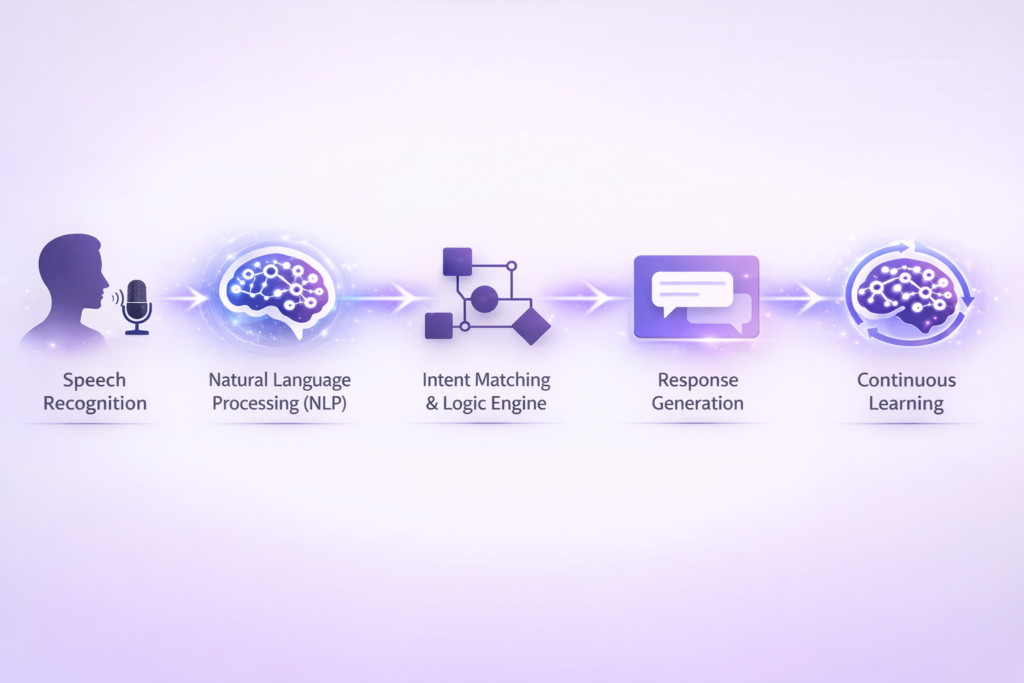
To make it easier to understand, here’s a estimated structured breakdown:
1. Small-Scale Projects (2-4 Weeks)
This is ideal for small businesses or informational websites that want basic voice functionality. For example, adding a voice-enabled search button that allows users to speak instead of type.
Typically, this includes integrating a speech-to-text API, setting up simple NLP intent recognition, building limited conversational flows (like FAQs), and running initial testing. If your backend systems are already structured and organized, implementation is relatively fast.
2. Mid-Level / Growth Stage Projects (4-8 Weeks)
At this stage, voice AI becomes more interactive. Ecommerce stores, SaaS platforms, and service businesses often fall into this category.
Here, the system must handle multiple intents, connect with product databases or service catalogs, integrate with CRM systems, and optimize structured data. Conversational flows become more advanced, and testing becomes deeper to ensure accuracy.
3. Enterprise-Level Voice AI Integration (8-16+ Weeks)
Enterprise projects are more complex because voice AI connects with multiple operational systems. This often includes advanced NLP modeling, multilingual capabilities, personalization layers, deep CRM/ERP integration, security validation, and compliance checks.
For industries like healthcare or fintech, additional regulatory layers increase the timeline.
4. AI-Driven Conversational Ecosystem (16+ Weeks)
This goes beyond integration – it becomes digital transformation. Organizations implementing omnichannel voice systems, AI-powered automation, smart device ecosystems, and personalized voice commerce fall into this category.
Voice AI becomes embedded across customer support, marketing, operations, and sales.
What Determines the Timeline?
Several factors influence speed:
- How organized your technical infrastructure is
- Whether APIs are ready for integration
- Clean and structured data availability
- Complexity of conversational design
- Multilingual requirements
- Compliance and security layers
- Level of AI customization needed
Projects slow down when backend systems are fragmented or content is unstructured. The cleaner your data and systems, the faster voice AI can be deployed. In short, voice search AI integration can take a few weeks or several months – depending on how deeply you want voice embedded into your digital ecosystem.
Ready to Lead in Voice Search AI?
Get a detailed cost estimate and ROI projection for your Voice Search AI integration project. Free consultation with our experts.
Request Your Custom StrategyHow Much Does Voice Search AI Integration Cost?
The investment required for voice search AI integration varies based on project scope, system complexity, and customization level. While there is no one-size-fits-all pricing, below are general industry estimates to help businesses understand the typical investment range. Actual investment depends on infrastructure readiness, integration depth, and customization requirements.
Estimated Market Investment Range
| Project Type | Estimated Investment (USD) | Best For | Scope Level |
| Foundational Integration | $3,000 – $10,000 | Small businesses, basic websites | Entry-Level |
| Growth-Level Integration | $10,000 – $35,000 | Ecommerce, SaaS, service platforms | Moderate |
| Enterprise Integration | $35,000 – $150,000+ | Large enterprises, regulated industries | Advanced |
| Ongoing Monthly Costs | Usage-Based | All project types | Continuous |
Foundational Integration ($3,000 – $10,000)
This includes basic speech-to-text API integration, simple NLP intent mapping, and limited conversational flows such as FAQ responses or voice-enabled search bars.
Growth-Level Integration ($10,000 – $35,000)
This tier involves custom NLP configuration, backend database integration, CRM connectivity, structured data optimization, and multi-intent conversational handling.
Enterprise-Level Integration ($35,000 – $150,000+)
Enterprise projects require advanced AI modeling, multilingual support, compliance validation, ERP/CRM integration, personalization layers, and scalability testing.
Ongoing Costs
Beyond implementation, businesses should budget for:
- API usage fees (based on voice query volume)
- Cloud infrastructure
- AI model refinement
- Monitoring and maintenance
What Kind of Businesses Benefit from Voice Search AI Integration?
Voice search isn’t limited to tech companies or large enterprises. It benefits any business where users search, ask questions, book services, or make decisions quickly. The key advantage is speed and convenience – users get answers without friction.
1. Ecommerce
In ecommerce, voice AI simplifies product discovery and purchasing decisions. Instead of typing filters manually, users can simply say:
“Find eco-friendly running shoes under $100.”
The AI instantly filters products based on price, category, and attributes. Voice can also support order tracking, stock checks, and personalized product recommendations.
For online stores, this reduces search friction and improves conversion rates by making product discovery conversational and intuitive.
2. SaaS Platforms
For SaaS businesses, voice AI improves user experience inside the platform. Users can navigate features, access documentation, or request help using natural speech.
For example:
“Show me how to integrate this tool with Salesforce.”
Instead of searching help articles manually, the system guides them directly. Voice AI can also assist during onboarding, reducing support tickets and improving user retention.
3. Healthcare
Healthcare platforms can use voice AI for appointment booking, service location queries, and general symptom guidance. Patients can ask simple questions and get quick responses, improving accessibility – especially for elderly users.
4. Financial Services
Banks and fintech companies can use voice AI for loan eligibility checks, account information, or product comparisons. Secure, conversational access improves customer convenience while reducing call center load.
5. Local & Multi-Location Businesses
Voice is extremely powerful for local discovery.
Users commonly ask:
- “Find the nearest branch.”
- “Are you open today?”
- “Do you offer same-day service?”
Voice integration improves visibility in local search environments and helps businesses capture high-intent queries.
How Voice Search Impacts Digital Marketing
Voice search doesn’t just change technology – it reshapes digital marketing strategy.
1. Conversational SEO
Content must answer real-world questions, not just target keywords. People speak differently than they type.
2. Featured Snippet Optimization
Voice assistants often pull answers from concise, well-structured content blocks. Clear summaries matter more than ever.
3. Local Search Visibility
A large percentage of voice searches are location-based. Optimizing Google Business Profiles and structured data becomes critical.
4. Entity Optimization
AI systems rely on structured brand signals – consistent business information, schema markup, and authority signals.
5. Reduced Click Dependency
Sometimes users get answers directly from voice assistants without visiting a website. That means brand presence and structured visibility matter even beyond traffic.
Voice AI pushes digital marketing toward clarity, structured data, topical authority, and conversational relevance. It aligns closely with Generative AI Optimization and AI-driven discovery models.
Common Mistakes That Delay Voice Search AI Integration
When businesses decide to implement voice search AI integration, delays often occur not because of technology limitations, but due to poor planning and unclear execution strategies.
| Issue | Explanation |
|---|---|
| Neglecting conversational search behavior | Ignoring how users naturally speak and ask questions in voice search can lead to irrelevant or poorly matched responses. |
| Overlooking Natural Language Processing (NLP) optimization | Voice search depends on understanding context and user intent. Without intent-focused and question-based content, accuracy and performance decrease. |
| Poor content structuring | Not organizing content with proper semantic structure, FAQs, and structured data makes it harder for AI to understand and respond correctly. |
| Technical misalignment during integration | If API compatibility, server setup, or scalable infrastructure are not ensured, it can cause system conflicts and project delays. |
| Underestimating data training requirements | AI models need clean, labeled, and structured data. Poor data preparation reduces accuracy and slows development. |
| Inadequate infrastructure planning | Without scalable architecture, voice AI systems may face performance issues as user traffic increases. |
| Lack of cross-team coordination | Poor communication between SEO teams, developers, and AI engineers can cause confusion and longer project timelines. |
| Unclear execution strategy | Without clear goals, milestones, and performance benchmarks, the implementation process can lose direction and delay launch. |
Measuring ROI After Implementation
Voice search ROI is not just about traffic – it’s about efficiency and experience.
Key performance indicators include:
- Voice query success rate
- Task completion rate
- Customer support cost reduction
- Improved engagement
- Assisted conversions
- AI-driven brand visibility
Many businesses see operational ROI first reduced support costs and faster customer interactions – before direct revenue impact becomes visible.
The Triple Minds Approach
At Triple Minds, we treat voice AI integration as part of a broader AI integration and digital authority strategy. The objective isn’t just enabling voice interaction — it’s ensuring your brand is understood, trusted, and surfaced across conversational search environments, powered by advanced AI model training techniques.
Businesses that integrate voice strategically today are not just improving user experience – they are positioning themselves for the next evolution of AI-driven discovery.
FAQs
Voice search AI integration involves adding speech recognition APIs, connecting NLP models to process user queries, and configuring the backend to deliver accurate voice-based responses. Proper SEO structuring and conversational content optimization are also essential.
AI analyzes conversational queries, user intent, and long-tail keywords to structure content in a natural Q&A format. This improves semantic relevance and increases chances of ranking in voice search results.
The timeline depends on data availability, your existing tech stack, API integrations, NLP training, security requirements, multilingual support, and testing phases. The more complex the setup, the longer the implementation takes.
Yes, voice AI can be added to existing websites, mobile apps, CRM systems, and eCommerce platforms using APIs and cloud-based AI services. It usually does not require rebuilding the entire system.
Yes, using third-party platforms like Google Cloud Speech-to-Text, Amazon Alexa, or Microsoft Azure Speech Services can significantly speed up development. They provide ready-made tools instead of building everything from scratch.
Custom models offer higher accuracy and better personalization but require more time and investment. API-based solutions are quicker to deploy and more cost-effective for most businesses.